The post International Business – Meaning, Process, Types & Factors appeared first on HKT Consultant.
]]>International business is also defined as the study of the internationalization process of multinational enterprises. A multinational enterprise (MNE) is a company that has a worldwide approach to markets, production and/or operations in several countries. Well-known MNEs include fast-food companies such as: McDonald’s (MCD), YUM (YUM), Starbucks Coffee Company (SBUX), Microsoft (MSFT), etc. Other industrial MNEs leaders include vehicle manufacturers such as: Ford Motor Company, and General Motors (GMC). Some consumer electronics producers such as Samsung, LG and Sony, and energy companies such as Exxon Mobil, and British Petroleum (BP) are also multinational enterprises.
To conduct business overseas, multinational companies need to bridge separate national markets into one global marketplace. There are two macro-scale factors that underline the trend of greater globalization. The first consists of eliminating barriers to make cross-border trade easier (e.g. free flow of goods and services, and capital, referred to as “free trade”). The second is technological change, particularly developments in communication, information processing, and transportation technologies.
International business managementSee more from basic to advanced









Import - Export businessSee more from basic to advanced




The post International Business – Meaning, Process, Types & Factors appeared first on HKT Consultant.
]]>The post The International Product Life-Cycle Theory appeared first on HKT Consultant.
]]>The international product life-cycle theory developed by Vernon was introduced in 1966 (Vernon 1966). Based on panel research of enterprises from the United States of America, Vernon’s product life-cycle explanations further developed the existing trade theories introduced by Heckscher-Ohlin and Leontief (Vernon 1972). Vernon assumed that the flow of information across national borders would be restricted and that products undergo predictable changes that have an impact on the firm’s internationalization strategies. The product lifecycle model was developed on these assumptions: the production process is characterized by economies of scale, the cycle changes over time, and tastes differ in diverse countries (i.e., each product does not account for a fixed proportion of expenditure for buyers at different income levels). Because information does not flow freely across national boundaries, three important conclusions follow.
- innovation of new products and processes is more likely to occur near a market where there is a strong demand for them than in a country with little demand.
- An entrepreneur is more likely to supply risk capital for the production of a new product if demand is likely to exist in his home market than if he has to turn to a foreign market.
- A producer located close to a market has a lower cost in transferring market knowledge into product design changes than one located far from the market (Vernon 1972).
The international product life-cycle theory claims that the market entry of a product is carried out in a foreign market depending on the position of the product in its country-specific product life-cycle curve. In the 1950s and 1960s, United States products led in the worldwide markets in many industries, while Europe and Japan required time to build up their own industries and infrastructures after World War II. Consequently, Vernon assumed that the United States served as a truly innovative market with customers with high purchasing power compared to other countries.
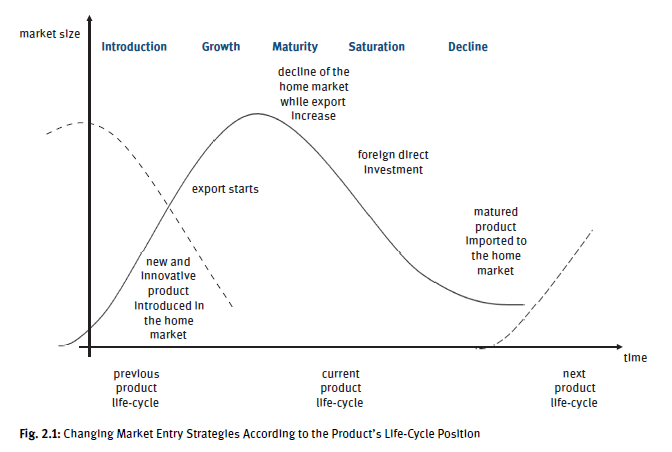
As illustrated in Figure 2.1, Vernon claimed that, for a certain time period, producers based in the US are likely to have a virtual monopoly on the manufacturing of new products introduced in the US An innovative product at its growth phase is produced inland and sold at relatively high prices. The output volume increases in the course of the market penetration inland, and experience curve effects appear. Due to the product’s attractive market growth forecasts, the number of enterprises that produce this product increases in the home country. As a result, standardization and product cost aspects become important in connection with the necessity for mass production outputs. At later stages in the growth phase of the product life-cycle, some foreigners start to demand the new and innovative product; and US exports begin (Vernon 1972).
While the growth rates decline during the maturity stage of the product life-cycle in the US home market, export activities to other countries increase. As foreigners’ incomes grow and lower income consumers abroad begin to buy the mature product, prices begin to fall, while, in parallel, US exports further increase. As the product sales continue and market volumes increase in foreign markets, it becomes economically desirable for US firms to establish foreign production. The time it takes until foreign production begins is dependent on the economies of scale, tariffs, transportation costs, income elasticity of demand, and the income level and size of the foreign market. At the end of the product life-cycle, manufacturing and sales in the US market become more and more unimportant. As a result, local manufacturing runs out due to the relatively high production costs in comparison to foreign countries. The remaining market volume during the decline phase of the product life-cycle is completely imported from abroad, while, at the same time, US firms introduce new and highly innovative products that launch the next product life-cycle (Vernon 1972).
2. Review of Vernon’s Model
To sum up, a firm’s market entry activities depend on the product’s position in the corresponding life-cycle. At first, the new innovative product is developed, produced, and sold in the US home market. In the second phase, product exports start; and while the product becomes mature, direct investments abroad begin. Finally, import from abroad increases, production is discontinued in the home market, and the demand is completely supplied by foreign countries. At this stage, the product has reached the decline phase of its lifecycle.
Vernon’s approach has made an essential contribution to the internationalization concept disciplines. The product life-cycle model provides a useful framework for explaining the post-World War II expansion of US manufacturing and investment activities. However, its explanatory power has waned with changes in the international environment (Robock & Simmonds 1989). Holding an innovative market leadership position does not necessarily last. For example, Japanese consumer electronics firms such as Sony started to replace previously leading consumer electronics firms in the US during the 1960s. At the beginning of the 21st century, Japanese consumer electronics firms suffer from competition from South Korean, Chinese, and Taiwanese firms, which took market share from the Japanese in various fields.
The model can be criticized in general because it assumes an ideal product life-cycle with coherent foreign activities. The theory is limited by the assumption that there is an attractive US home market from which US firms start their global activities. This model assumption is, from the 1960s perspective, substantiated for many industries where the US was ahead of Europe and Japan. It is true that large home markets provide the best prerequisites for experience curve effects and economies of scale. However, the general model validity is hard to test empirically due to the complexity of the product life-cycle. Industry-specific factors, such as tariff and non-tariff trade barriers, behavior preferences of the management, and investment incentives that significantly influence manufacturing costs, as well as cross-border trade and capital flows are not considered in the model (Luostarinen 1980). Vernon’s model is focused on manufacturing industries rather than on services industries.
Today, due to globalized trade patterns and intensified competition, technology and product life-cycles are shorter, while, in parallel, investments in R&D, operations and marketing, and so forth are increasing. Consequently, firms are often under pressure to sell their products globally – right from the beginning of the product life-cycle – in order to realize early economies of scale effects. Moreover, multinational firms often maintain different market entry concepts, such as export and foreign direct investment, in parallel. Nowadays, the customers’ purchasing power does not differ significantly in many industrially developed countries. (Vernon correctly assumed a US consumer’s higher purchasing power relative to the rest of the world in the 1950s and 1960s.) Moreover, customers’ expectations concerning the technical and quality performance of a product and service have become similar in many countries worldwide. As a result, the segmentation of the product life-cycle phases and corresponding conclusions for local sales, export, foreign direct investment, and import, according to the model, is rather arbitrary (Tesch 1980).
As a result of increased global business dynamics in recent years, there are cases of innovative firms that were unknown a couple of years ago. Meanwhile, some of these firms are playing a significant role in the international market (e.g., Huawei from China). Interestingly, taking the case of the online-based business concept of the Chinese Alibaba.com, we can deduce some minor similarities with Vernon’s approach. Alibaba’s global success at the beginning of the 21st century is based, among other reasons, on its quasi-monopoly positioning in its huge Chinese home market. Alibaba currently takes advantage of economies of scale and experience curve effects in China similar to those Vernon indicated as an advantage for US manufacturing industries in the post-war period.
Around a decade after its first publication in 1979, Vernon retracted the life-cycle model and agreed that there were fewer differences among countries in factor costs and market conditions (Barkema, Bell, & Pennings 1996). From today’s view, after decades of major economic and political progress in world trade, the international product life-cycle theory has lost much of its validity. Consequently, further internationalization models have been developed, which are described in the following sections of this chapter.
Source: Glowik Mario (2020), Market entry strategies: Internationalization theories, concepts and cases, De Gruyter Oldenbourg; 3rd edition.
The post The International Product Life-Cycle Theory appeared first on HKT Consultant.
]]>The post Location Theories of Internationalization appeared first on HKT Consultant.
]]>The location discussion in connection with international trade theories has a long history. The mercantile doctrine, the major economic theory from the 16th to the 18th century, claims that the prosperity of a country (accumulated in gold or other precious metals) should be increased by high number of exports and a low number of imports. The more one country wins from bilateral trade through the trade surplus accumulated in the national treasury, the more the other country loses (Robock & Simmonds 1989). The mercantile doctrine was replaced by Adam Smith’s ‘theory of absolute advantage’ published in The Wealth of Nations in 1776. Smith, who was ahead of his time when he supported liberalized trade systems, argued that countries differ in their manufacturing performance (absolute cost advantage). If one country specializing in a particular product exports the product to a country from which it imports another product the trade partner specializes in, all participating countries will benefit from international trade. Import restrictions such as customs duties reduce the gains from specialization and cause a nation to lose wealth (Hill, 2005; Parkin, Powell, & Matthews 2000).
David Ricardo further developed Smith’s idea regarding comparative cost advantage as discussed in On the Principles of Economy and Taxation, published in 1817. He claimed that countries should focus on items they can manufacture most efficiently in comparison to other nations. Consequently, countries should export those goods where they have a comparative advantage and import other products where the trade partner country has an advantage. Thus, differences in productivity among countries initiate trade ambitions and result in a higher standard of living for the participating countries (Hill 2005; Mankiw 2007).
Johann Heinrich von Thunen serves as the first ‘location theory’ scholar. In his publication, Der isolierte Staat (1826), he introduced a model of agricultural land use. The reason why von Thunen serves as a location theory pioneer is because he was the first to emphasize transportation costs against the background of agricultural land and forests locations. Farmers located close to areas where demand for forest and agricultural products is high make use of lower transportation costs, which encourage others to locate their activities in similar areas (which results in increasing prices for land as well) (Viitala 2016). In other words, von Thunen provided the basis for the distance factor theory (and industry network cluster research) which claims that close areas with similar institutional endowments provide better pre-requisites for mutual prosperous economic development than geographically and institutional diversified areas (Hertenstein, Sutherland & Anderson 2015).
During the post-World War II period, location concepts with regards to firms’ internationalization strategies attracted attention. Issues such as where it is most profitable to locate a firm’s production with regards to local market imperfections (compare transaction cost theory), transportation, plant size, advantages of monopolistic competition, and incorporation of technology became the center of interest (Churchill 1967). Swedish economists Heckscher and Ohlin claimed that countries differ in their factor endowments, such as ground, labor, and financial capital. These differences cause divergent competitive advantages among nations. In addition, countries have comparative advantages in those goods for which the necessary factors of manufacture are comparatively abundant locally, which causes the price of goods to be lower because their corresponding input costs are lower. Thus, a country should manufacture and export those products that use factors that are abundant at home. At the same time, nations that have a comparative disadvantage tend to import those goods whose production requires the factors that are relatively scarce in their country (Brakman, Garretsen, Van Marrewijk, & Van Witteloostuijn 2006; Robock & Simmonds 1989).
Location Models
Location concepts focus on the access and optimal allocation of the input variables needed for efficient and innovative manufacturing and service output (Rasmussen, Jensen, & Servais 2008). In general, it is claimed that country and industry-specific factor endowments influence a firm’s innovation, business orientation, and performance: for example, whether firms rather focus on home markets or international markets. For foreign firms, as a consequence, the strategic decision for market entry primarily depends on the location factors of the target country (Pan & Tse 2000; Tesch 1980).
Two central categories of location factors can be distinguished: the category of the macro-environment and, taking a more narrow perspective, the category of the firm’s industry environment. These categories will be introduced and discussed in the following sections.
2. Location Factors
2.1. The Macro Environment
The discussion about a firm’s resources, structures, and strategies, as well as its interface with its market environment is also found in the literature within the category of ‘institutional theories of organizations.’ The institutional theory serves as a framework for identifying and analyzing the factors that support the viability and legitimacy of organizations. In general, these factors include societal, economic, and political/legal regulations, as well as an organization’s tradition and history (Bruton, Ahlstrom, & Li 2010; Glover et al. 2014).
These factors have a direct impact on the strategies and organizational decisions of firms (North 1990). With the aim of improving their position and legitimacy, firms should adhere to rules such as regulatory structures and practices (Glover et al. 2014).
Contextual risks are a result of the external uncertainties embodied in the macro-environment of the firm’s international target market. For example, political/legal uncertainties arise from instability in the political system or from policies of the local government, such as those concerning private ownership (e.g., expropriation and intervention), operational risk (e.g., price control and local content requirements), and transfer risk (currency inconvertibility and remittance) (Pan & Tse 2000).
Aspects of the institutional environment can have a direct effect on a firm’s market entry strategy in a foreign target market. For example, legal restrictions on foreign ownership of domestic enterprises, as seen in India, establish definite limits on foreign equity holdings. Country uncertainties regarding the protection of intellectual property rights further contribute to environmental risks and can result in a firm’s reduced investment activity (Delios & Beamish 1999). Demographic characteristics can result not only in lower demand for a technology but also in modification and adaptation of existing technologies (Davidson & McFer- tidge 1985).
A well-known tool for scanning macro-environmental factors for a firm is PEST (political, economic, social, technology) analysis. In some sources, PEST is supplemented by ecological and legal factors, thus the acronym becomes PESTEL or PESTLE (Koumparoulis 2013). Drawbacks of PEST analysis are that originally less attention was paid to ecological issues. However, ecology has become an increasing challenge related to the global pollution of water and air, as well as exploitation of natural resources. Current global business behavior should be viewed in light of, hopefully, an increasing public awareness regarding ecological challenges. S. E. E. L. E. (society, ecology, economy, law, expertise) emphasizes societal (not narrowly ‘social’ according to PESTEL) and ecological issues and better considers modern service-industry driven societies. Important elements of the macro-environmental scan when applying S. E. E. L. E. are the following:
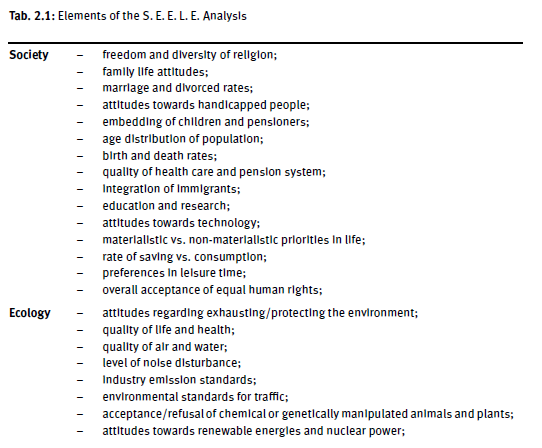
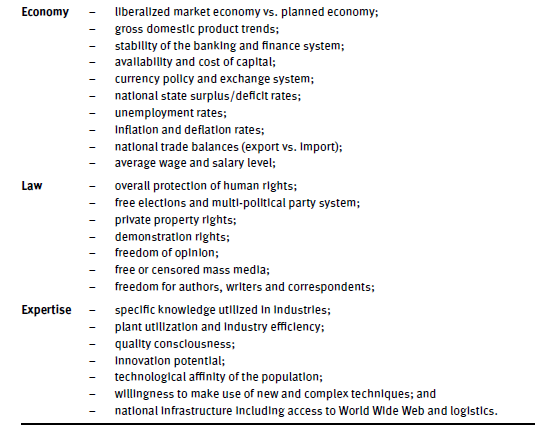
The study of market entry abroad necessarily assumes the recognition and understanding of the respective environmental macro structures. A firm that plans business activities in a foreign country needs to collect and evaluate necessary information based on the S. E. E. L. E. elements and their interconnections. In general, the educational system (as a fragment of ‘society’) established by the national government should attempt to provide qualified and ethically responsible people for the firms and organizations. At the same time, firms should be aware of their social responsibility. A ‘hire and fire’ policy that aims to exploit the employees for short-term objectives or, alternatively, internally developing and improving the qualifications of the firm’s personnel, reveal different behavioral and ethical aspects of a firm’s culture. These examples of diverse firm policies necessarily suggest positive or negative consequences for its national environments.
When local governments in a foreign market set new legal standards in order to reduce environmental damage (e.g., product labels that show the electricity consumption of an apparatus), the new standards hopefully cause a change in customer needs and preferences (e.g., product purchases with reduced power utilization). Consequently, such standards influence the destiny of a manufacturing firm and the sales potential of the products. If the firm has reliable, sophisticated market research and forecasting, it is better able to forecast new political and technological trends and appropriately focus the corresponding R&D activities. Suppose an enterprise performs well; its business will result in a higher number of employees. If not, employees need to be released; and the firm may face bankruptcy, which contributes to an economy’s higher unemployment rate (negative impact on its macro-environment).
A firm that targets foreign direct investment and compares different potential target markets may raise, among others, questions such as the following: How will costs and earnings develop in the respective regions in the future? Are the factor costs in countries with relatively low wage levels associated with lower educational levels that result in lower productivity and employees that are less conscious of quality? How much training is necessary for the work force? Do the work ethics and the loyalty of the staff differ culturally from the atmosphere at home? (Meyer 2006). Because factors of the macro-environment vary from country to country, they provide the basis of diversified opportunities and threats for the international business activity of the firm. An opportunity is a condition in the macro-environment that, if properly utilized, helps a firm achieve a competitive advantage, while a threat may hinder a company’s efforts to attain strategic competitiveness in global business (Hitt, Ireland, & Hoskisson 2015).
As is clear from the arguments and examples mentioned above, there are various linkages between the macro and the industry environments. These elements continuously evolve. Changes lead to modifications in the cost and revenue structure, which may be favorable or unfavorable to the firm (Rasmussen et al. 2008).
Thus, a continuous and permanent scan of the firm’s macro-environment, usually carried out by the firm’s market research department, is of vital importance to the company.
2.2. The Industry Environment
Industry groups consist of firms with similar missions, organizational structures, value-added activities, and strategies related to their products and services (Wheelen & Hunger 2010). The industry or task environment is a set of industry-specific location factors that directly influence a firm in its competitive position relative to local rivals and, logically speaking, its market entry and penetration strategy abroad. The best-known representative of industry analysis (‘five forces model’), which is thematically similar to the market-based view, is M. E. Porter (Porter 1980, 2003; Porter & Fuller 1986; Porter & van der Linde 1995). In contrast to the resource-based view (competitive advantages depend on the firm’s resources), the market-based view claims that sustainable competitive advantage and superior returns depend on the management’s recognition and utilization of the market and the influencing industry forces (Peters et al. 2011). In other words, the market based-view first takes an outside (market) – followed by an inside (firm) – perspective.
According to Porter (1990), two central concerns underlie the choice of a competitive strategy. The first is the industry structure in which the firm competes. Industries differ widely in the nature of competition, and not all industries offer equal opportunities for sustained profitability. The average profitability in pharmaceuticals is high, for example, while this is not the case in consumer electronics. The second central concern in a competitive strategy is positioning within an industry.
In each industry, the nature of competition depends on five competitive forces:
- the threat of new market entrants,
- the threat of substitute products or services,
- the bargaining power of suppliers,
- the bargaining power of buyers, and
- the rivalry among the existing competitors.
In modern marketing management, against the background of globalized and digitalized information technologies, we necessarily need to consider the role and the increasing influential power of stakeholders (which include the shareholders). Compared to the past, product and technology life-cycles have become significantly shorter, and thus should gain particular attention within an analysis of the firm’s target markets.
A firm’s performance is limited by these specific industry properties. The appearance and the strength of the forces vary from industry to industry and determine long-term industry profitability. These factors influence the attractiveness of the industry and the corresponding profits of the engaged firms (Porter 1990). According to the market-based view, the sources of value for the firm are embedded in the competitive situation characterizing its external product markets. Interaction among competitive industry forces, such as the bargaining power of suppliers and buyers, influences a firm’s profitability in the foreign target market (Hitt et al. 2015; Muller-Stewens & Lechner 2011; Wheelen & Hunger 2010). For example, a higher bargaining power for a firm in comparison to the bargaining power of the suppliers suggests that a firm might achieve higher performance because the existing suppliers have fewer alternatives within the industry.
Competitive dynamics are also influenced by barriers to entry resulting from the structure of the market (Grant 1991b; Makhija 2003). An industry environment that has high entry barriers is attractive to enter and provides, at least temporarily, higher returns for the existing companies, which take advantage of limited (foreign) competition (Peters, Siller, & Matzler 2011). Transactional risks related to market entry in foreign target markets arise as a result of the behavior of local firms, which may take action to maintain or increase entry barriers through offensive price strategies or lobbying their local governments (Pan & Tse 2000).
In the course of the development of industry analysis, the importance of the regional industry cluster (e.g., supplier-customer inter-firm relations; supporting service providers such as logistics, information technology, etc.) gained increased attention in location theories (McCann & Sheppard 2003). For example, for a firm considering a market entry through foreign direct investment, it tends to be more efficient to locate its production site close to existing local industry networks with access to an existing supplier instead of operating from a distance in remote areas.
Firms considering international market entry activities can evaluate and compare different industry clusters according to the following questions, among others: Are there any component supplier clusters available or under development in this region? Is the location an attractive one for competitors to initiate foreign direct investment activities? What infrastructure is available? How far away from the industry cluster are the major markets? How will the freight rates develop, which depends on the number of logistics firms that offer services in that region? (Meyer 2006). The rationale of the ‘incubator’ hypothesis is that a newly established industrialized area (industry cluster) offers firms attractive conditions for investment. In addition, enterprises usually benefit, at least temporarily, from tax incentives and reasonable prices for real estate. Through concentration in a cluster, firms create economies of scope by sharing storage facilities as well as transportation, which facilitates exports and imports. Especially with regard to technology-oriented complexes, for example science parks or economic development zones, the ‘incubator hypothesis’ has been useful (Rasmussen et al. 2008).
3. The Diamond Model
About a decade after categorizing the factors that affect competitive industry forces, Porter expanded the ‘competitiveness discussion’ from industry to country levels in what is known as the ‘diamond model.’ At the national level, location effects are what Porter describes as the competitive advantage of nations. Porter (1990) claims that the institutional framework at the firm’s home country fundamentally influences the firm’s motivation for internationalization (Porter 1990; Rasmussen et al. 2008). According to Porter, competition in many industries has internationalized -not only in manufacturing, but increasingly in services. Larger and internalized firms compete with truly global strategies involving selling and sourcing components and materials worldwide, and locate their activities in selected countries to take advantage of national divergent resource endowments. Porter’s diamond approach of internationalization is based on his empirical observation, which concludes that enterprises that are successful worldwide (‘global champions’) frequently originate in one country. His observation leads to the thesis that those enterprises, due to their industry environment, enjoy particularly favorable conditions, which make it possible for them to become internationally active and to attain a competitive advantage in other countries relative to the resident enterprises. Porter distinguishes four central factors and two supplementary factors that influence gaining a competitive advantage in foreign markets (Porter 1990).
Central Factor 1: Production Factor Conditions
Human resources refer to the quantity, skill, and cost of personnel and management, taking into account standard working hours and the work ethic. In connection with this, progressive factors attain special importance. Progressive factors are, for instance, the education and qualifications of the population, the potential for generating high innovation, efficient use and combination of human resources, and continuous adaptation to the requirements of (foreign) markets.
Physical resources refer to the availability and cost of a nation’s land, natural resources, infrastructure, country location and geographic size.
Knowledge resources refer to the nation’s stock of scientific, technical, and market knowledge concerning goods and services. Knowledge resources reside in universities, government research institutes, private research facilities, government statistical agencies, business and scientific literature, market research and databases, trade associations and other sources.
Capital resources are the amount and cost of capital available to finance industry. Capital is not homogeneous, but comes in various forms, such as secured and unsecured debt. The total stock of capital resources in a country and the forms in which it is deployed are influenced by the national rate of savings and by the structure of national capital markets, both of which vary widely among nations.
Infrastructure is the type, quality, and user cost of infrastructure available that affects competition, including road systems, logistics, telecommunication, access to the internet systems, banking and payment systems. Infrastructure also includes health care, housing stock, and cultural institutions, which affect the quality of life and the attractiveness of a nation as a place to live and work.
The quality of the production factors is more important to Porter than the quantity. Unlike the classical trade theories of Ricardo or Heckscher-Ohlin, Porter claims that it is advantageous for a country if physical resources (e.g., natural raw materials) are rare since the waste of resources is avoided through alternative innovative technologies that finally help to spare the environment (Porter 1990). The cases of Russia or Saudi Arabia, both countries rich in natural resources but comparatively weak in modern and technologically driven industries such as electronics, automotive, chemical, and others, supports Porter’s thesis. Finally, physical resources lose importance over time and become increasingly substitutable since an artificial way of producing them can be found or alternative production methods can be developed (e.g., in the energy sector, wind turbine and solar photovoltaic systems have replace coal and oil) (Welge & Holtbrugge 2015).
Central Factor 2: Home Demand Conditions
All factors that have an influence on the level of purchase demand are part of the category ‘home demand conditions.’ Nations gain a competitive advantage in industries where the home demand gives local firms a clearer or earlier picture of buyer needs than foreign competitors can have (Porter 1990). The size of the home market can be a criterion for competitive advantage (economies of scale). This efficiency could also lead to a domination of the industry in other countries (Hitt et al. 2015).
Quality and customer-tailored products and services become more important than just quantity recorded sales volumes. Particular characteristics of domestic demand, such as design, technology, and product functions, require specific attention by the industry (Welge & Holtbrugge 2015). As a result, firms are forced to be innovative, which positively influences the development of the whole industry. The expectations and wishes of customers at home can often result in innovative technological trends for worldwide sales in the future (Kutschker & Schmid 2011). The rate of growth of home demand can be as important to competitive advantage as its absolute market size. Rapid domestic growth forces a nation’s firm to adopt new technologies faster and, consequently, allows first mover advantages and valuable experience curve effects (Porter 1990). Today, for example, Chinese firms such as Alibaba and Huawei make use of their home market, which is among the largest in the world.
Central Factor 3: Supporting Industries
Porter describes the supplying and supporting industries in a country as, for instance, logistics, the educational system, and research and development capacities. Sophisticated, developed supply networks form the basis for stable production of technologically innovative standards with reasonable sourcing prices because supplying enterprises are confronted with high competitive pressure. Qualified suppliers are able to provide considerable input for further technological development (Welge & Holtbrugge 2015). A competitive advantage emerges from close working relationships between vendors and the industry. Suppliers help firms perceive new methods and opportunities for applying new technology. Firms gain quick access to information and innovation potentials. The exchange of R&D know-how and the joint problem solving of technical, engineering or software issues lead to faster and more efficient solutions. Through this process, the pace of innovation within the entire national industry is accelerated and finally leads to global competitive advantages (Porter 1990).
Central Factor 4: Firm Strategy, Structure, and Rivalry
Porter claims that the goals, strategies, and ways of organizing firms in industries vary among nations (Porter 1990:108). National advantage results from a good match among these choices. The pattern of rivalry at home also has a profound role to play in the process of innovation and in the ultimate prospects for international business. The higher the competitive pressure at home, the more enterprises are forced to internationalize. Nations will tend to succeed in industries where the management practices and modes of organization favored by the national environment are well suited to the industries’ sources of competitive advantage. Important national differences in management approaches occur in such areas as the way of motivating employees, the hierarchical structure of the enterprise, the strength of individual initiative, the ability to coordinate across functions, and management’s influence on customer relations (Hitt et al. 2015; Porter 1990; Welge & Holtbrugge 2015: 68).
Two Additional Factors: Government and the Role of Chance
The government positively or negatively influences the four central determinants mentioned above. Therefore, the role government and the role of chance should not be seen as separate independent factors. Factor conditions are affected by policies toward capital markets, legal property rights, a nation’s infrastructure, and the educational system. Governmental institutions establish technical standards for products (e.g., specification of safety and hygiene standards and emission standards), which influence the behavior of the market actors. Furthermore, the government also includes local public authorities, who are also buyers (e.g., office equipment) or lead infrastructure projects (Porter 1990).
Chance events are often beyond the influence of firms such as emerging new technologies (e.g., electric cars, 3-D printers). Such events often change the structure of the entire industry and provide opportunities for innovative firms. Advanced knowledge-driven industries, such as differentiated, innovative products, services, and technologies, are the most significant industries for a nation’s welfare. They are necessary in order to achieve a competitive advantage and, therefore, should be fostered by the national government. Advanced technologies are more scarce because their development demands large and often sustained investment in both human and physical capital (Porter 1990).
4. Review of the Location Concepts
The external environment of firms involved in international trade provides many opportunities but, simultaneously, is becoming increasingly complex and competitive. The liberalized global trade and capital flow framework and advanced logistics and communication systems provide many attractive chances and allow easier entry of firms into the international markets than was possible decades ago. In parallel, environmental uncertainty increases as a result of the amount of complexity plus the degree of change existing in a firm’s external environment. Considering these developments, Dai et al. (2013) emphasize that ‘location’ is decomposed into two separate factors: ‘place’ and ‘space.’ Place refers to the conventional location-specific attributes, while space emphasizes geographic distance and industry network characteristics. Thus, traditional locational ‘place’ concepts should be amplified by the issue of space’ in order to better understand multinational enterprise activities in global markets. Similarly, Beugelsdijk et al. (2013) argue that the term space should refer to characteristics among places combining within-country variations (e.g., investment behavior of firms with regards to a regional industry cluster in one country) and integrate these with between- country variations (e.g., comparison of the firms’ investment behavior concerning industry clusters between countries).
According to the location theory, before firms decide their market entry strategy, they have to scan the external macro-environment (e.g., S. E. E. L. E. or PESTEL) and industry environment (Porters five forces) in order to identify possible opportunities and threats in light of internal resources that reflect the strengths and weaknesses of the company. The more the firm is involved in global business and the higher the number of potential competitors, the greater the market research complexity. Internationalization in today’s context and complexity is less about just entering foreign markets than it is about increasing the firm’s exposure and response to permanently changing international business dynamics (Jones 2001).
The location theory assumes that the decision to make a direct investment in a particular country is certainly determined by its location factors. However, empirical studies of the relative influence of these individual factors, because of their enormous complexity, are rather difficult (Welge & Holtbrugge 2015: 69). For example, entrepreneurs may have preferences regarding selected target markets because of their personal relationship network and, therefore, do not consider location-specific factors alone. Multinational firms make use of diversified globally distributed operational networks, which even broadens the complexity of the location approaches in terms of global value chain analysis between cross-country industry clusters (e.g., a European cross-border automotive cluster between the southern part of Germany, the Czech Republic, Slovakia, and Hungary).
Porter claims in his diamond model that the competitiveness of enterprises is influenced by country-specific conditions. Some enterprises, therefore, have better prerequisites for successful international business activities because of favorable home market surroundings than others. Criticism arises because it is empirically hard to measure the ‘meaning of a competitive advantage,’ and some assumptions are rather speculative. The influence of each of the location factors, as well as their relations, is empirically difficult to verify. The model lacks the ability to consider behavioral patterns of entrepreneurs and/or the management. Precise recommendations for how to achieve a competitive advantage for the firm remains challenging, which, however, could be of interest to national governments that seek to foster their economies (Grant 1991a: 542).
The diamond model does not answer the question that asks under which circumstances it is desirable to enter the market through export or alternatively through foreign direct investment (Kutschker & Schmid 2011). Furthermore, the approach focuses on the home market conditions, which ignores the fact that multinational enterprises make use of cross-border value-added activities, depending on the costs at home and abroad. The model neglects, in light of modern globalized competitive forces, other countries and their impact on the competitiveness of firms in the home country and vice versa. This has led other authors to introduce the ‘double diamond.’ While the ‘single diamond’ model by Porter focuses on the ‘home country’ conditions, the ‘double diamond’ simultaneously takes into consideration the elements of the ‘home country’ and the ‘elements of the foreign markets’ with regards to their mutual influence on the performance of the competing firms originating in the home and foreign markets (Rugman & D’Cruz 1993; Rugman & Verbeke 1993).
Esterhuizen (2006) stresses the importance of human resources for the firm and, consequently, a nation’s competitiveness and amplifies the diamond to the ‘nine factor model’ by adding human resources, divided into categories such as ‘workers, politicians and bureaucrats, entrepreneurs, managers, and engineers,’ which are crucial to gaining a nation’s competitive advantage.
Despite all its weaknesses, location concepts and the diamond model have become widely known. The diamond model’s strength is its simplicity and pragmatic approach.
The diamond model expands traditional internationalization trade theories, connecting relevant strategic management questions with macro and industry-specific elements of nations and their industries (Grant 1991a).
Source: Glowik Mario (2020), Market entry strategies: Internationalization theories, concepts and cases, De Gruyter Oldenbourg; 3rd edition.
The post Location Theories of Internationalization appeared first on HKT Consultant.
]]>The post Internalization Theory appeared first on HKT Consultant.
]]>The internalization theory of Buckley and Casson (1998) is based on the transaction cost approach of Coase published in The Nature of the Firm (1937) and the market-hierarchy paradigm of Williamson (1975). Firms have two fundamental possibilities when dealing with transactions: externally in the market (e.g., contracts) or in-house through hierarchy (e.g., production). The transaction costs in the market need to be compared with the internal coordination costs that arise when operations are carried out in-house. Contractual transactions do not perform as expected by the contracting parties or even fail because of the actors’ bounded rationality phenomena (e.g., individual preferences) and the issue of market imperfections (Zhao, Luo, & Suh 2004). Market imperfections are described as follows.
Market imperfections
- First, market transactions are not free of costs for the firm because of limited information and a lack of reliable future market forecasts and because of time lags between initiation and completion of the international business activity.
- Second, there is a monopoly (or monopsony) incentive in terms of ‘internalization of the market’ (forward or backward integration) in order to implement the desired price.
- Third, the bilateral concentration of market power (bilateral monopoly) leads to an indeterminate or unstable bargaining situation.
- Fourth, there are market imperfections caused by an inequality between buyer and seller (e.g., because of its size and bargaining power) with respect to knowledge of the nature or value of the product.
- Finally, market imperfections arise from government interventions in international markets through tariffs or restrictions on capital movements, protectionism, and from discrepancies among countries in rates of income and profit taxation (Buckley & Casson 1976).
The extent and degree of being confronted by market imperfections mainly depends on three transaction dimensions as described in transaction cost theory, such as asset specificity, uncertainty, and frequency. These dimensions are introduced as follows (compare: Williamson 1975, 1985).
1.1. Asset Specificity
Asset specificity refers to the degree to which an asset can be redeployed to alternative uses and by alternative users (Williamson 1991).
There are six types of asset specificity:
- site specificity (causing an influence of operational efficiency of the business actor),
- physical asset specificity (e.g., specialized equipment, tools, and technologies),
- learning and experience curve assets of human resources,
- brand name,
- dedicated assets (investments caused by a particular customer), and
- temporal specificity (non-separability of applied technologies).
Bilateral dependence between market actors (e.g., supplier and customer) rises with increasing asset specificity (as a result of explicit investments causing ‘actor-specific sunk costs’) and, therefore, increases the financial risk. The probability of internalization of value-added activities (e.g., vertical forward integration by the supplier or vertical backward integration by the client firm) increases with an enhanced investment specificity (Williamson 1991).
1.2. Uncertainty
Actors’ uncertainty related to market transactions is the result of imperfect information (e.g., understanding of performance and quality of the product or service) combined with the actor’s bounded rationality dilemma (human decisions usually are not completely rational, but are influenced by emotions, experience, preferences, likes and dislikes).
Uncertainty as a result of market imperfections necessarily requires market research activities and the initiation, negotiation, and conclusion of contracts (which cause ex-ante costs). Contract supervision and putting through agreed conditions after the contract is signed cause ex-post costs. Because market actors can never rely on perfect and complete information, contracts naturally are imperfect as well because it is impossible to consider all potential eventualities in the course of the market transaction process in concrete contractual terms. The higher the uncertainty, the more difficult it is to include the entire complexity of possible future developments in contracts and, as a consequence, the higher the risk that the market transaction will fail (Williamson 1975; Zajac & Olsen 1993).
The danger of opportunistic behavior from the transaction partner rises in accordance with the perceived degree of uncertainty. Opportunism refers to the incomplete or distorted disclosure of information, especially calculated efforts to mislead, distort, disguise, obfuscate, or otherwise confuse (Williamson 1985). The costs of negotiating, monitoring, and enforcing contract conditions in order to ban opportunistic behavior have a tremendous impact on the amount of transaction costs (Hill 1990:501). Because contracts can help to mitigate the risk of opportunism in a relationship, they are frequently classified as contractual governance mechanisms (Hoetker & Mellewigt 2009).
In addition to (formal visible) contracts, which help to clarify the relationship expectations between the actors, invisible influencing factors such as trust and commitment also have a significant impact on the development of mutually shared expectations related to contractual relationships. The development of trust and commitment can be supported by the contracting actors’ efforts, such as timely communication, smooth exchange of correct information, and coordination of activities (Walter, Muller, Helfert, & Ritter 2003). However, all these efforts aiming to develop and maintain a trusting contractual relationship cause administrative costs.
1.3. Frequency
The more frequently equal transactions are carried out in the market, the lower the average costs of a transaction due to the actors’ learning and experience curve effects. In addition, mutual trust between the transaction partners may rise, which minimizes the contractual negotiation costs of the transaction partners. With an increasing frequency of transactions and mutual trust, the desire to internalize market transactions (hierarchy) decreases (Williamson 1999).
Therefore, market transactions are recommended as an efficient business form
- the more standardized the product and service that is the subject of the transaction;
- the higher the actors’ degree of information, which results in transactional transparency;
- when product offer and demand are sufficient, such as in polypol market forms; and
- the more frequently transactions are carried out by the actors.
Backward integration out of manufacturing into the supplier’s value-added activities would be implied by hierarchy.
The hybrid mode of business is located between market and hierarchy with respect to control mechanisms, legal responsibility, and costs and corresponding financial risks. An international joint venture serves as an examples of hybrid business entry strategy (Williamson 1991). Hybrid business models are chosen by actors attempting to balance their market uncertainty risk with the financial risk of internalizing market transactions.
2. Emergence of Multinational Enterprises
Buckley and Casson (1976) transferred the contents of the transaction cost concept to the idea of the multinational enterprise (MNE). Market imperfections (as previously defined in the transaction costs theory) for intermediate products require coordination efforts for global business activities. The desire to increase coordination efficiency has led to the phenomena of emerging MNEs. MNEs internalize the markets across national boundaries whenever the costs of internal organization of market activities are lower than market transactions. Decision determinants for favoring or disfavoring internalization depend on (Buckley & Casson 1976) the following:
- industry-specific factors, such as the nature of the product and the structure of the market (compare location theory/market based-view);
- region-specific factors, which relate to the geographical and societal characteristics of the markets (compare location theory/market based-view);
- nation-specific factors, such as political and fiscal relations between the nations concerned (compare location theory/market based-view); and
- firm-specific factors, which reflect the ability of the management to ‘internalize the market’ (compare resource-based view).
As illustrated in Figure 2.2, MNEs appear whenever it is cheaper to allocate international resources and value- added activities internally than by making transactions in the markets (Brown 1976; Buckley & Casson 1976). Because MNEs own and control resources and activities in different countries, they become able to maximize their profits in a world of imperfect markets. The higher the internal efficiency of in-house procurement and operations, the more desirable is the internalization of international market transactions (Caves 1982).
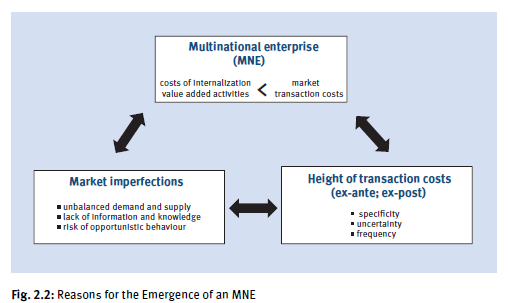
Buckley and Casson emphasize the role of an MNE as a cross-boundary developer and transferor of various kinds of knowledge and skills. In an imperfect market system, foreign investment has allowed MNEs to bypass imperfect external conditions through internalization (Buckley & Casson 1976).
In recent years, the classic internalization theory by Buckley and Casson (1976) has been further developed towards the new internalization theory which relies on two main behavioral assumptions. The first assumption is called bounded rationality, meaning that individuals’ behavior is intended to be rational, but is limited in always being so (Simon 1961). The second assumption, named bounded reliability, claims that individuals intend to be reliable but may fail to fulfill open-ended commitments for various reasons which may be out of the control of the individual. In the context of international expansion, internalization or de-internalization becomes a governance mechanism for managing the bounded rationality and bounded reliability of actors involved in international transactions (Cano-Kollmann et al. 2016; Kano & Verbeke 2015). In simple terms, the firm integrates (internalizes) market transactions into the organization because the management is better able to monitor, guide and control its (in-house) employees. This helps in overcoming the bounded rationality and bounded reliability dilemma more than in the case of external market actors (e.g., contracted but independent suppliers).
3. Review of Internalization Theory
Internalization theory extends the market imperfections approach as claimed in transaction cost theory by focusing on failings in intermediate-product markets rather than on final products. The internalization model identifies transaction costs as a main impulse for internationalization (Buckley & Casson 1976; Robock & Simmonds 1989). Buckley and Casson (1976) identified different factors determining the internationalization decision, which does not depend only on market imperfections but also on organizational capabilities, particularly in terms of internal market organization and coordination. As a result of their study, they were the first to describe and explain the emerging MNE phenomena, which has been increasingly seen since the 1970s. They also considered the role of knowledge (disparities) in driving foreign investment decisions as opposed to market transactions (Zuchella & Scabini 2007). MNEs appear when it is cheaper to allocate international knowledge resources internally than via the market mechanism (Brown 1976). However, the internalization theory is complex and, therefore, cause-and-effect variables are difficult to quantify in the course of empirical analysis.
Buckley and Casson (1976) focus on industry-specific factors related to internalizing markets for intermediate products in multistage production processes, for example through vertical integration. A vertically integrated firm is determined mainly by the interplay of comparative advantage, tariff and non-tariff trade barriers, and regional incentives to internalize. The firm will become an MNE whenever the combination of these factors makes it optimal to locate different operational stages of value-added activities in different countries (Buckley & Casson 1976).
However, there are other motives for enterprises to internationalize, such as for example the necessity of a supplier ‘to follow its customer’ to foreign markets. Moreover, the actual amount of transaction costs can hardly be quantified. Uncertainty is perceived differently by the operating management, and costs usually change over time. Due to the influence of transaction cost theory (Williamson 1975, 1985) the internalization model is based on ‘rationality’ but pays very limited attention to behavioral-sociological aspects, such as ethics, culture and norms, or personal preferences of the management (McIvor et al. 2006). Buckley and Casson (2009) moderate the critics by claiming that rationality does not imply the necessity of complete information. Instead, a rational decision maker collects only enough information to reduce uncertainty.
The latest research considers the behavioral aspects of trust-building and learning as drivers for the success of MNEs in international markets (Vahlne & Ivarsson 2014). Internalization may be rather disadvantageous in countries where the protection of invested private capital is not secure (consider, for example, the proceeding cases of expropriation of MNEs that originated in the oil industry in Venezuela).
The internalization concept of Buckley and Casson (1976) explains the growth of MNEs domestically and internationally. The approach focuses on a firm’s motives to internationalize but does not consider appropriately the potential of national governments and their political/legal influence on MNE investment decisions. For example, in countries such as China or India, it is often necessary or at least advisable to establish a joint venture with local firms in order to enter the foreign market successfully. The need to found a joint venture with a local partner influences the firm’s decision alternatives and may hinder realizing the concept of a complete internalization (e.g., through foreign direct investment) of foreign country activities into the firm’s hierarchy (Robock & Simmonds 1989).
Source: Glowik Mario (2020), Market entry strategies: Internationalization theories, concepts and cases, De Gruyter Oldenbourg; 3rd edition.
The post Internalization Theory appeared first on HKT Consultant.
]]>The post The EPRG Model of Internationalization by Perlmutter appeared first on HKT Consultant.
]]>The first element of E. P. R. G., the ethnocentric approach (home-country orientation) claims significant levels of control and standardized management procedures, implemented by top-down governance from the headquarters. The firm’s international business concentrates on exports without being significant in terms of the marketing mix (e.g., prices, product and services similar as at home). The ethnocentric concept has been defined by Barlett and Ghoshal (1990) as global strategy.
However, headquarters of multinational organizations often lack experience and knowledge of foreign markets and the diverse environments where their firm subsidiaries are operating. Those firms that have acknowledged the existence of national differences and the importance of considering these have pursued international expansion by adopting a polycentric approach (host-country oriented). Host-country oriented organizations tend to rely on locals’ expertise and provide each subsidiary with a certain degree of autonomy to manage their operations, as it is best suitable in the given context (Perlmutter 1986). According to Bartlett and Goshal (1990) the polycentric concept is described as international strategy.
A polycentric organization (region-oriented) consists of loosely connected quasi-independent subsidiaries where each subsidiary is usually comprised predominantly of local nationals, and processes and practices are adapted to the local conditions and needs of the respective target market. Bottom-up decision making has enabled organizations to capitalize on better-informed executives, better relationships with local authorities and improved perceptions of the company among locals (Lee, Kozlenkova & Palmatier 2015; Perlmutter 1969). The regiocentric organized firm, termed by Bartlett and Goshal (1990) as multinational strategy, emphasizes the existence of diverse regional markets. Similarities, for example between countries are summarized based on common characteristics when developing a regional strategy of the firm. Management decision authorities are mutually negotiated and agreed within the regions, which are, to a certain degree, independent from other regions (Glowik 2017; Perlmutter 1986).

In the case of a geocentric approach, the firm emphasizes a mutual global exchange of resources between the entire organizations’ units. The firm sets universal standards to responsively react to local needs, and the relationship between headquarters and its subsidiaries is characterized by collaboration. The aim is to make use of each country’s markets and corresponding national resources with what fits best and seems most suitable for increasing the profitability of the firm. Management norms, values and styles are broadly interpreted and governance is mutually negotiated within the whole organization Perlmutter 1986; Perlmutter & Heenan 1974).
Conceptual Weaknesses
The E. P. R. G. model provides valuable theoretical guidelines on how MNEs should organize their internationalization strategies according to firm resources, human behaviors and location-specific (institutional) environments in the foreign target markets. However, in business practice there is a permanent challenge for the firm’s management in terms of the organization’s degree of centralization or decentralization and the uncertainty as to whether home-based, single-country-based or region-oriented organizational structures fit best (Bartlett 1986). In business reality, decision-making processes are geographically overlapping. Therefore, the E. P. R. G. model tends to be complex and concreted quantification of ‘behavioral’ attitudes, naturally is difficult. The geocentric approach (transnational strategy) appears to be the ideal concept for MNEs. Specific challenges concerning the geocentric approach are related to limited flexibility, opportunistic behavior and local egoisms. For example, in managerial business practice the question is whether all organizations’ members are always willing to voluntarily exchange knowledge when they compete as regional profit centers within the organization. In addition, employees and managers, with family-related responsibilities, for example, are naturally less willing to frequently re-locate anywhere worldwide where the firm wants them to following global resource exchange necessities as in the geocentric model (Ahmadi et al. 2012; Glowik2017).
References
Ahmadi, S. A. A., Salamzadeh, Y., Daraei, M., and Akbari, J. (2012). Relationship between organizational culture and strategy implementation: Typologies and dimensions. Global Business and Management Reserach: An International Journal, 4(3, 4):286-99.
Bartlett, C. A. (1986). Building and managing the transnational: The new organizational challenge. In Competition in global industries: A conceptual framework. Boston: Harvard Business School Press.
Bartlett, C.A. and Ghoshal, S. (1990). Internationale Unternehmensfuhrung. Innovation, globale Effizienz, differenziertes Marketing. Frankfurt: Campus.
— (1998). Managing across borders: the transnational solution. Harvard: Harvard Press.
Glowik, M. (2017). Global strategies in the service industries. Dynamics, analysis and growth. London and NewYork: Routledge, Taylor and Francis Group.
Lee, J. Y., Kozlenkova, I. V., and Palmatier, R. W. (2015). Structural Marketing: Using organizational structure to achieve marketing objectives. Journal of the Academy of Marketing Science, 43(1):73-99.
Perlmutter, H. V. (1969). The tortuous evolution of the multinational corporation. Columbia Journal of World Business, 4:9-18.
Perlmutter, H. V. (1986). The tortuous evolution of the multinational corporation. Columbia Journal of world business, 4(1):9-18.
Perlmutter, H. V. and Heenan, D. (1974). How multinational should your top managers be? Harvard Business Review, 52(6):121-32.
Wind, Y., Douglas, S. P., and Perlmutter, H. V. (1973). Guidelines for developing international marketing strategies. Journal of Marketing, 37(2):14-23.
Source: Glowik Mario (2020), Market entry strategies: Internationalization theories, concepts and cases, De Gruyter Oldenbourg; 3rd edition.
The post The EPRG Model of Internationalization by Perlmutter appeared first on HKT Consultant.
]]>The post The Eclectic Paradigm appeared first on HKT Consultant.
]]>1.1. Ownership-Specific Advantages
The more ownership-specific advantages are possessed by an enterprise, the greater the inducement to internationalize them; and the wider the attractions of a foreign rather than a home country production base, the greater the likelihood that an enterprise will engage in international production. Such ownership-specific advantages may take the form of legally protected rights, patents, brand names, trademarks, or even a commercial monopoly in the market. Furthermore, if access to resources such as knowledge becomes essential for the making of a product or service, exclusive control over particular purchasing and/or distribution channels seems desirable. Ownership-specific advantages may arise from the size or technical characteristics of firms, the economies of scale in production, and qualified entrepreneurial capacity.
The eclectic approach of international production in an enterprise can be described like this: a national firm supplying its own market has various avenues for growth. It can diversify horizontally or laterally into new product lines, or vertically into new value chain activities. Alternatively, the firm can acquire other enterprises; or it can enter and exploit foreign markets. When it makes economic sense to choose the last route, the firm becomes an international enterprise (defined as a firm that services foreign markets). However, in order to be able to produce alongside indigenous firms domiciled in these foreign target markets, the firm possesses additional ownership advantages sufficient enough to outweigh the costs of servicing an unfamiliar or distant environment. The function of an enterprise is to transform, by the process of value generation, through valuable inputs into more valuable outputs (Dunning 1980a). Ownership advantages secure multinational enterprises’ competitive superiority (Rasmussen et al. 2008).
1.2. Internalization Advantages
Market imperfections arise wherever information about the product or service being marketed is not readily available or is costly to acquire and, as a result, wherever transaction costs are high. The risk of market failure causes enterprises to internalize market transactions in intangible assets (e.g., knowledge) or tangible assets (e.g., manufacturing facilities) (Dunning 1979,1995a). In-house value chain activities help the enterprise reduce the cost of information search in the market, expenses for negotiating and contracting with outside suppliers, and protection of intellectual property rights. Internalization advantages develop certain enterprise-specific capabilities concerning experience curves, operational scale effects and organizational skills. The issue of ‘internalization’ deals with the question as to why firms choose to engage in foreign direct investment rather than buy or sell intermediate products, in other words, performing market transactions (Dunning 2000).
Besides the phenomena of market imperfections, local governments’ intervention in the allocation of resources may also encourage firms to internalize their ownership advantages. This arises particularly with respect to government legislation toward production and, where there are differential tax and exchange rate policies, multinational enterprises may wish either to avoid or exploit them (Dunning 1980a).
1.3. Location-Specific Advantages
The ability of an MNE to acquire ownership-specific advantages is clearly related to the endowments that are specific to the countries in which they operate and particularly those endowments that are specific to their country of origin. Location-specific advantages answer the questions of where firms choose to locate their value-adding activities, as well as why firms produce in one country rather than another (Dunning 2002). Location advantages evaluate the alternative that it is more profitable for the MNE to use its ownership advantages together with factor inputs outside the home country (Rasmussen et al. 2008). Examples of location- specific advantages are government policy (with respect to tariff and non-tariff import barriers, infrastructure, etc.), access and costs of raw material and labor, market volume and market attractiveness, and transportation and communication infrastructure (Dunning 1980).
2. Market Entry Strategy According to Advantage Categories
Dunning derives the following recommendations for international business engagements from the ownership-location-internalization (OLI) advantage categories. The OLI paradigm suggests that MNEs that have merely ownership-specific advantages, and neither internalization nor location-specific advantages, should deal with their foreign business in the form of international contracts (e.g., licenses). However, the greater the ownership and internalization advantages possessed by firms and the more the location advantages of creating, acquiring (or augmenting), and exploiting these advantages from a location outside its home country, the higher the probability that foreign direct investment activities will be undertaken (Dunning 1994: 23-25). Where firms possess substantial ownership and internalization advantages but location advantages favor the home country, then domestic investment will be preferred to foreign direct investment; and foreign markets will be supplied by exports (Dunning & Dilyard 1999:13). The advantage category connections and corresponding market entry strategies are illustrated in Figure 2.3.
Initially addressed as a static model, Dunning further developed the eclectic paradigm several times over a period of more than twenty years, paying more attention over time to dynamic competitiveness and the strategic aspects of the firm (compare: Dunning, 1973,1983,1993,2001). Changes in the global markets witnessed since the 1990s, the deepening integration of global capital and logistics, the liberalization of cross-border markets, and the emergence of several new countries as important players in the global economic arena caused Dunning to modify and enlarge each of the OLI categories with dynamic components (Dunning 2001).

Resources and capabilities, such as the ability to internally produce and organize proprietary assets that match existing market needs at any given moment in time (static ownership advantages) were enlarged by context-specific issues to increase income-generating assets over time (dynamic ownership advantages). ‘Dynamic’ means, for example, that the trade-off of resources that can be internally developed with those externally acquired (e.g., through bilateral relationships with other market actors) becomes more crucial than the resources themselves (Dunning 1995b; 2001).
Location-specific advantages have been traditionally expressed by the availability of a country’s unique immobile natural resources, which the MNE may make use of. This category was enlarged by distinctive and non-imitable, location-bound created assets, such as the presence of firms that have specific local market knowledge (e.g., access to local customers because of suitable and efficient marketing communications). MNEs might form relationships to complement their own core competencies (e.g., advanced production technology) with the specific knowledge (e.g., marketing) of local firms in the foreign target markets, for example, through international joint ventures (Dunning 2001). Geographic locations that used to be regarded as targets for the supply of raw materials (e.g., static location advantages) are also becoming recognized as possible sources of learning and innovative capabilities (e.g., dynamic location advantages). The need for the firm’s efficiency improvement through rationalization highlights the importance of management’s strategic capabilities through developing dynamic capabilities (Dunning, Pak, & Beldona 2007).
3. Review of the Eclectic Paradigm
The achievement of Dunning’s paradigm is that multiple reasons are considered that influence an MNE’s choice of international market entry strategy. The appearance and combination of advantage categories serves as the basis for management decision making as to whether to proceed with exports, contractual entry modes such as licensing or franchising, or foreign direct investments.
The creation of the eclectic paradigm is based on different models, such as internalization theory which is built on transaction cost theory (internalization advantages), the resource-based view (ownership advantages), and location theory (location-specific advantages). In a parallel manner, criticism of the paradigm is related to its grounding in other theories. Hohenthal (2001) criticizes the paradigm for mixing three different and sometimes overlapping sets of explanations such as location concepts, resource-based theory, and transaction cost theory. This conglomerate of theories makes the eclectic paradigm very complex, limits validity testing of the model, and makes it difficult to use. The three advantage categories are formulated too generally, which makes it impossible to develop a concrete recommendation for an MNE’s internationalization strategy.
The eclectic paradigm presupposes that different firms have broadly similar objectives and respond to economic signals both consistently and following the same strategic direction. The model ignores the fact that a firm can also utilize different market entry modes (e.g., export and license) depending on its diversified businesses in the same foreign target country (Robock and Simmonds 1989).
The eclectic paradigm rather is suitable when considering circumstances in manufacturing industries instead of in internet-based service businesses. Due to the influence of the transaction cost theory, the eclectic paradigm assumes a rationally thinking actor who makes decisions mainly based on cost calculations. On the one hand, transaction costs are difficult to specify and quantify. On the other hand, the assumption of rational thinking is hard to accept when it comes to behavioral aspects, such as preferences or aversions of the entrepreneur and/or management, which also influence market entry decisions. The strategic concept concerning foreign market entry is not mandatory based on the pure rational trade-off of logical circumstances, but usually is influenced by the founding entrepreneur and/or the operating management and often driven by their individual experience related to foreign target markets.
Source: Glowik Mario (2020), Market entry strategies: Internationalization theories, concepts and cases, De Gruyter Oldenbourg; 3rd edition.
The post The Eclectic Paradigm appeared first on HKT Consultant.
]]>The post The Uppsala Model of Internationalization appeared first on HKT Consultant.
]]>During the mid-1960s, Carlson, one of the pioneers of internationalization process theories, argued that firms pass cultural barriers when entering foreign markets. With increasing experience in foreign operations, the enterprise is willing to enter one market after another (Carlson 1966). Firms handle the risk problem through an incremental decision-making process, where information acquired in one phase is used in the next phase to take further steps. Through this incremental behavior, the organization can maintain control over its foreign activities and gradually build up its knowledge of how to conduct business in diversified foreign markets (Carlson 1966; Forsgren 2002).
Based on the empirical observations of Swedish pharmaceutical, car, steel, pulp, and paper firms, Johanson and Vahlne (1977,1990) further developed the ideas of Carlson and introduced the gradual internationalization theory. Their research results, in connection with articles from other scholars at the University of Uppsala concerning the internationalization processes of firms (compare: Carlson 1975; Forsgren & Johanson 1975; Johanson & Wiedersheim 1975), later became known as the ‘Uppsala internationalization model’ (Bjorkman & Forsgren 2000). The Uppsala approach assumes that enterprises, due to a lack of foreign market knowledge, which is connected to corresponding market uncertainty, follow an incremental internationalization chain pattern.
Incremental internationalization pattern
At the start, there is no regular export. Business is concentrated in the home market. Then export begins via independent representatives (agents), later through sales subsidiary, and eventually foreign manufacturing may follow at the end (Johanson & Vahlne 1977)
Lack of knowledge, due to differences between countries with regard to language and culture, is an important obstacle when making decisions connected with the development of international business activities. As a consequence, another pattern can be derived: firms prefer entering new markets with lower psychic distance. Psychic distance is defined in terms of factors such as differences in language, culture, political systems, and others that disturb the flow of information between the firm and the market. Thus, firms start internationalization by going to those markets with somewhat lower geographical distance, which they can better understand and where the perceived market uncertainty is relatively low (Johanson & Vahlne 1977,1990).
In their incremental internationalization model, Johanson and Vahlne (1977) distinguish between state aspects (market commitment and market knowledge) and change aspects (current activities and commitment decisions).
- State aspect/market commitment: the degree of commitment is higher the more the resources are integrated and the more their value is derived from these activities. Vertical integration means a higher degree of commitment than a conglomerate foreign investment. An example of resources that cannot easily be directed to another market is a marketing and sales organization with country-specific product modifications and service with highly integrated customer relations. The more specialized the resources are to the specific market, the greater is the degree of commitment.
- State aspect/market knowledge: structure of competition, supplier and customer characteristics, and cultural aspects belong to market-specific knowledge, which can be gained only through experience during operation in the foreign market. Experiential knowledge, which is associated with particular conditions in the market in question, cannot be transferred to other individuals or markets. It can be considered a unique resource. The more valuable the resource for the firm, the stronger is the commitment to the market.
- Change aspect/current business activities: for instance, marketing and sales activities belong to running firm operations. The higher the investments in advertising in a foreign market, the more technologically sophisticated and differentiated the product, the larger the total commitment as a consequence of current activities.
- Change aspect/commitment decisions: enterprise decisions to commit resources (i.e., financial, human workforce, and advertisement) to foreign markets depend on a firm’s general business experience as well as market-specific experience.
Additional commitments are made in small steps unless the firms have a very large amount of resources and/or market conditions are stable and homogeneous or the firm has more of its experience from other markets with similar conditions. Further market experience leads to a stepwise increase in operations and integration with the foreign market environment, thus resulting in a greater market commitment (Johanson & Vahlne 1977).
The internationalization process of a firm has been similarly described by Luostarinen (1980) as a stepwise and orderly utilization of outward-going international business operations (compare Figure 2.4). The incremental and orderly geographical expansion from countries with close business distance to more distant markets causes an increasing dependence on marketing, purchasing, production, finance, human resources, and other functions of the company related to its international markets. Physical distance represents a restricting force to the flow of information and disfavors countries located farther away from the firm’s home base (Luostarinen 1980).
Market uncertainty in international business is usually related to knowledge. Learning is a process of accumulating knowledge either through access to information or business experience. The introduction of the concept of organizational learning represents a dynamic process where firms seek experiential knowledge about individual clients and markets, as well as about institutional factors, such as how to deal with local laws, governments, infrastructure and cultures. Information is accumulated through activities and presence in foreign markets, which increases costs. These costs arise in the process of collecting, encoding, transferring, and decoding knowledge, as well as changing the resource structures, processes, and routines in the
organization. Thus, knowledge plays a crucial role in international strategy decision-making (Eriksson, Jo- hanson, Maikgard, & Sharma 1997; Luostarinen 1980).
Internationalization is a process that is often difficult to plan without avoidance in advance. Organizational structures and routines are built gradually as a consequence of learning: First, a firm’s internal capabilities and competence (e.g., language and business culture qualifications of employees) and second, foreign market requirements (e.g., quality consciousness and service expectations). In this process, understanding the history of the firm is important. Sporadic interaction with actors in foreign markets provides little experience. The more the firm pursues durable and repetitive linkage with external participants abroad, the better the basis for the improvement of internal organizational routines and procedures (Eriksson et al. 1997).
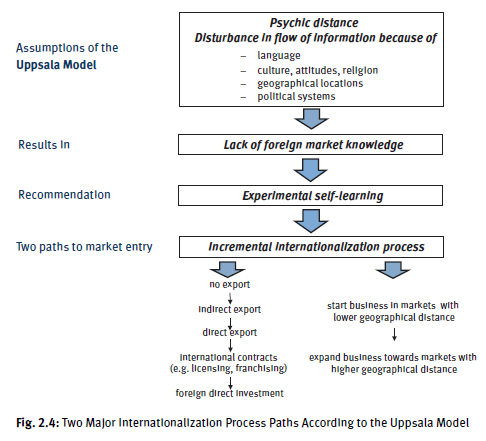
2. Review of the Uppsala model
According to the Uppsala approach, firms internationalize incrementally from physically and culturally close foreign business markets to more distant countries. During the internationalization process, the firm gains experience and knowledge stock that forms the basis for further foreign activities in countries that are located farther away from the home market. The organizational learning process through accumulated experiential knowledge and through ongoing activities is very important for the firm and its successful international business expansion. How the organizations learn and how their learning affects their organizational behavior are crucial elements of the Uppsala concept. The more market knowledge the firm acquires through its own experience, the less is the perceived risk and the higher is the propensity for foreign market entry.
During the last decades, the Uppsala model became one of the most cited, discussed, and criticized models in the international business literature (Barkema & Drogendijk 2007; Hadjikhani 1997). It is claimed that the model is too deterministic because it considers Swedish firms only, and research is grounded on a relatively small number of firm cases. In modern international business, firms are less inclined to repeat the value chain in each country. Instead, firms reconfigure their global value chains accordingly where revenues are high and/or costs are low. The model tends to ignore the fact that a firm also faces a risk by not entering a foreign market – the risk of not participating in an upcoming industry cluster of supplier and customer networks where the firm’s competitors are looking for their chance for business (Forsgren 2002).
The Uppsala model narrowly focuses on ‘knowledge’ and ‘learning’ as major influencing factors for market entry decisions and business performance in the course of the internationalization process (Dunning 2000). In modern business, there is a tendency towards shorter product life-cycles and faster knowledge transfer due to improved communication and information technologies; thus an incremental market entry may mean loosing sales opportunities because competitors may react faster. An incremental and rather slow international market entry involves the risk that investments are not amortized because technologically advanced products are waiting just around the corner.
The contents and information value of the model are largely restricted to the initial stages of internationalization processes and have a rather reactive character, leaving little room for entrepreneurial strategic choice (Autio, Sapienza, & Almeida 2000).
Recent research findings concerning the phenomenon of new venture firms indicate that firms show a more rapid pace of internationalization; and, contrary to Johanson and Vahlne’s panel of Swedish enterprises, smaller rather than larger firms make large internationalization steps in a shorter period of time (Hashai & Almor 2004). International new venture firms tend to disregard domestic markets from their inception in favor of the international marketplace, which seems to be more attractive (Young, Dimitratos, & Dana 2003). These firms make use of globally knit personal relations, often fostered by the founding entrepreneur. Instead of focusing on ‘self-learning,’ knowledge about foreign markets can be acquired through relationships and interaction with other market actors (Forsgren 2002).
Furthermore, psychic distance is perceived differently by operating managers in international business. People develop subjective mental maps of space (e.g., foreign geographical location) and distance (e.g., culture and language) that need not necessarily correspond to reality. Therefore, it is hard to assume that international business performance naturally correlates with the degree (which is difficult to measure and to quantify) of psychic distance (Stottinger & Schlegelmilch 2000).
Accumulated internationalization knowledge that affects both business knowledge and institutional knowledge is not limited to specific country markets. Organization-specific experience in foreign business can be used in all markets (Eriksson et al. 1997). Therefore, Bjorkman and Forsgren (2000) argue that the model is less valid for very large multinational enterprises and firms with extensive international experience in high-technology industries. The Uppsala approach focuses on manufacturing products where production takes place in the domestic market, and the goods are sold at arm’s length in overseas markets. Therefore, the business activities of firms with digital business concepts, such as in the service industry where manufacture and delivery are inseparable, do not fit into the export-based Uppsala model for the process of internationalization (Jones 2001).
The Uppsala concept concentrates on experiential learning through independent commitment decisions and a firm’s own business activities abroad. However, firms are occasionally forced to follow their clients when they enter foreign markets. The Uppsala model is not able to accept the possibility of imitative learning, i.e., monitoring other firms acting in a similar way and assimilating from them. An organization can also look for radically new alternatives alongside current business modes and decide on market entry according to the forecasted market opportunities and not according to its current level of foreign business experience (Jones & Coviello 2002). Thus, the possible internationalization routes are more multifaceted than anticipated by the Uppsala model (Forsgren 2002).
Several decades after publishing the Uppsala concept in the academic literature, Johanson and Vahlne (2003) concluded that firm behaviors and economic and regulatory environments have changed considerably or did not exist when the Uppsala model was published at the end of the 1970s. Markets and industries have become increasingly integrated worldwide. Internationalization processes are characterized by networks of relationships in which firms are linked to each other in various complex patterns. Instead of focusing on a single firm’s progress in ‘self-learning’ and ‘knowledge accumulation’ as recommended in Uppsala, internationalization processes should be seen from a business network perspective of the environment faced by an internationalizing firm (Johanson & Vahlne 2009). The network theory of internationalization is introduced and explained in the next section of this book.
Source: Glowik Mario (2020), Market entry strategies: Internationalization theories, concepts and cases, De Gruyter Oldenbourg; 3rd edition.
The post The Uppsala Model of Internationalization appeared first on HKT Consultant.
]]>The post Network Theory of Internationalization appeared first on HKT Consultant.
]]>In general, a network is a model or metaphor that describes a number of entities that are connected (Axels- son & Easton 1992). In the case of international industrial networks, the entities are actors involved in the economic process that converts resources into finished goods and services. The network model is based on the assumption that a firm’s changing internationalization situation is a result of its positioning in a network of firms and their connections to each other (Zuchella & Scabini 2007). The market is depicted as systems of social and industrial relationships among various parties. The network concept encompasses a firm’s set of relationships, both horizontal and vertical, with other entities, such as system and component suppliers, manufacturers, merchandisers, customers, and competitors, and includes relationships across industries and countries (Gulati, Nohria, & Zaheer 2000; Windeler 2005). By entering global networks, firms gain international knowledge through learning from other network actors, which assumes the establishment, development and protection of international business relations (Hakansson & Johanson 2001; Mathews 2002; Samiee 2008).
Learning Through Relationships
Internationalization is a process of increasing involvement in international operations, which results in an accumulation of knowledge about markets and institutions abroad (Ellis 2000; Welch & Luostarinen 1988). Modern internationalization processes are particularly characterized as a course of learning through network relationships (Sharma & Blomstermo 2003).
The network perspective draws attention to long-term business activities that exist among firms such as suppliers and customers in industrial markets. While the traditional Uppsala approach focuses on the circumstances and internationalization process of the individual firm, the network theory pays attention to the firm’s interconnections with local and foreign units (Bjorkman & Forsgren 2000; Zuchella & Scabini 2007). Through its ‘combinative capability,’ a firm exploits knowledge (collected in industry networks) for expansion into new markets. Thus, the efficient organization of knowledge transfer among the firm units is of vital importance for business performance (Kogut & Zander 1993; Zuchella & Scabini 2007).
Networks among buyers and sellers, which form the basis of effective communication, have to be established, thus providing firms with the opportunity and motivation to internationalize. Relevant information disseminates via social interaction (Ellis 2000). The nature of relationships influences the strategic decisions of the participating firms (Coviello & Munro 1997). Relationship-based strategies for market entry range from longterm oriented licensing agreements and contract manufacturing to international joint ventures with two or more partners (Mathews 2002).
1.1. The Impact of the Resource-Based View
The resource-based view (RBV) holds that a firm acquires competitive characteristics not simply as a function of its market location, such as its position in the value chain within a certain industry (compare: Penrose 1959). Competitive advantages are particularly derived from a firm’s ‘inner resources’ (e.g., managerial, organizational, technological resources, etc.) as well as from the firm’s capacity to absorb and integrate ‘external resources’ through relationships (Fahy 2002; Mathews 2002; Wernerfelt 1984).
According to Barney (1991), a firm’s resources should have the following attributes to gain sustained competitive advantage.
How to gain competitive advantage according to the resource-based view
- The first attribute is resource value. Resources are valuable when they enable a firm to conceive of or implement strategies that improve efficiency and effectiveness.
- Second, resources need to be rare, which means that current and potential competitors cannot rely simultaneously on them. A firm enjoys a competitive advantage when it is implementing a value-creating strategy that cannot be implemented by a large number of competitors that have limited access to the necessary resources (e.g., technological knowledge).
- Third, sustained competitive advantage can be reached ifvaluable resources can only be imperfectly imitated by competitors.
- Finally, rare and valuable resources cannot be substituted by competitors who are able to implement strategically equivalent resources (Barney 1991).
Consequently, the assumption that more knowledge would be likely to improve the efficiency and profitability of the firm acts as an incentive to acquire new knowledge and shape the scope and direction in the firm’s search for knowledge inside and outside its own organization (Penrose 1995). Based on the foundations of the RBV, Grant (1991b) argues that the fundamental prerequisite for market power is the presence of market entry barriers based upon a firm’s resources in the market, as for example scale economies, patents, international experience advantages, and brand reputation. The ability to establish a cost advantage requires possession of scale-efficient operations, superior process technology, ownership of low-cost sources of raw materials or access to low-wage labor. Differentiation advantage is conferred by superior quality and innovative products and services linked with proprietary technology or an extensive sales and service network.
The RBV perceives the firm as a unique bundle of idiosyncratic resources and capabilities where the primary task of management is to maximize value through the optimal deployment of existing resources and capabilities. In line with RBV, particular fostering of the knowledge resource is of vital importance in order for the firm to gain a competitive advantage. Grant (1996) describes ‘knowing how’ as ‘tacit knowledge’ and ‘knowing about facts and theories’ as ‘explicit knowledge.’ The critical distinction between the two lies in transferability and the mechanisms for transfer across individuals, space, and time. Explicit knowledge is revealed by its communication and tacit knowledge through application. Communication efficiency is a fundamental resource property, thus an important strength of the firm. At both individual and organizational levels, knowledge absorption depends upon a recipient’s ability to add new knowledge to existing knowledge (Grant 1996).
Knowledge transferability is important, not only between firms such as suppliers and customers, but even more critically, within the firm. Consequently, the creation of tacit knowledge and the ability to transfer it effectively within the organization, which includes its foreign operations, should move into the focus of the management (Chwialkowska & Ganiyu 2017). Transmission capacity is defined as the ability of a firm (or the relevant business unit within it) to articulate uses of its own knowledge, assess the needs and capabilities of the potential recipient thereof, and transmit knowledge in a way that allows it to be used in another location of the firm’s organization at home or abroad (Martin & Salomon 2003). The resource interaction in the coupling and matching of internal and external network processes affects knowledge transfer efficiency and, finally, has a vital impact on the firm’s overall business performance (Gadde, Hjelmgren, & Skarp 2012).
A firm’s industry network engagements, initiated in order to better manage resource assets, come along with advantages and also with potential risks. Why? Knowledge and experience serve as the most valuable firm resources. Protection of these resources from imitation by securing intellectual property rights (e.g., patents, copyrights, and trademarks) is of interest but, naturally, has limits. The choice of market entry mode affects the protection of strategic knowledge. For example, a wholly owned subsidiary provides better prerequisites for knowledge safekeeping than an international joint venture (Martin & Salomon 2003). Why? In a joint venture, knowledge is necessarily shared with the partner firm (e.g., value-adding process know-how). Consequently, through the process of learning and imitating, the joint venture partner firm may eventually become a competitor. Protection of intellectual property is always a challenge, and the key is to be faster than the competition if a leading technology firm wants to keep its competitors at bay. Innovators with advanced technological and managerial knowledge resources have to adapt their market entry concepts carefully and intelligently and should think twice when deciding with whom in the market to form a long-term partnership, such as an international joint venture (Teece 2000).
Mathews (2002) analyzed international activities, examining the cases of incumbents (firms that are already established in the worldwide market) and international latecomers (those with delayed global market entry) as examples based on the RBV. Latecomers are firms that delay their global market entry relative to the majority of their competitors. They use the benefits of their network relationships, which are a valuable resource and help them overcome market entry barriers such as limited knowledge about international markets, suppliers, and customers (Mathews, Hu, & Wu 2011). Learning from network partners allows a rapid substitution for less developed inner resources and experience; thus, international latecomers and/or small and medium-sized firms can leverage advantages from the incumbents, for example, through long-term partnerships. Within the global economy, international latecomers can more readily build their global operations by linking up with existing players than was possible in the past (Mathews 2002).
1.2. Resources and Dynamic Capabilities
Innovative firms that successfully act in the global arena usually exhibit dynamic capabilities to gain, reconfigure and integrate external and internal resources in order to match current market expectations and also to create market changes for the future (Liao, Kickul, & Ma 2009). Dynamic capabilities reflect a firm’s capacity to deploy resources through developing, carrying, and exchanging information, which leads to specific and identifiable processes concerning product development, international market entry, and relationship building (Lin, McDonough III, Lin, & Lin 2012). Particularly in web-based service industries, imperfectly imitable capabilities (e.g., innovative ideas) become more important as a source of competitive advantage than conventional asset resources, such as real estate, land and others (Erramilli, Agarwal, & Dev 2002). In stable markets where changes are predictable, dynamic capabilities rely on existing knowledge, and the learning process is limited to organizing and assembling resources as a consequence of market changes. However, because of liberalized global trade patterns, international markets have become more complex and, as a consequence, less predictable. Based on the RBV grounding, Teece et al. (1997) highlight a firm’s ability to achieve new forms of competitive advantage, necessary in turbulent and uncertain markets, as dynamic capabilities and mention two key aspects related to this.
- First, the term ‘dynamic’ refers to the capacity to renew competencies so as to achieve congruence with the changing business environment. Certain innovative responses are required when time-to-market decisions are crucial, the rate of technological change is rapid, and the nature of future competition and markets is difficult to determine. All these elements are valid in order to characterize the high-technology industries and their competitive market environments.
- Second, the term ‘capabilities’ emphasizes the key role of strategic management in appropriately adapting, integrating, and reconfiguring internal and external organizational skills, resources, and functional competencies to match the requirements of a changing environment. Capability is a special type of an organizationally embedded nontransferable firm-specific resource, whose purpose is to improve the productivity of the other resources possessed by the firm (Makadok 2001; Teece et al. 1997).
Successful players in the global marketplace are firms that can demonstrate timely responsiveness and rapid and flexible product innovation coupled with the management’s capability to effectively coordinate and redeploy internal and external competencies. Management activity cannot lead to the immediate replication of unique organizational skills through simply entering a market and piecing the parts together overnight. Replication takes time, and the replication of best practices always may be illusive. The potentials for firm capabilities are understood in terms of organization structures and managerial processes that support productive activity (Teece et al. 1997). Dynamic markets force firms to react, within the shortest possible time period, to changing business situations and so to renew competencies in order to respond innovatively in the market (Eisenhardt & Martin 2000; Zuchella & Scabini 2007).
1.3. The Approach ofJohanson and Mattsson
Beginning in the mid-1980s, among the first to focus attention on network dynamics in the internationalization of business were Johanson and Mattsson (1985, 1988,1992). They claimed that firms are embedded in industrial networks and linked to each other through long-lasting relationships that develop complex interfirm information channels. As a result, the industrial system is composed of firms engaged in supply, production, distribution and service. The authors describe this system as a network of relationships among the firms (Johanson & Mattsson 1988).
A firm’s internationalization development is to an important extent dependent on its position in the network. Thus, the internationalization characteristics of both the firm and the market influence the process. The firm’s market entry resources have different structures if the firm is highly internationalized (e.g., foreign market experience) in relationships than if it is less or not experienced at all. Furthermore, the market assets of other firms in the network have a different structure depending on whether the market has a high or low degree of internationalization. From this assumption, Johanson and Mattsson (1988) identify four categories that determine the degree of market internationalization in relation to the degree of firm internationalization. These categories are illustrated in Figure 2.5.
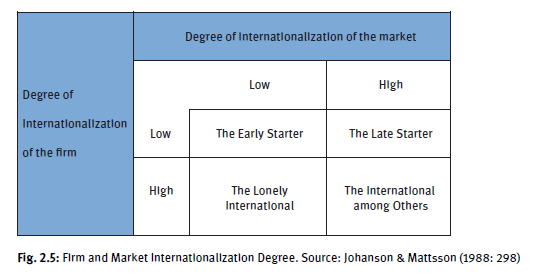
The early starter describes firms with few relationships with other enterprises abroad. Competitors, suppliers, and other firms in the domestic as well as in foreign markets have few but important international relationships. The initiative to start foreign operations comes from other parties, such as distributors or important customers located abroad.
The lonely international is a firm that is highly internationalized, while its market environment is not. The company has unique knowledge of cultures and institutions abroad developed through relationships in foreign markets. The firm’s advanced international expertise compared to other firms gives it a favorable position with easier access to international networks. Initiatives for further internationalization are not developed by other parties in the network since the firm’s suppliers, customers, and competitors are not internationalized. The lonely international has the qualifications and resources to promote internationalization for the firms that are engaged in the network. To exploit the advantages of being a ‘lonely international,’ the firm has to coordinate activities in the different national networks, which necessarily requires international integration knowledge (Johanson & Mattsson 1988).
The late starter describes a firm focused on the home market and forced to internationalize by other players, such as customers or suppliers that are actively involved in international business (e.g., the follow-the- customer phenomenon). Comparative disadvantages for the late starter come from having less international experience. But because it is embedded in the network, the late-coming firm is able to gain access to the knowledge and international experience of other firms (Johanson & Mattsson 1988). The descriptions of a late starter are in accordance with Matthews’ international latecomer phenomenon and its derived advantages and disadvantages for the firm in the global business arena (Mathews 2002).
The fourth category is the international among others. In this case, both the firm and its environment are highly internationalized. Market expansion and penetration of an international firm takes place in global networks. The advantage for this firm is that it is able to coordinate operations in international networks in order to react to changes in the market environments. Disadvantages derive from an increased communication and coordination complexity on a global scale. The international among others predominantly faces counterparts and competitors who are themselves internationally active in markets that are rather tightly structured. Major positional changes in the network will increasingly take place through mergers and acquisitions, as well as joint ventures, in contrast to the situations of firms in the previously introduced categories (Johanson & Mattsson 1988).
Johanson and Mattsson (1988) claim that the network approach can distinguish entry strategies that differ with regard to the characteristics and number of relationships the entry firm seeks to establish with other firms in the network. It can be expected that because of the cumulative nature of network processes, the sequential order of activities in international markets is important and should be given more attention in research. From the strategic point of the most interesting research issue is derived the analysis of how to get prepared for international market entry and penetration when the time is ripe. Following the idea of the network concept, preparedness for, and the successful implementation of, international market entry strategies is largely a matter of having relationships with other firms and institutions embedded in the network.
1.4. The Concept of Johanson and Vahlne
An increasing market dynamism linked with the rapid internationalization processes of firms, witnessed during recent decades, has led Johanson and Vahlne to review their own concept of psychic distance and conclude that ‘we have a situation where old models of internationalization processes are still applied quite fruitfully at the same time as a number of studies have suggested that there is a need for new and network- based models of internationalization. We think it might be worthwhile to reconcile and even integrate the two approaches’ (Johanson & Vahlne 2003:84). As a result, Johanson and Vahlne have further developed their Uppsala internationalization model of incremental market entry towards an integrated business network model for internationalization. They define business networks as sets of interconnected business relationships, in which each exchange relation is between firms and is conceptualized as collective steps. According to this definition, all firms are engaged in a limited set of business relationships with customers, suppliers and service providing firms (e.g., logistics, finance and banking) that, in turn, have relationships with other firms (Johanson & Vahlne 2003).
Hohenthal (2001) claims that there is always a connection of two separate pools of knowledge when a new relationship between actors is created. Through this connection, the firms gain access to each other’s knowledge systems (and their international experience), which can be used in other relationships and in the creation of new international business opportunities with less cost than would be required to generate the knowledge by themselves. International experience gives the firm an ability to see and evaluate global business opportunities and thereby reduce the uncertainty associated with commitments to foreign markets. Accumulated knowledge and experience in foreign markets leads to improved overall international business performance (Lou & Peng 1999).
Johanson and Vahlne (2003) distinguish between market-specific experience and operation experience. The former concerns conditions in the particular market and cannot, without great difficulty, be transferred to other markets. The latter refers to ways of organizing and developing international business operations that can more easily be transferred from market to market. Apparently, the internationalization of a firm is associated with commitment decisions such as cooperative agreements with suppliers, distributors or customers; acquisitions of competitors; or direct investment in operations and manufacturing abroad. The more specific and the more integrated those activities abroad, the stronger is the firm’s dependence on them and, as a consequence, the higher the corresponding market exit barriers (Johanson & Vahlne 2003). Within a business network perspective, market entry difficulties are not mainly associated with the general market surroundings in a country. The challenge is rather in terms of specific customer or supplier firms’ characteristics due to language, ethics, and cultural obstacles, such as different perspectives on avoiding business uncertainty and short- versus long-term business performance views (Hofstede 2001; Johanson & Vahlne 2003).
Consequently, Johanson and Vahlne (2003) combine the incremental internationalization process and the network models, assuming there is one set of business-related managerial issues that is relationship-specific and another set of challenges associated with country-specific institutional and cultural barriers. On the way to internationalization, the enterprise has to overcome these challenges. International expansion is a result of the firm’s establishment of relationships with other industry actors, such as suppliers and customers. Success in international business significantly depends on the company’s ability to build a network, which, for its part, depends on the firm’s learning openness and experience in developing it. Subsequent foreign entries benefit from the learning and experience gained from previous operations. Experienced managers who are familiar with international business help the company overcome difficulties related to entry activities in new markets (Li 1995). Johanson and Vahlne (2003) distinguish between three types of network learning, which acquire extraordinary importance with regard to prosperous internationalization activities.
Three types of network learning
First, firms do business in customer-supplier relationships. They learn partner-specific behaviors, such as willingness and ability to maintain and develop the relationship (e.g., order forecasting reliability, flexibility, and keeping promises related to the business). As a result, they learn about each other and how to coordinate their activities in ways that strengthen their joint business. Such connection increases the firms’ commitment in the foreign market.
Second, experience in relationship development assumes that when interacting in business engagements, the involved partner is learning skills that may be transferred to and used in other business transactions. These skills include how to get in touch with new business network actors (e.g., customers and suppliers) as well as expertise on knowing how to develop and deepen relationships with them.
Third, coordinating experience concerns several supplier relationships, for example concerning new product developments or just-in-time delivery schedules. It also concerns coordination between a supplier and a customer in order to make both parties’ value chain activities more efficient. All of these connect and intensify the relationships of the business network (Johanson & Vahlne 2003).
International business experience is not the result of positive international business outcomes only. Negative experiences gained from a firm’s failure concerning its foreign market entry are also of significant value for the management and develop the entire internationalization competence of a firm. Experience, whether negative or positive, thus seems to be important in the triggering, creation and development of the international market entry processes (Hohenthal 2001).
As a consequence of relationship learning, the firm acquires expertise on how to build new business relationships and how to connect them to each other. The relationship development experience is likely to be useful also when the enterprise approaches strategic relationships (Johanson and Vahlne 2003). For instance, joint ventures may be made in order to secure technological resources or to gain the strategic advantage of the cooperating partners through shared distribution channels relative to their competitors. Foreign market expansion is, first, a matter of developing the firm’s relationships in a specific market; second, establishing and developing supporting relationships (e.g., local politicians and government); and third, cultivating connections that are similar or connected to the focal one. In order to support a strategic relationship with a partner, the firm might be forced to develop a relationship in another country, thereby entering that foreign market (Johanson & Vahlne 2003).
Mathews (2002) similarly argues that firms possess a unique set of relationships that contribute to their own resources and capabilities. An enterprise is able to improve or enhance its capabilities by attracting and sharing resources with other firms with which it shares connections. A network perspective of the economy and its players, which can accommodate the perspectives of firms developing complementary strategies and accessing more mobile resources, needs to be contrasted with the conventional view that sees enterprises as atomistic entities engaged in arm’s length transactions with each other, mediated through the price system.
Those firms are viewed only as production entities with transparent technology in the form of a production function that converts input and output. However, markets have become increasingly integrated (e.g., software and hardware electronics in cars), industries have become digitalized, and value-added activities are more complex. Therefore, the conventional view of a (manufacturing) firm and its internationalization processes needs to be replaced with an interdisciplinary perspective and the firm’s location in networks.
The creation of knowledge through technological learning is crucial to gaining a competitive advantage in international business. Interactions with reliable business partners provide important insight into other firms’ research and how those products develop over time in the international markets. The functions and the design of products and services used to meet local customer expectations can be more easily observed through interlinks with foreign business partners. Thus, the development of future products and services can be adapted to better meet local market conditions. The main characteristic of those interlinked firms is their engagement in a global ‘lattice’ construction, with accelerated global expansion as the key goal. Firms that develop a corporate culture and organizational structures that ensure the effective integration of technological and administrative learning from their international interfaces will boost their performance in international business (Zahra 2005; Zahra, Ireland, & Hitt 2000). As a result, the resource-based view turns out to be a suitable ground for understanding the dynamics of international competition. Seeing the emerging global economy as networks of interlinked enterprises provides a fresh perspective on the process of internationalization (Mathews 2002; Sharma & Blomstermo 2003).
Vahlne and Johanson (2017:9) affirm that ‘what happens in a firm happens in relationships.’ A global ‘market’ for exchanges, comprising social and economic transactions, is amplified and hybridized through modern technologies and ongoing digitalization, with which intangible and tangible elements are traded. Through a convergent shift in technologies, organizations, and geographies, we see a new underlying reality of international business (IB): the rise of knowledge connectivity in innovation systems. There is a need to further explore the nature of the connections that span geographic, organizational and technological space (Cano-Kollmann et al. 2016). In place of discussions of ‘one-off’ knowledge transfer or development, the new agenda consequently necessitates continuous two-way interactions in knowledge development (Vahlne & Bhatti 2019).
1.5. Review of Inter-Organizational Network Positioning Approach
The network concept draws particular attention to the social and cognitive ties that are formed among actors (e.g., suppliers, customers, service providers, banks, etc.) engaged in international business. The rapid growth of new entrants in the global arena leads to the conclusion that enterprises do not necessarily internationalize incrementally as claimed in the Uppsala approach (Johanson & Vahlne 1977).
Against the background of globalization, international firms make increasing use of their global networks. While traditional foreign-market entry research describes how firms decide on markets and appropriate entry modes on their own, the network approach concentrates on how existing actors influence the entry of new firms into networks that provide the base for business activities abroad (Bjorkman & Forsgren 2000).
Firms maintain a range of bilateral relationships, and researchers who favor the network approach need to include a variety of variables in their analysis. Thus, the measurement and evaluation of a firm’s business performance within the context of international relationships and their individual impact on the firm’s performance in terms of its foreign market entry success are methodologically enormously complex and are, therefore, challenging (Samiee & Walters 2006). Further conceptual difficulties are measuring the ownership control and the efficiency and effectiveness of bilateral relationships in networks (Jones & Coviello 2002).
Network research tends to focus on the actor’s behavior in oligopolistic business-to-business market surroundings (Dunning 1995a). The resource dependence theory, which is derived from the resource-based view, emphasizes resource exchanges, such as in international joint ventures, as the central feature of these relationships (Newbert 2007). According to this perspective, groups and organizations gain power over each other by controlling valued resources. In parallel, there is always the risk of opportunistic behavior from the participating players in the industry network. This causes network instabilities as a considerable number of firms involved in joint ventures experience failures, much to their regret (Das & Teng 2000; Glaister, Husan, & Buckley 2003; Schuler 2001). While descriptions of individual examples through case studies of business reality are often satisfactory, the corresponding research results are hard to generalize and future predictions tend to be vague. Consequently, the theoretical potential of drawing conclusions about common patterns of internationalization in global networks is challenging and requires intensive and costly research (Bjorkman & Forsgren 2000).
Since the 1990s, the network approach of internationalization has been amplified. Innovative, young, and usually small firms often start their foreign business early in their establishment. Therefore, the phenomenon of rapid and not necessarily gradual internationalization processes has entered the academic literature. The appearance of these types of firms and the influence of their ‘entrepreneurs’ have led to a second stream of the network approach that specifically focuses on social ties of bilateral personal relationships in terms of the firm’s international market entry strategies.
2. Interpersonal Relationships Approach
2.1. Early Internationalization of the Firm
The digitalization of various industries, e-commerce, improved and faster logistics, and liberalized trade patterns has permanently fostered new business opportunities for smaller firms with limited conventional resources. The phenomenon of rapid internationalization of relatively young firms has directed the focus of scholarly research to the role and influence of the entrepreneur in the firm’s international activities (Oviatt & Mc Dougall 1994; Shrader, Oviatt, & Mc Dougall 2000).
Firms that are able to internationalize rapidly often have established personal relationships with firms abroad. Consequently, they are intensively embedded in international business structures (Hohenthal 2001). Thus, members of the international network value relationships rather than discrete and contractual, formalized transactions (Coviello & Munro 1997).
How to define an ‘early internationalized
The emergence of digitalized service-based industries in particular has further supported the business opportunities of small and medium-sized enterprises to internationalize rapidly after inception. The changing pattern of internationalization, especially among small firms, has been increasingly discussed in the literature. However, definitions that describe the phenomena of firms that internationalize in the early stages after the firm’s founding are rather heterogeneous than unified in the literature (Lopez, Kundu, & Ciravegna 2009).
One of the most cited definitions stems from Oviatt and McDougall (Oviatt & Mc Dougall 1994: 49, 94), who describe an international new venture (INV) as a business organization that ‘from inception, seeks to derive significant competitive advantage from the use of resources in the sale of outputs in multiple countries.’ Further INV definitions, to name just a few, are from Zahra et al. (2000), who specify INVs as firms competing in several countries with operations in different international regions and targeting multiple market segments. Coviello (2006) describes INVs as ‘different’ from conception because from near founding, they have a global focus and commit resources to international activities. According to Madsen (2013), INVs coordinate value chain activities across borders within three years of inception. Abrahamsson et al. (2018), claim that INVs are dynamically capable in reconfigurating their external relationships to a higher degree than other firms.
Adding to the complexity is variation in the definitions regarding the time span between the establishment of an INV and its first international sales, as well as how much foreign sales should contribute to total sales. Shrader et al. (2000:1235) describe INVs as firms that start their international activities “within six years after the firm’s formation”. Knight and Cavusgil (1996:12) limit the time span to up to “three years to reach an export sales level of at least 25 percent”. In contrast, Oviatt and McDougall (1997: 86) define a period of “six years” as a standard time span, whereas Rennie (1993: 45-46) claims a period of only “two years with 75 percent of revenues” coming from exports (Glowik & Bruhs 2014). Table 2.3 provides an overview and summarizes INV definitions as currently present in the literature.
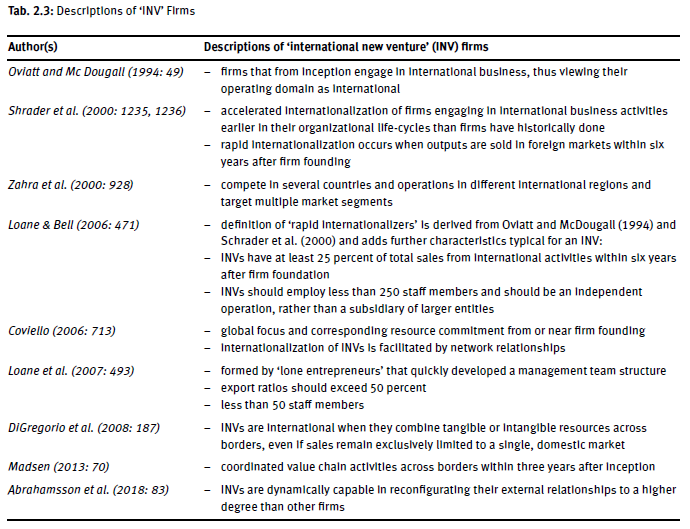
In addition to INVs, another differentiating term emerged in the literature: the ‘born global.’ INVs and born global deal with the same phenomenon: a category of firms that implement their international business from their foundation. They develop their internationalization knowledge through an ‘absorptive capability,’ usually fostered and developed by their entrepreneurs, who use their versatile and diversified personal relationship ties in foreign markets. Born global firms are usually found in new technological-based service businesses with a strong customer orientation linked to the utmost flexibility in order to adapt their market entry strategy to the needs of the local market circumstances (Sharma & Blomstermo 2003). Table 2.4 illustrates the most common descriptions of born global firms in the literature.
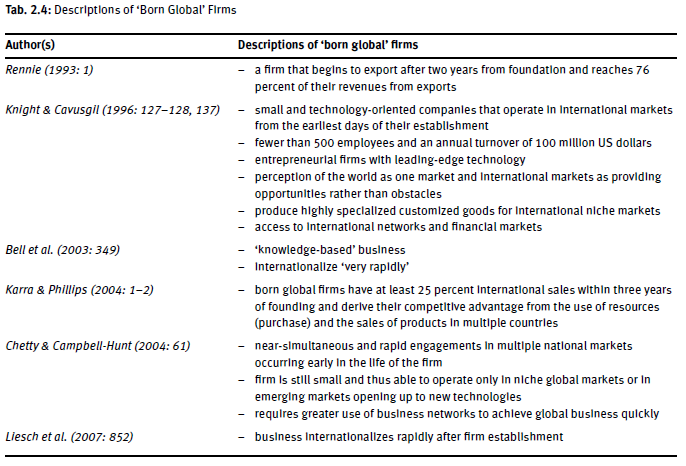
Grant (1996) emphasizes the role of the individual as the primary actor in knowledge creation and the principal repository of knowledge. According to this logic, a firm’s potentials to immediately launch international business engagements are fostered by the firm’s people, in particular the entrepreneur, who is often, but not always, the founder and business owner (Zahra et al. 2005). Entrepreneurial capabilities may result in finding ways to create value beyond the established competitors and usually conventional, resource-rich industry incumbents. Competitive advantages in the global marketplace are mainly derived from the particular intangible assets of the young and early internationalizing firm (e.g., organizational cultures and personal relationships). Consequently, the success of the firm is influenced by the ability of the entrepreneur to mobilize and dynamically combine external and internal resources and adapt them to changes in the environment. Particularly, personal contacts and social interaction play an extraordinary role when it comes to market entry decisions – especially where complex technological products with a high service value are concerned (Axelsson & Easton 1992; Ellis 2000). Dynamic capabilities allow a flexible reconfiguration of the firm’s asset structures in terms of product portfolio, process efficiency, and personal and organizational experience (Zuchella & Scabini 2007).
International entrepreneurship has been identified as involving firm activity that crosses national borders. Consequently, it is a combination of innovative, proactive, and risk-seeking behavior intended to create value in organizations (Jones & Coviello 2002; McDougall & Oviatt 2000; Young et al. 2003). McDougall and Oviatt
(2003) enlarged the definition of international entrepreneurship ‘as the discovery, enactment, evaluation, and exploitation of opportunities – across national borders – to create future goods and services.’
An integrative model comparing traditional and rather large firms versus modern entrepreneurial small business firms and their diversified internationalization processes was developed by Bell at al. (2003) and is illustrated in Figure 2.6. The authors claim that firms can follow different pathways of internationalization. These modes include the traditional, the ‘born global,’ and the ‘born again global’ pathways. The model attempts to explore and seeks to explain any variations in the patterns, pace, and process of internationalization. The authors illustrate contrasting internationalization patterns, including different motivations, aims, strategies, and methods of market entry.
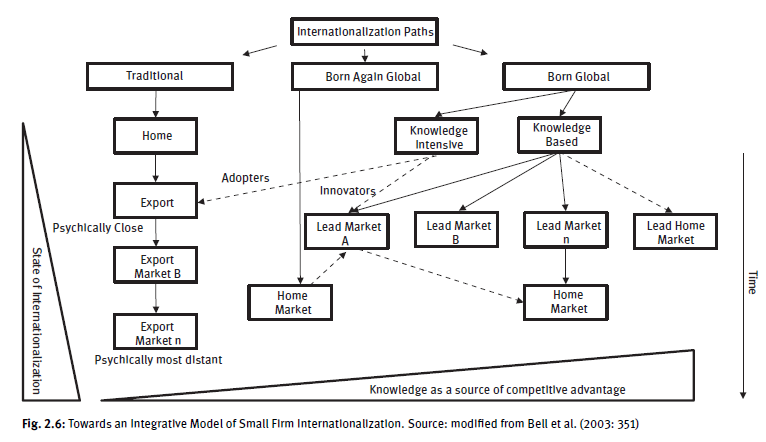
In business reality, internationalization patterns tend to be highly individualistic, situation specific, and unique. Firms with advanced international knowledge tend to launch international business faster and often more efficiently. The internationalization process is significantly dependent on external environmental conditions as well as on a firm’s internal circumstances, including resource availability, behavioral characteristics, and a global vision of the key personnel. Enterprises may pass through periods of rapid internationalization and drawbacks in international business. These periods are influenced by political/legal impacts, the firm’s customers, or other actors in the industry network. The focus of the model by Bell et al. (2003) is on strategic issues with respect to internationalization concepts of small firms. Additionally, the model provides recommendations for strategy formulation and implementation in order to assist the internationalization process.
2.2. The Dimension of Time
In their model, Jones and Coviello (2005) combine the dimension of time, management’s behavioral aspects, and the influence of the external environment on the firm’s performance. The scholars assume that internationalization is a reflection of time-based behavior, specific to individual entrepreneurs as participants and managers of social systems and networks. Behavioral aspects of the entrepreneur, determined by the decisions and actions that occur at a specific point in time, move to the center of research interest (Jones & Coviello 2002). The relationship between the entrepreneur, the organization, and the external environment is viewed from a systems perspective and assumes the continued activity of input, process motion, output, and feedback over time, whereby elements of the external environment moderate internationalization behavior. The entrepreneurial influence serves to combine resources and knowledge as part of the strategic and tactical activity of the firm (Jones & Coviello 2002, 2004).
Entrepreneurial activities include specific decisions and actions that result in or contribute to internationalization. External associations, such as international business links with other firms abroad and corresponding modes of market entry, are seen as part of that interaction (as indicated on two dimensions, time and country distance). Cross-border activity may commence or terminate at any time, thus leading to a complex pattern of internationalization decisions, processes, and activities. Enterprises with an open, responsive interactivity with the external foreign business community will internationalize more rapidly and successfully than those whose boundaries are relatively impermeable. Consequently, internationalization is a process of behavior that emerges as a firm’s unique response to internal and external influences and is particularly driven by the entrepreneur. Time is a fundamental component of internationalization in that each firm has a history comprised of significant internationalization events occurring at specific points in time. For example, the establishment of a new type of cross-border link, such as the start of an export activity, represents a milestone in the firm’s chronology of internationalization (Jones & Coviello 2002).
The internationalization process is understood as ‘value-creating-events’ (Jones & Coviello 2005). As illustrated in Figure 2.7, the entrepreneur’s level of innovativeness, risk tolerance, and managerial competence has a significant impact on the firm and its organizational structure. The firm’s internationalization behavior is a result of ‘fingerprint pattern’ and profiles over a period of time. The ‘fingerprint’ of internationalization behavior includes the functional diversity (decision of entry mode choice) and country diversity (geographic, economic, and cultural distance) in relation to time. ‘Fingerprint’ patterns give a static impression at a specific point in time, whereas profiles identify changes over a period of time. Thus, the firm’s internationalization process (e.g., market entry organization) mirrors the entrepreneurial behavior and the firm’s organization (organic vs. mechanistic). Internationalization can be seen as a firm-level entrepreneurial behavior manifested by events and outcomes in relation to time. Internationalization behavior influences the firm’s performance expressed in financial data (profit or loss as indicators of market success) or non-financial assets (degree of organizational learning). Different ‘fingerprint’ patterns of internationalization behavior evolve over time, and firm performance will impact future behavior through an iterative process of further organizational learning.
Reuber and Fischer (1999:31) build on the relationship of time and the ‘stock of experience,’ which influence the international new venture’s performance. Experience includes things that happen or events that occur during a specific time period. A particular event can have both a positive and negative impact on the international business of the firm. For instance, the loss of a key customer might reduce the sales revenue in the short term. This loss may result in better long-term performance if the firm is able to learn from its experience, for example through improvement of product quality or service.
Hurmerinta-Peltomaki (2003) claims that traditional internationalization models describe a firm’s export activities as a linear and predictable pattern on a simple, orderly, or progressive path, which is often an unrealistic notion. Consideration should be given to the idea that particular events or experiences in the past may cause a firm’s reorientation, moving the foreign trade activities in a negative direction and causing export involvement to decrease or even to be interrupted.
Thus, experience over a period of time may cause strategic reorientation that alters or stops the international activities of the firm. Time enables us to understand various organizational processes, in particular those of decision making and learning from positive and negative business episodes. During decision making, the owner or manager intentionally attempts, in the present, to connect the past to the future by assessing the relevance of his/her experience to the future. Experience is the antecedent of present and future activities, and it is this property that makes it relevant and interesting (Butler 1995; Reuber & Fischer 1999).
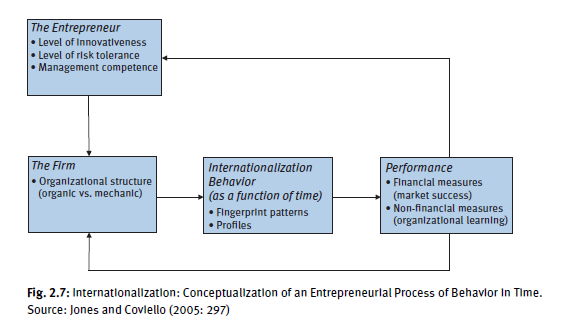
The past experience dimension, on both the organizational (enterprise) and the individual (entrepreneur) level should be taken into account when describing a firm’s internationalization process. Thus, cyclical, experience-based internationalization on an individual level affects internationalization on an organizational level. Cyclical internationalization may also be perceived on an organizational level in a forward-backward- forward movement. For example, the enterprise is able to utilize its past export experience to continue the internationalization process at present and in the future (Hurmerinta-Peltomaki 2003).
The dimensions of time in international business have not been emphasized adequately in conventional concepts of internationalization so far. As illustrated in Figure 2.8, the direction of development in research on the internationalization process evidently proceeds from the upper left-hand corner (positive direction-linear) towards the lower right-hand corner (no fixed direction-cyclical) (Hurmerinta-Peltomaki 2003).
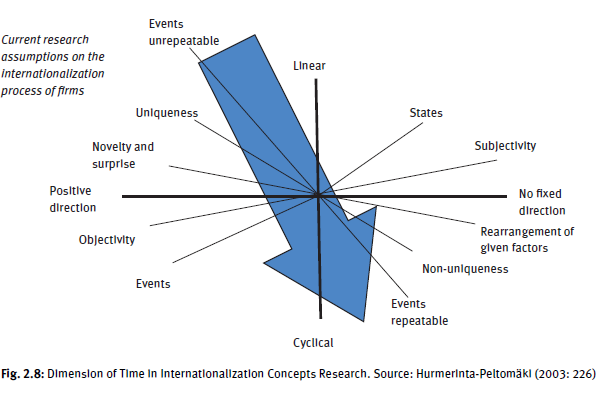
Traditional research on internationalization is mostly based on a linear idea of time; that is, the models consist of several identifiable and distinct successive stages. A higher stage of international activities indicates a greater foreign involvement (Leonidou & Katsikeas 1996). The challenge in this context is to understand internationalization as a process that is highly dynamic and time dependent. However, paradoxically almost all internationalization models are static in nature; for example, models fail to conceive each export stage as a continuum of episodes and micro-steps (Leonidou & Katsikeas 1996). This is one explanation as to why ‘stages models’ on internationalization are commonly used because permanent changes between the stages are difficult to perceive by researchers. It could be said that two dimensions of time are relevant to the development of internationalization concepts: linear, which describes the human understanding of time as a forward-going line in a positive direction (past-present-future), and cyclical time, which reflects the business reality, but where there is no fixed direction or arrow. This allows for the description of a backward direction of internationalization (Hurmerinta-Peltomaki 2003).
2.3. Towards a Conceptualized Model Typology of International New Ventures and Born Global Firms
Due to a lack of previous or fixed routines in entering foreign markets, international new ventures (or the synonym, born globals) combine their conventional resource disadvantages with the potentials of other actors through personal relationships usually fostered and developed by the entrepreneur (Sharma & Blom- stermo 2003).
DiGregorio et al. (2008: 190) emphasize the concept of entrepreneurship ‘as the nexus of individuals and opportunities’ applied to international new ventures by distinguishing between opportunities that entail novel resource combinations versus opportunities that entail novel market combinations. The first category of opportunities essentially generates potential for creating value by combining internationally dispersed resources. The latter category of opportunities entails leveraging existing resources into new markets. Resource combination chances refer to the potential to create value via innovative arrangements of international strategic factors. Such factors may include assets that are confined to certain geographic locations, for example access to natural resources, labor force qualifications, and consciousness of the customers and employees. Resource combinations may also involve cross-border pooling of innovative entrepreneurial talent and corresponding knowledge, and/or access to important markets. Market combinations, on the other hand, entail introducing a particular product or service from one country into one or more other countries. Introducing this new perspective enables the delineation of two distinct phenomena: first, the creation of international ventures and second, the process of internationalization of recently established ventures. DiGregorio et al. (2008) categorizes firms into four typologies (compare Figure 2.9).
Quadrant I – Domestic New Venture
The first quadrant contains new venture firms that have a strictly domestic orientation. That means no international sales or resource combination occurs. Such firms cannot be defined as an international new venture but, instead, are a domestic joint venture.
Quadrant II – Accelerated International Sales
International new venture firms categorized in this segment begin international sales at an early stage but do not combine resources across borders. These firms concentrate their resources locally and are typically founded in response to local opportunities. They rapidly expand their market scope to include international markets in order to take advantage of their domestically based resources to exploit differences between local and foreign markets in terms of quality or cost.
Quadrant III – Cross-Border Resource Integration
International new venture firms take advantage of geographically dispersed resources and the diverse knowledge embedded within those resources. The combination of resources across national borders is the main basis for gaining competitive advantage. Because they are embedded in international networks, their opportunities to improve the product quality, service, innovation potentials, or cost structures are enhanced. Existing business models in one market are transferred into another.
Quadrant IV – International Resource and Market Combination
Firms located in this segment depend on cross-border interactions for their tangible and intangible resources in order to realize market opportunities. Competitive advantage is developed by careful management of the risks associated with multiple entries into foreign markets. For these firms, internationalization is a means of creating new value via cross-border resource combination and capturing existing value via international sales (DiGregorio et al. 2008).
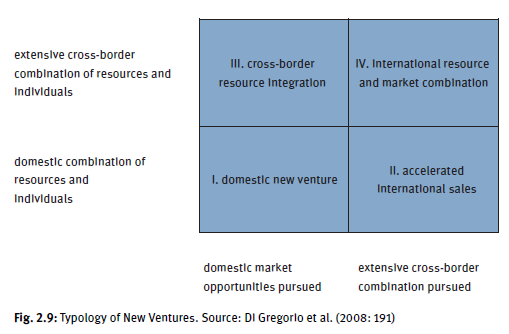
International new ventures emerge when resources abroad are combined without necessarily coordinating value chain activities internationally as witnessed for multinational enterprises. For example, an international new venture is created by combining a resource such as technology or a business model from one country with resources and/or markets in another country. International new ventures arise from leveraging domestic resources into foreign markets or to exploit new foreign resource combinations. While Oviatt and McDougall (1994) focus on internationalization soon after a firm’s inception, the concept of Di Gregorio et al. (2008) concentrates on the emergence process of an international new venture. The importance concerning external opportunities of foreign resources (e.g., material procurement, knowledge, and technology transfer), which help to improve the firm’s performance in domestic and foreign markets, has been ignored so far. Entrepreneurs of young firms seeking to internationalize should intensively and permanently search for foreign resource opportunities.
Gabrielsson et al. (2008) propose a born global firm definition that includes various aspects. A firm should have a global market potential and entrepreneurial competence that enables rapid internationalization. Furthermore, a firm should have a distinct differentiation strategy and products with unique technology, superior design, unique service know-how, or other highly specialized competencies. Born globals understand foreign markets as a chance to explore and create new knowledge regarding products with global market potentials. The establishment of a successful start-up firm needs a global vision linked with reasonable risk awareness.
The time factor should be regarded along with two dimensions: precocity (early internationalization) and speed (effectiveness). All-in-all, these types of firms show a broad entrepreneurial scope, high intensity in their business focus, and rapid growth (Gabrielsson et al. 2008; Kuemmerle 2002).
In order to overcome the conceptualization weakness of the entrepreneurial models, Gabrielsson et al. (2008) attempt to develop a combined approach that includes the born global phenomenon and its behavior over time. They describe the firm’s development in different stages and the reasons it proceeds as it does. As a result, the evolution process is divided into three phases: first, the introduction and initial launch phase; second, growth and resource accumulation; and third, the break-out and desired strategies phase.
The first phase, the introduction, describes the period when born globals have limited resources and an undeveloped organizational structure. They rely on unique and mostly tacit knowledge to achieve competitive advantage. The most important resources are the firm founder(s) and other employee resource (knowledge) capabilities and inimitable skills. Combined with entrepreneurship, these abilities may lead to the development of products with global market potential. Firm growth mostly depends on the distribution channel strategy and the relationships chosen – for example, a long-term sales contract concluded with a multinational enterprise and further relationships created through personal relationships of the entrepreneur. Organizational learning is important for the success of the born global, especially knowledge about foreign markets (Gabrielsson et al. 2008).
Phase two describes growth and resource accumulation. Business success depends on the product and service itself and the ability to place it on the market. Knowledge rests on the ability to learn from partners, suppliers, and customers, as well as collected success and failure experiences (Gabrielsson et al. 2008).
Phase three, the break-out and desired strategies phase, describes the period where the born global decides on a strategy based on its previous learning and experience in order to arrange its own position in the markets and its industry network. The strategic reorientation is influenced by the desire for independence from global players and the control of its own actions. A fundamental global vision and devotion are necessary as well as the availability of a client portfolio, which allows the development of international success to continue. At this stage, a born global may develop and continuously grow to become a ‘normal multinational enterprise’ in the future (Gabrielsson et al. 2008).
2.4. The Phenomenon of the ‘Born Again Global’
The limited focus on the start-up phase of new venture firms led (Bell et al. 2003) to an expansion of the discussion of the ‘born again global’ phenomenon. This term describes firms that have become well established in their domestic market with apparently no great motivation to internationalize, but which have suddenly embraced rapid and dedicated internationalization. Born again global firms fail to conform to the conventional stage models of small firms’ internationalization process concepts, which concentrate on the initial phase from the firm’s inception.
The radical change in internationalization behavior of the born again global firm may be triggered by a critical incident or several events happening at the same time. These incidents may include a change of ownership or management, a decision to follow a main customer to foreign markets, or the introduction of internet- based distribution channels. Especially a change of ownership or management has a significant influence on the internationalization path of born again global firms. Not only top management representatives with an international vision, but also other human resources of the firm with special international expertise (for example, embedded in the firm’s sales or purchasing department) influence the company’s internationalization re-launch. Furthermore, additional financial resources and new opportunities may come up due to access to new international industry networks and, consequently, more amplified knowledge (Bell et al. 2003).
The motivation of born again global firms to internationalize is, in comparison to born globals, rather reactive; they only respond to a critical event. Business goals of born again global firms include the utilization of new industry relationships and corresponding emerging resources. Born again global firms show, after the initial reactive event, a more systematic and structured approach to internationalization than born global (international new venture) firms. They also tend to originate from traditional industries rather than from high technology and service sectors. It might be assumed that born again global firms have a better position from which to finance rapid internationalization because they have secure revenues from their home market. These firms have a certain stock of financial resources and knowledge from the ‘critical incident’ at their disposal. However, international business success will not become reality if the firm faces difficulties in the domestic market (Bell et al. 2003).
The born again global concept may also apply well to service intensive organizations because these firms will remain in the domestic market until the business idea and the service quality has been verified as successful and able to be culturally adapted abroad. Another explanation of the born again global firm phenomenon is that these firms initially tried to internationalize but failed. Thus, they decided to build up a supporting domestic infrastructure that would allow them to internationalize quickly and successfully at a later time (Bell et al. 2003; Gabrielsson et al. 2008). An entrepreneurial person may also be able to bring organizational change and innovation to established enterprises. These changes in strategies and knowledge may enable the corporation to form new capabilities and sources of innovation and creativity. Two different approaches derive from this: first, ‘corporate entrepreneurship’ and second, ‘dispersed corporate entrepreneurship,’ also known as ‘intrapreneurship’ (Zuchella & Scabini 2007). These approaches will be introduced in the following chapter.
2.5. Individual and Corporate International Entrepreneurship
When born global firms have grown successfully over time and thus have become mature and carry out various cross-border activities, the variability of the term ‘entrepreneurship’ is increased. Corporate entrepreneurship is characterized by a new division in an established company that identifies and develops new business opportunities for the firm. The department or division acts autonomously, has a relatively flat hierarchical structure, but has strong internal integration with high availability of resources and support from management. In contrast to this, the term dispersed corporate entrepreneurship (intrapreneurship) assumes that every employee has the potential to behave in an entrepreneurial way. Thus, entrepreneurial groups are formed and deal with normal managerial tasks. This entrepreneurial culture within the company culture serves as a basis for any activity, including among others the firm’s internationalization movements (Zuchella & Scabini 2007). The phenomenon of rapid internationalization is often a result of a firm’s internal projects carried out by team members with an entrepreneurial and international spirit (‘international intrapreneurship’) (Cavus- gil & Knight 2015).
There are several ways that entrepreneurial activities can take place either inside or outside of a firm. Developing them inside the firm would involve organizational structures and managerial capabilities. Outside development would include another business stakeholder – for example, long-term contractual relationships with a supplying firm. Entrepreneurial activities increasingly become the focus of international subsidiaries of mature and rather large enterprises. These subsidiaries are controlled by the firm’s headquarters but act proactively and find new resources and chances to expand their business. Over time, they develop their own unique capabilities and personal bilateral relationships. The local environment makes local managers alert to new opportunities and creates an entrepreneurial orientation within the subsidiary. As a result, the local subsidiaries act independently for the most part in pursuing opportunities and develop an organizational culture that sets particular international goals and strategic directions. This development of entrepreneurial subsidiaries can be seen in connection with the need for local market responsiveness. To what extent the subsidiary can determine independent actions, roles, and objectives, or whether these issues have to be strictly in accordance with the goals of the headquarters seems to be important. The self-determined and autonomous approach facilitates local entrepreneurship. It ensures exposure to different resources, local knowledge, and close contact with markets and their customers. Entrepreneurial subsidiaries allow further development of adapted solutions and more effective management in the course of the firm’s internationalization process (Zuchella & Scabini 2007).
If the role of the firm’s international subsidiary is more independent and innovative, it develops and implements better performing strategies because it is closer to the local markets. Moreover, this role supports the employee’s motivation to be innovative and entrepreneurial in the future. It can be assumed that turbulent, complex, and dynamic environments better foster entrepreneurship due to the pressure for the firm to be competitive through permanent innovation and improvement. Nevertheless, there is still a need for coordination and integration of companies in order to avoid duplication of efforts. The multinational firm needs to monitor and evaluate the subsidiary in strategic and financial terms, which cannot be done without managerial and organization efforts that entail corresponding costs (Zuchella & Scabini 2007).
2.6. Review of the International New Venture, Born Global, and Entrepreneurial Concepts
Entrepreneurship and its impact on a firm’s internationalization concepts are upcoming research topics particularly in light of digitalization and corresponding new technology-driven business concepts. The different contributions in this field have their roots in many disciplines (e.g., business administration and social sciences, psychology), but generally accepted definitions and unified theoretical frameworks are still missing (Holmquist 2003; Zuchella & Scabini 2007). Despite the lack of a uniform model, the international start-up phenomena has contributed significantly to a changing perspective of modern internationalization strategies against traditional internationalization concepts. Major differences between traditional firm internationalization versus modern internationalization are summarized in Table 2.5.
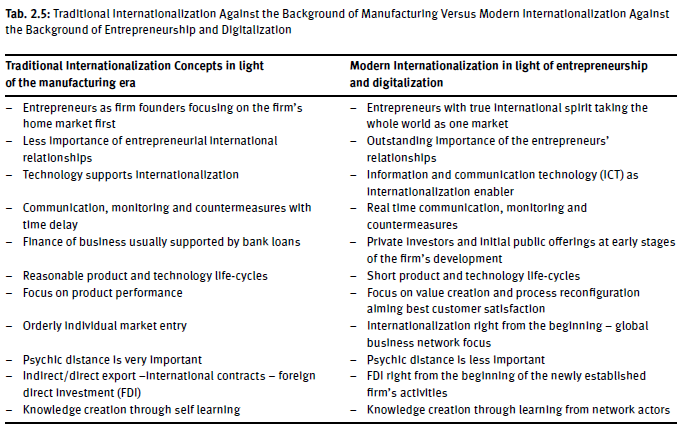
Digitalization serves as a transformation process which includes not only operations, but the company’s value propositions and its internationalization path – the move form product- towards process-oriented. Tech-driven service start-ups, in particular, make use of new business opportunities which are possible through digitalization. Relationships fostered by the founding entrepreneur serve as a vital facilitator for implementing a young firm’s digital business concepts (Coviello et al. 2017). Success in international business is dependent upon the embedding of the entrepreneur in cross-border institutional structures comprising national and international networks (Young et al. 2003). In addition to the role and influence of the entrepreneur, international new venture models take into account various other influential factors (e.g., the
factor of time, internationalization processes, and internal and external environmental surroundings of the firm). The weight of a single businessperson or entrepreneur when making internationalization decisions seems significant in start-ups and/or small and medium-sized companies. This influence is, however, rather restricted or even legally restrained in larger or multinational companies. The impact of the owner on internationalization decisions is fundamentally stronger in hierarchical cultures with a relatively high degree of top-down decision power than in less hierarchical firm cultures.
Rialp-Criado et al. (2002) critically mention diversified denominations such as international new venture, born global, instant international, and so forth, which describe the same phenomenon of internationalization but increase the confusion and complexity of the theoretical concept. They further argue that the term ‘global’ is too ‘optimistic’ to be suitable for most firms and their degree of international scope. Therefore, the authors recommend using the term ‘international new venture.’ In the corresponding literature, there are variations in the definitions regarding the time span until an international new venture records the first international sales after its establishment and how much this contributes to the total sales.
Therefore, confusion arises because there are no fixed definitions of the time span concerning the initiation of international business after the firm’s establishment and the extent of foreign business in order to arrive at a common basis for empirical research.
Entrepreneurs take considerable risks when they pursue opportunities in international markets. Differences in international business performance among firms arise because of the creativity and modes of exploitation the entrepreneurs might use. Entrepreneurs are also embedded in a social context and in institutional external environments and experience with success and failure influence their internationalization behavior (Zahra et al. 2005).
Loane et al. (2007) argue that entrepreneurship research tends to focus on the owner or key decision maker. In light of project team structures, particularly in knowledge-based industries, this approach needs to be reconsidered. Team members as a collective may have more experience in a greater number of international markets, and their combined networks of contacts are likely to be more extensive than those of a single founder. Rapidly internationalizing small and medium-sized firms are often founded by teams that have more diverse skills and wider personal network relationships (Cooper & Dailly 1997; Loane, Bell, & Cunningham 2014). Similarly, Zuchella and Scabini (2007) recommend that the role of individuals, as well as organizations, has to be analyzed in conjunction with their relationship networks.
A firm-specific transformational process, sometimes provoked spontaneously due to severe market or technology changes, causes new organizational structures (Van de Ven & Poole 1995).
However, testing and measuring of entrepreneurial activity in international new ventures, and time-based approaches tends to be difficult due to the difficulty of generating quantifiable data. For example, it is hard to verify whether a particular time event (e.g., meeting with visitors who passed the firm’s booth at the trade fair by chance and later became international customers) causes changes or routes the international business activities of the firm in a particular direction. Thus, empirical methodology and a structured, dominant theoretical framework are missing in the current literature.
Source: Glowik Mario (2020), Market entry strategies: Internationalization theories, concepts and cases, De Gruyter Oldenbourg; 3rd edition.
The post Network Theory of Internationalization appeared first on HKT Consultant.
]]>The post About Strategy and Internationalization appeared first on HKT Consultant.
]]>Larger firms, such as multinational enterprises, usually follow three types of strategies that are hierarchically linked to the firm’s corporate level, strategic business unit (SBU) level, and functional (department) level. On the top management level (corporate level), there are directional strategies (where we should compete?) that can be categorized as growth, stability and retrenchment strategies. A growth strategy, as the term itself indicates, is launched in order to increase the firm’s turnover and profits through expansion. A stability strategy is implemented, for example, after the acquisition of another firm, so organizational integration of the acquired business activities is required. A retrenchment strategy is realized through the shutdown or outsourcing of businesses that continuously accumulate losses, and there is little hope that these poorly performing business units will recover in the future (Wheelen & Hunger 2010).
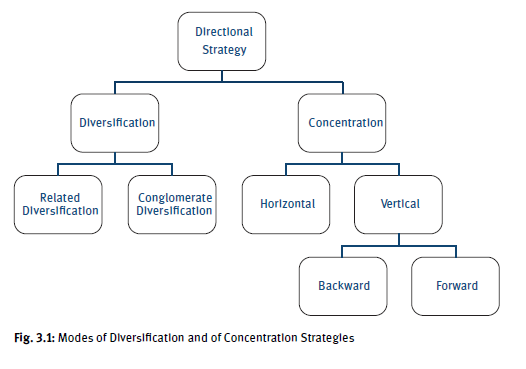
As illustrated in Figure 3.1, growth strategies are realized by expanding business activities in the current industry through enlargement of the current product portfolio or depth of value-adding activities. In this case we distinguish horizontal concentration (e.g., amplified range of the firm’s current products and services) and concentration strategy through vertical backward integration (taking over value-added activities previously done by the supplier) and vertical forward integration (moving ‘closer to the customer’ through one’s own sales branches). Concentration strategies are implemented by the management to focus on developing strategic core competencies, for example to gain technological leadership in a particular market. Concentration strategies are recommended when the management believes that the firm is doing business in markets which indicate attractive growth rates for the future. In case the firm’s management realizes (as a result of the environmental analysis, done for example with S. E. E. L. E. analysis methods) that the firm is not positioned in attractive and promising markets for the future, the management may decide to launch a diversification strategy. Diversification strategies are recommended to spread the firm’s business risk among separate and usually independent markets. In this case, new products and services are offered in related industries (related diversification – from the perspective of the firm’s current core business/current value adding activities) or in totally unrelated industries (conglomerate diversification – from the perspective of the firm’s current core business/current value adding activities). An example of conglomerate diversification is the carmaker Daimler AG which operates in the financing business through Mercedes-Benz Bank. Instead of manufacturing, Daimler has also recently entered the car-sharing business.
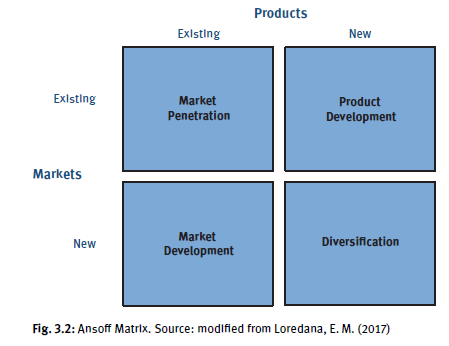
The ‘Ansoff product-market matrix’ categorizes four different strategic alternatives related to existing products and/or new products which are connected to business opportunities in existing and/or new markets (compare Figure 3.2). In case of market penetration, the management aims to increase its market share in existing markets with existing products and services. Market penetration can be reached, for example, through approaching competitors’ customers, gaining customers who did not buy the product before and intensifying the buying behavior of current firm customers through realizing higher purchase volumes (Loredana 2017; Schawel & Billing 2011). The second category – ‘product development’ – targets increasing demand in the existing market through the development of new or modified products (e.g., better matching specific customer requirements through products and services at different quality and price levels). In case of market development current firm products are offered in new markets (e.g., geographic business expansion). Diversification, according to the Ansoff matrix, is when new markets are entered with new products (Loredana 2017; Schawel & Billing 2011).
Porter’s concept of competitive strategies, named cost leadership, differentiation, and niche strategies, is realized in the firm’s strategic business units (SBUs). Competitive strategies (how we should compete?) follow up the top management’s decision on a directional strategic level (e.g., growth strategy through concentration or diversification). In case of cost leadership strategy the firm targets cost-efficient value-adding activities through economies of scale and experience curve effects, which are ideally combined with a high bargaining power of the firm. Cost leaders aim to learn ‘from the mistakes of the early moving firms.’ They are often found in rather mature markets which indicate high market volumes but intense price competition. Therefore cost leadership firms usually offer standardized products (Porter 1980; Porter & Kramer 2014). The opposite occurs in a differentiation strategy in which the management targets to differentiate the firm’s product and service from its competitors, for example through technological innovation, service, quality and sustainability. Therefore products and services are usually sold at higher levels than the average market price. Niche strategies combine both ‘cost aspects’ and ‘differentiation’ in rather smaller, separated markets. Porter has been criticized because of the nebulous line between ‘how much differentiation and how much cost awareness’ a firm’s management should take into consideration. Therefore, Porter further developed his concepts of generic (competitive) strategies and added ‘niche strategy with differentiation focus’ and ‘niche strategy with cost focus.’ Conceptual weaknesses still exist in terms of potential segmentation drawbacks concerning cost elements and differentiation elements (because the management needs to always consider both sides). Moreover the generic strategies are difficult to quantify and thus empirical verification is difficult. Despite conceptual weaknesses, there is no doubt: Porter’s generic strategies enjoy a high level of publicity, especially among business practitioners (Porter 1980; Porter & Kramer 2014).
At the final stage, after the directional strategy and the competitive strategy decisions have been made, the firm’s management needs to decide on the appropriate strategy mix on a functional (department) level. Functional strategy implements and realizes directional and business unit strategies by maximizing the firm’s department strengths and effectiveness (how we should implement what was decided on directional and competitive level before?). Functional strategies are concerned with developing a distinctive competence in order to provide the enterprise and its business units with a competitive advantage (Wheelen & Hunger 2010). For example, we distinguish purchasing strategies (e.g., single, parallel or multiple sourcing strategies), marketing strategies (e.g., penetration or skimming, push or pull strategies, shower or waterfall strategies), R&D strategies (technological leadership or followership strategy), and operations (e.g., individual order, serial or mass production). The firm gains competitive advantages when there is a strategic fit on all three levels (directional, competitive and functional). For example, a growth strategy through concentration and cost leadership necessarily requires a push strategy (communication), shower strategy (timing) and price penetration strategy in the marketing department, and technological followership in the research and development department, and so on.
In light of globalized integrated valued-added activities and international trade and capital flow patterns, a firm’s growth strategy is often realized through enlargement of its business by means of geographic expansion into foreign markets. As a result, the firm is engaged in internationalization processes because its products and services are transferred across national boundaries. The firm’s management selects the country and relevant actors; where or with whom the transaction should be performed; and the corresponding international exchange transaction modality, which is called a firm’s market entry strategy or, synonymously, market entry mode (Andersen & Buvik 2002). An entry mode refers to the institutional or organizational arrangement chosen by the firm for its business activities in target foreign markets (Hollensen, Boyd, & Ulrich 2011). The international business activity can range from manufacturing of goods, to servicing customers, to sourcing various inputs (Holtbrugge & Baron 2013; Welch, Benito, & Petersen 2007). When entering new markets, the operating management is confronted with various challenges that usually come along with more or less known societal, ecological, economic, legal/political, expertise (S. E. E. L. E.) and environmental surroundings. Thus, there should be various advantages from international business activities that cause firms to consider taking the risk of entering foreign markets. What motivates a firm to internationalize? The following are the main reasons
- Demand-oriented factors: Foreign market entry because of its attractiveness in terms of market volume and growth rates, which provide additional sales volumes, in addition to (often) saturated home markets.
- Supply-oriented factors: Access to rare and valuable resources found in foreign markets, such as qualified and motivated employees, raw materials, knowledge, technological expertise, infrastructure, and others.
- Follow-the-customer necessity: To avoid the risk of being dropped from the procurement list of an important customer, the supplier needs to follow its customer, which is engaged in a foreign target market.
- Follow-the-competitor necessity: To avoid leaving the competitors either with all the sales opportunities or all the investment benefits provided in a regional industry cluster in foreign markets, the firm must join the competitors in the foreign markets.
- Financial reasons: To realize the advantages of foreign markets because of investment incentives (tax reductions, subsidies), large multinationals can make use of cross-stock listing, less costly debt financing because of lower interest rates, and the higher liquidity of the foreign markets.
As is clear from the internationalization motives presented above, a firm does not always make its decision about whether, where, and how to internationalize independently but often makes the decision as a result of its bilateral relationships with other actors in its relevant industry network.
The strategic decision process in the course of entering foreign markets is relatively complex, and the outcomes of foreign business normally have a vital impact on a firm’s destiny. In other words, the decision regarding the foreign entry mode strategy is one of the most critical for the management. Among others, it is usually costly to change the mode of entry once it is established due to its long-term consequences for the firm (Brouthers & Hennart 2007; Pedersen, Petersen, & Benito 2002).
The choice of which foreign country to enter commits a firm to operating in a certain geographical and sociocultural terrain and signals its future strategic intention to customers, suppliers, competitors, and other stakeholders (Ellis 2000). The portfolio of international market entry strategies can basically be distinguished among contractual forms (e.g., exports, franchising, original equipment manufacturing); cooperative partnerships, such as international joint ventures; and foreign direct investments (e.g., wholly owned subsidiaries). These strategies will be explained in detail in the following sections of the chapter.
Source: Glowik Mario (2020), Market entry strategies: Internationalization theories, concepts and cases, De Gruyter Oldenbourg; 3rd edition.
The post About Strategy and Internationalization appeared first on HKT Consultant.
]]>The post Contractual Modes of Market Entry appeared first on HKT Consultant.
]]>Export describes business activities where goods and/or services are sold outside the country in which the major value-added activities took place. Export allows a fast and relatively less risky foreign market entry. The exporter’s major risk is a financial risk (importer does not pay for the cargo) that can be reduced by asking for pre-payment before delivery or by using a letter of credit or export credit insurance. By developing the service or manufacturing the products at home and exporting them abroad, the organization is able to realize substantial economies of scale effects from its expanded sales volumes in the foreign markets in addition to its sales in the local market (Hitt, Ireland, & Hoskisson 2015). Exports help to develop the firm’s international business competence and innovative capabilities due to the firm’s access to information located in foreign markets. According to Love and Ganotakis (2013), knowledge-intensive service-sector firms are able to gain earlier benefits from their expansion to export markets than manufacturing firms.
Basically, we distinguish between direct and indirect exports. Indirect exports and direct exports describe transactions in which the firm delivers products and/or services to an importing company based on a con
tractual agreement. Having no, or very little, experience in the business of foreign trade, it is desirable for the firm to initiate its first foreign engagement through indirect exports. This market entry mode is called indirect export because an intermediary, with a commission, searches for potential customers (importers) in the target foreign country. The commission is subject to negotiation between the exporter and the intermediary and usually ranges from two to fifteen percent of the contract value. The commission is due after a contract is signed by the exporter and importer. Because the intermediary searches for pre-negotiated agreements with potential importing customers, the exporting firm is not confronted with challenging socio-cultural conditions, such as unfamiliar negotiation behaviors or language barriers. However, intermediaries who run their business based on a commission often carry the products of competing firms and, therefore, tend to have divided loyalties (Hill 2012).
In the case of direct exports, the firm undertakes personal relationships with the importing customer abroad. Direct export requires more resources relative to indirect business because of traveling as well as actively managing the negotiations and contracts. The advantages from direct market access and the benefits from gaining valuable first-hand customer information may easily exceed the costs of active export management. Carriers and banks are important participants in the exporter’s business-to-business network. The carrier’s willingness and degree of resource commitment influence the performance of on-time delivery of the cargo from the exporter to the importer. The bank, through its transfer of timely payments and its fee and loan policy (which is also a result of the bank’s resource commitment), has further significant impacts on the importer’s and exporter’s degree of satisfaction. The mutual resource commitments of the exporting firm, the importer, the bank, and the carrier for a direct export contract are illustrated in Figure 3.3. A particular form of export without the involvement of a bank is called barter. With barters, products and services are mutually exchanged between exporter and importer without financial payments. The volume of the products exchanged may differ depending on the unit value of each product. Barter businesses come about with firms located in rather fragile regions in terms of the economy, infrastructure, and finance.
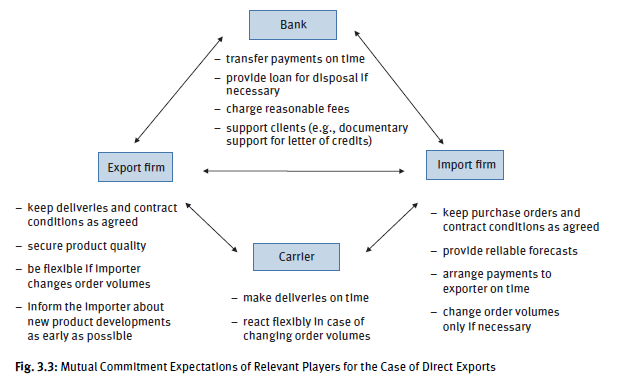
The major challenges for a firm doing export business are cross-border trade barriers. Because of liberalized trade patterns as a result of the General Agreement on Tariffs and Trade (GATT), which became effective in 1948 and was replaced in 1995 by the World Trade Organization (WTO), the average customs import tariffs are lower or for some cases disappeared compared to the past. However, nontariff barriers (e.g. quotas, bureaucratic import documentation), which are more difficult to gain evidence about, may remain a threat for the exporting firm, especially in volatile export target markets where the government of the host country tends to make use of barriers in order to accommodate the domestic industry lobby.
Export easily becomes uneconomical for bulky products and/or long-distance markets, which entail relatively high transportation costs. Furthermore, in light of globalization, firms face the challenges of supply flexibility and efficient management of demand changes in order to gain competitive advantage (Vollmann, Berry, Why- bark, & Jacobs 2005). Exports from geographically distant markets result in a longer transportation lead time, thus reducing the delivery forecast change response time. The after-sales service becomes more difficult and expensive when the manufacturing location is far away from the export sales market. Domestic production and export may not be appropriate if lower cost locations or highly skilled staff for manufacturing and selling the product or service is available abroad or if local manufacturing is supported by infrastructure incentives granted by the local government (Hill 2012).
In the past, products with a relatively high degree of tangibility and a low demand for interaction between producer and final customer were usually exported. In recent years, we have witnessed export activities for products with a high degree of intangibility, such as software development or accounting services. An example is India, known as an exporting country (Blomstermo, Sharma, & Sallis 2006). E-commerce-based communication, sales, and distribution channels make it possible for an exporter to neither require an intermediary nor be permanently physically present in the target foreign markets. However, the biggest threat for exporting firms comes along with recently emerging protectionism in some countries (for example, compare the case of increasing tariffs between the United States and China).
2. Contract Manufacturing
In highly competitive and technologically fast changing industrial environments, manufacturers often consider establishing production capacities in a foreign market. The major reasons for market entry through contract manufacturing (synonymous term: original equipment manufacturing) are the following: a firm takes advantage of lower-cost locations and is able to save logistics costs due to local manufacturing in the target foreign market. The original equipment manufacturing (OEM) strategy allows the brand manufacturer a faster market entry abroad via the contracted firm than through foreign direct investments. This is particularly the case in high-technology industries where product innovations, simultaneously launched on a global scale, are of vital importance in order to gain competitive advantage. While the original equipment contractor (OEC) firm concentrates on the production, the brand manufacturer can bundle the resources in its core competencies, such as research and development or marketing. In other words, contract manufacturing is linked to the ‘make-or-buy’ question (Morschett 2005). The OEC can combine production for several OEMs and thus realize economies of scale (Plambeck & Taylor 2005). Further incentives for contract manufacturing from the OEM’s perspective are improved sensitivity to local customer needs and avoidance of host country import taxes or quota restrictions (Hollensen 2014).
How does the OEM system work in practice? The OEM (brand manufacturer) searches for a potential firm in the foreign target market that is able to manufacture, based on the OEM’s desired cost structure, the technical specification and quality standards of the OEM’s products. When the OEM has found a suitable and capable firm, a contract is signed; and the OEC starts production of quantities of the OEM’s product. It is important to mention that the OEC puts the OEM’s brand name on the product at the end of the assembly process. Because the brand is visible on the product, consumers do not realize the product is assembled by the OEC. However, consumers are usually charged at the same price level (market goodwill of the OEM’s brand) they were used to paying when it was manufactured by the OEM. The lower unit manufacturing costs (because the product is manufactured by the OEC) but higher sales price (as though it was manufactured by the OEM) finally generates higher OEM margins.
According to the conditions, which are negotiated between the contracting parties, the OEC may launch individual component assembly operations (semi-products) or manufacture complete products including services (full operations). Payments by the OEM to the OEC are generally calculated on a per unit basis. In many cases, the OEM contracts with different OECs located at different places around the globe. Thus, the OEM benefits from each OEC’s proximity to the market, which results in an increased flexibility to balance the production capacities of each OEC, if necessary (Hollensen 2014). This close proximity helps to accelerate the OEM’s time-to-market responses in case of fluctuating order volumes. Additionally, contract manufacturing enables the OEM to undertake foreign operations without making a final investment commitment in the foreign target market. As a result, the OEM reduces its investment risk through its contractual agreement with the OEC (instead of establishing its own operations). The contract between the OEM and OEC can be terminated at any time – for example, if sales volumes in the target foreign markets shrink (Cole, Mason, Hau, & Yan 2001). The mutual resource commitments of the OEM and OEC when aiming to realize a successful and sustainable contractual relationship are illustrated in Figure 3.4.
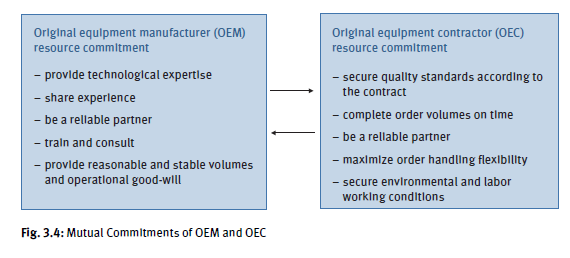
How about the potential drawbacks of contract manufacturing? Disadvantages for the OEM can derive from the OEM’s loss of direct hierarchical control of the manufacturing and administrative (such as quality control) processes. The ongoing fulfillment of quality, based on the technical specification set by the OEM, is of vital importance. In case the OEC does not meet the quality or working condition standards as agreed upon in the contract, this failure may cause serious damage to the OEM’s reputation in the markets. Thus, partner selection, contract negotiation, and quality control procedures have great importance (Hollensen 2014).
Furthermore, there is a risk for the OEM that the cost and desired benefits become unbalanced because of transaction costs related to the contract partner’s selection process and negotiation procedures (ex-ante costs) and ex-post costs, such as monitoring and control of delivery punctuality, assembly quantity, and assembly quality (Williamson 1991). The more OEM activities initiated by the original brand firm, the higher the complexity, which provokes expanded information and communication structures. The original brand manufacturer has to decide which value-added activities (products and services) are transferred to a contracting firm. There is another risk when the OEM outsources activities that contributed to the ability of the OEM in the past to differentiate itself from its competition (Kita 2001). In the worst case, core competencies of the brand manufacturer are transferred to the OEC. As a result, the OEC acquires knowledge through its absorptive capability, which helps to develop the overall manufacturing and business expertise of the OEC. Thus, after a certain period of time, the OEC may become a competitor to the OEM on the global markets by learning from its OEM contracting partner.
The terms ‘contract manufacturing’ and ‘outsourcing’ should be clearly separated. The first serves as a method for increasing the OEM’s manufacturing capacities at home by utilizing the OEC’s capacities in the foreign target market (manufacturing activities continue at the OEM).
If, however, the OEM decides to terminate the manufacturing of a certain product at its home base and, instead, shifts the entire production to another firm, this is called outsourcing. In contrast to internal sourcing of materials, components, or products and services within a firm, outsourcing is the process of employing an external provider to perform functions that could be performed in-house (Bertrand & Mol 2013; Potkany 2008).
Outsourcing enables a firm to flexibly handle its customer-order management. The firm’s manufacturing capacities are located outside the firm’s hierarchy as an alternative to owning the production facilities. The management is often better able to focus on its core competencies, such as marketing or research and development, to achieve competitive advantage (Cheng, Cantor, Dresner, & Grimm 2012). Experience curve effects and the specific manufacturing expertise of the contracted firm enables the company to perform tasks more effectively (Caruth, Pane Haden, & Caruth 2012). Outsourcing may help to reduce the fixed costs of the internal manufacturing facilities and thus lower the break-even point, which helps to improve a firm’s return on equity (ROE). Suppose a corporate executive’s performance is evaluated on the basis of the contribution to the firm’s ROE; the management tends to have a strong incentive to increase outsourcing (Kotabe & Murray 2004).
However, the more the brand manufacturer shifts value-added activities to contracted firms, the less the brand manufacturer is involved in value-added activities processes. The engineering expertise; technological knowledge; and, finally, the innovation capabilities and quality consciousness of the branded firm incrementally decrease over time. Further potential drawbacks of shifting value-added activities to outside firms are changes in employee morale and erosion of organizational loyalty. An organizational-cultural mismatch between the contract partners may lead to a lower product and service quality, which damages the brand manufacturer’s reputation (Caruth et al. 2012).
In the case of Philips (the Netherlands), it became increasingly difficult to remain efficient and innovative concerning new product developments in the consumer electronics industry. In 2008, Philips announced that it would transfer more than 70 percent of its television set manufacturing orders to contract manufacturers such as TCL Corporation (China), TVP (Taiwan), Hon Hai Precisions (Taiwan), and Funai Electric (Japan). In parallel, these previously rather less-known Asian-based electronics firms strengthened their technological and manufacturing expertise through learning during contract manufacturing relationships with OEMs such as Philips, among other reasons (Digitimes.com 2008). Around five years later, in 2013, Philips sold the remnants of its audio, video, multimedia, and accessories activities to Japan’s Funai Electric for 150 million euros in cash and a brand-license fee. The Dutch group reported the management targets of becoming primarily a maker of healthcare, medical equipment, and lighting products and, thus, terminated its once-core business of consumer electronics (Van den Oever 2013). Other ‘international latecomers,’ such as Flextronics of Singapore and Hon Hai Precision Foxconn of Taiwan, successfully used contract manufacturing as a learning tool on their way to becoming major players in the electronics industries (Tung & Wan 2012).
3. Licensing
Contractual licensing relationships describe the transfer of knowledge between one licensor and usually various licensees. The licensor, as the owner of knowledge – for example, concerning a product technology – needs to have a registered patent or trademark, which legally protects the licensor from illegal use of its intellectual property. When applied as an international market entry mode, the licensor grants exclusive rights to a licensee located in the target foreign country to use the intellectual property for a defined purpose for a certain period of time as agreed to by both parties in the contract (Aulakh, Jiang, & Li 2013).
In other words, licensing describes contractual transactions in which the owner of knowledge-based resource assets sells to another organization or individual the right to use these intangible resources for a defined purpose. Under the licensing arrangement, the licensor transfers, but does not give up, this ownership of the knowledge in exchange for the payment of royalties by the licensee (Luostarinen & Welch 1997). The royalty to the licensor, agreed to and documented in the contract, is normally calculated and paid based on each product unit sold by the licensee. License agreements offer the advantage to the licensee of gaining access to advanced, but legally protected, intellectual knowledge. The licensee takes the entrepreneurial risk and undertakes financial investments in facilities for material procurement, manufacturing, marketing, sales, and distribution of the products and services in the target foreign markets where the licensed knowledge is used (compare Figure 3.5).
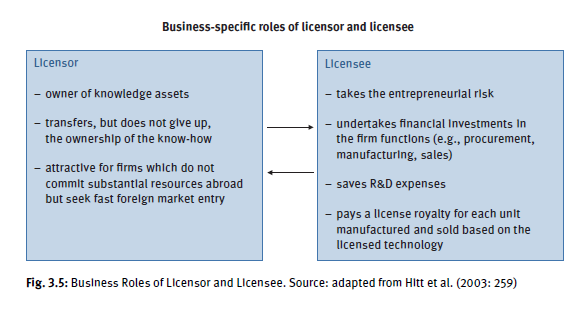
Licensing can be attractive for rather small firms that have limited financial resources because it allows them to build up operations outside their home country. Furthermore, licensing as an international market entry mode is desirable in industries characterized by relatively short product and technology life-cycles, such as high-technology industries.
Potential drawbacks for the licensor come along with the fact of having no control over the operations and quality of the products and services created by the licensee. Innovation can be commercialized quickly with little investment risk. However, the success of a technological innovation in the market is totally dependent on the commitment and effectiveness of the licensees (Grant 2013). Because of the licensee’s operational value-added activities, the licensor is unable to realize experience curve and economies of scale effects. The licensor’s reputation can be damaged if the licensee does not appropriately follow the quality, safety, or environmental protection standards agreed to in the contract. In parallel, depending on the licensee’s learning capabilities, there is a threat that a new competitor is built up, based on the licensor’s knowledge and expertise. Many firms have made the mistake of thinking they could maintain control over their knowhow within the framework of a licensing agreement. RCA Corporation, for example, once licensed its color television set technology to Japanese firms. The Japanese companies quickly assimilated the technology, improved on it, and used it to successfully enter worldwide markets, taking substantial market share from RCA (Hill 2012).
4. Franchising
Franchising is a contractual agreement between a franchisor and usually many franchisees that are legally and financially separated (Hendrikse & Jiang 2007). Combs et al. (2004) describe the process of franchising as follows: the franchisor sells to the franchisees (typically small business owners) the right to commercialize goods or services under the franchisor’s established brand name (market goodwill) and a proven business concept. During the contractual relationship, the franchisor provides ongoing commercial, administrative, and technical assistance. In return, the franchisee typically pays an initial start-up fee, royalties based on the sales, and advertising fees – all of which depend on the conditions agreed to in the franchising contract. The franchise system combines the advantages of ongoing research and development activities, marketing, and economy of scale potentials offered by the franchisor with the regional market knowledge, cultural sensitivity, and entrepreneurial talents of the franchisee. The franchisees are most familiar with the local customer preferences and, thus, can better fine-tune their local sales behavior. From the perspective of the owner of the business concept, franchising allows a relatively fast entry into target foreign markets (Zentes, Morschett, & Schramm-Klein 2011). The responsibilities and expectations of the franchisor and franchisee are illustrated in Figure 3.6).
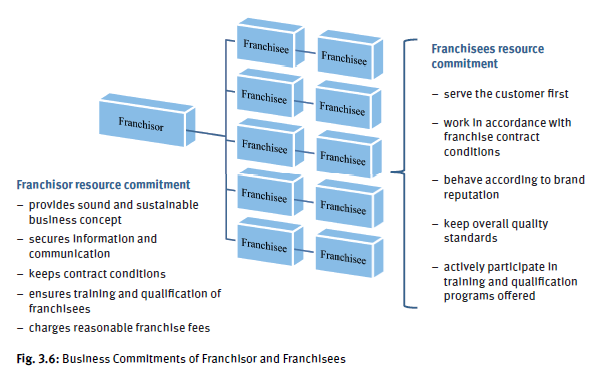
Potential drawbacks for a franchisor derive from the limited hierarchical control over the franchisee, which is an independent contractor, not an employee of the franchisor. Franchisees can harm the reputation of the franchisor and its business concept if they do not follow the quality, hygiene, and working condition standards specified in the contract. Moreover, the franchisor depends on the franchisee as an information source because the latter has direct contact with the customers. Therefore, market forecasts and necessary product and service modification, which may influence the business concept, depend on the franchisee’s information input. Having this in mind, the franchisor can lower the risk of franchisee dependence by simultaneously investing in financial and managerial assets, such as wholly owned operations in the target market (Dunning, Pak, & Beldona 2007).
Conflicts in the franchisor-franchisee relationship mainly arise from disagreements over objectives such as sales and profits, which may result from poor communication or failure. The potential for conflicts is reduced if franchisor and franchisee view each other as partners in running a business with common objectives and operating procedures. This approach requires a strong common culture with shared values established by means of intense communication between franchisor and franchisee. Another way of reducing disputes is to establish an efficient and transparent monitoring and reporting system between the franchisor and franchisee – for example, real-time access to computer-based inventory and accounting systems (Hollensen 2014).
However, the more the franchisee is monitored and controlled by the franchisor, the more questionable becomes the entrepreneurial freedom of the franchisee, which is usually claimed as one of the driving advantages when promoting franchise concepts. Because of the franchise start-up fee – which can easily reach, conditional to the business concept, more than one hundred thousand euros – the dependency of the franchisee on the franchisor seems to be incomparably higher than vice versa from the franchisor’s perspective. Thus, as in all contractual relationships, the right selection of a partner, which includes the careful evaluation of the business concept, is of vital importance for the involved parties.
5. Management Contracts
Management contracts offer a means through which a firm may use some of its personnel to assist a firm located in a target foreign country for a specified fee and period of time (Wheelen & Hunger 2010). The management (knowledge) transfer recipient is seeking a contractual partner that is able to run its enterprise and,
in parallel, qualifies and trains its staff by providing technical, commercial, and managerial knowledge. At the same time, the transferring firm enters new foreign markets, selling its managerial expertise and bringing in resources that help to improve the competitive positioning of the contract partner abroad, who in return pays fees for the consulting service (compare Figure 3.7). Through contractual relations with local governments, the firm is able to enter potential foreign markets where the local authorities may have a less than open attitude towards foreign investors (Foscht & Podmenik 2005).
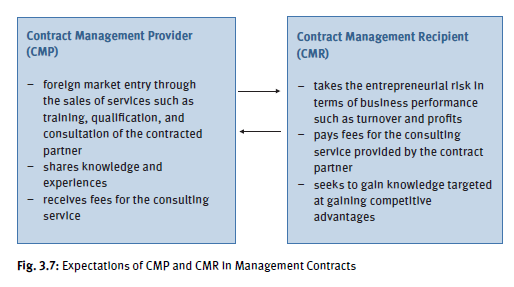
While training the staff, including transfer of managerial and technological knowhow, there is a risk for the CMP that a new competitor is being fostered and developed. In addition, the management supplying firm needs to send qualified personnel, particularly those with cultural sensitivity and language skills. Such a qualified pool of employees is not always readily available. Personal and cultural conflict with locals may arise, depending on the expatriate’s characteristics and qualifications for carrying out the contract tasks. Opposing expectations regarding the management contracts between the contracting firm and the local firm may also provide the basis for conflicts. The local management may have divergent work ethics or show a less motivated learning behavior. Nevertheless, management contracts can be an interesting and profitable market entry mode. In order to successfully realize management contract projects, considerable effort needs to be made in terms of communication at the local level as well as back at the CMP headquarters (Luostarinen & Welch 1997).
6. Turnkey Contracts
Turnkey describes a market entry mode where a firm sells complete operations and supply and distribution chain services: material procurement, assembly, testing, and aftersales service, including warranty support (Henning 2013:18). Turnkey operations are usually used in large investment initiatives, such as the design, planning, construction, and building of a large manufacturing plant in a target foreign country. Market entry through turnkey usually includes the start-up of operations as well as necessary training, qualification, and consulting with the local personnel. The firm then ‘turns the key over’ to the local government in return for an agreed-upon payment of use fee (Deresky 2014). Turnkey operations are attractive for firms that have, for example, specific engineering and complex technological process knowhow.
The build, operate, transfer (BOT) concept is a variation of the turnkey operation. Instead of turning the facility (e.g., power plant or toll road) over to the host country when completed, the firm operates the facility for a fixed period of time. During this operating period, the company earns back the investment, plus a profit. At the end of the time period agreed upon with the foreign contract partner, the firm turns the facility over to the contract partner – for example, the local government at little or no cost to the host country (Naisbitt 1996; Wheelen & Hunger 2010).
Critical success factors for the turnkey selling firm usually derive from the availability of qualified personnel; a less developed infrastructure; security issues; and limited availability of local suppliers, logistics, and other service firm networks. There may also be a particular risk exposure if the turnkey contract is with the local government of the target foreign country, which is often the case in politically and economically rather fragile countries. The firm may face the threat of contract revocation initiated by the government if differences of opinion related to the project aims and targets arise between the contract partners, which may occur over time (Deresky 2014).
Source: Glowik Mario (2020), Market entry strategies: Internationalization theories, concepts and cases, De Gruyter Oldenbourg; 3rd edition.
The post Contractual Modes of Market Entry appeared first on HKT Consultant.
]]>