The post Learn Programming Languages (JavaScript, Python, Java, PHP, C, C#, C++, HTML, CSS) appeared first on HKT Consultant.
]]>Not all programming jobs are the same, however. Different roles, companies, and types of software require knowing and understanding different programming languages—and it’s often beneficial to know multiple languages. Trying to break into the field of software programming can be a daunting experience, especially for professionals with no prior programming experience.
Whether you’re new to programming or looking to brush up on your skills, it helps to know which languages are in high demand. Here are 10 of the most popular programming languages of 2020 based on the number of job postings listed on job search site Indeed, the average annual salary for those jobs, and factors such as ease of use and potential for growth.
Top 10 Most Popular Programming Languages
1. Python

Number of jobs: 19,000
Average annual salary: $120,000
Benefits: Python is widely regarded as a programming language that’s easy to learn, due to its simple syntax, a large library of standards and toolkits, and integration with other popular programming languages such as C and C++. In fact, it’s the first language that students learn in the Align program, Gorton says. “You can cover a lot of computer science concepts quickly, and it’s relatively easy to build on.” It is a popular programming language, especially among startups, and therefore Python skills are in high demand.
Drawbacks: Python is not suitable for mobile application development.
Common uses: Python is used in a wide variety of applications, including artificial intelligence, financial services, and data science. Social media sites such as Instagram and Pinterest are also built on Python.
2. JavaScript
Number of jobs: 24,000
Average annual salary: $118,000
Benefits: JavaScript is the most popular programming language for building interactive websites; “virtually everyone is using it,” Gorton says. When combined with Node.js, programmers can use JavaScript to produce web content on the server before a page is sent to the browser, which can be used to build games and communication applications that run directly in the browser. A wide variety of add-ons extend the functionality of JavaScript as well.
Drawbacks: Internet browsers can disable JavaScript code from running, as JavaScript is used to code pop-up ads that in some cases can contain malicious content.
Common uses: JavaScript is used extensively in website and mobile application development. Node.js allows for the development of browser-based applications, which do not require users to download an application.
3. Java
Number of jobs: 29,000
Average annual salary: $104,000
Benefits: Java is the programming language most commonly associated with the development of client-server applications, which are used by large businesses around the world. Java is designed to be a loosely coupled programming language, meaning that an application written in Java can run on any platform that supports Java. As a result, Java is described as the “write once, run anywhere” programming language.
Drawbacks: Java is not ideal for applications that run on the cloud, as opposed to the server (which is common for business applications). In addition, the software company Oracle, which owns Java, charges a licensing fee to use the Java Development Kit.
Common uses: Along with business applications, Java is used extensively in the Android mobile operating system.
4. C#
Number of jobs: 18,000
Average annual salary: $97,000
Benefits: Microsoft developed C# as a faster and more secure variant of C. It is fully integrated with Microsoft’s .NET software framework, which supports the development of applications for Windows, browser plug-ins, and mobile devices. C# offers shared codebases, a large code library, and a variety of data types.
Drawbacks: C# can have a steep learning curve, especially for resolving errors. It is less flexible than languages such as C++.
Common uses: C# is the go-to language for Microsoft ad Windows application development. It can also be used for mobile devices and video game consoles using an extension of the .NET Framework called Mono.
5. C
Number of jobs: 8,000
Average annual salary: $97,000
Benefits: Along with Python and Java, C forms a “good foundation” for learning how to program, Gorton says. As one of the first programming languages ever developed, C has served as the foundation for writing more modern languages such as Python, Ruby, and PHP. It is also an easy language to debug, test, and maintain.
Drawbacks: Since it’s an older programming language, C is not suitable for more modern use cases such as websites or mobile applications. C also has a complex syntax as compared to more modern languages.
Common uses: Because it can run on any type of device, C is often used to program hardware, such as embedded devices in automobiles and medical devices used in healthcare.
6. C++
Number of jobs: 9,000
Average annual salary: $97,000
Benefits: C++ is an extension of C that works well for programming the systems that run applications, as opposed to the applications themselves. C++ also works well for multi-device and multi-platform systems. Over time, programmers have written a large set of libraries and compilers for C++. Being able to use these utilities effectively is just as important to understanding a programming language as writing code, Gorton says.
Drawbacks: Like C, C++ has complex syntax and an abundance of features that can make it complicated for new programmers. C++ also does not support run-time checking, which is a method of detecting errors or defects while software is running.
Common uses: C++ has many uses and is the language behind everything from computer games to mathematical simulations.
7. Go
Number of jobs: 1,700
Average annual salary: $93,000
Benefits: Also referred to as Golang, Go was developed by Google to be an efficient, readable, and secure language for system-level programming. It works well for distributed systems, in which systems are located on different networks and need to communicate by sending messages to each other. While it is a relatively new language, Go has a large standards library and extensive documentation.
Drawbacks: Go has not gained widespread use outside of Silicon Valley. Go does not include a library for graphical user interfaces, which are the most common ways that end-users interact with any device that has a screen.
Common uses: Go is used primarily for applications that need to process a lot of data. In addition to Google, companies using Go for certain applications include Netflix, Twitch, and Uber.
8. R
Number of jobs: 1,500
Average annual salary: $93,000
Benefits: R is heavily used in statistical analytics and machine learning applications. The language is extensible and runs on many operating systems. Many large companies have adopted R in order to analyze their massive data sets, so programmers who know R are in great demand.
Drawbacks: R does not have the strict programming guidelines of older and more established languages.
Common uses: R is primarily used in statistical software products.
9. Swift
Number of jobs: 1,800
Average annual salary: $93,000
Benefits: Swift is Apple’s language for developing applications for Mac computers and Apple’s mobile devices, including the iPhone, iPad, and Apple Watch. Like many modern programming languages, Swift has a highly readable syntax, runs code quickly, and can be used for both client-side and server-side development.
Drawbacks: Swift can only be used on newer versions of iOS 7 and will not work with older applications. As a newer programming language, the code can be unstable at times, and there are fewer third-party resources available to programmers.
Common uses: Swift is used for iOS and macOS applications.
10. PHP
Number of jobs: 7,000
Average annual salary: $81,000
Benefits: PHP is widely used for server-side web development, when a website frequently requests information from a server. As an older language, PHP benefits from a large ecosystem of users who have produced frameworks, libraries, and automation tools to make the programming language easier to use. PHP code is also easy to debug.
Drawbacks: As Python and JavaScript have gained popularity, PHP’s popularity has dropped. PHP is also known for its security vulnerabilities. According to Indeed, most PHP programmers take short-term roles that last less than one year.
Common uses: PHP is the code running content-oriented websites such as Facebook, WordPress, and Wikipedia.
7 Other Programming Languages to Consider
The following programming languages aren’t quite as popular as the 10 listed above, but they are also worth considering if you’re looking to expand your programming options.
- Dart is optimal for programming applications that need to run on multiple platforms, such as Windows and iOS.
- Kotlin is used to develop applications for the Android OS.
- MATLAB is a proprietary language developed by MathWorks and used for scientific research and numerical computing.
- Perl got its start for programming text, which makes it easy to learn and popular for developing a proof of concept.
- Ruby is losing traction as compared to other languages, but the Ruby on Rails framework was influential to other, later Web application frameworks for Python, PHP, and JavaScript.
- Rust emphasizes high performance and security and is useful for applications where many things are happening concurrently.
- Scala, named as a play on scalable language, is compatible with Java and is useful for cloud-based applications.
Which Programming Language Should You Learn?
Some programmers are able to build a career out of being an expert in one language, but many programmers learn new languages frequently, Gorton says. It’s not uncommon for a professional programmer to be fluent in three or four different languages, he adds.
The type of software you want to develop is one consideration for which programming languages to learn. While there are no concrete rules for what language is used to write what software, a few trends offer some guidance:
- Web-based startups are more likely to be programming in Python and JavaScript.
- Larger companies tend to develop their internal software applications using C# or Java and their Web applications using PHP.
- Programs for data analytics typically use the R and MATLAB programming languages.
- Embedded devices, such as those in the automotive and healthcare industries, run software written in C, C++, or Rust.
- Applications that run on the cloud are increasingly written in Go or Scala.
- Mobile applications are increasingly written in Swift or Kotlin.
The post Learn Programming Languages (JavaScript, Python, Java, PHP, C, C#, C++, HTML, CSS) appeared first on HKT Consultant.
]]>The post Create your professional WordPress website without code appeared first on HKT Consultant.
]]>Here are just a few examples of the types of websites you can build with WordPress:
- Blog – A blog is a special type of website devoted to sharing thoughts, photos, reviews, tutorials, recipes and so much more. Blogs usually display the most recently-published content first.
- E-commerce website – An e-commerce website allows you to sell goods or services online and collect payment via an online payment system. You can download and install a WordPress e-commerce plugin to extend the default functionality of WordPress so you can have an online store on your website.
- Business website – Many businesses will benefit from having an online presence in the form of their own website. If your business needs a website for customers to learn about your company and what you have to offer, WordPress is an excellent option. Customers can contact you, ask for a quote, schedule an appointment and much more.
- Membership website – A membership website allows you to put content behind a paywall or an account login. To access pages or posts, users must login or pay for the content. WordPress can also handle membership websites with additional plugins.
- Portfolio website – Show off your artwork, design skills and more with a portfolio website built on WordPress.
- Forum website – A forum website can be a helpful place for users to ask questions or share advice. Believe it or not, many forum websites run on WordPress.
- Event website – Hosting an event? WordPress makes it easy for you to share your event details and sell tickets.
- E-learning website – Students can take online courses, track their progress, download resources and much more from an e-learning website.
- Wedding website – Share the details of your big day with a wedding website built on WordPress. With an array of WordPress wedding themes, you can get a website up quickly and easily.
The possibilities are endless when it comes to customizing a WordPress web. WordPress themes and plugins can add new design options and added functionality. Check out WordPress.org for free themes and plugins.
Please wait while you are redirected...or Click Here if you do not want to wait.The post Create your professional WordPress website without code appeared first on HKT Consultant.
]]>The post Great Thinkers and their Big Ideas appeared first on HKT Consultant.
]]>I
J
K
L
M
N
O
P
Q
R
S
O
P
Q
R
S
T
U
V
Voltaire
W
X
Y
Z
0-9 & other
The post Great Thinkers and their Big Ideas appeared first on HKT Consultant.
]]>The post Nature and scope of science appeared first on HKT Consultant.
]]>Science (from the Latin word scientia, meaning “knowledge”)[1] is a systematic enterprise that builds and organizes knowledge in the form of testable explanations and predictions about the universe.[2][3][4]
The earliest roots of science can be traced to Ancient Egypt and Mesopotamia in around 3500 to 3000 BCE.[5][6] Their contributions to mathematics, astronomy, and medicine entered and shaped Greek natural philosophy of classical antiquity, whereby formal attempts were made to provide explanations of events in the physical world based on natural causes.[5][6] After the fall of the Western Roman Empire, knowledge of Greek conceptions of the world deteriorated in Western Europe during the early centuries (400 to 1000 CE) of the Middle Ages[7] but was preserved in the Muslim world during the Islamic Golden Age.[8] The recovery and assimilation of Greek works and Islamic inquiries into Western Europe from the 10th to 13th century revived “natural philosophy”,[7][9] which was later transformed by the Scientific Revolution that began in the 16th century[10] as new ideas and discoveries departed from previous Greek conceptions and traditions.[11][12][13][14] The scientific method soon played a greater role in knowledge creation and it was not until the 19th century that many of the institutional and professional features of science began to take shape;[15][16][17] along with the changing of “natural philosophy” to “natural science.”[18]
Modern science is typically divided into three major branches that consist of the natural sciences (e.g., biology, chemistry, and physics), which study nature in the broadest sense; the social sciences (e.g., economics, psychology, and sociology), which study individuals and societies; and the formal sciences (e.g., logic, mathematics, and theoretical computer science), which study abstract concepts. There is disagreement,[19][20] however, on whether the formal sciences actually constitute a science as they do not rely on empirical evidence.[21] Disciplines that use existing scientific knowledge for practical purposes, such as engineering and medicine, are described as applied sciences.[22][23][24][25]
Science is based on research, which is commonly conducted in academic and research institutions as well as in government agencies and companies. The practical impact of scientific research has led to the emergence of science policies that seek to influence the scientific enterprise by prioritizing the development of commercial products, armaments, health care, and environmental protection.
Branches of science
Modern science is commonly divided into three major branches that consist of the natural sciences, social sciences, and formal sciences. Each of these branches comprise various specialized yet overlapping scientific disciplines that often possess their own nomenclature and expertise.[90] Both natural and social sciences are empirical sciences[91] as their knowledge is based on empirical observations and is capable of being tested for its validity by other researchers working under the same conditions.[92]
There are also closely related disciplines that use science, such as engineering and medicine, which are sometimes described as applied sciences. The relationships between the branches of science are summarized by the following table.
| Science | |||
|---|---|---|---|
| Formal science | Empirical sciences | ||
| Natural science | Social science | ||
| Foundation | Logic; Mathematics; Statistics | Physics; Chemistry; Biology; Earth science; Space science |
Economics; Political science; Sociology; Psychology |
| Application | Computer science | Engineering; Agricultural science; Medicine; Dentistry; Pharmacy |
Business administration; Jurisprudence; Pedagogy |
Natural science
 The scale of the Universe mapped to branches of science and showing how one system is built atop the next through the hierarchy of the sciences.
Natural science is concerned with the description, prediction, and understanding of natural phenomena based on empirical evidence from observation and experimentation. It can be divided into two main branches: life science (or biological science) and physical science. Physical science is subdivided into branches, including physics, chemistry, astronomy and earth science. These two branches may be further divided into more specialized disciplines. Modern natural science is the successor to the natural philosophy that began in Ancient Greece. Galileo, Descartes, Bacon, and Newton debated the benefits of using approaches which were more mathematical and more experimental in a methodical way. Still, philosophical perspectives, conjectures, and presuppositions, often overlooked, remain necessary in natural science.[93] Systematic data collection, including discovery science, succeeded natural history, which emerged in the 16th century by describing and classifying plants, animals, minerals, and so on.[94] Today, “natural history” suggests observational descriptions aimed at popular audiences.[95]
Social science
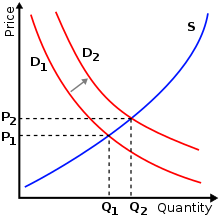 In economics, the supply and demand model describes how prices vary as a result of a balance between product availability and demand.
Social science is concerned with society and the relationships among individuals within a society. It has many branches that include, but are not limited to, anthropology, archaeology, communication studies, economics, history, human geography, jurisprudence, linguistics, political science, psychology, public health, and sociology. Social scientists may adopt various philosophical theories to study individuals and society. For example, positivist social scientists use methods resembling those of the natural sciences as tools for understanding society, and so define science in its stricter modern sense. Interpretivist social scientists, by contrast, may use social critique or symbolic interpretation rather than constructing empirically falsifiable theories, and thus treat science in its broader sense. In modern academic practice, researchers are often eclectic, using multiple methodologies (for instance, by combining both quantitative and qualitative research). The term “social research” has also acquired a degree of autonomy as practitioners from various disciplines share in its aims and methods.
Formal science
Formal science is involved in the study of formal systems. It includes mathematics,[96][97] systems theory, and theoretical computer science. The formal sciences share similarities with the other two branches by relying on objective, careful, and systematic study of an area of knowledge. They are, however, different from the empirical sciences as they rely exclusively on deductive reasoning, without the need for empirical evidence, to verify their abstract concepts.[21][98][92] The formal sciences are therefore a priori disciplines and because of this, there is disagreement on whether they actually constitute a science.[19][20] Nevertheless, the formal sciences play an important role in the empirical sciences. Calculus, for example, was initially invented to understand motion in physics.[99] Natural and social sciences that rely heavily on mathematical applications include mathematical physics, mathematical chemistry, mathematical biology, mathematical finance, and mathematical economics.
References
- Harper, Douglas. “science”. Online Etymology Dictionary. Retrieved September 20, 2014.
- Wilson, E.O. (1999). “The natural sciences”. Consilience: The Unity of Knowledge (Reprint ed.). New York, New York: Vintage. pp. 49–71. ISBN978-0-679-76867-8.
- “… modern science is a discovery as well as an invention. It was a discovery that nature generally acts regularly enough to be described by laws and even by mathematics; and required invention to devise the techniques, abstractions, apparatus, and organization for exhibiting the regularities and securing their law-like descriptions.”— p.vii Heilbron, J.L. (editor-in-chief)(2003). “Preface”. The Oxford Companion to the History of Modern Science. New York: Oxford University Press. pp. vii–X. ISBN 978-0-19-511229-0.
- “science”. Merriam-Webster Online Dictionary. Merriam-Webster, Inc. Retrieved October 16, 2011. 3 a:knowledge or a system of knowledge covering general truths or the operation of general laws especially as obtained and tested through scientific method b: such knowledge or such a system of knowledge concerned with the physical world and its phenomena.
- “The historian … requires a very broad definition of “science” – one that … will help us to understand the modern scientific enterprise. We need to be broad and inclusive, rather than narrow and exclusive … and we should expect that the farther back we go [in time] the broader we will need to be.” p.3—Lindberg, David C. (2007). “Science before the Greeks”. The beginnings of Western science: the European Scientific tradition in philosophical, religious, and institutional context(Second ed.). Chicago, Illinois: University of Chicago Press. pp. 1–27. ISBN978-0-226-48205-7.
- Grant, Edward (2007). “Ancient Egypt to Plato”. A History of Natural Philosophy: From the Ancient World to the Nineteenth Century (First ed.). New York, New York: Cambridge University Press. pp. 1–26. ISBN978-052-1-68957-1.
- Lindberg, David C. (2007). “The revival of learning in the West”. The beginnings of Western science: the European Scientific tradition in philosophical, religious, and institutional context (Second ed.). Chicago, Illinois: University of Chicago Press. pp. 193–224. ISBN978-0-226-48205-7.
- Lindberg, David C. (2007). “Islamic science”. The beginnings of Western science: the European Scientific tradition in philosophical, religious, and institutional context (Second ed.). Chicago, Illinois: University of Chicago Press. pp. 163–92. ISBN978-0-226-48205-7.
- Lindberg, David C. (2007). “The recovery and assimilation of Greek and Islamic science”. The beginnings of Western science: the European Scientific tradition in philosophical, religious, and institutional context (2nd ed.). Chicago, Illinois: University of Chicago Press. pp. 225–53. ISBN978-0-226-48205-7.
- Principe, Lawrence M. (2011). “Introduction”. Scientific Revolution: A Very Short Introduction (First ed.). New York, New York: Oxford University Press. pp. 1–3. ISBN978-0-199-56741-6.
- Lindberg, David C. (1990). “Conceptions of the Scientific Revolution from Baker to Butterfield: A preliminary sketch”. In David C. Lindberg; Robert S. Westman (eds.). Reappraisals of the Scientific Revolution (First ed.). Chicago, Illinois: Cambridge University Press. pp. 1–26. ISBN978-0-521-34262-9.
- Lindberg, David C. (2007). “The legacy of ancient and medieval science”. The beginnings of Western science: the European Scientific tradition in philosophical, religious, and institutional context (2nd ed.). Chicago, Illinois: University of Chicago Press. pp. 357–368. ISBN978-0-226-48205-7.
- Del Soldato, Eva (2016). Zalta, Edward N. (ed.). The Stanford Encyclopedia of Philosophy(Fall 2016 ed.). Metaphysics Research Lab, Stanford University.
- Grant, Edward (2007). “Transformation of medieval natural philosophy from the early period modern period to the end of the nineteenth century”. A History of Natural Philosophy: From the Ancient World to the Nineteenth Century (First ed.). New York, New York: Cambridge University Press. pp. 274–322. ISBN978-052-1-68957-1.
- Cahan, David, ed. (2003). From Natural Philosophy to the Sciences: Writing the History of Nineteenth-Century Science. Chicago, Illinois: University of Chicago Press. ISBN978-0-226-08928-7.
- The Oxford English Dictionarydates the origin of the word “scientist” to 1834.
- Lightman, Bernard (2011). “13. Science and the Public”. In Shank, Michael; Numbers, Ronald; Harrison, Peter (eds.). Wrestling with Nature : From Omens to Science. Chicago: University of Chicago Press. p. 367. ISBN978-0226317830.
- Harrison, Peter(2015). The Territories of Science and Religion. Chicago: University of Chicago Press. pp. 164–165. ISBN 9780226184517. The changing character of those engaged in scientific endeavors was matched by a new nomenclature for their endeavors. The most conspicuous marker of this change was the replacement of “natural philosophy” by “natural science”. In 1800 few had spoken of the “natural sciences” but by 1880, this expression had overtaken the traditional label “natural philosophy”. The persistence of “natural philosophy” in the twentieth century is owing largely to historical references to a past practice (see figure 11). As should now be apparent, this was not simply the substitution of one term by another, but involved the jettisoning of a range of personal qualities relating to the conduct of philosophy and the living of the philosophical life.
- Bishop, Alan (1991). “Environmental activities and mathematical culture”. Mathematical Enculturation: A Cultural Perspective on Mathematics Education. Norwell, Massachusetts: Kluwer Academic Publishers. pp. 20–59. ISBN978-0-792-31270-3.
- Bunge, Mario (1998). “The Scientific Approach”. Philosophy of Science: Volume 1, From Problem to Theory. 1(revised ed.). New York, New York: Routledge. pp. 3–50. ISBN978-0-765-80413-6.
- Fetzer, James H. (2013). “Computer reliability and public policy: Limits of knowledge of computer-based systems”. Computers and Cognition: Why Minds are not Machines (1st ed.). Newcastle, United Kingdom: Kluwer Academic Publishers. pp. 271–308. ISBN978-1-443-81946-6.
- Fischer, M.R.; Fabry, G (2014). “Thinking and acting scientifically: Indispensable basis of medical education”. GMS Zeitschrift für Medizinische Ausbildung. 31(2): Doc24. doi:3205/zma000916. PMC 4027809. PMID 24872859.
- Abraham, Reem Rachel (2004). “Clinically oriented physiology teaching: strategy for developing critical-thinking skills in undergraduate medical students”. Advances in Physiology Education. 28(3): 102–04. doi:1152/advan.00001.2004. PMID 15319191.
- Sinclair, Marius. “On the Differences between the Engineering and Scientific Methods”. The International Journal of Engineering Education.
- “Engineering Technology :: Engineering Technology :: Purdue School of Engineering and Technology, IUPUI”. www.engr.iupui.edu. Retrieved September 7, 2018.
- Grant, Edward (January 1, 1997). “History of Science: When Did Modern Science Begin?”. The American Scholar. 66(1): 105–113. JSTOR 41212592.
- Pingree, David(December 1992). “Hellenophilia versus the History of Science”. Isis. 83 (4): 554–63. Bibcode:..83..554P. doi:10.1086/356288. JSTOR 234257.
- Sima Qian(司馬遷, d. 86 BCE) in his Records of the Grand Historian (太史公書) covering some 2500 years of Chinese history, records Sunshu Ao (孫叔敖, fl. c. 630–595 BCE – Zhou dynasty), the first known hydraulic engineer of China, cited in (Joseph Needham et al. (1971) Science and Civilisation in China 3 p. 271) as having built a reservoir which has lasted to this day.
- Rochberg, Francesca (2011). “Ch.1 Natural Knowledge in Ancient Mesopotamia”. In Shank, Michael; Numbers, Ronald; Harrison, Peter (eds.). Wrestling with Nature : From Omens to Science. Chicago: University of Chicago Press. p. 9. ISBN978-0226317830.
- McIntosh, Jane R. (2005). Ancient Mesopotamia: New Perspectives. Santa Barbara, California, Denver, Colorado, and Oxford, England: ABC-CLIO. pp. 273–76. ISBN978-1-57607-966-9.
- Aaboe (May 2, 1974). “Scientific Astronomy in Antiquity”. Philosophical Transactions of the Royal Society. 276(1257): 21–42. Bibcode:1974RSPTA.276…21A. doi:10.1098/rsta.1974.0007. JSTOR 74272.
- R D. Biggs (2005). “Medicine, Surgery, and Public Health in Ancient Mesopotamia”. Journal of Assyrian Academic Studies. 19(1): 7–18.
- Lehoux, Daryn (2011). “2. Natural Knowledge in the Classical World”. In Shank, Michael; Numbers, Ronald; Harrison, Peter (eds.). Wrestling with Nature : From Omens to Science. Chicago: University of Chicago Press. p. 39. ISBN978-0226317830.
- See the quotation in Homer(8th century BCE) Odyssey302–03
- “Progress or Return” in An Introduction to Political Philosophy: Ten Essays by Leo Strauss(Expanded version of Political Philosophy: Six Essays by Leo Strauss, 1975.) Ed. Hilail Gilden. Detroit: Wayne State UP, 1989.
- Cropsey; Strauss (eds.). History of Political Philosophy (3rd ed.). p. 209.
- O’Grady, Patricia F. (2016). Thales of Miletus: The Beginnings of Western Science and Philosophy. New York City, New York and London, England: Routledge. p. 245. ISBN978-0-7546-0533-1.
- Burkert, Walter(June 1, 1972). Lore and Science in Ancient Pythagoreanism. Cambridge, Massachusetts: Harvard University Press. ISBN 978-0-674-53918-1. Archived from the original on January 29, 2018.
- Pullman, Bernard (1998). The Atom in the History of Human Thought. pp. 31–33. Bibcode:book…..P. ISBN978-0-19-515040-7.
- Cohen, Henri; Lefebvre, Claire, eds. (2017). Handbook of Categorization in Cognitive Science(Second ed.). Amsterdam, The Netherlands: Elsevier. p. 427. ISBN 978-0-08-101107-2.
- Margotta, Roberto (1968). vFZrAAAAMAAJ The Story of MedicineCheck |url= value (help). New York City, New York: Golden Press.
- Touwaide, Alain (2005). Glick, Thomas F.; Livesey, Steven; Wallis, Faith (eds.). Medieval Science, Technology, and Medicine: An Encyclopedia. New York City, New York and London, England: Routledge. p. 224. ISBN978-0-415-96930-7.
- Leff, Samuel; Leff, Vera (1956). From Witchcraft to World Health. London, England: Macmillan.
- Mitchell, Jacqueline S. (February 18, 2003). “The Origins of Science”. Scientific American Frontiers. PBS. Archived from the originalon March 3, 2003. Retrieved November 3, 2016.
- “Plato, Apology”. p. 17. Archivedfrom the original on January 29, 2018. Retrieved November 1, 2017.
- “Plato, Apology”. p. 27. Archivedfrom the original on January 29, 2018. Retrieved November 1, 2017.
- “Plato, Apology, section 30”. Perseus Digital Library. Tufts University. 1966. Archivedfrom the original on January 27, 2017. Retrieved November 1, 2016.
- Nicomachean Ethics (H. Rackham ed.). Archived from the original on March 17, 2012. Retrieved September 22, 2010. 1139b
- McClellan III, James E.; Dorn, Harold (2015). Science and Technology in World History: An Introduction. Baltimore, Maryland: Johns Hopkins University Press. pp. 99–100. ISBN978-1-4214-1776-9.
- Edwards, C.H. Jr. (1979). The Historical Development of the Calculus(First ed.). New York City, New York: Springer-Verlag. p. 75. ISBN 978-0-387-94313-8.
- Lawson, Russell M. (2004). Science in the Ancient World: An Encyclopedia. Santa Barbara, California: ABC-CLIO. pp. 190–91. ISBN978-1-85109-539-1.
- Murphy, Trevor Morgan (2004). Pliny the Elder’s Natural History: The Empire in the Encyclopedia. Oxford, England: Oxford University Press. p. 1. ISBN9780199262885.
- Doode, Aude (2010). Pliny’s Encyclopedia: The Reception of the Natural History. Cambridge, England: Cambridge University Press. p. 1. ISBN9781139484534.
- Smith, A. Mark (June 2004), “What is the History of Medieval Optics Really About?”, Proceedings of the American Philosophical Society, 148(2): 180–94, JSTOR 1558283, PMID 15338543
- Lindberg, David C. (2007). “Roman and early medieval science”. The beginnings of Western science: the European Scientific tradition in philosophical, religious, and institutional context (Second ed.). Chicago, Illinois: University of Chicago Press. pp. 132–162. ISBN978-0-226-48205-7.
- Wildberg, Christian (May 1, 2018). Zalta, Edward N. (ed.). The Stanford Encyclopedia of Philosophy. Metaphysics Research Lab, Stanford University – via Stanford Encyclopedia of Philosophy.
- Aristotle, PhysicsII, 3, and Metaphysics V, 2
- Grant, Edward (1996). The Foundations of Modern Science in the Middle Ages: Their Religious, Institutional and Intellectual Contexts. Cambridge Studies in the History of Science. Cambridge University Press. pp. 7–17. ISBN978-0521567626.
- Grant, Edward (2007). “Islam and the eastward shift of Aristotelian natural philosophy”. A History of Natural Philosophy: From the Ancient World to the Nineteenth Century. Cambridge University Press. pp. 62–67. ISBN978-0-521-68957-1.
- The Cambridge history of Iran. Fisher, W.B. (William Bayne). Cambridge: University Press. 1968–1991. ISBN978-0521200936. OCLC 745412.
- “Bayt al-Hikmah”. Encyclopædia Britannica. Archivedfrom the original on November 4, 2016. Retrieved November 3, 2016.
- Klein-Frank, F. Al-Kindi. In Leaman, O & Nasr, H (2001). History of Islamic Philosophy. London: Routledge. p. 165. Felix Klein-Frank (2001) Al-Kindi, pp. 166–67. In Oliver Leaman & Hossein Nasr. History of Islamic Philosophy. London: Routledge.
- “Science in Islam”. Oxford Dictionary of the Middle Ages. 2009.
- Toomer, G.J. (1964). “Reviewed work: Ibn al-Haythams Weg zur Physik, Matthias Schramm”. Isis. 55(4): 463–65. doi:1086/349914. JSTOR 228328. See p. 464: “Schramm sums up [Ibn Al-Haytham’s] achievement in the development of scientific method.”, p. 465: “Schramm has demonstrated .. beyond any dispute that Ibn al-Haytham is a major figure in the Islamic scientific tradition, particularly in the creation of experimental techniques.” p. 465: “only when the influence of ibn al-Haytam and others on the mainstream of later medieval physical writings has been seriously investigated can Schramm’s claim that ibn al-Haytam was the true founder of modern physics be evaluated.”
- Smith 2001:Book I, [6.54]. p. 372
- Selin, H (2006). Encyclopaedia of the History of Science, Technology, and Medicine in Non-Western Cultures. pp. 155–156. Bibcode:book…..S. ISBN978-1-4020-4559-2.
- Numbers, Ronald (2009). 9780674057418 Galileo Goes to Jail and Other Myths about Science and ReligionCheck |url= value (help). Harvard University Press. p. 45. ISBN 978-0-674-03327-6.
- Shwayder, Maya (April 7, 2011). “Debunking a myth”. The Harvard Gazette. Retrieved May 11, 2019.
- Smith 2001
- McGinnis, Jon (2010). The Canon of Medicine. Oxford University. p. 227.
- Lindberg, David (1992). The Beginnings of Western Science. University of Chicago Press. p. 162. ISBN9780226482040.
- “St. Albertus Magnus | German theologian, scientist, and philosopher”. Archivedfrom the original on October 28, 2017. Retrieved October 27, 2017.
- Smith, A. Mark (2001). “Alhacen’s Theory of Visual Perception: A Critical Edition, with English Translation and Commentary, of the First Three Books of Alhacen’s “De aspectibus”, the Medieval Latin Version of Ibn al-Haytham’s “Kitāb al-Manāẓir”: Volume One”. Transactions of the American Philosophical Society. 91(4): i–337. JSTOR 3657358.
- Smith, A. Mark (1981). “Getting the Big Picture in Perspectivist Optics”. Isis. 72(4): 568–89. doi:1086/352843. JSTOR 231249. PMID 7040292.
- Goldstein, Bernard R (2016). “Copernicus and the Origin of his Heliocentric System”. Journal for the History of Astronomy. 33(3): 219–35. doi:1177/002182860203300301.
- Cohen, H. Floris(2010). How modern science came into the world. Four civilizations, one 17th-century breakthrough(Second ed.). Amsterdam: Amsterdam University Press. ISBN 9789089642394.
- “Galileo and the Birth of Modern Science”. American Heritage of Invention and Technology. 24.
- van Helden, Al (1995). “Pope Urban VIII”. The Galileo Project. Archivedfrom the original on November 11, 2016. Retrieved November 3, 2016.
- MacTutor Archive, Gottfried Wilhelm von Leibniz
- Freudenthal, Gideon; McLaughlin, Peter (May 20, 2009). The Social and Economic Roots of the Scientific Revolution: Texts by Boris Hessen and Henryk Grossmann. Springer Science & Business Media. ISBN9781402096044.
- Thomas G. Bergin (ed.), Encyclopedia of the Renaissance(Oxford and New York: New Market Books, 1987).
- see Hall (1954), iii; Mason (1956), 223.
- Cassels, Alan. Ideology and International Relations in the Modern World. p. 2.
- Ross, Sydney (1962). “Scientist: The story of a word”(PDF). Annals of Science. 18(2): 65–85. doi:1080/00033796200202722. Retrieved March 8, 2011.To be exact, the person who coined the term scientist was referred to in Whewell 1834 only as “some ingenious gentleman.” Ross added a comment that this “some ingenious gentleman” was Whewell himself, without giving the reason for the identification. Ross 1962, p. 72.
- von Bertalanffy, Ludwig (1972). “The History and Status of General Systems Theory”. The Academy of Management Journal. 15(4): 407–26. doi:2307/255139. JSTOR 255139.
- Naidoo, Nasheen; Pawitan, Yudi; Soong, Richie; Cooper, David N.; Ku, Chee-Seng (October 2011). “Human genetics and genomics a decade after the release of the draft sequence of the human genome”. Human Genomics. 5(6): 577–622. doi:1186/1479-7364-5-6-577. PMC 3525251. PMID 22155605.
- Rashid, S. Tamir; Alexander, Graeme J.M. (March 2013). “Induced pluripotent stem cells: from Nobel Prizes to clinical applications”. Journal of Hepatology. 58(3): 625–629. doi:1016/j.jhep.2012.10.026. ISSN 1600-0641. PMID 23131523.
- Abbott, B.P.; Abbott, R.; Abbott, T.D.; Acernese, F.; Ackley, K.; Adams, C.; Adams, T.; Addesso, P.; Adhikari, R.X.; Adya, V.B.; Affeldt, C.; Afrough, M.; Agarwal, B.; Agathos, M.; Agatsuma, K.; Aggarwal, N.; Aguiar, O.D.; Aiello, L.; Ain, A.; Ajith, P.; Allen, B.; Allen, G.; Allocca, A.; Altin, P.A.; Amato, A.; Ananyeva, A.; Anderson, S.B.; Anderson, W.G.; Angelova, S.V.; et al. (2017). “Multi-messenger Observations of a Binary Neutron Star Merger”. The Astrophysical Journal. 848(2): L12. arXiv:05833. Bibcode:2017ApJ…848L..12A. doi:10.3847/2041-8213/aa91c9.
- Cho, Adrian (2017). “Merging neutron stars generate gravitational waves and a celestial light show”. Science. doi:1126/science.aar2149.
- “Scientific Method: Relationships Among Scientific Paradigms”. Seed Magazine. March 7, 2007. Archived from the originalon November 1, 2016. Retrieved November 4,2016.
- Bunge, Mario Augusto (1998). Philosophy of Science: From Problem to Theory. Transaction Publishers. p. 24. ISBN978-0-7658-0413-6.
- Popper, Karl R. (2002a) [1959]. “A survey of some fundamental problems”. The Logic of Scientific Discovery. New York, New York: Routledge Classics. pp. 3–26. ISBN978-0-415-27844-7. OCLC 59377149.
- Gauch Jr., Hugh G. (2003). “Science in perspective”. Scientific Method in Practice. Cambridge, United Kingdom: Cambridge University Press. pp. 21–73. ISBN978-0-52-101708-4.
- Oglivie, Brian W. (2008). “Introduction”. The Science of Describing: Natural History in Renaissance Europe(Paperback ed.). Chicago, Illinois: University of Chicago Press. pp. 1–24. ISBN978-0-226-62088-6.
- “Natural History”. Princeton University WordNet. Archivedfrom the original on March 3, 2012. Retrieved October 21, 2012.
- Tomalin, Marcus (2006). Linguistics and the Formal Sciences. doi:2277/0521854814.
- Löwe, Benedikt (2002). “The Formal Sciences: Their Scope, Their Foundations, and Their Unity”. Synthese. 133: 5–11. doi:1023/a:1020887832028.
- Bill, Thompson (2007), “2.4 Formal Science and Applied Mathematics”, The Nature of Statistical Evidence, Lecture Notes in Statistics, 189(1st ed.), Springer, p. 15
- Mujumdar, Anshu Gupta; Singh, Tejinder (2016). “Cognitive science and the connection between physics and mathematics”. In Anthony Aguirre; Brendan Foster (eds.). Trick or Truth?: The Mysterious Connection Between Physics and Mathematics. The Frontiers Collection (1st ed.). Switzerland: SpringerNature. pp. 201–218. ISBN978-3-319-27494-2.
- Richard Dawkins (May 10, 2006). “To Live at All Is Miracle Enough”. RichardDawkins.net. Archived from the originalon January 19, 2012. Retrieved February 5, 2012.
- Stanovich, Keith E. (2007). How to Think Straight About Psychology. Boston: Pearson Education. pp. 106–147. ISBN978-0-205-68590-5.
- “The amazing point is that for the first time since the discovery of mathematics, a method has been introduced, the results of which have an intersubjective value!” (Author’s punctuation)}} —di Francia, Giuliano Toraldo (1976). “The method of physics”. The Investigation of the Physical World. Cambridge, United Kingdom: Cambridge University Press. pp. 1–52. ISBN978-0-521-29925-1.
- Wilson, Edward (1999). Consilience: The Unity of Knowledge. New York: Vintage. ISBN978-0-679-76867-8.
- Fara, Patricia (2009). “Decisions”. Science: A Four Thousand Year History. Oxford, United Kingdom: Oxford University Press. p. 408. ISBN978-0-19-922689-4.
- Nola, Robert; Irzik, Gürol (2005k). “naive inductivism as a methodology in science”. Philosophy, science, education and culture. Science & technology education library. 28. Springer. pp. 207–230. ISBN978-1-4020-3769-6.
- Nola, Robert; Irzik, Gürol (2005j). “The aims of science and critical inquiry”. Philosophy, science, education and culture. Science & technology education library. 28. Springer. pp. 207–230. ISBN978-1-4020-3769-6.
- van Gelder, Tim (1999). “”Heads I win, tails you lose”: A Foray Into the Psychology of Philosophy”(PDF). University of Melbourne. Archived from the original (PDF) on April 9, 2008. Retrieved March 28, 2008.
- Pease, Craig (September 6, 2006). “Chapter 23. Deliberate bias: Conflict creates bad science”. Science for Business, Law and Journalism. Vermont Law School. Archived from the originalon June 19, 2010.
- Shatz, David (2004). Peer Review: A Critical Inquiry. Rowman & Littlefield. ISBN978-0-7425-1434-8. OCLC 54989960.
- Krimsky, Sheldon (2003). Science in the Private Interest: Has the Lure of Profits Corrupted the Virtue of Biomedical Research. Rowman & Littlefield. ISBN978-0-7425-1479-9. OCLC 185926306.
- Bulger, Ruth Ellen; Heitman, Elizabeth; Reiser, Stanley Joel (2002). The Ethical Dimensions of the Biological and Health Sciences (2nd ed.). Cambridge University Press. ISBN978-0-521-00886-0. OCLC 47791316.
- Backer, Patricia Ryaby (October 29, 2004). “What is the scientific method?”. San Jose State University. Archived from the originalon April 8, 2008. Retrieved March 28, 2008.
- Ziman, John (1978c). “Common observation”. Reliable knowledge: An exploration of the grounds for belief in science. Cambridge: Cambridge University Press. pp. 42–76. ISBN978-0-521-22087-3.
- Ziman, John (1978c). “The stuff of reality”. Reliable knowledge: An exploration of the grounds for belief in science. Cambridge: Cambridge University Press. pp. 95–123. ISBN978-0-521-22087-3.
- Popper, Karl R. (2002e) [1959]. “The problem of the empirical basis”. The Logic of Scientific Discovery. New York, New York: Routledge Classics. pp. 3–26. ISBN978-0-415-27844-7. OCLC 59377149.
- “SIAM: Graduate Education for Computational Science and Engineering”. Society for Industrial and Applied Mathematics. Archivedfrom the original on December 28, 2016. Retrieved November 4, 2016.
- Godfrey-Smith, Peter (2003c). “Induction and confirmation”. Theory and Reality: An Introduction to the Philosophy of Science (1st ed.). Chicago, Illinois: University of Chicago. pp. 39–56. ISBN978-0-226-30062-7.
- Godfrey-Smith, Peter (2003o). “Empiricism, naturalism, and scientific realism?”. Theory and Reality: An Introduction to the Philosophy of Science (1st ed.). Chicago, Illinois: University of Chicago. pp. 219–232. ISBN978-0-226-30062-7.
- Godfrey-Smith, Peter (2003b). “Logic plus empiricism”. Theory and Reality: An Introduction to the Philosophy of Science (1st ed.). Chicago, Illinois: University of Chicago. pp. 19–38. ISBN978-0-226-30062-7.
- Godfrey-Smith, Peter (2003d). “Popper: Conjecture and refutation”. Theory and Reality: An Introduction to the Philosophy of Science (1st ed.). Chicago, Illinois: University of Chicago. pp. 57–74. ISBN978-0-226-30062-7.
- Godfrey-Smith, Peter (2003g). “Lakatos, Laudan, Feyerabend, and frameworks”. Theory and Reality: An Introduction to the Philosophy of Science (1st ed.). Chicago, Illinois: University of Chicago. pp. 102–121. ISBN978-0-226-30062-7.
- Popper, Karl (1972). Objective Knowledge.
- “Shut up and multiply”. LessWrong Wiki. September 13, 2015. Archivedfrom the original on October 19, 2016. Retrieved November 4, 2016.
- Newton-Smith, W.H. (1994). The Rationality of Science. London: Routledge. p. 30. ISBN978-0-7100-0913-5.
- Bird, Alexander (2013). Zalta, Edward N. (ed.). “Thomas Kuhn”. Stanford Encyclopedia of Philosophy. Retrieved October 26, 2015.
- S. Kuhn, The Structure of Scientific Revolutions, 2nd. ed., Chicago: Univ. of Chicago Pr., 1970, p. 206. ISBN0-226-45804-0
- Godfrey-Smith, Peter (2003j). “Naturalistic philosophy in theory and practice”. Theory and Reality: An Introduction to the Philosophy of Science (1st ed.). Chicago, Illinois: University of Chicago. pp. 149–162. ISBN978-0-226-30062-7.
- Brugger, E. Christian (2004). “Casebeer, William D. Natural Ethical Facts: Evolution, Connectionism, and Moral Cognition”. The Review of Metaphysics. 58(2).
- Winther, Rasmus Grønfeldt (2015). “The Structure of Scientific Theories”. Stanford Encyclopedia of Philosophy. Retrieved November 4, 2016.
- Popper, Karl Raimund (1996). In Search of a Better World: Lectures and Essays From Thirty Years. New York, New York: Routledge. ISBN978-0-415-13548-1.
- Dawkins, Richard; Coyne, Jerry (September 2, 2005). “One side can be wrong”. The Guardian. London. Archivedfrom the original on December 26, 2013.
- “Barry Stroud on Scepticism”. philosophy bites. December 16, 2007. Archivedfrom the original on January 23, 2012. Retrieved February 5, 2012.
- Peirce (1877), “The Fixation of Belief”, Popular Science Monthly, v. 12, pp. 1–15, see §IV on 6–7ArchivedApril 15, 2016, at the Wayback Machine. Reprinted Collected Papers v. 5, paragraphs 358–87 (see 374–76), Writings v. 3, pp. 242–57 (see 247–48), Essential Peirce v. 1, pp. 109–23 (see 114–15), and elsewhere.
- Peirce (1905), “Issues of Pragmaticism”, The Monist, v. XV, n. 4, pp. 481–99, see “Character V” on 491. Reprinted in Collected Papersv. 5, paragraphs 438–63 (see 451), Essential Peirce v. 2, pp. 346–59 (see 353), and elsewhere.
- Peirce (1868), “Some Consequences of Four Incapacities”, Journal of Speculative Philosophy 2, n. 3, pp. 140–57, see p. 141Archived April 15, 2016, at the Wayback Machine. Reprinted in Collected Papers, v. 5, paragraphs 264–317, Writings v. 2, pp. 211–42, Essential Peirce v. 1, pp. 28–55, and elsewhere.
- Ziman, J.M.(1980). “The proliferation of scientific literature: a natural process”. Science. 208 (4442): 369–71. Bibcode:..208..369Z. doi:10.1126/science.7367863. PMID 7367863.
- Subramanyam, Krishna; Subramanyam, Bhadriraju (1981). Scientific and Technical Information Resources. CRC Press. ISBN978-0-8247-8297-9. OCLC 232950234.
- “MEDLINE Fact Sheet”. Washington DC: United States National Library of Medicine. Archivedfrom the original on October 16, 2011. Retrieved October 15, 2011.
- Petrucci, Mario. “Creative Writing – Science”. Archived from the originalon January 6, 2009. Retrieved April 27,2008.
- Schooler, J. W. (2014). “Metascience could rescue the ‘replication crisis'”. Nature. 515(7525): 9. Bibcode:515….9S. doi:10.1038/515009a. PMID 25373639.
- Smith, Noah. “Why ‘Statistical Significance’ Is Often Insignificant”. Bloomberg. Retrieved November 7, 2017.
- Pashler, Harold; Wagenmakers, Eric Jan (2012). “Editors’ Introduction to the Special Section on Replicability in Psychological Science: A Crisis of Confidence?”. Perspectives on Psychological Science. 7(6): 528–530. doi:1177/1745691612465253. PMID 26168108.
- Ioannidis, John P. A.; Fanelli, Daniele; Dunne, Debbie Drake; Goodman, Steven N. (October 2, 2015). “Meta-research: Evaluation and Improvement of Research Methods and Practices”. PLOS Biology. 13(10): –1002264. doi:1371/journal.pbio.1002264. ISSN 1545-7885. PMC 4592065. PMID 26431313.
- Feynman, Richard (1974). “Cargo Cult Science”. Center for Theoretical Neuroscience. Columbia University. Archived from the originalon March 4, 2005. Retrieved November 4,2016.
- Novella, Steven, et al. The Skeptics’ Guide to the Universe: How to Know What’s Really Real in a World Increasingly Full of Fake. Grand Central Publishing, 2018. pp. 162.
- “Coping with fraud”(PDF). The COPE Report 1999: 11–18. Archived from the original (PDF) on September 28, 2007. Retrieved July 21, 2011. It is 10 years, to the month, since Stephen Lock … Reproduced with kind permission of the Editor, The Lancet.
- “Eusocial climbers”(PDF). E.O. Wilson Foundation. Retrieved September 3, 2018. But he’s not a scientist, he’s never done scientific research. My definition of a scientist is that you can complete the following sentence: ‘he or she has shown that…’,” Wilson says.
- “Our definition of a scientist”. Science Council. Retrieved September 7, 2018. A scientist is someone who systematically gathers and uses research and evidence, making a hypothesis and testing it, to gain and share understanding and knowledge.
- Cyranoski, David; Gilbert, Natasha; Ledford, Heidi; Nayar, Anjali; Yahia, Mohammed (2011). “Education: The PhD factory”. Nature. 472(7343): 276–79. Bibcode:472..276C. doi:10.1038/472276a. PMID 21512548.
- Kwok, Roberta (2017). “Flexible working: Science in the gig economy”. Nature. 550: 419–21. doi:1038/nj7677-549a.
- Woolston, Chris (2007). Editorial (ed.). “Many junior scientists need to take a hard look at their job prospects”. Nature. 550: 549–552. doi:1038/nj7677-549a.
- Lee, Adrian; Dennis, Carina; Campbell, Phillip (2007). “Graduate survey: A love–hurt relationship”. Nature. 550(7677): 549–52. doi:1038/nj7677-549a.
- Stockton, Nick (October 7, 2014), “How did the Nobel Prize become the biggest award on Earth?”, Wired, retrieved September 3, 2018
- “Nobel Prize Facts”. Nobel Foundation. Archivedfrom the original on July 8, 2017. Retrieved October 11, 2015.
- Spanier, Bonnie (1995). “From Molecules to Brains, Normal Science Supports Sexist Beliefs about Difference”. Im/partial Science: Gender Identity in Molecular Biology. Indiana University Press. ISBN9780253209689.
- Rosser, Sue V. (March 12, 2012). Breaking into the Lab: Engineering Progress for Women in Science. New York: New York University Press. p. 7. ISBN978-0-8147-7645-2.
- Goulden, Mark; Frasch, Karie; Mason, Mary Ann (2009). Staying Competitive: Patching America’s Leaky Pipeline in the Sciences. University of Berkeley Law.
- Change of Heart: Career intentions and the chemistry PhD. Royal Society of Chemistry. 2008.
- Parrott, Jim (August 9, 2007). “Chronicle for Societies Founded from 1323 to 1599”. Scholarly Societies Project. Archivedfrom the original on January 6, 2014. Retrieved September 11, 2007.
- “The Environmental Studies Association of Canada – What is a Learned Society?”. Archived from the originalon May 29, 2013. Retrieved May 10, 2013.
- “Learned societies & academies”. Archived from the originalon June 3, 2014. Retrieved May 10, 2013.
- “Accademia Nazionale dei Lincei”(in Italian). 2006. Archived from the original on February 28, 2010. Retrieved September 11, 2007.
- Meynell, G.G. “The French Academy of Sciences, 1666–91: A reassessment of the French Académie royale des sciences under Colbert (1666–83) and Louvois (1683–91)”. Archived from the originalon January 18, 2012. Retrieved October 13, 2011.
- Bush, Vannevar (July 1945). “Science the Endless Frontier”. National Science Foundation. Archivedfrom the original on November 7, 2016. Retrieved November 4, 2016.
- “Main Science and Technology Indicators – 2008-1”(PDF). OECD. Archived from the original(PDF) on February 15, 2010.
- Ladwig, Peter (2012). “Perceived familiarity or factual knowledge? Comparing operationalizations of scientific understanding”. Science and Public Policy. 39(6): 761–74. doi:1093/scipol/scs048.
- Eveland, William (2004). “How Web Site Organization Influences Free Recall, Factual Knowledge, and Knowledge Structure Density”. Human Communication Research. 30(2): 208–33. doi:1111/j.1468-2958.2004.tb00731.x.
- Dickson, David (October 11, 2004). “Science journalism must keep a critical edge”. Science and Development Network. Archived from the originalon June 21, 2010.
- Mooney, Chris (November–December 2004). “Blinded By Science, How ‘Balanced’ Coverage Lets the Scientific Fringe Hijack Reality”. Columbia Journalism Review. Vol. 43 no. 4. Archivedfrom the original on January 17, 2010. Retrieved February 20, 2008.
- McIlwaine, S.; Nguyen, D.A. (2005). “Are Journalism Students Equipped to Write About Science?”. Australian Studies in Journalism. 14: 41–60. Archivedfrom the original on August 1, 2008. Retrieved February 20, 2008.
- Goldberg, Jeanne (2017). “The Politicization of Scientific Issues: Looking through Galileo’s Lens or through the Imaginary Looking Glass”. Skeptical Inquirer. 41(5): 34–39. Archived from the original on August 16, 2018. Retrieved August 16, 2018.
- Bolsen, Toby; Druckman, James N. (2015). “Counteracting the Politicization of Science”. Journal of Communication (65): 746.
- Freudenberg, William F. “Scientific Certainty Argumentation Methods (SCAMs): Science and the Politics of Doubt”. Sociological Inquiry. 78: 2–38. doi:1111/j.1475-682X.2008.00219(inactive December 4, 2019).
- van der Linden, Sander; Leiserowitz, Anthony; Rosenthal, Seth; Maibach, Edward (2017). “Inoculating the Public against Misinformation about Climate Change”(PDF). Global Challenges. 1 (2): 1. doi:1002/gch2.201600008. PMC 6607159. PMID 31565263.
The post Nature and scope of science appeared first on HKT Consultant.
]]>The post Social Science: meaning, nature and scope appeared first on HKT Consultant.
]]>Positivist social scientists use methods resembling those of the natural sciences as tools for understanding society, and so define science in its stricter modern sense. Interpretivist social scientists, by contrast, may use social critique or symbolic interpretation rather than constructing empirically falsifiable theories, and thus treat science in its broader sense. In modern academic practice, researchers are often eclectic, using multiple methodologies (for instance, by combining both quantitative and qualitative research). The term “social research” has also acquired a degree of autonomy as practitioners from various disciplines share in its aims and methods.
History
The history of the social sciences begins in the Age of Enlightenment after 1650,[1] which saw a revolution within natural philosophy, changing the basic framework by which individuals understood what was “scientific”. Social sciences came forth from the moral philosophy of the time and were influenced by the Age of Revolutions, such as the Industrial Revolution and the French Revolution.[2] The social sciences developed from the sciences (experimental and applied), or the systematic knowledge-bases or prescriptive practices, relating to the social improvement of a group of interacting entities.[3][4]
The beginnings of the social sciences in the 18th century are reflected in the grand encyclopedia of Diderot, with articles from Jean-Jacques Rousseau and other pioneers. The growth of the social sciences is also reflected in other specialized encyclopedias. The modern period saw “social science” first used as a distinct conceptual field.[5] Social science was influenced by positivism,[2] focusing on knowledge based on actual positive sense experience and avoiding the negative; metaphysical speculation was avoided. Auguste Comte used the term “science sociale” to describe the field, taken from the ideas of Charles Fourier; Comte also referred to the field as social physics.[2][6]
Following this period, five paths of development sprang forth in the social sciences, influenced by Comte in other fields.[2] One route that was taken was the rise of social research. Large statistical surveys were undertaken in various parts of the United States and Europe. Another route undertaken was initiated by Émile Durkheim, studying “social facts”, and Vilfredo Pareto, opening metatheoretical ideas and individual theories. A third means developed, arising from the methodological dichotomy present, in which social phenomena were identified with and understood; this was championed by figures such as Max Weber. The fourth route taken, based in economics, was developed and furthered economic knowledge as a hard science. The last path was the correlation of knowledge and social values; the antipositivism and verstehen sociology of Max Weber firmly demanded this distinction. In this route, theory (description) and prescription were non-overlapping formal discussions of a subject.
Around the start of the 20th century, Enlightenment philosophy was challenged in various quarters. After the use of classical theories since the end of the scientific revolution, various fields substituted mathematics studies for experimental studies and examining equations to build a theoretical structure. The development of social science subfields became very quantitative in methodology. The interdisciplinary and cross-disciplinary nature of scientific inquiry into human behaviour, social and environmental factors affecting it, made many of the natural sciences interested in some aspects of social science methodology.[7] Examples of boundary blurring include emerging disciplines like social research of medicine, sociobiology, neuropsychology, bioeconomics and the history and sociology of science. Increasingly, quantitative research and qualitative methods are being integrated in the study of human action and its implications and consequences. In the first half of the 20th century, statistics became a free-standing discipline of applied mathematics. Statistical methods were used confidently.
In the contemporary period, Karl Popper and Talcott Parsons influenced the furtherance of the social sciences.[2] Researchers continue to search for a unified consensus on what methodology might have the power and refinement to connect a proposed “grand theory” with the various midrange theories that, with considerable success, continue to provide usable frameworks for massive, growing data banks; for more, see consilience. The social sciences will for the foreseeable future be composed of different zones in the research of, and sometime distinct in approach toward, the field.[2]
The term “social science” may refer either to the specific sciences of society established by thinkers such as Comte, Durkheim, Marx, and Weber, or more generally to all disciplines outside of “noble science” and arts. By the late 19th century, the academic social sciences were constituted of five fields: jurisprudence and amendment of the law, education, health, economy and trade, and art.[3]
Around the start of the 21st century, the expanding domain of economics in the social sciences has been described as economic imperialism.[8]
Branches
The social science disciplines are branches of knowledge taught and researched at the college or university level. Social science disciplines are defined and recognized by the academic journals in which research is published, and the learned social science societies and academic departments or faculties to which their practitioners belong. Social science fields of study usually have several sub-disciplines or branches, and the distinguishing lines between these are often both arbitrary and ambiguous.
Anthropology
Anthropology is the holistic “science of man”, a science of the totality of human existence. The discipline deals with the integration of different aspects of the social sciences, humanities, and human biology. In the twentieth century, academic disciplines have often been institutionally divided into three broad domains. The natural sciences seek to derive general laws through reproducible and verifiable experiments. The humanities generally study local traditions, through their history, literature, music, and arts, with an emphasis on understanding particular individuals, events, or eras. The social sciences have generally attempted to develop scientific methods to understand social phenomena in a generalizable way, though usually with methods distinct from those of the natural sciences.
The anthropological social sciences often develop nuanced descriptions rather than the general laws derived in physics or chemistry, or they may explain individual cases through more general principles, as in many fields of psychology. Anthropology (like some fields of history) does not easily fit into one of these categories, and different branches of anthropology draw on one or more of these domains.[9] Within the United States, anthropology is divided into four sub-fields: archaeology, physical or biological anthropology, anthropological linguistics, and cultural anthropology. It is an area that is offered at most undergraduate institutions. The word anthropos (ἄνθρωπος) in Ancient Greek means “human being” or “person”. Eric Wolf described sociocultural anthropology as “the most scientific of the humanities, and the most humanistic of the sciences”.
The goal of anthropology is to provide a holistic account of humans and human nature. This means that, though anthropologists generally specialize in only one sub-field, they always keep in mind the biological, linguistic, historic and cultural aspects of any problem. Since anthropology arose as a science in Western societies that were complex and industrial, a major trend within anthropology has been a methodological drive to study peoples in societies with more simple social organization, sometimes called “primitive” in anthropological literature, but without any connotation of “inferior”.[10] Today, anthropologists use terms such as “less complex” societies or refer to specific modes of subsistence or production, such as “pastoralist” or “forager” or “horticulturalist” to refer to humans living in non-industrial, non-Western cultures, such people or folk (ethnos) remaining of great interest within anthropology.
The quest for holism leads most anthropologists to study a people in detail, using biogenetic, archaeological, and linguistic data alongside direct observation of contemporary customs.[11] In the 1990s and 2000s, calls for clarification of what constitutes a culture, of how an observer knows where his or her own culture ends and another begins, and other crucial topics in writing anthropology were heard. It is possible to view all human cultures as part of one large, evolving global culture. These dynamic relationships, between what can be observed on the ground, as opposed to what can be observed by compiling many local observations remain fundamental in any kind of anthropology, whether cultural, biological, linguistic or archaeological.[12]
Communication studies
Communication studies deals with processes of human communication, commonly defined as the sharing of symbols to create meaning. The discipline encompasses a range of topics, from face-to-face conversation to mass media outlets such as television broadcasting. Communication studies also examines how messages are interpreted through the political, cultural, economic, and social dimensions of their contexts. Communication is institutionalized under many different names at different universities, including “communication”, “communication studies”, “speech communication”, “rhetorical studies”, “communication science”, “media studies”, “communication arts”, “mass communication”, “media ecology”, and “communication and media science”.
Communication studies integrates aspects of both social sciences and the humanities. As a social science, the discipline often overlaps with sociology, psychology, anthropology, biology, political science, economics, and public policy, among others. From a humanities perspective, communication is concerned with rhetoric and persuasion (traditional graduate programs in communication studies trace their history to the rhetoricians of Ancient Greece). The field applies to outside disciplines as well, including engineering, architecture, mathematics, and information science.
Economics
Economics is a social science that seeks to analyze and describe the production, distribution, and consumption of wealth.[13] The word “economics” is from the Ancient Greek οἶκος oikos, “family, household, estate”, and νόμος nomos, “custom, law”, and hence means “household management” or “management of the state”. An economist is a person using economic concepts and data in the course of employment, or someone who has earned a degree in the subject. The classic brief definition of economics, set out by Lionel Robbins in 1932, is “the science which studies human behavior as a relation between scarce means having alternative uses”. Without scarcity and alternative uses, there is no economic problem. Briefer yet is “the study of how people seek to satisfy needs and wants” and “the study of the financial aspects of human behavior”.
Buyers bargain for good prices while sellers put forth their best front in Chichicastenango Market, Guatemala.
Economics has two broad branches: microeconomics, where the unit of analysis is the individual agent, such as a household or firm, and macroeconomics, where the unit of analysis is an economy as a whole. Another division of the subject distinguishes positive economics, which seeks to predict and explain economic phenomena, from normative economics, which orders choices and actions by some criterion; such orderings necessarily involve subjective value judgments. Since the early part of the 20th century, economics has focused largely on measurable quantities, employing both theoretical models and empirical analysis. Quantitative models, however, can be traced as far back as the physiocratic school. Economic reasoning has been increasingly applied in recent decades to other social situations such as politics, law, psychology, history, religion, marriage and family life, and other social interactions. This paradigm crucially assumes (1) that resources are scarce because they are not sufficient to satisfy all wants, and (2) that “economic value” is willingness to pay as revealed for instance by market (arms’ length) transactions. Rival heterodox schools of thought, such as institutional economics, green economics, Marxist economics, and economic sociology, make other grounding assumptions. For example, Marxist economics assumes that economics primarily deals with the investigation of exchange value, of which human labour is the source.
The expanding domain of economics in the social sciences has been described as economic imperialism.[8][14]
Education
Education encompasses teaching and learning specific skills, and also something less tangible but more profound: the imparting of knowledge, positive judgement and well-developed wisdom. Education has as one of its fundamental aspects the imparting of culture from generation to generation (see socialization). To educate means ‘to draw out’, from the Latin educare, or to facilitate the realization of an individual’s potential and talents. It is an application of pedagogy, a body of theoretical and applied research relating to teaching and learning and draws on many disciplines such as psychology, philosophy, computer science, linguistics, neuroscience, sociology and anthropology.[15]
The education of an individual human begins at birth and continues throughout life. (Some believe that education begins even before birth, as evidenced by some parents’ playing music or reading to the baby in the womb in the hope it will influence the child’s development.) For some, the struggles and triumphs of daily life provide far more instruction than does formal schooling (thus Mark Twain’s admonition to “never let school interfere with your education”).
Geography
Geography as a discipline can be split broadly into two main sub fields: human geography and physical geography. The former focuses largely on the built environment and how space is created, viewed and managed by humans as well as the influence humans have on the space they occupy. This may involve cultural geography, transportation, health, military operations, and cities. The latter examines the natural environment and how the climate, vegetation and life, soil, oceans, water and landforms are produced and interact.[16] Physical geography examines phenomena related to the measurement of earth. As a result of the two subfields using different approaches a third field has emerged, which is environmental geography. Environmental geography combines physical and human geography and looks at the interactions between the environment and humans.[17] Other branches of geography include social geography, regional geography, and geomatics.
Geographers attempt to understand the Earth in terms of physical and spatial relationships. The first geographers focused on the science of mapmaking and finding ways to precisely project the surface of the earth. In this sense, geography bridges some gaps between the natural sciences and social sciences. Historical geography is often taught in a college in a unified Department of Geography.
Modern geography is an all-encompassing discipline, closely related to GISc, that seeks to understand humanity and its natural environment. The fields of urban planning, regional science, and planetology are closely related to geography. Practitioners of geography use many technologies and methods to collect data such as GIS, remote sensing, aerial photography, statistics, and global positioning systems (GPS).
History
History is the continuous, systematic narrative and research into past human events as interpreted through historiographical paradigms or theories.
History has a base in both the social sciences and the humanities. In the United States the National Endowment for the Humanities includes history in its definition of humanities (as it does for applied linguistics).[18] However, the National Research Council classifies history as a social science.[19] The historical method comprises the techniques and guidelines by which historians use primary sources and other evidence to research and then to write history. The Social Science History Association, formed in 1976, brings together scholars from numerous disciplines interested in social history.[20]
Law
The social science of law, jurisprudence, in common parlance, means a rule that (unlike a rule of ethics) is capable of enforcement through institutions.[21] However, many laws are based on norms accepted by a community and thus have an ethical foundation. The study of law crosses the boundaries between the social sciences and humanities, depending on one’s view of research into its objectives and effects. Law is not always enforceable, especially in the international relations context. It has been defined as a “system of rules”,[22] as an “interpretive concept”[23] to achieve justice, as an “authority”[24] to mediate people’s interests, and even as “the command of a sovereign, backed by the threat of a sanction”.[25] However one likes to think of law, it is a completely central social institution. Legal policy incorporates the practical manifestation of thinking from almost every social science and the humanities. Laws are politics, because politicians create them. Law is philosophy, because moral and ethical persuasions shape their ideas. Law tells many of history’s stories, because statutes, case law and codifications build up over time. And law is economics, because any rule about contract, tort, property law, labour law, company law and many more can have long-lasting effects on the distribution of wealth. The noun law derives from the late Old English lagu, meaning something laid down or fixed[26] and the adjective legal comes from the Latin word lex.[27]
Linguistics
Linguistics investigates the cognitive and social aspects of human language. The field is divided into areas that focus on aspects of the linguistic signal, such as syntax (the study of the rules that govern the structure of sentences), semantics (the study of meaning), morphology (the study of the structure of words), phonetics (the study of speech sounds) and phonology (the study of the abstract sound system of a particular language); however, work in areas like evolutionary linguistics (the study of the origins and evolution of language) and psycholinguistics (the study of psychological factors in human language) cut across these divisions.
The overwhelming majority of modern research in linguistics takes a predominantly synchronic perspective (focusing on language at a particular point in time), and a great deal of it—partly owing to the influence of Noam Chomsky—aims at formulating theories of the cognitive processing of language. However, language does not exist in a vacuum, or only in the brain, and approaches like contact linguistics, creole studies, discourse analysis, social interactional linguistics, and sociolinguistics explore language in its social context. Sociolinguistics often makes use of traditional quantitative analysis and statistics in investigating the frequency of features, while some disciplines, like contact linguistics, focus on qualitative analysis. While certain areas of linguistics can thus be understood as clearly falling within the social sciences, other areas, like acoustic phonetics and neurolinguistics, draw on the natural sciences. Linguistics draws only secondarily on the humanities, which played a rather greater role in linguistic inquiry in the 19th and early 20th centuries. Ferdinand Saussure is considered the father of modern linguistics.
Political science
Political science is an academic and research discipline that deals with the theory and practice of politics and the description and analysis of political systems and political behaviour. Fields and subfields of political science include political economy, political theory and philosophy, civics and comparative politics, theory of direct democracy, apolitical governance, participatory direct democracy, national systems, cross-national political analysis, political development, international relations, foreign policy, international law, politics, public administration, administrative behaviour, public law, judicial behaviour, and public policy. Political science also studies power in international relations and the theory of great powers and superpowers.
Political science is methodologically diverse, although recent years have witnessed an upsurge in the use of the scientific method,[29][page needed] that is, the proliferation of formal-deductive model building and quantitative hypothesis testing. Approaches to the discipline include rational choice, classical political philosophy, interpretivism, structuralism, and behaviouralism, realism, pluralism, and institutionalism. Political science, as one of the social sciences, uses methods and techniques that relate to the kinds of inquiries sought: primary sources such as historical documents, interviews, and official records, as well as secondary sources such as scholarly articles are used in building and testing theories. Empirical methods include survey research, statistical analysis or econometrics, case studies, experiments, and model building. Herbert Baxter Adams is credited with coining the phrase “political science” while teaching history at Johns Hopkins University.
Psychology
Psychology is an academic and applied field involving the study of behaviour and mental processes. Psychology also refers to the application of such knowledge to various spheres of human activity, including problems of individuals’ daily lives and the treatment of mental illness. The word psychology comes from the Ancient Greek ψυχή psyche (“soul”, “mind”) and logy (“study”).
Psychology differs from anthropology, economics, political science, and sociology in seeking to capture explanatory generalizations about the mental function and overt behaviour of individuals, while the other disciplines focus on creating descriptive generalizations about the functioning of social groups or situation-specific human behaviour. In practice, however, there is quite a lot of cross-fertilization that takes place among the various fields. Psychology differs from biology and neuroscience in that it is primarily concerned with the interaction of mental processes and behaviour, and of the overall processes of a system, and not simply the biological or neural processes themselves, though the subfield of neuropsychology combines the study of the actual neural processes with the study of the mental effects they have subjectively produced. Many people associate psychology with clinical psychology, which focuses on assessment and treatment of problems in living and psychopathology. In reality, psychology has myriad specialties including social psychology, developmental psychology, cognitive psychology, educational psychology, industrial-organizational psychology, mathematical psychology, neuropsychology, and quantitative analysis of behaviour.
Psychology is a very broad science that is rarely tackled as a whole, major block. Although some subfields encompass a natural science base and a social science application, others can be clearly distinguished as having little to do with the social sciences or having a lot to do with the social sciences. For example, biological psychology is considered a natural science with a social scientific application (as is clinical medicine), social and occupational psychology are, generally speaking, purely social sciences, whereas neuropsychology is a natural science that lacks application out of the scientific tradition entirely. In British universities, emphasis on what tenet of psychology a student has studied and/or concentrated is communicated through the degree conferred: B.Psy. indicates a balance between natural and social sciences, B.Sc. indicates a strong (or entire) scientific concentration, whereas a B.A. underlines a majority of social science credits. This is not always necessarily the case however, and in many UK institutions students studying the B.Psy, B.Sc, and B.A. follow the same curriculum as outlined by The British Psychological Society and have the same options of specialism open to them regardless of whether they choose a balance, a heavy science basis, or heavy social science basis to their degree. If they applied to read the B.A. for example, but specialized in heavily science-based modules, then they will still generally be awarded the B.A.
Sociology
Sociology is the systematic study of society, individuals’ relationship to their societies, the consequences of difference, and other aspects of human social action.[30] The meaning of the word comes from the suffix “-logy”, which means “study of”, derived from Ancient Greek, and the stem “soci-“, which is from the Latin word socius, meaning “companion”, or society in general.
Auguste Comte (1798–1857) coined the term, Sociology, as a way to apply natural science principles and techniques to the social world in 1838.[31][32] Comte endeavoured to unify history, psychology and economics through the descriptive understanding of the social realm. He proposed that social ills could be remedied through sociological positivism, an epistemological approach outlined in The Course in Positive Philosophy [1830–1842] and A General View of Positivism (1844). Though Comte is generally regarded as the “Father of Sociology”, the discipline was formally established by another French thinker, Émile Durkheim (1858–1917), who developed positivism as a foundation to practical social research. Durkheim set up the first European department of sociology at the University of Bordeaux in 1895, publishing his Rules of the Sociological Method. In 1896, he established the journal L’Année Sociologique. Durkheim’s seminal monograph, Suicide (1897), a case study of suicide rates among Catholic and Protestant populations, distinguished sociological analysis from psychology or philosophy.[33]
Karl Marx rejected Comte’s positivism but nevertheless aimed to establish a science of society based on historical materialism, becoming recognized as a founding figure of sociology posthumously as the term gained broader meaning. Around the start of the 20th century, the first wave of German sociologists, including Max Weber and Georg Simmel, developed sociological antipositivism. The field may be broadly recognized as an amalgam of three modes of social thought in particular: Durkheimian positivism and structural functionalism; Marxist historical materialism and conflict theory; and Weberian antipositivism and verstehen analysis. American sociology broadly arose on a separate trajectory, with little Marxist influence, an emphasis on rigorous experimental methodology, and a closer association with pragmatism and social psychology. In the 1920s, the Chicago school developed symbolic interactionism. Meanwhile, in the 1930s, the Frankfurt School pioneered the idea of critical theory, an interdisciplinary form of Marxist sociology drawing upon thinkers as diverse as Sigmund Freud and Friedrich Nietzsche. Critical theory would take on something of a life of its own after World War II, influencing literary criticism and the Birmingham School establishment of cultural studies.
Sociology evolved as an academic response to the challenges of modernity, such as industrialization, urbanization, secularization, and a perceived process of enveloping rationalization.[34] The field generally concerns the social rules and processes that bind and separate people not only as individuals, but as members of associations, groups, communities and institutions, and includes the examination of the organization and development of human social life. The sociological field of interest ranges from the analysis of short contacts between anonymous individuals on the street to the study of global social processes. In the terms of sociologists Peter L. Berger and Thomas Luckmann, social scientists seek an understanding of the Social Construction of Reality. Most sociologists work in one or more subfields. One useful way to describe the discipline is as a cluster of sub-fields that examine different dimensions of society. For example, social stratification studies inequality and class structure; demography studies changes in a population size or type; criminology examines criminal behaviour and deviance; and political sociology studies the interaction between society and state.
Since its inception, sociological epistemologies, methods, and frames of enquiry, have significantly expanded and diverged.[35] Sociologists use a diversity of research methods, collect both quantitative and qualitative data, draw upon empirical techniques, and engage critical theory.[32] Common modern methods include case studies, historical research, interviewing, participant observation, social network analysis, survey research, statistical analysis, and model building, among other approaches. Since the late 1970s, many sociologists have tried to make the discipline useful for purposes beyond the academy. The results of sociological research aid educators, lawmakers, administrators, developers, and others interested in resolving social problems and formulating public policy, through subdisciplinary areas such as evaluation research, methodological assessment, and public sociology.
In the early 1970s, women sociologists began to question sociological paradigms and the invisibility of women in sociological studies, analysis, and courses.[36] In 1969, feminist sociologists challenged the discipline’s androcentrism at the American Sociological Association’s annual conference.[37] This led to the founding of the organization Sociologists for Women in Society, and, eventually, a new sociology journal, Gender & Society. Today, the sociology of gender is considered to be one of the most prominent sub-fields in the discipline.
New sociological sub-fields continue to appear — such as community studies, computational sociology, environmental sociology, network analysis, actor-network theory, gender studies, and a growing list, many of which are cross-disciplinary in nature.[38]
Methodology
Social research
The origin of the survey can be traced back at least early as the Domesday Book in 1086,[41][42] while some scholars pinpoint the origin of demography to 1663 with the publication of John Graunt’s Natural and Political Observations upon the Bills of Mortality.[43] Social research began most intentionally, however, with the positivist philosophy of science in the 19th century.
In contemporary usage, “social research” is a relatively autonomous term, encompassing the work of practitioners from various disciplines that share in its aims and methods. Social scientists employ a range of methods in order to analyse a vast breadth of social phenomena; from census survey data derived from millions of individuals, to the in-depth analysis of a single agent’s social experiences; from monitoring what is happening on contemporary streets, to the investigation of ancient historical documents. The methods originally rooted in classical sociology and statistical mathematics have formed the basis for research in other disciplines, such as political science, media studies, and marketing and market research.
Social research methods may be divided into two broad schools:
Quantitative designs approach social phenomena through quantifiable evidence, and often rely on statistical analysis of many cases (or across intentionally designed treatments in an experiment) to create valid and reliable general claims.
Qualitative designs emphasize understanding of social phenomena through direct observation, communication with participants, or analysis of texts, and may stress contextual and subjective accuracy over generality.
Social scientists will commonly combine quantitative and qualitative approaches as part of a multi-strategy design. Questionnaires, field-based data collection, archival database information and laboratory-based data collections are some of the measurement techniques used. It is noted the importance of measurement and analysis, focusing on the (difficult to achieve) goal of objective research or statistical hypothesis testing. A mathematical model uses mathematical language to describe a system. The process of developing a mathematical model is termed ‘mathematical modelling’ (also modeling). Eykhoff (1974) defined a mathematical model as ‘a representation of the essential aspects of an existing system (or a system to be constructed) that presents knowledge of that system in usable form’.[44] Mathematical models can take many forms, including but not limited to dynamical systems, statistical models, differential equations, or game theoretic models.
These and other types of models can overlap, with a given model involving a variety of abstract structures. The system is a set of interacting or interdependent entities, real or abstract, forming an integrated whole. The concept of an integrated whole can also be stated in terms of a system embodying a set of relationships that are differentiated from relationships of the set to other elements, and from relationships between an element of the set and elements not a part of the relational regime. A dynamical system modeled as a mathematical formalization has a fixed “rule” that describes the time dependence of a point’s position in its ambient space. Small changes in the state of the system correspond to small changes in the numbers. The evolution rule of the dynamical system is a fixed rule that describes what future states follow from the current state. The rule is deterministic: for a given time interval only one future state follows from the current state.
Social scientists often conduct Program Evaluation, which is a systematic method for collecting, analyzing, and using information to answer questions about projects, policies and programs,[45] particularly about their effectiveness and efficiency. In both the public and private sectors, stakeholders often want to know whether the programs they are funding, implementing, voting for, receiving or objecting to are producing the intended effect. While program evaluation first focuses around this definition, important considerations often include how much the program costs per participant, how the program could be improved, whether the program is worthwhile, whether there are better alternatives, if there are unintended outcomes, and whether the program goals are appropriate and useful.[46]
Theory
Other social scientists emphasize the subjective nature of research. These writers share social theory perspectives that include various types of the following:
- Critical theory is the examination and critique of society and culture, drawing from knowledge across social sciences and humanities disciplines.
- Dialectical materialism is the philosophy of Karl Marx, which he formulated by taking the dialectic of Hegel and joining it to the materialism of Feuerbach.
- Feminist theory is the extension of feminism into theoretical, or philosophical discourse; it aims to understand the nature of gender inequality.
- Marxist theories, such as revolutionary theory and class theory, cover work in philosophy that is strongly influenced by Karl Marx’s materialist approach to theory or is written by Marxists.
- Phronetic social science is a theory and methodology for doing social science focusing on ethics and political power, based on a contemporary interpretation of Aristotelian phronesis.
- Post-colonial theory is a reaction to the cultural legacy of colonialism.
- Postmodernism refers to a point of departure for works of literature, drama, architecture, cinema, and design, as well as in marketing and business and in the interpretation of history, law, culture and religion in the late 20th century.
- Rational choice theory is a framework for understanding and often formally modeling social and economic behaviour.
- Social constructionism considers how social phenomena develop in social contexts.
- Structuralism is an approach to the human sciences that attempts to analyze a specific field (for instance, mythology) as a complex system of interrelated parts.
- Structural functionalism is a sociological paradigm that addresses what social functions various elements of the social system perform in regard to the entire system.
Other fringe social scientists delve in alternative nature of research. These writers share social theory perspectives that include various types of the following:
- Intellectual critical-ism describes a sentiment of critique towards, or evaluation of, intellectuals and intellectual pursuits.
- Scientific criticalism is a position critical of science and the scientific method.
Education and degrees
Most universities offer degrees in social science fields.[47] The Bachelor of Social Science is a degree targeted at the social sciences in particular. It is often more flexible and in-depth than other degrees that include social science subjects.[a]
In the United States, a university may offer a student who studies a social sciences field a Bachelor of Arts degree, particularly if the field is within one of the traditional liberal arts such as history, or a BSc: Bachelor of Science degree such as those given by the London School of Economics, as the social sciences constitute one of the two main branches of science (the other being the natural sciences). In addition, some institutions have degrees for a particular social science, such as the Bachelor of Economics degree, though such specialized degrees are relatively rare in the United States.
Graduate students may get a Master’s degree (Master of Arts, Master of Science or a field-specific degree such as Master of Public Administration) or Ph.D.
References
- Kuper, Adam (1996). The Social Science Encyclopedia. Taylor & Francis. ISBN978-0-415-10829-4.
- Kuper, A., and Kuper, J. (1985). The Social Science Encyclopaedia.
- Social sciences, Columbian Cyclopedia. (1897). Buffalo: Garretson, Cox & Company. p. 227.
- Peck, H.T., Peabody, S.H., and Richardson, C.F. (1897). The International Cyclopedia, A Compendium of Human Knowledge. Rev. with large additions. New York: Dodd, Mead and Company.
- William Thompson(1775–1833) (1824). An Inquiry into the Principles of the Distribution of Wealth Most Conducive to Human Happiness; applied to the Newly Proposed System of Voluntary Equality of Wealth.
- According to Comte, the social physicsfield was similar to that of natural sciences.
- Vessuri, H. (2002). “Ethical Challenges for the Social Sciences on the Threshold of the 21st Century”. Current Sociology. 50: 135–50. doi:1177/0011392102050001010.
- Lazear, E.P. (2000). “Economic Imperialism”. The Quarterly Journal of Economics. 115: 99–146. doi:1162/003355300554683.
- Wallerstein, I. (2003). “Anthropology, Sociology, and Other Dubious Disciplines”(PDF). Current Anthropology. 44 (4): 453–65. doi:1086/375868.
- Lowie, Robert (1924). Primitive Religion. Routledge and Sons.; Tylor, Edward (1920). Primitive Culture. New York: J.P. Putnam’s Sons.Originally published 1871.
- Nanda, Serenaand Richard Warms. Culture Counts. Wadsworth. 2008. Chapter One
- Rosaldo, Renato. Culture and Truth: The remaking of social analysis. Beacon Press. 1993; Inda, John Xavier and Renato Rosaldo. The Anthropology of Globalization. Wiley-Blackwell. 2007
- economics – Britannica Online Encyclopedia
- Becker, Gary S.(1976). The Economic Approach to Human Behavior. Links to arrow-page viewable chapter. University of Chicago Press.
- An overview of education
- “What is geography?”. AAG Career Guide: Jobs in Geography and Related Geographical Sciences. Association of American Geographers. Archived from the originalon October 6, 2006. Retrieved October 9, 2006.
- Hayes-Bohanan, James. “What is Environmental Geography, Anyway?”. Retrieved October 9, 2006.
- “About NEH”. National Endowment for the Humanities.
- Research-Doctorate Programs in the United States: Continuity and Change
- See the SSHA website
- Robertson, Geoffrey(2006). Crimes Against Humanity. Penguin. p. 90. ISBN 978-0-14-102463-9.
- Hart, H.L.A.(1961). The Concept of Law. Oxford University Press. ISBN 978-0-19-876122-8.
- Dworkin, Ronald(1986). Law’s Empire. Harvard University Press. ISBN 978-0-674-51836-0.
- Raz, Joseph(1979). The Authority of Law. Oxford University Press. ISBN 978-0-19-956268-8.
- Austin, John(1831). The Providence of Jurisprudence Determined.
- see Etymonline Dictionary
- see Merriam-Webster’s Dictionary
- Ebenstein, Alan (2002). Introduction to Political Thinkers. Boston, Massachusetts: Wadsworth.
- Hindmoor, Andrew (August 8, 2006). Rational Choice. ISBN978-1-4039-3422-2.
- Witt, Jon (2018). SOC 218. McGraw-Hill. p. 2. ISBN978-1-259-70272-3.
- A Dictionary of Sociology, Article: Comte, Auguste
- Witt, Jon (2018). SOC 2018. McGraw-Hill. ISBN978-1-259-70272-3.
- Gianfranco Poggi (2000). Oxford: Oxford University Press. Chapter 1.
- Habermas, Jürgen, The Philosophical Discourse of Modernity: Modernity’s Consciousness of Time, Polity Press (1990), paperback, ISBN0-7456-0830-2, p. 2.
- Giddens, Anthony, Duneier, Mitchell, Applebaum, Richard. 2007. Introduction to Sociology. Sixth Edition.New York: W.W. Norton and Company. Chapter 1.
- Lorber, Judith (1994). Paradoxes of Gender. New Haven, CT: Yale University Press. ISBN978-0-300-06497-1.
- Laube, Heather; Hess, Bess B. (2001). “The Founding of SWS”. Sociologists for Women in Society. Retrieved February 5, 2018.
- Vuong, Quan-Hoang (2019). The Vietnamese Social Sciences at a Fork in the Road. De Gruyter. ISBN978-3110686081.
- Zaki Badawi, A (2002). Dictionary of the Social Sciences – Oxford Reference. doi:1093/acref/9780195123715.001.0001. ISBN978-0-19-512371-5.
- Josephson-Storm, Jason (2017). The Myth of Disenchantment: Magic, Modernity, and the Birth of the Human Sciences. Chicago: University of Chicago Press. pp. 101–14. ISBN978-0-226-40336-6.
- H. Halsey (2004), A history of sociology in Britain: science, literature, and society, p. 34
- Geoffrey Duncan Mitchell (1970), A new dictionary of sociology, p. 201
- Willcox, Walter (1938) The Founder of Statistics.
- Eykhoff, Pieter System Identification: Parameter and State Estimation, Wiley & Sons, (1974). ISBN0-471-24980-7
- Administration for Children and Families (2010) The Program Manager’s Guide to Evaluation. Chapter 2: What is program evaluation?.
- Shackman, Gene (February 11, 2018). “What Is Program Evaluation: A Beginner’s Guide”. The Global Social Change Research Project. SSRN3060080.
- Peterson’s (Firm : 2006– ). (2007). Peterson’s graduate programs in the humanities, arts, & social sciences, 2007. Lawrenceville, New Jersey: Peterson’s.
The post Social Science: meaning, nature and scope appeared first on HKT Consultant.
]]>The post What is a Scientific Theory? appeared first on HKT Consultant.
]]>The University of California, Berkley, defines a theory as “a broad, natural explanation for a wide range of phenomena. Theories are concise, coherent, systematic, predictive, and broadly applicable, often integrating and generalizing many hypotheses.” A scientific theory is an explanation of an aspect of the natural world that can be repeatedly tested and verified in accordance with the scientific method, using accepted protocols of observation, measurement, and evaluation of results. Where possible, theories are tested under controlled conditions in an experiment.[1][2] In circumstances not amenable to experimental testing, theories are evaluated through principles of abductive reasoning. Established scientific theories have withstood rigorous scrutiny and embody scientific knowledge.[3]
The meaning of the term scientific theory (often contracted to theory for brevity) as used in the disciplines of science is significantly different from the common vernacular usage of theory.[4] In everyday speech, theory can imply an explanation that represents an unsubstantiated and speculative guess,[4] whereas in science it describes an explanation that has been tested and widely accepted as valid. These different usages are comparable to the opposing usages of prediction in science versus common speech, where it denotes a mere hope.
The strength of a scientific theory is related to the diversity of phenomena it can explain and its simplicity. As additional scientific evidence is gathered, a scientific theory may be modified and ultimately rejected if it cannot be made to fit the new findings; in such circumstances, a more accurate theory is then required. That does not mean that all theories can be fundamentally changed (for example, well established foundational scientific theories such as evolution, heliocentric theory, cell theory, theory of plate tectonics, germ theory of disease, etc.). In certain cases, the less-accurate unmodified scientific theory can still be treated as a theory if it is useful (due to its sheer simplicity) as an approximation under specific conditions. A case in point is Newton’s laws of motion, which can serve as an approximation to special relativity at velocities that are small relative to the speed of light.
Scientific theories are testable and make falsifiable predictions.[5] They describe the causes of a particular natural phenomenon and are used to explain and predict aspects of the physical universe or specific areas of inquiry (for example, electricity, chemistry, and astronomy). Scientists use theories to further scientific knowledge, as well as to facilitate advances in technology or medicine.
As with other forms of scientific knowledge, scientific theories are both deductive and inductive,[6] aiming for predictive and explanatory power.
The paleontologist Stephen Jay Gould wrote that “…facts and theories are different things, not rungs in a hierarchy of increasing certainty. Facts are the world’s data. Theories are structures of ideas that explain and interpret facts.”[7]
About theories
Theories and laws
Both scientific laws and scientific theories are produced from the scientific method through the formation and testing of hypotheses, and can predict the behavior of the natural world. Both are typically well-supported by observations and/or experimental evidence.[29] However, scientific laws are descriptive accounts of how nature will behave under certain conditions.[30] Scientific theories are broader in scope, and give overarching explanations of how nature works and why it exhibits certain characteristics. Theories are supported by evidence from many different sources, and may contain one or several laws.[31]
A common misconception is that scientific theories are rudimentary ideas that will eventually graduate into scientific laws when enough data and evidence have been accumulated. A theory does not change into a scientific law with the accumulation of new or better evidence. A theory will always remain a theory; a law will always remain a law.[29][32][33] Both theories and laws could potentially be falsified by countervailing evidence.[34]
Theories and laws are also distinct from hypotheses. Unlike hypotheses, theories and laws may be simply referred to as scientific fact.[35][36] However, in science, theories are different from facts even when they are well supported.[37] For example, evolution is both a theory and a fact.[4]
Theories as axioms
The logical positivists thought of scientific theories as statements in a formal language. First-order logic is an example of a formal language. The logical positivists envisaged a similar scientific language. In addition to scientific theories, the language also included observation sentences (“the sun rises in the east”), definitions, and mathematical statements. The phenomena explained by the theories, if they could not be directly observed by the senses (for example, atoms and radio waves), were treated as theoretical concepts. In this view, theories function as axioms: predicted observations are derived from the theories much like theorems are derived in Euclidean geometry. However, the predictions are then tested against reality to verify the theories, and the “axioms” can be revised as a direct result.
The phrase “the received view of theories” is used to describe this approach. Terms commonly associated with it are “linguistic” (because theories are components of a language) and “syntactic” (because a language has rules about how symbols can be strung together). Problems in defining this kind of language precisely, e.g., are objects seen in microscopes observed or are they theoretical objects, led to the effective demise of logical positivism in the 1970s.
Theories as models
The semantic view of theories, which identifies scientific theories with models rather than propositions, has replaced the received view as the dominant position in theory formulation in the philosophy of science.[38][39][40] A model is a logical framework intended to represent reality (a “model of reality”), similar to the way that a map is a graphical model that represents the territory of a city or country.[41][42]

In this approach, theories are a specific category of models that fulfill the necessary criteria (see above). One can use language to describe a model; however, the theory is the model (or a collection of similar models), and not the description of the model. A model of the solar system, for example, might consist of abstract objects that represent the sun and the planets. These objects have associated properties, e.g., positions, velocities, and masses. The model parameters, e.g., Newton’s Law of Gravitation, determine how the positions and velocities change with time. This model can then be tested to see whether it accurately predicts future observations; astronomers can verify that the positions of the model’s objects over time match the actual positions of the planets. For most planets, the Newtonian model’s predictions are accurate; for Mercury, it is slightly inaccurate and the model of general relativity must be used instead.
The word “semantic” refers to the way that a model represents the real world. The representation (literally, “re-presentation”) describes particular aspects of a phenomenon or the manner of interaction among a set of phenomena. For instance, a scale model of a house or of a solar system is clearly not an actual house or an actual solar system; the aspects of an actual house or an actual solar system represented in a scale model are, only in certain limited ways, representative of the actual entity. A scale model of a house is not a house; but to someone who wants to learn about houses, analogous to a scientist who wants to understand reality, a sufficiently detailed scale model may suffice.
Differences between theory and model
Several commentators[45] have stated that the distinguishing characteristic of theories is that they are explanatory as well as descriptive, while models are only descriptive (although still predictive in a more limited sense). Philosopher Stephen Pepper also distinguished between theories and models, and said in 1948 that general models and theories are predicated on a “root” metaphor that constrains how scientists theorize and model a phenomenon and thus arrive at testable hypotheses.
Engineering practice makes a distinction between “mathematical models” and “physical models”; the cost of fabricating a physical model can be minimized by first creating a mathematical model using a computer software package, such as a computer aided design tool. The component parts are each themselves modelled, and the fabrication tolerances are specified. An exploded view drawing is used to lay out the fabrication sequence. Simulation packages for displaying each of the subassemblies allow the parts to be rotated, magnified, in realistic detail. Software packages for creating the bill of materials for construction allows subcontractors to specialize in assembly processes, which spreads the cost of manufacturing machinery among multiple customers. See: Computer-aided engineering, Computer-aided manufacturing, and 3D printing.
From philosophers of science
Karl Popper described the characteristics of a scientific theory as follows:[5]
- It is easy to obtain confirmations, or verifications, for nearly every theory—if we look for confirmations.
- Confirmations should count only if they are the result of risky predictions; that is to say, if, unenlightened by the theory in question, we should have expected an event which was incompatible with the theory—an event which would have refuted the theory.
- Every “good” scientific theory is a prohibition: it forbids certain things to happen. The more a theory forbids, the better it is.
- A theory which is not refutable by any conceivable event is non-scientific. Irrefutability is not a virtue of a theory (as people often think) but a vice.
- Every genuine test of a theory is an attempt to falsify it, or to refute it. Testability is falsifiability; but there are degrees of testability: some theories are more testable, more exposed to refutation, than others; they take, as it were, greater risks.
- Confirming evidence should not count except when it is the result of a genuine test of the theory; and this means that it can be presented as a serious but unsuccessful attempt to falsify the theory. (I now speak in such cases of “corroborating evidence”.)
- Some genuinely testable theories, when found to be false, might still be upheld by their admirers—for example by introducing post hoc (after the fact) some auxiliary hypothesis or assumption, or by reinterpreting the theory post hoc in such a way that it escapes refutation. Such a procedure is always possible, but it rescues the theory from refutation only at the price of destroying, or at least lowering, its scientific status, by tampering with evidence. The temptation to tamper can be minimized by first taking the time to write down the testing protocol before embarking on the scientific work.
Popper summarized these statements by saying that the central criterion of the scientific status of a theory is its “falsifiability, or refutability, or testability“.[5] Echoing this, Stephen Hawking states, “A theory is a good theory if it satisfies two requirements: It must accurately describe a large class of observations on the basis of a model that contains only a few arbitrary elements, and it must make definite predictions about the results of future observations.” He also discusses the “unprovable but falsifiable” nature of theories, which is a necessary consequence of inductive logic, and that “you can disprove a theory by finding even a single observation that disagrees with the predictions of the theory”.[47]
Several philosophers and historians of science have, however, argued that Popper’s definition of theory as a set of falsifiable statements is wrong[48] because, as Philip Kitcher has pointed out, if one took a strictly Popperian view of “theory”, observations of Uranus when first discovered in 1781 would have “falsified” Newton’s celestial mechanics. Rather, people suggested that another planet influenced Uranus’ orbit—and this prediction was indeed eventually confirmed.
Kitcher agrees with Popper that “There is surely something right in the idea that a science can succeed only if it can fail.”[49] He also says that scientific theories include statements that cannot be falsified, and that good theories must also be creative. He insists we view scientific theories as an “elaborate collection of statements”, some of which are not falsifiable, while others—those he calls “auxiliary hypotheses”, are.
According to Kitcher, good scientific theories must have three features:[49]
- Unity: “A science should be unified…. Good theories consist of just one problem-solving strategy, or a small family of problem-solving strategies, that can be applied to a wide range of problems.”
- Fecundity: “A great scientific theory, like Newton’s, opens up new areas of research…. Because a theory presents a new way of looking at the world, it can lead us to ask new questions, and so to embark on new and fruitful lines of inquiry…. Typically, a flourishing science is incomplete. At any time, it raises more questions than it can currently answer. But incompleteness is not vice. On the contrary, incompleteness is the mother of fecundity…. A good theory should be productive; it should raise new questions and presume those questions can be answered without giving up its problem-solving strategies.”
- Auxiliary hypotheses that are independently testable: “An auxiliary hypothesis ought to be testable independently of the particular problem it is introduced to solve, independently of the theory it is designed to save.” (For example, the evidence for the existence of Neptune is independent of the anomalies in Uranus’s orbit.)
Like other definitions of theories, including Popper’s, Kitcher makes it clear that a theory must include statements that have observational consequences. But, like the observation of irregularities in the orbit of Uranus, falsification is only one possible consequence of observation. The production of new hypotheses is another possible and equally important result.
Analogies and metaphors
The concept of a scientific theory has also been described using analogies and metaphors. For instance, the logical empiricist Carl Gustav Hempel likened the structure of a scientific theory to a “complex spatial network:”
Its terms are represented by the knots, while the threads connecting the latter correspond, in part, to the definitions and, in part, to the fundamental and derivative hypotheses included in the theory. The whole system floats, as it were, above the plane of observation and is anchored to it by the rules of interpretation. These might be viewed as strings which are not part of the network but link certain points of the latter with specific places in the plane of observation. By virtue of these interpretive connections, the network can function as a scientific theory: From certain observational data, we may ascend, via an interpretive string, to some point in the theoretical network, thence proceed, via definitions and hypotheses, to other points, from which another interpretive string permits a descent to the plane of observation.[50]
Michael Polanyi made an analogy between a theory and a map:
A theory is something other than myself. It may be set out on paper as a system of rules, and it is the more truly a theory the more completely it can be put down in such terms. Mathematical theory reaches the highest perfection in this respect. But even a geographical map fully embodies in itself a set of strict rules for finding one’s way through a region of otherwise uncharted experience. Indeed, all theory may be regarded as a kind of map extended over space and time.[51]
A scientific theory can also be thought of as a book that captures the fundamental information about the world, a book that must be researched, written, and shared. In 1623, Galileo Galilei wrote:
Philosophy [i.e. physics] is written in this grand book—I mean the universe—which stands continually open to our gaze, but it cannot be understood unless one first learns to comprehend the language and interpret the characters in which it is written. It is written in the language of mathematics, and its characters are triangles, circles, and other geometrical figures, without which it is humanly impossible to understand a single word of it; without these, one is wandering around in a dark labyrinth.[52]
The book metaphor could also be applied in the following passage, by the contemporary philosopher of science Ian Hacking:
I myself prefer an Argentine fantasy. God did not write a Book of Nature of the sort that the old Europeans imagined. He wrote a Borgesian library, each book of which is as brief as possible, yet each book of which is inconsistent with every other. No book is redundant. For every book there is some humanly accessible bit of Nature such that that book, and no other, makes possible the comprehension, prediction and influencing of what is going on…Leibniz said that God chose a world which maximized the variety of phenomena while choosing the simplest laws. Exactly so: but the best way to maximize phenomena and have simplest laws is to have the laws inconsistent with each other, each applying to this or that but none applying to all.[53]
In physics
In physics, the term theory is generally used for a mathematical framework—derived from a small set of basic postulates (usually symmetries—like equality of locations in space or in time, or identity of electrons, etc.)—that is capable of producing experimental predictions for a given category of physical systems. A good example is classical electromagnetism, which encompasses results derived from gauge symmetry (sometimes called gauge invariance) in a form of a few equations called Maxwell’s equations. The specific mathematical aspects of classical electromagnetic theory are termed “laws of electromagnetism,” reflecting the level of consistent and reproducible evidence that supports them. Within electromagnetic theory generally, there are numerous hypotheses about how electromagnetism applies to specific situations. Many of these hypotheses are already considered to be adequately tested, with new ones always in the making and perhaps untested. An example of the latter might be the radiation reaction force. As of 2009, its effects on the periodic motion of charges are detectable in synchrotrons, but only as averaged effects over time. Some researchers are now considering experiments that could observe these effects at the instantaneous level (i.e. not averaged over time).[54][55]
Reference
- National Academy of Sciences (US) (1999). Science and Creationism: A View from the National Academy of Sciences(2nd ed.). National Academies Press. p. 2. doi:10.17226/6024. ISBN 978-0-309-06406-4. PMID 25101403.
- The Structure of Scientific Theories. The Stanford Encyclopedia of Philosophy. Metaphysics Research Lab, Stanford University. 2016.
- Schafersman, Steven D. “An Introduction to Science”.
- “Is Evolution a Theory or a Fact?”. National Academy of Sciences. 2008.
- Popper, Karl (1963), Conjectures and Refutations, Routledge and Kegan Paul, London, UK. Reprinted in Theodore Schick (ed., 2000), Readings in the Philosophy of Science, Mayfield Publishing Company, Mountain View, Calif.
- Andersen, Hanne; Hepburn, Brian (2015). Edward N. Zalta (ed.). Scientific Method. The Stanford Encyclopedia of Philosophy.
- The Devil in Dover,
- Howard, Don A. (23 June 2018). Zalta, Edward N. (ed.). The Stanford Encyclopedia of Philosophy. Metaphysics Research Lab, Stanford University – via Stanford Encyclopedia of Philosophy.
- Alan Baker (2010) [2004]. “Simplicity”. Stanford Encyclopedia of Philosophy. California: Stanford University. ISSN 1095-5054.
- Courtney A, Courtney M (2008). “Comments Regarding “On the Nature Of Science””. Physics in Canada. 64 (3): 7–8. arXiv:0812.4932.
- Elliott Sober, Let’s Razor Occam’s Razor, pp. 73–93, from Dudley Knowles (ed.) Explanation and Its Limits, Cambridge University Press (1994).
- National Academy of Sciences (2008), Science, Evolution, and Creationism.
- Hooke, Robert (1635–1703). Micrographia, Observation XVIII.
- Misner, Charles W.; Thorne, Kip S.; Wheeler, John Archibald (1973). Gravitation, p. 1049. New York: W. H.Freeman and Company. ISBN 0-7167-0344-0.
- See Acid–base reaction.
- Bước lên tới:a b c “Chapter 1: The Nature of Science”. www.project2061.org.
- See, for example, Common descent and Evidence for common descent.
- For example, see the article on the discovery of Neptune; the discovery was based on an apparent violation of the orbit of Uranus as predicted by Newtonian mechanics. This explanation did not require any modification of the theory, but rather modification of the hypothesis that there were only seven planets in the Solar System.
- U. Le Verrier (1859), (in French), “Lettre de M. Le Verrier à M. Faye sur la théorie de Mercure et sur le mouvement du périhélie de cette planète”, Comptes rendus hebdomadaires des séances de l’Académie des sciences (Paris), vol. 49 (1859), pp. 379–83.
- For example, the modern theory of evolution (the modern evolutionary synthesis) incorporates significant contributions from R. A. Fisher, Ernst Mayr, J. B. S. Haldane, and many others.
- Weinberg S (1993). Dreams of a Final Theory: The Scientist’s Search for the Ultimate Laws of Nature.
- Maxwell, J. C., & Thompson, J. J. (1892). A treatise on electricity and magnetism. Clarendon Press series. Oxford: Clarendon.
- “How the Sun Shines”. www.nobelprize.org.
- The strong force, the electroweak force, and gravity. The electroweak force is the unification of electromagnetism and the weak force. All observed causal interactions are understood to take place through one or more of these three mechanisms, although most systems are far too complicated to account for these except through the successive approximations offered by other theories.
- Albert Einstein (1905) “Zur Elektrodynamik bewegter Körper Archived 2009-12-29 at the Wayback Machine“, Annalen der Physik 17: 891; English translation On the Electrodynamics of Moving Bodies by George Barker Jefferyand Wilfrid Perrett (1923); Another English translation On the Electrodynamics of Moving Bodies by Megh Nad Saha (1920).
- Schwarz, John H (Mar 1998). “Recent developments in superstring theory”. Proceedings of the National Academy of Sciences of the United States of America. 95 (6): 2750–57. Bibcode:1998PNAS…95.2750S. doi:10.1073/pnas.95.6.2750. PMC 19640. PMID 9501161.
- See Tests of special relativity. Also, for example: Sidney Coleman, Sheldon L. Glashow, Cosmic Ray and Neutrino Tests of Special Relativity, Phys. Lett. B405 (1997) 249–52, found here [1]. An overview can be found here.
- Roberto Torretti, The Philosophy of Physics (Cambridge: Cambridge University Press, 1999), pp. 289–90.
- “Scientific Laws and Theories”.
- See the article on Physical law, for example.
- “Definitions of Fact, Theory, and Law in Scientific Work”. 16 March 2016.
- “Harding (1999)”.
- William F. McComas (30 December 2013). The Language of Science Education: An Expanded Glossary of Key Terms and Concepts in Science Teaching and Learning. Springer Science & Business Media. p. 107. ISBN 978-94-6209-497-0.
- “What’s the Difference Between a Scientific Hypothesis, Theory and Law?”.
- Gould, Stephen Jay (1981-05-01). “Evolution as Fact and Theory”. Discover. 2 (5): 34–37.
- Further examples are here [2], and in the article on Evolution as fact and theory.
- “Essay”. ncse.com. Retrieved 25 March 2015.
- Suppe, Frederick (1998). “Understanding Scientific Theories: An Assessment of Developments, 1969–1998” (PDF). Philosophy of Science. 67: S102–S115. doi:10.1086/392812. Retrieved 14 February 2013.
- Halvorson, Hans (2012). “What Scientific Theories Could Not Be” (PDF). Philosophy of Science. 79 (2): 183–206. CiteSeerX 10.1.1.692.8455. doi:10.1086/664745. Retrieved 14 February 2013.
- Frigg, Roman (2006). “Scientific Representation and the Semantic View of Theories” (PDF). Theoria. 55 (2): 183–206. Retrieved 14 February 2013.
- Hacking, Ian (1983). Representing and Intervening. Introductory Topics in the Philosophy of Natural Science. Cambridge University Press.
- Box, George E.P. & Draper, N.R. (1987). Empirical Model-Building and Response Surfaces. Wiley. p. 424
- Lorenzo Iorio (2005). “On the possibility of measuring the solar oblateness and some relativistic effects from planetary ranging”. Astronomy and Astrophysics. 433 (1): 385–93. arXiv:gr-qc/0406041. Bibcode:2005A&A…433..385I. doi:10.1051/0004-6361:20047155.
- Myles Standish, Jet Propulsion Laboratory (1998)
- For example, Reese & Overto (1970); Lerner (1998); also Lerner & Teti (2005), in the context of modeling human behavior.
- Isaac Asimov, Understanding Physics (1966) pp. 4–5.
- Hawking, Stephen (1988). A Brief History of Time. Bantam Books. ISBN 978-0-553-38016-3.
- Hempel. C.G. 1951 “Problems and Changes in the Empiricist Criterion of Meaning” in Aspects of Scientific Explanation. Glencoe: the Free Press. Quine, W.V.O 1952 “Two Dogmas of Empiricism” reprinted in From a Logical Point of View. Cambridge: Harvard University Press
- Philip Kitcher 1982 Abusing Science: The Case Against Creationism, pp. 45–48. Cambridge: The MIT Press
- Hempel CG 1952. Fundamentals of Concept Formation in Empirical Science. (Volume 2, #7 of Foundations of the Unity of Science. Toward an International Encyclopedia of Unified Science). University of Chicago Press, p. 36.
- Polanyi M. 1958. Personal Knowledge. Towards a Post-Critical Philosophy. London: Routledge & Kegan Paul, p. 4.
- Galileo Galilei, The Assayer, as translated by Stillman Drake(1957), Discoveries and Opinions of Galileo pp. 237–38.
- Hacking I. 1983. Representing and Intervening. Cambridge University Press, p. 219.
- Koga J and Yamagiwa M (2006). Radiation reaction effects in ultrahigh irradiance laser pulse interactions with multiple electrons.
- Plass, G.N., 1956, The Carbon Dioxide Theory of Climatic Change, Tellus VIII, 2. (1956), pp. 140–54.
The post What is a Scientific Theory? appeared first on HKT Consultant.
]]>The post Becoming and evolution of a scientific theory appeared first on HKT Consultant.
]]>The scientific method involves the proposal and testing of hypotheses, by deriving predictions from the hypotheses about the results of future experiments, then performing those experiments to see whether the predictions are valid. This provides evidence either for or against the hypothesis. When enough experimental results have been gathered in a particular area of inquiry, scientists may propose an explanatory framework that accounts for as many of these as possible. This explanation is also tested, and if it fulfills the necessary criteria (see above), then the explanation becomes a theory. This can take many years, as it can be difficult or complicated to gather sufficient evidence.
Once all of the criteria have been met, it will be widely accepted by scientists (see scientific consensus) as the best available explanation of at least some phenomena. It will have made predictions of phenomena that previous theories could not explain or could not predict accurately, and it will have resisted attempts at falsification. The strength of the evidence is evaluated by the scientific community, and the most important experiments will have been replicated by multiple independent groups.
Theories do not have to be perfectly accurate to be scientifically useful. For example, the predictions made by classical mechanics are known to be inaccurate in the relatistivic realm, but they are almost exactly correct at the comparatively low velocities of common human experience.[14] In chemistry, there are many acid-base theories providing highly divergent explanations of the underlying nature of acidic and basic compounds, but they are very useful for predicting their chemical behavior.[15] Like all knowledge in science, no theory can ever be completely certain, since it is possible that future experiments might conflict with the theory’s predictions.[16] However, theories supported by the scientific consensus have the highest level of certainty of any scientific knowledge; for example, that all objects are subject to gravity or that life on Earth evolved from a common ancestor.[17]
Acceptance of a theory does not require that all of its major predictions be tested, if it is already supported by sufficiently strong evidence. For example, certain tests may be unfeasible or technically difficult. As a result, theories may make predictions that have not yet been confirmed or proven incorrect; in this case, the predicted results may be described informally with the term “theoretical”. These predictions can be tested at a later time, and if they are incorrect, this may lead to the revision or rejection of the theory.
Modification and improvement
If experimental results contrary to a theory’s predictions are observed, scientists first evaluate whether the experimental design was sound, and if so they confirm the results by independent replication. A search for potential improvements to the theory then begins. Solutions may require minor or major changes to the theory, or none at all if a satisfactory explanation is found within the theory’s existing framework.[18] Over time, as successive modifications build on top of each other, theories consistently improve and greater predictive accuracy is achieved. Since each new version of a theory (or a completely new theory) must have more predictive and explanatory power than the last, scientific knowledge consistently becomes more accurate over time.
If modifications to the theory or other explanations seem to be insufficient to account for the new results, then a new theory may be required. Since scientific knowledge is usually durable, this occurs much less commonly than modification.[16] Furthermore, until such a theory is proposed and accepted, the previous theory will be retained. This is because it is still the best available explanation for many other phenomena, as verified by its predictive power in other contexts. For example, it has been known since 1859 that the observed perihelion precession of Mercury violates Newtonian mechanics,[19] but the theory remained the best explanation available until relativity was supported by sufficient evidence. Also, while new theories may be proposed by a single person or by many, the cycle of modifications eventually incorporates contributions from many different scientists.[20]
After the changes, the accepted theory will explain more phenomena and have greater predictive power (if it did not, the changes would not be adopted); this new explanation will then be open to further replacement or modification. If a theory does not require modification despite repeated tests, this implies that the theory is very accurate. This also means that accepted theories continue to accumulate evidence over time, and the length of time that a theory (or any of its principles) remains accepted often indicates the strength of its supporting evidence.
Unification
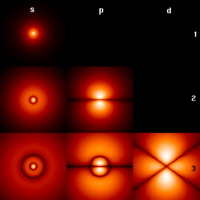
In some cases, two or more theories may be replaced by a single theory that explains the previous theories as approximations or special cases, analogous to the way a theory is a unifying explanation for many confirmed hypotheses; this is referred to as unification of theories.[21] For example, electricity and magnetism are now known to be two aspects of the same phenomenon, referred to as electromagnetism.[22]
When the predictions of different theories appear to contradict each other, this is also resolved by either further evidence or unification. For example, physical theories in the 19th century implied that the Sun could not have been burning long enough to allow certain geological changes as well as the evolution of life. This was resolved by the discovery of nuclear fusion, the main energy source of the Sun.[23] Contradictions can also be explained as the result of theories approximating more fundamental (non-contradictory) phenomena. For example, atomic theory is an approximation of quantum mechanics. Current theories describe three separate fundamental phenomena of which all other theories are approximations;[24] the potential unification of these is sometimes called the Theory of Everything.[21]
Example: Relativity
In 1905, Albert Einstein published the principle of special relativity, which soon became a theory.[25] Special relativity predicted the alignment of the Newtonian principle of Galilean invariance, also termed Galilean relativity, with the electromagnetic field.[26] By omitting from special relativity the luminiferous aether, Einstein stated that time dilation and length contraction measured in an object in relative motion is inertial—that is, the object exhibits constant velocity, which is speed with direction, when measured by its observer. He thereby duplicated the Lorentz transformation and the Lorentz contraction that had been hypothesized to resolve experimental riddles and inserted into electrodynamic theory as dynamical consequences of the aether’s properties. An elegant theory, special relativity yielded its own consequences,[27] such as the equivalence of mass and energy transforming into one another and the resolution of the paradox that an excitation of the electromagnetic field could be viewed in one reference frame as electricity, but in another as magnetism.
Einstein sought to generalize the invariance principle to all reference frames, whether inertial or accelerating.[28] Rejecting Newtonian gravitation—a central force acting instantly at a distance—Einstein presumed a gravitational field. In 1907, Einstein’s equivalence principle implied that a free fall within a uniform gravitational field is equivalent to inertial motion.[28] By extending special relativity’s effects into three dimensions, general relativity extended length contraction into space contraction, conceiving of 4D space-time as the gravitational field that alters geometrically and sets all local objects’ pathways. Even massless energy exerts gravitational motion on local objects by “curving” the geometrical “surface” of 4D space-time. Yet unless the energy is vast, its relativistic effects of contracting space and slowing time are negligible when merely predicting motion. Although general relativity is embraced as the more explanatory theory via scientific realism, Newton’s theory remains successful as merely a predictive theory via instrumentalism. To calculate trajectories, engineers and NASA still uses Newton’s equations, which are simpler to operate.[16]
Assumptions in formulating theories
An assumption (or axiom) is a statement that is accepted without evidence. For example, assumptions can be used as premises in a logical argument. Isaac Asimov described assumptions as follows:
…it is incorrect to speak of an assumption as either true or false, since there is no way of proving it to be either (If there were, it would no longer be an assumption). It is better to consider assumptions as either useful or useless, depending on whether deductions made from them corresponded to reality…Since we must start somewhere, we must have assumptions, but at least let us have as few assumptions as possible.[46]
Certain assumptions are necessary for all empirical claims (e.g. the assumption that reality exists). However, theories do not generally make assumptions in the conventional sense (statements accepted without evidence). While assumptions are often incorporated during the formation of new theories, these are either supported by evidence (such as from previously existing theories) or the evidence is produced in the course of validating the theory. This may be as simple as observing that the theory makes accurate predictions, which is evidence that any assumptions made at the outset are correct or approximately correct under the conditions tested.
Conventional assumptions, without evidence, may be used if the theory is only intended to apply when the assumption is valid (or approximately valid). For example, the special theory of relativity assumes an inertial frame of reference. The theory makes accurate predictions when the assumption is valid, and does not make accurate predictions when the assumption is not valid. Such assumptions are often the point with which older theories are succeeded by new ones (the general theory of relativity works in non-inertial reference frames as well).
The term “assumption” is actually broader than its standard use, etymologically speaking. The Oxford English Dictionary (OED) and online Wiktionary indicate its Latin source as assumere (“accept, to take to oneself, adopt, usurp”), which is a conjunction of ad- (“to, towards, at”) and sumere (to take). The root survives, with shifted meanings, in the Italian assumere and Spanish sumir. The first sense of “assume” in the OED is “to take unto (oneself), receive, accept, adopt”. The term was originally employed in religious contexts as in “to receive up into heaven”, especially “the reception of the Virgin Mary into heaven, with body preserved from corruption”, (1297 CE) but it was also simply used to refer to “receive into association” or “adopt into partnership”. Moreover, other senses of assumere included (i) “investing oneself with (an attribute)”, (ii) “to undertake” (especially in Law), (iii) “to take to oneself in appearance only, to pretend to possess”, and (iv) “to suppose a thing to be” (all senses from OED entry on “assume”; the OED entry for “assumption” is almost perfectly symmetrical in senses). Thus, “assumption” connotes other associations than the contemporary standard sense of “that which is assumed or taken for granted; a supposition, postulate” (only the 11th of 12 senses of “assumption”, and the 10th of 11 senses of “assume”).
Reference
- National Academy of Sciences (US) (1999). Science and Creationism: A View from the National Academy of Sciences(2nd ed.). National Academies Press. p. 2. doi:10.17226/6024. ISBN 978-0-309-06406-4. PMID 25101403.
- The Structure of Scientific Theories. The Stanford Encyclopedia of Philosophy. Metaphysics Research Lab, Stanford University. 2016.
- Schafersman, Steven D. “An Introduction to Science”.
- “Is Evolution a Theory or a Fact?”. National Academy of Sciences. 2008.
- Popper, Karl (1963), Conjectures and Refutations, Routledge and Kegan Paul, London, UK. Reprinted in Theodore Schick (ed., 2000), Readings in the Philosophy of Science, Mayfield Publishing Company, Mountain View, Calif.
- Andersen, Hanne; Hepburn, Brian (2015). Edward N. Zalta (ed.). Scientific Method. The Stanford Encyclopedia of Philosophy.
- The Devil in Dover,
- Howard, Don A. (23 June 2018). Zalta, Edward N. (ed.). The Stanford Encyclopedia of Philosophy. Metaphysics Research Lab, Stanford University – via Stanford Encyclopedia of Philosophy.
- Alan Baker (2010) [2004]. “Simplicity”. Stanford Encyclopedia of Philosophy. California: Stanford University. ISSN 1095-5054.
- Courtney A, Courtney M (2008). “Comments Regarding “On the Nature Of Science””. Physics in Canada. 64 (3): 7–8. arXiv:0812.4932.
- Elliott Sober, Let’s Razor Occam’s Razor, pp. 73–93, from Dudley Knowles (ed.) Explanation and Its Limits, Cambridge University Press (1994).
- National Academy of Sciences (2008), Science, Evolution, and Creationism.
- Hooke, Robert (1635–1703). Micrographia, Observation XVIII.
- Misner, Charles W.; Thorne, Kip S.; Wheeler, John Archibald (1973). Gravitation, p. 1049. New York: W. H.Freeman and Company. ISBN 0-7167-0344-0.
- See Acid–base reaction.
- Bước lên tới:a b c “Chapter 1: The Nature of Science”. www.project2061.org.
- See, for example, Common descent and Evidence for common descent.
- For example, see the article on the discovery of Neptune; the discovery was based on an apparent violation of the orbit of Uranus as predicted by Newtonian mechanics. This explanation did not require any modification of the theory, but rather modification of the hypothesis that there were only seven planets in the Solar System.
- U. Le Verrier (1859), (in French), “Lettre de M. Le Verrier à M. Faye sur la théorie de Mercure et sur le mouvement du périhélie de cette planète”, Comptes rendus hebdomadaires des séances de l’Académie des sciences (Paris), vol. 49 (1859), pp. 379–83.
- For example, the modern theory of evolution (the modern evolutionary synthesis) incorporates significant contributions from R. A. Fisher, Ernst Mayr, J. B. S. Haldane, and many others.
- Weinberg S (1993). Dreams of a Final Theory: The Scientist’s Search for the Ultimate Laws of Nature.
- Maxwell, J. C., & Thompson, J. J. (1892). A treatise on electricity and magnetism. Clarendon Press series. Oxford: Clarendon.
- “How the Sun Shines”. www.nobelprize.org.
- The strong force, the electroweak force, and gravity. The electroweak force is the unification of electromagnetism and the weak force. All observed causal interactions are understood to take place through one or more of these three mechanisms, although most systems are far too complicated to account for these except through the successive approximations offered by other theories.
- Albert Einstein (1905) “Zur Elektrodynamik bewegter Körper Archived 2009-12-29 at the Wayback Machine”, Annalen der Physik 17: 891; English translation On the Electrodynamics of Moving Bodies by George Barker Jefferyand Wilfrid Perrett (1923); Another English translation On the Electrodynamics of Moving Bodies by Megh Nad Saha (1920).
- Schwarz, John H (Mar 1998). “Recent developments in superstring theory”. Proceedings of the National Academy of Sciences of the United States of America. 95 (6): 2750–57. Bibcode:1998PNAS…95.2750S. doi:10.1073/pnas.95.6.2750. PMC 19640. PMID 9501161.
- See Tests of special relativity. Also, for example: Sidney Coleman, Sheldon L. Glashow, Cosmic Ray and Neutrino Tests of Special Relativity, Phys. Lett. B405 (1997) 249–52, found here [1]. An overview can be found here.
- Roberto Torretti, The Philosophy of Physics (Cambridge: Cambridge University Press, 1999), pp. 289–90.
- “Scientific Laws and Theories”.
- See the article on Physical law, for example.
- “Definitions of Fact, Theory, and Law in Scientific Work”. 16 March 2016.
- “Harding (1999)”.
- William F. McComas (30 December 2013). The Language of Science Education: An Expanded Glossary of Key Terms and Concepts in Science Teaching and Learning. Springer Science & Business Media. p. 107. ISBN 978-94-6209-497-0.
- “What’s the Difference Between a Scientific Hypothesis, Theory and Law?”.
- Gould, Stephen Jay (1981-05-01). “Evolution as Fact and Theory”. Discover. 2 (5): 34–37.
- Further examples are here [2], and in the article on Evolution as fact and theory.
- “Essay”. ncse.com. Retrieved 25 March 2015.
- Suppe, Frederick (1998). “Understanding Scientific Theories: An Assessment of Developments, 1969–1998” (PDF). Philosophy of Science. 67: S102–S115. doi:10.1086/392812. Retrieved 14 February 2013.
- Halvorson, Hans (2012). “What Scientific Theories Could Not Be” (PDF). Philosophy of Science. 79 (2): 183–206. CiteSeerX 10.1.1.692.8455. doi:10.1086/664745. Retrieved 14 February 2013.
- Frigg, Roman (2006). “Scientific Representation and the Semantic View of Theories” (PDF). Theoria. 55 (2): 183–206. Retrieved 14 February 2013.
- Hacking, Ian (1983). Representing and Intervening. Introductory Topics in the Philosophy of Natural Science. Cambridge University Press.
- Box, George E.P. & Draper, N.R. (1987). Empirical Model-Building and Response Surfaces. Wiley. p. 424
- Lorenzo Iorio (2005). “On the possibility of measuring the solar oblateness and some relativistic effects from planetary ranging”. Astronomy and Astrophysics. 433 (1): 385–93. arXiv:gr-qc/0406041. Bibcode:2005A&A…433..385I. doi:10.1051/0004-6361:20047155.
- Myles Standish, Jet Propulsion Laboratory (1998)
- For example, Reese & Overto (1970); Lerner (1998); also Lerner & Teti (2005), in the context of modeling human behavior.
- Isaac Asimov, Understanding Physics (1966) pp. 4–5.
- Hawking, Stephen (1988). A Brief History of Time. Bantam Books. ISBN 978-0-553-38016-3.
- Hempel. C.G. 1951 “Problems and Changes in the Empiricist Criterion of Meaning” in Aspects of Scientific Explanation. Glencoe: the Free Press. Quine, W.V.O 1952 “Two Dogmas of Empiricism” reprinted in From a Logical Point of View. Cambridge: Harvard University Press
- Philip Kitcher 1982 Abusing Science: The Case Against Creationism, pp. 45–48. Cambridge: The MIT Press
- Hempel CG 1952. Fundamentals of Concept Formation in Empirical Science. (Volume 2, #7 of Foundations of the Unity of Science. Toward an International Encyclopedia of Unified Science). University of Chicago Press, p. 36.
- Polanyi M. 1958. Personal Knowledge. Towards a Post-Critical Philosophy. London: Routledge & Kegan Paul, p. 4.
- Galileo Galilei, The Assayer, as translated by Stillman Drake(1957), Discoveries and Opinions of Galileo pp. 237–38.
- Hacking I. 1983. Representing and Intervening. Cambridge University Press, p. 219.
- Koga J and Yamagiwa M (2006). Radiation reaction effects in ultrahigh irradiance laser pulse interactions with multiple electrons.
- Plass, G.N., 1956, The Carbon Dioxide Theory of Climatic Change, Tellus VIII, 2. (1956), pp. 140–54.
The post Becoming and evolution of a scientific theory appeared first on HKT Consultant.
]]>The post List of Theological Belief Systems appeared first on HKT Consultant.
]]>Buddhism
Christianity
Hinduism
Islam
Judaism
Sikhism
Taoism
Zoroastrianism
Please wait while you are redirected...or Click Here if you do not want to wait.The post List of Theological Belief Systems appeared first on HKT Consultant.
]]>The post List of Art movements appeared first on HKT Consultant.
]]>A
B
C
D
E
F
G
H
I
J
K
L
M
N
O
P
Q
R
S
T
U
V
W
X
Y
Z
0-9 & other
The post List of Art movements appeared first on HKT Consultant.
]]>The post Political Theories and Concepts appeared first on HKT Consultant.
]]>F
G
H
I
J
K
L
M
N
O
P
Q
R
S
T
U
V
W
X
Y
Z
0-9 & other
The post Political Theories and Concepts appeared first on HKT Consultant.
]]>