The post Corporate accounting: definition, functions and branches appeared first on HKT Consultant.
]]>Corporate accounting is a process, which systematically and comprehensively records business events and transactions, and translate it into the financial information of the business entity to assist the stakeholders in the decision-making process.
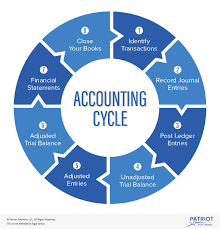
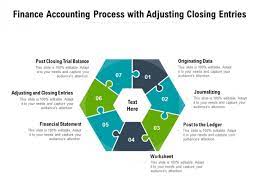
In this process, the transactions are identified, recorded, arranged, summarized, simplified properly and then communicated to the interested parties.
Generally Accepted Accounting Principles (GAAP) provide the rules for the preparation of the accounting statements, in the form of concepts, conventions, assumptions and principles. It not only removes confusion but also provide consistency and uniformity in the process. These are the fundamental assumptions, on which the entire system of accounting is based.
Main contentsSee more from basic to advanced











Branches of Accounting

- Financial Accounting: It is that branch of accounting, which involves the recording of the transactions, inclined towards the preparation of trial balance and final accounts.
- Cost Accounting: Cost account is the accounting discipline, which deals with costs, i.e. the unit costs of the goods produced and services provided. It helps the management of the organization in fixing the price, controlling costs and providing relevant information for the purpose of decision making.
- Management Accounting: The accounting system which supplies the necessary information to the management, for rational decision making. The information may be concerned with funds, costs, profits and losses and so forth. This information is helpful in determining the effect of the decisions and analysing the performance of the entity.
- Tax Accounting: The accounting system that deals with the tax return and its payment, instead of preparation of final accounts of the enterprise, is called tax accounting.
- Social Accounting: This branch of accounting is commonly termed as social responsibility accounting. It aims at unveiling the facilities provided by the entity to the society, in terms of medical, housing, education, and so forth.
These accounting branches have been developed as a result of rapid economic development and technological improvements, that increased the company’s scale of operations. Due to this very reason, the management functions has become complicated and resulted in the development of branches.
Functions of corporate accounting
- Systematic record keeping: The first and foremost function of accounting is the systematic record keeping of the financial transactions, on a regular basis.
- Facilitating rational decision making: Another important function of accounting is to communicate the results, i.e. the net profit or loss to the users, with the help of financial statements, so as to help the interested parties in rational decision making.
- Legal compliance: The accounting statements must be prepared keeping in mind the compliance with the relevant laws.
- Protection of business assets: Accounting not only keeps a record of all the business assets but also ensures no unauthorized use of assets or property belonging to the enterprise.
- Determination of Profit/loss: Accounting plays a very important role in the ascertainment of profit earned or loss sustained by the enterprise in an accounting period. This is possible only when a proper record of all the business transactions, revenues and expenses are maintained.
- Ascertaining the profitability, liquidity and solvency of the entity: With the help of the financial statement, i.e. Balance sheet and profit and loss account, the financial position of the enterprise can easily be ascertained.
The fundamental objective of accounting is to keep complete records of the business transactions, so as to determine the financial performance and position of the enterprise and convey the information to the user groups such as shareholders, employees, creditors, suppliers, government and other groups.
The post Corporate accounting: definition, functions and branches appeared first on HKT Consultant.
]]>The post Nature of Business and Accounting appeared first on HKT Consultant.
]]>The objective of most businesses is to earn a profit. Profit is the difference between the amounts received from customers for goods or services and the amounts paid for the inputs used to provide the goods or services. This text focuses on businesses operating to earn a profit. However, many of the same concepts and principles also apply to not-for-profit organizations such as hospitals, churches, and government agencies.
1. Types of Businesses
Three types of businesses operating for profit include service, merchandising, and manufacturing businesses. Some examples of each type of business are given below.
Service businesses provide services rather than products to customers.
Delta Air Lines (transportation services)
The Walt Disney Company (entertainment services)
Merchandising businesses sell products they purchase from other businesses to customers.
Walmart (general merchandise)
Amazon.com (Internet books, music, videos)
Manufacturing businesses change basic inputs into products that are sold to customers.
Ford Motor Co. (cars, trucks, vans)
Dell, Inc. (personal computers)
2. Role of Accounting in Business
The role of accounting in business is to provide information for managers to use in operating the business. In addition, accounting provides information to other users in assessing the economic performance and condition of the business.
Thus, accounting can be defined as an information system that provides reports to users about the economic activities and condition of a business. You could think of accounting as the “language of business.” This is because accounting is the means by which businesses’ financial information is communicated to users.
The process by which accounting provides information to users is as follows:
- Identify users.
- Assess users’ information needs.
- Design the accounting information system to meet users’ needs.
- Record economic data about business activities and events.
- Prepare accounting reports for users.
As illustrated in Exhibit 1, users of accounting information can be divided into two groups: internal users and external users.
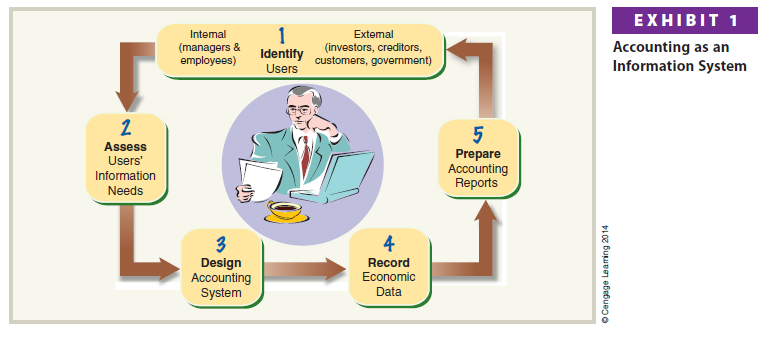
Internal users of accounting information include managers and employees. These users are directly involved in managing and operating the business. The area of accounting that provides internal users with information is called managerial accounting, or management accounting.
The objective of managerial accounting is to provide relevant and timely information for managers’ and employees’ decision-making needs. Oftentimes, such information is sensitive and is not distributed outside the business. Examples of sensitive information might include information about customers, prices, and plans to expand the business. Managerial accountants employed by a business are employed in private accounting.
External users of accounting information include investors, creditors, customers, and the government. These users are not directly involved in managing and operating the business. The area of accounting that provides external users with information is called financial accounting.
The objective of financial accounting is to provide relevant and timely information for the decision-making needs of users outside of the business. For example, financial reports on the operations and condition of the business are useful for banks and other creditors in deciding whether to lend money to the business. General-purpose financial statements are one type of financial accounting report that is distributed to external users. The term general-purpose refers to the wide range of decision-making needs that these reports are designed to serve. Later in this chapter, general-purpose financial statements are described and illustrated.
3. Role of Ethics in Accounting and Business
The objective of accounting is to provide relevant, timely information for user decision making. Accountants must behave in an ethical manner so that the information they provide users will be trustworthy and, thus, useful for decision making. Managers and employees must also behave in an ethical manner in managing and operating a business. Otherwise, no one will be willing to invest in or loan money to the business.
Ethics are moral principles that guide the conduct of individuals. Unfortunately, business managers and accountants sometimes behave in an unethical manner. Many of the managers of the companies listed in Exhibit 2 engaged in accounting or business fraud. These ethical violations led to fines, firings, and lawsuits. In some cases, managers were criminally prosecuted, convicted, and sent to prison.
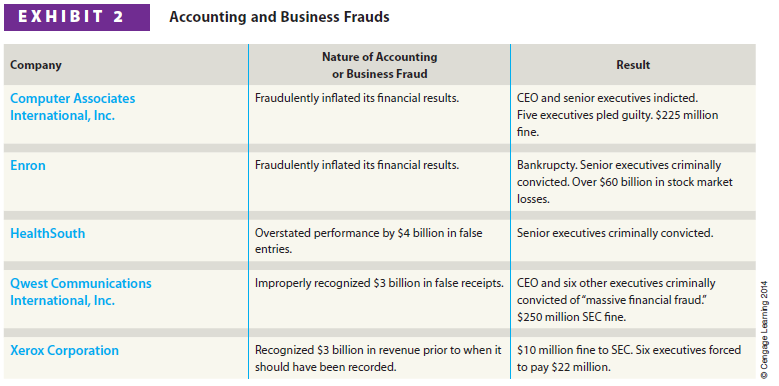
What went wrong for the managers and companies listed in Exhibit 2? The answer normally involved one or both of the following two factors:
Failure of Individual Character. An ethical manager and accountant is honest and fair. However, managers and accountants often face pressures from supervisors to meet company and investor expectations. In many of the cases in Exhibit 2, managers and accountants justified small ethical violations to avoid such pressures. However, these small violations became big violations as the company’s financial problems became worse.
Culture of Greed and Ethical Indifference. By their behavior and attitude, senior managers set the company culture. In most of the companies listed in Exhibit 2, the senior managers created a culture of greed and indifference to the truth.
As a result of the accounting and business frauds shown in Exhibit 2, Congress passed new laws to monitor the behavior of accounting and business. For example, the Sarbanes-Oxley Act of 2002 (SOX) was enacted. SOX established a new oversight body for the accounting profession called the Public Company Accounting Oversight Board (PCAOB). In addition, SOX established standards for independence, corporate responsibility, and disclosure.
How does one behave ethically when faced with financial or other types of pressure? Guidelines for behaving ethically are shown in Exhibit 3.

4. Opportunities for Accountants
Numerous career opportunities are available for students majoring in accounting. Currently, the demand for accountants exceeds the number of new graduates entering the job market. This is partly due to the increased regulation of business caused by the accounting and business frauds shown in Exhibit 2. Also, more and more businesses have come to recognize the importance and value of accounting information.
As indicated earlier, accountants employed by a business are employed in private accounting. Private accountants have a variety of possible career options within a company. Some of these career options are shown in Exhibit 4 along with their starting salaries. Accountants who provide audit services, called auditors, verify the accuracy of financial records, accounts, and systems. As shown in Exhibit 4, several private accounting careers have certification options.
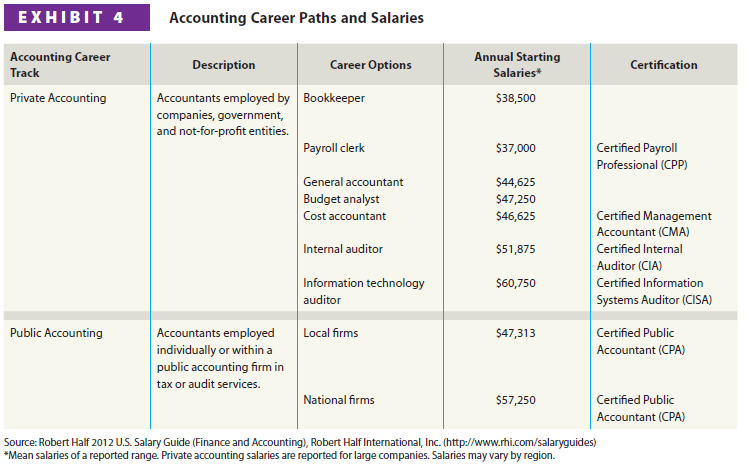
Accountants and their staff who provide services on a fee basis are said to be employed in public accounting. In public accounting, an accountant may practice as an individual or as a member of a public accounting firm. Public accountants who have met a state’s education, experience, and examination requirements may become Certified Public Accountants (CPAs). CPAs typically perform general accounting, audit, or tax services. As can be seen in Exhibit 4, CPAs have slightly better starting salaries than private accountants. Career statistics indicate, however, that these salary differences tend to disappear over time.
Because all functions within a business use accounting information, experience in private or public accounting provides a solid foundation for a career. Many positions in industry and in government agencies are held by individuals with accounting backgrounds.
Source: Warren Carl S., Reeve James M., Duchac Jonathan (2013), Corporate Financial Accounting, South-Western College Pub; 12th edition.
The post Nature of Business and Accounting appeared first on HKT Consultant.
]]>The post Generally Accepted Accounting Principles appeared first on HKT Consultant.
]]>Accounting principles and concepts develop from research, accepted accounting practices, and pronouncements of regulators. Within the United States, the Financial Accounting Standards Board (FASB) has the primary responsibility for developing accounting principles. The FASB publishes Statements of Financial Accounting Standards as well as Interpretations of these Standards. In addition, the Securities and Exchange Commission (SEC), an agency of the U.S. government, has authority over the accounting and financial disclosures for companies whose shares of ownership (stock) are traded and sold to the public. The SEC normally accepts the accounting principles set forth by the FASB. However, the SEC may issue Staff Accounting Bulletins on accounting matters that may not have been addressed by the FASB.
Many countries outside the United States use generally accepted accounting principles adopted by the International Accounting Standards Board (IASB). The IASB issues International Financial Reporting Standards (IFRSs). Differences currently exist between FASB and IASB accounting principles. However, the FASB and IASB are working together to reduce and eliminate these differences into a single set of accounting principles. Such a set of worldwide accounting principles would help facilitate investment and business in an increasingly global economy.
In this chapter and text, accounting principles and concepts are emphasized. It is through this emphasis on the “why” as well as the “how” that you will gain an understanding of accounting.
1. Business Entity Concept
The business entity concept limits the economic data in an accounting system to data related directly to the activities of the business. In other words, the business is viewed as an entity separate from its owners, creditors, or other businesses. For example, the accountant for a business with one owner would record the activities of the business only and would not record the personal activities, property, or debts of the owner.
A business entity may take the form of a proprietorship, partnership, corporation, or limited liability company (LLC). Each of these forms and their major characteristics are listed below.
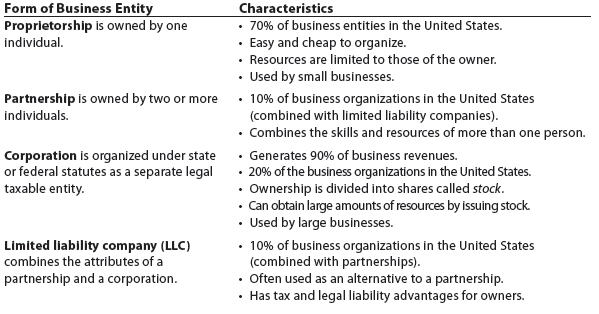
The three types of businesses discussed earlier—service, merchandising, and manufacturing—may be organized as proprietorships, partnerships, corporations, or limited liability companies. Because of the large amount of resources required to operate a manufacturing business, most manufacturers such as Ford Motor Company are corporations. Most large retailers such as Walmart and Home Depot are also corporations. Companies organized as corporations often include Inc. as part of their name to indicate that they are incorporated. For example, Apple’s legal name is Apple Inc.
2. Cost Concept
Under the cost concept, amounts are initially recorded in the accounting records at their cost or purchase price. To illustrate, assume that Aaron Publishers purchased the following building on February 20, 2012, for $150,000:
Price listed by seller on January 1, 2012 $160,000
Aaron Publishers’ initial offer to buy on January 31, 2012 140,000
Purchase price on February 20, 2012 150,000
Estimated selling price on December 31, 2014 220,000
Assessed value for property taxes, December 31,2014 190,000
Under the cost concept, Aaron Publishers records the purchase of the building on February 20, 2012, at the purchase price of $150,000. The other amounts listed above have no effect on the accounting records.
The fact that the building has an estimated selling price of $220,000 on December 31, 2014, indicates that the building has increased in value. However, to use the $220,000 in the accounting records would be to record an illusory or unrealized profit. If Aaron Publishers sells the building on January 9, 2016, for $240,000, a profit of $90,000 ($240,000 – $150,000) is then realized and recorded. The new owner would record $240,000 as its cost of the building.
The cost concept also involves the objectivity and unit of measure concepts. The objectivity concept requires that the amounts recorded in the accounting records be based on objective evidence. In exchanges between a buyer and a seller, both try to get the best price. Only the final agreed-upon amount is objective enough to be recorded in the accounting records. If amounts in the accounting records were constantly being revised upward or downward based on offers, appraisals, and opinions, accounting reports could become unstable and unreliable.
The unit of measure concept requires that economic data be recorded in dollars. Money is a common unit of measurement for reporting financial data and reports.
Example Exercise 1-1 Cost Concept
On August 25, Gallatin Repair Service extended an offer of $125,000 for land that had been priced for sale at $150,000. On September 3, Gallatin Repair Service accepted the seller’s counteroffer of $137,000. On October 20, the land was assessed at a value of $98,000 for property tax purposes. On December 4, Gallatin Repair Service was offered $160,000 for the land by a national retail chain. At what value should the land be recorded in Gallatin Repair Service’s records?
Follow My Example 1-1
$137,000. Under the cost concept, the land should be recorded at the cost to Gallatin Repair Service.
Source: Warren Carl S., Reeve James M., Duchac Jonathan (2013), Corporate Financial Accounting, South-Western College Pub; 12th edition.
The post Generally Accepted Accounting Principles appeared first on HKT Consultant.
]]>The post The Accounting Equation appeared first on HKT Consultant.
]]>The following equation shows the relationship among assets, liabilities, and stockholders’ equity:
Assets = Liabilities + Stockholders’ Equity
This equation is called the accounting equation. Liabilities usually are shown before stockholders’ equity in the accounting equation because creditors have first rights to the assets.
Given any two amounts, the accounting equation may be solved for the third unknown amount. To illustrate, if the assets owned by a business amount to $100,000 and the liabilities amount to $30,000, the stockholders’ equity is equal to $70,000, as shown below.

Example Exercise 1-2 Accounting Equation
You’re A Star is a motivational consulting business. At the end of its accounting period, December 31,2013, You’re A Star has assets of $800,000 and liabilities of $350,000. Using the accounting equation, determine the following amounts:
- Stockholders’ equity as of December 31, 2013.
- Stockholders’ equity as of December 31,2014, assuming that assets increased by $130,000 and liabilities decreased by $25,000 during 2014.
Follow My Example 1-2
- Assets = Liabilities + Stockholders’ Equity
$800,000 = $350,000 + Stockholders’ Equity
Stockholders’ Equity = $450,000
- First, determine the change in stockholders’ equity during 2014 as follows:
Assets = Liabilities + Stockholders’ Equity
$130,000 = -$25,000 + Stockholders’ Equity
Stockholders’ Equity = $155,000
Next, add the change in stockholders’ equity during 2014 to the stockholders’ equity on December 31, 2013 to arrive at stockholders’ equity on December 31,2014, as shown below.
Stockholders’ Equity on December 31, 2014 = $450,000 + $155,000 = $605,000
Source: Warren Carl S., Reeve James M., Duchac Jonathan (2013), Corporate Financial Accounting, South-Western College Pub; 12th edition.
The post The Accounting Equation appeared first on HKT Consultant.
]]>The post Business Transactions and the Accounting Equation appeared first on HKT Consultant.
]]>All business transactions can be stated in terms of changes in the elements of the accounting equation. How business transactions affect the accounting equation can be illustrated by using some typical transactions. As a basis for illustration, a business organized by Chris Clark is used.
Assume that on November 1, 2013, Chris Clark organizes a corporation that will be known as NetSolutions. The first phase of Chris’s business plan is to operate Net-Solutions as a service business assisting individuals and small businesses in developing Web pages and installing computer software. Chris expects this initial phase of the business to last one to two years. During this period, Chris plans on gathering information on the software and hardware needs of customers. During the second phase of the business plan, Chris plans to expand NetSolutions into a personalized retailer of software and hardware for individuals and small businesses.
Each transaction during NetSolutions’ first month of operations is described in the following paragraphs. The effect of each transaction on the accounting equation is then shown.
Transaction A – Nov. 1, 2013 Chris Clark deposited $25,000 in a bank account in the name of NetSolutions in exchange for shares of stock in the corporation.
Stock issued to stockholders’ (owners), such as Chris Clark, is referred to as capital stock. This transaction increases assets by increasing Cash (on the left side of the equation) by $25,000. To balance the equation, Capital Stock under stockholders’ equity (on the right side of the equation) increases by the same amount.
The effect of this transaction on NetSolutions’ accounting equation is shown below.

The accounting equation shown above is only for the corporation, NetSolutions. Under the business entity concept, Chris Clark’s personal assets, such as a home or personal bank account, and personal liabilities are excluded from the equation.
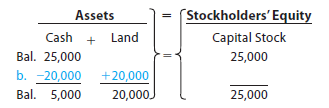
Transaction B – Nov. 5, 2013 NetSolutions paid $20,000 for the purchase of land as a future building site.
The land is located in a business park with access to transportation facilities. Chris Clark plans to rent office space and equipment during the first phase of the business plan. During the second phase, Chris plans to build an office and a warehouse for NetSolutions on the land.
The purchase of the land changes the makeup of the assets, but it does not change the total assets. The items in the equation prior to this transaction and the effect of the transaction are shown below. The new amounts are called balances.
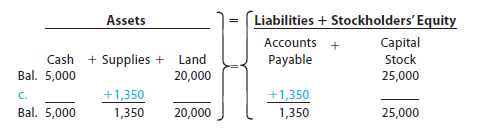
Transaction C – Nov. 10, 2013 NetSolutions purchased supplies for $1,350 and agreed to pay the supplier in the near future.
You have probably used a credit card to buy clothing or other merchandise. In this type of transaction, you received clothing for a promise to pay your credit card bill in the future.
That is, you received an asset and incurred a liability to pay a future bill. NetSolutions entered into a similar transaction by purchasing supplies for $1,350 and agreeing to pay the supplier in the near future. This type of transaction is called a purchase on account and is often described as follows: Purchased supplies on account, $1,350.
The liability created by a purchase on account is called an account payable. Items such as supplies that will be used in the business in the future are called prepaid expenses, which are assets. Thus, the effect of this transaction is to increase assets (Supplies) and liabilities (Accounts Payable) by $1,350, as follows:
Transaction D – Nov. 18, 2013 NetSolutions received cash of$7,500for providing services to customers.
You may have earned money by painting houses or mowing lawns. If so, you received money for rendering services to a customer. Likewise, a business earns money by selling goods or services to its customers. This amount is called revenue.
During its first month of operations, NetSolutions received cash of $7,500 for providing services to customers. The receipt of cash increases NetSolutions’ assets and also increases stockholders’ equity in the business. The revenues of $7,500 are recorded in a Fees Earned column to the right of Capital Stock. The effect of this transaction is to increase Cash and Fees Earned by $7,500, as follows.
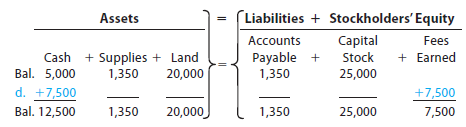
Different terms are used for the various types of revenues. As illustrated above, revenue from providing services is recorded as fees earned. Revenue from the sale of merchandise is recorded as sales. Other examples of revenue include rent, which is recorded as rent revenue, and interest, which is recorded as interest revenue.
Instead of receiving cash at the time services are provided or goods are sold, a business may accept payment at a later date. Such revenues are described as fees earned on account or sales on account. For example, if NetSolutions had provided services on account instead of for cash, transaction (d) would have been described as follows: Fees earned on account, $7,500.
In such cases, the firm has an account receivable, which is a claim against the customer. An account receivable is an asset, and the revenue is earned and recorded as if cash had been received. When customers pay their accounts, Cash increases and Accounts Receivable decreases.
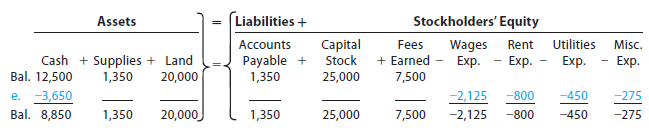
Transaction E – Nov. 30, 2013 NetSolutions paid the following expenses during the month: wages, $2,125; rent, $800; utilities, $450; and miscellaneous, $275.
During the month, NetSolutions spent cash or used up other assets in earning revenue. Assets used in this process of earning revenue are called expenses. Expenses include supplies used and payments for employee wages, utilities, and other services.
NetSolutions paid the following expenses during the month: wages, $2,125; rent, $800; utilities, $450; and miscellaneous, $275. Miscellaneous expenses include small amounts paid for such items as postage, coffee, and newspapers. The effect of expenses is the opposite of revenues in that expenses reduce assets and stockholders’ equity. Like fees earned, the expenses are recorded in columns to the right of Capital Stock. However, since expenses reduce stockholders’ equity, the expenses are entered as negative amounts. The effect of this transaction is shown below.
Businesses usually record each revenue and expense transaction as it occurs. However, to simplify, NetSolutions’ revenues and expenses are summarized for the month in transactions (d) and (e).
Transaction F – Nov. 30, 2013 NetSolutions paid creditors on account, $950.
When you pay your monthly credit card bill, you decrease the cash and decrease the amount you owe to the credit card company. Likewise, when NetSolutions pays $950 to creditors during the month, it reduces assets and liabilities, as shown below.

Paying an amount on account is different from paying an expense. The paying of an expense reduces stockholders’ equity, as illustrated in transaction (e). Paying an amount on account reduces the amount owed on a liability.
Transaction G – Nov. 30, 2013 Chris Clark determined that the cost of supplies on hand at the end of the month was $550.
The cost of the supplies on hand (not yet used) at the end of the month is $550. Thus, $800 ($1,350 – $550) of supplies must have been used during the month. This decrease in supplies is recorded as an expense, as shown below.

Transaction H – Nov. 30, 2013 NetSolutions paid $2,000 to stockholders (Chris Clark) as dividends.
Dividends are distributions of earnings to stockholders. The payment of dividends decreases cash and stockholders’ equity. Like expenses, dividends are recorded in a separate column to the right of Capital Stock as a negative amount. The effect of the payment of dividends of $2,000 is shown below.

Dividends should not be confused with expenses. Dividends do not represent assets or services used in the process of earning revenues. Instead, dividends are considered a distribution of earnings to stockholders.
Summary The transactions of NetSolutions are summarized below. Each transaction is identi- Summary fied by letter, and the balance of each accounting equation element is shown after every transaction.
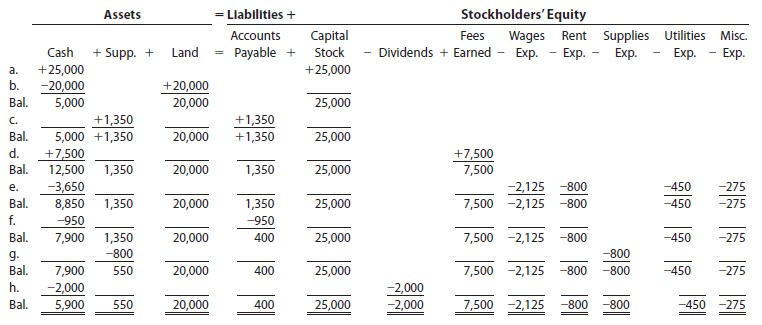
You should note the following:
- The effect of every transaction is an increase or a decrease in one or more of the accounting equation elements.
- The two sides of the accounting equation are always equal.
- The stockholders’ equity (owner’s equity) is increased by amounts invested by stockholders (capital stock).
- The stockholders’ equity (owner’s equity) is increased by revenues and decreased by expenses.
- The stockholders’ equity (owner’s equity) is decreased by dividends paid to stockholders.
Stockholders’ equity is classified as:
-
- Capital Stock
- Retained Earnings.
Capital stock is shares of ownership distributed to investors of a corporation. It represents the portion of stockholders’ equity contributed by investors. For NetSolutions, shares of capital stock of $25,000 were distributed to Chris Clark in exchange for investing in the business.
Retained earnings is the stockholders’ equity created from business operations through revenue and expense transactions. For NetSolutions, retained earnings of $3,050 were created by its November operations (revenue and expense transactions), as shown below.
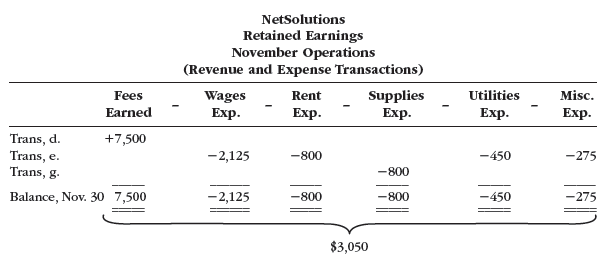
Stockholders’ equity created by investments by stockholders (capital stock) and by business operations (retained earnings) is reported separately. Since dividends are distributions of earnings to stockholders, dividends reduce retained earnings. NetSolutions paid $2,000 in dividends during November, thus reducing retained earnings to $1,050 ($3,050 — $2,000).
The effects of investments by stockholders, dividends, revenues, and expenses on stockholders’ equity are illustrated in Exhibit 5.

Example Exercise 1-3 Transactions
Salvo Delivery Service is owned and operated by Joel Salvo. The following selected transactions were completed by Salvo Delivery Service during February:
- Received cash from owner as additional investment in exchange for capital stock, $35,000.
- Paid creditors on account, $1,800.
- Billed customers for delivery services on account, $ 11,250.
- Received cash from customers on account, $6,740.
- Paid dividends, $1,000.
Indicate the effect of each transaction on the accounting equation elements (Assets, Liabilities, Stockholders’ Equity Capital Stock, Dividends, Revenue, and Expense). Also indicate the specific item within the accounting equation element that is affected. To illustrate, the answer to (1) is shown below.
- Asset (Cash) increases by $35,000; Stockholders’ Equity (Capital Stock) increases by $35,000.
Follow My Example 1-3
- Asset (Cash) decreases by $1,800; Liability (Accounts Payable) decreases by $1,800.
- Asset (Accounts Receivable) increases by $11,250; Revenue (Delivery Service Fees) increases by $11,250.
- Asset (Cash) increases by $6,740; Asset (Accounts Receivable) decreases by $6,740.
- Asset (Cash) decreases by $1,000; Dividends increases by $1,000.
Source: Warren Carl S., Reeve James M., Duchac Jonathan (2013), Corporate Financial Accounting, South-Western College Pub; 12th edition.
The post Business Transactions and the Accounting Equation appeared first on HKT Consultant.
]]>The post Financial Statements appeared first on HKT Consultant.
]]>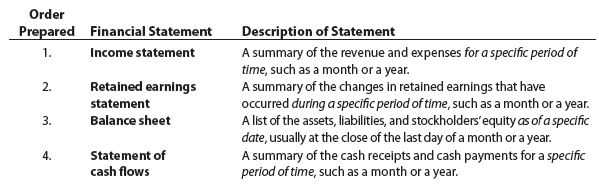
The four financial statements and their interrelationships are illustrated in Exhibit 6, on page 17. The data for the statements are taken from the summary of transactions of NetSolutions on page 13.
All financial statements are identified by the name of the business, the title of the statement, and the date or period of time. The data presented in the income statement, the retained earnings statement, and the statement of cash flows are for a period of
time. The data presented in the balance sheet are for a specific date.
1. Income Statement
The income statement reports the revenues and expenses for a period of time, based on the matching concept. This concept is applied by matching the expenses incurred during a period with the revenue that those expenses generated. The excess of the
revenue over the expenses is called net income, net profit, or earnings. If the expenses exceed the revenue, the excess is a net loss.
The revenue and expenses for NetSolutions were shown in the equation as separate increases and decreases. Net income for a period increases the stockholders’ equity (retained earnings) for the period. A net loss decreases the stockholders’ equity (retained earnings) for the period.
The revenue, expenses, and the net income of $3,050 for NetSolutions are reported in the income statement in Exhibit 6. The order in which the expenses are listed in the income statement varies among businesses. Most businesses list expenses in order
of size, beginning with the larger items. Miscellaneous expense is usually shown as the last item, regardless of the amount.
2. Retained Earnings Statement
The retained earnings statement reports the changes in the retained earnings for a period of time. It is prepared after the income statement because the net income or net loss for the period must be reported in this statement. Similarly, it is prepared before the balance sheet, since the amount of retained earnings at the end of the period must be reported on the balance sheet. Because of this, the retained earnings statement is often viewed as the connecting link between the income statement and balance sheet.
The following two types of transactions affected NetSolutions’ retained earnings during November:
- Revenues and expenses, which resulted in net income of $3,050.
- Dividends of $2,000 paid to stockholders (Chris Clark).
These transactions are summarized in the retained earnings statement for NetSolutions shown in Exhibit 6.
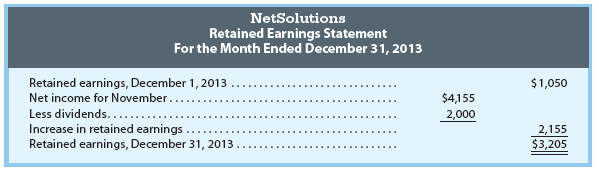
Since NetSolutions has been in operation for only one month, it has no retained earnings at the beginning of November. For December, however, there is a beginning balance—the balance at the end of November. This balance of $1,050 is reported on the retained earnings statement.
To illustrate, assume that NetSolutions earned net income of $4,155 and paid dividends of $2,000 during December. The retained earnings statement for NetSolutions for December is shown below.
3. Balance Sheet
The balance sheet in Exhibit 6 reports the amounts of NetSolutions’ assets, liabilities, and stockholders’ equity as of November 30, 2013. The asset and liability amounts are taken from the last line of the summary of transactions on page 13.
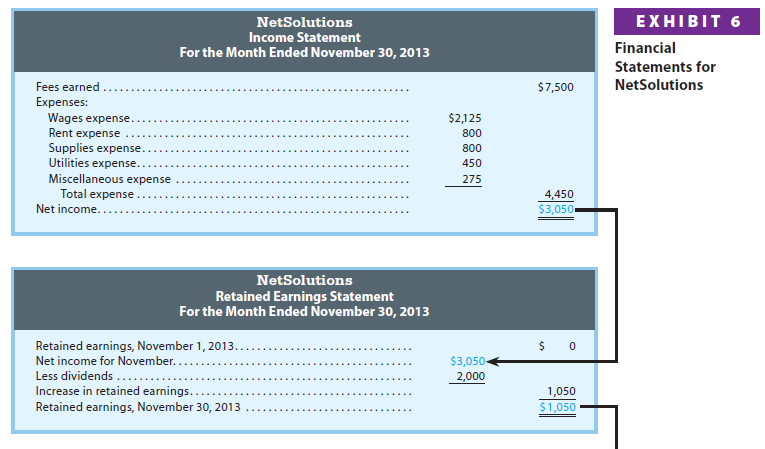
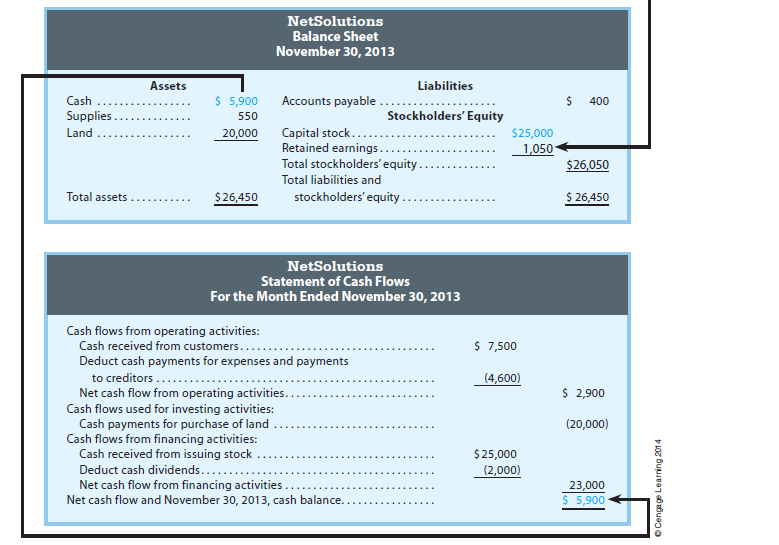
Retained earnings as of November 30, 2013, is taken from the retained earnings statement. The form of balance sheet shown in Exhibit 6 is called the account form. This is because it resembles the basic format of the accounting equation, with assets on the left side and the liabilities and stockholders’ equity sections on the right side.[1]
The assets section of the balance sheet presents assets in the order that they will be converted into cash or used in operations. Cash is presented first, followed by receivables, supplies, prepaid insurance, and other assets. The assets of a more permanent nature are shown next, such as land, buildings, and equipment.
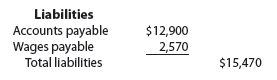
In the liabilities section of the balance sheet in Exhibit 6, accounts payable is the only liability. When there are two or more liabilities, each should be listed and the total amount of liabilities presented as follows:
4. Statement of Cash Flows
The statement of cash flows consists of the following three sections, as shown in Exhibit 6:
- operating activities
- investing activities
- financing activities
Each of these sections is briefly described below.
Cash Flows from Operating Activities This section reports a summary of cash re-ceipts and cash payments from operations. The net cash flow from operating activities normally differs from the amount of net income for the period. In Exhibit 6, NetSolutions reported net cash flows from operating activities of $2,900 and net income of $3,050. This difference occurs because revenues and expenses may not be recorded at the same time that cash is received from customers or paid to creditors.
Cash Flows from Investing Activities This section reports the cash transactions for the acquisition and sale of relatively permanent assets. Exhibit 6 reports that NetSolutions paid $20,000 for the purchase of land during November.
Cash Flows from Financing Activities This section reports the cash transactions related to cash investments by stockholders, borrowings, and cash dividends. Exhibit 6 shows that Chris Clark invested $25,000 in exchange for capital stock and dividends of $2,000 were paid during November.
Preparing the statement of cash flows requires that each of the November cash transactions for NetSolutions be classified as an operating, investing, or financing activity. Using the summary of transactions shown on page 13, the November cash transactions for NetSolutions are classified as follows:
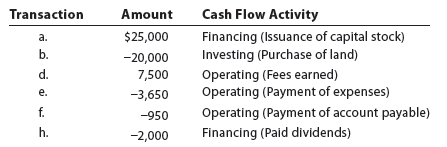
Transactions (c) and (g) are not listed above since they did not involve a cash receipt or payment. In addition, the payment of accounts payable in transaction (f) is classified as an operating activity since the account payable arose from the purchase of supplies, which are used in operations. Using the preceding classifications of November cash transactions, the statement of cash flows is prepared as shown in Exhibit 6.[2]
The ending cash balance shown on the statement of cash flows is also reported on the balance sheet as of the end of the period. To illustrate, the ending cash of $5,900 reported on the November statement of cash flows in Exhibit 6 is also reported as the amount of cash on hand in the November 30, 2013, balance sheet.
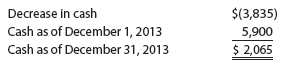
Since November is NetSolutions’ first period of operations, the net cash flow for November and the November 30, 2013, cash balance are the same amount, $5,900, as shown in Exhibit 6. In later periods, NetSolutions will report in its statement of cash flows a beginning cash balance, an increase or a decrease in cash for the period, and an ending cash balance. For example, assume that for December NetSolutions has a decrease in cash of $3,835. The last three lines of NetSolutions’ statement of cash flows for December would be as follows:
5. Interrelationships Among Financial Statements
Financial statements are prepared in the order of the income statement, retained earnings statement, balance sheet, and statement of cash flows. This order is important because the financial statements are interrelated. These interrelationships for NetSolutions are shown in Exhibit 6 and are described below.[3]
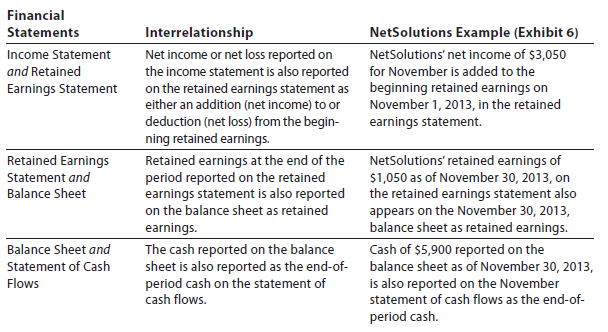
The preceding interrelationships are important in analyzing financial statements and the impact of transactions on a business. In addition, these interrelationships serve as a check on whether the financial statements are prepared correctly. For example, if the ending cash on the statement of cash flows does not agree with the balance sheet cash, then an error has occurred.
Source: Warren Carl S., Reeve James M., Duchac Jonathan (2013), Corporate Financial Accounting, South-Western College Pub; 12th edition.
The post Financial Statements appeared first on HKT Consultant.
]]>The post Financial Analysis and Interpretation: Ratio of Liabilities to Stockholders’ Equity appeared first on HKT Consultant.
]]>The relationship between liabilities and stockholders’ equity, expressed as a ratio of liabilities to stockholders’ equity, is computed as follows:

NetSolutions’ ratio of liabilities to stockholders’ equity at the end of November is

To illustrate, recent balance sheet data (in millions) for Google Inc. and McDonald’s Corporation are shown below.
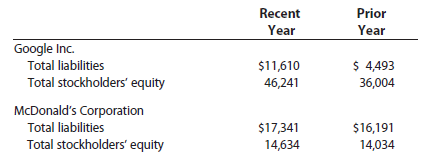
The rights of creditors to a business’s assets come before the rights of the owners or stockholders. Thus, the lower the ratio of liabilities to stockholders’ equity, the better able the company is to withstand poor business conditions and to pay its obligations to creditors.
Google is unusual in that it has a very low amount of liabilities; thus, its ratio of liabilities to stockholders’ equity of 0.25 in the recent year and 0.12 in the prior year is low. In contrast, McDonald’s has more liabilities; its ratio of liabilities to stockholders’ equity is 1.18 in the recent year and 1.15 in the prior year. Since McDonald’s ratio of liabilities to stockholders’ equity increased slightly, its creditors are slightly more at risk at the end of the recent year. Also, McDonald’s creditors are more at risk than are Google’s creditors. The creditors of both companies are, however, well protected against the risk of nonpayment.
Source: Warren Carl S., Reeve James M., Duchac Jonathan (2013), Corporate Financial Accounting, South-Western College Pub; 12th edition.
The post Financial Analysis and Interpretation: Ratio of Liabilities to Stockholders’ Equity appeared first on HKT Consultant.
]]>The post Using Accounts to Record Transactions appeared first on HKT Consultant.
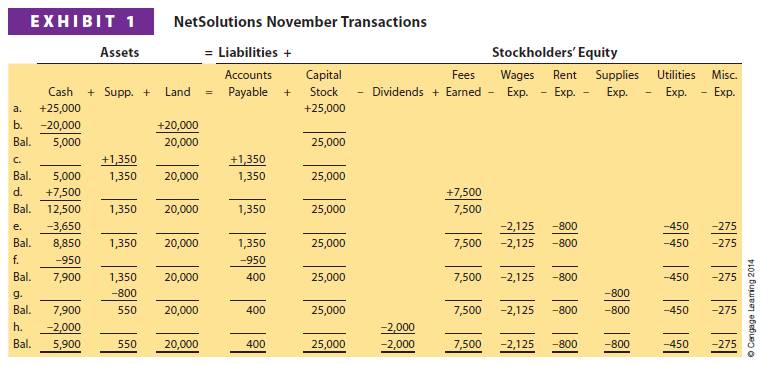
]]>To illustrate, the Cash column of Exhibit 1 records the increases and decreases in cash. Likewise, the other columns in Exhibit 1 record the increases and decreases in the other accounting equation elements. Each of these columns can be organized into a separate account.
An account, in its simplest form, has three parts.
- A title, which is the name of the accounting equation element recorded in the account.
- A space for recording increases in the amount of the element.
- A space for recording decreases in the amount of the element.
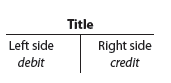
The account form presented below is called a T account because it resembles the letter T. The left side of the account is called the debit side, and the right side is called the credit side.1
The amounts shown in the Cash column of Exhibit 1 would be recorded in a cash account as follows:
The amounts shown in the Cash column of Exhibit 1 would be recorded in a cash account as follows:
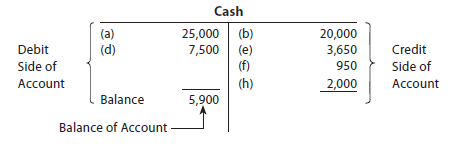
Recording transactions in accounts must follow certain rules. For example, increases in assets are recorded on the debit (left side) of an account. Likewise, decreases in assets are recorded on the credit (right side) of an account. The excess of the debits of an asset account over its credits is the balance of the account.
To illustrate, the receipt (increase in Cash) of $25,000 in transaction (a) is entered on the debit (left) side of the cash account shown above. The letter or date of the transaction is also entered into the account. This is done so if any questions later arise related to the entry, the entry can be traced back to the underlying transaction data. In contrast, the payment (decrease in Cash) of $20,000 to purchase land in transaction (b) is entered on the credit (right) side of the account.
The balance of the cash account of $5,900 is the excess of the debits over the credits as shown below.

The balance of the cash account is inserted in the account, in the Debit column. In this way, the balance is identified as a debit balance.[1] This balance represents NetSolutions’ cash on hand as of November 30, 2013. This balance of $5,900 is reported on the November 30, 2013, balance sheet for NetSolutions as shown in Exhibit 6 of Chapter 1.
In an actual accounting system, a more formal account form replaces the T account. Later in this chapter, a four-column account is illustrated. The T account, however, is a simple way to illustrate the effects of transactions on accounts and financial statements. For this reason, T accounts are often used in business to explain transactions.
Each of the columns in Exhibit 1 can be converted into an account form in a similar manner as was done for the Cash column of Exhibit 1. However, as mentioned earlier, recording increases and decreases in accounts must follow certain rules. These rules are discussed after the chart of accounts is described.
Chart of Accounts
A group of accounts for a business entity is called a ledger. A list of the accounts in the ledger is called a chart of accounts. The accounts are normally listed in the order in which they appear in the financial statements. The balance sheet accounts are listed first, in the order of assets, liabilities, and stockholders’ equity. The income statement accounts are then listed in the order of revenues and expenses.
Assets are resources owned by the business entity. These resources can be physical items, such as cash and supplies, or intangibles that have value. Examples of intangible assets include patent rights, copyrights, and trademarks. Assets also include accounts receivable, prepaid expenses (such as insurance), buildings, equipment, and land.
Liabilities are debts owed to outsiders (creditors). Liabilities are often identified on the balance sheet by titles that include payable. Examples of liabilities include accounts payable, notes payable, and wages payable. Cash received before services are delivered creates a liability to perform the services. These future service commitments are called unearned revenues. Examples of unearned revenues include magazine subscriptions received by a publisher and tuition received at the beginning of a term by a college.
Stockholders’ equity is the stockholders’ right to the assets of the business. Stockholders’ equity is represented by the balance of the capital stock and retained earnings accounts. A dividends account represents distributions of earnings to stockholders.
Revenues are increases in stockholders’ equity as a result of selling services or products to customers. Examples of revenues include fees earned, fares earned, commissions revenue, and rent revenue.
Expenses result from using up assets or consuming services in the process of generating revenues. Examples of expenses include wages expense, rent expense, utilities expense, supplies expense, and miscellaneous expense.
A chart of accounts should meet the needs of a company’s managers and other users of its financial statements. The accounts within the chart of accounts are numbered for use as references. A numbering system is normally used, so that new accounts can be added without affecting other account numbers.
Exhibit 2 is NetSolutions’ chart of accounts that is used in this chapter. Additional accounts will be introduced in later chapters. In Exhibit 2, each account number has two digits. The first digit indicates the major account group of the ledger in which the account is located. Accounts beginning with 1 represent assets; 2, liabilities; 3, stockholders’ equity; 4, revenue; and 5, expenses. The second digit indicates the location of the account within its group.
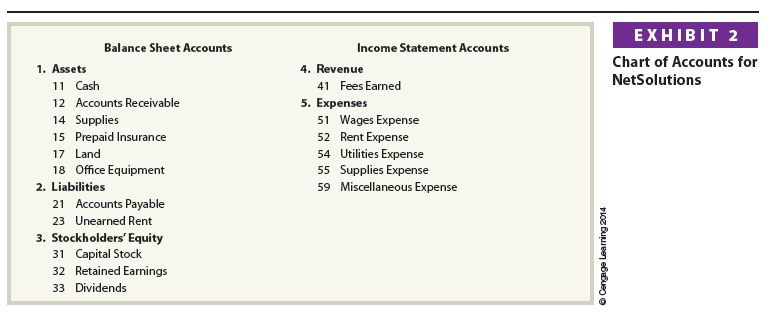
Each of the columns in Exhibit 1 has been assigned an account number in the chart of accounts shown in Exhibit 2. In addition, Accounts Receivable, Prepaid Insurance, Office Equipment, and Unearned Rent have been added. These accounts will be used in recording NetSolutions’ December transactions.
Source: Warren Carl S., Reeve James M., Duchac Jonathan (2013), Corporate Financial Accounting, South-Western College Pub; 12th edition.
The post Using Accounts to Record Transactions appeared first on HKT Consultant.
]]>The post Double-Entry Accounting System appeared first on HKT Consultant.
]]>- Every business transaction to be recorded in at least two accounts.
- The total debits recorded for each transaction to be equal to the total credits recorded.
The double-entry accounting system also has specific rules of debit and credit for recording transactions in the accounts.
1. Balance Sheet Accounts
The debit and credit rules for balance sheet accounts are as follows:

2. Income Statement Accounts
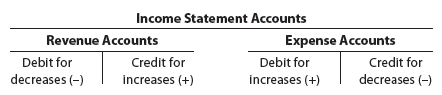
The debit and credit rules for income statement accounts are based on their relationship with stockholders’ equity. As shown on page 55, stockholders’ equity accounts are increased by credits. Since revenues increase stockholders’ equity (retained earnings), revenue accounts are increased by credits and decreased by debits. Since stockholders’ equity (retained earnings) accounts are decreased by debits, expense accounts are increased by debits and decreased by credits. Thus, the rules of debit and credit for revenue and expense accounts are as follows:
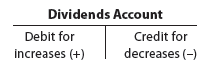
3. Dividends
The debit and credit rules for recording dividends are based on the effect of dividends on stockholders’ equity (retained earnings). Since dividends decrease stockholders’ equity (retained earnings), the dividends account is increased by debits. Likewise, the dividends account is decreased by credits. Thus, the rules of debit and credit for the dividends account are as follows:
4. Normal Balances
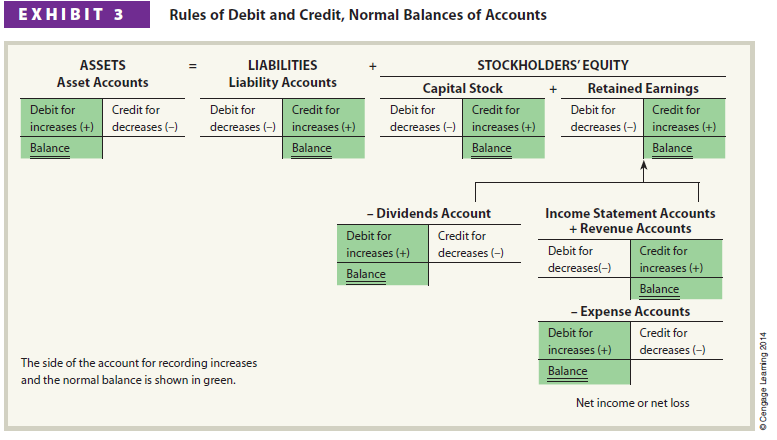
The sum of the increases in an account is usually equal to or greater than the sum of the decreases in the account. Thus, the normal balance of an account is either a debit or credit depending on whether increases in the account are recorded as debits or credits. For example, since asset accounts are increased with debits, asset accounts normally have debit balances. Likewise, liability accounts normally have credit balances.
The rules of debit and credit and the normal balances of the various types of accounts are summarized in Exhibit 3. Debits and credits are sometimes abbreviated as Dr. for debit and Cr. for credit.
When an account normally having a debit balance has a credit balance, or vice versa, an error may have occurred or an unusual situation may exist. For example, a credit balance in the office equipment account could result only from an error. This is because a business cannot have more decreases than increases of office equipment. On the other hand, a debit balance in an accounts payable account could result from an overpayment.
5. Journalizing
Using the rules of debit and credit, transactions are initially entered in a record called a journal. In this way, the journal serves as a record of when transactions occurred and were recorded. To illustrate, the November transactions of NetSolutions from Chapter 1 are used.
Transaction A Nov. 1 Chris Clark deposited $25,000 in a bank account in the name of NetSolutions in exchange for capital stock.
This transaction increases an asset account and increases an stockholders’ Analysis equity account. It is recorded in the journal as an increase (debit) to Cash and an increase (credit) to Capital Stock.
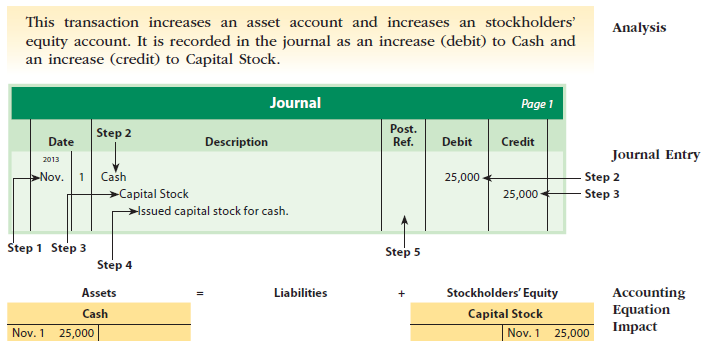
The transaction is recorded in the journal using the following steps:
Step 1. The date of the transaction is entered in the Date column.
Step 2. The title of the account to be debited is recorded in the left-hand margin under the Description column, and the amount to be debited is entered in the Debit column.
Step 3. The title of the account to be credited is listed below and to the right of the debited account title, and the amount to be credited is entered in the Credit column.
Step 4. A brief description may be entered below the credited account.
Step 5. The Post. Ref. (Posting Reference) column is left blank when the journal entry is initially recorded. This column is used later in this chapter when the journal entry amounts are transferred to the accounts in the ledger.
The process of recording a transaction in the journal is called journalizing. The entry in the journal is called a journal entry.
The following is a useful method for analyzing and journalizing transactions:
- Carefully read the description of the transaction to determine whether an asset, a liability, a stockholders’ equity, a revenue, an expense, or a dividends account is affected.
- For each account affected by the transaction, determine whether the account increases or decreases.
- Determine whether each increase or decrease should be recorded as a debit or a credit, following the rules of debit and credit shown in Exhibit 3.
- Record the transaction using a journal entry.
The following table summarizes terminology that is often used in describing a transaction along with the related accounts that would be debited and credited.
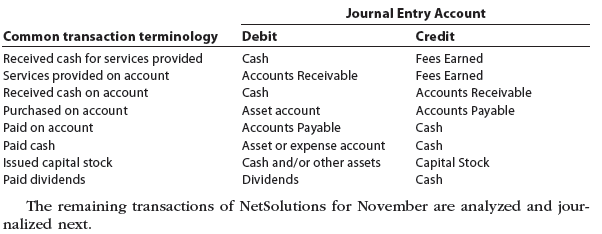
The remaining transactions of NetSolutions for November are analyzed and journalized next.
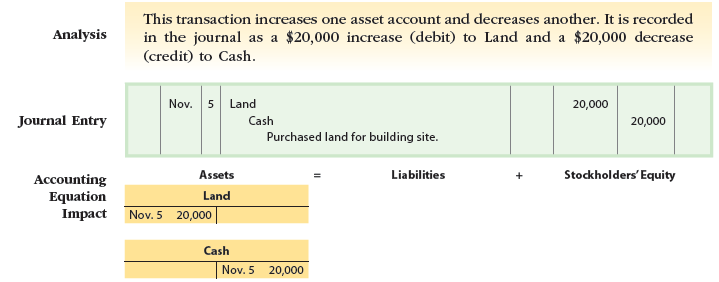
Transaction B Nov. 5 NetSolutions paid $20,000for the purchase of land as a future building site.
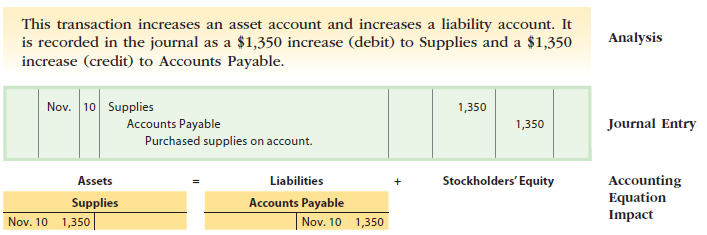
Transaction C Nov. 10 NetSolutions purchased supplies on account for $1,350.
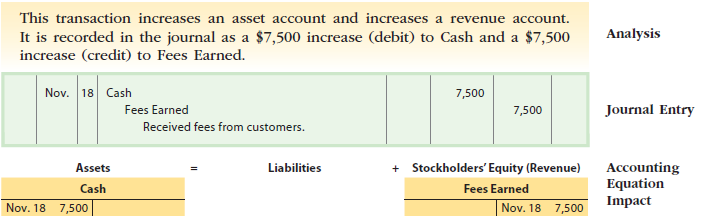
Transaction D Nov. 18 NetSolutions received cash of $7,500from customers for services provided.
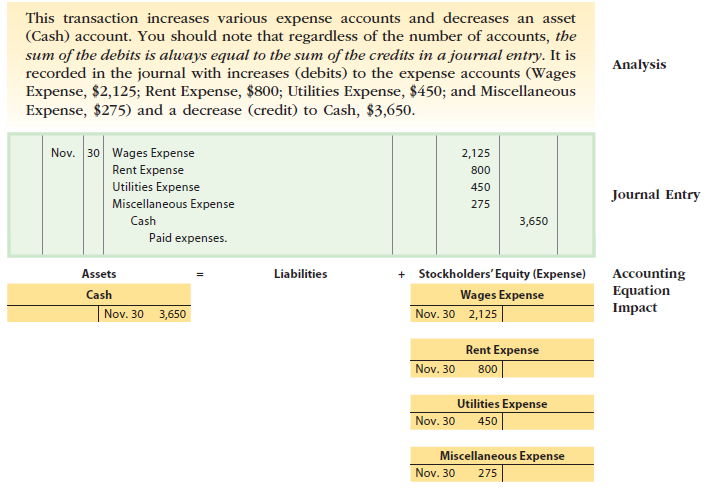
Transaction E Nov. 30 NetSolutions incurred the following expenses: wages, $2,125; rent, $800; utilities, $450; and miscellaneous, $275.
Transaction F Nov. 30 NetSolutions paid creditors on account, $950.
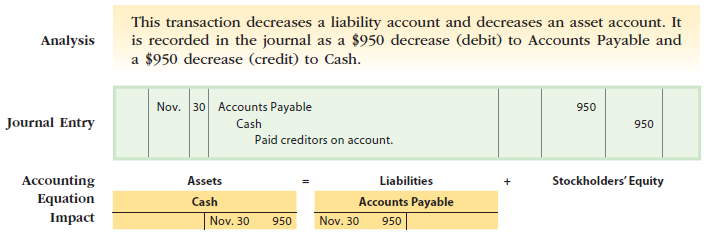
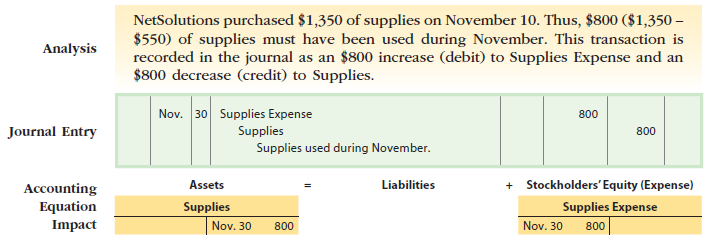
Transaction G Nov. 30 Chris Clark determined that the cost of supplies on hand at November 30 was $550.
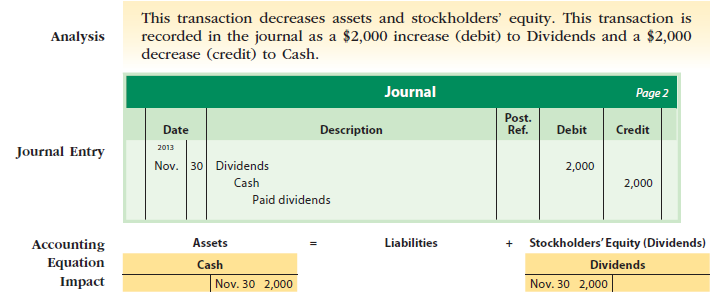
Transaction H Nov. 30 NetSolutions paid $2,000 to stockholders (Chris Clark) as dividends.
Source: Warren Carl S., Reeve James M., Duchac Jonathan (2013), Corporate Financial Accounting, South-Western College Pub; 12th edition.
The post Double-Entry Accounting System appeared first on HKT Consultant.
]]>The post Posting Journal Entries to Accounts appeared first on HKT Consultant.
]]>The December transactions of NetSolutions are used to illustrate posting from the journal to the ledger. By using the December transactions, an additional review of analyzing and journalizing transactions is provided.
Transaction Dec. 1 NetSolutions paid a premium of $2,400 for an insurance policy for liability, theft, and fire. The policy covers a one-year period.
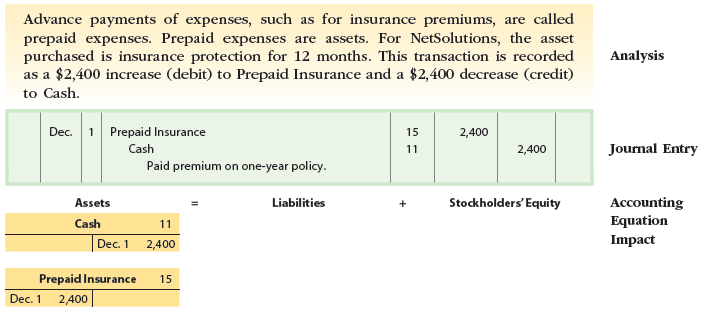
The posting of the preceding December 1 transaction is shown in Exhibit 4. Notice that the T account form is not used in Exhibit 4. In practice, the T account is usually replaced with a standard account form similar to that shown in Exhibit 4.
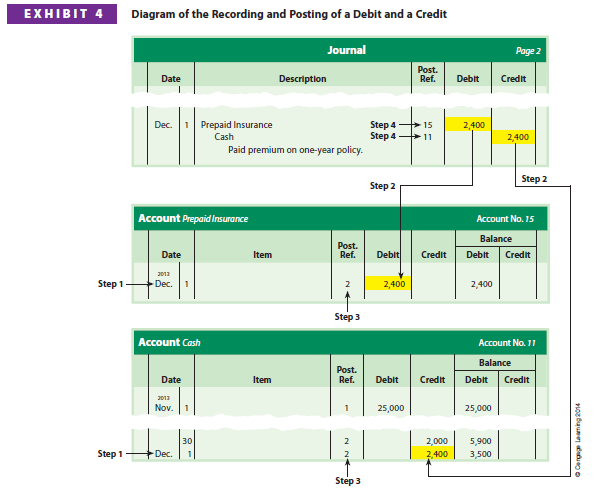
The debits and credits for each journal entry are posted to the accounts in the order in which they occur in the journal. To illustrate, the debit portion of the December 1 journal entry is posted to the prepaid account in Exhibit 4 using the following four steps:
Step 1. The date (Dec. 1) of the journal entry is entered in the Date column of Prepaid Insurance.
Step 2. The amount (2,400) is entered into the Debit column of Prepaid Insurance.
Step 3. The journal page number (2) is entered in the Posting Reference (Post. Ref.) column of Prepaid Insurance.
Step 4. The account number (15) is entered in the Posting Reference (Post. Ref.) column in the journal.
As shown in Exhibit 4, the credit portion of the December 1 journal entry is posted to the cash account in a similar manner.
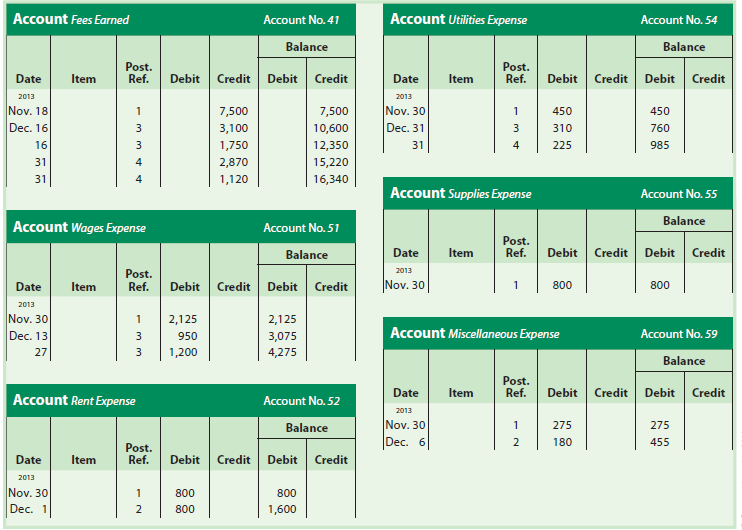
The remaining December transactions for NetSolutions are analyzed and journalized in the following paragraphs. These transactions are posted to the ledger in Exhibit 5 on pages 69–70. To simplify, some of the December transactions are stated in summary form. For example, cash received for services is normally recorded on a daily basis. However, only summary totals are recorded at the middle and end of the month for NetSolutions.
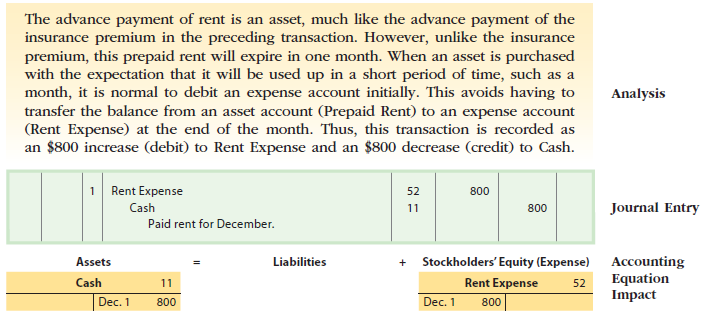
Transaction Dec. 1 NetSolutions paid rent for December, $800. The company from which NetSolutions is renting its office space now requires the payment of rent on the first of each month, rather than at the end of the month.
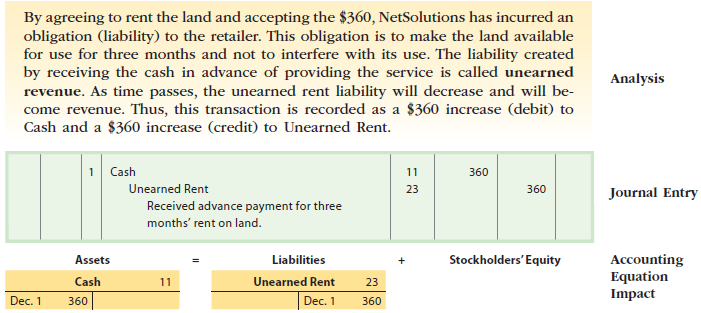
Transaction Dec. 1 NetSolutions received an offer from a local retailer to rent the land purchased on November 5. The retailer plans to use the land as a parking lot for its employees and customers. NetSolutions agreed to rent the land to the retailer for three months, with the rent payable in advance. NetSolutions received $360for three months’ rent beginning December 1.
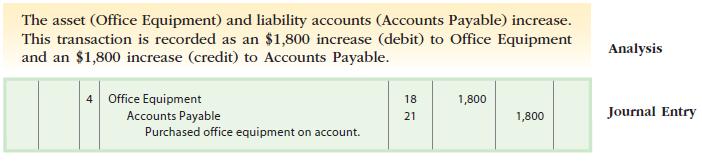
Transaction Dec. 4 NetSolutions purchased office equipment on account from Executive Supply Co. for $1,800.

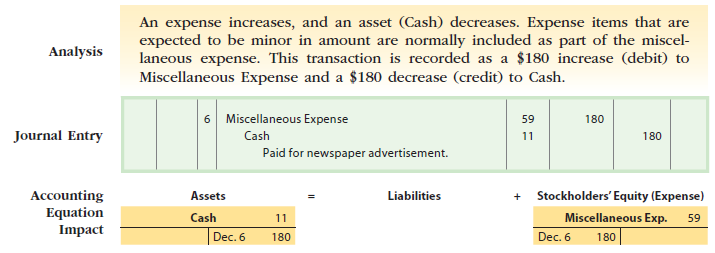
Transaction Dec. 6 NetSolutions paid $180 for a newspaper advertisement.
An expense increases, and an asset (Cash) decreases. Expense items that are expected to be minor in amount are normally included as part of the miscellaneous expense. This transaction is recorded as a $180 increase (debit) to Miscellaneous Expense and a $180 decrease (credit) to Cash.
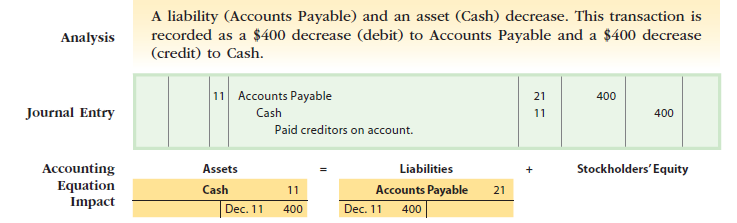
Transaction Dec. 11 NetSolutions paid creditors $400.
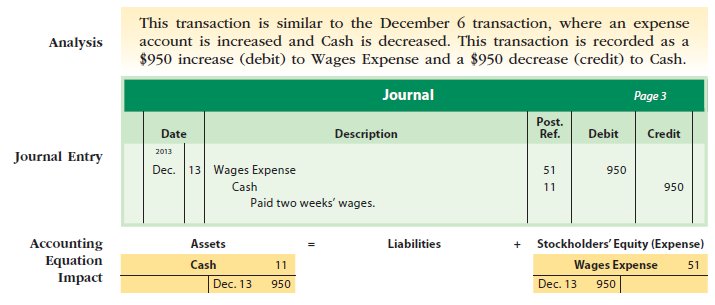
Transaction Dec. 13 NetSolutions paid a receptionist and a part-time assistant $950for two weeks’ wages.
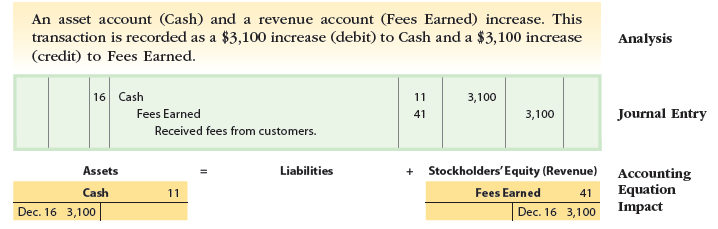
Transaction Dec. 16 NetSolutions received $3,100 from fees earned for the first half of December.
Transaction Fees earned on account totaled $1,750 for the first half of December.
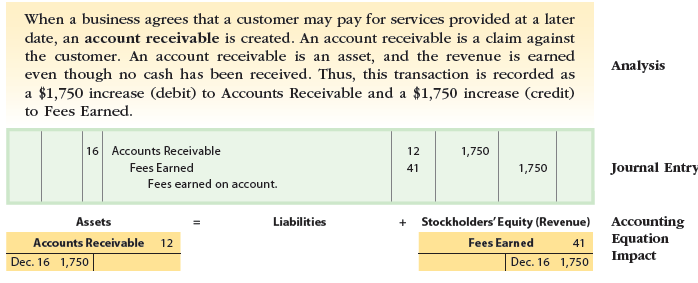
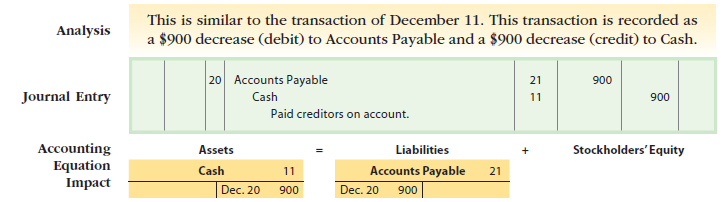
Transaction Dec. 20 NetSolutions paid $900 to Executive Supply Co. on the $1,800 debt owed from the December 4 transaction.
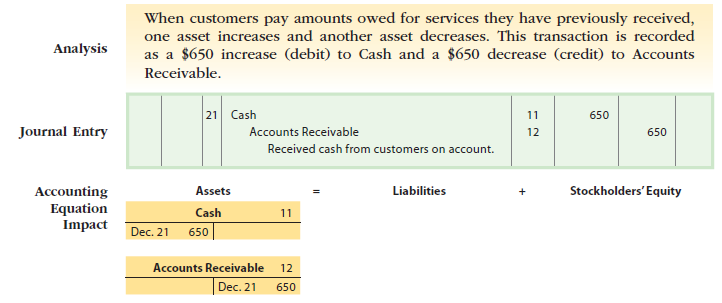
Transaction Dec. 21 NetSolutions received $650 from customers in payment of their accounts.
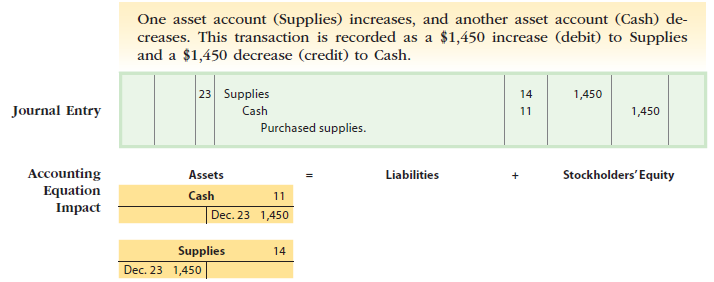
Transaction Dec. 23 NetSolutions paid $1,450for supplies.
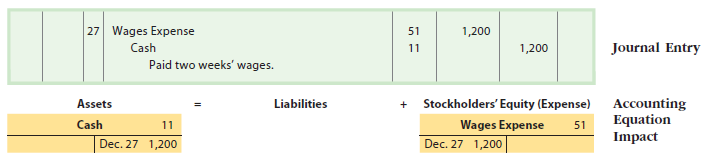
Transaction Dec. 27 NetSolutions paid the receptionist and the part-time assistant $1,200 for two weeks’ wages.

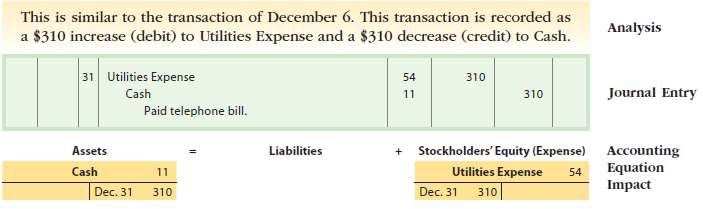
Transaction Dec. 31 NetSolutions paid its $310 telephone bill for the month.
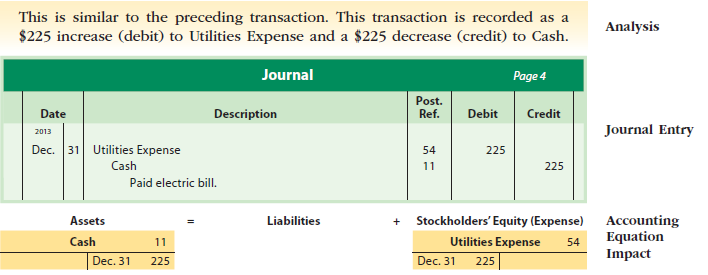
Transaction Dec. 31 NetSolutions paid its $225 electric bill for the month.
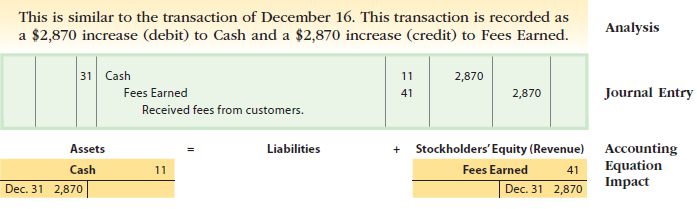
Transaction Dec. 31 NetSolutions received $2,870 from fees earned for the second half of December.
Transaction Dec. 31 Fees earned on account totaled $1,120 for the second half of December.
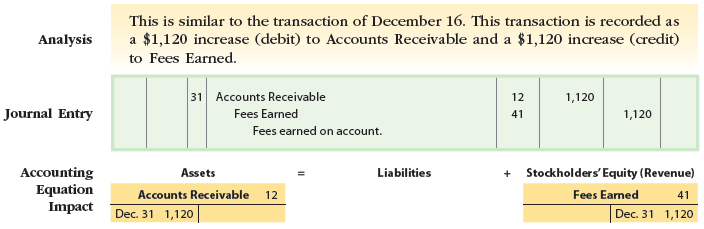
Transaction Dec. 31 Paid dividends of $2,000.
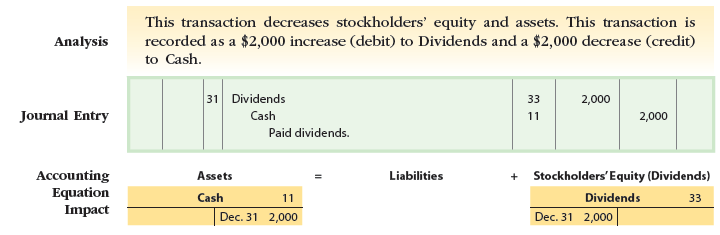
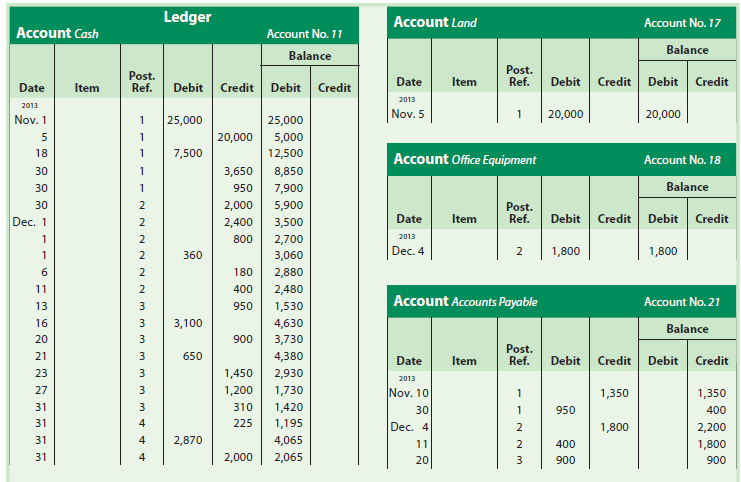
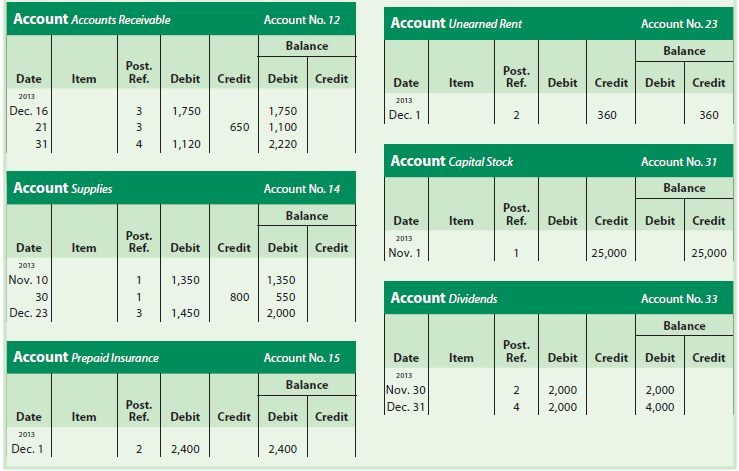
Exhibit 5 shows the ledger for NetSolutions after the transactions for both November and December have been posted.
Source: Warren Carl S., Reeve James M., Duchac Jonathan (2013), Corporate Financial Accounting, South-Western College Pub; 12th edition.
The post Posting Journal Entries to Accounts appeared first on HKT Consultant.
]]>