The post Logistics Management: meaning, functions, importance, process and best practices appeared first on HKT Consultant.
]]>In simple terms, the goal of logistics management is to have the right amount of a resource or input at the right time, getting it to the appropriate location in proper condition, and delivering it to the correct internal or external customer. Logistics managers are referred to as logisticians. Logistic resources, such as tanks, pipelines, and ships, have the main objective of making products, equipment, and raw material flow easier throughout processes to maximize profits. Logistics activities typically include inbound and outbound transportation management, fleet management, warehousing, materials handling, order fulfillment, logistics network design, inventory control, supply/demand planning and management of third-party logistics services providers.
To varying degrees, logistics functions include customer service, sourcing and procurement, production planning and scheduling, packaging, and assembly. Logistics management is part of all the levels of planning and execution, including strategic, operational and tactical. Further, it coordinates all the logistics activities, and it integrates logistics activities with other functions, including marketing, sales, manufacturing, finance and information technology.
Main contentsSee more from basic to advanced


The post Logistics Management: meaning, functions, importance, process and best practices appeared first on HKT Consultant.
]]>The post Logistics Defined appeared first on HKT Consultant.
]]>Logistics is also referred to as a physical distribution. Philip Kotler defines logistics as “Planning, implementing, and controlling the physical flows of materials and finished goods from point of origin to point of use to meet the customer’s need at a profit.”1 The American Council of Logistics Management defines logistics as “the process of planning, implementing and controlling the efficient, cost effective flow and storage of raw materials, in-process inventory, finished goods and related information from point of origin to point of consumption for the purpose of conforming to customers’ requirements.”2
Logistics management is basically an integrative process which optimizes the flow of materials and supplies through an organization and its operations to the customer. Martin Christopher says that “logistics is essentially a planning process and an information-based activity.”3 It is also described by Philip Scary as “the corporate traffic cop” directing flow of material from the source through production and distribution to the final customer. The ultimate objective of a logistics function is to support corporate goals by delivering products to the consumer at the time and place of his choice. However, this objective must be balanced against the cost of providing service.
Source: Sople V.V (2013), Logistics Management, Pearson Education India; Third edition.
The post Logistics Defined appeared first on HKT Consultant.
]]>The post Scope of Logistics appeared first on HKT Consultant.
]]>It is evident from Table 1.1 that it costs nearly USD 150 billion to move material from one user to another in India. The key issues are freights and inventory management. A country’s public distribution system needs logistical support to deliver the goods to the right place at the right time for the lowest possible cost. At micro level, logistics plays a critical role in the value delivery system of a business organization to provide a superior customer service. Hence, the mission of a logistical system is to achieve the desired level of delivered service and quality at the lowest possible cost. The scope of logistics covers management of material procurement through manufacturing to delivery of finished products to the consumer. In a nutshell, any productivity improvement that could be achieved in any part of a logistics system, whether at macro or micro levels, would help in cost reduction and proper deployment of scarce national resources to a productive purpose.

PERVASIVENESS OF LOGISTICS
1. Logic in Logistics for 30-Minutes Pizza
Ideally, the time taken for registering the order should be one minute. After that the pizza goes to the guy in the “make line.” He takes two minutes, and then oven time is five minutes. When the pizza comes out of the oven it is inspected. One minute goes into quality check and packing. Another minute goes in checking the route and confirming the order one last time.
The moment he is leaving, the delivery boy shouts the out-of-the-door time, which is normally between 10 and 12 minutes. Then everybody yells out “drive safe.” When he returns he punches the time in. At the end of the day the average delivery time for all his orders is checked. This helps the manager figure out which orders were not delivered in time. The next day, the store manager calls each one of those whose orders got delayed and apologizes.
The essence is process sequencing, just-in-time inventory availability, and time management for the success in this service operations logistics.
Source: http://www. agencyfaqs.com/news/interviews/data/68.html
2. Twenty-Four Hour ATM
An ATM (automatic teller machine) is not a novelty today. Invariably, all major banks in India started this service as a part of the retail finance drive. In fact, foreign banks operating in India were the pioneers in ATMs in India. However, the lead taken by ICICI, HDFC, and Citi Bank gave the face-lift to the ATM concept, as a result of which it has witnessed an exponential growth to over 75000 numbers in 2011. The success of ATMs depend on the effectiveness of the networking. The logistics supply chain for the currency notes needs to be very efficient so as to ensure the availability of the currency notes at the stroke of a button. An ATM is a service product having perishability as the basic characteristic, which needs to be looked into to satisfy the “any time” cash need of the customer who is time starved. The other logistics aspect is the information on the credit limits available to the customer at any point of cash withdrawal. Data warehousing and data mining with automatic updating for real-time information on credit worthiness are the other essential support systems required for processing the customer request for cash withdrawal. E-business solution takes care of the complex transaction processes involved in ATM operations.
3. Dabbawalas of Mumbai
Dabbawalas of Mumbai offer a reliable foolproof logistics system of delivering lunch boxes to over 200,000 office employees every day without mix up of having the wrong tiffin going to the wrong office or arriving late, irrespective of conditions such as rains, strikes, and scorching heat. A team of around 5000 men and women, mostly illiterate, operate in assigned areas in Mumbai, each handling 25-30 dabbas, which is the optimum lot size as more could create confusion and affect promptness, which will lead to customer dissatisfaction. The dabbas are collected from the houses and put in tiffin racks at a network of 96 railway stations all over Mumbai to load into the train for further movement toward delivery points. They use a colour code system on the dabbas to identify the collection and delivery points. After the lunch hour, the system operates in reverse direction, again displaying accuracy with collection and quality of delivery closer to Six Sigma. This system gives a much cheaper alternative to office workers than having their food in restaurants and food joints. With this logistics system, 400,000 transactions are done daily with the precision of Six Sigma accuracy.
Source: Information adapted from MyDabbawala.com.
4. Laundry Service in Five Star Hotels
The laundry service in a five star hotels is a very simple service operation that does not use any sophisticated software tools. At 10 a.m., the housekeeping department collects the laundry from 210 rooms of a 300-room hotel operating at 70 per cent occupancy. The laundry is divided into three parts; staff uniforms, room laundry (bed sheets, pillow covers), and guest clothes. Special attention is given to the guest’s clothes for same-day or express delivery. Every single piece of clothing is allotted an identification code, and the information is punched into the computer for tracking, processing, and final delivery. The entire laundry is handed over to the laundry service supplier, who collects the laundry in the morning and delivers to the housekeeping department in the evening per the customers’ requirements. This is a simple but effective laundry logistics operation of a hotel housekeeping department that leads to customer satisfaction.
5. Indian Postal Service
Indian Postal Service is one of the largest logistics networks in the world today that delivers the letters in the most cost-effective way. The Indian Postal Service operates through a network of 1,54,973 post offices covering 6,09,030 villages, towns, and cities across the country, delivering 3000 million letters every year. They use all transportation modes available in India for movement of postal cargo. The collection of letters from 5,79,595 letter boxes, followed by sorting, packing, moving, unpacking, and again sorting for final delivery is a mammoth logistical task that they have performed cost effectively for the past one and a half centuries.
Source: http://www. indiapost.gov. in
6. Gulf War in 1991
After World War II, the 1991 Gulf War was the largest military operation, lasting for four days. The planning process of logistics operations was initiated many months before the actual war started. It involved the movement of over 1,25,000 ground troops to defend the area, stretching to 175 km long and 300 km deep in the Saudi Arabian desert. Around 500 tactical cargo trucks and 200 wheeled vehicles moved into place within the short time frame of two weeks. The ammunition of 35,000 tonnes, fuel of 5.6 million gallons, rations of 2 million meals, and drinking water of 1 million gallons were made available at the appropriate time during the war operations. Entire logistics operations were based on information flow, which was based on excellent communication connectivity across the supply chain using the latest technology. The status of material, food, maintenance, and manpower to individual supply chain centres was reported on a daily basis to organize and facilitate speedy replenishment from the United States and bases in Europe. The logistics involved were of mammoth scale. However, efficiency and effectiveness of logistics operations contributed greatly to the success of the winners.
Source: http://ibib.cfc.dnd.ca, http://en.wikipedia.org
7. Public Distribution System
Food Corporation of India (FCI), a government undertaking, is handling the massive logistics operations of the procurement, storage, and distribution of foodgrains throughout the country. FCI moves around 22 million tonnes of foodgrains over the distance of 1500 km per annum. On an average, 4,00,000 bags are transported by rail, road, and inland water from the point of production to the point of consumption for distribution across 4,50,000 fair price shops spread across the country. On an average, FCI is storing over 23 million tonnes of grains in 1700 warehouses, which are near the consumption centres at various locations in the country.
Source: Sople V.V (2013), Logistics Management, Pearson Education India; Third edition.
The post Scope of Logistics appeared first on HKT Consultant.
]]>The post Logistics – A System Concept appeared first on HKT Consultant.
]]>The concept of logistics is based on the system approach. The flow of material from a supplier to a manufacturing plant and finally to the end customer is viewed as a single chain, ensuring efficiency and effectiveness in sequential activities to achieve the objective of customer satisfaction at a reduced cost. Logistics recognizes that all the activities of material movement across the business process are interdependent and need close coordination. These activities are to be managed as a system and not as functional silos. The functional areas of logistics, termed “Logistics Mix” by Martin Christopher,4 consist of:
Information Flow
- Order registration
- Order checking and editing
- Order processing
- Coordination
Warehousing
- Material storage
- Load unitizing and material handling
- Site selection and network planning
- Order picking and filling
- Dispatch documentation
Inventory Control
- Material requirement planning
- Inventory level decisions for customer service objectives
Packaging
- For handling and damage prevention
- For communication
- For inter-modal transportation
Transportation
- Route planning
- Mode selection
- Vehicle scheduling
The objective of logistics is to facilitate the flow of material across the supply chain of an enterprise so as to cost effectively make available the right product at the right place at the right time. Logistics has to achieve the two polemic goals of customer satisfaction and least cost. This is possible only when all the logistics functions are working as a unified system to achieve the common goal.
Source: Sople V.V (2013), Logistics Management, Pearson Education India; Third edition.
The post Logistics – A System Concept appeared first on HKT Consultant.
]]>The post Customer Value Chain from Logistics appeared first on HKT Consultant.
]]>- Globalization
- Focus on supply chain management
- Outsourcing of non-core-competency functional areas
The entire world has become a global village for the marketers because of the liberalization of economies of countries and the emergence of World Trade Organization (WTO), which is forcing the business organizations to supply products beyond the national boundary wherever there is a market opportunity. In such a situation, the role of logistics will include providing the time and place utility of the products to the customers.
Businesses across the world are striving to be competitive. Business organizations are struggling not only for growth but also for survival. In the process, the focus has changed to the supply chain; that is, integrating a process of procurement, processing, and distribution with one thread to deliver the value to the customer. Logistics plays a key role in the value delivery process, and the success of supply chain management greatly depends on logistics planning and its support.
Outsourcing is becoming an acceptable trend in business. Corporations have realized that doing everything by themselves does not result in effective and efficient use of the scarce resources available to them. It is better to outsource the functional areas to an expert who can do the job at the least cost and can bring effectiveness and efficiency to the operations. Logistics is an area in which a majority of the business organizations have no core competency, and hence it needs to be outsourced for operating effectiveness and efficiencies. Today, logistics is shaped into a separate service industry offering complete customized logistics solutions specific to products, shipments, customers, or markets.
Michel Porter was the first commentator to highlight the need for business organizations to understand that competitive success could only come through cost leadership or by offering differentiated product and services. Costs can be reduced by an effective logistics management, which will also enhance the differentiation through superior customer service. As shown in Figure 1.1, the value chain activities of a firm can be categorized into primary activities consisting of inbound logistics; operations; outbound logistics; marketing, sales, and services; and support activities such as infrastructure, human resource management, technology development, and procurement.

Logistics delivers value to the customer through three logistical phases:
- Inbound logistics—Operations preceding the manufacturing. This includes movement of raw materials and components for processing from suppliers.
- Process logistics—Operations directly related to processing. This includes storage and movement of raw materials and components within the manufacturing premises per the manufacturing schedules. The inventory management of stored materials and in-process goods is part of process logistics.
- Outbound logistics—Operations following the production process. This includes the warehousing, transportation, and inventory management of finished products.
In all above categories of logistics, both physical flows of products from a raw material supplier to the end customer in the forward direction and flow of information from market to the raw material supplier in the reverse direction are monitored and controlled.
Logistics cost break-up in the above three categories shows a larger percentage in outbound logistics and in component-wise, transportation (see Table 1.2) covers the larger proportion.
The total logistics cost as percentage of the sales differs with product categories. For low unit value mass distributed products, the logistics cost may be 30-40 per cent of the sales value, which in the case of high value engineering items may not exceed 5-8 per cent. With proper systems and controls, the logistical cost, which will be ultimately loaded on to the product and borne by the customer, can be reduced, and the benefits can be passed on to the customer by way of value addition through a combination of price, quality, and service.

Source: Sople V.V (2013), Logistics Management, Pearson Education India; Third edition.
The post Customer Value Chain from Logistics appeared first on HKT Consultant.
]]>The post Logistics Functions appeared first on HKT Consultant.
]]>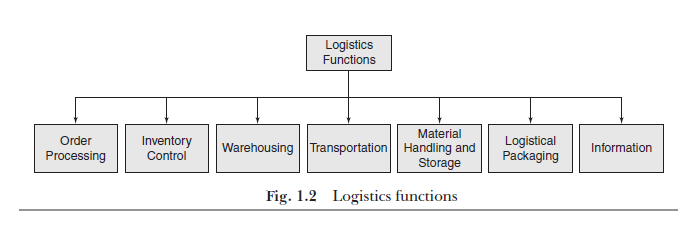
1. Order Processing
It is an important task in logistics operations. The purchase order placed by a buyer to a supplier is an important legal document of the transactions between the two parties. This document incorporates the description or technical details of the product to supply, price, delivery period, payment terms, taxes, and other commercial terms as agreed. The processing of this document is important as it has a direct relationship with the order or the performance cycle time, which indicates the time when the order is received and when the material is received by the customer. The order processing activity consists of the following steps:
- Order checking for any deviations in agreed-upon or negotiated terms
- Prices, payment, and delivery terms
- Checking the availability of materials in stocks
- Production and material scheduling for shortages
- Acknowledging the order indicating deviations, if any
The above process consumes more time if paperwork is involved. If the processing of the order is slow and complicated, it will have a direct effect on the delivery period committed. It may increase the transportation cost in order to deliver the material faster to compensate for the delays in the order processing operation.
Order processing is a routine operation but requires a great deal of planning, training of people involved, and investment in the system to bring efficiency and accuracy to it. In a large organization where thousands of orders are received each day, it becomes impossible to manually register the order and process the order quickly and correctly. In such a situation, a system capable of handling such voluminous work with minimum or no human involvement is a necessity. In addition, due to competitive pressure, the order fulfilment cycle has to be shortened to have an edge over the rival firms for retaining the customers. The only solution is to devise an order processing system ensuring efficiency and accuracy, but with minimal investment costs.
2. Inventory Management
Inventory management is to keep enough inventory stocks to meet customer requirements, and simultaneously its carrying cost should be the lowest. It is basically an exercise of striking a balance between the customer service for not losing market opportunity and the cost to meet the same. The inventory is the greatest culprit in the overall supply chain of a firm because of its huge carrying cost, which indirectly eats away the profits. It consists of the cost of financing the inventory, insurance, storage, losses, damages, and pilferages. The average cost of carrying inventory varies from 10 to 25 per cent of the total inventory per year depending on the products. In the case of perishable products, it is on the higher side. Even though inventory is a major concern, without it a firm cannot meet the regular and timely product requirements of its customers.
There are two approaches to inventory management: one is cost approach and the other is customer satisfaction. Business firms try to strike a balance between the two. Due to advance communications and computing facilities, some business firms in business-to-business (B2B) markets are operating on a zero-inventory level by adopting the JIT (just-in-time) technique. But this is possible with co-partnership between the purchaser and the supplier, and they communicate on a real-time basis.
3. Warehousing
Warehousing is the storing of finished goods until they are sold. It plays a vital role in logistics operations of a firm. The effectiveness of an organization’s marketing depends on the appropriate decision on warehousing. In today’s context, warehousing is treated as a switching facility rather than a storage place. It is a major cost centre, and many problems at the customer end are directly a result of improper warehousing management. Warehousing is the key decision area in logistics. The major decisions in warehousing are:
- Location of warehousing facilities
- Number of warehouses
- Size of the warehouse
- Warehouse layout
- Design of the building
- Ownership of the warehouse
Warehousing is an important component of logistics as it is directly linked to the ability of a firm to deliver the desired level of customer service. The ownership of a warehouse is private, public, or contractual. Each has advantages and disadvantages associated with it, and a firm has to choose the best options depending on its objectives and the resources available. However, the decision on warehousing requires proper planning and analysis, as well as help from experts in real estate, industrial engineering, and operations research.
4. Transportation
For movement of goods from the supplier to the buyer, transportation is the most fundamental and important component of logistics. When an order is placed, the transaction is not complete till the goods are physically moved to the customer’s place. The physical movement of goods is through various transportation modes. For low unit value products, the transportation cost component is 20 per cent of the product cost. In logistics costs, its share varies from 65 to 70 per cent in the case of mass-consumed, very low unit-priced products.
Firms choose the mode of transportation depending on the infrastructure of transportation in the country or region, Cost is the most important consideration in the selection of a particular mode of transport. However sometimes urgency of the goods at the customer end overrides the cost consideration, and the goods are sent through the fastest mode, which is an expensive alternative.
The consideration of whether the firm should have its own fleet or go in for outsourcing depends on investment, operating costs, expertise, and reliability. The common modes available are road carriers, railways, airways, ships, pipelines, and ropeways. Depending on the customer requirements and the availability of transportation infrastructure and its reach and cost, firms decide on the mode with an optimum cost under the given product-market conditions.
5. Material Handling and Storage System
The speed of the inventory movement across the supply chain depends on the material handling methods. An improper method of material handling will add to the product damages and delays in deliveries and incidental overheads. Mechanization and automation in material handling enhance the logistics system productivity. Other considerations for selection of a material handling system are the volumes to be handled, the speed required for material movement, and the level of service to be offered to the customer.
The storage system is important for maximum space utilization (floor and cubic) in the given size of a warehouse. The material handling system should support the storage system for speedy movement (storage and retrieval) of goods in and out of the warehouse.
6. Logistical Packaging
Logistical or industrial packaging is a critical element in the physical distribution of a product, which influences the efficiency of the logistical system. It differs from product packaging, which is based on marketing objectives. However, logistical packaging plays an important role in damage protection, ease in material handling, and storage space economy. The unitization of load has a major bearing on logistical packaging with regard to the packaging cost.
7. Information
Logistics is basically an information-based activity of inventory movement across a supply chain. Hence, an information system plays a vital role in delivering a superior service to the customers.
Use of IT tools for information identification, access, storage, analysis, retrieval, and decision support in logistics is helping business firms to enhance their competitiveness.
Source: Sople V.V (2013), Logistics Management, Pearson Education India; Third edition.
The post Logistics Functions appeared first on HKT Consultant.
]]>The post Logistics for Business Excellence appeared first on HKT Consultant.
]]>- Integration of logistics into the business
- Integration of components of logistics
Any business process consists of a set of activities that include raw material procurement, conversion, and the distribution of finished products for selling. To accomplish the objective of making available the right product at the right place and at the right time with less cost, the help of another process called logistics is needed to take care of the material storage and movement across three stages of a business process. The objectives of the business will not be achieved unless logistics is integrated into the business process. The integration will make the business process run as a chain rather than isolated process elements. The logistics process is a set consisting of a number of activities, including warehousing, material handling, storage, packaging, transportation, and information flow (see Figure 1.3).
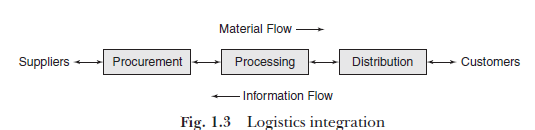
For a logistics operation to run smoothly, proper integration among the components of the logistics process is imperative. The efficiency and effectiveness of the entire system depend on how individual elements get coordinated and work as a system and not as functional silos.
In an integrated logistics process, a close coordination between inventory flow and information flow is essential for system efficiency and effectiveness. For a manufacturer, the inventory flow starts after the material is shipped from a supplier to the processing or manufacturing centre and ends with the delivery of the finished product to the customer or user. In the case of a retailer, the logistics process starts after the material is dispatched from the manufacturer or wholesaler and ends with final delivery to the user. The volume of logistical activities varies with the width of the supply chain, the product category, and the volume of the business.
In a business process, there is continuous value addition at each stage of inventory transformation until it is finally delivered to the customer. Logistics supports the value creation process and hence it requires continuous attention of the management. For the focused attention, logistics activities can broadly be divided into three areas of business operations wherein the logistics needs are quite different.
1. Procurement
It is also known as buying or purchasing activity. The material movement from suppliers to the buyer comes under the purview of inbound logistics. The raw material, components, parts, and
consumables required for manufacturing operations should be available at the plant at the start of production schedules. The logistics activities include transportation and storage. The focus here is on a timely movement of the goods in an economic load size for transportation. Procurement is concerned with availability of desired material for the manufacturing in the right quantity. To save on the inventory carrying costs, the frequent but small lot sizes are planned. However, with an increased transportation frequency, the freight charges may go up, which may be offset by savings on inventory carrying costs.
2. Processing
The logistics operation in manufacturing is concerned with movement of in-process or work-inprogress inventory. Logistics here helps in preparing production scheduling. It is concerned with availability of inventory for the products to be manufactured, the places where they are manufactured, and the timings when they are manufactured. For example, the sub-assemblies for the truck will be manufactured at the decentralized locations from where these have to be brought to the main plant for carrying out the main truck assembly. The process logistics here takes care of the movement of the right parts and components to the respective sub-assembly plants and from there to the main assembly plant as and when required per the production schedules. Process logistics takes care of the movement of inventory for requirements of the internal customer where the degree of uncertainty is very low because the manufacturing operations are under the control of management.
3. Distribution
The movement of finished goods from a manufacturing plant to the customer or user comes under the purview of outbound logistics. The availability of material at the point of sale and the time it is required by the customer is vital for an enterprise to encash the opportunity. The material may be required at various places in the distribution channels. The requirement of each of the channel members may be different in terms of quantity, product variety, frequency of delivery, transportation, and so on. The outbound logistics ensures movement of the material per the requirements at the right place and at the right time, but with the minimum cost.
The logistical activities at three places—procurement, processing, and distribution—in a supply chain overlap, but the requirements are different. Hence, the prime goal of the integrated logistics should be to coordinate the inventory movement across the supply chain for system effectiveness and efficiency to gain a competitive advantage.
Source: Sople V.V (2013), Logistics Management, Pearson Education India; Third edition.
The post Logistics for Business Excellence appeared first on HKT Consultant.
]]>The post Objectives of Logistics Management appeared first on HKT Consultant.
]]>1. Inventory Reduction
Inventory is the biggest culprit and adversely affecting the bottom line of an enterprise. Through a financial accountancy perspective, inventory is an asset and does not cause any appreciable disadvantage even when it is stocked in an excess quantity. Traditionally, firms have carried an excess of inventory for the purpose of extending excellent customer service. However, inventory as an asset requires investment to possess it. The funds invested are blocked and cannot be used for any other productive purpose. Moreover, there is a capital cost associated with it. The carrying cost will be equivalent to the interest on the funds at the bank borrowing rates currently applicable. The carrying cost will be drain on the enterprise profits. Hence, the prime objective of logistics is to maintain the inventory at the minimum level. However, the customer service goal can be managed through small, but frequent supplies. A higher transportation cost will be much lower than the inventory carrying cost resulting in better margins.
2. Reliable and Consistent Delivery Performance
On-time delivery is crucial to the customer to maintain his production schedule. The customer is not interested in a faster delivery of the material ahead of production schedule. This area of operation is subject to variance. However, proper planning on transportation modes and inventory availability along with a variation factor will reduce the variance. The other objective of logistics should be consistency in delivery performance; this will help build customer confidence for keeping a long-term relationship.
3. Freight Economy
Freight is a major cost element in logistics cost. This can be reduced by adopting measures such as freight consolidation, transport mode selection, route planning, load unitizing, and long distance shipments.
4. Minimum Product Damages
Product damages add to the logistics cost. The reason for product damages are improper logistical packaging, frequent consignment handling, absence of load unitizing, and so on. Use of mechanized material handling equipment, load unitization, and proper logistical packaging will reduce the product damages.
5. Quick Response
This is related to the capability of a firm to extend the service to the customer in the shortest time frame. Use of the latest technologies in information processing and communications will enhance the decision-making capability in terms of accuracy and time, enabling the enterprise to be flexible enough to fulfil the customer requirements in volumes and varieties in the shortest time frame. For example, smaller shipments could be delivered rapidly at the point of consumption.
Source: Sople V.V (2013), Logistics Management, Pearson Education India; Third edition.
The post Objectives of Logistics Management appeared first on HKT Consultant.
]]>The post Logistics Solution appeared first on HKT Consultant.
]]>There are some organizations from the transportation segment offering timely freight services across the length of the country. The other segment is warehouse service providers. The clearing and forwarding agents have the expertise in handling export and import cargo and customs formalities. All these segments have their expertise in their individual areas of operation, but lack the ability to deliver a holistic solution. The task of integrating these various arms of logistics to provide a comprehensive service from a single window is known as logistics solution. The solution may be customized for products, pickup, and delivery locations; volumes to be handled; and formalities to be completed. A single unit, which can handle all the logistics segments in a seamless fashion to provide a hassle free logistics service to the clients, can provide a complete logistics solution.
Today, logistics is widely used in virtually every area and can form the basis for a domestic kitchen inventory on one extreme to complex activities in manufacturing a luxury car within a prescribed time frame with stipulated specifications on the other. The success of a logistics serviceproviding company depends on the conceptualization and implementation of logistics solutions, tuning to the needs of the customer.
Source: Sople V.V (2013), Logistics Management, Pearson Education India; Third edition.
The post Logistics Solution appeared first on HKT Consultant.
]]>The post Logistics Future appeared first on HKT Consultant.
]]>At a macro level, growth of a country’s economy depends on the availability of an excellent logistics infrastructure. Speed of goods movement greatly depends on the road and rail networks across the length and breadth of the country and the load bearing capacities of the national and state highways to carry heavy cargos. The air links and port terminal facilities are equally important for boosting export trade.
The Internet and communications technologies have made the entire world a global village. Due to globalization and emergence of the WTO regime, buying and selling activities have become more competitive and have crossed national boundaries. Material movements need to be speedy, reliable, and consistent in a cross-border business exchange process. It is virtually inconceivable in today’s economy for a firm to function without efficient and effective logistics. It will not be an exaggeration to call logistics the backbone of a county’s economy at both macro and micro levels. In the future, logistics will assume a greater role in using scarce resources judiciously and in releasing them for a more productive usage to improve the margins. Logistics no doubt has a great future, and it is at the centre of world trade.
In Indian context, due to liberalization of the economy, trade and commerce activities have witnessed a manifold increase. Many foreign multinational firms have started trading activities on Indian soils. They have outsourced their distribution activities to logistics firms. Even among Indian companies, logistics outsourcing has become an accepted trend for the following reasons:
- Cost saving
- Focus on core business
- Paucity of funds
- Reduction in liabilities
- Wider geographical coverage
- Cross-pollination of better available practices.
The future of logistics in India is very bright provided the issues such as abolition of octroi levy, rationalization of customs formalities, privatization of ports, improvement in road and rail infrastructure, creation of modern warehouse facilities on scale economics, and creating cold chain infrastructure are taken care of through government initiatives with proper policy formulations. With implementation of the WTO directives, logistics services will be in great demand in the future. This is evident from the fact that third party logistics service providers have proliferated in India after the economic liberalization in 1991. Fast Moving Consumer Goods (FMCG), consumer durables, retail chains, food processing, pharmaceuticals, electronic goods, and automobile industries are major drivers to logistics activities in India.
India is geographically well positioned to emerge as the single largest sourcing hub for a wide range of products—lifestyle, pharmaceuticals, chemicals, intermediates, perishables, machinery, and automobile spare parts to mention a few. There are huge opportunities for Indian exporters and logistics service providers to explore the benefits from the close relationship that augers well for both. At a macro level, India is spending 13 per cent of its GDP (India’s GDP at Rs 46,93,6.02 billion—USD 1173 bn— during 2007-08, as per the Economic Survey for 2007-08 presented in Parliament by the Finance Minister) on logistics. The planned growth of 6 per cent per annum in GDP in the eighth Five Year Plan, speaks of the future scope of logistics and the role it has to play in years to come in the Indian economy.
Source: Sople V.V (2013), Logistics Management, Pearson Education India; Third edition.
The post Logistics Future appeared first on HKT Consultant.
]]>