The post Production Management: Definition, Function and Scope appeared first on HKT Consultant.
]]>In modern times, production management has to perform a variety of functions, namely: (i) Design and development of production process; (ii) Production planning and control; (iii) Implementation of the plan and related activities to produce the desired output; (iv) Administration and co-ordination of the activities of various components and departments responsible for producing the necessary goods and services.
The scope of production management is indeed vast. Commencing with the selection of location, it covers such activities as acquisition of land, constructing building, procuring and installing machinery, purchasing and storing raw materials and converting them into saleable products. Added to the above are other related topics such as quality management, maintenance management, production planning and control, methods improvement and work simplification and other related areas.
Main contentsSee more from basic to advanced


The post Production Management: Definition, Function and Scope appeared first on HKT Consultant.
]]>The post Historical Evolution of Production and Operations Management appeared first on HKT Consultant.
]]>The traditional view of manufacturing management began in eighteenth century when Adam Smith recognised the economic benefits of specialisation of labour. He recommended breaking of jobs down into subtasks and recognises workers to specialised tasks in which they would become highly skilled and efficient. In the early twentieth century, F.W. Taylor implemented Smith’s theories and developed scientific management. From then till 1930, many techniques were developed prevailing the traditional view. Brief information about the contributions to manufacturing management is shown in the Table 1.1.
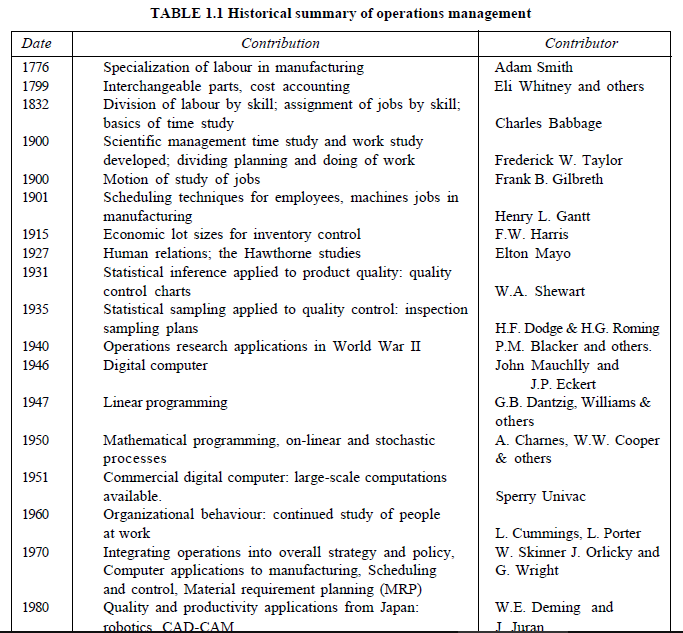
Production management becomes the acceptable term from 1930s to 1950s. As F.W. Taylor’ s works become more widely known, managers developed techniques that focussed on economic efficiency in manufacturing. Workers were studied in great detail to eliminate wasteful efforts and achieve greater efficiency. At the same time, psychologists, socialists and
other social scientists began to study people and human behaviour in the working environment. In addition, economists, mathematicians, and computer socialists contributed newer, more sophisticated analytical approaches.
With the 1970s emerges two distinct changes in our views. The most obvious of these, reflected in the new name operations management was a shift in the service and manufacturing sectors of the economy. As service sector became more prominent, the change from ‘production’ to ‘operations’ emphasized the broadening of our field to service organizations. The second, more suitable change was the beginning of an emphasis on synthesis, rather than just analysis, in management practices.
Source: KumarAnil, Suresh N. (2009), Production and operations management, New Age International Pvt Ltd; 2nd Ed. edition.
The post Historical Evolution of Production and Operations Management appeared first on HKT Consultant.
]]>The post Concept of Production appeared first on HKT Consultant.
]]>Production is defined as “the step-by-step conversion of one form of material into another form through chemical or mechanical process to create or enhance the utility of the product to the user. ” Thus production is a value addition process. At each stage of processing, there will be value addition.
Edwood Buffa defines production as ‘a process by which goods and services are created’.
Some examples of production are: manufacturing custom-made products like, boilers with a specific capacity, constructing flats, some structural fabrication works for selected customers, etc., and manufacturing standardized products like, car, bus, motor cycle, radio, television, etc.

Source: KumarAnil, Suresh N. (2009), Production and operations management, New Age International Pvt Ltd; 2nd Ed. edition.
The post Concept of Production appeared first on HKT Consultant.
]]>The post Production System appeared first on HKT Consultant.
]]>The production system has the following characteristics:
- Production is an organized activity, so every production system has an objective.
- The system transforms the various inputs to useful outputs.
- It does not operate in isolation from the other organization system.
- There exists a feedback about the activities, which is essential to control and improve system performance.
Classification of Production System
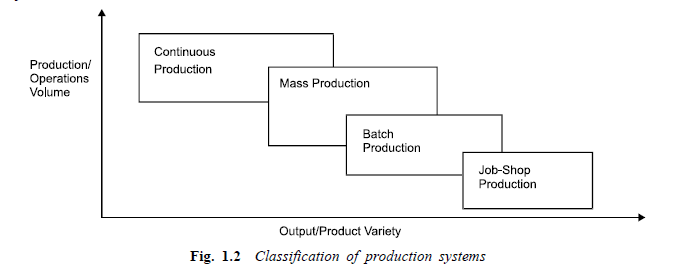
Production systems can be classified as Job Shop, Batch, Mass and Continuous Production systems.
1. JOB SHOP PRODUCTION
Job shop production are characterised by manufacturing of one or few quantity of products designed and produced as per the specification of customers within prefixed time and cost. The distinguishing feature of this is low volume and high variety of products.
A job shop comprises of general purpose machines arranged into different departments. Each job demands unique technological requirements, demands processing on machines in a certain sequence.
Characteristics
The Job-shop production system is followed when there is:
- High variety of products and low volume.
- Use of general purpose machines and facilities.
- Highly skilled operators who can take up each job as a challenge because of uniqueness.
- Large inventory of materials, tools, parts.
- Detailed planning is essential for sequencing the requirements of each product, capacities for each work centre and order priorities.
Advantages
Following are the advantages of job shop production:
- Because of general purpose machines and facilities variety of products can be produced.
- Operators will become more skilled and competent, as each job gives them learning opportunities.
- Full potential of operators can be utilised.
- Opportunity exists for creative methods and innovative ideas.
Limitations
Following are the limitations of job shop production:
- Higher cost due to frequent set up changes.
- Higher level of inventory at all levels and hence higher inventory cost.
- Production planning is complicated.
- Larger space requirements.
Batch Production
Batch production is defined by American Production and Inventory Control Society (APICS) “as a form of manufacturing in which the job passes through the functional departments in lots or batches and each lot may have a different routing. ” It is characterised by the manufacture of limited number of products produced at regular intervals and stocked awaiting sales.
Characteristics
Batch production system is used under the following circumstances:
- When there is shorter production runs.
- When plant and machinery are flexible.
- When plant and machinery set up is used for the production of item in a batch and change of set up is required for processing the next batch.
- When manufacturing lead time and cost are lower as compared to job order production. Advantages
Following are the advantages of batch production:
- Better utilisation of plant and machinery.
- Promotes functional specialisation.
- Cost per unit is lower as compared to job order production.
- Lower investment in plant and machinery.
- Flexibility to accommodate and process number of products.
- Job satisfaction exists for operators.
Limitations
Following are the limitations of batch production:
- Material handling is complex because of irregular and longer flows.
- Production planning and control is complex.
- Work in process inventory is higher compared to continuous production.
- Higher set up costs due to frequent changes in set up.
2. MASS PRODUCTION
Manufacture of discrete parts or assemblies using a continuous process are called mass production. This production system is justified by very large volume of production. The machines are arranged in a line or product layout. Product and process standardisation exists and all outputs follow the same path.
Characteristics
Mass production is used under the following circumstances:
- Standardisation of product and process sequence.
- Dedicated special purpose machines having higher production capacities and output rates.
- Large volume of products.
- Shorter cycle time of production.
- Lower in process inventory.
- Perfectly balanced production lines.
- Flow of materials, components and parts is continuous and without any back tracking.
- Production planning and control is easy.
- Material handling can be completely automatic.
Advantages
Following are the advantages of mass production:
- Higher rate of production with reduced cycle time.
- Higher capacity utilisation due to line balancing.
- Less skilled operators are required.
- Low process inventory.
- Manufacturing cost per unit is low.
Limitations
Following are the limitations of mass production:
- Breakdown of one machine will stop an entire production line.
- Line layout needs major change with the changes in the product design.
- High investment in production facilities.
- The cycle time is determined by the slowest operation.
3. CONTINUOUS PRODUCTION
Production facilities are arranged as per the sequence of production operations from the first operations to the finished product. The items are made to flow through the sequence of operations through material handling devices such as conveyors, transfer devices, etc.
Characteristics
Continuous production is used under the following circumstances:
- Dedicated plant and equipment with zero flexibility.
- Material handling is fully automated.
- Process follows a predetermined sequence of operations.
- Component materials cannot be readily identified with final product.
- Planning and scheduling is a routine action.
Advantages
Following are the advantages of continuous production:
- Standardisation of product and process sequence.
- Higher rate of production with reduced cycle time.
- Higher capacity utilisation due to line balancing.
- Manpower is not required for material handling as it is completely automatic.
- Person with limited skills can be used on the production line.
- Unit cost is lower due to high volume of production.
Limitations
Following are the limitations of continuous production:
- Flexibility to accommodate and process number of products does not exist.
- Very high investment for setting flow lines.
- Product differentiation is limited.
Source: KumarAnil, Suresh N. (2009), Production and operations management, New Age International Pvt Ltd; 2nd Ed. edition.
The post Production System appeared first on HKT Consultant.
]]>The post Production Management appeared first on HKT Consultant.
]]>E.S. Buffa defines production management as, “Production management deals with decision making related to production processes so that the resulting goods or services are produced according to specifications, in the amount and by the schedule demanded and out of minimum cost.“
Objectives of Production Management
The objective of the production management is ‘to produce goods services of right quality and quantity at the right time and right manufacturing cost’.
1. Right Quality
The quality of product is established based upon the customers needs. The right quality is not necessarily best quality. It is determined by the cost of the product and the technical characteristics as suited to the specific requirements.
2. Right Quantity
The manufacturing organization should produce the products in right number. If they are produced in excess of demand the capital will block up in the form of inventory and if the quantity is produced in short of demand, leads to shortage of products.
3. Right Time
Timeliness of delivery is one of the important parameter to judge the effectiveness of production department. So, the production department has to make the optimal utilization of input resources to achieve its objective.
4. Right Manufacturing Cost
Manufacturing costs are established before the product is actually manufactured. Hence, all attempts should be made to produce the products at pre-established cost, so as to reduce the variation between actual and the standard (pre-established) cost.
Source: KumarAnil, Suresh N. (2009), Production and operations management, New Age International Pvt Ltd; 2nd Ed. edition.
The post Production Management appeared first on HKT Consultant.
]]>The post Operating System appeared first on HKT Consultant.
]]>Everett E. Adam & Ronald J. Ebert define operating system as, “An operating system (function) of an organization is the part of an organization that produces the organization’s physical goods and services. ”
Ray Wild defines operating system as, “An operating system is a configuration of resources combined for the provision of goods or services. ”
1. Concept of Operations
An operation is defined in terms of the mission it serves for the organization, technology it employs and the human and managerial processes it involves. Operations in an organization can be categorised into manufacturing operations and service operations. Manufacturing operations is a conversion process that includes manufacturing yields a tangible output: a product, whereas, a conversion process that includes service yields an intangible output: a deed, a performance, an effort.
2. Distinction between Manufacturing Operations and Service Operations
Following characteristics can be considered for distinguishing manufacturing operations with service operations:
- Tangible/Intangible nature of output
- Consumption of output
- Nature of work (job)
- Degree of customer contact
- Customer participation in conversion
- Measurement of performance.
Manufacturing is characterised by tangible outputs (products), outputs that customers consume overtime, jobs that use less labour and more equipment, little customer contact, no customer participation in the conversion process (in production), and sophisticated methods for measuring production activities and resource consumption as product are made.
Service is characterised by intangible outputs, outputs that customers consumes immediately, jobs that use more labour and less equipment, direct consumer contact, frequent customer participation in the conversion process, and elementary methods for measuring conversion activities and resource consumption. Some services are equipment based namely rail-road services, telephone services and some are people based namely tax consultant services, hair styling.
Source: KumarAnil, Suresh N. (2009), Production and operations management, New Age International Pvt Ltd; 2nd Ed. edition.
The post Operating System appeared first on HKT Consultant.
]]>The post Operations Management: Framework and Objectives appeared first on HKT Consultant.
]]>Managing operations can be enclosed in a frame of general management function as shown in Fig. 1.3. Operation managers are concerned with planning, organizing, and controlling the activities which affect human behaviour through models.
1.1. Planning
Activities that establishes a course of action and guide future decision-making is planning.
The operations manager defines the objectives for the operations subsystem of the organization, and the policies, and procedures for achieving the objectives. This stage includes clarifying the role and focus of operations in the organization’s overall strategy. It also involves product planning, facility designing and using the conversion process.
1.2. Organizing
Activities that establishes a structure of tasks and authority. Operation managers establish a structure of roles and the flow of information within the operations subsystem. They determine the activities required to achieve the goals and assign authority and responsibility for carrying them out.
1.3. Controlling
Activities that assure the actual performance in accordance with planned performance. To ensure that the plans for the operations subsystems are accomplished, the operations manager must exercise control by measuring actual outputs and comparing them to planned operations management. Controlling costs, quality, and schedules are the important functions here.
1.4. Behaviour
Operation managers are concerned with how their efforts to plan, organize, and control affect human behaviour. They also want to know how the behaviour of subordinates can affect management’s planning, organizing, and controlling actions. Their interest lies in decision-making behaviour.
1.5. Models
As operation managers plan, organise, and control the conversion process, they encounter many problems and must make many decisions. They can simplify their difficulties using models like aggregate planning models for examining how best to use existing capacity in short-term, break even analysis to identify break even volumes, linear programming and computer simulation for capacity utilisation, decision tree analysis for long-term capacity problem of facility expansion, simple median model for determining best locations of facilities etc.

2. Objectives of Operations Management
Objectives of operations management can be categorised into customer service and resource utilisation.
2.1. Customer Service
The first objective of operating systems is the customer serivce to the satisfaction of customer wants. Therefore, customer service is a key objective of operations management. The operating system must provide something to a specification which can satisfy the customer in terms of cost and timing. Thus, primary objective can be satisfied by providing the ‘right thing at a right price at the right time’.
These aspects of customer service—specification, cost and timing—are described for four functions in Table 1.2. They are the principal sources of customer satisfaction and must, therefore, be the principal dimension of the customer service objective for operations managers.

Generally an organization will aim reliably and consistently to achieve certain standards and operations manager will be influential in attempting to achieve these standards. Hence, this objective will influence the operations manager’s decisions to achieve the required customer service.
2.2. Resource Utilisation
Another major objective of operating systems is to utilise resources for the satisfaction of customer wants effectively, i.e., customer service must be provided with the achievement of
effective operations through efficient use of resources. Inefficient use of resources or inadequate customer service leads to commercial failure of an operating system.
Operations management is concerned essentially with the utilisation of resources, i.e., obtaining maximum effect from resources or minimising their loss, under utilisation or waste. The extent of the utilisation of the resources’ potential might be expressed in terms of the proportion of available time used or occupied, space utilisation, levels of activity, etc. Each measure indicates the extent to which the potential or capacity of such resources is utilised. This is referred as the objective of resource utilisation.
Operations management is also concerned with the achievement of both satisfactory customer service and resource utilisation. An improvement in one will often give rise to deterioration in the other. Often both cannot be maximised, and hence a satisfactory performance must be achieved on both objectives. All the activities of operations management must be tackled with these two objectives in mind, and many of the problems will be faced by operations managers because of this conflict. Hence, operations managers must attempt to balance these basic objectives.
Table 1.3 summarises the twin objectives of operations management. The type of balance established both between and within these basic objectives will be influenced by market considerations, competitions, the strengths and weaknesses of the organization, etc. Hence, the operations managers should make a contribution when these objectives are set.

Source: KumarAnil, Suresh N. (2009), Production and operations management, New Age International Pvt Ltd; 2nd Ed. edition.
The post Operations Management: Framework and Objectives appeared first on HKT Consultant.
]]>The post Managing Global Operations appeared first on HKT Consultant.
]]>There are four developments, which have spurred the trend toward globalization. These are:
- Improved transportation and communication technologies;
- Opened financial systems;
- Increased demand for imports; and
- Reduced import quotas and other trade barriers.
When a firm sets up facilities abroad it involve some added complexities in its operation. Global markets impose new standards on quality and time. Managers should not think about domestic markets first and then global markets later, rather it could be think globally and act
locally. Also, they must have a good understanding of their competitors. Some other important challenges of managing multinational operations include other languages and customs, different management style, unfamiliar laws and regulations, and different costs.
Managing global operations would focus on the following key issues:
- To acquire and properly utilize the following concepts and those related to global operations, supply chain, logistics, etc.
- To associate global historical events to key drivers in global operations from different perspectives.
- To develop criteria for conceptualization and evaluation of different global operations.
- To associate success and failure cases of global operations to political, social, economical and technological environments.
- To envision trends in global operations.
- To develop an understanding of the world vision regardless of their country of origin, residence or studies in a respectful way of perspectives of people from different races, studies, preferences, religion, politic affiliation, place of origin, etc.
Source: KumarAnil, Suresh N. (2009), Production and operations management, New Age International Pvt Ltd; 2nd Ed. edition.
The post Managing Global Operations appeared first on HKT Consultant.
]]>The post Scope of Production and Operations Management appeared first on HKT Consultant.
]]>- Location of facilities
- Plant layouts and material handling
- Product design
- Process design
- Production and planning control
- Quality control
- Materials management
- Maintenance management.
1. Location of Facilities
Location of facilities for operations is a long-term capacity decision which involves a long term commitment about the geographically static factors that affect a business organization. It is an important strategic level decision-making for an organization. It deals with the questions such as ‘where our main operations should be based?’
The selection of location is a key-decision as large investment is made in building plant and machinery. An improper location of plant may lead to waste of all the investments made in plant and machinery equipments. Hence, location of plant should be based on the company’s expansion
plan and policy, diversification plan for the products, changing sources of raw materials and many other factors. The purpose of the location study is to find the optimal location that will results in the greatest advantage to the organization.
2. Plant Layout and Material Handling
Plant layout refers to the physical arrangement of facilities. It is the configuration of departments, work centres and equipment in the conversion process. The overall objective of the plant layout is to design a physical arrangement that meets the required output quality and quantity most economically.
According to James Moore, “Plant layout is a plan of an optimum arrangement of facilities including personnel, operating equipment, storage space, material handling equipments and all other supporting services along with the design of best structure to contain all these facilities”.
‘Material Handling’ refers to the ‘moving of materials from the store room to the machine and from one machine to the next during the process of manufacture’. It is also defined as the ‘art and science of moving, packing and storing of products in any form’. It is a specialised activity for a modern manufacturing concern, with 50 to 75% of the cost of production. This cost can be reduced by proper section, operation and maintenance of material handling devices. Material handling devices increases the output, improves quality, speeds up the deliveries and decreases the cost of production. Hence, material handling is a prime consideration in the designing new plant and several existing plants.
3. Product Design
Product design deals with conversion of ideas into reality. Every business organization have to design, develop and introduce new products as a survival and growth strategy. Developing the new products and launching them in the market is the biggest challenge faced by the organizations. The entire process of need identification to physical manufactures of product involves three functions: marketing, product development, manufacturing. Product development translates the needs of customers given by marketing into technical specifications and designing the various features into the product to these specifications. Manufacturing has the responsibility of selecting the processes by which the product can be manufactured. Product design and development provides link between marketing, customer needs and expectations and the activities required to manufacture the product.
4. Process Design
Process design is a macroscopic decision-making of an overall process route for converting the raw material into finished goods. These decisions encompass the selection of a process, choice of technology, process flow analysis and layout of the facilities. Hence, the important decisions in process design are to analyse the workflow for converting raw material into finished product and to select the workstation for each included in the workflow.
5. Production Planning and Control
Production planning and control can be defined as the process of planning the production in advance, setting the exact route of each item, fixing the starting and finishing dates for each item, to give production orders to shops and to follow up the progress of products according to orders.
The principle of production planning and control lies in the statement ‘First Plan Your Work and then Work on Your Plan’. Main functions of production planning and control includes planning, routing, scheduling, dispatching and follow-up.
Planning is deciding in advance what to do, how to do it, when to do it and who is to do it. Planning bridges the gap from where we are, to where we want to go. It makes it possible for things to occur which would not otherwise happen.
Routing may be defined as the selection of path which each part of the product will follow, which being transformed from raw material to finished products. Routing determines the most advantageous path to be followed from department to department and machine to machine till raw material gets its final shape.
Scheduling determines the programme for the operations. Scheduling may be defined as ‘the fixation of time and date for each operation’ as well as it determines the sequence of operations to be followed.

Dispatching is concerned with the starting the processes. It gives necessary authority so as to start a particular work, which has already been planned under ‘Routing’ and ‘Scheduling’. Therefore, dispatching is ‘release of orders and instruction for the starting of production for any item in acceptance with the route sheet and schedule charts’.
The function of follow-up is to report daily the progress of work in each shop in a prescribed proforma and to investigate the causes of deviations from the planned performance.
6. Quality Control
Quality Control (QC) may be defined as ‘a system that is used to maintain a desired level of quality in a product or service’. It is a systematic control of various factors that affect the quality of the product. Quality control aims at prevention of defects at the source, relies on effective feed back system and corrective action procedure.
Quality control can also be defined as ‘that industrial management technique by means of which product of uniform acceptable quality is manufactured’. It is the entire collection of activities which ensures that the operation will produce the optimum quality products at minimum cost.
The main objectives of quality control are:
- To improve the companies income by making the production more acceptable to the customers e., by providing long life, greater usefulness, maintainability, etc.
- To reduce companies cost through reduction of losses due to defects.
- To achieve interchangeability of manufacture in large scale production.
- To produce optimal quality at reduced price.
- To ensure satisfaction of customers with productions or services or high quality level, to build customer goodwill, confidence and reputation of manufacturer.
- To make inspection prompt to ensure quality control.
- To check the variation during manufacturing.
7. Materials Management
Materials management is that aspect of management function which is primarily concerned with the acquisition, control and use of materials needed and flow of goods and services connected with the production process having some predetermined objectives in view.
The main objectives of materials management are:
- To minimise material cost.
- To purchase, receive, transport and store materials efficiently and to reduce the related cost.
- To cut down costs through simplification, standardisation, value analysis, import substitution, etc.
- To trace new sources of supply and to develop cordial relations with them in order to ensure continuous supply at reasonable rates.
- To reduce investment tied in the inventories for use in other productive purposes and to develop high inventory turnover ratios.
8. Maintenance Management
In modern industry, equipment and machinery are a very important part of the total productive effort. Therefore, their idleness or downtime becomes are very expensive. Hence, it is very important that the plant machinery should be properly maintained.
The main objectives of maintenance management are:
- To achieve minimum breakdown and to keep the plant in good working condition at the lowest possible cost.
- To keep the machines and other facilities in such a condition that permits them to be used at their optimal capacity without interruption.
- To ensure the availability of the machines, buildings and services required by other sections of the factory for the performance of their functions at optimal return on investment.
Source: KumarAnil, Suresh N. (2009), Production and operations management, New Age International Pvt Ltd; 2nd Ed. edition.
The post Scope of Production and Operations Management appeared first on HKT Consultant.
]]>The post Need for Selecting a Suitable Location appeared first on HKT Consultant.
]]>PLAN LOCATION AND LAYOUT
- When starting a new organisation, e., location choice for the first time.
- In case of existing organisation.
- In case of Global Location.
1. In Case of Location Choice for the First Time or New Organisations
Cost economies are always important while selecting a location for the first time, but should keep in mind the cost of long-term business/organisational objectives. The following are the factors to be considered while selecting the location for the new organisations:
- Identification of region: The organisational objectives along with the various long-term considerations about marketing, technology, internal organisational strengths and weaknesses, region- specific resources and business environment, legal-governmental environment, social environment and geographical environment suggest a suitable region for locating the operations facility.
- Choice of a site within a region: Once the suitable region is identified, the next step is choosing the best site from an available set. Choice of a site is less dependent on the organisation’s long-term strategies. Evaluation of alternative sites for their tangible and intangible costs will resolve facilities-location problem.
The problem of location of a site within the region can be approached with the following cost-oriented non-interactive model, i.e, dimensional analysis.
- Dimensional analysis: If all the costs were tangible and quantifiable, the comparison and selection of a site is easy. The location with the least cost is selected. In most of the cases intangible costs which are expressed in relative terms than in absolute terms. Their relative merits and demerits of sites can also be compared easily. Since both tangible and intangible costs need to be considered for a selection of a site, dimensional analysis is used.
Dimensional analysis consists in computing the relative merits (cost ratio) for each of the cost items for two alternative sites. For each of the ratios an appropriate weightage by means of power is given and multiplying these weighted ratios to come up with a comprehensive figure on the relative merit of two alternative sites, i.e.,
C1M, c2m, ., CzM are the different costs associated with a site M on the ‘z’ different cost items.
CXN, C2n, …, CzN are the different costs associated with a site N and Wx, W2, W3, …, Wz are the weightage given to these cost items, then relative merit of the M and site N is given by:

If this is > 1, site N is superior and vice-versa.
When starting a new factory, plant location decisions are very important because they have direct bearing on factors like, financial, employment and distribution patterns. In the long run, relocation of plant may even benefit the organization. But, the relocation of the plant involves stoppage of production, and also cost for shifting the facilities to a new location. In addition to these things, it will introduce some inconvenience in the normal functioning of the business. Hence, at the time of starting any industry, one should generate several alternate sites for locating the plant. After a critical analysis, the best site is to be selected for commissioning the plant. Location of warehouses and other facilities are also having direct bearing on the operational performance of organizations.
The existing firms will seek new locations in order to expand the capacity or to place the existing facilities. When the demand for product increases, it will give rise to following decisions:
- Whether to expand the existing capacity and facilities.
- Whether to look for new locations for additional facilities.
- Whether to close down existing facilities to take advantage of some new locations.
2. In Case of Location Choice for Existing Organisation
In this case a manufacturing plant has to fit into a multi-plant operations strategy. That is, additional plant location in the same premesis and elsewere under following circumstances:
- Plant manufacturing distinct products.
- Manufacturing plant supplying to specific market area.
- Plant divided on the basis of the process or stages in manufacturing.
- Plants emphasizing flexibility.
The different operations strategies under the above circumstances could be:
- Plants manufacturing distinct products: Each plant services the entire market area for the organization. This strategy is necessary where the needs of technological and resource inputs are specialized or distinctively different for the different product-lines.
For example, a high quality precision product-line should not be located along with other product-line requiring little emphasis on precision. It may not be proper to have too many contradictions such as sophisticated and old equipment, highly skilled and semi-skilled personnel, delicates processes and those that could permit rough handlings, all under one roof and one set of managers. Such a setting leads to much confusion regarding the required emphasis and the management policies.
Product specialization may be necessary in a highly competitive market. It may be necessary to exploit the special resources of a particular geographical area. The more decentralized these pairs are in terms of the management and in terms of their physical location, the better would be the planning and control and the utilization of the resources.
- Manufacturing plants supplying to a specific market area: Here, each plant manufactures almost all of the company’s products. This type of strategy is useful where market proximity consideration dominates the resources and technology considerations. This strategy requires great deal of coordination from the corporate office. An extreme example of this strategy is that of soft drinks bottling plants.
- Plants divided on the basis of the process or stages in manufacturing: Each production process or stage of manufacturing may require distinctively different equipment capabilities, labour skills, technologies, and managerial policies and emphasis. Since the products of one plant feed into the other plant, this strategy requires much centralized coordination of the manufacturing activities from the corporate office that are expected to understand the various technological aspects of all the plants.
- Plants emphasizing flexibility: This requires much coordination between plants to meet the changing needs and at the same time ensure efficient use of the facilities and resources. Frequent changes in the long-term strategy in order to improve be efficiently temporarily, are not healthy for the organization. In any facility location problem the central question is: ‘Is this a location at which the company can remain competitive for a long time?’
For an established organization in order to add on to the capacity, following are the ways:
- Expansion of the facilities at the existing site: This is acceptable when it does not violate the basic business and managerial outlines, e., philosophies, purposes, strategies and capabilities. For example, expansion should not compromise quality, delivery, or customer service.
- Relocation of the facilities (closing down the existing ones): This is a drastic step which can be called as ‘Uprooting and Transplanting’. Unless there are very compelling reasons, relocation is not done. The reasons will be either bringing radical changes in technology, resource availability or other destabilization.
All these factors are applicable to service organizations, whose objectives, priorities and strategies may differ from those of hardcore manufacturing organizations.
3. In Case of Global Location
Because of globalisation, multinational corporations are setting up their organizations in India and Indian companies are extending their operations in other countries. In case of global locations there is scope for virtual proximity and virtual factory.
3.1. Virtual Proximity
With the advance in telecommunications technology, a firm can be in virtual proximity to its customers. For a software services firm much of its logistics is through the information/ communication pathway. Many firms use the communications highway for conducting a large portion of their business transactions. Logistics is certainly an important factor in deciding on a location—whether in the home country or abroad. Markets have to be reached. Customers have to be contacted. Hence, a market presence in the country of the customers is quite necessary.
3.2. Virtual Factory
Many firms based in USA and UK in the service sector and in the manufacturing sector often out sources part of their business processes to foreign locations such as India. Thus, instead of one’s own operations, a firm could use its business associates’ operations facilities. The Indian BPO firm is a foreign-based company’s ‘virtual service factory’. So a location could be one’s own or one’s business associates. The location decision need not always necessarily pertain to own operations.
3.3. Reasons for a Global/Foreign Location
3.3.1. Tangible Reasons
The trangible reasons for setting up an operations facility abroad could be as follows:
Reaching the customer: One obvious reason for locating a facility abroad is that of capturing a share of the market expanding worldwide. The phenomenal growth of the GDP of India is a big reason for the multinationals to have their operations facilities in our country. An important reason is that of providing service to the customer promptly and economically which is logistics-dependent. Therefore, cost and case of logistics is a reason for setting up manufacturing facilities abroad. By logistics set of activities closes the gap between production of goods/services and reaching of these intended goods/services to the customer to his satisfaction. Reaching the customer is thus the main objective. The tangible and intangible gains and costs depend upon the company defining for itself as to what that ‘reaching’ means. The tangible costs could be the logistics related costs; the intangible costs may be the risk of operating is a foreign country. The tangible gains are the immediate gains; the intangible gains are an outcome of what the company defines the concepts of reaching and customer for itself.
The other tangible reasons could be as follows:
- The host country may offer substantial tax advantages compared to the home country.
- The costs of manufacturing and running operations may be substantially less in that foreign country. This may be due to lower labour costs, lower raw material cost, better availability of the inputs like materials, energy, water, ores, metals, key personnel etc.
- The company may overcome the tariff barriers by setting up a manufacturing plant in a foreign country rather than exporting the items to that country.
3.3.2. Intangible Reasons
The intangible reasons for considering setting up an operations facility abroad could be as follows:
- Customer-related Reasons
- With an operations facility in the foreign country, the firm’s customers may feel secure that the firm is more accessible. Accessibility is an important ‘service quality’ determinant.
- The firm may be able to give a personal tough.
- The firm may interact more intimately with its customers and may thus understand their requirements better.
- It may also discover other potential customers in the foreign location.
- Organisational Learning-related Reasons
- The firm can learn advanced technology. For example, it is possible that cutting-edge technologies can be learn by having operations in an technologically more advanced country. The firm can learn from advanced research laboratories/universities in that country. Such learning may help the entire product-line of the company.
- The firm can learn from its customers abroad. A physical location there may be essential towards this goal.
- It can also learn from its competitors operating in that country. For this reason, it may have to be physically present where the action is.
- The firm may also learn from its suppliers abroad. If the firm has a manufacturing plant there, it will have intensive interaction with the suppliers in that country from whom there may be much to learn in terms of modern and appropriate technology, modern management methods, and new trends in business worldwide.
- Other Strategic Reasons
- The firm by being physically present in the host country may gain some ‘local boy’ kind of psychological advantage. The firm is no more a ‘foreign’ company just sending its products across international borders. This may help the firm in lobbying with the government of that country and with the business associations in that country.
- The firm may avoid ‘political risk’ by having operations in multiple countries.
- By being in the foreign country, the firm can build alternative sources of supply. The firm could, thus, reduce its supply risks.
- The firm could hunt for human capital in different countries by having operations in those countries. Thus, the firm can gather the best of people from across the globe.
- Foreign locations in addition to the domestic locations would lower the market risks for the firm. If one market goes slow the other may be doing well, thus lowering the overall risk.
Source: KumarAnil, Suresh N. (2009), Production and operations management, New Age International Pvt Ltd; 2nd Ed. edition.
The post Need for Selecting a Suitable Location appeared first on HKT Consultant.
]]>