The post Quality Management – Understanding how does it improve firm performance appeared first on HKT Consultant.
]]>Quality management ensures that an organization, product or service is consistent. It has four main components: quality planning, quality assurance, quality control and quality improvement. Quality management is focused not only on product and service quality, but also on the means to achieve it. Quality management, therefore, uses quality assurance and control of processes as well as products to achieve more consistent quality. What a customer wants and is willing to pay for it determines quality. It is a written or unwritten commitment to a known or unknown consumer in the market. Thus, quality can be defined as fitness for intended use or, in other words, how well the product performs its intended function.
Main contentsSee more from basic to advanced


The post Quality Management – Understanding how does it improve firm performance appeared first on HKT Consultant.
]]>The post What is Quality? appeared first on HKT Consultant.
]]>People deal with the issue of quality continually in their daily lives. We concern ourselves with quality when we are shopping groceries, eating in a restaurant, and making a major purchase, such as an automobile, a home, a television, or a personal computer. Perceived quality is a major factor by which people make distinctions in the marketplace. Whether we articulate them openly or keep them in the back of our minds, we all apply a number of criteria when making a purchase. The extent to which a purchase meets these criteria determines its quality in our eyes.
One way to understand quality as a consumer-driven concept is to consider the example of eating at a restaurant. How will you judge the quality of the restaurant? Most people apply such criteria as the following:
- Service
- Response time
- Food preparation
- Environment or atmosphere
- Price
- Selection
This example gets at one aspect of quality—the results aspect. Does the product or service meet or exceed customer expectations? This is a critical aspect of quality, but it is not the only one. Total quality is a much broader concept that encompasses not just the results aspect but also the quality of people and the quality of processes.
Quality has been defined in a number of different ways by a number of different people and organizations. Consider the following definitions:
- Performance that meets or exceeds expectations.1
- Performance that meets the customer’s needs.2
- Consistently meeting customer needs and expectations.3
- Satisfying the customer today and getting better tomorrow.4
In his landmark book Out of the Crisis, quality pioneer W Edwards Deming makes the point that quality must be defined from the perspective of the stakeholder. The customer has a stake in the quality of a product or service, the production workers have a stake in it, and the organization that employs the production worker has a stake in it. Each of these entities should have their own view of quality and all of their views should mesh.5
Although Deming’s landmark book is now dated, his thoughts on quality are still valid and insightful. Deming makes the point that quality has many different criteria and that these criteria change continually.6 To complicate matters even further, different people value the various criteria differently. For this reason, it is important to measure consumer preferences and to remeasure them frequently. Deming gives an example of the criteria that are important to him in selecting paper:7
- It is not slick and, therefore, takes pencil or ink well.
- Writing on the back does not show through.
- It fits into a three-ring notebook.
- It is available at most stationery stores and is, therefore, easily replenished.
- It is reasonably priced.
Each of these preferences represents a variable the manufacturer can measure and use to continually improve decision making. Deming is well known for his belief that 94% of workplace problems are caused by management and especially for his role in helping Japan rise up out of the ashes of World War II to become a major industrial power. Deming’s contributions to the quality movement are explained in greater depth later in this chapter.
Although there is no universally accepted definition of quality, enough similarity does exist among the definitions that common elements can be extracted:
- Quality involves meeting or exceeding customer expectations.
- Quality applies to products, services, people, processes, and environments.
- Quality is an ever-changing state (i.e., what is considered quality today may not be good enough to be considered quality tomorrow).
With these common elements extracted, the following definition of quality can be set forth:
Quality is a dynamic state associated with products, services, people, processes, and environments that meets or exceeds expectations and helps produce superior value.
Consider the individual elements of this definition: The dynamic state element speaks to the fact that what is considered quality can and often does change as time passes and circumstances are altered. For example, gas mileage is an important criterion in judging the quality of modern automobiles. However, in the days of 20-cent-per-gallon gasoline, consumers were more likely to concern themselves with horsepower, cubic inches, and acceleration rates than with gas mileage.
The products, services, people, processes, and environments element is critical. It makes the point that quality applies not just to the products and services provided, but also to the people and processes that provide them and the environments in which they are provided. In the short term, two competitors who focus on continual improvement might produce a product of comparable quality. But the competitor who looks beyond just the quality of the finished product and also focuses on the continual improvement of the people who produce the product, the processes they use, and the environment in which they work will win in the long run and, most frequently, in the short run. This is because quality products are produced most consistently by quality organizations.
The superior value element acknowledges that quality is a key element in providing superior value (i.e., superior quality, cost, and service).
Quality, Value, and Organizational Excellence
It is important for quality professionals to understand how quality fits into the bigger picture of providing superior value to customers. Organizations survive and thrive in a globally competitive marketplace by providing superior value to customers. Achieving organizational excellence is about developing the ability to consistently provide superior value to customers over the long term. Superior value has three basic elements: superior quality, superior cost, and superior service.
In order to achieve organizational excellence—the level of performance necessary for long-term success in a global environment—it is necessary to consistently provide superior value to customers. Quality is obviously one of the key elements in providing superior value. But total quality is even more than that. Total quality is a broad-based approach that encompasses all three of the elements of superior value. Continually improving the quality of products, processes, services, and costs is what total quality is all about—hence the name total quality. Organizations that effectively apply the total quality approach to management are the ones most likely to achieve organizational excellence.
Source: Goetsch David L., Davis Stanley B. (2016), Quality Management for organizational excellence introduction to total Quality, Pearson; 8th edition.
The post What is Quality? appeared first on HKT Consultant.
]]>The post The Total Quality Approach Defined appeared first on HKT Consultant.
]]>
An easy way to grasp the concept of total quality is to consider the analogy of a three-legged stool, as shown in Figure 1.1. The seat of the stool is customer focus. This means with total quality the customer is in the “driver’s seat” as the primary arbiter of what is acceptable in terms of quality. Each of the three legs is a broad element of the total quality philosophy (i.e., measures, people, and processes). The “measures” leg of the stool makes the point that quality can and must be measured. The “people” leg of the stool makes the point that quality cannot be inspected into a product or service. Rather, it must be built in by people who are empowered to do their jobs the right way. The “processes” leg of the stool makes the point that processes must be improved, continually and forever. What is considered excellent today may be just mediocre tomorrow. Consequently, “good enough” is never good enough.
Another way to understand total quality as a concept is shown in Figure 1.2. Notice that the first part of the definition in Figure 1.2 explains the what of total quality; the second part explains the how. In the case of total quality, the how is important because it is what separates this approach to doing business from all of the others.

The total in total quality indicates a concern for quality in the broadest sense—what has come to be known as the “Big Q.” Big Q refers to quality of products, services, people, processes, and environments. Correspondingly, “Little Q” refers to a narrower concern that focuses on the quality of one of these elements or individual quality criteria within an individual element.
1. How Is Total Quality Different?
What distinguishes the total quality approach from traditional ways of doing business can be found in how it is achieved. The distinctive characteristics of total quality are these: strategically based, customer focus (internal and external), obsession with quality, use of the scientific approach in decision making and problem solving, long-term commitment, teamwork, continual process improvement, bottom-up education and training, freedom through control, unity of purpose, and employee involvement and empowerment, all deliberately aimed at supporting the organizational strategy. The underlying concept that drives the need for total quality is competitiveness. Although pride of product (or service) is a philosophical driver of the total quality concept—organizations that produce a product or provide a service should want it to represent them in a way they can be proud of—the practical driver is competitiveness. In today’s globally competitive business environment, organizations cannot survive, much less thrive, unless they outperform the competition in proving superior value. And quality is an essential ingredient in superior value (quality, cost, service). The individual characteristics relating to total quality shown in Figure 1.2 are explained later in this chapter.
2. The Historic Development of Total Quality
The total quality movement had its roots in the time and motion studies conducted by Frederick Taylor in the 1920s. Table 1.1 is a time line that shows some of the major events in the evolution of the total quality movement since the days of Taylor. Taylor is now known as “the father of scientific management.”
The most fundamental aspect of scientific management is the separation of planning and execution. Although the division of labor spawned tremendous leaps forward in productivity, it virtually eliminated the old practice of one highly skilled individual performing all the tasks required to produce a quality product. In a sense, that individual was CEO, production worker, and quality controller all rolled into one. Taylor’s scientific management did away with this by making planning the job of management and production the job of labor. To keep quality from falling through the cracks, it was necessary to create a separate quality department. Such departments had shaky beginnings, and just who was responsible for quality became a clouded issue.

As the volume and complexity of manufacturing grew, quality became an increasingly difficult issue. Volume and complexity together gave birth to quality engineering in the 1920s and reliability engineering in the 1950s. Quality engineering, in turn, resulted in the use of statistical methods in the control of quality, which eventually led to the concepts of control charts and statistical process control, which are now fundamental aspects of the total quality approach.
Reliability engineering emerged in the 1950s. It began a trend toward moving quality control away from the traditional after-the-fact approach and toward inserting it throughout the design and production processes. However, for the most part, quality control in the 1950s and 1960s involved inspections that resulted in nothing more than cutting out bad parts.
World War II had an impact on quality that is still being felt. In general, the effect was negative for the United States and positive for Japan. Because of the urgency to meet production schedules during the war, U.S. companies focused more on meeting delivery dates than on quality. This approach became a habit that carried over even after the war.
Japanese companies, on the other hand, were forced to learn to compete with the rest of the world in the production of nonmilitary goods. At first, their attempts were unsuccessful, and “Made in Japan” remained synonymous with poor quality, as it had been before World War II. Around 1950, however, Japan decided to get serious about quality and establishing ways to produce quality products.
Japanese manufacturers overcame a reputation for producing cheap, shabby products and developed a reputation as world leaders in the production of quality products. More than any other single factor, it was the Japanese miracle— which was not a miracle at all but the result of a concerted effort that took 20 years to really bear fruit—that got the rest of the world to focus on quality. When Western companies finally realized that quality was the key factor in global competition, they responded. Unfortunately, their first responses were the opposite of what was needed.
In spite of these early negative reactions, Western companies began to realize that the key to competing in the global marketplace was to improve quality. With this realization, the total quality movement finally began to gain momentum.
Source: Goetsch David L., Davis Stanley B. (2016), Quality Management for organizational excellence introduction to total Quality, Pearson; 8th edition.
The post The Total Quality Approach Defined appeared first on HKT Consultant.
]]>The post Two Views of Quality appeared first on HKT Consultant.
]]>The traditional view of quality expected one improvement per employee per year. Total quality organizations expect to make at least ten or more improvements per employee per year. Organizations that think traditionally focus on short-term profits. The total quality approach focuses on long-term profits and continual improvement.
The following statements summarize some of the major differences between the traditional view of quality and the total quality perspective:
- Productivity versus quality. The traditional view is that productivity and quality are always in conflict. You cannot have both. The total quality view is that lasting productivity gains are made only as a result of quality improvements.
- How quality is defined. The traditional view is that quality is defined solely as meeting customer specifications. The total quality view is that quality means satisfying customer needs and exceeding customer expectations.
- How quality is measured. The traditional view is that quality is measured by establishing an acceptable level of nonconformance and measuring against that benchmark. The total quality view is that quality is measured by establishing high-performance benchmarks for customer satisfaction and then continually improving performance.
- How quality is achieved. The traditional view is that quality is inspected into the product. The total quality view is that quality is determined by product and process design and achieved by effective control techniques.
- Attitude toward defects. The traditional view is that defects are an expected part of producing a product. Measuring defects per hundred is an acceptable standard. The total quality view is that defects are to be prevented using effective control systems and should be measured in defects per million (Six Sigma).
- Quality as a function. The traditional view is that quality is a separate function. The total quality view is that quality should be fully integrated throughout the organization—it should be everybody’s responsibility.
- Responsibility for quality. The traditional view is that employees are blamed for poor quality. The total quality view is that at least 85% of quality problems are management’s fault.
- Supplier relationships. The traditional view is that supplier relationships are short term and cost driven. The total quality view is that supplier relationships are long term and quality oriented.
Source: Goetsch David L., Davis Stanley B. (2016), Quality Management for organizational excellence introduction to total Quality, Pearson; 8th edition.
The post Two Views of Quality appeared first on HKT Consultant.
]]>The post Key Elements of Total Quality appeared first on HKT Consultant.
]]>1. Strategically Based
Total quality organizations have a comprehensive strategic plan that contains at least the following elements: vision, mission, broad objectives, and activities that must be completed to accomplish the broad objectives. The strategic plan of a total quality organization is designed to give it a sustainable competitive advantage in the marketplace. The competitive advantages of a total quality organization are geared toward achieving world-leading quality and improving on it, continually and forever.
2. Customer Focus
In a total quality setting, the customer is the driver. This point applies to both internal and external customers. External customers define the quality of the product or service delivered. Internal customers help define the quality of the people, processes, and environments associated with the products or services.
3. Obsession with Quality
In a total quality organization, internal and external customers define quality. With quality defined, the organization must then become obsessed with meeting or exceeding this definition. This means all personnel at all levels approach all aspects of the job from the perspective of “How can we do this better?” When an organization is obsessed with quality, “good enough” is never good enough.
4. Scientific Approach
Total quality detractors put off by such concepts as employee empowerment sometimes view total quality as nothing more than another name for “soft” management or “people” management. Although it is true that people skills, involvement, and empowerment are important in a total quality setting, they represent only a part of the equation. Another important part is the use of the scientific approach in structuring work and in making decisions and solving problems that relate to the work. This means that hard data are used in establishing benchmarks, monitoring performance, and making improvements.
Long-Term Commitment attempt to adopt the total quality approach. This is because they look at total quality as just another management innovation rather than as a whole new way of doing business that requires an entirely new corporate culture. Too few organizations begin the implementation of total quality with the longterm commitment to change that is necessary for success.
5. Teamwork
In traditionally managed organizations, the best competitive efforts are often among departments within the organization. Internal competition tends to use energy that should be focused on improving quality and, in turn, external competitiveness.
Continual Process Improvement
Products are developed and services delivered by people using processes within environments (systems). To continually improve the quality of products or services—which is a fundamental goal in a total quality setting—it is necessary to continually improve systems.
6. Education and Training
Education and training are fundamental to total quality because they represent the best way to improve people on a continual basis. It is through education and training that people who know how to work hard learn how to also work smart.
7. Freedom Through Control
Involving and empowering employees is fundamental to total quality as a way to simultaneously bring more minds to bear on the decision-making process and increase the ownership employees feel about decisions that are made. Total quality detractors sometimes mistakenly see employee involvement as a loss of management control, when in fact control is fundamental to total quality. The freedoms enjoyed in a total quality setting are actually the result of well-planned and well-carried-out controls. Controls such as scientific methodologies lead to freedom by empowering employees to solve problems within their scope of control.
8. Unity of Purpose
Historically, management and labor have had an adversarial relationship in U.S. industry. One could debate the reasons behind management-labor discord ad infinitum without achieving consensus. From the perspective of total quality, who or what is to blame for adversarial management-labor relations is irrelevant. What is important is this: To apply the total quality approach, organizations must have unity of purpose. This means that internal politics have no place in a total quality organization. Rather, collaboration should be the norm.
A question frequently asked concerning this element of total quality is “Does unity of purpose mean that unions will no longer be needed?” The answer is that unity of purpose has nothing to do with whether unions are needed. Collective bargaining is about wages, benefits, and working conditions, not about corporate purpose and vision. Employees should feel more involved and empowered in a total quality setting than in a traditionally managed situation, but the goal of total quality is to enhance competitiveness, not to eliminate unions. For example, in Japan, where companies are known for achieving unity of purpose, unions are still very much in evidence. Unity of purpose does not necessarily mean that labor and management will always agree on wages, benefits, and working conditions, but it does mean that all employees work toward the common goal.
9. Employee Involvement and Empowerment
Employee involvement and empowerment is one of the most misunderstood elements of the total quality approach and one of the most misrepresented by its detractors. The basis for involving employees is twofold. First, it increases the likelihood of a good decision, a better plan, or a more effective improvement by bringing more minds to bear on the situation—not just any minds but the minds of the people who are closest to the work in question. Second, it promotes ownership of decisions by involving the people who will have to implement them.
Empowerment means not just involving people but also involving them in ways that give them a real voice. One of the ways this can be done is by structuring work that allows employees to make decisions concerning the improvement of work processes within well-specified parameters. Should a machinist be allowed to unilaterally drop a vendor if the vendor delivers substandard material? No. However, the machinist should have an avenue for offering his or her input into the matter.
Should the same machinist be allowed to change the way she sets up her machine? If by so doing she can improve her part of the process without adversely affecting someone else’s, yes. Having done so, her next step should be to show other machinists her innovation so that they might try it.
10. Peak Performance
When effectively practiced, total quality allows every aspect of an organization to operate at peak levels. This means that all personnel and processes are operating at their best. Peak performance is essential to organizations that operate in a global environment where competition is intense, constant, and unforgiving.
Source: Goetsch David L., Davis Stanley B. (2016), Quality Management for organizational excellence introduction to total Quality, Pearson; 8th edition.
The post Key Elements of Total Quality appeared first on HKT Consultant.
]]>The post Total Quality Pioneers appeared first on HKT Consultant.
]]>1. Deming’s Contributions
Of the various quality pioneers in the United States, the best known is W. Edwards Deming. Deming’s contribution was his ability to see the big picture, envision the impact of quality on it, and meld different management philosophies into a new, workable, unitary whole. More than any other quality pioneer, Deming is responsible for the total quality approach.
Deming came a long way to achieve the status of internationally acclaimed quality expert. During his formative years, Deming’s family bounced from small town to small town in Iowa and Wyoming, trying in vain to rise out of poverty. These early circumstances gave Deming a lifelong appreciation for economy and thrift. In later years, even after he was generating a substantial income, Deming maintained only a simple office in the basement of his modest home out of which he conducted his international consulting business.
Working as a janitor and at other odd jobs, Deming worked his way through the University of Wyoming, where he earned a bachelor’s degree in engineering. He went on to receive a master’s degree in mathematics and physics from the University of Colorado and a doctorate in physics from Yale.
His only full-time employment for a corporation was with Western Electric. Many feel that what he witnessed during his employment there had a major impact on the direction the rest of his life would take. Deming was disturbed by the amount of waste he saw at Western Electrics Hawthorne plant. It was there that he pioneered the use of statistics in quality.
Although Deming was asked in 1940 to help the U.S. Bureau of the Census adopt statistical sampling techniques, his reception in the United States during these early years was not positive. With little real competition in the international marketplace, major U.S. corporations felt little need for his help. Corporations from other countries were equally uninterested. However, attitudes toward Deming’s idea were changed by World War II. The need to rebuild after the devastation of World War II, particularly in bombed-out Japan, brought Deming’s ideas on quality to the forefront.
During World War II, almost all of Japan’s industry went into the business of producing war materials. After the war, those firms had to convert to the production of consumer goods, and the conversion was not very successful. To have a market for their products, Japanese firms had to enter the i nternational marketplace. This move put them in direct competition with companies from the other industrialized countries of the world, and the Japanese firms did not fare well.
By the late 1940s, key industrial leaders in Japan had finally come to the realization that the key to competing in the international marketplace is quality. At this time, Shigeiti Mariguti of Tokyo University, Sizaturo Mishibori of Toshiba, and several other Japanese leaders invited Deming to visit Japan and share his views on quality. Unlike their counterparts in the United States, the Japanese industrialists accepted Deming’s views, learned his techniques, and adopted his philosophy. So powerful was Deming’s impact on industry in Japan that the most coveted award a company there can win is the Deming Prize. In fact, the standards that must be met to win this prize are so difficult and so strenuously applied that it is now being questioned by some Japanese companies.
By the 1980s, leading industrialists in the United States were where their Japanese counterparts had been in the late 1940s. At last, Deming’s services began to be requested in his own country. By this time, Deming was over 80 years old. He had not been received as openly and warmly in the United States as he was in Japan. Deming’s attitude toward corporate executives in the United States can be described as cantankerous at best.
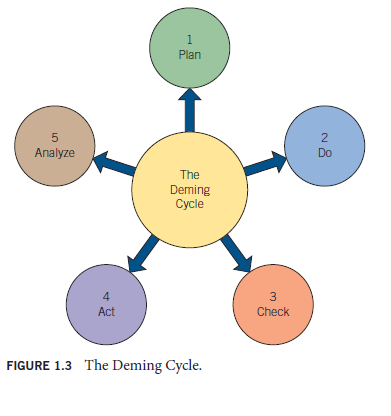
Deming’s contributions to the quality movement would be difficult to overstate. Many consider him the founder of the movement. The things for which he is most widely known are the Deming Cycle, his Fourteen Points, and his Seven Deadly Diseases.8
The Deming Cycle Summarized in Figure 1.3, the Deming Cycle was developed to link the production of a product with consumer needs and focus the resources of all departments (research, design, production, marketing) in a cooperative effort to meet those needs. The Deming Cycle proceeds as follows:
- Conduct consumer research and use it in planning the product (plan).
- Produce the product (do).
- Check the product to make sure it was produced in accordance with the plan (check).
- Market the product (act).
- Analyze how the product is received in the marketplace in terms of quality, cost, and other criteria (analyze).
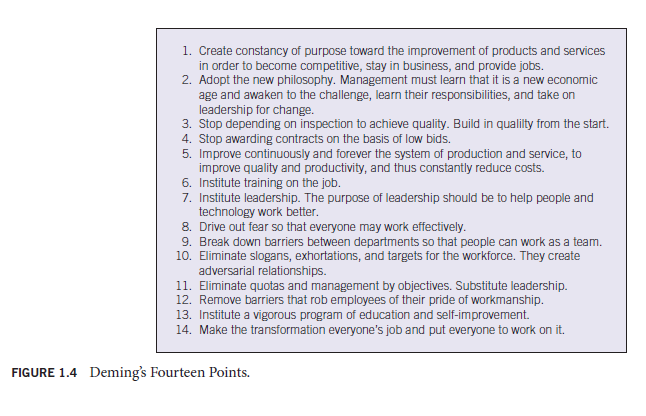
Deming’s Fourteen Points Deming’s philosophy is both summarized and operationalized by his Fourteen Points, which are contained in Figure 1.4. Deming modified the specific wording of various points over the years, which accounts for the minor differences among the Fourteen Points as described in various publications. Deming stated repeatedly in his later years that if he had it all to do over again, he would leave off the numbers.
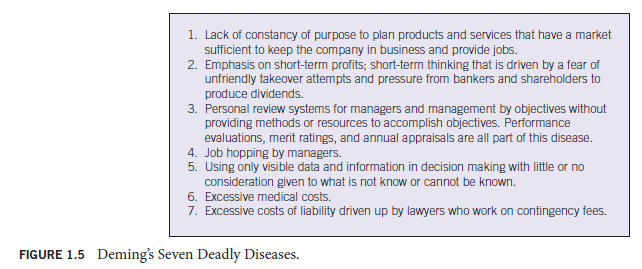
Deming’s Seven Deadly Diseases The Fourteen Points summarize Deming’s views on what a company must do to effect a positive transition from business as usual to world-class quality. The Seven Deadly Diseases summarize the factors that he believed can inhibit such a transformation (see Figure 1.5).
The description of these factors rings particularly true when viewed from the perspective of U.S. firms trying to compete in the global marketplace. Some of these factors can be eliminated by adopting the total quality approach, but three cannot. This does not bode well for U.S. firms trying to regain market share. Total quality can eliminate or reduce the impact of a lack of consistency, personal review systems, job hopping, and using only visible data. However, total quality will not free corporate executives from pressure to produce short-term profits, excessive medical costs, or excessive liability costs. These are diseases of the nation’s financial, health care, and legal systems, respectively.
By finding ways for business and government to cooperate appropriately without collaborating inappropriately, other industrialized countries have been able to focus their industry on long-term rather than short-term profits, hold down health care costs, and prevent the proliferation of costly litigation that has occurred in the United States. Excessive health care and legal costs represent non-value-added costs that must be added to the cost of products produced and services delivered in the United States.
2. Juran’s Contributions
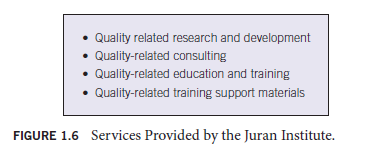
Joseph M. Juran ranks near Deming in the contributions he has made to quality and the recognition he has received as a result. His Juran Institute Inc. in Wilton, Connecticut, is an international leader in conducting training, research, and consulting activities in the area of quality management (see Figure 1.6). Quality materials produced by Juran have been translated into 14 different languages.
Juran holds degrees in both engineering and law. The emperor of Japan awarded him the Order of the Sacred Treasure medal, in recognition of his efforts to develop quality in Japan and to promote friendship between Japan and
figure 1.6 Services Provided by the Juran Institute.
the United States. Juran is best known for the following contributions to the quality philosophy:
- Juran’s Three Basic Steps to Progress
- Juran’s Ten Steps to Quality Improvement
- The Pareto Principle
- The Juran Trilogy
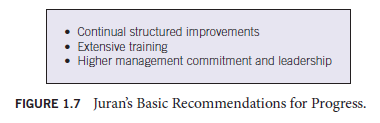
Juran’s Three Basic Steps to Progress Juran’s Three Basic Steps to Progress (listed in Figure 1.7) are broad steps that, in Juran’s opinion, companies must take if they are to achieve world-class quality. He also believes there is a point of diminishing return that applies to quality and competitiveness.
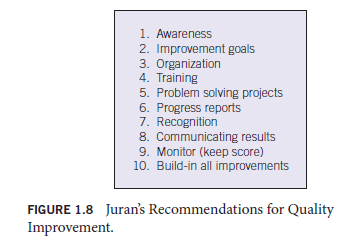
Juran’s Ten Steps to Quality Improvement Examining Juran’s Ten Steps to Quality Improvement (in Figure 1.8), you will see some overlap between them and Deming’s Fourteen Points. They also mesh well with the philosophy of quality experts whose contributions are explained later in this chapter.
The Pareto Principle The Pareto Principle espoused by Juran shows up in the views of most quality experts, although it often goes by other names. According to this principle, organizations should concentrate their energy on eliminating the vital few sources that cause the majority of problems. Further, both Juran and Deming believe that systems that are controlled by management are the systems in which the majority of problems occur.
The Juran Trilogy The Juran Trilogy summarizes the three primary managerial functions. Juran’s views on these functions are explained in the following sections.
Quality Planning Quality planning involves developing the products, systems, and processes needed to meet or exceed customer expectations. The following steps are required:
- Determine who the customers are.
- Identify customers’ needs.
- Develop products with features that respond to customer needs.
- Develop systems and processes that allow the organization to produce these features.
- Deploy the plans to operational levels.
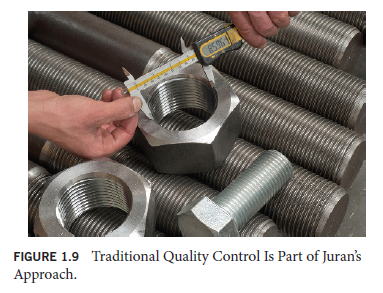
Quality Control The control of quality involves the following processes (see Figure 1.9):
- Assess actual quality performance.
- Compare performance with goals.
- Act on differences between performance and goals.
Quality Improvement The improvement of quality should be ongoing and continual:
- Develop the infrastructure necessary to make annual quality improvements.
- Identify specific areas in need of improvement, and implement improvement projects.
- Establish a project team with responsibility for completing each improvement project.
- Provide teams with what they need to be able to diagnose problems to determine root causes, develop solutions, and establish controls that will maintain gains made.
3. Crosby’s Contributions
Philip B. Crosby started his career in quality later than Deming and Juran. His corporate background includes 14 years as director of quality at ITT Corporation (1965-1979). He left ITT in 1979 to form Philip Crosby Associates, an international consulting firm on quality improvement, which he ran until 1992, when he retired as CEO to devote his time to lecturing on quality-related issues. More recently, Crosby had once again entered the business arena as a quality consultant until his death in 2001.
Crosby, who defined quality simply as conformance, is best known for his advocacy of zero-defects management and prevention as opposed to statistically acceptable levels of quality. He is also known for his Quality Vaccine and Crosby’s Fourteen Steps to Quality Improvement.
Crosby’s Quality Vaccine consists of three ingredients:9
- Determination
- Education
- Implementation
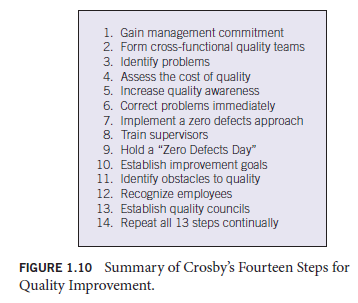
His Fourteen Steps to Quality Improvement are listed in Figure 1.10.
Source: Goetsch David L., Davis Stanley B. (2016), Quality Management for organizational excellence introduction to total Quality, Pearson; 8th edition.
The post Total Quality Pioneers appeared first on HKT Consultant.
]]>The post Keys to Total Quality Success appeared first on HKT Consultant.
]]>- Senior management delegation and poor leadership. Some organizations attempt to start a quality initiative by delegating responsibility to a hired expert rather than applying the leadership necessary to get everyone involved.
- Team mania. Ultimately teams should be established, and all employees should be involved with them. However, working in teams is an approach that must be learned. Supervisors must learn how to be effective coaches, and employees must learn how to be team players. The organization must undergo a cultural change before teamwork can succeed. Rushing in and putting everyone in teams before learning has occurred and the corporate culture has changed will create problems rather than solve them.
- Deployment process. Some organizations develop quality initiatives without concurrently developing plans for integrating them into all elements of the organization (operations, budgeting, marketing, etc.).
- Taking a narrow, dogmatic approach. Some organizations are determined to take the Deming approach, Juran approach, or Crosby approach and use only the principles prescribed in them. None of the approaches advocated by these and other leading quality experts is truly a one-size-fits-all proposition. Even the experts encourage organizations to tailor quality programs to their individual needs.
- Confusion about the differences among education, awareness, inspiration, and skill building. In order for people to do their part in making the total quality approach work effectively, they must have the skills to apply the fundamental tools of quality. Making them aware of quality and inspiring them to accept it at a philosophical level are good and necessary steps in the right direction. But helping them develop the actual skills necessary to implement the concept must also be part of the transformational process.
Source: Goetsch David L., Davis Stanley B. (2016), Quality Management for organizational excellence introduction to total Quality, Pearson; 8th edition.
The post Keys to Total Quality Success appeared first on HKT Consultant.
]]>The post The Future of Quality Management in the Twenty-First Century appeared first on HKT Consultant.
]]>- Increasing global competition. More and better competition from emerging industrialized nations will be an ongoing part of life for organizations.
- Increasing customer expectations. Today’s global customer is interested in not just the quality of a product provided but also the quality of the organization that backs it up. Customers want an excellent product or service from an organization that also provides accurate billing, reliable delivery, after-purchase support, and social responsibility.
- Opposing economic pressures. The global marketplace exerts enormous, unrelenting pressure on organizations to continually improve quality while simultaneously reducing the prices they charge for goods and services. The key to achieving higher quality and lower prices for customers is the reduction of the expenses associated with satisfying unhappy customers—expenses that amount to as much as 25% of the cost of sales in many companies.
- New approaches to management. Companies that succeed in the global marketplace have learned that you manage budgets, but lead people. The old approach of providing an occasional seminar or motivational speech for employees without making any fundamental changes in the way the organization operates will no longer work.
1. Quality Management Characteristics for the Future
To succeed in the global marketplace for now and in the future, organizations need to operate according to the principles of quality management. Such companies will have the following characteristics:
- A total commitment to continually increasing value for customers, investors, and employees
- A firm understanding that market driven means that quality is defined by customers, not the company
- A commitment to leading people with a bias for continuous improvement and communication
- A recognition that sustained growth requires the simultaneous achievement of four objectives continually forever: (a) customer satisfaction, (b) cost leadership, (c) effective human resources, and (d) integration with the supplier base
- A commitment to fundamental improvement through knowledge, skills, problem solving, and teamwork
- A commitment to fast-paced, constant learning, and an ability to respond quickly to changes in the competitive environment
- A commitment to achieving end-to-end collaboration using web-based, on-demand tools that are fully integrated throughout the supply chain
- A commitment to maintaining an environment in which creativity, critical thinking, and innovation are not just encouraged and supported, but demanded
As long as the concept of competition exists, there will be a need for quality management. In the twenty-first century, globalization will only intensify the level of competition businesses face. That is why the book you are now reading has been translated into Korean and Indonesian. The concept of quality management is being adopted globally and, as a result, will continue to be applied and refined through this century.
Companies that develop the characteristics listed above will be those that fully institutionalize the principles of quality management. Quality management as both a practice and a profession has a bright future. In fact, in terms of succeeding in the global marketplace, quality management is the future. Consequently, more and more companies are making quality management the way they do business, and more and more institutions of higher education are offering quality management courses and programs.
Source: Goetsch David L., Davis Stanley B. (2016), Quality Management for organizational excellence introduction to total Quality, Pearson; 8th edition.
The post The Future of Quality Management in the Twenty-First Century appeared first on HKT Consultant.
]]>The post Quality Certifications appeared first on HKT Consultant.
]]>The requirements for all of these certifications are available at the ASQ’s Web site: www.asq.org/certification. At this Web site, there is a list of the various certifications available through the ASQ. Simply click on the certification of interest, and all relevant information pertaining to that certification will be available. In addition, the ASQ provides assistance to potential examinees who are preparing for certification examinations: They may find the help they need under the heading “Prepare for the exam” at the applicable page on the ASQ’s certification Web site address (www.asq.org/ certification). The requirements and body of knowledge relating to the most pertinent of these certifications—Manager of Quality/Organizational Excellence, Quality Engineer, and Quality Technician—are summarized in the following paragraphs.
2. Manager of Quality/Organizational Excellence
This certification is for managers who lead and champion continual process-improvement initiatives, facilitates and leads team efforts to establish and monitor customer and supplier relations, supports strategic planning and deployment efforts, assists in the development of measurement systems, motivates staff, evaluates staff, manages projects, manages human resources, analyzes budgets and finances, evaluates risk, and uses management tools and techniques.
Education and Experience Requirements In order to sit for the Manager of Quality/Organizational Excellence examination, individuals must have ten years of experience in one or more of the following areas: leadership, strategic plan development and deployment, management elements and methods, quality management tools, customer focus, supply-chain management, and training and development. At least five of the ten years of experience in one or more of these areas of expertise must be at the decision-making level. Education waivers of up to five years are allowed for individuals who have completed a diploma or degree from an institution accredited by the ASQ. The waivers apply as follows: (1) one year for a technical diploma, (2) two years for an associate degree, (3) four years for a baccalaureate degree, and (4) five years for a master or doctorate degree.
Examination Topics The ASQ offers a practice examination that helps prospective examinees determine what the test covers and what areas or topics they might need to review more thoroughly. The body of knowledge covered on the examination for certification as a Manager of Quality/ Organizational Excellence is as follows:
- Leadership. Organizational structures and culture, leadership challenges, team and team processes, and the ASQ Code of Ethics.
- Strategic plan development and deployment. Strategic planning models, business environment analysis, and strategic plan deployment.
- Management elements and methods. Management skills and abilities, communication skills and abilities, project management, quality systems, and quality models and theories.
- Quality management tools. Problem-solving tools, process management, and measurement/metrics.
- Customer-focused organizations. Customer identification, segmentation, and relationship management.
- Supply-chain management. Supplier selection, supplier communications, supplier performance, supplier improvement, supplier certification/partnerships/ alliances, and supplier logistics.
- Training and development. Training plans, needs analysis, training material/curriculum development and delivery, and training effectiveness/evaluation.
3. Quality Engineer
The Quality Engineer certification is for individuals who develop and operate quality control systems, apply and analyze testing and inspection procedures, use metrology and statistical systems to diagnose and correct quality problems, understand human factors and motivation, understand quality cost techniques, develop and administer management information systems, and audit quality systems for identifying deficiencies and correcting them.
Education and Experience Requirements In order to sit for the Quality Engineer certification examination, individuals must have a minimum of eight years of work experience in one or more of the following disciplines: management and leadership, the quality system, product and process design, product and process control, and continuous improvement. Waivers of part of the experience requirement available to individuals who have completed a diploma or degree from an institution accredited by the ASQ are as follows: (1) one year for a technical diploma, (2) two years for an associate degree, (3) four years for a baccalaureate degree, and (4) five years for a masters or doctorate degree.
Examination Topics The ASQ provides a practice examination that helps prospective examinees find out what the test covers and what areas or topics they might need to review more thoroughly. The body of knowledge covered on the examination for certification as a Quality Engineer is as follows:
- Management and leadership. Topics include quality philosophies and foundations, the quality management system, the ASQ Code of Ethics, leadership principles and techniques, facilitation principles and techniques, communication skills, customer relations, supplier management, and barriers to quality.
- The quality system. Topics include elements of the quality system, documentation of the quality system, quality standards and other guidelines, quality audits, cost of quality, and quality training.
- Product and process design. Topics include classification of quality characteristics, design inputs and review, technical drawings and specifications, design verification, and reliability/maintainability.
- Product and process control. Topics include tools, material control, acceptance sampling, measurement and testing, metrology, and measurement analysis.
- Continuous improvement. Topics include quality control tools, quality management planning tools, continuous improvement techniques, corrective action, and preventive action.
- Quantitative methods and tools. Topics include collecting and summarizing data, quantitative concepts, probability distributions, statistical decision making, relationships between variables, statistical process control, process and performance capability, and design and analysis of experiments.
4. Quality Technician
This certification is for paraprofessionals who—under the direction of quality engineers and managers—analyze and solve quality problems, prepare inspection plans and instructions, select applications for sampling plans, prepare procedures, train inspectors, perform audits, analyze quality data, analyze quality costs, and apply basic statistical methods for process control.
Education and Experience Requirements In order to sit for the Quality Technician examination, individuals must have at least four years of higher education and/or work experience in one or more of the following disciplines: quality concepts and tools, statistical techniques, metrology and calibration, inspection and testing, quality audits, and pre- ventive/corrective action. Education waivers of up to three years are allowed for individuals who have completed a certification program or degree from an institution accredited by the ASQ. The waivers apply as follows: (1) one year for certification through the Quality Technology program of a community college or technical school, (2) two years for an associate degree, and (3) three years for a baccalaureate, masters, or doctorate degree.
Examination Topics The ASQ offers a practice examination that helps prospective examinees find out what the test covers and what topics they might need to review more thoroughly. The body of knowledge covered on the examination for certification as a Quality Technician is as follows:
- Quality concepts and tools. Topics include quality concepts, quality tools, and team functions.
- Statistical techniques. Topics include general concepts, calculations, and control charts.
- Metrology and calibration. Topics include measurement and test equipment and calibration.
- Inspection and testing. Topics include blueprint reading and interpretation, inspection concepts, inspection techniques and processes, and sampling.
- Quality audits. Topics include audit types, audit components, and tools/techniques.
- Preventive and corrective action. Topics include preventive action, corrective action, and nonconforming material.
For more detail concerning the certification examinations, readers are encouraged to visit the certification pages of the ASQ’s Web site: www.asq.org/certification. Details concerning study materials, costs, examination dates, and application procedures are provided on these pages.
Source: Goetsch David L., Davis Stanley B. (2016), Quality Management for organizational excellence introduction to total Quality, Pearson; 8th edition.
The post Quality Certifications appeared first on HKT Consultant.
]]>The post Quality and Competitiveness of the firm appeared first on HKT Consultant.
]]>The relationship between quality and competitiveness is best illustrated by an example from the world of athletics. Consider track star Juan Arballo. In high school, he was his track team’s best sprinter. Competing at the district level, Juan easily topped the competition in such events as the 100-, 200-, and 400-meter runs and several relays in which he was the anchor. He did well enough in high school to win a college scholarship. However, at the college level the competition was of a higher quality, and Juan found he had to train harder and run smarter to win. This he did, and although he no longer won every race, Juan did well enough to pursue a spot on the U.S. Olympic team. In the Olympic Trials, the quality of the competition was yet
again better than that to which Juan was accustomed. He made the Olympic team but only in two events: the 200- meter dash and the 4 x 100 relay.
In the preliminary events at the Olympics, Juan Arballo found the quality of his competitors to be even better than he had imagined it would be. Some competitors had preliminary times better than the best times he had ever run in meets. Clearly, Juan faced the competitive challenge of his career. When his event was finally run, Juan, for the first time in his life, did not place high enough to win a medal. The quality of the global competition was simply beyond his reach.
In this example, at each successive level of competition the quality of the competitors increased. A similar phenomenon happens to businesses in the marketplace. Companies that used to compete only on a local, regional, or national level now find themselves competing against
companies from throughout the world. Like Juan Arballo, some of these companies find the competition to be more intense than any they have ever encountered. Only those who are able to produce world-class quality can compete at this level. In practical terms, it is extremely important for a country’s businesses to be able to compete globally. When they can’t, jobs are lost and the quality of life in that country declines correspondingly.
How Quality and Competitiveness Encourage Job Satisfaction and Financial Benefits
Human resource professionals know that job satisfaction is affected by several factors including working conditions, opportunity for advancement, workload, stress level, relationships with co-workers, relationships with supervisors, and financial benefits. What is less known is that all of these job satisfaction factors are affected by an organization’s commitment to quality and, in turn, competitiveness. The formula is simple. The better an organization’s quality is, the more competitive the organization is. The more competitive an organization is, the better everything in the organization functions.
For example, because everything that affects quality and competitiveness is continually improved in an organization that is committed to total quality, working conditions, workload, and stress levels tend to be better in the organization. Because competitive organizations have no trouble finding customers for their products and services, they are able to stay in business and even grow which, in turn, provides opportunities for advancement. In addition, because competitive organizations generate a profit, they are better able to reward their personnel financially (salary, benefits, bonuses, incentive pay, and perquisites).
Finally, in competitive organizations that continually improve quality, interpersonal relationships among employees and between employees and supervisors tend to be more positive because the quality of these relationships is stressed and continually improved. Further, relationships always go better when they are not complicated by the stress of wondering about layoffs, reductions in force, restructuring, buyouts, and all of the other pressures inflicted on employees of organizations that struggle to stay in business. In short, everything tends to work better in organizations that effectively use quality management to maintain their competitive edge.
2. COST OF POOR QUALITY
Many business executives adopt the attitude that ensuring quality is good thing to do until hard times set in and cost cutting is necessary. During tough times, quality initiatives are often the first functions to go. Companies that take this approach are those that have never integrated continual quality improvement as a normal part of doing business. Rather, they see it as a stand-alone, separate issue. What executives in such companies fail to calculate or to even understand is the costs associated with poor quality. This ironic dilemma is best illustrated with an example of two companies.
2.1. A Tale of Two Companies
Two companies, ABC Inc. and XYZ Inc., both need to compete in the global marketplace in order to survive. As might be expected, over the years competition has become increasingly intense. In order to be more competitive, ABC’s executives undertook a major company-wide cost-cutting initiative. They eliminated quality audits; changed from trusted, proven suppliers to low-bid suppliers; purchased new computer systems; cut back on research and development; and reduced customer service staff.
These cost-cutting strategies did have the desired effect of decreasing the company’s overhead, but they also had the unplanned consequences of disrupting the company’s ability to satisfy customers and reducing the company’s potential to develop new business in the future. The net outcome of all this was unhappy customers, disenchanted employees, and a decline in business. To make matters even worse, the company was still struggling with the poor performance record that caused its executives to want to cut costs in the first place.
The executives of XYZ Inc. also needed to make some changes in order to stay competitive, but they decided to take a different approach. XYZ’s management team set out to identify all of the costs that would disappear if their company improved its performance in key areas. The costs identified included those associated with the following: late deliveries to customers, billing errors, scrap and rework, and accounts payable errors. In other words, XYZ’s executives decided to identify the costs associated with poor quality. Having done so, they were able to begin improvement projects in the areas identified without making cuts in functions essential to competitiveness (e.g., product quality, research and development, customer service).
2.2. Cost of Poor Quality and Competitiveness
Few things affect an organization’s ability to compete in the global marketplace more than the costs associated with poor quality. When an organization does what is necessary to improve its performance by reducing deficiencies in key areas (cycle time, warranty costs, scrap and rework, on-time delivery, billing, etc.), it can reduce overall costs without eliminating essential services, functions, product features, and personnel. Reducing the costs associated with poor quality is mandatory for companies that hope to compete in the global marketplace. Reducing such costs is one of the principal drivers behind the total quality concept of continual improvement.
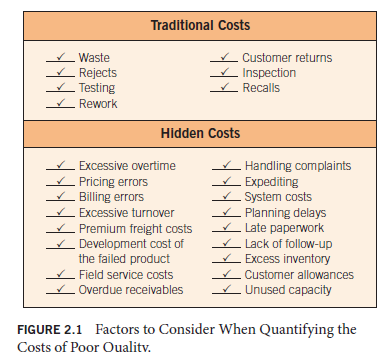
Figure 2.1 summarizes both the traditional and the hidden costs of poor quality. The key principle to understand when examining the hidden costs shown in Figure 2.1 is that if every activity in an organization is performed properly every time, these costs simply disappear.
2.3. Interpreting the Costs of Poor Quality
Once activities have been identified that exist only or primarily because of poor quality, improvement projects can be undertaken to correct the situation. It is important at this stage to select those projects that have the greatest potential to yield the highest return. The following steps can be used to measure the costs of poor quality so that selected improvement projects have the highest priority:
- Identify all activities that exist only or primarily because of poor quality.
- Decide how to estimate the costs of these activities.
- Collect data on these activities and make the cost estimates.
- Analyze the results and take necessary corrective actions in the proper order of priority.
Reducing the cost of poor quality reduces all other costs— product costs, the cost of doing business, and so on. This, in turn, improves the superior value equation: quality, cost, and service.
3. COMPETITIVENESS AND THE U.S. ECONOMY
The United States came out of World War II as the only major industrialized nation with its manufacturing sector completely intact. A well-oiled manufacturing sector and the availability of abundant raw materials helped the United States become the world leader in the production and export of durable goods. This resulted in a period of unparalleled prosperity and one of the highest standards of living ever experienced by any country.
While the United States was enjoying its position as the world’s preeminent economic superpower, the other industrialized nations of the world, particularly Japan and Germany, were busy rebuilding their manufacturing sectors. As Japanese and German manufacturers rebuilt, two things became apparent to them:
- To succeed, they would have to compete globally.
- To compete globally, they would have to produce goods of world-class quality, which meant producing better goods but at reasonable, competitive prices.
Basking in their prosperity, U.S. manufacturers were slow to catch on that the game had changed from mass production with acceptable levels of waste to quality production with things done right the first time every time to provide superior value for customers. The old game was best cost. The new game had become best cost and best quality. When foreign companies—through a combination of better training, better technology, and better management—began to eat away at markets, U.S. companies, mistakenly seeing cost rather than quality as the issue, began sending work offshore to hold down labor costs. By the time U.S. companies learned that quality and value were key to success in the global marketplace, Japan, Germany, Taiwan, and Korea had made major inroads into global markets previously dominated by U.S. manufacturers (e.g., steel, automobiles, computers, and consumer electronics). In a relatively short period of time, the United States went from the world’s leading lender and exporter to the world’s biggest debtor, with a huge balance- of-trade deficit. By 1980, the United States was consuming more than it produced and the trend continues to this day.
Impact of Competitiveness on Quality of Life
A nation’s ability to compete in the global marketplace has a direct bearing on the quality of life of its citizens. Because the ability to compete translates into the ability to do a better job of producing quality goods, it is critical that nations and individual organizations within them focus their policies, systems, and resources in a coordinated way on continually improving both quality and competitiveness.
The United States began the first decade of the new century poised on the precipice of a growing gap between the haves and the have-nots. While Canada, France, Germany, Italy, Japan, Sweden, and Great Britain have taken steps to link economics, education, and labor market policy in ways that promote competitiveness, the United States is still debating the need for an industrial policy and struggling to reverse the decline of its public schools.
During the 1980s, the United States improved productivity by putting more people to work. Other countries improved their productivity by making the individual worker more efficient. Most new entrants into the workforce during the 1970s and 1980s were people who had not worked previously, primarily women. This influx of new workers helped the United States maintain its traditionally high level of productivity. However, by the 1990s, the gains that could be made by increasing the number of people in the workforce had been made.
From 2010 to the foreseeable future, the number of people in the prime working-years age groups in the United States will be on the decline.1 As the size of the workforce continues the downward trend that began in the early 1990s, the only way to improve productivity will be to do what other industrialized countries have done—concentrate on improving the efficiency of individual workers. In other words, businesses in the United States will need to get more work out of fewer workers. As some businesses have already learned, the best way to do this is to adopt the total quality philosophy.
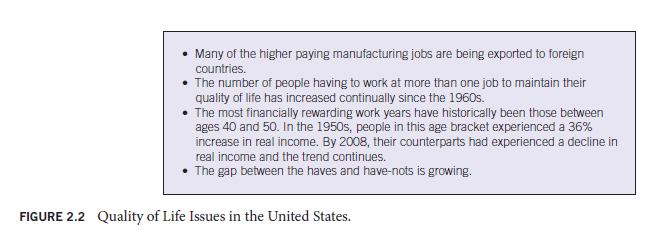
Figure 2.2 contains several vignettes relating to the quality of life in the United States. This figure presents either a bleak picture of bad times to come or an unprecedented national challenge. To meet the challenge, companies in the United States will have to produce world-class value, which will require a commitment to superior quality, cost, and service.
4. FACTORS INHIBITING COMPETITIVENESS
Improving competitiveness on a national scale is no simple matter. Much can be done at the level of the individual company, where the total quality approach can be applied to great advantage, but competitiveness on a national scale requires more than just total quality. Students of quality management must understand this point. Failure to understand the limits of total quality has caused some business leaders to expect too much too soon. This, as a result, has turned them into detractors.
This section describes factors that can inhibit competitiveness but are beyond the scope of total quality. They are socioeconomic and sociopolitical in nature and are indigenous to the United States. In the age of global competition, managers should apply the principles of total quality to help make their individual organizations more competitive. Simultaneously, they should work through the political and social systems as private citizens and community
leaders to help level the playing field among nations by correcting the inhibitors explained in this section. These inhibitors fall into the following categories: business- and government-related factors, family-related factors, and education-related factors.
4.1. Business- and Government-Related Factors
Those U.S. companies trying to compete in the global marketplace are rowing upstream while dragging an anchor. Actually, they drag three anchors. This was pointed out many years ago by W. Edwards Deming when he first set forth his Seven Deadly Diseases. His second, sixth, and seventh deadly diseases are as follows:2
- Emphasis on short-term profits fed by fear of unfriendly takeover attempts and pressure from lenders or shareholders
- Excessive medical costs
- Excessive costs of liability inflated by lawyers working on contingency fees
Each of these diseases adds cost to a company’s products without adding value. Nothing could be worse when viewed from the perspective of competitiveness. A company might equal all competitors point for point on all quality and productivity criteria and still lose in the marketplace because it is a victim of deadly diseases that drive up the cost of its product.
Excessive medical costs and litigation, primarily related to workers’ compensation, have also slanted the playing field in favor of foreign competitors. The annual cost of workers’ compensation to U.S. businesses is almost $30 billion. This is a non-value-added cost that increases the price these businesses must charge for their products. Litigation and the associated legal costs have made tort reform an issue in the U.S. Congress and in the legislatures of most states. However, intense lobbying by trial lawyers has prevented any significant tort reform.
Overcoming these business-related inhibitors will require business and government to work together in a positive, constructive partnership to enact policies that will reduce these non-value-added costs to a minimum. To accomplish this goal, the United States will have to undertake major restructuring of its financial, legal, and medical systems.
4.2. Family-Related Factors
Human resources are a critical part of the competitiveness equation. Just as one of the most important factors in fielding a competitive athletic team is having the best possible players, one of the most important factors in fielding a competitive company is having the best possible employees. Consequently, the quality of the labor pool is important. The more knowledgeable, skilled, motivated, and able to learn members of the labor pool are, the better.
Well-educated, well-trained, motivated members of the labor pool quickly become productive employees when given jobs. Although providing ongoing training for employees is important in the age of global competitiveness, the type of training provided is important. Organizations that can offer training that has immediate and direct application spend less than those that have to begin by providing basic education for functionally illiterate employees. Since the 1970s, U.S. businesses have had to devote increasing amounts of money to basic education efforts, whereas foreign competitors have been able to provide advanced training that very quickly translates into better quality and productivity.
Many factors account for this difference. Some of these can be traced directly to the family. If the family unit, regardless of how it is constituted, is the nation’s most important human resource development agency, the labor pool from which U.S. companies must draw their employees cannot match that in competing countries.
Single parents who must work full-time have little or no time to help their children excel in school. Children with parents who do not value education are unlikely to value it themselves. If the family has a strong influence—positive or negative, by design or by default—on the attitudes of children toward learning and work, the United States faces deep- seated problems that must be solved if its companies are going to compete in the global marketplace.
4.3. Education-Related Factors
The transition from classroom to workplace has never been easy, but in the age of global competition it has only become more difficult. The needs of employers have increased markedly. Unfortunately, the academic performance of students in the United States has not kept pace with changes in the global marketplace. High school graduation rates in the United States rank near the bottom when compared with those in other leading industrialized nations—nations that America must compete with. In addition, the performance of those students who do graduate from high school is markedly lower than that of their contemporaries in competing industrialized countries.
On international tests of academic performance in such key areas as reading, mathematics, science, and problem solving, American students lag well behind their contemporaries in other countries. This is bad news for employers in the United States that must compete in an increasingly global environment. Human performance is one of the key ingredients in quality, productivity, value, organizational excellence, and all of the other factors that affect global competitiveness. Students who enter the workplace unable to perform at competitive levels in reading, mathematics, science, and problem solving just handicap their employers.
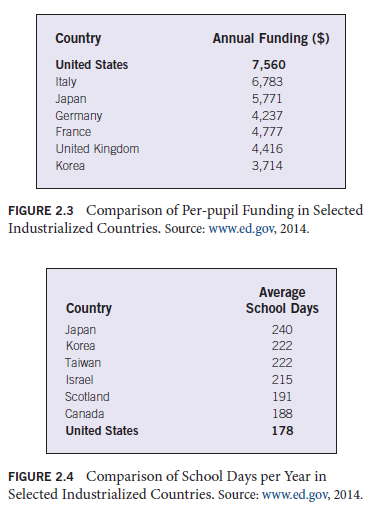
Figure 2.3 compares annual expenditures per pupil for leading industrialized countries. Of the top seven, the United States spends the most, whereas Korea spends the least. Figure 2.4 compares the number of school days required of students annually in the leading industrialized countries. With this criterion, the order is reversed when comparing the United States and Japan.
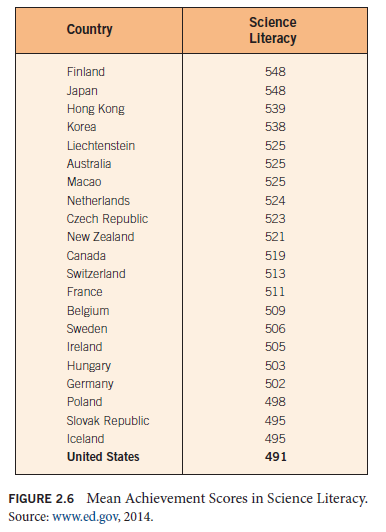
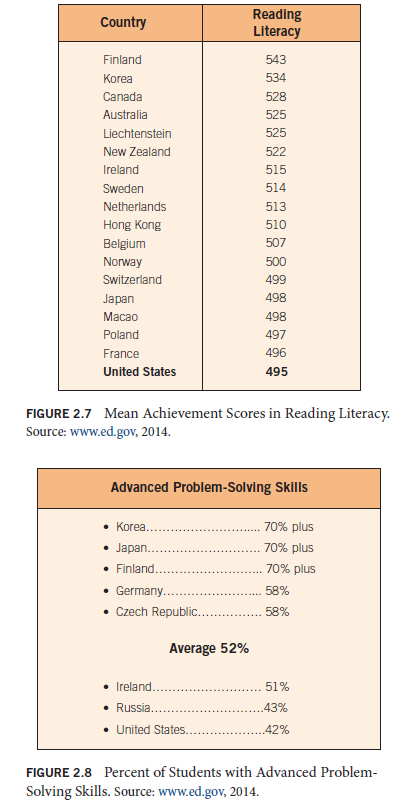
Figures 2.5, 2.6, 2.7, and 2.8 show the actual rankings of student performance on international tests of reading, mathematics, science, and problem solving as tracked by the Organization for Economic Cooperation and Development (OECD). Figure 2.5 shows the relative performance rankings of students in mathematics literacy. The average score of students from the United States is well below the international average (483 versus 498). Figure 2.6 shows similar results in science literacy. Figure 2.7 shows that students from the United States scored an average of 495 on reading while the average international score was 500. These scores do not bode well for the United States or for its employers who must compete in the global arena. In fact, what the scores mean is that if global competition were a footrace, the United States would be starting 100 yards behind in a 200-yard race.

5. U.S. Manufacturers and Global Competition
The most important sectors in determining the quality of life in a country are manufacturing and agriculture. The United States has led the world in agricultural production for many years and still does. The United States also led the world in manufacturing productivity for many years. Beginning with the 1960s, however, this lead began to slip. The decline continued and accelerated through the 1980s to the point that the U.S. manufacturing sector entered the 1990s struggling uphill to regain ground. In the mid- 1990s, however, the United States began to reemerge as a world-class competitor. No longer is the United States, or any other country, the clear-cut leader in terms of manufacturing productivity. With the dawning of the new millennium, Japan, the United States, Germany, and Korea became increasingly competitive.
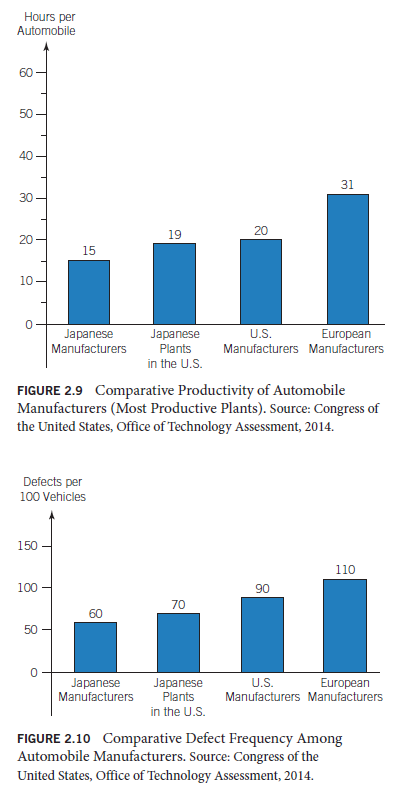
Figure 2.9 compares the productivity of automobile manufacturers in Japan, the United States, and Europe. In this chapter, the term productivity is used several times. In this context, the term should be viewed as “total factor productivity” (ratio of outputs to inputs from labor, capital, materials, and energy). The graph compares the average hours required by the most productive plants to produce one automobile. Japanese plants located in Japan are able to produce an automobile in an average of 15 hours. European manufacturers require more than twice that much time. Such U.S. manufacturers as General Motors, Ford, and Chrysler require an average of 20 hours per automobile. Japanese manufacturers with assembly plants in the United States using U.S. workers, such as Mazda, average 19 hours per automobile. Because hourly wages in Europe tend to be higher than those in Japan and the United States, European firms operate at a double competitive disadvantage. European and U.S. firms are nibbling away at these productivity differences to the point that the gap between the best and worst producers is slowly but steadily closing.
Another area in which Japanese firms have gained a competitive advantage is product development. The product development cycle—the time it takes to turn an idea into a finished product—is typically shorter in Japan than in the United States and Europe. This allows Japanese firms to get new products to the market faster. Japanese automobile manufacturers take an average of two years to complete the product development cycle compared with more than three years for their competitors in the United States and Europe.
Another basis for comparison among automobile manufacturers is quality. Productivity gained at the expense of quality yields no competitive advantage. Figure 2.10 compares the major automobile-producing nations in terms of the average number of defects per 100 vehicles manufactured. The quality comparisons follow the same trends found in the earlier productivity comparisons. Japanese manufacturers average the fewest defects; European manufacturers average the most. American manufacturers find it difficult to compete in the global marketplace when their productivity and quality are not up to international standards—a situation that must be reversed if the United States is to regain the preeminent position it has historically enjoyed in the world community.
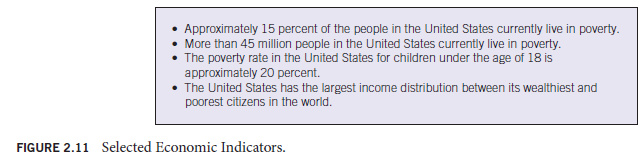
Even a cursory examination of key economic indicators raises concerns. The ability of a country to compete in the manufacturing arena is a direct determinant of its quality of life. Manufacturing created the great American middle class. If the manufacturing sector dwindles because it cannot compete globally, the middle class dwindles correspondingly. Figure 2.11 contains a number of facts that indicate what has happened to the U.S. economy during the years since World War II. These are the years in which U.S. manufacturers have steadily lost ground to foreign competition.
Do these comparisons mean that U.S. manufacturers cannot compete? The answer is no. American manufacturers were slow to respond to the international quality revolution.
However, in the 1980s and into the new millennium, the realization that quality coupled with productivity was the key to winning global competition caused many U.S. firms to begin adopting the approach set forth in this book while s imultaneously pushing for change in areas beyond their control (cost of capital, industrial policy, etc.). As the total quality approach continues to gain acceptance, companies in the United States are closing the competitiveness gap.
6. COMPARISONS OF INTERNATIONAL COMPETITORS
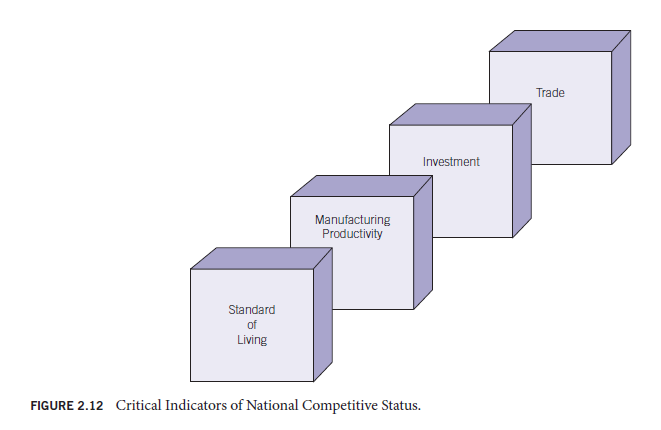
According to a report published by the World Economic Forum, the United States has reclaimed its place as the most competitive country in the world community.3 This is good news, since the United States had slipped to fifth place during the 1990s. This means that in spite of the poor performance of students in the United States when compared with the performance of students in other industrialized nations, the United States has managed to improve in the areas of standard of living, manufacturing productivity, investment, and trade, which are critical indicators of national competitive status (Figure 2.12).
7. HUMAN RESOURCES AND COMPETITIVENESS
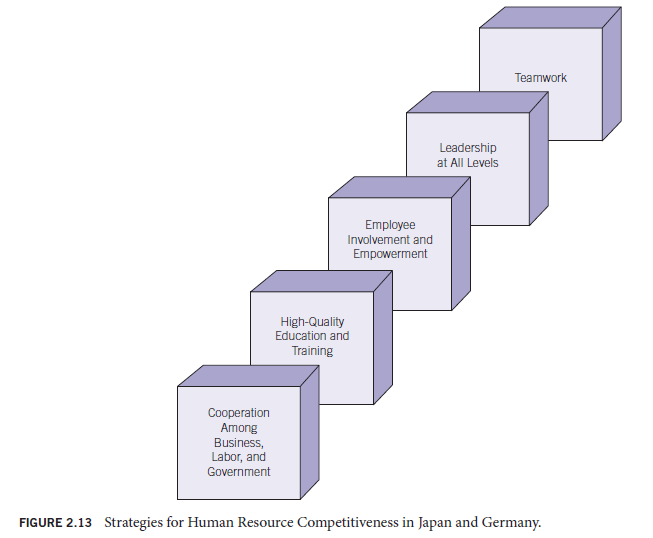
The point is made continually throughout this book that the most valuable resources for enhancing competitiveness are human resources. The truth of this point becomes apparent if one studies the approach taken by Germany and Japan to rebuild from the rubble of World War II. Both countries were devastated. Being left with only one real resource, the human resource, Germany and Japan were forced to adopt an approach that used this resource to the greatest possible advantage.
The German and Japanese systems are not perfect, nor are they infallible. They are examples of approaches that work as well as any other two systems can in a continually changing and unsure global marketplace. Further, they make wise and effective use of human resources.
Business, government, and labor leaders in the United States could learn a great deal from Germany and Japan. People often respond to suggestions that such study might be helpful by claiming that the culture of the United States is so different that what works in these countries won’t work in the United States. Such thinking misses the point entirely: few countries could be more different from one another than Japan and Germany, yet the approaches to competitiveness adopted by these countries are strikingly similar (see Figure 2.13).
Source: Goetsch David L., Davis Stanley B. (2016), Quality Management for organizational excellence introduction to total Quality, Pearson; 8th edition.
The post Quality and Competitiveness of the firm appeared first on HKT Consultant.
]]>