The post Sales Management: Meaning, Objectives, Functions, Scope, Process, Determinants, Tools and Other Details appeared first on HKT Consultant.
]]>Sales management refers to the administration of the personal selling a company’s product line(s). It includes the planning, implementation, and control of sales programs, as well as recruiting, training, motivating, and evaluating members of the sales force. In a small business, these various functions may be performed by the owner or by the sales manager. The fundamental role of the sales manager is to develop and administer a selling program that effectively contributes to the organization’s goals. The sales manager for a small business would likely decide how many salespeople to employ, how best to select and train them, what sort of compensation and incentives to use to motivate them, what type of presentation they should make, and how the sales function should be structured for maximum contact with customers.
Sales management is just one facet of a company’s overall marketing mix, which encompasses strategies related to the “four Ps”: products, pricing, promotion, and place (distribution). Objectives related to promotion are achieved through three supporting functions: 1) advertising, which includes direct mail, radio, television, and print advertisements, among other media; 2) sales promotion, which includes tools such as coupons, rebates, contests, and samples; and (3) personal selling, which is the domain of the sales manager.
Although the role of sales managers is multidisciplinary in scope, their primary responsibilities are: 1) setting goals for a sales force; 2) planning, budgeting, and organizing a program to achieve those goals; 3) implementing the program; and 4) controlling and evaluating the results. Even when a sales force is already in place, the sales manager will likely view these responsibilities as an ongoing process necessary to adapt to both internal and external changes.
Main contentsSee more from basic to advanced








The post Sales Management: Meaning, Objectives, Functions, Scope, Process, Determinants, Tools and Other Details appeared first on HKT Consultant.
]]>The post Evolution of the Sales Department appeared first on HKT Consultant.
]]>With the Industrial Revolution, which began in about 1760 in England and shortly after the American Revolution in the United States, it became increasingly necessary to find and sell new markets. Newly built factories were turning out huge quantities of goods of every description. Their continued operation demanded great expansions in the area of sales coverage, as adjacent markets could not absorb the increased quantities being manufactured. But even under these circumstances other business problems took precedence over selling. These were problems associated with hiring large numbers of workers, and acquiring land, buildings, and machinery. To solve them, large amounts of capital had to be raised. The result was that more and more businesses adopted the corporate form of organization—the day of large-scale manufacturing enterprises had arrived. Firsthand, administration of all phases of the operation being beyond the capabilities of most individuals, authority was increasingly delegated to others. Separate functional departments were established, but sales departments were set up only after the activation of manufacturing and financial departments.
The advent of specialized sales departments helped to solve the organizational problems of market expansion, but another problem remained— communicating with customers. Little by little, manufacturers shifted portions of the marketing function to intermediaries. At the start, goods were sold to retailers, who resold them directly to consumers. Eventually, some larger retailers began to purchase for resale to other retailers, and, as time passed, many of these evolved into wholesale institutions. Other wholesalers developed out of the import-export business. The manufacturer’s sales department was becoming more remote from consumers, and it was increasingly difficult to maintain contact with final buyers and users of the product and to control the conditions under which wholesalers and retailers made their sales. Thus, in some respects, the addition of intermediaries to the channel of distribution complicated the problem of market expansion.
Meanwhile, marketing activities conducted by the manufacturer’s sales department grew in importance. Many tasks, such as advertising and sales promotion, became increasingly complex. One solution was to split the marketing function, a trend that is still continuing. New departments were and are being organized for the performance of specialized marketing tasks. Marketing activities today are carried on not only by the sales department, but by such departments as advertising, marketing research, export, sales promotion, merchandising, traffic and shipping, and credits and collections. In spite of this growing fragmentation of marketing operations, the sales department still occupies a strategically important position. The underlying responsibility for the making of sales has not shifted elsewhere. Businesses continue to rely upon their sales departments for the inward flow of income. It has been aptly said that the sales department is the income-producing division of business.
Source: Richard R. Still, Edward W. Cundliff, Normal A. P Govoni, Sandeep Puri (2017), Sales and Distribution Management: Decisions, Strategies, and Cases, Pearson; Sixth edition.
The post Evolution of the Sales Department appeared first on HKT Consultant.
]]>The post Sales Management appeared first on HKT Consultant.
]]>The American Marketing Association’s definition made sales management synonymous with management of the sales force, but modern sales managers have considerably broader responsibilities. Sales managers are in charge of personal-selling activity, and their primary assignment is management of the personal sales force. However, personnel-related tasks do not comprise their total responsibility, so we call their personnel-related responsibilities “sales force management.”
Sales managers are responsible for organizing the sales effort, both within and outside their companies. Within the company, the sales manager builds formal and informal organizational structures that ensure effective communication not only inside the sales department but in its relations with other organizational units. Outside the company, the sales manager serves as a key contact with customers and other external publics and is responsible for building and maintaining an effective distribution network.
Sales managers have still other responsibilities. They are responsible for participating in the preparation of information critical to the making of key marketing decisions, such as those on budgeting, sales quotas, and territories. They participate—to an extent that varies with the company—in decisions on products, marketing channels and distribution policies, advertising and other promotion, and pricing. Thus, the sales manager is both an administrator in charge of personal-selling activity and a member of the executive group that makes marketing decisions of all types.
Sales management is a vital function in many kinds of enterprises. Manufacturing and wholesaling businesses encounter a broad range of problems in sales management. Retail institutions, small and large, have sales management problems, even though the differences (when compared to the problems of manufacturers and wholesalers) are so great that retailing problems (at least in the academic world) are ordinarily considered separately. But some retailers have sales management problems more akin to those of manufacturers and wholesalers than to those of other retailers—the computer hardware dealer, the pharmaceutical distributor, and the direct-to-consumer marketer all are in this category. Firms selling intangibles, such as the insurance company, the consultant, the mutual fund, and the airline have problems in sales management.
Sales management problems exist even in companies not employing sales personnel as, for example, in the company that uses manufacturers’ agents (rather than its own sales personnel) to reach its markets; indeed, the problems of managing a sales force of “independent outsiders” often are more complex than when sales personnel are on the company payroll.
Source: Richard R. Still, Edward W. Cundliff, Normal A. P Govoni, Sandeep Puri (2017), Sales and Distribution Management: Decisions, Strategies, and Cases, Pearson; Sixth edition.
The post Sales Management appeared first on HKT Consultant.
]]>The post Objectives of Sales Management appeared first on HKT Consultant.
]]>Top management delegates to marketing management, which then delegates to sales management, sufficient authority to achieve these three general objectives. In the process, objectives are translated into more specific goals—they are broken down and redefined as definite goals that the company has a reasonable chance of reaching. During the planning that precedes goal setting, sales executives provide estimates on market and sales potentials, the capabilities of the sales force and the intermediaries, and the like. Once these goals are finalized, it is up to sales executives to guide and lead the sales personnel and intermediaries, who play critical roles in implementing the selling plans.
Hence, sales management is influential in charting the course of future operations. It provides higher management with informed estimates and facts for making marketing decisions and for setting sales and profit goals. Largely on sales management’s appraisal of market opportunities, targets are set for sales volume, gross margin, and net profit in units of product and in dollars, with benchmarks of growth projected for sales and profits at specific future dates. Whether or not these targets are reached depends upon the performance of sales and other marketing personnel.
Source: Richard R. Still, Edward W. Cundliff, Normal A. P Govoni, Sandeep Puri (2017), Sales and Distribution Management: Decisions, Strategies, and Cases, Pearson; Sixth edition.
The post Objectives of Sales Management appeared first on HKT Consultant.
]]>The post Sales Management and Financial Results appeared first on HKT Consultant.
]]>sales – cost of sales = gross margin
gross margin – expenses = net profit
Sales management influences the “numbers cranked into these formulas.” Sales, gross margin, and expenses are affected by the caliber and performance of sales management, and these are the major determinants of net profit. The cost-of-sales factor cannot be affected directly by sales management, but it can be affected indirectly since sales volume must be sufficient to permit maintenance of targeted unit costs of production and distribution. Periodically, these formulas become the company operating statement and are used by the board of directors, and by stockholders, in appraising top management’s performance. Moreover, top management uses these formulas in judging the effectiveness of sales management.
Sometimes, sales executives stress sales volume while neglecting gross margin and expenses. In these instances, even though sales volume increases, gross margin declines, expenses increase proportionately, and net profits are reduced. If these conditions prevail for long, profits disappear and losses appear. Often the best treatment for this situation is to shrink sales volume and expenses. Even with a lower sales volume, skilled sales management can reduce expenses and raise gross margin sufficiently to convert a loss into a profit.
It is also possible to err in the opposite direction and to overemphasize high gross margins and low expenses—because of a preoccupation with percentage relationships. Percentages of gross margin and expense are important, but sales management should be more concerned with dollar relationships. The important net profit is dollar net profit, not the percentage of net profit. It is a small consolation to have satisfactory gross margin and expense percentages if total sales volume and net profits are inadequate. Sales management should worry more about sales and profit dollars than about percentage relationships.
The company maximizes its net profits if it obtains an optimum relationship among the four factors. Sales management, both in its planning and operating roles, aims for an optimum relationship among the three factors it can directly affect: sales, gross margin, and expenses. Sales management works with others (such as those in charge of production and advertising) to assure that sales volume is sufficient to attain targeted cost of sales, the fourth factor.
Source: Richard R. Still, Edward W. Cundliff, Normal A. P Govoni, Sandeep Puri (2017), Sales and Distribution Management: Decisions, Strategies, and Cases, Pearson; Sixth edition.
The post Sales Management and Financial Results appeared first on HKT Consultant.
]]>The post Sales Executive as Coordinator appeared first on HKT Consultant.
]]>1. Organization and Coordination
Coordination of the different order-getting methods (personal selling, advertising, and so forth) is achieved through a single responsible, top-ranking executive. Generally, this is the marketing vice-president, director of marketing, or marketing manager. This executive is responsible for minimizing the possibility that the different order-getting departments will work at cross-purposes or work toward sales goals in isolation (with little knowledge of what others are doing).
Inside the sales department, from the department head to down, all sales executives are responsible for coordinating the organizational units under their control. In sales departments that function smoothly, generally democratic administration is the rule. All subordinates affected by a decision are consulted in advance and are allowed to participate in making it—thus reducing the tendency to resist directives issued by superiors. Not only are there minimum opportunities for misunderstandings to occur, but subordinates, as well as superiors, are able to visualize the circumstances giving rise to decisions.
2. Planning and Coordination
The sales executive, having specialized knowledge of the market and of the capabilities of the sales force, is involved in achieving coordination in marketing objectives and drafts plans that achieve desired results at optimum cost. Sales executives determine the elements (personal selling, advertising, and so forth) that make up the marketing program, apportioning the relative amounts of each so as—at least theoretically—to equate its marginal effectiveness with that of other elements. Coordination among the marketing planners is essential if they are to lay out specific programs for achieving predetermined sales, profit, and growth objectives. The sales executive, as a member of the planning group, seeks to secure a marketing program that is both appropriate for market conditions and reflects the probable contribution of the sales force.
3. Coordination with Other Elements in the Marketing Program
Many responsibilities of sales executives relate to coordinating personal selling with other order-getting methods. Personal-selling efforts must be coordinated with advertising, display, and other promotional efforts if the total marketing effort is to achieve the desired results. Just as they must “build coordination into” the marketing plan, sales executives must achieve coordination during the plan’s implementation.
Synchronizing personal selling with advertising is particularly important. Advertising may prove uneconomic unless the sales force capitalizes upon the interest aroused. Personal-selling effort is wasted in explaining details that might be explained by advertising, but when sales personnel and the advertising use the same appeals—if both tell the same story—promotional impact is magnified. The timing and sequence with which different phases of the personal-selling and advertising efforts are executed affect the firm’s chances of achieving marketing success. An advertising effort should be implemented within the context of the larger marketing effort, and the same applies to personal-selling effort.
Sales executives are involved in coordinating other promotional efforts with the personal-selling effort. Point-of-purchase displays, for example, are set up in retail stores where customers will see them at the precise time that tie-in advertisements appear in national and local media. It is the job of the sales force to achieve this timing and coordination. In a similar manner, the sales personnel alerts dealers to special couponing or sampling efforts so that they can benefit from heightened customer interest.
4. Coordination with the Distributive Network
Sales executives coordinate personal selling with the marketing efforts of the intermediaries. Among the most important aspects are gaining product distribution, obtaining dealer identification, reconciling business goals, and sharing promotional risks.
Gaining product distribution. When a new product is introduced, sales executives are responsible for obtaining distribution. Unless the product is sold directly to final users, the sales department must persuade intermediaries to associate themselves with the new product’s distribution. It is not an easy task to gain distribution Intermediaries refuse to stock a new product unless the manufacturer’s sales staff presents convincing arguments of its salability. Some manufacturers succeed in “pulling” their products through the distribution channel by means of heavy advertising to final buyers, but such instances of “forced distribution” are rare.
Regardless of the distribution channels used, the manufacturer of a new product, as often as not, faces distributor lethargy and dealer indifference, and must use missionary selling. But, as frequently happens in marketing a new consumer product, even missionary selling may be handicapped because corporate chains and other integrated retailers commonly do not permit decentralized calls on their individual outlets. Thus, the manufacturer of a new product may have to build a demand for it in as many outlets as are initially willing to handle it and then prove the existence of an established market demand to the remaining “desired outlets” before adequate distribution is secured. Consequently, the sales executive must ensure that the manufacturer’s initial promotional efforts are tied in with those of the intermediaries who first stock the product. As distribution in more outlets is secured, the sales executive sees to it that progressively larger shares of the promotional burden are shifted to the intermediaries. Thus, coordinating the promotional efforts of the manufacturer and its intermediaries grows increasingly important as the product is made available in more outlets, and sales executives must adjust their coordinating efforts accordingly.
Obtaining dealer identification. In furthering the chances that the personal-selling effort will succeed, the sales executive must ensure that final buyers know which local outlets stock the product. Even if advertising succeeds in preselling the product, there will be no sales if final buyers cannot find the outlets that stock it. Inadequate dealer identification results in clogged distribution channels—all the way from the dealer’s stockroom to the factory. In some instances, dealers take the initiative in publicizing the availability of the product. But, in most cases, sales personnel promote dealer identification through providing store signs, furnishing preprints and reprints of advertisements, supplying advertising mats for local insertions, and assisting in building merchandise displays. In other cases, sales executives arrange for the placing of local advertising over the dealers’ names.
The sales force plays a related role in marketing many consumer products, particularly those distributed through self-service retailers. It is important that consumers, once in the right retail stores, can locate the product with minimum difficulty. Display at the point of purchase bridges the gap between advertising impact and the retail sale. Whenever merchandising aids, such as interior display pieces or shelf markers, are used, sales executives must teach salespeople how to obtain the retailers’ permission to use them. Timing is important in securing permissions—at the start of a special promotional campaign, for example, retailers are more willing to allow the erection of displays (particularly if they have ample supplies of the product on hand) than they are during slow-selling seasons.
Reconciling business goals. Skillful coordinating by sales executives and the sales force minimizes the natural friction that develops because of conflicts, imaginary or real, between the business goals of the manufacturer and the intermediaries. The less the manufacturer and the intermediaries work at cross-purposes, the greater the return to both parties.
One approach is for the manufacturer to share business information with the intermediaries. Certain information is imparted through trade advertising, but salespeople personalize much data for intermediaries. While the results of marketing research studies, for example, have significance for individual intermediaries, sales executives have special reports prepared for personal presentation and explanation by the sales force.
The manufacturer needs information on the operating situation and problems of the intermediaries. Sales personnel, through regular and special reports, serve as the vehicles of communication. Sales executives recognize that only if timely information is available on the needs and attitudes of intermediaries is it possible to provide them with effective promotional and other assistance. The sales executive makes periodic appraisals of existing marketing policies in the light of information provided by salespeople in the field, thus ensuring that those policies already in effect, as well as those newly formulated are appropriate for the total marketing situation.
Sales executives ensure that sales personnel are fair and impartial in their dealings with intermediaries. No outlet should be favored at the expense of another; all should receive equitable treatment. Salespeople need continuous training to keep them abreast of current operating policies, practices and procedures; Effective supervision is required to ensure that they are being applied fairly as well as properly. Providing this training and supervision is the responsibility of sales executives.
Sharing promotional risks. The marketing program often calls for the manufacturer and the intermediaries to share promotional risks (such as through cooperative advertising). In these cases, sales executives ensure that the sales personnel make effective presentations designed to convince dealers to participate. Manufacturers utilizing selective or exclusive agency distribution stand to gain the most from sharing promotional risk with intermediaries; in these situations, sales executives and the sales force play roles in both the initial selection of middle-men as well as in obtaining their consent to share promotional risks. Manufacturers using mass distribution do not find it feasible to delegate much promotional authority to their intermediaries. However, regardless of the company’s distribution policy, any steps that the sales executive takes to make the job of the middleman more interesting, more profitable, and more challenging facilitate the task of coordination.
5. Coordination and Implementation of Overall Marketing Strategy
When the overall marketing strategy is being put into effect, coordination problems occur while timing and securing the best sequence of execution of the various phases. For example, if a new product is to be introduced at a trade show or exhibition, the sales executive coordinates with advertising executives to ensure that the proper interval elapses before advertisements appear or salespeople make calls on dealers in the product’s behalf. Similar coordinating action ensures proper spacing of the advertising in relation to the call schedules of salespeople. Furthermore, sales executives see that field sales personnel integrate every phase and segment of the promotional programs of distributors and dealers.
Successful market introduction of a new brand is a severe test of the mettle and the level of competence possessed by all members of the marketing management team, including sales executives. The Introduction of a new brand requires policies, strategies, and detailed plans, all of them appropriate to the company’s marketing situation. Proper timing of the stages in the introduction plan is important because launching a brand at the wrong time, or faulty timing at any stage will kill or reduce the chances for success. All the promotional efforts on behalf of the new brand require coordination: advertising with personal selling and the manufacturer’s total promotion with intermediaries activities.
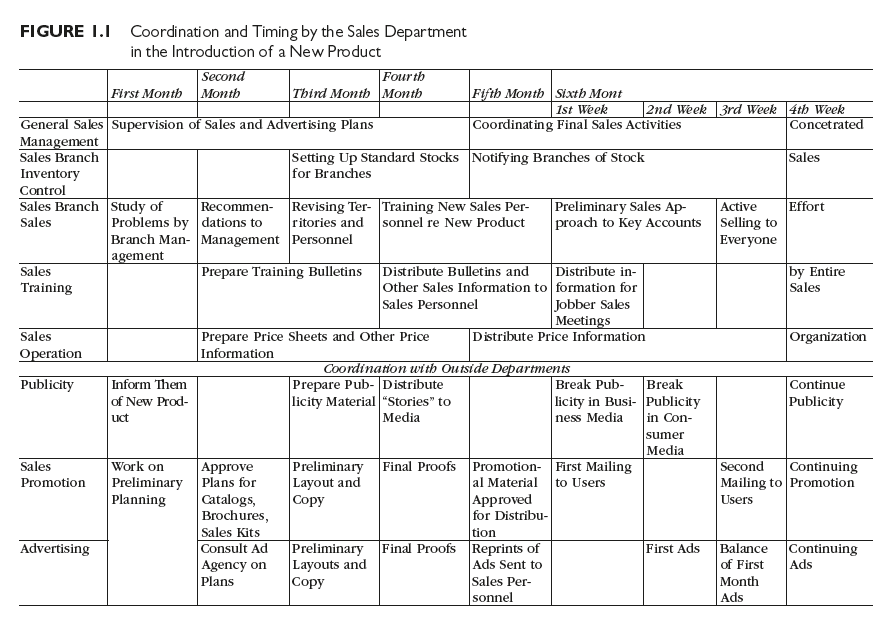
It is not enough for sales executives to know the techniques and problems of new-brand introduction. They must be capable of putting the plans into action, to implement them effectively. They must skillfully execute the program of market introduction. Figure 1.1 illustrates a sales department’s planned coordinating action and emphasizes the importance of timing of coordination effort in the introduction of a new product. Notice, for instance, that publicity releases break at about the time that the product becomes available. Notice, too, that salespeople are alerted ahead of time, but not too far in advance for them to lose their enthusiasm.
Source: Richard R. Still, Edward W. Cundliff, Normal A. P Govoni, Sandeep Puri (2017), Sales and Distribution Management: Decisions, Strategies, and Cases, Pearson; Sixth edition.
The post Sales Executive as Coordinator appeared first on HKT Consultant.
]]>The post Sales Management and Control appeared first on HKT Consultant.
]]>
Sizing up the situation. Sales executives start by reviewing the personalselling objectives of the firm. They analyze these objectives with respect to the present, the past, and the future, in an attempt to answer four questions:
- Where are we now?
- How did we get here?
- Where are we going?
- How do we get there?
After satisfying themselves that the company’s personal-selling objectives, both long range and short range, are reconcilable, sales executives appraise them relative to the plans, policies, and procedures that have been used, are being used, or are intended for use in the effort to reach personal-selling objectives. In the course of sizing up the situation, sales executives find and correct weaknesses or imperfections in the sales plans and the policies and procedures used in their implementation.
Setting quantitative performance standards. After ironing out planning weaknesses, sales executives set quantitative standards against which to measure performance. Standard setting requires continual experimentation, and lost standards are far from precise. The ultimate test of a particular standard’s appropriateness is whether it contributes more to personal-selling efficiency than it costs.
Intelligent standard setting requires identification of the individuals who are responsible for the activity or group of activities being put under control. No two salespersons or executives perform exactly alike, even though they may operate in circumstances identical in every other respect. Thus, standards are often expressed as ranges of acceptable performance. Although it is convenient to think of a standard as a fixed value, there should be an upper and lower limit within which human variation may take place. When the performance of an organizational unit passes either of these control limits, the danger flag is up, thus signaling that the situation is out of control.
Gathering and processing data on actual performance. The type and amount of information needed for controlling sales depend upon the standards selected. But, regardless of the nature of this information, it should not be in excess of sales management’s real needs, nor should its cost of collection and processing be more than its worth. Consequently, sales management determines—at regular intervals—whether the information being reported is sufficiently important and being used often enough to justify its costs. Sales executives also keep in mind that changes in executives, basic policies, or other matters may alter the usefulness of information. Occasionally, too, they look for cases where the same or similar information is being obtained from more than one source, representing opportunities for savings through eliminating duplications in reporting. Sometimes, also, savings is realized through reducing or lengthening the intervals at which information is gathered and processed.
For standards to be of maximum value, sales executives must have information on actual performances soon enough to permit timely corrective action. An efficient system of sales control not only furnishes information necessary to managerial evaluation of performance but also promptly relays it, together with suggestions for actions, to the appropriate organizational unit. But information on actual sales performance is often slow in arriving on the sales executive’s desk, considerably delaying performance evaluations. For example, many companies, perhaps even most, require sales personnel to make weekly sales reports; in such cases, a week or more may pass before the sales executive acts on the report. But progress is being made in improving the timeliness of sales control information. Utilization of electronic data-processing systems for handling sales control data has sped up information evaluation and feedback.
Evaluating performance. Evaluation of performance means comparing actual results with standards. Because of differences in territorial and other conditions, it is difficult to compare individual performances. However, it is possible to explain each individual salesperson’s variations from standard. Departures from standard are classified into uncontrollable and controllable variations. Variations beyond the control of the person being appraised include those caused by rapid and unexpected changes in economic conditions; changes in governmental activities; and wars, strikes, floods, droughts, and other natural disasters. Variations over which the person has the responsibility include obtaining proper sales coverage, following up leads, selling a balanced line, securing adequate credit information, and the like. The principle is that subordinates should not be held responsible for conditions beyond their control. In appraising performance, it is important to exclude uncontrollable variations.
Action to correct controllable variation. Management corrects the variation explained by factors within the control of the person being evaluated. Management, in other words, takes steps to move the individual’s performance in the direction of the standards. The specific actions taken differ with the nature of the variation. But management’s actions assume one or more of three forms: (1) direction, or pointing out more effective ways to perform certain tasks; (2) guidance, or providing additional instructions or training; and (3) restraint, or the installation of procedures and practices aimed at keeping results within desired bounds.
Adjusting for uncontrollable variation. The amount of uncontrollable variation in the comparison indicates the relative need for adjusting sales plans and policies. If uncontrollable variation suggests that present sales objectives are unrealistic or not in line with current expectations, basic revisions in the objectives are made. Thus, if a comparison of results with standards reveals substantial uncontrollable variation, adjustment of standards to attainable levels is in order.
Source: Richard R. Still, Edward W. Cundliff, Normal A. P Govoni, Sandeep Puri (2017), Sales and Distribution Management: Decisions, Strategies, and Cases, Pearson; Sixth edition.
The post Sales Management and Control appeared first on HKT Consultant.
]]>The post Sales Control – Informal and Formal appeared first on HKT Consultant.
]]>Formal control and written sales policies. Early evidence of the introduction of formal sales controls is the introduction of sales policies in writing. No enterprise, however small, can survive for long without policies, but smaller firms often operate satisfactorily, even though they do not put their policies in writing. As the sales organization grows, the limits within which action is to take place in given situations needs to
be spelled out in detail. A large organization not only has more complex problems than a small organization but there is less chance that everyone will know what to do in every circumstance. The large organization needs written sales and marketing policies to ensure substantial uniformity of action. Uniformity is essential both among different persons handling similar problems and among the same persons handling similar problems at different times. Written policies also conserve executive time. Because policies are written, more time can be used for planning and making decisions on problems not covered by existing policies. Sales executives reserve time for handling “policy exceptions,” and if they encounter enough exceptions of similar nature, a new policy is formulated and is put in writing.
Policy formulation and review. The process of policy formulation and review illustrates the dynamics of executive control. A good policy evolves from thorough study and evaluation of tangible information. However, many sales policies deal with subjects on which quantitative data are lacking, especially when management is experimenting with new ideas. When objectives are not set explicitly (because of lack of information), results vary from the standard because of factors (“uncontrollable variations”) beyond the control of the individual being evaluated. Thus, coincident to the scaling down of objectives, sales management reviews the original plans. Eventually, through successive revisions, policies initially based on inadequate data often become appropriate and “good.”
Formal control over sales volume. One formal control, introduced early in the history of a firm, is that over sales volume. Estimating how much of a product can be sold in a specified future period is a prerequisite both for planning and control. Sales volume performance is best appraised by comparing it with potential sales volume. The “sales or market forecast,” therefore, serves as a standard for evaluating sales performance. However, the periodic forecast of sales is not enough for effective control over sales volume. During the intervals between forecasts, sales management monitors such factors as industry sales trends, activities of competitors, and share-of-the-market percentages. Significant changes in these factors may call for changes in sales objectives, plans, policies, and procedures.
Budgetary control. Ultimately, formal control requires installation of sales budgetary controls and setting up of sales territories. Budgetary control represents an extension of control over sales volume to control over margins and expenses and, hence, over profits. When control reaches this stage, sales management can project individual profit-and- loss statements for such units as sales territories, products, marketing channels, and classes of customers. Through using such estimating devices as standard costs of distribution, sales management sets standards for controlling individual expense items and the gross margin. Through marketing costs analysis, sales management appraises sales performance against predetermined standards. In this way, the soft points, the areas where sales performance is below par, are brought to management’s attention. The net result is to reduce the time between drops in performance and corrective action.
Source: Richard R. Still, Edward W. Cundliff, Normal A. P Govoni, Sandeep Puri (2017), Sales and Distribution Management: Decisions, Strategies, and Cases, Pearson; Sixth edition.
The post Sales Control – Informal and Formal appeared first on HKT Consultant.
]]>The post Sales Control and Organization appeared first on HKT Consultant.
]]>Source: Richard R. Still, Edward W. Cundliff, Normal A. P Govoni, Sandeep Puri (2017), Sales and Distribution Management: Decisions, Strategies, and Cases, Pearson; Sixth edition.
The post Sales Control and Organization appeared first on HKT Consultant.
]]>The post Buyer-Seller Dyads appeared first on HKT Consultant.
]]>Franklin Evans researched buyer-seller dyads in the life insurance business. Prospects who bought insurance knew more about salespersons and their companies, and felt more positively toward them, than did prospects who did not buy. Furthermore, the more alike salespersons and their prospects were, the greater was the likelihood that a sale would result. This was true for physical characteristics (age, height), other objective factors (income, religion, education), and variables that relate to personality factors (politics, smoking).
Evans’s findings have significance for sales management. Whenever possible, sales personnel should be assigned to prospects whose characteristics are similar to their own, thus improving the chance of successful dyadic relationships. Pairing salespersons with customers of similar backgrounds is more easily accomplished in industrial selling, where there are fewer prospects about whom information is needed, than in consumer- goods selling, where the number of prospects and customers per salesperson is much larger.
Henry Tosi studied dyads of wholesale drug salespeople and retail pharmacists who made buying decisions. When the buyer perceived the salesperson’s performance to be similar to his or her concept of “ideal” performance, the number of sources from which purchases were made was low. Although this did not necessarily result in a larger percentage of purchases from the salesperson, customer satisfaction with the salesperson’s behavior did at least allow the salesperson to get into the store. Tosi concluded that, in addition to the physical characteristics and personality and objective factors cited by Evans, the customer’s perception of what that behavior should be is a necessary condition for the continuation of dyadic interaction.
Another factor influencing buyer-seller dyadic interactions is the buyer’s initial conditioning with respect to selling. Salespeople have been maligned, and was the butt of nasty stories for generations. People are taught from childhood to beware of the tricky salesperson.
There are indications that salespeople, not as stereotyped, but as they actually perform, leave much to be desired in the impact they make on customers. Studies of the attitudes of buyers and purchasing agents reveal that many are critical of the salesperson’s lack of product knowledge, failure to follow up, general unreliability, slavish adherence to “canned” presentations, blatant use of flattery, bad manners, commercial dishonesty, and so forth.
Figure 2.1 is a conceptual model of “salesperson-buyer” dyadic relationships. This model, developed after an extensive literature search, views the sales process as being influenced by both salesperson and buyer, each a focal person influenced by personal characteristics and role requirements. Personal characteristics include personality, values, attitudes, past experiences, and the like. Role set requirements (for example, formal authority and organizational autonomy) interact with personal characteristics to shape needs and expectations. Focal persons’ perceptions of each other’s needs may lead to adjustments of their own (see the “feedback” mechanism represented by the broken lines in Figure 2.1).
Based on individual needs and expectations, each focal person develops a strategy aimed to negotiate a favorable exchange. That strategy may embrace persuasion, ingratiation, communication of facts or offers, friendship, and other elements. If the strategies are compatible, an exchange takes place. Otherwise, the salesperson and the buyer may stop interacting, or based on feedback from the unsuccessful negotiation, either or both may adapt by altering strategy, attempting to adjust needs and expectations, or modifying role requirements. Role requirements, as well as needs and expectations, often are determined by forces beyond the focal person’s control, so one or both may find it impossible to adapt. For instance, to meet a buyer’s expectations, a salesperson may need to set prices, yet this may be against company policy and beyond the salesperson’s control. When the particular round of negotiations is terminated regardless of its outcome, the experience becomes an input into future interactions of the salesperson and customer.

Source: Richard R. Still, Edward W. Cundliff, Normal A. P Govoni, Sandeep Puri (2017), Sales and Distribution Management: Decisions, Strategies, and Cases, Pearson; Sixth edition.
The post Buyer-Seller Dyads appeared first on HKT Consultant.
]]>