The post Firm Strategy and Strategic Management appeared first on HKT Consultant.
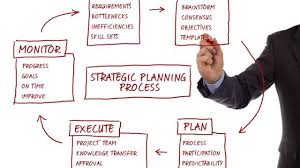
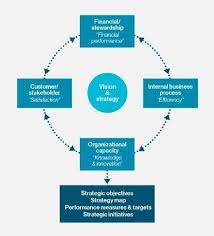
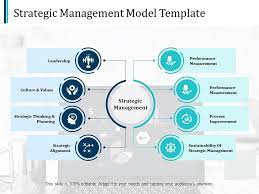
]]>Firm strategy involves the formulation and implementation of the major goals and initiatives taken by an organization’s managers on behalf of stakeholders, based on consideration of resources and an assessment of the internal and external environments in which the organization operates. Firm strategy provides overall direction to an enterprise and involves specifying the organization’s objectives, developing policies and plans to achieve those objectives, and then allocating resources to implement the plans. Academics and practicing managers have developed numerous models and frameworks to assist in strategic decision-making in the context of complex environments and competitive dynamics. Firm strategy is not static in nature; the models often include a feedback loop to monitor execution and to inform the next round of planning.
Michael Porter identifies three principles underlying strategy:
- creating a “unique and valuable [market] position”
- making trade-offs by choosing “what not to do”
- creating “fit” by aligning company activities with one another to support the chosen strategy
Management theory and practice often make a distinction between strategic management and operational management, with operational management concerned primarily with improving efficiency and controlling costs within the boundaries set by the organization’s strategy.
Main contentsSee more from basic to advanced















The post Firm Strategy and Strategic Management appeared first on HKT Consultant.
]]>The post What Is Strategic Management? appeared first on HKT Consultant.
]]>1. What Is a Cohesion Case?
A distinguishing, popular feature of this text is the cohesion case, named so because a written case on a company appears at the end of this chapter, and then all other chapters feature end-of-chapter assurance of Learning Exercises to apply strategic-planning concepts, tools, and techniques to the cohesion case company. The Hershey company is featured as the new cohesion case in this edition, because Hershey is a well-known, well-managed global firm undergoing strategic change. By working through the Hershey-related exercises at the end of each chapter, students become well prepared to develop an effective strategic plan for any company assigned to them (or their team) to perform a strategic-management case analysis. case analysis is a core part of almost every strategic-management course globally.
2. Defining Strategic Management
Strategic management is the art and science of formulating, implementing, and evaluating cross-functional decisions that enable an organization to achieve its objectives. As this definition implies, strategic management focuses on integrating management, marketing, finance and accounting, production and operations, research and development (R&D), and information systems to achieve organizational success. the term strategic management in this text is used synonymously with the term strategic planning. the latter term is more often used in the business world, whereas the former is often used in academia. Sometimes the term strategic management is used to refer to strategy formulation, implementation, and evaluation, with strategic planning referring only to strategy formulation. the purpose of strategic management is to exploit and create new and different opportunities for tomorrow; long-range planning, in contrast, tries to optimize for tomorrow the trends of today.
The term strategic planning originated in the 1950s and was popular between the mid-1960s and the mid-1970s. During these years, strategic planning was widely believed to be the answer for all problems. at the time, much of corporate America was “obsessed” with strategic planning. Following that boom, however, strategic planning was cast aside during the 1980s as various planning models did not yield higher returns. the 1990s, however, brought the revival of strategic planning, and the process is widely practiced today in the business world. Many companies today have a chief strategy officer (CSO). McDonald’s hired a new cSO in October 2015.
A strategic plan is, in essence, a company’s game plan. Just as a football team needs a good game plan to have a chance for success, a company must have a good strategic plan to compete successfully. Profit margins among firms in most industries are so slim that there is little room for error in the overall strategic plan. A strategic plan results from tough managerial choices among numerous good alternatives, and it signals commitment to specific markets, policies, procedures, and operations in lieu of other, “less desirable” courses of action.
The term strategic management is used at many colleges and universities as the title for the capstone course in business administration. this course integrates material from all business courses, and, in addition, introduces new strategic-management concepts and techniques being widely used by firms in strategic planning.
Source: David Fred, David Forest (2016), Strategic Management: A Competitive Advantage Approach, Concepts and Cases, Pearson (16th Edition).
The post What Is Strategic Management? appeared first on HKT Consultant.
]]>The post Stages of Strategic Management appeared first on HKT Consultant.
]]>Because no organization has unlimited resources, strategists must decide which alternative strategies will benefit the firm most. Strategy-formulation decisions commit an organization to specific products, markets, resources, and technologies over an extended period of time. Strategies determine long-term competitive advantages. For better or worse, strategic decisions have major multifunctional consequences and enduring effects on an organization. Top managers have the best perspective to understand fully the ramifications of strategy-formulation decisions; they have the authority to commit the resources necessary for implementation.
Strategy implementation requires a firm to establish annual objectives, devise policies, motivate employees, and allocate resources so that formulated strategies can be executed. Strategy implementation includes developing a strategy-supportive culture, creating an effective organizational structure, redirecting marketing efforts, preparing budgets, developing and using information systems, and linking employee compensation to organizational performance.
Strategy implementation often is called the “action stage” of strategic management. Implementing strategy means mobilizing employees and managers to put formulated strategies into action. Often considered to be the most difficult stage in strategic management, strategy implementation requires personal discipline, commitment, and sacrifice. Successful strategy implementation hinges on managers’ ability to motivate employees, which is more an art than a science. Strategies formulated but not implemented serve no useful purpose.
Interpersonal skills are especially critical for successful strategy implementation. Strategy- implementation activities affect all employees and managers in an organization. Every division and department must decide on answers to questions such as “What must we do to implement our part of the organization’s strategy?” and “How best can we get the job done?” The challenge of implementation is to stimulate managers and employees throughout an organization to work with pride and enthusiasm toward achieving stated objectives.
Strategy evaluation is the final stage in strategic management. Managers desperately need to know when particular strategies are not working well; strategy evaluation is the primary means for obtaining this information. All strategies are subject to future modification because external and internal factors constantly change. Three fundamental strategy-evaluation activities are (1) reviewing external and internal factors that are the bases for current strategies, (2) measuring performance, and (3) taking corrective actions. Strategy evaluation is needed because success today is no guarantee of success tomorrow! Success always creates new and different problems; complacent organizations experience demise.
Formulation, implementation, and evaluation of strategy activities occur at three hierarchical levels in a large organization: corporate, divisional or strategic business unit, and functional. By fostering communication and interaction among managers and employees across hierarchical levels, strategic management helps a firm function as a competitive team. Most small businesses and some large businesses do not have divisions or strategic business units; they have only the corporate and functional levels. Nevertheless, managers and employees at these two levels should be actively involved in strategic-management activities.
Peter Drucker says the prime task of strategic management is thinking through the overall mission of a business-that is, of asking the question, “What is our business?” This leads to the setting of objectives, the development of strategies, and the making of today’s decisions for tomorrow’s results. This clearly must be done by a part of the organization that can see the entire business; that can balance objectives and the needs of today against the needs of tomorrow; and that can allocate resources of men and money to key results.
Source: David Fred, David Forest (2016), Strategic Management: A Competitive Advantage Approach, Concepts and Cases, Pearson (16th Edition).
The post Stages of Strategic Management appeared first on HKT Consultant.
]]>The post Integrating Intuition and Analysis appeared first on HKT Consultant.
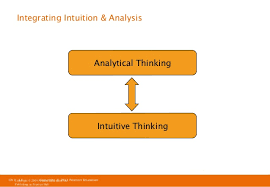
]]>Based on past experiences, judgment, and feelings, most people recognize that intuition is essential to making good strategic decisions. Intuition is particularly useful for making decisions in situations of great uncertainty or little precedent. It is also helpful when highly interrelated variables exist or when it is necessary to choose from several plausible alternatives. Some managers and owners of businesses profess to have extraordinary abilities for using intuition alone in devising brilliant strategies. For example, will Durant, who organized GM, was described by Alfred Sloan as “a man who would proceed on a course of action guided solely, as far as i could tell, by some intuitive flash of brilliance. He never felt obliged to make an engineering hunt for the facts. Yet at times, he was astoundingly correct in his judgment.”3 albert Einstein acknowledged the importance of intuition when he said, “i believe in intuition and inspiration. at times i feel certain that i am right while not knowing the reason. imagination is more important than knowledge, because knowledge is limited, whereas imagination embraces the entire world.”4 although some organizations today may survive and prosper because they have intuitive geniuses managing them, many are not so fortunate. Most organizations can benefit from strategic management, which is based on integrating intuition and analysis in decision making. choosing an intuitive or analytic approach to decision making is not an either-or proposition. Managers at all levels in an organization inject their intuition and judgment into strategic- management analyses. analytical thinking and intuitive thinking complement each other.
Operating from the i’ve-already-made-up-my-mind-don’t-bother-me-with-the-facts mode is not management by intuition; it is management by ignorance.5 Drucker says, “i believe in intuition only if you discipline it. ‘Hunch’ artists, who make a diagnosis but don’t check it out with the facts, are the ones in medicine who kill people, and in management kill businesses.”6 As Henderson notes:
The accelerating rate of change today is producing a business world in which customary managerial habits in organizations are increasingly inadequate. Experience alone was an adequate guide when changes could be made in small increments. But intuitive and experience-based management philosophies are grossly inadequate when decisions are strategic and have major, irreversible consequences.7
In a sense, the strategic-management process is an attempt to duplicate what goes on in the mind of a brilliant, intuitive person who knows the business and assimilates and integrates that knowledge using analysis to formulate effective strategies.
1. Adapting to Change
The strategic-management process is based on the belief that organizations should continually monitor internal and external events and trends so that timely changes can be made as needed. The rate and magnitude of changes that affect organizations are increasing dramatically, as evidenced by how the drop in oil prices caught so many firms by surprise. Firms, like organisms, must be “adept at adapting” or they will not survive. To survive, all organizations must astutely identify and adapt to change. The strategic-management process is aimed at allowing organizations to adapt effectively to change over the long run. waterman noted:
in today’s business environment, more than in any preceding era, the only constant is change. Successful organizations effectively manage change, continuously adapting their bureaucracies, strategies, systems, products, and cultures to survive the shocks and prosper from the forces that decimate the competition.8
On a political map, the boundaries between countries may be clear, but on a competitive map showing the real flow of financial and industrial activity, the boundaries have largely disappeared. The speedy flow of information has eaten away at national boundaries so that people worldwide readily see for themselves how other people live and work. we have become a borderless world with global citizens, global competitors, global customers, global suppliers, and global distributors! Many firms headquartered in the United States are challenged by out- side-U.S.-based companies in many industries. For example, Toyota, Honda, Yamaha, Suzuki, Volkswagen, Samsung, and Kia have huge market shares in the United States.
The need to adapt to change leads organizations to key strategic-management questions, such as “What kind of business should we become?” “Are we in the right field(s)?” “Should we reshape our business?” “What new competitors are entering our industry?” “What strategies should we pursue?” “How are our customers changing?” “Are new technologies being developed that could put us out of business?”
The Internet promotes endless comparison shopping, enabling consumers worldwide to band together to demand discounts. the internet has transferred power from businesses to individuals. Buyers used to face big obstacles when attempting to get the best price and service, such as limited time and data to compare, but now consumers can quickly scan hundreds of vendor offerings. Both the number of people shopping online and the average amount they spend is increasing dramatically. Digital communication has become the name of the game in marketing. consumers today are flocking to blogs, sending tweets, watching and posting videos on Youtube, and spending hours on tumbler, Facebook, Reddit, instagram, and Linkedin, instead of watching television, listening to the radio, or reading newspapers and magazines. facebook recently unveiled features that further marry these social sites to the wider internet. Facebook users can now log onto various business shopping sites from their social site, so their friends can see what items they have purchased from what companies. facebook wants their members to use their identities to manage all their online identities. Most traditional retailers boost in-store sales using their websites to promote in-store promotions.
Source: David Fred, David Forest (2016), Strategic Management: A Competitive Advantage Approach, Concepts and Cases, Pearson (16th Edition).
The post Integrating Intuition and Analysis appeared first on HKT Consultant.
]]>The post Key terms in Strategic Management appeared first on HKT Consultant.
]]>1. Competitive Advantage
Strategic management is all about gaining and maintaining competitive advantage. this term can be defined as any activity a firm does especially well compared to activities done by rival firms, or any resource a firm possesses that rival firms desire.
Having fewer fixed assets than rival firms can provide major competitive advantages. for example, apple has virtually no manufacturing facilities of its own, and rival Sony has 57 electronics factories. Apple relies almost entirely on contract manufacturers for production of all its products, whereas Sony owns its own plants. Having fewer fixed assets has enabled apple to remain financially lean.
according to cEO Paco Underhill of Envirosell, “where it used to be a polite war, it’s now a 21st-century bar fight, where everybody is competing with everyone else for the customers’ money.” Shoppers are “trading down: Nordstrom is taking customers from Neiman Marcus and Saks Fifth Avenue, T.J. Maxx and Marshalls are taking customers from most other stores in the mall, and Family Dollar is taking revenues from Walmart.9 Getting and keeping competitive advantage is essential for long-term success in an organization. in mass retailing, big-box companies, such as Walmart, Best Buy, and Sears, are losing competitive advantage to smaller stores, reflecting the dramatic shift in mass retailing to becoming smaller. As customers shift more to online purchases, less brick and mortar is definitely better for sustaining competitive advantage in retailing. Walmart Express stores of less than 40,000 square feet each, rather than its 185,000-square-foot Supercenters, and Office Depot’s new 5,000-square-foot stores are examples of smaller is better.
Normally, a firm can sustain a competitive advantage for only a certain period because of rival firms imitating and undermining that advantage. thus, it is not adequate simply to obtain competitive advantage. A firm must strive to achieve sustained competitive advantage by (1) continually adapting to changes in external trends and events and internal capabilities, competencies, and resources; and (2) effectively formulating, implementing, and evaluating strategies that capitalize on those factors.
2. Strategists
Strategists are the individuals most responsible for the success or failure of an organization. they have various job titles, such as chief executive officer, president, owner, chair of the board, executive director, chancellor, dean, and entrepreneur. Jay Conger, professor of organizational behavior at the London Business School and author of Building Leaders, says, “All strategists have to be chief learning officers. we are in an extended period of change. If our leaders aren’t highly adaptive and great models during this period, then our companies won’t adapt either, because ultimately leadership is about being a role model.”
Strategists help an organization gather, analyze, and organize information. They track industry and competitive trends, develop forecasting models and scenario analyses, evaluate corporate and divisional performance, spot emerging market opportunities, identify business threats, and develop creative action plans. Strategic planners usually serve in a support or staff role. Usually found in higher levels of management, they typically have considerable authority for decision making in the firm. The CEO is the most visible and critical strategic manager. Any manager who has responsibility for a unit or division, responsibility for profit and loss outcomes, or direct authority over a major piece of the business is a strategic manager (strategist).
In the last few years, the position of CSO has become common in many organizations, including Sun Microsystems, Network Associates, Clarus, Lante, Marimba, Sapient, Commerce One, BBDO, Cadbury Schweppes, General Motors, Ellie Mae, Cendant, Charles Schwab, Tyco, Campbell Soup, Morgan Stanley, and Reed-Elsevier. This corporate officer title represents recognition of the growing importance of strategic planning in business. Franz Koch, the CSO of German sportswear company Puma AG, was recently promoted to CEO of Puma. When asked about his plans for the company, Koch said on a conference call, “I plan to just focus on the long-term strategic plan.” Academic Research Capsule 1-1 reveals when CSOs are most often hired.
Strategists differ as much as organizations do, and these differences must be considered in the formulation, implementation, and evaluation of strategies. Strategists differ in their attitudes, values, ethics, willingness to take risks, concern for social responsibility, concern for profitability, concern for short-run versus long-run aims, and management style—some will not even consider various types of strategies because of their personal philosophies.. The founder of Hershey, Milton Hershey, built the company so that he could afford to manage an orphanage. From corporate profits, Hershey today cares for about 900 boys and 1,000 girls in its boarding school for pre-K through grade 12.
Athletic coaches are also strategists. Football, basketball, baseball, soccer, and in fact most athletic contests are often won or lost based a team’s game plan. For example, a basketball coach may plan to fast break and play up-tempo, rather than play more half court, if the players are smaller and faster, or if the team has more depth than the opposing team. A few great college basketball coaches today are Mike Krzyzewski at Duke, John Calipari at Kentucky, Jim Boeheim at Syracuse, and Tom Izzo at Michigan State. Great college basketball coaches years ago included John Wooden, Jim Valvano, Dean Smith, and Bobby Knight. Another great coach of yesteryear was Nolan Richardson, who developed excellent game plans and, in 1994, as the first black head coach at a major university in the South, led the Arkansas Razorbacks men’s basketball team to win the NCAA college basketball national championship versus Duke.10 Switching to football, some inspirational, strategic-planning-related quotes from legendary National Football League (NFL) coaches are provided in Table 1-1.
3. When Are Chief Strategy Officers (CSOs) Hired/Appointed?
An increasing number of firms are employing a chief strategy officer (CSO). In an article published in 2014, Menz and Sheef examined 200 S&P 500 firms over a 5-year period to examine what factors contribute to firms hiring a CSO and what factors contribute to a CSO affecting a firm’s financial performance. Of the sampled firms, on average, during the study, 42 percent employed a CSO. Although many factors may lead to a firm’s decision to appoint a CSO, the authors focused on five key areas that prior research suggests as most important and most likely to lead to a CSO appointment:
- As the business portfolio increases (e.g., the firm becomes more diversified)
- As acquisition activity expands
- As alliance activity increases
- As a firm’s size grows
- As top management team interdependence increases
Results of the Menz and Sheef study reveal that an increase in management interdependence and growth in acquisition activity were most commonly associated with hiring a new CSO.
Source: Based on Markus Menz and Christine Sheef, “Chief Strategy Officers: Contingency Analysis of Their Presence in Top Management Teams,” Strategic Management Journal 35, no. 3 (March 2014): 461-471.
4. Vision and Mission Statements
Many organizations today develop a vision statement that answers the question “What do we want to become?” Developing a vision statement is often considered the first step in strategic planning, preceding even development of a mission statement. Many vision statements are a single sentence. For example, the vision statement of Stokes Eye Clinic in Florence, South Carolina, is “Our vision is to take care of your vision.”
Mission statements are “enduring statements of purpose that distinguish one business from other similar firms. A mission statement identifies the scope of a firm’s operations in product and market terms.”11 It addresses the basic question that faces all strategists: “What is our business?” A clear mission statement describes the values and priorities of an organization. Developing a mission statement compels strategists to think about the nature and scope of present operations and to assess the potential attractiveness of future markets and activities. A mission statement not only broadly charts the future direction of an organization but it also serves as a constant reminder to its employees of why the organization exists and what the founders envisioned when they put their fame and fortune (and names) at risk to breathe life into their dreams.
5. External Opportunities and Threats
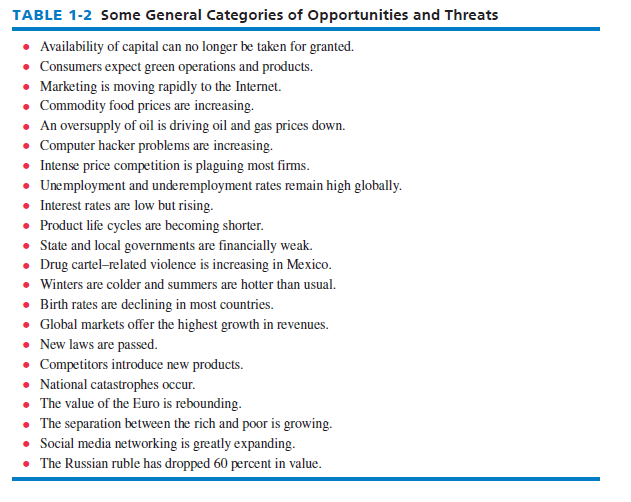
External opportunities and external threats refer to economic, social, cultural, demographic, environmental, political, legal, governmental, technological, and competitive trends and events that could significantly benefit or harm an organization in the future. Opportunities and threats are largely beyond the control of a single organization—thus the word external. Some general categories of opportunities and threats are listed in Table 1-2, but be mindful that dollars, numbers, percentages, ratios, and quantification are essential, so strategists can assess the magnitude of opportunities and threats and take appropriate actions. For example, in Table 1-2, rather than saying “Marketing is moving rapidly to the Internet,” strategists who take the time to do research would find, for example, that “spending on online advertisements globally rose about 25 percent in 2014, according to eMarketer, and represented about 39 percent of total advertising spending in the USA.12 Strategies must be formulated and implemented based on specific factual information to the extent possible-because so much is at stake in having a good game plan.

External trends and events are creating a different type of consumer and consequently a need for different types of products, services, and strategies. Many companies in many industries face the severe threat of online sales eroding brick-and-mortar sales. A competitor’s strength could be a threat, or a rival firm’s weakness could be an opportunity.
A basic tenet of strategic management is that firms need to formulate strategies to take advantage of external opportunities and avoid or reduce the impact of external threats. For this reason, identifying, monitoring, and evaluating external opportunities and threats are essential for success. This process of conducting research and gathering and assimilating external information is sometimes called environmental scanning or industry analysis. Lobbying is one activity that some organizations use to influence external opportunities and threats.
6. Internal Strengths and Weaknesses
Internal strengths and internal weaknesses are an organization’s controllable activities that are performed especially well or poorly. They arise in the management, marketing, finance/ accounting, production/operations, research and development, and management information systems (MIS) activities of a business. Identifying and evaluating organizational strengths and weaknesses in the functional areas of a business is an essential strategic-management activity. Organizations strive to pursue strategies that capitalize on internal strengths and eliminate internal weaknesses.
Strengths and weaknesses are determined relative to competitors. Relative deficiency or superiority is important information. Also, strengths and weaknesses can be determined by elements of being rather than performance. For example, a strength may involve ownership of natural resources or a historic reputation for quality. Strengths and weaknesses may be determined relative to a firm’s own objectives. For instance, high levels of inventory turnover may not be a strength for a firm that seeks never to stock-out.
In performing a strategic-management case analysis, it is important to be as divisional as possible when determining and stating internal strengths and weaknesses. In other words, for a company such as Walmart saying, “Sam Club’s revenues grew 11 percent in the recent quarter,” is much better than Walmart couching all of its internal factors in terms of the firm as a whole. “Being divisional” will enable strategies to be more effectively formulated because in strategic planning, firms must allocate resources among divisions (segments) of the firm (that is, by product, region, customer, or whatever the various units of the firm are), such as Walmart’s Sam’s Club versus Walmart’s Supercenters, or Walmart’s Mexico segment versus Walmart’s Europe segment.
Both internal and external factors should be stated as specifically as possible, using numbers, percentages, dollars, and ratios, as well as comparisons over time to rival firms. Specificity is important because strategies will be formulated and resources allocated based on this information. The more specific the underlying external and internal factors, the more effectively strategies can be formulated and resources allocated. Determining the numbers takes more time, but survival of the firm often is at stake, so doing some research and incorporating numbers associated with key factors is essential.
Internal factors can be determined in a number of ways, including computing ratios, measuring performance, and comparing to past periods and industry averages. Various types of surveys also can be developed and administered to examine internal factors, such as employee morale, production efficiency, advertising effectiveness, and customer loyalty.
7. Long-Term Objectives
Objectives can be defined as specific results that an organization seeks to achieve in pursuing its basic mission. Long-term means more than one year. Objectives are essential for organizational success because they provide direction; aid in evaluation; create synergy; reveal priorities; focus coordination; and provide a basis for effective planning, organizing, motivating, and controlling activities. Objectives should be challenging, measurable, consistent, reasonable, and clear. In a multidimensional firm, objectives are needed both for the overall company and each division.
8. Strategies
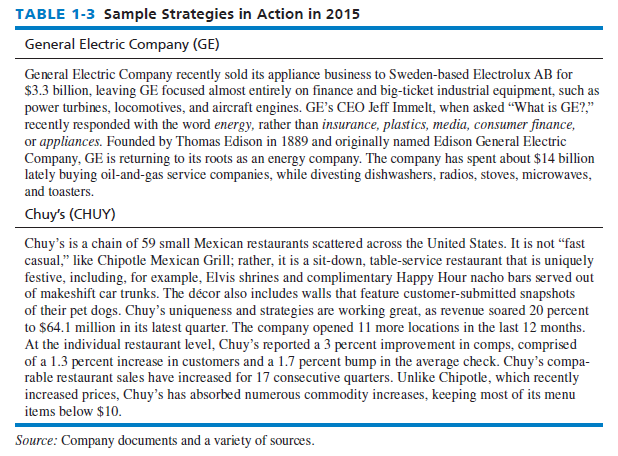
Strategies are the means by which long-term objectives will be achieved. Business strategies may include geographic expansion, diversification, acquisition, product development, market penetration, retrenchment, divestiture, liquidation, and joint ventures. Strategies currently being pursued by some companies are described in Table 1-3.
Strategies are potential actions that require top-management decisions and large amounts of the firm’s resources. They affect an organization’s long-term prosperity, typically for at least five years, and thus are future-oriented. Strategies also have multifunctional and multidivisional consequences and require consideration of both the external and internal factors facing the firm.
9. Annual Objectives
Annual objectives are short-term milestones that organizations must achieve to reach longterm objectives. Like long-term objectives, annual objectives should be measurable, quantitative, challenging, realistic, consistent, and prioritized. They must also be established at the corporate, divisional, and functional levels in a large organization. Annual objectives should be stated in terms of management, marketing, finance/accounting, production/operations, R&D, and MIS accomplishments. A set of annual objectives is needed for each long-term objective. These objectives are especially important in strategy implementation, whereas long-term objectives are particularly important in strategy formulation. Annual objectives provide the basis for allocating resources.
10. Policies
Policies are the means by which annual objectives will be achieved. Policies include guidelines, rules, and procedures established to support efforts to achieve stated objectives. Policies are guides to decision making and address repetitive or recurring situations. Usually, policies are stated in terms of management, marketing, finance/accounting, production/ operations, R&D, and MIS activities. They may be established at the corporate level and apply to an entire organization, at the divisional level and apply to a single division, or they may be established at the functional level and apply to particular operational activities or departments.
Like annual objectives, policies are especially important in strategy implementation because they outline an organization’s expectations of its employees and managers. Policies allow consistency and coordination within and between organizational departments. Policy change is sometimes difficult. For example, years ago, it was unquestioningly accepted that people could smoke in their offices, in restaurants, in hotels, and on airplanes. But as people and companies became educated about the harms of smoking—not only to smokers but also to nonsmokers —policy in businesses began to change. Even with the vast changes in smoking in public areas, smoking rates are still high. In the United States, Kentucky takes the lead in having more smokers than in any other state: 30.2 percent of residents, followed by West Virginia and Mississippi; Utah has the lowest rate (12.2%), followed by California and Minnesota.13 In the United States overall, 20.5 percent of men smoke, compared to 15.8 percent of women. For a brief time, people thought the answer might be “tobacco-less” cigarettes, as electronic cigarettes hit the market. Unfortunately, however, the product still injects nicotine into the smoker’s body.
Substantial research suggests that a healthier workforce can more effectively and efficiently implement strategies. Smoking has become a heavy burden for Europe’s state-run social welfare systems, with smoking-related diseases costing more than $100 billion a year. Smoking also is a huge burden on companies worldwide, so firms are continually implementing policies to curtail smoking. Starbucks has banned smoking within 25 feet of its 7,000 stores not located inside another retail establishment.
Source: David Fred, David Forest (2016), Strategic Management: A Competitive Advantage Approach, Concepts and Cases, Pearson (16th Edition).
The post Key terms in Strategic Management appeared first on HKT Consultant.
]]>The post The Strategic-Management Model appeared first on HKT Consultant.
]]>where are we now?
where do we want to go?
How are we going to get there?
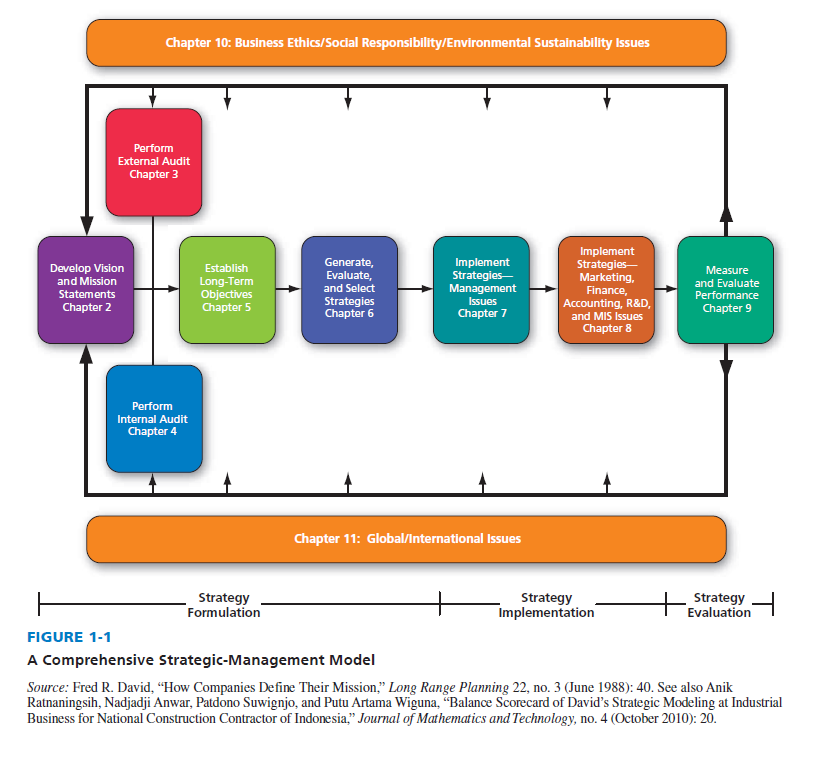
Identifying an organization’s existing vision, mission, objectives, and strategies is the logical starting point for strategic management because a firm’s present situation and condition may preclude certain strategies and may even dictate a particular course of action. Every organization has a vision, mission, objectives, and strategy, even if these elements are not consciously designed, written, or communicated. The answer to where an organization is going can be determined largely by where the organization has been!
The strategic-management process is dynamic and continuous. A change in any one of the major components in the model can necessitate a change in any or all of the other components. For instance, African countries coming online could represent a major opportunity and require a change in long-term objectives and strategies; a failure to accomplish annual objectives might require a change in policy; or a major competitor’s change in strategy might require a change in the firm’s mission. Therefore, strategy formulation, implementation, and evaluation activities should be performed on a continual basis, not just at the end of the year or semiannually. The strategic-management process never really ends.
Note in the strategic-management model that business ethics, social responsibility, and environmental sustainability issues impact all activities in the model, as discussed in Chapter 10. Also, note in the model that global and international issues impact virtually all strategic decisions, as described in detail in chapter 11.
The strategic-management process is not as cleanly divided and neatly performed in practice as the strategic-management model suggests. Strategists do not go through the process in lockstep fashion. Generally, there is give-and-take among hierarchical levels of an organization. Many organizations conduct formal meetings semiannually to discuss and update the firm’s vision, mission, opportunities, threats, strengths, weaknesses, strategies, objectives, policies, and performance. These meetings are commonly held off-premises and are called retreats. The rationale for periodically conducting strategic-management meetings away from the work site is to encourage more creativity and candor from participants. Good communication and feedback are needed throughout the strategic-management process. The Academic Research Capsule 1-2 reveals what activity is most important in the strategic-management process.
Application of the strategic-management process is typically more formal in larger and well- established organizations. Formality refers to the extent that participants, responsibilities, authority, duties, and approach are specified. Smaller businesses tend to be less formal. Firms that compete in complex, rapidly changing environments, such as technology companies, tend to be more formal in strategic planning. Firms that have many divisions, products, markets, and technologies also tend to be more formal in applying strategic-management concepts. Greater formality in applying the strategic-management process is usually positively associated with organizational success.15
What Activity Is Most Important in the Strategic-Management Process?
Recent research has examined the strategic-management process and concluded that perhaps the most important “activity” is the feedback loop, because strategy must be thought of as a “verb rather than a noun.” Rose and Cray contend that strategy is a “living, evolving conceptual entity,” and as such must be engulfed in flexibility. “Flexibility” should also be reflected in the structures put in place to monitor and modify strategic plans. Flexibility safeguards should increasingly be known and practiced throughout the firm, especially at lower levels of the organization. The stages of strategic management (formulation, implementation, and evaluation) are so fluid as to be virtually indistinguishable when one starts and the other ends. Thus, in the comprehensive model illustrated, the encompassing feedback loop is vitally important to enable firms to readily adapt to changing conditions. A significant change in any activity (box) in the model could necessitate change(s) in other activities.
Source: Based on Wade Rose and David Cray “The Role of Context in the Transformation of Planned Strategy into Implemented Strategy,” International Journal of Business Management and Economic Research 4, no. 3 (2013): 721-737.
Source: David Fred, David Forest (2016), Strategic Management: A Competitive Advantage Approach, Concepts and Cases, Pearson (16th Edition).
The post The Strategic-Management Model appeared first on HKT Consultant.
]]>The post Benefits of Engaging in Strategic Management appeared first on HKT Consultant.
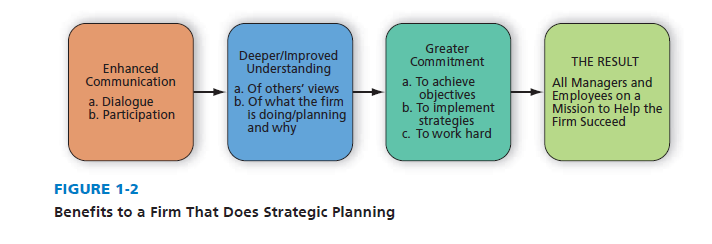
]]>Historically, the principal benefit of strategic management has been to help organizations formulate better strategies through the use of a more systematic, logical, and rational approach for decision making. In addition, the process, rather than the decision or document, is also a major benefit of engaging in strategic management. Through involvement in the process (i.e., dialogue and participation), managers and employees become committed to supporting the organization. Communication is a key to successful strategic management. communication may be the most important word in management. Figure 1-2 illustrates this intrinsic benefit of a firm engaging in strategic planning. Note that all firms need all employees “on a mission” to help the firm succeed.
Dale Mcconkey said, “Plans are less important than planning.” The manner in which strategic management is carried out is therefore exceptionally important. A major aim of the process is to achieve understanding and commitment from all managers and employees. Understanding may be the most important benefit of strategic management, followed by commitment. when managers and employees understand what the organization is doing and why, they often feel a part of the firm and become committed to assisting it. This is especially true when employees also understand links between their own compensation and organizational performance. Managers and employees become surprisingly creative and innovative when they understand and support the firm’s mission, objectives, and strategies. a great benefit of strategic management, then, is the opportunity that the process provides to empower individuals. Empowerment is the act of strengthening employees’ sense of effectiveness by encouraging them to participate in decision making and to exercise initiative and imagination, and rewarding them for doing so. William Fulmer said, “You want your people to run the business as it if were their own.”
Strategic planning is a learning, helping, educating, and supporting process, not merely a paper-shuffling activity among top executives. Strategic-management dialogue is more important than a nicely bound strategic-management document. The worst thing strategists can do is develop strategic plans themselves and then present them to operating managers to execute. Through involvement in the process, line managers become “owners” of the strategy. Ownership of strategies by the people who have to execute them is a key to success!
Although making good strategic decisions is the major responsibility of an organization’s owner or chief executive officer, both managers and employees must also be involved in strategy formulation, implementation, and evaluation activities. Participation is a key to gaining commitment for needed changes. An increasing number of corporations and institutions are using strategic management to make effective decisions. But strategic management is not a guarantee for success; it can be dysfunctional if conducted haphazardly.
1. Financial Benefits
Organizations that use strategic-management concepts are generally more profitable and successful than those that do not. Businesses using strategic-management concepts show significant improvement in sales, profitability, and productivity compared to firms without systematic planning activities. High-performing firms tend to do systematic planning to prepare for future fluctuations in their external and internal environments. Firms with management systems that utilize strategic-planning concepts, tools, and techniques generally exhibit superior long-term financial performance relative to their industry.
High-performing firms seem to make more informed decisions with good anticipation of both short- and long-term consequences. In contrast, firms that perform poorly often engage in activities that are shortsighted and do not reflect good forecasting of future conditions. Strategists of low-performing organizations are often preoccupied with solving internal problems and meeting paperwork deadlines. They typically underestimate their competitors’ strengths and overestimate their own firm’s strengths. They often attribute weak performance to uncontrollable factors such as a poor economy, technological change, or foreign competition.
More than 100,000 businesses in the United States fail annually. Business failures include bankruptcies, foreclosures, liquidations, and court-mandated receiverships. Although many factors besides a lack of effective strategic management can lead to business failure, the planning concepts and tools described in this text can yield substantial financial benefits for any organization.
2. Nonfinancial Benefits
Besides helping firms avoid financial demise, strategic management offers other tangible benefits, such as enhanced awareness of external threats, improved understanding of competitors’ strategies, increased employee productivity, reduced resistance to change, and a clearer understanding of performance-reward relationships. Strategic management enhances the problem-prevention capabilities of organizations because it promotes interaction among managers at all divisional and functional levels. Firms that have nurtured their managers and employees, shared organizational objectives with them, empowered them to help improve the product or service, and recognized their contributions can turn to them for help in a pinch because of this interaction.
In addition to empowering managers and employees, strategic management often brings order and discipline to an otherwise floundering firm. It can be the beginning of an efficient and effective managerial system. Strategic management may renew confidence in the current business strategy or point to the need for corrective actions. The strategic-management process provides a basis for identifying and rationalizing the need for change to all managers and employees of a firm; it helps them view change as an opportunity rather than as a threat. Some nonfinancial benefits of a firm utilizing strategic management, according to Greenley, are increased discipline, improved coordination, enhanced communication, reduced resistance to change, increased forward thinking, improved decision making, increased synergy, and more effective allocation of time and resources.16
Source: David Fred, David Forest (2016), Strategic Management: A Competitive Advantage Approach, Concepts and Cases, Pearson (16th Edition).
The post Benefits of Engaging in Strategic Management appeared first on HKT Consultant.
]]>The post Why Some Firms Do No Strategic Planning appeared first on HKT Consultant.
]]>- No formal training in strategic management
- No understanding of or appreciation for the benefits of planning
- No monetary rewards for doing planning
- No punishment for not planning
- Too busy “firefighting” (resolving internal crises) to plan ahead
- View planning as a waste of time, since no product/service is made
- Laziness; effective planning takes time and effort; time is money
- Content with current success; failure to realize that success today is no guarantee for success tomorrow; even Apple Inc. is an example
- Overconfident
- Prior bad experience with strategic planning done sometime/somewhere
Source: David Fred, David Forest (2016), Strategic Management: A Competitive Advantage Approach, Concepts and Cases, Pearson (16th Edition).
The post Why Some Firms Do No Strategic Planning appeared first on HKT Consultant.
]]>The post Pitfalls in Strategic Planning appeared first on HKT Consultant.
]]>Here are some pitfalls to watch for and avoid in strategic planning:
- Using strategic planning to gain control over decisions and resources
- Doing strategic planning only to satisfy accreditation or regulatory requirements
- Too hastily moving from mission development to strategy formulation
- Failing to communicate the plan to employees, who continue working in the dark
- Top managers making many intuitive decisions that conflict with the formal plan
- Top managers not actively supporting the strategic-planning process
- failing to use plans as a standard for measuring performance
- Delegating planning to a “planner” rather than involving all managers
- failing to involve key employees in all phases of planning
- failing to create a collaborative climate supportive of change
- viewing planning as unnecessary or unimportant
- Becoming so engrossed in current problems that insufficient or no planning is done
- Being so formal in planning that flexibility and creativity are stifled17
Source: David Fred, David Forest (2016), Strategic Management: A Competitive Advantage Approach, Concepts and Cases, Pearson (16th Edition).
The post Pitfalls in Strategic Planning appeared first on HKT Consultant.
]]>The post Comparing Business and Military Strategy appeared first on HKT Consultant.
]]>Both business and military organizations try to use their own strengths to exploit competitors’ weaknesses. If an organization’s overall strategy is wrong (ineffective), then all the efficiency in the world may not be enough to allow success. Business or military success is generally not the happy result of accidental strategies. Rather, success is the product of both continuous attention to changing external and internal conditions and the formulation and implementation of insightful adaptations to those conditions. The element of surprise provides great competitive advantages in both military and business strategy; information systems that provide data on opponents’ or competitors’ strategies and resources are also vitally important.
A fundamental difference between military and business strategy is that business strategy is formulated, implemented, and evaluated with an assumption of competition, whereas military strategy is based on an assumption of conflict. Nonetheless, military conflict and business competition are so similar that many strategic-management techniques apply equally to both. Business strategists have access to valuable insights that military thinkers have refined over time. Superior strategy formulation and implementation can overcome an opponent’s superiority in numbers and resources.
Born in Pella in 356 bce, Alexander the Great was king of Macedon, a state in northern ancient Greece. Tutored by Aristotle until the age of 16, Alexander had created one of the largest empires of the ancient world by the age of 30, stretching from the Ionian Sea to the Himalayas. Alexander was undefeated in battle and is considered one of history’s most successful commanders. He became the measure against which military leaders even today compare themselves, and military academies throughout the world still teach his strategies and tactics. Alexander the Great once said, “Greater is an army of sheep led by a lion, than an army of lions led by a sheep.” This quote reveals the overwhelming importance of an excellent strategic plan for any organization to succeed. the legendary Alabama football coach Bear Bryant asserted, “I will defeat the opposing coach’s team with my players, but if given a week’s notice, i could defeat the opposing coach’s team with his players and he take my players.”
Both business and military organizations must adapt to change and constantly improve to be successful. Too often, firms do not change their strategies when their environment and competitive conditions dictate the need to change. Gluck offered a classic military example of this:
When Napoleon won, it was because his opponents were committed to the strategy, tactics, and organization of earlier wars. When he lost—against Wellington, the Russians, and the Spaniards—it was because he, in turn, used tried-and-true strategies against enemies who thought afresh, who were developing the strategies not of the last war but of the next.19
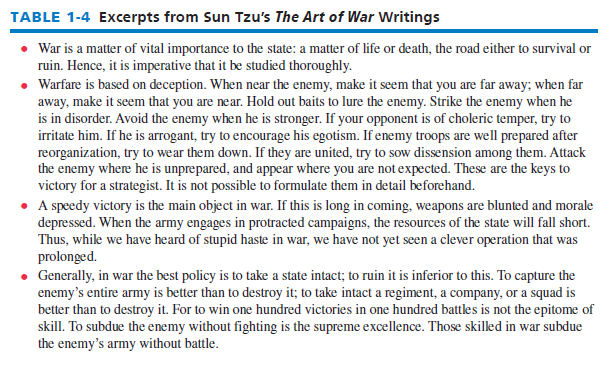
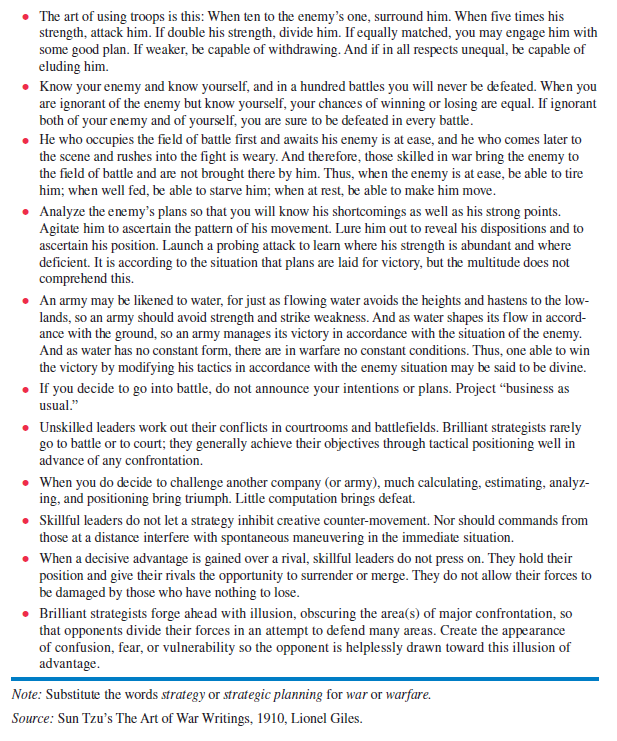
Sun Tzu’s The Art of War has been applied to many fields well outside of the military. Much of the text is about how to fight wars without actually having to do battle: It gives tips on how to outsmart one’s opponent so that physical battle is not necessary. As such, the book has found application as a training guide for many competitive endeavors that do not involve actual combat, such as in devising courtroom trial strategy or acquiring a rival company. There are business books applying its lessons to office politics and corporate strategy. Many Japanese companies make the book required reading for their top executives. The book is a popular read among Western business managers who have turned to it for inspiration and advice on how to succeed in competitive business situations.
The Art of War has also been applied in the world of sports in preparing for athletic contests. NFL coach Bill Belichick is known to have read the book and used its lessons to gain insights in preparing for games. Australian cricket coaches, as well as Brazilian association football coaches Luis Felipe Scolari and Carolos Alberto Parreira, embraced the text. Scolari made the Brazilian World Cup squad of 2002 study the ancient work during their successful campaign.
Similarities can be construed from Sun Tzu’s writings to the practice of formulating and implementing strategies among businesses today. Table 1-4 provides narrative excerpts from The Art of War. As you read through the table, consider which of the principles of war apply to business strategy as companies today compete aggressively to survive and grow.

Source: David Fred, David Forest (2016), Strategic Management: A Competitive Advantage Approach, Concepts and Cases, Pearson (16th Edition).
The post Comparing Business and Military Strategy appeared first on HKT Consultant.
]]>