The post Corporate Management Science: scope and main contents appeared first on HKT Consultant.
]]>The field was initially an outgrowth of applied mathematics, where early challenges were problems relating to the optimization of systems which could be modeled linearly, i.e., determining the optima (maximum value of profit, assembly line performance, crop yield, bandwidth, etc. or minimum of loss, risk, costs, etc.) of some objective function. Today, management science encompasses any organizational activity for which a problem is structured in mathematical form to generate managerially relevant insights.
Corporate management science is concerned with a number of different areas of study: One is developing and applying models and concepts that may prove useful in helping to illuminate management issues and solve managerial problems. The models used can often be represented mathematically, but sometimes computer-based, visual or verbal representations are used as well or instead. Another area is designing and developing new and better models of organizational excellence.
The management scientist’s mandate is to use rational, systematic, science-based techniques to inform and improve decisions of all kinds. The techniques of management science are not restricted to business applications but may be applied to military, medical, public administration, charitable groups, political groups or community groups.
Its origins can be traced to operations research, which became influential during World War II when the Allied forces recruited scientists of various disciplines to assist with military operations. In these early applications, the scientists used simple mathematical models to make efficient use of limited technologies and resources. The application of these models to the corporate sector became known as management science.
Main contentsSee more from basic to advanced












The post Corporate Management Science: scope and main contents appeared first on HKT Consultant.
]]>The post The Definition of Management appeared first on HKT Consultant.
]]>People who have studied GE aren’t surprised. The company has thrived for more than a century because managers throughout the years created the ideal environment and condi- tions: a shared sense of purpose and pride, a passion for change and willingness to take risks, and, most important, an obsession with people and making them the best they can be.
The commitment to developing leaders at all levels began in the late 1800s with CEO Charles Coffin, who emphasized that GE’s most important product was not lightbulbs or transformers but, rather, managerial talent. Every manager at GE is required to spend a huge amount of time on human resources issues—recruiting, training, appraising, mentor- ing, and developing leadership talent for the future.6
A key aspect of managing is to recognize the role and importance of other people. Early twentieth-century management scholar Mary Parker Follett defined management as “the art of getting things done through people.”7
More recently, noted management theorist Peter Drucker stated that the job of manag- ers is to give direction to their organizations, provide leadership, and decide how to use or- ganizational resources to accomplish goals.8 Getting things done through people and other resources and providing leadership and direction are what managers do. These activities apply to top executives such as Bill Gates of Microsoft and Steve Jobs of Apple but also to the leader of an airport security team, a supervisor of an accounting department, or a direc- tor of sales and marketing. Moreover, management often is considered universal because it uses organizational resources to accomplish goals and attain high performance in all types of profit and nonprofit organizations.
Thus, our definition of management is: the attainment of organizational goals in an
effective and efficient manner through planning, organizing, leading, and controlling organizational resources. This definition holds two important ideas: (1) the four functions of planning, organizing, leading, and controlling, and (2) the attainment of organizational goals in an effective and efficient manner. Managers use a multitude of skills to perform these functions. Management’s conceptual, human, and technical skills are discussed later in the chapter. Exhibit 1.1 illustrates the process of how managers use resources to attain organiza- tional goals. Although some management theorists identify additional management functions, such as staffing, communicating, or decision making, those additional functions will be dis- cussed as subsets of the four primary functions in Exhibit 1.1. Chapters of this book are devoted to the multiple activities and skills associated with each function, as well as to the environment, global competitiveness, and ethics, which influence how managers perform these functions.

Source: Daft Richard L., Marcic Dorothy (2009), Understanding Management, South-Western College Pub; 8th edition.
The post The Definition of Management appeared first on HKT Consultant.
]]>The post Organizational Performance appeared first on HKT Consultant.
]]>Organizations pervade our society. Most college students will work in an organization— perhaps Cingular Wireless, Toronto General Hospital, Office Depot, or Hollywood Video. College students already are members of several organizations, such as a university or a junior college, YMCA, church, fraternity, or sorority. College students also deal with or- ganizations every day—to renew a driver’s license, be treated in a hospital emergency room, buy food from a supermarket, eat in a restaurant, or purchase new clothes. Managers are responsible for these organizations and for seeing that resources are used wisely to attain organizational goals.
Our formal definition of an organization is a social entity that is goal-directed and de-liberately structured. Social entity means being made up of two or more people. Goal-directed means designed to achieve some outcome, such as to make a profit (for example, Old Navy, Starbucks), to win pay increases for members (AFL-CIO), to meet spiritual needs (say, the United Methodist Church), or provide social satisfaction (a college sorority, for instance).
Deliberately structured means that tasks are divided and responsibility for their performance is assigned to organization members. This definition applies to all organizations, including both profit and nonprofit. Small, offbeat, and nonprofit organizations are more numerous than large, visible corporations—and just as important to society.
Based on our definition of management, the manager’s responsibility is to coordinate resources in an effective and efficient manner to accomplish the organization’s goals. Organizational effectiveness is the extent to which the organization achieves a stated goal, or succeeds in accomplishing what it tries to do. Organizational effectiveness means pro- viding a product or service that customers value.
Organizational efficiency refers to the amount of resources used to achieve an organi- zational goal. It is based on how much raw material, money, and people are necessary for producing a given volume of output. Efficiency can be calculated as the amount of re- sources used to produce a product or service.
Efficiency and effectiveness can both be at high levels in the same organization. During the tough economy of the early 2000s, companies such as Eaton Corporation, which makes hydraulic and electrical devices, struggled to wring as much production as it could from scaled-back factories and a reduced workforce. Managers initiated process improvements, outsourced some work to companies that could do it cheaper, streamlined ordering and shipping procedures, and shifted work to the most efficient assembly lines. At Eaton, these adjustments enabled the company to cut costs and hold the line on prices as well as meet its quality and output goals.9
Sometimes, however, managers’ efforts to improve efficiency can hurt organizational effectiveness, especially in relation to severe cost-cutting. Some years ago, a former CEO at Delta Airlines dramatically increased cost efficiency by cutting spending on personnel, food, cleaning, and maintenance. These moves temporarily rescued the company from a fi- nancial tailspin, but they also precluded Delta from meeting its effectiveness goals. The airline fell to last place among major carriers in on-time performance, the morale of em- ployees sank, and customer complaints about dirty planes and long lines at ticket counters increased by more than 75 percent.10
The ultimate responsibility of managers is to achieve high performance. This means the attainment of organizational goals by using resources in an efficient and effective manner.
Source: Daft Richard L., Marcic Dorothy (2009), Understanding Management, South-Western College Pub; 8th edition.
The post Organizational Performance appeared first on HKT Consultant.
]]>The post Management Skills appeared first on HKT Consultant.
]]>When Skills Fail
Good management skills are not automatic. Particularly during turbulent times, managers really have to stay on their toes and apply all their skills and competencies in a way that benefits the organization and its stakeholders—employees, customers, investors, the community, and so forth. In recent years, numerous highly publicized examples have shown what happens when managers fail to apply their skills effectively to meet the demands of an uncertain, rapidly changing world.
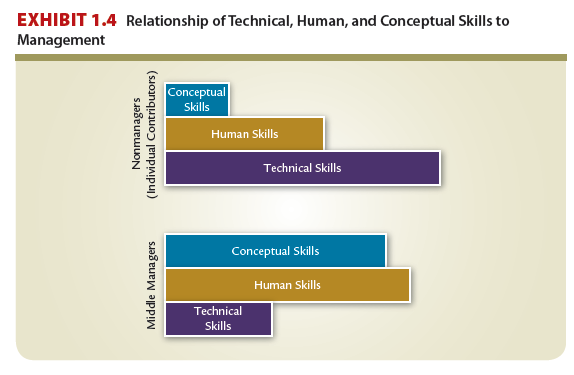
Everyone has flaws and weaknesses, and these shortcomings become most apparent under conditions of rapid change, uncertainty, or crisis.15 Consider the uproar that resulted in 2013 from the decision of managers at the Internal Revenue Service (IRS) to apply additional screening to tax-exempt applications from conservative Tea Party groups. When a manager for so-called Group 7822, an IRS office that screens and processes thousands of applications a year from organizations seeking tax-exempt status, noticed a growing number of applications from groups identifying themselves as part of the Tea Party, the manager advised workers to flag them and similar groups to see if their purpose was too political to be eligible under the rules for tax exemption. It has long been a practice to give extra scrutiny to certain kinds of groups that present a potential for fraudulent use of tax exempt status, but critics say the agency went too far in how it applied the practice to conservative political organizations, in some cases delaying applications for years. Congressional investigators are probing whether agency activities constituted discrimination against conservative groups, and the full story of what happened and why is still emerging.16 IRS managers at all levels involved in the decision appear to have needed stronger conceptual skills to prevent this crisis from happening, and higher-level executives had to call upon all their conceptual and human skills to resolve the dilemma and work to restore the public trust.
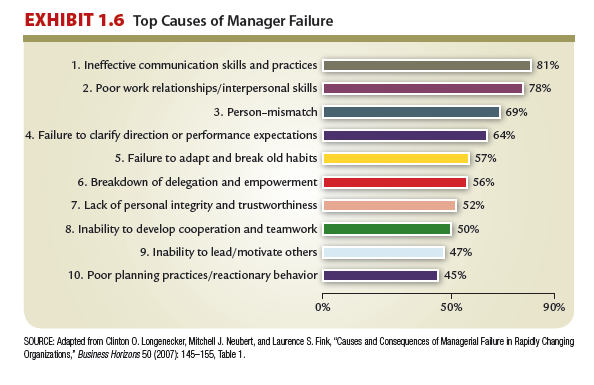
The numerous ethical and financial scandals of recent years have left people cynical about business and government managers and even less willing to overlook mistakes. Crises and examples of deceit and greed grab the headlines, but many more companies falter or fail less spectacularly. Managers fail to listen to customers, are unable to motivate employees, or can’t build a cohesive team. For example, the reputation of Zynga, maker of games like Farmville that were ubiquitous on Facebook for a while, plummeted along with its share price in 2012. Although there were several problems at Zynga, one was that founder and former CEO Mark Pincus had an aggressive style that made it difficult to build a cohesive team. The exodus of key executives left the company floundering, and the company’s shares fell 70 percent. Pincus stepped down as CEO in July 2013, and former Xbox executive Don Mattrick took over to try to revive the once-hot game maker.17 Exhibit 1.6 shows the top 10 factors that cause managers to fail to achieve desired results, based on a survey of managers in U.S. organizations operating in rapidly changing business environments.18 Notice that many of these factors are due to poor human skills, such as the inability to develop good work relationships, a failure to clarify direction and performance expectations, or an inability to create cooperation and teamwork. The number one reason for manager failure is ineffective communication skills and practices, cited by 81 percent of managers surveyed. Especially in times of uncertainty or crisis, if managers do not communicate effectively, including listening to employees and customers and showing genuine care and concern, organizational performance and reputation suffer.
Source: Daft Richard L., Marcic Dorothy (2009), Understanding Management, South-Western College Pub; 8th edition.
The post Management Skills appeared first on HKT Consultant.
]]>The post Management Functions appeared first on HKT Consultant.
]]>Twenty-five-year-old Daniel Wheeler is a first-line manager in his first management job at Del Monte Foods, where he is involved directly in promoting products, approving packaging sleeves, and organizing sampling events.12 Kevin Kurtz is a middle manager at Lucasfilm, where he works with employees to develop marketing campaigns for some of the entertainment company’s hottest films.13 Domenic Antonellis is CEO of the New England Confectionary Co. (Necco), the company that makes those tiny pastel candy hearts stamped with phrases such as “Be Mine” and “Kiss Me.”14 All three are managers and must contribute to planning, organizing, leading, and controlling their organizations— but in different amounts and ways.
During turbulent times, managers really have to stay on their toes and use all their skills and competencies to benefit the organization and its stakeholders—employees, customers, investors, the community, and so forth. In recent years, numerous, highly publicized ex- amples showed us what happens when managers fail to effectively and ethically apply their skills to meet the demands of an uncertain, rapidly changing world. Companies such as Enron, Tyco, and WorldCom were flying high in the 1990s but came crashing down under the weight of financial scandals. Others, such as Rubbermaid, Kmart, and Xerox, are strug- gling because of years of management missteps.
Although corporate greed and deceit grab the headlines, many more companies fal- ter or fail less spectacularly. Managers fail to listen to customers, misinterpret signals from the marketplace, or can’t build a cohesive team and execute a strategic plan. Over the past several years numerous CEOs, including Carly Fiorina at Hewlett-Packard, Michael Eisner at Disney, and David Pottruck at Charles Schwab Corp., have been ousted because of their failure to implement their strategic plans and improve business results.
Examination of struggling organizations and executives offers a glimpse into the mis- takes that managers often make in a turbulent environment.15 Perhaps the biggest blunder is managers’ failure to comprehend and adapt to the rapid pace of change in the world around them. For example, even though Xerox’s PARC research center practically invented the personal computer, top managers resisted getting into the computer business until it was too late to even get in the game, much less have a chance at winning. A related problem stems from top managers who create a climate of fear in the organization so people are afraid to tell the truth. Thus, bad news gets hidden, and important signals from the marketplace are missed.
Other critical management missteps include poor communication skills and failure to listen; treating people only as instruments to be used; suppressing dissenting view- points; and being unable to build a management team characterized by mutual trust and respect.16 The financial scandals of the early twenty-first century, from Enron to mutual- fund mismanagement, clearly show what can happen, for instance, when top managers pay more attention to money and Wall Street than they do to their employees and customers.
As another example, consider what happened at The New York Times when it became publicly known that Jayson Blair, a rising young reporter, had fabricated and plagiarized many of his stories. Only then did top executives acknowledge the pervasive unhappiness that existed in the newsroom. Executive editor Howell Raines, who had created an envi- ronment that favored certain editors and reporters while others were afraid to offer dis- senting viewpoints or tell their managers the truth, resigned under pressure following the scandal. The Times still is struggling to regain its footing and reclaim its honorable image.
Source: Daft Richard L., Marcic Dorothy (2009), Understanding Management, South-Western College Pub; 8th edition.
The post Management Functions appeared first on HKT Consultant.
]]>The post Making the Leap: Becoming a New Manager appeared first on HKT Consultant.
]]>Making the shift from individual contributor to manager is often tricky. Mark Zuckerberg, whose company, Facebook, went public a week before he turned 28 years old, provides an example. In a sense, the public has been able to watch as Zuckerberg has “grown up” as a manager. He was a strong individual performer in creating the social media platform and forming the company, but he fumbled with day-to-day management, such as interactions with employees and communicating with people both inside and outside Facebook. Zuckerberg was smart enough to hire seasoned managers, including former Google executive Sheryl Sandberg, and cultivate advisors and mentors who have coached him in areas where he is weak. He also shadowed David Graham at the offices of The Post Company (the publisher of The Washington Post before it was purchased by Jeff Bezos) for four days to try to learn what it is like to manage a large organization. Now that Facebook is a public company, Zuckerberg is watched more closely than ever to see if he has what it takes to be a manager of a big public corporation.24
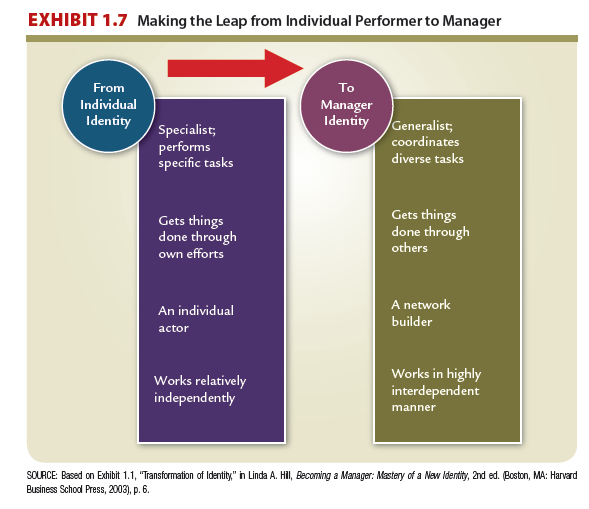
Harvard professor Linda Hill followed a group of 19 managers over the first year of their managerial careers and found that one key to success is to recognize that becoming a manager involves more than learning a new set of skills. Rather, becoming a manager means a profound transformation in the way people think of themselves, called personal identity, which includes letting go of deeply held attitudes and habits and learning new ways of thinking.25 Exhibit 1.7 outlines the transformation from individual performer to manager. The individual performer is a specialist and a “doer.” His or her mind is conditioned to think in terms of performing specific tasks and activities as expertly as possible. The manager, on the other hand, has to be a generalist and learn to coordinate a broad range of activities. Whereas the individual performer strongly identifies with his or her specific tasks, the manager has to identify with the broader organization and industry.
In addition, the individual performer gets things done mostly through his or her own efforts and develops the habit of relying on self rather than others. The manager, though, gets things done through other people. Indeed, one of the most common mistakes that new managers make is wanting to do all the work themselves, rather than delegating to others and developing others’ abilities.26 Hill offers a reminder that, as a manager, you must “be an instrument to get things done in the organization by working with and through others, rather than being the one doing the work.”27
Another problem for many new managers is that they expect to have greater freedom to do what they think is best for the organization. In reality, though, managers find themselves hemmed in by interdependencies. Being a successful manager means thinking in terms of building teams and networks and becoming a motivator and organizer within a highly interdependent system of people and work.28 Although the distinctions may sound simple in the abstract, they are anything but. In essence, becoming a manager means becoming a new person and viewing oneself in a completely new way.
Many new managers have to make the transformation in a “trial by fire,” learning on the job as they go, but organizations are beginning to be more responsive to the need for new manager training. The cost to organizations of losing good employees who can’t make the transition is greater than the cost of providing training to help new managers cope, learn, and grow. In addition, some organizations use great care in selecting people for managerial positions, including ensuring that each candidate understands what management involves and really wants to be a manager.
Source: Daft Richard L., Marcic Dorothy (2009), Understanding Management, South-Western College Pub; 8th edition.
The post Making the Leap: Becoming a New Manager appeared first on HKT Consultant.
]]>The post Managing in Small Businesses and Nonprofit Organizations appeared first on HKT Consultant.
]]>One interesting finding is that managers in small businesses tend to emphasize roles different from those of managers in large corporations. Managers in small companies often see their most important role as that of spokesperson because they must promote the small, growing company to the outside world. The entrepreneur’s role is also critical in small businesses because managers have to be innovative and help their organizations develop new ideas to remain competitive. At LivingSocial, for example, founder and CEO, Tim O’Shaughnessy, spends a lot of his time promoting the rapidly growing daily-deal site and talking with department heads about potential new products and services.43 Small-business managers tend to rate lower on the leader role and on information-processing roles, compared with their counterparts in large corporations.
Nonprofit organizations also represent a major application of management talent.44 Organizations such as the Salvation Army, Nature Conservancy, Greater Chicago Food Depository,
Girl Scouts, and Cleveland Orchestra all require excellent management. The functions of planning, organizing, leading, and controlling apply to nonprofits just as they do to business organizations, and managers in nonprofit organizations use similar skills and perform similar activities. The primary difference is
that managers in businesses direct their activities toward earning money for the company and its owners, whereas managers in nonprofits direct their efforts toward generating some kind of social impact. The characteristics and needs of nonprofit organizations created by this distinction present unique challenges for managers.45
Financial resources for government and charity nonprofit organizations typically come from taxes, appropriations, grants, and donations rather than from the sale of products or services to customers. In businesses, managers focus on improving the organization’s products and services to increase sales revenues. In nonprofits, however, services are typically provided to nonpaying clients, and a major problem for many organizations is securing a steady stream of funds to continue operating. Nonprofit managers, committed to serving clients with limited resources, must focus on keeping organizational costs as low as pos- sible.46 Donors generally want their money to go directly to helping clients rather than for overhead costs. If nonprofit managers can’t demonstrate a highly efficient use of resources, they might have a hard time securing additional donations or government appropriations. Although the Sarbanes-Oxley Act (the 2002 corporate governance reform law) doesn’t apply to nonprofits, for example, many are adopting its guidelines, striving for greater transparency and accountability to boost credibility with constituents and be more competitive when seeking funding.47
In addition, some types of nonprofit organizations, such as hospitals and private universities that obtain revenues from selling services to clients, do have to contend with a bottom line in the sense of having to generate enough revenues to cover expenses, so managers often struggle with the question of what constitutes results and effectiveness. It is easy to measure revenues compared to expenses, but the metrics of success in nonprofits are typically much more ambiguous. Managers have to measure intangibles such as “improve public health,” “upgrade the quality of education,” or “increase appreciation for the arts.” This intangible nature also makes it more difficult to gauge the performance of employees and managers. An added complication is that managers in some types of nonprofits depend on volunteers and donors who cannot be supervised and controlled in the same way that a business manager deals with employees. Many people who move from the corporate world to a nonprofit are surprised to find that the work hours are often longer and the stress greater than in their previous management jobs.48
The roles defined by Mintzberg also apply to nonprofit managers, but they may differ somewhat. We might expect managers in nonprofit organizations to place more emphasis on the roles of spokesperson (to “sell” the organization to donors and the public), leader (to build a mission-driven community of employees and volunteers), and resource allocator (to distribute government resources or grant funds that are often assigned top-down).
Managers in all organizations—large corporations, small businesses, and nonprofit organizations—carefully integrate and adjust the management functions and roles to meet challenges within their own circumstances and keep their organizations healthy.
Source: Daft Richard L., Marcic Dorothy (2009), Understanding Management, South-Western College Pub; 8th edition.
The post Managing in Small Businesses and Nonprofit Organizations appeared first on HKT Consultant.
]]>The post Management and the New Workplace appeared first on HKT Consultant.
]]>The old workplace is characterized by routine, specialized tasks, and standardized control procedures. Employees typically perform their jobs in one company facility, such as an automobile factory in Detroit or an insurance agency in Des Moines. The organization is coordinated and controlled through the vertical hierarchy, and decision-making authority resides with upper-level managers.
In the new workplace, by contrast, work is free-flowing and flexible. The shift is most obvi- ous in e-commerce and high-tech organizations, which have to respond to changing markets and competition at a second’s notice. Numerous other organizations, such as McKinsey & Company, Canada Life, and Nokia, are also incorporating mechanisms to enhance speed and flexibility. Empowered employees are expected to seize opportunities and solve problems as they emerge. Structures are flatter, and lower-level employees make decisions based on widespread information and guided by the organization’s mission and values.35
Knowledge is shared widely rather than hoarded by managers, and people throughout the company keep in touch with a broader range of colleagues via advanced technology. Some organizations, such as Tenary Software, are trying these new models.
The workplace is organized around networks rather than rigid hierarchies, and work is often virtual, with managers having to supervise and coordinate people who never actually “come to work” in the traditional sense. Thanks to modern informa- tion and communications technology, employees can perform their jobs from home or another remote location, at any time of the day or night.36 Flexible hours, tele- commuting, and virtual teams are increasingly popular ways of working that require new skills from managers. Using virtual teams allows organizations to use the best peo- ple for specific jobs, no matter where they are located, which enables a fast, innovative response to competitive pressures. Teams also may include outside contractors, suppli- ers, customers, competitors, and interim managers who are not affiliated with a specific organization but, instead, work on a project-by-project basis. The valued worker is one who learns quickly, shares knowledge, and is comfortable with risk, change, and ambiguity.
1. FORCES ON ORGANIZATIONS
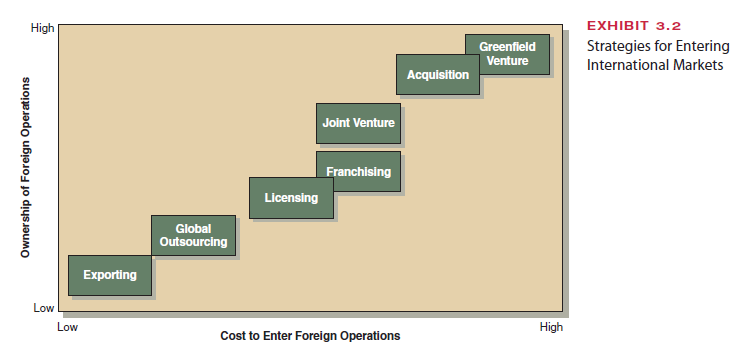
The most striking change affecting organizations and management is technology. Consider that computing power has roughly doubled every 18 months over the past 30 years while the cost has declined by half or more every 18 months.37 In addition, the Internet, which was little more than a curiosity to many managers as recently as a decade ago, has trans- formed the way business is done. Many organizations use digital networking technologies to tie together employees and company partners in far-flung operations. Organizations are increasingly shifting significant chunks of what once were considered core functions to outsiders via outsourcing, joint ventures, and other complex alliances. Companies are becoming interconnected, and managers have to learn how to coordinate relationships with other organizations and influence people who can’t be managed and commanded in tradi- tional ways.
The Internet and other new technologies also are tied closely to globalization. Although global interconnections bring many opportunities, they also bring new threats, raise new risks, and accelerate complexity and competitiveness. Think about the trend toward outsourcing to low-cost providers in other countries. To cut costs, U.S. companies have been sending manufacturing work to other countries for years. Now, work involving high-level knowledge is also being outsourced to countries such as India, Malaysia, and South Africa. India’s Wipro Ltd., for example, writes software, performs consulting work, integrates back-office solutions, undertakes systems integration, and handles technical support for some of the biggest corporations in the United States—and does this for 40 percent less than comparable U.S. companies can do the work.38
Diversity of the population and the workforce in the United States is another fact of life for organizations. The general population of the United States, and thus of the workforce, is growing more ethnically and racially diverse. In addition, generational diversity is a pow- erful force in today’s workplace, with employees of all ages working together on teams and projects in a way rarely seen in the past. In the face of these transformations, organizations are learning to value change, innovation, and speed over stability and efficiency.
The fundamental paradigm during much of the twentieth century was a belief that things can be stable. In contrast, the new paradigm recognizes change and chaos as the natural order of things.39 Events in today’s world are turbulent and unpredictable, with small and large crises occurring frequently. Rock star David Bowie has staked the newest phase of his career on that turbulence (see Bowie Bonds feature on next page).
One way that managers are addressing the complexity of today’s world is by renewing their emphasis on innovation. With the power of the Internet, for example, companies have lost much of their ability to control information to consumers and the public, so they are forced to innovate with increasingly better products and services to remain competitive. The intense competition brought about by globalization also spurs compa- nies to keep pace with new technologies and innovative management practices.40 A re- port from a group of leading scientists, executives, and educators points to the growing innovation strength of countries such as China and India, which are poised to usurp America’s position as an innovation leader. Between the years of 1991 and 2003, research and development spending in China exceeded that in the United States by bil- lions of dollars.41
Over the past few years, though, an explosion of attention to innovation roared through U.S. firms. For example, Motorola, which seemed to be on the has-been list in the opening years of the twenty-first century, roared back to life with hot new products such as the RAZR phone, the ROKR, the first combination cell phone and iPod, and the Q phone and e-mail device, designed to compete with the BlackBerry. Motorola CEO Ed Zander is implementing management and cultural changes that support an ongoing process of innovation.42
Motorola’s changes reflect a broader movement in U.S. firms, seen in companies from General Electric to IBM to Procter & Gamble, as managers are emphasizing creativity and innovation to compete in a new era. General Electric CEO Jeff Immelt, for example, shifted from emphasizing growth through acquisition to pushing growth through technological in- novation and providing additional resources for GE’s scientific research labs. Procter & Gamble collaborates widely with individual entrepreneurs and other firms, even competitors, to crank out innovative products.43
2. NEW MANAGEMENT COMPETENCIES
In the face of these transitions, managers must rethink their approach to organizing, di- recting, and motivating employees. Today’s best managers give up their command-and- control mind-set to focus on coaching and providing guidance, creating organizations that are fast, flexible, innovative, and relationship-oriented. In many of today’s best companies, leadership is dispersed throughout the organization, and managers empower others to gain the benefit of their ideas and creativity.
Success in the new workplace depends on the strength and quality of collaborative relationships. Rather than a single- minded focus on profits, today’s managers recognize the critical importance of staying connected to employees and customers. New ways of working emphasize collaboration across functions and hierarchical levels as well as with other companies. Team- building skills are crucial. Instead of managing a department of employees, many managers act as team leaders of ever-shifting, temporary projects.
At SEI Investments, the work is distributed among 140 teams. Some are permanent, such as those that serve major cus- tomers or focus on specific markets, but many are designed to work on short-term projects or problems. Computer linkups, called pythons, drop from the ceiling. As people change assign- ments, they just unplug their pythons, move their desks and chairs to a new location, plug into a new python, and get to work on the next project.44
An important management challenge in the new workplace is to build a learning organization by creating an organiza- tional climate that values experimentation and risk taking, ap- plies current technology, tolerates mistakes and failure, and re- wards nontraditional thinking and the sharing of knowledge.
Everyone in the organization participates in identifying and solving problems, which enables the organization to continu- ously experiment, improve, and increase its capability. The role of managers is not to make decisions but, instead, to create learning capability, in which everyone is free to experiment and learn what works best.
3. TURBULENT TIMES: MANAGING CRISES AND UNEXPECTED EVENTS
Many managers dream of working in an organization and a world in which life seems rela- tively calm, orderly, and predictable, but their reality is one of increasing turbulence and disorder. Today’s managers and organizations face various levels of crisis every day—from the loss of computer data, to charges of racial discrimination, to a factory fire, to workplace violence. These organizational crises are compounded by crises on a more global level.
Consider a few of the major events that affected U.S. companies within the last few years: the bursting of the dot-com bubble, which led to the failure of thousands of compa- nies and the rapid decline of technology stocks; the crash of Enron as a result of a complex series of unethical and illegal accounting gimmicks, the subsequent investigations of nu- merous other corporations, and implementation of new corporate governance laws; terror- ist attacks in New York City and Washington, DC, that destroyed the World Trade Center, seriously damaged the Pentagon, killed thousands of people, and interrupted busi-ness around the world; the crash of the space shuttle Columbia and the ensuing investiga- tion that revealed serious cultural and management problems at NASA; Hurricane Katrina’s devastating impact on organizations in New Orleans and the Gulf Coast, as well as numer- ous companies that do business with them; the removal of spinach from supermarkets because of e-coli; and continuing terrorist threats against the United States and its allies— causing companies to hire experts to manage potential crises. Even the Hilton family, Paris’s parents, hired a crisis manager after she got arrested and sent to jail.45 These and other events brought the uncertainty and turbulence of today’s world clearly to the fore- front of everyone’s mind and made crisis management a critical skill for every manager.
Dealing with the unexpected has always been part of the manager’s job, but our world has become so fast, interconnected, and complex that unexpected events happen more frequently and more often with greater and more painful consequences. All of the new management skills and competencies we discussed are important to managers in such an environment. Crisis management places further demands on today’s managers. Some of the most recent thinking on crisis management suggests the importance of five leadership skills.
- Stay calm.
- Be visible.
- Put people before business.
- Tell the truth.
- Know when to get back to business.
Stay calm. A leader’s emotions are contagious, so leaders have to stay calm, focused, and optimistic about the future. Perhaps the most important part of a manager’s job in a crisis situation is to absorb people’s fears and uncertainties. Although managers acknowl- edge the difficulties, they remain rock-steady and hopeful, which gives comfort, inspira- tion, and hope to others.
Be visible. When the world becomes ambiguous and frightening to people, they need to feel that someone is in control. After Hurricane Katrina hit New Orleans, Scott Cowen, president of Tulane University, stayed on campus until he was sure that everyone was evac- uated and everything that possibly could be done to control the damage was in place.47 In times of crisis, leadership cannot be delegated. When Russian president Vladimir Putin continued his holiday after the sinking of the submarine Kursk in August 2000, his reputa- tion diminished worldwide.48
By contrast, Melvin Wilson of Mississippi Power stayed visible and maintained impor- tant networks to deal with a real catastrophe. Imagine that you are a mid-level marketing manager at a public utilities company. One day you’re reviewing next year’s advertising campaign. A day later you’re responsible for coordinating the feeding, housing, and health care of 11,000 repair workers from around the country. That’s the situation that Melvin Wilson, a marketing manager for Mississippi Power, found himself in when Hurricane Katrina hit the state in August 2005, wiping out 1,000 miles of power lines, destroying
65 percent of the company’s transmission and distribution facilities, damaging 300 trans- mission towers, and knocking out power for all 195,000 customers. The company had a disaster recovery plan in place, but managers were suddenly thrust into a situation that was twice as bad as the worst-case scenario.
Mississippi Power’s corporate headquarters was totally destroyed, its disaster response center flooded and useless. Early recovery work had to be done without access to computers, phones, or basic sanitary facilities. Confusion and chaos reigned. “My day job didn’t prepare me for this,” Wilson told a reporter in a choked voice as he struggled to find nurses, beds, tetanus shots, laundry service, showers, security services, and food for repair workers.
Other managers, from all levels and divisions, have dealt with similar predicaments. One manager compared the process to managing an Army division at war! Amazingly, Mississippi Power employees got the job done smoothly and efficiently, restoring power in just 12 days, thus meeting the bold target of restoring power by the symbolic date of September 11. The tale of how this was done is one of the great crisis-management stories of modern times, and a lesson for managers in how much can be accomplished quickly when it’s managed right.49
The managers at Mississippi Power illustrate many of these new management com- petencies, which enabled the company to execute a swift, ambitious disaster plan and restore power in only 12 days following Hurricane Katrina. Two decades ago, hurricane response was run from the top down, but managers learned that setting priorities from headquarters was ineffective during times of chaos and confusion. Today, decision making has been pushed far down to the level of the substation, and employees are empowered to act within certain guidelines to accomplish a basic mission: “Get the power on.”
The corporate culture, based on values of unquestionable trust, superior performance, and total commitment, supports individual initiative and the confidence of management that employees will respond with quick action and on-the-spot innovation. During the disaster recovery, even out-of-state crews working unsupervised were empowered to engineer their own solutions to problems in the field. Networking and team-building skills also are highly valued at Mississippi Power. Middle managers like Melvin Wilson forged networks of relationships throughout the company, with other organizations, and with power company managers in other states, which enabled them to quickly gain access to critical resources and build teams with the right combination of skills. Overall, Missis- sippi Power reflects the qualities of a learning organization in which employees, from line workers to accountants, are encouraged to experiment, innovate, share knowledge, and solve problems.
Melvin Wilson also illustrates some of the qualities needed for effective crisis manage- ment. When he took on the role of “director of storm logistics,” he suppressed his own emotions to present a calm and focused persona, which kept employees’ emotions directed in a positive way on the job to be done. At the same time, he and other managers made sure that plans were in place to assist employees whose homes were damaged (fortunately, no employees were killed in the storm). Wilson was a highly visible leader throughout the re- covery, working 20-hour days and sleeping on the floor. Top leaders were visible as well, meeting with storm directors every day and helping boost the morale of recovery workers.
Leadership during crises and unexpected events is becoming important for all organiza- tions in today’s complex world. Managers in crisis situations should stay calm, be visible, put people before business, tell the truth, and know when to get back to business. Human skills become critical during times of turbulence and crisis.
Put people before business. The companies that weather a crisis best, whether the crisis is large or small, are those in which managers make people and human feelings their top priority. Ray O’Rourke, managing director for global corporate affairs at Morgan Stanley, put it this way following September 11: “Even though we are a financial services company, we didn’t have a financial crisis on our hands; we had a human crisis. After that point, everything was focused on our people.”50
Tell the truth. Managers should get as much information from as many diverse sources as they can, do their best to determine the facts, and then be open and straightfor- ward about what’s going on. After a 17-year-old patient at Duke University Hospital died following a botched organ transplant, hospital managers compounded the organizational crisis by failing to communicate with the media and community for nine full days after the tragedy was reported in the press.51
Know when to get back to business. Although managers should first deal with the physical and emotional needs of people, they should get back to business as soon as possible. The company has to keep going, and a natural human tendency makes us want to rebuild and move forward. Rejuvenation of the business is a sign of hope and an inspiration to employees. Moments of crisis also present excellent opportunities for looking forward and using the emotional energy that has emerged to build a better company.
This is a challenging time to be entering the field of management. Throughout this book, you will learn much more about the new workplace, about the new and dynamic roles that managers are playing in the twenty-first century, and about how you can be an effec- tive manager in a complex, ever-changing world.
Source: Daft Richard L., Marcic Dorothy (2009), Understanding Management, South-Western College Pub; 8th edition.
The post Management and the New Workplace appeared first on HKT Consultant.
]]>The post The Learning Organization appeared first on HKT Consultant.
]]>Managers began thinking about the concept of the learning organization after the pub- lication of Peter Senge’s book, The Fifth Discipline: The Art and Practice of Learning Orga- nizations.53 Senge described the kind of changes that managers have to undergo to help their organizations adapt to an increasingly chaotic world. These ideas gradually evolved to describe characteristics of the organization itself. No single view describes what the learn- ing organization looks like. The learning organization is an attitude or philosophy about what an organization can become.
1. DEFINITION OF A LEARNING ORGANIZATION
The learning organization can be defined as one in which everyone is engaged in identify- ing and solving problems, enabling the organization to continuously experiment, change, and improve, thus increasing its capacity to grow, learn, and achieve its purpose. The es- sential idea is problem solving, in contrast to the traditional organization designed for effi- ciency. In the learningorganization, all employees look for problems, such as understand- ing special customer needs. Employees also solve problems, which means putting things together in unique ways to meet a customer’s needs.
Many of today’s managers are quite aware that sustained competitive advantage can come only by developing the learning capacity of everyone in the organization. This aware- ness is reflected in a survey conducted by Strategy Business. The magazine asked its online subscribers, along with a group of thinkers, educators, interview subjects, and scholars, to vote for the ideas discussed in Strategy Business over the last 10 years that they consider most likely to remain relevant for at least the next decade. The concept of the learning or- ganization ranked second on the list of top 10 ideas.54
2. CHARACTERISTICS OF A LEARNING ORGANIZATION
To develop a learning organization, managers make changes in all the subsystems of the organization. Three important adjustments to promote continuous learning are: shifting to a team-based structure, empowering employees, and sharing information. These three characteristics are illustrated in Exhibit 1.6, and each is described here.
Team-based structure. An important value in a learning organization is collab- oration and communication across departmental and hierarchical boundaries. Self-directed teams comprise the basic building block of the structure. These teams are made up of employees with different skills who share or rotate jobs to produce an entire product or service. Traditional management tasks are pushed down to lower levels of the organization, with teams often taking responsibility for training, safety, scheduling, and deci- sions about work methods, pay and reward systems, and coordination with other teams.
Although team leadership is vital, in learning organizations the traditional boss is nearly eliminated. People on the team are given the skills, information, tools, motivation, and authority to make decisions central to the team’s performance and to respond creatively and flexibly to new challenges and opportunities that arise.
Employee empowerment. Empowerment means unleashing the power and creativity of employees by giving them the freedom, resources, information, and skills to make decisions and perform effectively. Traditional management tries to limit employees, whereas empowerment expands their behavior. Empowerment may be reflected in self- directed work teams, quality circles, job enrichment, and employee-participation groups, as well as through decision-making authority, training, and information so people can per- form jobs without close supervision.

In learning organizations, people are a manager’s primary source of strength, not a cost to be minimized. Companies that adopt this perspective believe in treating employees well by providing competitive wages and good working conditions, as well as by investing time and money in training programs and opportunities for personal and professional develop- ment. In addition, they often provide a sense of employee ownership by sharing gains in productivity and profits.55
Open Information. A learning organization is flooded with information. To identify needs and solve problems, people have to be aware of what’s going on. They must understand the whole organization as well as their part in it. Formal data about budgets, profits, and departmental expenses are available to everyone. “If you really want to respect individuals,” says Solectron Corp.’s Winston Chen, “you’ve got to let them know how they’re doing—and let them know soon enough so they can do something about it.”56
Managers know that providing too much information is better than providing too little. In addition, managers encourage people throughout the organization to share information. For example, at Viant Inc., which helps companies build and maintain web-based busi- nesses, people are rewarded for their willingness to absorb and share knowledge. Rather than encouraging consultants to hoard specialized knowledge, CEO Bob Gett says, “We value you more for how much information you’ve given to the guy next to you.”
Source: Daft Richard L., Marcic Dorothy (2009), Understanding Management, South-Western College Pub; 8th edition.
The post The Learning Organization appeared first on HKT Consultant.
]]>The post Managing the Technology-Driven Workplace appeared first on HKT Consultant.
]]>Many employees perform much of their work on computers and may be a part of virtual teams, connected electronically to colleagues around the world. Even in factories that produce physical goods, machines have taken over much of the routine and uniform work, freeing workers to use more of their minds and abilities. Managers and employees in today’s companies focus on opportunities rather than efficiencies, which requires that they be flexible, creative, and unconstrained by rigid rules and structured tasks.
1. THE SHIFTING WORLD OF E-BUSINESS
Today, much business takes place by digital processes over a computer network rather than in physical space. E-business refers to the work an organization does by using electronic linkages (including the Internet) with customers, partners, suppliers, employ- ees, or other key constituents. Organizations that use the Internet or other electronic linkages to communicate with employees or customers are engaged in e-business.
E-commerce is a narrower term. It refers specifically to business exchanges or transactions that occur electronically. E-commerce replaces or enhances the exchange of money and prod- ucts with the exchange of data and information from one computer to another. Three types of e-commerce are business-to-consumer, business-to-business, and consumer-to-consumer.
Companies such as Amazon.com, 800-Flowers, Expedia.com, and Progressive are engaged in what is referred to as business-to-consumer e-commerce (B2C), because they sell products and services to consumers over the Internet. Although this type of exchange is probably the most visible expression of e-commerce to the public, the fastest growing area of e-commerce is business-to-business e-commerce (B2B), which refers to electronic transactions between organizations. Today, much B2B e-commerce takes place over the Internet.59
Large organizations such as Wal-Mart, General Electric, Carrier Corp., General Motors, and Ford Motor Company buy and sell billions of dollars worth of goods and services a year via either public or private Internet linkages.60 For example, General Motors sells about 300,000 previously owned vehicles a year online through SmartAuction. Ford purchases a large portion of the steel it uses to build cars through e-Steel.61
Some companies take e-commerce to high levels to achieve amazing performance through supply chain management. Supply chain management refers to managing the sequence of suppliers and purchasers, covering all stages of processing from obtaining raw materials to distributing finished goods to consumers.62 Dell Computer was a pioneer in the use of end-to-end digital supply-chain networks to keep in touch with customers, take orders, buy components from suppliers, coordinate with manufacturing partners, and ship customized products directly to consumers. This trend is affecting every industry, prompt- ing a group of consultants at a Harvard University conference to conclude that businesses today must either “Dell or be Delled.”63
The third area of e-commerce, consumer-to-consumer (C2C), is made possible
when an Internet-based business acts as an intermediary between and among consumers. One of the best-known examples of C2C e-commerce is the web-based auction such as auctions made possible by eBay. Internet auctions create a large electronic market- place where consumers can buy and sell directly with one another, usually handling nearly the entire transaction via the web. Members of eBay in the United States alone sold approximately $10.6 billion in merchandise during the first 6 months of 2005. Merchandise sales worldwide in the previous year were approximately $36 billion.64
Another growing area of C2C commerce is peer-to-peer (P2P) file-sharing net-
works. Companies such as Kazaa and Grokster provide the technology for swapping music, movies, software, and other files. Online music sharing, in particular, has zoomed in popularity, and although music companies and record retailers currently are engaged in a heated battle with file-sharing services, these companies are likely here to stay.
2. INNOVATIVE TECHNOLOGY IN THE WORKPLACE
New electronic technologies also shape the organization and how it is managed. A century ago, Frederick Taylor described the kind of worker needed in the iron industry: “Now one of the first requirements for a man who is fit to handle pig iron as a regular occupation is that he shall be so stupid and so phlegmatic that he more nearly resembles in his mental makeup the ox than any other type.”66 The philosophy of scientific management was that managers structured and controlled jobs so carefully that thinking on the part of employees wasn’t required—indeed, it usually was discouraged.
How different things are today! Many organizations depend on employees’ minds more than their physical bodies. In companies where the power of an idea determines success, managers’ primary goal is to tap into the creativity and knowledge of every employee.
Technology provides the architecture that supports and reinforces this new workplace. One approach to information management is enterprise resource planning (ERP), systems that weave together all of a company’s major business functions, such as order pro- cessing, product design, purchasing, inventory, manufacturing, distribution, human re- sources, receipt of payments, and forecasting of future demand.
ERP supports a companywide management system in which everyone, from the CEO down to a machine operator on the factory floor, has instant access to critical information. People can see the big picture and act quickly, based on up-to-the-minute information. Thus, ERP also supports management attempts to harness and leverage organizational knowledge.
Peter Drucker coined the term knowledge work more than 40 years ago,68 but only in re- cent years did managers begin to genuinely recognize knowledge as an important organiza- tional resource that should be managed just as they manage cash flow or raw materials. Knowledge management refers to efforts to systematically find, organize, and make available a company’s intellectual capital and to foster a culture of continuous learning and knowledge sharing so that a company’s activities build on what is already known.69
A growing segment of knowledge management is the use of sophisticated cus- tomer relationship management (CRM), systems that collect and manage large amounts of data about customers and make them available to employees, enabling bet- ter decision making and superior customer service. The use of CRM has virtually exploded over the past several years. In Bain and Company’s 2005 management tool survey, for example, three out of four companies reported using CRM, up from only 35 percent of companies in 2000, one of the largest and fastest usage increases ever re- vealed by the survey.
Information technology also is contributing to the rapid growth of outsourcing— contracting out selected functions or activities to other organizations that can do the work more cost-efficiently. Today’s companies are outsourcing like crazy to free up cash for investment in long-term research and innovation. Outsourcing—along with other trends such as supply chain management, customer relationship management, telecommuting, and virtual teamwork—requires that managers be technologically savvy and also that they learn to manage a complex web of relationships. These relationships might reach far be- yond the boundaries of the physical organization; they often are built through flexible e-links between a company and its employees.
Source: Daft Richard L., Marcic Dorothy (2009), Understanding Management, South-Western College Pub; 8th edition.
The post Managing the Technology-Driven Workplace appeared first on HKT Consultant.
]]>