The post Doing Management Research: A Comprehensive Guide appeared first on HKT Consultant.
]]>Doing Management Research is a fabulous contribution to our field. Thietart and his colleagues have put together a unique and valuable guide to help management scholars more deeply understand the issues, dynamics and contradictions of executing first class managerial research. This book will hold an important place on the researcher’s desk for years to come’ – Michael Tushman, Harvard Business School ‘This is an excellent in-depth examination of the conduct of management research. It will serve as a valuable resource for management scholars and researchers and is a must read for Ph.D. students in management.’ — Michael Hitt, Arizona State University.
This book will prove to be an excellent guide for those engaged in management research for the first time and an excellent refresher for more experienced scholars. Raymond Thietart and his colleagues should be thanked roundly for this comprehensive volume’ – Gordon Walker, Southern Methodist University, Cox Business School `This textbook makes an outstanding contribution to texts on management research. For researchers considering management research it offers an extensive guide to the research process’ – Paula Roberts, Nurse Researcher Doing Management Research, a major new textbook, provides answers to questions and problems which researchers invariably encounter when embarking on management research, be it quantitative or qualitative.
This book will carefully guide the reader through the research process from beginning to end. An excellent tool for academics and students, it enables the reader to acquire and build upon empirical evidence, and to decide what tools to use to understand and describe what is being observed, and then, which methods of analysis to adopt. There is an entire section dedicated to writing up and communicating the research findings. Written in an accessible and easy-to-use style, this book can be read from cover to cover or dipped into, to clarify particular issues during the research process. Doing Management Research results from the ‘hands-on’ experience of a large group of researchers who have all had to address the different issues raised when undertaking management research. It is anchored in real methodological problems that researchers face in their work. This work will also become one of the most useful reference tools for senior researchers who are looking for answers to epistemological or methodological problems.
Main contentsSee more from basic to advanced















The post Doing Management Research: A Comprehensive Guide appeared first on HKT Consultant.
]]>The post Epistemological Foundations appeared first on HKT Consultant.
]]>In this chapter, we invite researchers wanting to establish the legitimacy of their work to examine their research approach by posing the following three questions:
What is the nature of the knowledge we can generate through our research? Before we can embark on a quest for new knowledge, we have to ascertain clearly what it is we are looking for. Will such knowledge be objective? Will it be an accurate representation of a reality that exists independently of our experience or understanding of it? Or will it be our particular interpretation of reality? Is such knowledge a construction of reality? We encourage researchers to question their vision of the social world – to consider the relationship between subject and object.
How can we generate scientific knowledge? Are we to generate new knowledge through a process of explanation, understanding or construction? In asking this we are questioning the path we take to gain knowledge.
What is the value and status of this knowledge? Is the knowledge we generate scientific or non-scientific? How can we assess this? How can we verify and corroborate our new knowledge? Is it credible and transferable? Is it intelligible and appropriate? Through questioning these criteria we can evaluate the knowledge we produce.
To answer these questions, researchers can draw inspiration from the three major paradigms that representing the main epistemological streams in organizational science: the positivist, interpretativist and constructivist paradigms. According to Kuhn (1970), paradigms are models, intellectual frameworks or frames of reference, with which researchers in organizational science can affiliate themselves. The positivist paradigm is dominant in organizational science. However, there has always been a conflict between positivism and interpretativism, which defends the particularity of human sciences in general, and organizational science in particular. Constructivism, meanwhile, is becoming increasingly influential among researchers working in organizational science.
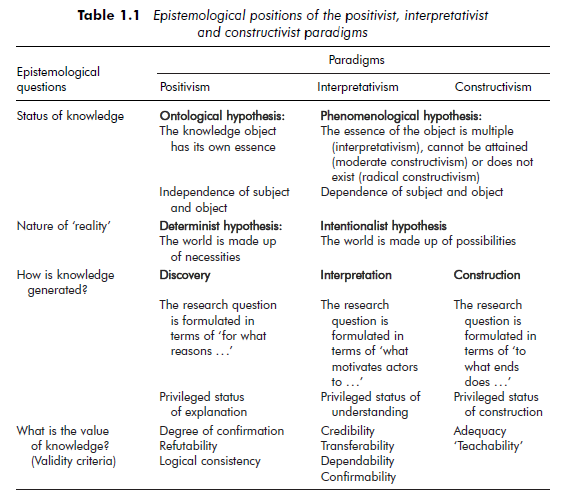
Constructivism and interpretativism share several assumptions about the nature of reality. However, they differ in the particular ideas they express about the process of creating knowledge and the criteria with which to validate research. As we will see further on, the aim of positivism is to explain reality, whereas interpretativism seeks, above all, to understand it and constructivism essentially constructs it. The answers given to different epistemological questions by each of the paradigms are summarized in Table 1.1.
In the rest of this chapter we will concentrate on explaining the different positions taken by each of the paradigms vis-a-vis the nature of the knowledge produced, the path taken to obtain that knowledge and the criteria used to validate the knowledge. This discussion will lead on to an inquiry into the existence of epistemological pluralism, which we will look into further in the final part of the chapter.
Source: Thietart Raymond-Alain et al. (2001), Doing Management Research: A Comprehensive Guide, SAGE Publications Ltd; 1 edition.
The post Epistemological Foundations appeared first on HKT Consultant.
]]>The post What is Knowledge? appeared first on HKT Consultant.
]]>
1. A Positivist Understanding of Reality
For positivists, reality exists in itself. It has an objective essence, which researchers must seek to discover. The object (reality) and the subject that is observing or testing it are independent of each other. The social or material world is thus external to individual cognition – as Burrell and Morgan put it (1979: 4): ‘Whether or not we label and perceive these structures, the realists maintain, they still exist as empirical entities.’ This independence between object and subject has allowed positivists to propound the principle of objectivity, according to which a subject’s observation of an external object does not alter the nature of that object. This principle is defined by Popper (1972: 109): ‘Knowledge in this objective sense is totally independent of anybody’s claim to know; it is also independent of anybody’s belief, or disposition to assent; or to assert, or to act. Knowledge in the objective sense is knowledge without a knowing subject.’ The principle of the objectivity of knowledge raises various problems when it is applied in the social sciences. Can a person be his or her own object? Can a subject really observe its object without altering the nature of that object? Faced with these different questions, positivist researchers will exteriorize the object they are observing. Durkheim (1982) thus exteriorizes social events, which he considers as ‘things’. He maintains that ‘things’ contrast with ideas in the same way as our knowledge of what is exterior to us contrasts with our knowledge of what is interior. For Durkheim, ‘things’ encompasses all that which the mind can only understand if we move outside our own subjectivity by means of observation and testing.
In organizational science, this principle can be interpreted as follows. Positivist researchers examining the development of organizational structures will take the view that structure depends on a technical and organizational reality that is independent of themselves or those overseeing it. The knowledge produced by the researcher observing this reality (or reconstructing the cause- and-effect chain of structural events) can lead to the development of an objective knowledge of organizational structure.
In postulating the essence of reality and, as a consequence, subject-object independence, positivists accept that reality has its own immutable and quasiinvariable laws. A universal order exists, which imposes itself on everything: individual order is subordinate to social order, social order is subordinate to ‘vital’ order and ‘vital’ order is subordinate to material order. Human beings are subject to this order. They are products of an environment that conditions them, and their world is made up of necessities. Freedom is restricted by invariable laws, as in a determinist vision of the social world. The Durkheimian notion of social constraint is a good illustration of the link between the principle of external reality and that of determinism. For Durkheim (1982), the notion of social constraint implies that collective ways of acting or thinking have a reality apart from the individuals who constantly comply with them. The individual finds them already shaped and, in Durkheim’s (1982) view, he or she cannot then act as if they do not exist, or as if they are other than what they are.
Consequently, the knowledge produced by positivists is objective and a-contextual – in that it relates to revising existing laws and to an immutable reality that is external to the individual and independent of the context of interactions between actors.
2. A Subjective Reality?
In the rival interpretativist and constructivist paradigms, reality has a more precarious status. According to these paradigms, reality remains unknowable because it is impossible to reach it directly. Radical constructivism declares that ‘reality’ does not exist, but is invented, and great caution must be used when using the term (Glasersfeld, 1984). Moderate constructivists do not attempt to answer this question. They neither reject nor accept the hypothesis that reality exists in itself. The important thing for them is that this reality will never be independent of the mind, of the consciousness of the person observing or testing it. For interpretativists, ‘there are multiple constructed realities that can be studied only holistically; inquiry into these multiple realities will inevitably diverge (each inquiry raises more questions than it answers) so that prediction and control are unlikely outcomes although some level of understanding (verstehen) can be achieved’ (Lincoln and Guba, 1985: 37). Consequently, for constructivists and interpretativists, ‘reality’ (the object) is dependent on the observer (the subject). It is apprehended by the action of the subject who experiences it. We can therefore talk about a phenomenological hypothesis, as opposed to the ontological hypothesis developed by the positivists. The phenomenological hypothesis is based on the idea that a phenomenon is the internal manifestation of that which enters our consciousness. Reality cannot be known objectively – to seek objective knowledge of reality is utopian. One can only represent it, that is, construct it.
Subject-object interdependence and the rebuttal of the postulate that reality is objective and has its own essence has led interpretativist and constructivist researchers to redefine the nature of the social world.
For interpretativists and constructivists, the social world is made up of interpretations. These interpretations are constructed through actors’ ‘interactions, in contexts that will always have their own peculiarities. Interactions among actors, which enable development of an intersubjectively shared meaning, are at the root of the social construction of reality’ (Berger and Luckman, 1966).
The self-fulfilling prophecies of Watzlawick (1984) are a good illustration of the way actors can themselves construct the social world. A self-fulfilling prophecy is a prediction that verifies itself. According to Watzlawick (1984), it is a supposition that, simply by its existence, leads the stated predicted event to occur and confirms its own accuracy. The prediction proves to be accurate, not because the chain of cause and effect has been explained, nor by referring to laws of an external reality, but because of our understanding, at a particular moment, of the interactions among actors. From this, the succession of subsequent interactions is easy to foresee. Consequently, according to Watzlawick (1984), the degree to which we can predict behavior is linked not to a determinism external to the actors, but to the actors’ submission to imprisonment in an endless game that they themselves have created. In self-fulfilling prophecy, the emphasis is on interaction and the determining role of the actors in constructing reality. Such prophecies depend heavily on context. They can only be made once we understand the context of the interaction – an understanding through which we are able to learn the rules of the game.
Consequently, interpretativists and constructivists consider that individuals create their environments by their own thoughts and actions, guided by their goals. In this world where everything is possible and nothing is determined, and in which we are free to make our own choices, it has become necessary to reject determinism in favor of the intentionalist hypothesis. The knowledge produced in this way will be subjective and contextual, which has numerous research implications, as Lincoln and Guba emphasize in the case of the inter- pretativist paradigm.
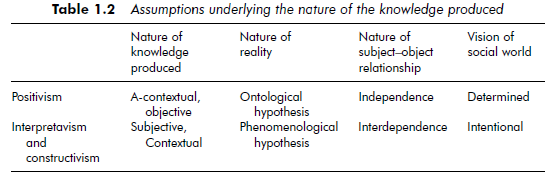
To sum up, the nature of the knowledge that we can hope to produce will depend on our assumptions about the nature of reality, of the subject-object relationship and the social world we envisage (see Table 1.2).
These elements (nature of reality, nature of the subject-object link, vision of the social world) constitute reference points for researchers wishing to define the epistemological position of their research.
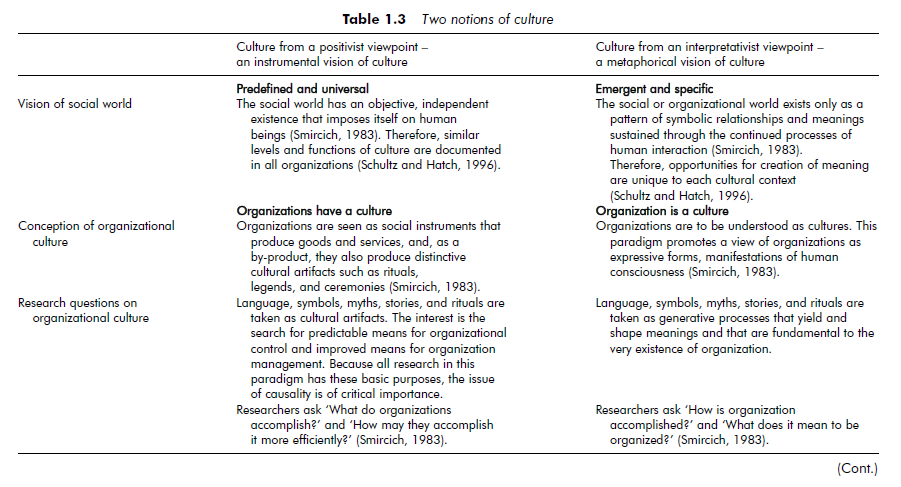
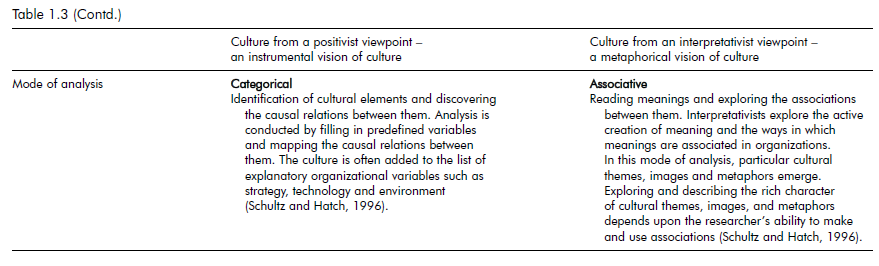
Table 1.3, constructed on the basis of work by Smircich (1983) and Schultz and Hatch (1996), shows clearly that the nature of the knowledge produced in the field of organizational culture depends on the researcher’s assumptions about the nature of the social world.
Their understanding of the nature of the knowable reality and the social world will indicate the path researchers must take to obtain knowledge. In a positivist framework, researchers seek to discover the laws imposed on actors. In an interpretativist framework, they seek to understand how actors construct the meaning they give to social reality. In a constructivist framework, researchers contribute to the actors’ construction of social reality.
Source: Thietart Raymond-Alain et al. (2001), Doing Management Research: A Comprehensive Guide, SAGE Publications Ltd; 1 edition.
The post What is Knowledge? appeared first on HKT Consultant.
]]>The post Generating New Knowledge appeared first on HKT Consultant.
]]>By accepting the assumptions of objectivity, the ontology of reality and the determinism of the social world, positivists commit themselves to the search for external reality and the mechanisms that condition it. The positive ideal would be to find a universal law that explains reality and reveals objective truth.
Even the most traditional positivists recognize that this ideal remains utopian (Comte, 1844, 1988). However, they maintain that an understanding of the laws that govern reality is a prerequisite for generating new knowledge. Scientific progress is thus characterized by a reduction in the number of laws as links are established between them. The key idea behind this vision is that these laws exist even if they cannot all be discovered.
The positivist vision of reality leans towards explanatory research, to answer the question ‘for what reasons’. Such research seeks constant concomitance among phenomena, and tries to reconstruct chains of cause and effect. In the example of organizational structure, the positivist researcher tries to reconstruct the causes of structural events, so as to determine the laws that, independently of the actors involved, have governed organizational reality.
The causal approach accounts for a social fact by relating it to another social fact external to the individuals involved. It leads researchers to examine the economic, political and technical reasons for the fact’s presence. As the positivist paradigm has evolved, it has detached itself from pure causal research. It now recognizes more than simply linear causality (one cause – one effect), and accepts the possibility of multiple or circular causality. It is therefore possible to take a positivist position without implying that all laws through which we can explain reality are laws of linear causality. Nevertheless, in generating new knowledge, the positivist paradigm still follows a path determined largely by the idea that knowable reality has its own meaning, and that this meaning does not necessarily depend on a researcher’s personal beliefs.
2. Interpreting Reality
Interpretavism calls the possibility of uncovering causal links into question, because ‘all entities are in a state of mutual simultaneous shaping, so that it is impossible to distinguish causes from effects’ (Lincoln and Guba, 1985: 38). The process of creating knowledge therefore involves understanding the meaning actors give to reality – rather than explaining reality, interpretativists try to understand it through actors’ interpretations. This process must take account of actors’ intentions, motivation, expectations, motives and beliefs – which all relate more to practice than to facts. Thus, unlike positivists, interpretativists draw a clear distinction between understanding and explaining.
Positivists make no such differentiation between understanding and explaining; the second, by necessity, encompasses the first. Explanation implies understanding. Nevertheless, this is not an understanding that emanates from the meaning actors give to their actions.
The privileged status that interpretativists accord to understanding is based on the concept of verstehen (understanding) developed by Max Weber. This concept unites the two levels of understanding on which the knowledge creation process is based. On one level, verstehen is the process by which individuals are led, in their daily lives, to interpret and understand their world. On another level, and in a more restrictive sense, verstehen is the process by which researchers interpret the subjective meanings behind the behavior of the individuals they are studying (Lee, 1991).
Understanding, or interpreting, behavior must by necessity involve inquiring into local meanings (localized in time and place) that actors give to their behavior. In the case of organizational structure, interpretativist researchers will be drawn towards contextualized research to analyze the daily functioning of an organization. This involves carrying out field studies, which favor direct observation and on-site interviews.
3. Constructing Reality
Constructivists share this research approach as far as understanding is concerned, but with two essential differences. Whereas for interpretativists the process of understanding consists above all of ‘revealing’ the reality of the actors studied, constructivism sees the process of understanding as contributing to constructing that reality. Reality is thus constructed by the act of knowing, rather than being given by an objective perception of the world (Le Moigne, 1995). According to this hypothesis, the path we take when we generate knowledge is constructed as we go along. This conception of knowledge construction is strongly present in the works of Piaget (1970), for whom knowledge is as much a process as a result. Moreover, for constructivists, the process of understanding is linked to the aim of the researcher’s knowledge project. In this there is a teleological hypothesis, which advances the notion that all human activity involves a predetermined purpose or design. The process of building up knowledge therefore has to take account of subjective intentions or purpose. Le Moigne (1995) emphasizes that, in comparison with positivism, the different constructivist epistemologies enable researchers to recognize a knowledge project, rather than a knowledge object that is separate from its investigator. To understand in terms of purposes or plausible goals becomes the aim of scientific research.
The answers given by the positivist, interpretativist and constructivist paradigms to the first two epistemological questions (the nature of the knowledge our research produces and the path we take to produce it) will have strong implications on the value of this knowledge. The third section of this chapter deals with the status and validity of knowledge.
Source: Thietart Raymond-Alain et al. (2001), Doing Management Research: A Comprehensive Guide, SAGE Publications Ltd; 1 edition.
The post Generating New Knowledge appeared first on HKT Consultant.
]]>The post Validity Criteria of Knowledge appeared first on HKT Consultant.
]]>1. Positivist Validity Criteria
For positivism, specific criteria enable researchers to distinguish clearly between scientific and non-scientific knowledge. These criteria have evolved along with positivism, and have moved from ‘verification’ to ‘degree of confirmation’ and ‘degree of refutation’.
1.1. Verification
Early positivists applied the principle of ‘verification’: a proposition is either analytical or synthetic, and is either true by virtue of its own definition or, in certain situations, by virtue of practical experience. A synthetic proposition has meaning if, and only if, it can be verified empirically (Blaug, 1992). Verification obliges researchers to assure the truth of their statements through empirical verification.
1.2. Degree of confirmation
As positivism has evolved, other criteria have supplanted verification. The term ‘degree of confirmation’ refers to the probabilistic logic proposed by Carnap. The logic of confirmation calls the certainty of truth into question. It is based on the idea that we cannot say that a proposition is universally true, but only that it is probable. We can never be sure that it is true in every case and in all circumstances. Consequently, we can only confirm it against experience, or by drawing on the results of other theories – but we will not be able to establish its truth as certain (Hempel, 1964). Carnap’s (1962) vision of science can be summed up as follows: All theories are impossible to prove, but they present different degrees of probability. Scientific honesty consists of only stating theories that are highly probable, or simply specifying for each scientific theory the factors that support it and the theory’s probability in light of these factors. A theory can be probable – in fact Carnap replaces the notion of proof by degree of probability. Researchers who subscribe to Carnap’s probabilistic logic are compelled to evaluate the degree of probability with which their statements are confirmed.
1.3. Refutation
According to Popper’s principle of ‘refutation’, we can never maintain that a theory is true, but we can say it is not true – that is, that it has been refuted. The following example is a good illustration. To the question ‘Are all swans white?’ the only answer that is scientifically acceptable is ‘No’. However many white swans we have observed, we do not have the right to infer that all swans are white. Observing a single black swan is sufficient to refute this conclusion.
A theory that has not been refuted is then a theory that is provisionally corroborated. The term ‘corroboration’ is important for Popper, who draws a clear distinction between it and ‘confirmation’:
By the degree of corroboration of a theory I mean a concise report evaluating the state (at a certain time t) of the critical discussion of a theory, with respect to the way it solves its problems; its degree of testability; the severity of the tests it has undergone; and the way it has stood up to these tests … The main purpose of the formulae that I proposed as definition of the degree of corroboration was to show that, in many cases, the more improbable (improbable in the sense of the calculus of probability) hypothesis is preferable.
According to this principle, a theory is scientific if it is refutable – that is, if it accepts that certain results may invalidate it. However, any theory that cannot be refuted is not scientific. This includes psychoanalysis (for example, the Freudian hypothesis of the subconscious) and Marxism, along with other theories that remain valid whatever observations are made about them. Popper insists on the asymmetry of verification and invalidation. For him, there is no logic of proof, but a logic of refutation, and argues that, consequently, we must construct our scientific propositions from hypotheses that can be refuted.
1.4. Logical consistency
Finally, in assessing the validity of research, positivism only recognizes as scientific those methods that respect formal logic (deductive logic). This idea is referred to as ‘logical consistency’. One test for logical consistency is to show that all of a theory’s propositions are related to one another by the rules of formal logic, or are logically deducible from the same set of premises (Lee, 1991). Positivism refuses to consider inductive logic as scientific. It argues that the only logic that enables us to reproduce reality objectively is deductive logic.
Inductive logic enables us to move from particular observations to general statements. Deductive logic, on the other hand, uses true premises and the rules of formal inference to establish the truth-value of a proposition (or its non-refutation). These two types of logic will be examined in greater depth in Chapter 3.
2. Interpretativist Validity Criteria
Interpretativists and constructivists both question the primacy of deductive logic, and the specific and universal character of the validity criteria proposed by positivists. For interpretativists, validity criteria are criteria of trustworthiness. Lincoln and Guba (1985) identify these as credibility, transferability, dependability and confirmability.
Credibility
How can one establish confidence in the ‘truth’ of the findings of a particular inquiry for the subjects with which and the context in which the inquiry was carried out? When we consider the assumption of multiple constructed realities, there is no ultimate benchmark to which one can turn for justification – whether in principle or by a technical adjustment via the falsification principle. Reality is now a multiple set of mental constructions … To demonstrate ‘truth value’ we must show that the reconstructions that have been arrived at via the inquiry are credible to the constructors of the original multiple realities . . . The implementation of the credibility criterion becomes a twofold task: first, to carry out the inquiry in such a way that the probability that the findings will be found to be credible is enhanced, and, second, to demonstrate the credibility of the findings by having them approved by the constructors of the multiple realities being studied.
(Lincoln and Guba, 1985: 295-6)
Transferability
How can one determine the extent to which the findings of a particular inquiry have applicability in other contexts or with other subjects? Interpretativists make the assumption that at best only working hypotheses may be abstracted, the transferability of which is an empirical matter, depending on the degree of similarity between sending and receiving contexts. Transferability inferences cannot be made by an investigator who knows only the sending context.
(Lincoln and Guba, 1985: 297)
Dependability
How can one determine whether the findings of an inquiry would be repeated if the inquiry were replicated with the same (or similar) subjects in the same (or similar) context? In the conventional paradigm, for this criterion there must be something tangible and unchanging ‘out there’ that can serve as a benchmark if the idea of replication is to make sense. An interpretativist sees reliability as part of a larger set of factors that are associated with the observed changes. Dependability takes into account both factors of instability and factors of phenomenal or design induced change.
(Lincoln and Guba, 1985: 299)
Confirmability
How can we establish the degree to which the findings of an inquiry are determined by the subjects and conditions of the inquiry and not by the biases, motivations, interests, or perspectives of the inquirer? An interpretativist prefers a qualitative definition of this criterion. This definition removes the emphasis from the investigator (it is no longer his or her objectivity that is at stake) and places it where, as it seems to the investigator, it ought more logically to be: on the data themselves. The issue is no longer the investigator’s characteristics but the characteristics of the data: are they or are they not confirmable?
(Lincoln and Guba, 1985: 300)
3. Constructivist Validity Criteria
Constructivists question the classic criteria proposed by positivists. They contest the verification-refutation alternative, saying verification is illusory and refutation inadequate. It is illusory, they say, to devise a scientific process using verification criteria when one’s vision of the world is based on phenomenological and intentionalist hypotheses. It is inadequate to devise a scientific process using refutability criteria when one defends the constructed and transforming nature of research projects in disciplines such as organizational science.
In constructivism, criteria for validating knowledge are still very much a topic of debate. However, while constructivist epistemology refuses to acknowledge any single validity criterion, certain authors propose sources for validating knowledge. We will present two of them here; the adequation (or suitability) criterion proposed by Glasersfeld (1984), and the ‘teachability’ criterion defended by Le Moigne (1995).
Adequation Glasersfeld (1984), who is considered a radical constructivist, holds that knowledge is valid when it fits a given situation. He illustrates this principle using the metaphor of a key. A key fits if it opens the lock it is supposed to open. Here, suitability refers to a capacity: that of the key and not of the lock. Thanks to professional burglars, we are only too well aware that many keys cut very differently from our own may nonetheless open our door!
Teachability The criteria relating to teachable knowledge can be expressed in terms of reproducibility, intelligibility, and constructibility. In Le Moigne’s (1995) view, it is no longer enough for model-makers to demonstrate knowledge. They have to show that this knowledge is both constructible and reproducible, and therefore intelligible. It is important for modelers to be scrupulous about explaining their aims when constructing teachable knowledge.
The validity criteria applied by constructivists do not impose a single method of constructing knowledge, but are able to accept and defend a multiplicity of methods. Constructivists do not see deductive reasoning as the only valid reasoning method, accepting too other methods such as analogy and metaphor.
Source: Thietart Raymond-Alain et al. (2001), Doing Management Research: A Comprehensive Guide, SAGE Publications Ltd; 1 edition.
The post Validity Criteria of Knowledge appeared first on HKT Consultant.
]]>The post Plurality of Epistemological Paradigms appeared first on HKT Consultant.
]]>The coexistence of positivist, interpretativist and constructivist paradigms in works in organizational science may be seen as either a sign of the immaturity of this science, or as an opportunity for researchers working within this discipline. Kuhn (1970) holds that the presence of a single paradigm characterizes normal science, while the coexistence of different paradigms can be symptomatic of periods of scientific revolution. However, researchers in organizational theory tend to see plurality as an opportunity, and approach this plurality using a number of standpoints or strategies. On the basis of work done by Scherer (1998), we can point to three main positions possible. In the view of certain authors (Burrell and Morgan, 1979; Jackson and Carter, 1991), who advocate isolationism, a researcher must choose one of the paradigms and stick to it. Others (Lee, 1991; Pfeffer, 1993; Donaldson, 1997), who advocate integration, say we should direct our efforts towards seeking a common standard. For those who advocate a multi-paradigm approach (Weaver and Gioia, 1994; Schultz and Hatch, 1996), dialogue between paradigms is possible and even desirable.
Isolationists argue that the different paradigms that exist within organizational theory cannot be reconciled – that no dialogue is possible between them, and should not even be attempted. ‘There is no common measure among paradigms of inquiry, so that representatives of opposed paradigms live in different worlds, hold mutually exclusive beliefs, use different vocabularies, etc.’ (Weaver and Gioia, 1994: 565). Here, the fragmentation of organizational science can be explained in part by the fact that researchers voluntarily adopt a particular paradigm – in the view of Burrell and Morgan (1979), adopting a paradigm is a veritable act of faith.
Many authors insist that integration and the establishment of a reference paradigm is the only guarantee of true scientific progress (Pfeffer, 1993; Lee, 1991; Donaldson, 1997). They argue that consensus about a paradigm is a precondition for the development of organizational science, and that fragmentation is an obstacle to this. Lee (1991) proposes an integrated framework that reconciles the three levels of understanding: a subjective understanding, an interpretive understanding and a positivist understanding. Donaldson (1997), meanwhile, proposes a reintegration of frameworks under the hegemony of a positivist paradigm.
It is often said that much research in organizational science borrows elements from different paradigms, thus obtaining what could be called a mixed epistemological position. Miles and Huberman (1984a) give an example of a moderate positivist position.
An example of moderate positivism
It is good for researchers to make their preferences clear. All too often, the reader has to intuit whether the author is, for example, operating from the standpoint of a logical positivist, a symbolic interactionist, or a social phenomeno- logist. These people all look differently at the world of social affairs and social science. We think of ourselves as logical positivists who recognize and try to atone for the limitations of that approach. Soft-nosed logical positivism, maybe . . . We believe that social phenomena exist not only in the mind but also in the objective world – and that there are some lawful and reasonably stable relationships to be found among them. In part, of course, these phenomena exist objectively in the world because people construe them in common or agreed-upon ways, so those perceptions are crucial in understanding why social behavior takes the form it does. Still, even if people do not themselves apprehend the same analytical constructs as those derived by researchers, this does not make such constructs invalid or contrived. Given our belief in social regularities, there is a corollary: Our task is to express them as precisely as possible, attending to their range and generality and to the local and historical contingencies under which they occur.
(Miles and Huberman, 1984a: 19)
Advocates of the multi-paradigm perspective maintain, meanwhile, that dialogue between paradigms is not only possible but necessary to advance our understanding of social phenomena. Weaver and Gioia state that:
A successful multi-paradigm perspective must explain how different theoretical approaches might be related, but must do so (a) while preserving genuine multiplicity (e.g. the relatedness does not involve the reduction of one approach to another) and, (b), without uncritically embracing the disunifying paradigms paradigm (i.e. the increasingly entrenched view of organizational inquiry that – by appealing to the incommensurability thesis – purports unalterably to divide the field into mutually exclusive and contradictory metatheoretical camps).
(Weaver and Gioia, 1994: 566)
According to this perspective, works that propose different methodologies enable dialogue between paradigms. For instance, Hassard (1991) considered the case of Britain’s Fire Brigade from the standpoint of the four paradigms identified by Burrell and Morgan (1979). Similarly, Schultz and Hatch (1996) presented a new multi-paradigm strategy based on an interplay between paradigms. By examining research into organizational culture, Schultz and Hatch revealed connections and contrasts between paradigms, and thus provided a foundation for new interpretations of culture.
Source: Thietart Raymond-Alain et al. (2001), Doing Management Research: A Comprehensive Guide, SAGE Publications Ltd; 1 edition.
The post Plurality of Epistemological Paradigms appeared first on HKT Consultant.
]]>The post Constructing the Research Problem appeared first on HKT Consultant.
]]>The research problem is a key element of the research process: it translates and crystallizes the researcher’s knowledge project, his or her objective. It is through the research problem that researchers study aspects of the reality they hope to discover, or attempt to develop an understanding of that reality.
To know what we are looking for seems to be a prerequisite for any research work. As Northrop (1959) puts it, ‘Science does not begin with facts or hypotheses but with a specific problem’. In accordance, a lot of textbooks assume that researchers always start from a defined problematic: a general question to which they want to respond. But the problems that we address as researchers are not simply handed to us by the world about us. We invent them, we construct them – whatever our knowledge goal may be. The process of constructing a research problem is then itself an integral part of the research process, a step that is all the more decisive as it constitutes the foundation on which everything else is to be built.
Traditionally, too, the processes of constructing the architecture and the methodology of a research project – the research design – are seen to be guided by the research problem. But these mapping-out stages can themselves influence the initial definition of the problematic at hand. They can lead to alterations in the research problem. In fact, it is not unusual for researchers to recognize that the concepts contained in their initial research problem are insufficient or poorly defined when they try to put them into practice, or after an in-depth reading of related works (see Figure 2.1).
Constructing the research problem is an essential step that can serve to guide the research process and the methodological choices made within it. At the same time, however, consideration of the research process and associated methodological choices can itself influence how the research problem will be constructed (see the following example for an illustration of this recursive aspect of constructing the research problem).

Constructing the research problem, a circular process
In her work into the cognitive approach of the organization, Allard-Poesi (1998) investigates causal mapping – the graphical representation of a person’s causal beliefs about a particular domain. Her initial objective was to understand what a collective causal map in organizations actually is and how it emerges from the individual causal maps of its members, which supposedly vary greatly. A review of existent works on causal maps revealed that the notion of cognitive map is used in reference to very different methodologies, and involves differing and even contradictory constructs and visions of cognition. It seemed, in fact, more pertinent to consider a causal map as a tool for apprehending the representations held by members of an organization than as a theoretical construct in itself. This thinking led Allard-Poesi to redefine her question by way of the notion of representation. Her research problem became ‘What does collective representation in organizations consist of, and how does it emerge from the differing representations held by organizational members?’ By redefining her research problem in this way, Allard-Poesi was able to open up her theoretical framework, which had initially been centered on the cognitive approach of the organization. She was able to reconsider her research design, notably by taking a more socio-cognitive approach.
Constructing one’s research problem appears then to be a recursive process, with no set rules. It is without doubt the moment in which the researcher’s skills are really put to the test: skills in areas of intuition, precision, realism and imagination.
Source: Thietart Raymond-Alain et al. (2001), Doing Management Research: A Comprehensive Guide, SAGE Publications Ltd; 1 edition.
The post Constructing the Research Problem appeared first on HKT Consultant.
]]>The post What is a Research Problem? appeared first on HKT Consultant.
]]>To construct a research problem is to elaborate a question or problematic through which the researcher will construct or discover reality. The question produced links or examines theoretical, methodological or empirical elements.
The theoretical elements of the research problem may be concepts (collective representation, change, learning, collective knowledge or cognitive schemes, for example), explicative or descriptive models of phenomena (for instance, innovation processes in an unstable environment or learning processes in groups) or theories (such as Festinger’s theory of cognitive dissonance). Some authors place particular emphasis on the primacy of the question’s theoretical dimension. However, in our opinion, we can also construct a research problem by linking or examining theoretical elements, empirical elements or methodological elements. For example, empirical elements could be a decision taken by a board of directors, a result such as the performance of a business, or facts or events; methodological elements could include the method of cognitive mapping, a scale for measuring a concept or a method to support decision-making processes.
A theoretical, empirical or methodological element does not, in itself, constitute a research problem. To take up our first examples, neither ‘the Cuban missile crisis’ nor ‘a method of constructing the representations held by managers’ constitute in themselves a research problem. They are not questions through which we can construct or discover reality. However, examining these elements or the links between them can enable the creation or discovery of reality, and therefore does constitute a research problem. So, ‘How can we move beyond the limits of cognitive mapping to elicit the representations held by managers?’ or ‘How was the decision made to blockade during the Cuban crisis?’ do constitute research problems.
Examining facts, theoretical or methodological elements, or the links between them enables a researcher to discover or create other theoretical or methodological elements or even other facts. For instance, researchers may hope their work will encourage managers to reflect more about their vision of company strategy. In this case, they will design research that will create facts and arouse reactions that will modify social reality (Cossette and Audet, 1992). The question the researcher formulates therefore indirectly expresses the type of contribution the research will make: a contribution that is for the most part theoretical, methodological or empirical. In this way, we can talk of different types of research problem (see following examples).
Example: Different types of research problems
- ‘What does a collective representation in an organization consist of, what is its nature and its constituent elements, and how does it emerge from the supposedly differing representations held by its members?’ This research problem principally links concepts, and may be considered as theoretical.
- ‘How can we move beyond the limits of cognitive mapping in eliciting the representations held by managers?’ In this case, the research problem would be described as methodological.
- ‘How can we accelerate the process of change in company X?’ The research problem here is empirical (the plans for change at X). The contribution may be both methodological (creating a tool to assist change) and empirical (speeding up change in company X).
The theoretical, methodological or empirical elements that are created or discovered by the researcher (and which constitute the research’s major contribution) will enable reality to be explained, predicted, understood or changed. In this way the research will meet the ultimate goals of management science.
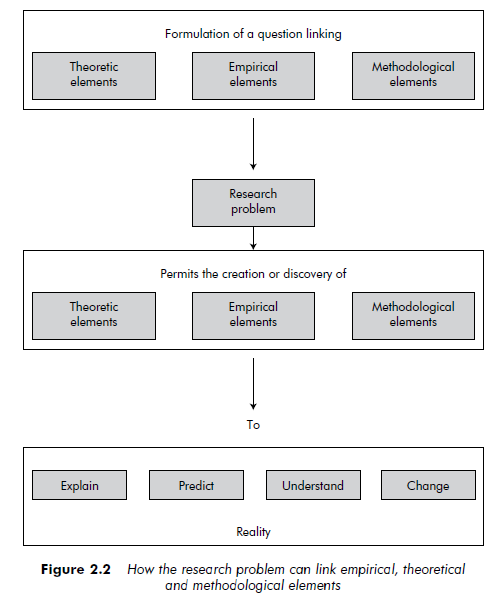
To sum up, constructing a research problem consists of formulating a question linking theoretical, empirical or methodological elements, a question which will enable the creation or discovery of other theoretical, empirical or methodological elements that will explain, predict, understand or change reality (see Figure 2.2).
2. Different Research Problems for Different Knowledge Goals
A knowledge goal assumes a different signification according to the researcher’s epistemological assumptions. The type of knowledge researchers seek, and that of their research problem, will differ depending on whether they hold a positivist, interpretative or constructivist vision of reality.
For a positivist researcher, the research problem consists principally of examining facts so as to discover the underlying structure of reality. For an interpretative researcher, it is a matter of understanding a phenomenon from the inside in an effort to understand the significations people attach to reality, as well as their motivations and intentions. Finally, for constructivist researchers, constructing a research problem consists of elaborating a knowledge project which they will endeavor to satisfy by means of their research.
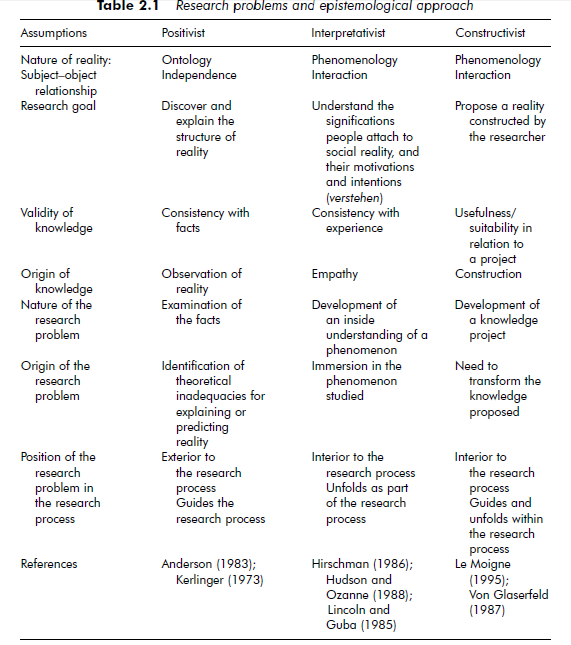
These three different epistemological perspectives are based on different visions of reality and on the researcher’s relationship with that reality. Consequently, they each attribute a different origin and role to the research problem, and give it a different position in the research process.
The research problem and, therefore, the process by which it is formulated will differ according to the type of knowledge a researcher wishes to produce.
The relationship between the epistemological assumptions of the researcher and the type of research problem they will tend to produce is presented in Table 2.1. The categories presented here can only be indicative and theoretical. Their inclusion is intended to provide pointers that researchers can use in identifying their presuppositions, rather than to suggest they are essential considerations in the construction of a research problem. Most research problems in management sciences are in fact rooted in these different perspectives.
However, once a research problem has been temporarily defined during the research process, it is useful to try to understand the assumptions underlying it, in order to fully appreciate their implications for the research design and results.
2.1. A positivist approach
Positivists consider that reality has its own essence, independently of what individuals perceive – this is what we call an ontological hypothesis. Furthermore, this reality is governed by universal laws: real causes exist and causality is the rule of nature – the determinist hypothesis. To understand reality, we must then try to explain it, to discover the simple and systematic associations between variables underlying a phenomenon (Kerlinger, 1973).
From the positivist viewpoint, then, the research problem consists essentially of examining facts. Researchers construct their research problem by identifying inadequacies or inconsistencies in existing theories, or between theories and facts (Landry, 1995). The results of the research will be aimed at resolving or correcting these inadequacies or inconsistencies so as to improve our knowledge about the underlying structure of reality (see Figure 2.3).
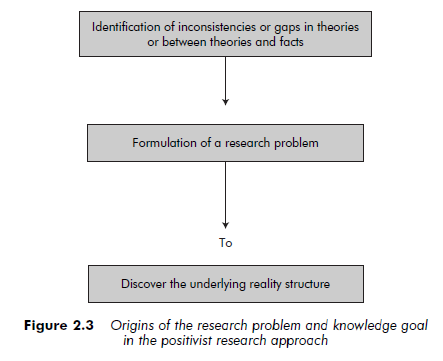
The nature of the knowledge sought and of the research problem in the positivist epistemology imply that, in the research process, the research problem should be external to scientific activity. Ideally, the research problem is independent of the process that led the researcher to pose it. The research problem then serves as a guide to the elaboration of the architecture and methodology of the research.
2.2. An interpretativist approach
For interpretativists, reality is essentially mental and perceived – the phenomenological hypothesis – and the researcher and the subjects studied interact with each other – the hypothesis of interactivity (Hudson and Ozanne, 1988). In accordance with these hypotheses, interpretativists’ knowledge goal is not to discover reality and the laws underlying it, but to develop an understanding (verstehen) of social realities. This means developing an understanding of the culturally shared meanings, the intentions and motives of those involved in creating these social realities, and the context in which these constructions are taking place (Hudson and Ozanne, 1988; Schwandt, 1994).
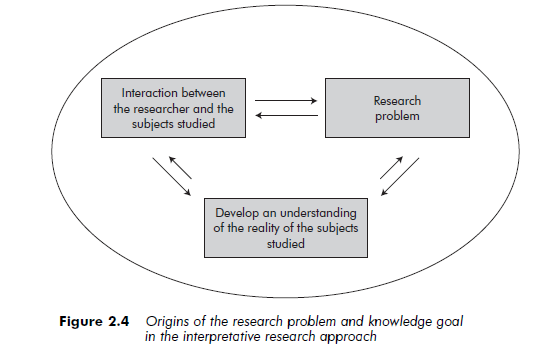
In this perspective, the research process is not directed by an external knowledge goal (as in the positivist research approach), but consists of developing an understanding of the social reality experienced by the subjects of the study. The research problem, therefore, does not involve examining facts to discover their underlying structure, but understanding a phenomenon from the viewpoint of the individuals involved in its creation – in accordance with their own language, representations, motives and intentions (Hudson and Ozanne, 1988; Hirschman, 1986).
The research problem thus unfolds from researcher’s immersion in the phenomenon he or she wishes to study (efforts to initiate change in a university, for example). By immersing him or herself in the context, the researcher will be able to develop an inside understanding of the social realities he or she studies. In particular, the researcher will recognize and grasp the participant’s problems, motives and meanings (for instance, what meanings actors attach to the university president’s efforts to initiate change, and how they react to them).
Here, constructing a research problem does not equate to elaborating a general theoretical problematic that will guide the research process, with the ultimate aim of explaining or predicting reality. The researcher begins from an interest in a phenomenon, and then decides to develop an inside understanding of it. The specific research problem emerges as this understanding develops. Although interpretativists may enter their research setting with some prior knowledge of it, and a general plan, they do not work from established guidelines or strict research protocols. They seek instead to constantly adapt to the changing environment, and to develop empathy for its members (Hudson and Ozanne, 1988). From the interpretative perspective, this is the only way to understand the social realities that people create and experience (Lincoln and Guba, 1985). The research problem will then take its final form semiconcomitantly with the outcome of the research, when researchers have developed an interpretation of the social reality they have observed or in which they have participated (see Figure 2.4).
This is, of course, a somewhat simplistic and extreme vision of interpreta- tivism. Researchers often begin with a broadly defined research problem that will guide their observations (see Silverman, 1993, for example). This is, however, difficult to assess as most interpretative research, published in American journals at least, are presented in the standard academic format: The research problem is announced in the introduction to the article, and often positioned in relation to existing theories and debates, which can give the mistaken impression that the researchers have clearly defined their research problem before beginning their empirical investigation, as in the positivist approach.
2.3. A constructivist research approach
For the constructivists, knowledge and reality are created by the mind. There is no unique real world that pre-exists independently from human mental activity and language: all observation depends on its observer – including data, laws of nature and external objects (Segal, 1990: 21). In this perspective, ‘reality is pluralistic – i.e. it can be expressed by a different symbol and language system – but also plastic – i.e. it is shaped to fit the purposeful acts of intentional human agents’ (Schwandt, 1994: 125). The knowledge sought by constructivists is therefore contextual and relative, and above all instrumental and goal-oriented (Le Moigne, 1995). Constructivist researchers construct their own reality, starting from and drawing on their own experience in the context ‘in which they act’ (Von Glaserfeld, 1988: 30). The dynamics and the goal of the knowledge construction are always linked to the intentions and the motives of the researcher, who experiments, acts and seeks to know. Eventually, the knowledge constructed should serve the researcher’s contingent goals: it must be operational. It will then be evaluated according to whether it has fulfilled the researcher’s objectives or not – that is, according to a criterion of appropriateness (Le Moigne, 1995).
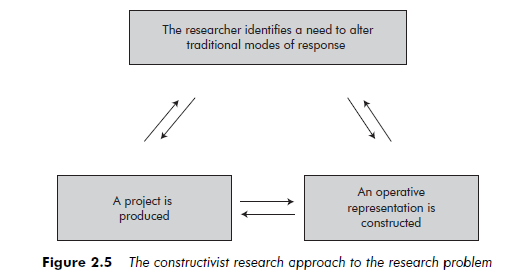
From this perspective, constructing the research problem is to design a goal- oriented project. This project originates in the identification of a need to alter traditional responses to a given context – to change accepted modes of action or of thought. The construction of the research problem takes place gradually as the researcher develops his or her own experience of the research. The project is in fact continually redefined as the researcher interacts with the reality studied (Le Moigne, 1995). Because of this conjectural aspect of the constructivist process of constructing knowledge, the research problem only appears after the researcher has enacted a clear vision of the project and has stabilized his or her own construction of reality.
Thus, as in the interpretative research approach, the constructivist’s research problem is only fully elaborated at the end of the research process. In the constructivist research approach, however, the process of constructing the research problem is guided by the researcher’s initial knowledge project (see Figure 2.5). The researcher’s subjectivity and purposefulness are then intrinsic to the constructivist project. This intentional dimension of the constructivist research approach departs from the interpretative one. The interpretative research process is not aimed at transforming reality and knowledge and does not take into account the goal-oriented nature of knowledge.
The type of research problem produced, and the process used to construct it, will vary depending on the nature of the knowledge sought and the underlying vision of reality. As we pointed out earlier, the categories we have presented are representative only. If a researcher does not strongly support a particular epistemological view from the outset, he or she could construct a research problem by working from different starting points. In such a process, it is unlikely that the researcher will follow a linear and pre-established dynamics.
Source: Thietart Raymond-Alain et al. (2001), Doing Management Research: A Comprehensive Guide, SAGE Publications Ltd; 1 edition.
The post What is a Research Problem? appeared first on HKT Consultant.
]]>The post Process of Constructing the Research Problem appeared first on HKT Consultant.
]]>Researchers can use different points of departure to elaborate their research problem. Concepts, theories, theoretical models relating to the phenomenon they wish to study, methodological approaches or tools, facts observed within organizations, a field-study opportunity, a general theme of interest, or a combination of these may be used. Studying a well-known research problem using a new methodological approach, using an existing theory to study a new phenomenon or re-examining theories (in light of the problems encountered by managers, for example) are all possible routes to take in elaborating a research problem.
1.1. Concepts, theories and theoretical models
Reading over published research works with a critical eye can reveal conceptual contradictions, gaps or inadequacies within the body of theoretical knowledge on a given subject. Strange constructs, theoretical inadequacies in some models, contradictory positions among researchers, heterogeneous research designs, concepts or study contexts, are all openings and, therefore, opportunities for constructing a research problem.
A large number of researchers have used the insufficiencies of existing theories (see the following example) or a comparison of two contradictory theoretical frameworks as starting points in constructing their research problems. In this connection, articles synthesizing the current state of a theme or a particular concept are often useful bases on which to construct a research problem.
Example: Starting from existing theories
Steers (1975) reviews 17 multivariate models of organizational effectiveness. Organizational effectiveness is defined as the efficiency with which an organization acquires and uses its resources within a given environment. The author compares these models along four dimensions: primary evaluation criteria, nature – descriptive versus normative – generalizability and derivation – and synthesizes their inadequacies. His analysis starts from the observation that the concept of organizational effectiveness is rarely defined in existent literature, even when it is expressly referred to. While the author does not himself explicitly choose a new perspective from which to study organizational effectiveness, his remarks and observations on the dimensions of the concept are still angles from which to elaborate new research problems.
For example, following on from Steer’s work, one could think of introducing a social dimension in the concept of organizational effectiveness, a dimension that is often overshadowed in theoretical works. The research could thus aim to answer the following question: ‘What is the social dimension of organizational effectiveness?’
Detecting inadequacies or contradictions in theories or in definitions of existing concepts is one useful method for starting research. Using a theory or theoretical perspective to study phenomena other than those to which it has until now been applied can also form an interesting basis on which to elaborate research problems (see the following example). Finally, we can simply choose to test certain theoretical principles that have already been advanced, but have not yet been convincingly tested.
Example: Using an existing theoretical perspective to study a new phenomenon
Tracy (1993) proposed to use the living systems theory developed by Miller (1978) for studying organizational behavior and management. He focused his analysis on usual organizational topics and phenomena – in particular, organizational structure – to which the living systems theory has already been applied, and proposed a synthesis of this research. In this article, Tracy outlines the general precepts of the theory and then details its underlying assumptions and theoretical implications. The article offers a good introduction for those interested in constructing a research problem using this theoretical framework.
From Tracy’s work, one could envisage studying organizational configurations using the living systems theory. This theory proposes in fact a typology of the subsystems involved in the organization of living systems, identifies the properties and the role of actors and suggests how to regulate the system transversally. The initial research question could be: ‘How can the specialization of skills be managed within organizations?’ The research goal would be to construct a typology of company configurations according to the organizational goals and environment – that is, using the living systems theory.
1.2. Starting from a methodology
While, at the moment, most research problems in management science seem to find their genesis in theoretical and conceptual thinking, the methodological approaches or tools used can also constitute interesting starting points for elaborating a research problem. Two possibilities are here available to the researcher. First, the research problem may consist of examining existing methods or methodological approaches, identifying their limits and attempting to propose new ones (see following example). One could propose a new scale for measuring performance, or a new method to analyze discourse, or to support decision-making, for example.
Example: Using a methodology
Eden et al. (1983) set out to design a method to support strategic decision-making in groups. Two assumptions underlie this research project: first, that creating consensus in a group while taking into account the particularities of its members’ individual visions is difficult and, second, that traditional group decision-making methods rely on formal approaches. The research goal, therefore, was to design a decision-making method that accounted for potential differences in managers’ representations of their problems, and that would facilitate consensus and creative resolution of strategic problems. The method they proposed used cognitive mapping techniques (see Chapter 16). Through cognitive mapping, managers’ representations are elicited and then aggregated. These aggregates are then discussed in groups, which enables the strategic problems encountered to be resolved creatively.
The other possible route is to use a new method or a new methodological approach to tackle a theoretical research problem that has already been the subject of other research. In this case, however, researchers should be careful to justify from the start the research problem they are studying (drawing on one of the configurations described in the previous section). Moreover, any method used implies a certain number of constraints that will, to a certain extent, limit the investigation. Many methods, for instance, fall within a given epistemological tradition or involve particular theoretical assumptions that are not necessarily made explicit. It is then very useful to pay attention to such considerations before deciding upon a particular research method. Researchers should weigh up all restraints inherent in the method used, and should evaluate their implications at a theoretical level.
Example: Tackling a classic research problem through a new method
Barr et al. (1992) began their research with the following question: ‘Why is it that, in the same environment, and whatever the quality and expertise of their management teams, certain companies are able to adapt and renew themselves while others cannot – and decline inexorably?’ Considering the limitations of classic theoretical frameworks, the authors chose to study the problem of organizational renewal from a cognitive perspective. They developed and analyzed organizational cognitive maps of two companies and then linked their conclusions to organizational learning theory.
1.3. Starting from a concrete problem
Companies’ difficulties and managers’ questions are favorite starting points for research in management. A research problem constructed on this basis ensures interest in the project from a managerial point of view. However, we need to make sure that, eventually, we also find a theoretical perspective on which the research problem and design will both rely.
1.4. Starting from a research setting
Some researchers begin their investigations with a research setting already in mind. This is very often the case when companies enter into research agreements: the researcher and the company agree on a relatively general research topic, for which precise modalities then have to be defined. In such a situation, the construction of a research problem will often be influenced by managerial considerations.
In the case of particularly inductive research, for example, when an interpretative approach is used (see Gioia and Chittipeddi, 1991), researchers often start with a very broad question in mind and a research setting in which to carry out their enquiry. Their research problem will only truly emerge as they gain a clearer understanding of the context (see Section 1). There are, however, disadvantages in setting off on a field study without a specific research problem (see Section 2.2).
1.5. Starting from an area of interest
Finally, many researchers will naturally be drawn towards studying a particular theme. However, interest in a particular domain does not constitute a ‘question’ as such. The theme the researcher is interested in must then be refined, clarified and tested according to theories, methodologies, managerial interests or possible fieldwork opportunities, so as to elaborate a research problem as such. Researchers might look for any theoretical gaps in the chosen domain, review the concepts most frequently invoked and the methods most often used, or question whether other concepts or methods may be relevant; or identify managers’ preoccupations. Researchers have to consider what they can bring to the subject, and what field opportunities are available to them.
2. ‘Good’ Research Problems
Beyond the various starting points mentioned previously, there are no recipes for defining a good research problem, nor any ‘ideal’ routes to take. On top of this, as we have seen, researchers subscribing to different epistemological paradigms will not define a ‘good research problem’ in the same way. We can, nevertheless, try to provide researchers with some useful guidelines, and warn them against possible pitfalls to be aware of when defining their research problem.
2.1. Delimiting the research problem
Be precise and be clear Researchers should always endeavor to give themselves as precise and concise a research problem as possible. In other words, the way the research problem is formulated should not lend itself to multiple interpretations (Quivy and Van Campenhoudt, 1988). For example, the question ‘What impact do organizational changes have on the everyday life of employees?’ is too vague. What are we to understand by ‘organizational changes’? Does this mean structural change? Changes in the company’s strategy? Changes in the decision-making process? We would advise this researcher to put his or her research problem to a small group of people, and to invite them individually to indicate what they understand it to mean. The research problem will be all the more precise when interpretations of it converge and correspond to the author’s intention.
Having a precise research problem does not mean, however, that the field of analysis involved is restricted. The problem may necessitate a vast amount of empirical or theoretical investigation. Having a precise research problem simply means that its formulation is univocal. In this perspective, researchers are advised to avoid problems that are too long or confused, which prevent a clear understanding of the researcher’s objective and intention. In short, the research problem must be formulated sufficiently clearly to ground and direct the researcher’s project.
Be feasible In the second place, novice researchers or researchers with limited time and resources should endeavor to give themselves a relatively narrow research problem:
As I tell my students, your aim should be to say ‘a lot about a little problem’. This means avoiding the temptation to say ‘a little about a lot’. Precisely because the topic is so wide-ranging, one can flit from one aspect to another without being forced to refine and test each piece of analysis.
(Silverman, 1993: 3)
If a research problem is too broad, researchers risk finding themselves with a mass of theoretical information or empirical data (if they have already started their fieldwork) which quickly becomes unmanageable and which will make defining the research problem even more difficult (‘What am I going to do with all that?’). In other words, the research problem must be realistic and feasible, i.e. in keeping with the researcher’s resources in terms of personality, time and finances. This dimension is less problematic when researchers have significant time and human resources at their disposal (see Gioia and Chittipeddi, 1991).
In short, a relatively limited and clear research problem prevents the researcher from falling into the trap of what Silverman (1993) calls ‘tourism’. Here, Silverman is referring to research that begins in the observational field, without any precisely defined goals, theories or hypotheses, and focuses on social events and activities that appear to be new and different. There is a danger here of overvaluing cultural or subcultural differences and forgetting the common points and similarities between the culture being studied and that to which one belongs. For instance, a researcher who is interested in managers’ work and restricts his or her attention to their more spectacular interventions would be forgetting aspects that are no less interesting and instructive – for example, the daily and routine aspects of the manager’s work.
Be practical As their theoretical or empirical investigative work proceeds, researchers can clarify and narrow down their research problem. If they are initially interested in a particular domain (organizational learning for instance), they may formulate a fairly broad initial question (‘What variables favor organizational learning?’). They may then limit this question to a particular domain (‘What variables favor organizational learning during the strategic planning process?’) and/or specify the conceptual framework they are interested in (‘What cognitive or structural variables favor organizational learning during the strategic planning process?’). Through this narrowing down, the theoretical and empirical investigation will be guided and then easier to conduct.
Conversely, one should avoid confining oneself to a very narrow research problem. If the problem involves conditions that are too difficult to meet, the possibilities for empirical investigation may be greatly reduced. Similarly, if researchers focus too soon on a specific question, they may shut themselves off from many research opportunities that might well have broadened the scope of their research problem. They also risk limiting their understanding of the context in which the phenomenon studied is taking place. Finally, if researchers limit their research problem too much when it has been little studied, they may have only few theoretical and methodological elements to draw on when beginning their fieldwork. They will then have to carry out an exploratory theoretical work to redefine their initial research problem.
In sum, it appears difficult to strike a balance between a too large research problem that is impossible to contain, and a too limited research problem that shuts off study opportunities. This is one of the major difficulties researchers will confront when starting out on a research project.
2.2. Recognizing the assumptions underlying a research problem
Scientific Goal Beyond the qualities of clarity and feasibility, the research problem must possess qualities of ‘relevance’. Quivy and Van Campenhoudt (1988) define ‘relevance’ as the general mode and intention – explicative, normative, moral or philosophical – underlying a research problem. A research problem is ‘relevant’ if its underlying intention is understanding or explaining reality (which are the overriding goals of science). ‘Do bosses exploit workers?’ ‘Is work flexibility socially fair?’ ‘What are the organization’s aims?’ are questions that translate moral (in the case of the first two) and philosophical intentions (in the case of the last one). But in our opinion, the principal aim of the social sciences is not to make moral judgements about the functioning of organizations – even if a moral or political concern may inspire a research problem (Parker, 1993; 1994). The social sciences lack sufficient methods to answer philosophical problems – even if philosophical thinking, through epistemology in particular, is essential to the development of these disciplines. In sum, a research problem must translate into a knowledge project, whether comprehensive, explicative or predictive.
Underlying values and assumptions While a research problem should not have a ‘moral’ or ‘political’ intention, researchers must be aware of and question its underlying values and assumptions (others than the epistemological assumptions we have mentioned earlier in this chapter). For example, and it is particularly true in management sciences, some research problems are stamped with the idea that research enables humanity to progress and the organization’s efficiency to be improved. For instance, the research problem ‘how can we improve organizational learning?’ conceals the assumption that organizational learning improves the organization’s efficiency or the employees’ well-being. But is it necessarily so?
Because of the strong influence of trends in managerial and economic thinking, one must be particularly wary of concepts and notions that contain the idea of progress or improvement in efficiency in management science – in relation, for instance, to culture, change, consensus or communication. But, as Silverman (1993: 5) puts it, ‘an uncritical belief in “progress” is an unacceptable basis for scientific research’. In our opinion, researchers should question the assumptions and values underlying their research problem and that will influence their research design and methodology and, therefore, their research results and implications. To return to our initial example, why should we assume that organizations must learn, that they must have a ‘strong’ culture, that the environment changes more quickly today than before, or that shared meanings and consensus in the organization improve its functioning and efficiency? Are these assumptions based on some reality? Or are they the expression of our current values and ways of thinking: new imperatives that replace those of the scientific work organizations of the 1920s?
Silverman (1993) here calls researchers to use a historical, cultural and political sensitivity in order to detect the interests and motivations behind their research problem and to understand how and why these ‘problems’ emerge. Why is there more interest in, and therefore more research problems about, organizational learning today? What does this sudden interest in ‘environmental issues’ mean? Such questions can help us to understand how and why these new ‘realities’ emerge. They also encourage us to look critically at the way we formulate our research problems, thus freeing ourselves from some taken-for- granted beliefs about organizations.
3. Constructing a Research Problem: Illustrations
Given the difficulties outlined above, constructing a research problem is rarely a matter of taking just one of the routes we have presented. It is often a case of moving back and forth between theoretical and empirical steps. A general research problem stemming from an initial review of existent literature may prove flawed when the concepts it relies on are operationalized or may be too broad to investigate with limited means and resources. In the following, we present two examples of paths taken by researchers in constructing a research problem. These different experiences are not presented as model examples. To the contrary, they are intended to show the diversity of processes that may be followed and the difficulties that may be encountered when constructing a research problem.
A linear dynamic A research problem can emerge clearly and quite quickly after research has begun. As the example described below shows, combining two theoretical approaches (the evolutionist theory and the theory of non-linear dynamic systems) to analyze a relatively classic phenomenon (the management of innovation) enables one to compose an original research problem relatively early in the research process.
Example: A question resulting from the confrontation between two theoretical fields
My research question was directly inspired by my training. As a graduate in pure mathematics, I sought to use my theoretical knowledge to gain a better understanding of organizations. My thesis was based on studying the evolution dynamics of a group of innovation projects. I started from chaos theory, with which I was familiar, and I chose to apply it to the management of innovation principally because it appealed to me. While reviewing related work on the subject, I noticed that innovations were rarely studied at the level of a population, and that their evolution dynamics was non-linear. I then thought of using evolutionary theory to build a model of the laws underlying the evolution of this population. I discovered that parametric models were potentially chaotic. This drew my ideas together and I had my research problem: ‘How does a population of innovation projects live and die?’ Once I had posed my research problem, my research work consisted of testing this conceptual framework.
A recursive dynamics While the process followed in the previous example seemed to unfold without great difficulty, the construction of a research problem is often less linear. A lot of research begins on ill-defined theoretical and methodological bases. The difficulties will be all the greater if the researcher chooses to work from an original or little-known epistemological perspective. The following example illustrates a more treacherous route. This young researcher was initially interested in the process of knowledge capitalization within an organization. After theoretical reflection on the subject, she redefined her research problem and focused on the collective construction of knowledge. Her research problem then seemed to be clear enough: ‘How does collective knowledge construct itself within organizations?’ This redefinition led her to conduct new theoretical investigations, but she has had trouble developing an empirical vision of her research problem. Her choice of constructivism as her epistemological position has numerous implications in the construction of her research problem. After an initial exploratory empirical phase, she now feels that synthesizing her initial observations will enable her to specify the practical terms of her research problem.
Example: A research problem resulting from theoretical reflection in the constructivist perspective
I began my thesis in December and I’ve already taken three months to arrive at a satisfactory research problem. When I first started on my thesis, I wanted to study the process of knowledge capitalization within organizations. This is an important managerial problem that interests many companies. However, I quickly reached my first impasse: firstly, a thesis had already been written on a closely related subject, and secondly, it seemed important to me to tackle the problem of knowledge construction before that of its capitalization.
Over the following three months, I read through published works with a new research problem in mind. I wanted to know how knowledge was collectively constructed and to understand its dynamics within organizations. This is a subject that had never really been dealt with at the level at which I wished to study it, that of working groups. I skimmed through some writings on knowledge in different domains and eventually took the direction of an American model of social psychology. However, I found it difficult to integrate this very heterogeneous reading material in the way I had hoped.
Over the summer I found a company that was interested in my research, and I had to begin to actively put together an initial conceptual framework (very perfunctory to start with) and to delve into epistemological and methodological considerations. However, I didn’t know how to observe knowledge construction and was not really sure which information to collect. I opted for a very inductive process.
After around three months of fieldwork, I have neither completely resolved these methodological questions nor really defined my epistemological position. I am now synthesizing my first field results, which I hope will enable me to clarify these points and specify my research problem.
Finally These two ‘stories’ are, of course, far from being comparable. They reflect different states of advancement in the research process (the research has been completed in the first example, but is ongoing in the second). However, they illustrate some of the difficulties researchers can come up against when they are trying to construct their research problem. In addition to the difficulties engendered by theoretical investigation and by drafting an initial broad research problem, researchers often meet instrumentation problems or empirical constraints that can lead them to redefine their research problem (see Chapter 7). These difficulties are even greater when a field opportunity presents itself or when the researcher seeks to define his or her epistemological position. Then it is a question of ‘making the best with what you have’. A researcher might, for example, conduct an initial exploratory study (as in the two examples cited above) and specify the research problem once he or she has developed an initial ‘understanding’ of the phenomenon studied. Alternatively, the researcher may prefer to wait until he or she has resolved his or her methodological or epistemological problems. We strongly advise researchers who encounter such difficulties to discuss them with their colleagues. The questions they will ask and the efforts at clarification the researcher will be pushed to make will serve as leads, openings and sources of inspiration and structuring that will help to construct a research problem.
Source: Thietart Raymond-Alain et al. (2001), Doing Management Research: A Comprehensive Guide, SAGE Publications Ltd; 1 edition.
The post Process of Constructing the Research Problem appeared first on HKT Consultant.
]]>The post Theoretical Background of Processes Central to the Construction of Knowledge appeared first on HKT Consultant.
]]>The dichotomy (exploration and test) we suggest in this chapter is justified by the different types of logic that are characteristic of these two processes. To explore, the researcher adopts an approach that is either inductive or abductive, or both – whereas testing calls for a deductive method.
1. Logical Principles
1.1. Deduction
By definition, deduction is characterized by the fact that, if the hypotheses formulated initially (premises) are true, then the conclusion that follows logically from these premises must necessarily be true.
Example: A classic deduction: the syllogism of Socrates
-
- All men are mortal.
- Socrates is a man.
- Socrates is mortal.
In this example of deductive logic, (1) and (2) are the premises and (3) the conclusion. It is not possible that (3) is false once (1) and (2) are accepted as true. Schematically this argument follows the following logic: every A is B, C is A, therefore C is B. (See also Chapter 1)
We should not, however, limit deduction to the type of syllogism evoked in the above example. In fact, logicians make a distinction between formal and constructive deduction. Formal deduction is an argument or an inference – a logical operation by which one concludes the necessary consequence of one or several propositions – that consists of moving from the implicit to the explicit, the most usual form being the syllogism. Although formal deduction involves valid logical reasoning, it is sterile insofar as the conclusion does not enable us to learn a new fact. The conclusion is already presupposed in the premises; consequently the argument is tautological. Constructive deduction, on the other hand, while also leading to a necessary conclusion, makes a contribution to our knowledge. The conclusion is a demonstration – composed not only of the contents of the premises, but also of the logic by which one shows that one circumstance is the consequence of another.
Deductive logic thus underpins the hypothetico-deductive method. This consists of elaborating one or more general hypotheses, and then comparing them against a particular reality in order to assess the validity of the hypotheses formulated initially.
1.2. Induction and abduction
Induction, in logic, usually means to assert the truth of a general proposition by considering particular cases that support it. Mill (1843: 26) defines it as ‘the operation of discovering and proving general propositions . . . by which we infer that what we know to be true in a particular case or cases, will be true in all cases which resemble the former in certain assignable respects’. Induction is called summative (or complete) if it proceeds through an enumeration of all cases that its conclusion is valid for. Induction is called ampliative (or incomplete) if its conclusion goes beyond its premises. That is, the conclusion is not a logical consequence of the premises. Ampliative induction is thus an inconclusive argument.
This argument illustrates the principle of induction. Researchers in management, however, frequently explore complex contexts; drawing from them a large number of observations of a variety of natures which are at first ambiguous. They will then attempt to structure their observations so as to derive meaning from them. In the social sciences, the aim is not really to produce universal laws, but rather to propose new theoretical conceptualizations that are valid and robust, and are thought through in minute detail. It is said, then, that the researcher proceeds by abduction (a term employed in particular by Eco, 1990) or by adduction (term used by Blaug, 1992).
Thus induction is a logical inference which confers on a discovery an a priori constancy (that is, gives it the status of law), whereas abduction confers on it an explanatory status which then needs to be tested further if it is to be tightened into a rule or a law.
By applying an abductive method, the researcher in management can use analogy and metaphor to account for observed phenomena, or to illustrate or explain propositions. The aim is to use the comparison as an aid in deriving meaning. An analogy is an expression of a relationship or a similarity between several different elements. Consequently, to argue analogically involves drawing connections and noting resemblances (so long as these indicate some sort of relationship). The researcher proceeds then by association, through familial links between observed phenomena. Metaphors are transfers by analogical substitution – a metaphor is a figure of speech by which we give a new signification to a name or a word, in order to suggest some similarity. The metaphor is thus relevant only as far as the comparison at hand; it can be described as an abridged comparison.
In management, recourse to analogical reasoning or metaphor is common when researchers choose to construct knowledge through exploration. Pentland (1995) establishes a relationship between the structures and processes of grammatical models and the structure characteristics of an organizational environment along with the corresponding processes likely to be produced within it. Using metaphor as a transfer by analogical substitution, Pentland demonstrates to what extent the ‘grammatical metaphor’ can be useful in understanding organizational processes.
In his work Images of Organization, Morgan (1986) discusses using metaphor as an aid in analyzing organizations. Morgan sees metaphor as a tool with which to decode and to understand. He argues that metaphorical analysis is an effective way of dealing with organizational complexity. Morgan raises the metaphorical process to the status of legitimate research device. He distinguishes several metaphorical conceptions of the organization: in particular as a machine, an organism, a brain and a culture. The choice of which metaphorical vision to borrow influences the meaning produced.
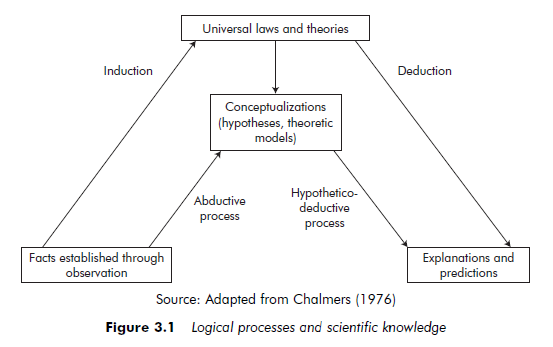
1.3. Constructing knowledge
Although so far we have differentiated between induction and deduction, used respectively for exploration and testing, these two logics are complementary when it comes to the construction of scientific knowledge (see Figure 3.1).
It is traditionally considered that deductive reasoning moves from the general to the particular, and inductive from the particular to the general. For Blaug (1992) however, induction and deduction are distinguished by the character – demonstrative or not – of the inferences formed. The conclusions of inductive or abductive reasoning are not demonstrations. They represent relationships that, through the thoroughness with which they have been established, have achieved the status of valid propositions. These propositions are not, however, certain – as those elaborated through deduction can be. They are regarded as inconclusive, or uncertain, inferences.
Yet ‘certain’ and ‘uncertain’ inferences are both integral to the process of constructing new knowledge. From our observations, we can be led to infer the existence of laws (through induction – an uncertain inference) or, more reasonably, conceptualizations: explanations or conjectures (through abduction – again uncertain). These laws or conceptualizations might then be used as premises, and be subjected to tests. By testing them we might hopefully develop inferences of which we are certain (through deduction). In this way, researchers are able to advance explanatory and/or predictive conclusions.
2. Theoretical Elements
Exploration can often lead researchers to formulate one or more temporary working hypotheses. These hypotheses may in turn be used as the basis of further reflection, or in structuring a cohesive body of observations. But while the final result of the exploration process (using an abductive approach) takes the form of hypotheses, models, or theories, these constitute the starting point of the testing process (in which deduction is employed). It is from these theoretical elements that the researcher will try to find an answer to the question he or she posed initially.
2.1. Hypotheses
In everyday usage, a hypothesis is a conjecture about why, when, or how an event occurs. It is a supposition about the behavior of different phenomena or about the relationships that may exist between them. One proposes, as a hypothesis, that a particular phenomenon is an antecedent or a consequent of, or is invariably concomitant to, other given phenomena. Developed through theoretical reflection, drawing on the prior knowledge the researcher has of the phenomena being studied, hypotheses are actually the relationships we establish between our theoretical concepts.
A concept refers to certain characteristics or phenomena that can be grouped together. Alternatively, a concept represents similarities in otherwise diverse phenomena … Concepts are located in the world of thought . . . are abstracted forms and do not reflect objects in their entirety but comprehend only a few aspects of objects.
When we map out a hypothesis, we explain the logic of the relations that link the concepts involved (see Figure 3.2). From the moment it has been formulated, the hypothesis replaces the initial research question, and takes the form of a provisional answer.

If the direction of the hypothesis is positive, the more Concept 1 is present, the stronger Concept 2 will be; if the direction is negative, then the presence of Concept 1 will lessen the presence of Concept 2.
Like the research subject, a research hypothesis should have certain specific properties. First, the hypothesis should be expressed in observable form. To assess its value as an answer to the research question, it needs to be weighed against experimental and observational data. It should therefore indicate the type of observations that must be collected, as well as the relationships that must be established between these observations in order to verify to what extent the hypothesis is confirmed (or not) by facts.
For example, let us consider the following hypothesis: ‘There are as many readings of a text as there are readers of it.’ Here we have an expression that cannot be operationalized, and which therefore cannot constitute an acceptable research hypothesis in the sense we have outlined. In reading a text we acquire a mental image which will always lose something when it is verbalized. The concept of protocol sentences is generally applied in such a case, but this can still only partly account for the results of the reading.
On the other hand, a hypothesis such as ‘Organizations with interorganizational linkages should show a lower failure rate than comparable organizations without such linkages’ (Miner et al., 1990: 691) indicates the kind of observations we need to have access to if we are to assess its legitimacy. The researcher is led to identify the existence or not of interorganizational links and the suspension or not of the organization’s activities. The hypothesis can be represented by the diagram in Figure 3.3.

Second, hypotheses should not be relationships based on social prejudices or stereotypes. For example, the hypothesis that ‘absenteeism increases with an increase in the number of women in a company’ leads to a distorted view of social reality. Ideological expressions cannot be treated as hypotheses.
In practice, it is rare for researchers to restrict themselves to only one hypothesis. The researcher is most often led to work out a body of hypotheses, which must be coherent and logically consistent. It is only then that we have the form of a model.
2.2. Models
There are many definitions of the term ‘model’. According to Kaplan (1964: 263): ‘We say that any system A is a model of system B if the study of A is useful for the understanding of B without regard to any direct or indirect causal connection between A and B.’
In the social sciences, a model is a schematic illustration of physical or cognitive relationships among its elements. In practice, a ‘model’ is a simplified representation of a process or a system that is designed to explain and/or simulate a real situation. The model is then schematic, in that the number of parameters it incorporates is sufficiently limited that they can be readily explained and manipulated.
The subject-model relationship is by nature subjective. In other words, the model does not aim to account for every aspect of the subject, nor even every aspect of any one possible approach to the subject (see Figure 3.4).
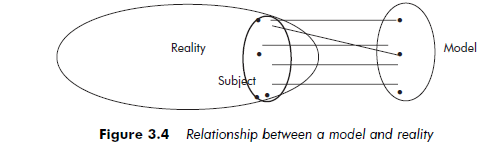
2.3. Theories
In broad terms, a theory can be said to be a body of knowledge, which forms a system, on a particular subject or in a particular field. But this definition is of limited use in practice. That said, as authors continue to formalize more precisely what they mean by theory, the number of definitions of the term continues to increase. Zaltman, et al. (1973) note ten different definitions, all of which have one point in common: theories are sets of interconnected propositions. Ambiguity or confusion between the terms ‘theory’ and ‘model’ is not uncommon.
It is not the aim of the present chapter to settle this debate. We will use the term here with the definition suggested by Bunge (1967: 387):
Theory designates a system of hypotheses. A set of scientific hypotheses is a scientific theory if and only if it refers to a given factual subject matter and every member of the set is either an initial assumption (axiom, subsidiary assumption, or datum) or a logical consequence of one or more initial assumptions.
To be more precise, we can adopt the vocabulary of Lakatos (1974), and say that a theory is a system made up of a ‘core’ and a ‘protective belt’ (see Figure 3.5). The core includes the basic hypotheses that underlie the theory, those which are required – they can be neither rejected nor modified. In other words, the core cannot be modified by methodological decision. It is surrounded by the protective belt, which contains explicit auxiliary hypotheses that supplement those of the core, along with observations and descriptions of initial conditions (Chalmers, 1976).
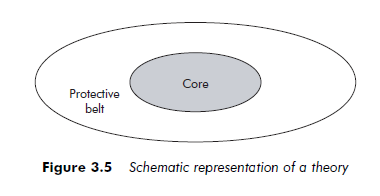
Researchers in management do not deal with laws or universal theories. Instead they construct or test theories that are generally qualified as substantive. It is important to distinguish the claims of such substantive theories from those of more universal theories. Glaser and Strauss (1967) make a distinction between substantive and formal theories: a substantive theory is a theoretical development in direct relation to an empirical domain, whereas a formal theory relates to a conceptual domain.
A concept of inclusion exists between these two levels of theories. A formal theory usually incorporates several substantive theories that have been developed in different or comparable empirical fields. While formal theories are more ‘universal’ than substantive theories, which are ‘rooted’ in a context, a formal theory generally evolves from the successive integration of several substantive theories (Glaser and Strauss, 1967).
In the above discussion we have looked at the two types of logic that underlie the two processes we employ in constructing knowledge (exploration and testing). We have also considered the theoretical elements key to these logical processes.
Source: Thietart Raymond-Alain et al. (2001), Doing Management Research: A Comprehensive Guide, SAGE Publications Ltd; 1 edition.
The post Theoretical Background of Processes Central to the Construction of Knowledge appeared first on HKT Consultant.
]]>