The post Questionnaire survey for quantitative research appeared first on HKT Consultant.
]]>Survey vs Questionnaire: Differences and Definitions
A questionnaire is used to collect data from a list of questions. It’s not used to look for trends, behavior or a bigger picture. A survey is data collection through a set of questions for the purposes of statistical analysis
A survey involves gathering data to use for analysis and forecasting. As opposed to its questionnaire cousin, the data isn’t analyzed in isolation. Surveys do look for trends, behavior, and the bigger picture.
Here’s another way to put it: A questionnaire is one-purpose data collection through a set of questions. A survey is data collection through a set of questions for the purposes of statistical analysis.
The definition of a questionnaire
Here’s an example of a questionnaire. Flashback to the last time you joined a gym, maybe you went for a health check when you signed up. You would have been asked to answer a list of specific questions about medical history.
That was a questionnaire. The information you provided is used to assess risk, help with diagnoses and paint a picture of your medical history. It’s not used to look for trends, behavior or a bigger picture.
The definition of a survey
Think of a survey as a major project, aimed at using data to reach informed conclusions. Yes, that’s right – a survey could be regarded as a questionnaire on steroids.
With a survey, you can dig deeper and find out peoples’ opinions and ideas. You can ask demographic survey questions, you can find out how engaged your employees are, or you can do market research. And much more.
Main contentsSee more from basic to advanced


Why do people mix up the two?
Well, it’s simple—they’re very similar. In fact, a big part of any survey involves a questionnaire. Marketing professionals and research specialists have always differentiated the two, but things have changed since the advent of the Internet. As more individuals and organizations started to manage their own research projects, the two terms became interchangeable.
“Survey” has become a synonym for “questionnaire”—and vice versa.
Now, just to dial your level of confusion up to 11, there’s also such a thing as a survey questionnaire. It starts as a simple questionnaire but later transforms into a survey—mindblown.
Imagine you’re trying to gauge how your employees feel about working with you. By using Likert Scale Questionnaires, you can ask people to express their feelings on a scale of, say, one to five. Then by aggregating the scores, you can get an overall picture of satisfaction levels within your organization.
Advantages of questionnaires include increased speed of data collection, low or no cost requirements, and higher levels of objectivity compared to many alternative methods of primary data collection. However, questionnaires have certain disadvantages such as selection of random answer choices by respondents without properly reading the question. Moreover, there is usually no possibility for respondents to express their additional thoughts about the matter due to the absence of a relevant question.
There are following types of questionnaires
Computer questionnaire. Respondents are asked to answer the questionnaire which is sent by mail. The advantages of the computer questionnaires include their inexpensive price, time-efficiency, and respondents do not feel pressured, therefore can answer when they have time, giving more accurate answers. However, the main shortcoming of the mail questionnaires is that sometimes respondents do not bother answering them and they can just ignore the questionnaire.
Telephone questionnaire. Researcher may choose to call potential respondents with the aim of getting them to answer the questionnaire. The advantage of the telephone questionnaire is that, it can be completed during the short amount of time. The main disadvantage of the phone questionnaire is that it is expensive most of the time. Moreover, most people do not feel comfortable to answer many questions asked through the phone and it is difficult to get sample group to answer questionnaire over the phone.
In-house survey. This type of questionnaire involves the researcher visiting respondents in their houses or workplaces. The advantage of in-house survey is that more focus towards the questions can be gained from respondents. However, in-house surveys also have a range of disadvantages which include being time consuming, more expensive and respondents may not wish to have the researcher in their houses or workplaces for various reasons.
Mail Questionnaire. This sort of questionnaires involve the researcher to send the questionnaire list to respondents through post, often attaching pre-paid envelope. Mail questionnaires have an advantage of providing more accurate answer, because respondents can answer the questionnaire in their spare time. The disadvantages associated with mail questionnaires include them being expensive, time consuming and sometimes they end up in the bin put by respondents.
Questionnaires can include the following types of questions:
Open question questionnaires. Open questions differ from other types of questions used in questionnaires in a way that open questions may produce unexpected results, which can make the research more original and valuable. However, it is difficult to analyze the results of the findings when the data is obtained through the questionnaire with open questions.
Multiple choice questions. Respondents are offered a set of answers they have to choose from. The downsize of questionnaire with multiple choice questions is that, if there are too many answers to choose from, it makes the questionnaire, confusing and boring, and discourages the respondent to answer the questionnaire.
Dichotomous Questions. This type of questions gives two options to respondents – yes or no, to choose from. It is the easiest form of questionnaire for the respondent in terms of responding it.
Scaling Questions. Also referred to as ranking questions, they present an option for respondents to rank the available answers to the questions on the scale of given range of values (for example from 1 to 10).
Survey Monkey represents one of the most popular online platforms for facilitating data collection through questionnaires. Substantial benefits offered by Survey Monkey include its ease to use, presentation of questions in many different formats and advanced data analysis capabilities.
The post Questionnaire survey for quantitative research appeared first on HKT Consultant.
]]>The post The questionnaire in the survey process appeared first on HKT Consultant.
]]>The first task with any survey is to define the objectives that the study is to answer. These will relate to the issue at hand and may be very specific, such as to determine which of two alternative product formulations is preferred, or rather broader, such as to segment the market into different user groups. Where the objectives are specific, the questionnaire writer’s task is usually rather more straightforward than where the survey is exploratory in nature. A specific objective usually implies that there is a specific question to be answered and it is the questionnaire writer’s job to find the most appropriate way of answering that question.
Where research is exploratory, then the questionnaire writer’s task is less predetermined, and a major part of the task is determining what data need to be collected and how they are best collected. With this type of project it is common to carry out preliminary qualitative research to determine what the issues are within the market, and how subjects in the market view them and talk about them. This will help the questionnaire writer to determine which questions to ask and the type of language to use in order to carry out the ‘conversation’ with respondents in a way that they will understand and will help them to provide the information that is sought.
A questionnaire writer who is not familiar with the vocabulary of a market can very quickly come unstuck. This does not just relate to complex business-to-business markets, but can arise almost anywhere. A questionnaire on the subject of bras to be asked of a sample of women was designed by a man, and referred throughout to ‘front-opening’ and ‘back-opening’ bras. Very soon after the piloting of the questionnaires had begun, the researcher received a visit from his fearsome head of field, who pointed out in no uncertain terms that, ‘while men may “open” bras, women most definitely “fasten” them’.
Before any questions can be asked, though, the sample must be defined, and the sampling method and the data collection medium must be determined. These are all crucial stages in designing a survey that is appropriate to answering the objectives, and although outside the scope of this book, all will have an influence on the way in which the questionnaire is written.
After the interviews have been carried out and the data collected, they will need to be analysed. How the data are to be collated and analysed will have an influence on how the questionnaire is written and laid out, as well as determining some of the questions that will need to be asked for analysis purposes. A screening questionnaire for a focus group of eight people will not have to make the same allowances for data input and analysis that a survey of 1,000 people must make, nor ensure that all likely cross-analyses are anticipated and the appropriate questions asked.
Questionnaire writing thus does not exist in a vacuum, but is an integral part of the survey process. How the questionnaire is written thus affects the remaining survey processes, and what is to happen in those processes affects how the questionnaire is written.
Source: Brace Ian (2018), Questionnaire Design: How to Plan, Structure and Write Survey Material for Effective Market Research, Kogan Page; 4th edition.
The post The questionnaire in the survey process appeared first on HKT Consultant.
]]>The post Stakeholders in the questionnaire appeared first on HKT Consultant.
]]>- The clients, or people commissioning the survey, require the questionnaire to collect the information that will enable them to answer their business objectives.
- The interviewers, where used, want a questionnaire that is straightforward to administer, has questions that are easily understood by respondents, and has somewhere where they can easily record those responses.
- Respondents want a questionnaire that poses them questions that they can answer without too much effort, and that maintains their interest, without taking up too much of their time.
- The data processors want a questionnaire layout that allows for uncomplicated data entry, where necessary, and for the straightforward production of data tables or other analyses that may be required.
- The researcher or questionnaire writer has to strive to meet all of these people’s needs, and to do so whilst working within the parameters of a budget that has usually been agreed with the client, which in turn means working within an agreed interview length and survey structure.
It is not always possible to meet all of these needs at the same time.
One of the roles of the researcher is to juggle the demands of the different stakeholders. The two stakeholders who must be given the highest priority are the client – whose information needs must be met – and the respondent – whose cooperation we rely on first to agree to be interviewed and then to answer our questions truthfully, which can sometimes require significant mental effort. Respondents are generally volunteers who are giving their time, frequently for no reward, and, apart from the impact on the quality of the data, we have no right to bore them or antagonize them. To do so is only likely to rebound on their willingness to take part in future surveys. Against their needs, though, we sometimes have to balance those of the interviewer and data processor, in the knowledge that, if we make the questionnaire too complex or difficult for them, we are increasing the risk of errors occurring.
The questionnaire writer’s job can be summarized, then, as being to write a questionnaire that collects the data required to answer the objectives of the study as objectively as possible and without irritating or annoying the respondents, whilst minimizing the likelihood of error occurring at any stage in the data collection and analysis process.
Source: Brace Ian (2018), Questionnaire Design: How to Plan, Structure and Write Survey Material for Effective Market Research, Kogan Page; 4th edition.
The post Stakeholders in the questionnaire appeared first on HKT Consultant.
]]>The post The objectives of the study relating to the questionnaire appeared first on HKT Consultant.
]]>The brief that the researcher receives may sometimes include the business objectives for the study and the research objectives required to achieve them. For example:
Business objective: to enter the mobile telecoms market with a pricing package that is attractive to at least 60 per cent of the current contract market.
Research objectives:
- to determine the distribution of the amount that mobile telecoms users who have a contract pay per month;
- to determine how that amount is made up from standing charges, call charges and special offers and discounts;
- to determine level of satisfaction with current supplier;
- to determine the level of price advantage that would be required for them to consider switching supplier.
However, it is not uncommon for researchers to be given only the business objectives or only the research objectives.
If researchers are provided only with the business objectives, then the implication is that they should determine what the research objectives should be in order to meet the business objectives. These should be agreed with the client or business manager, to ensure that no misunderstandings have occurred regarding the business objectives and that no areas of information have been omitted.
Sometimes researchers are supplied only with the research objectives. It is perfectly possible for the questionnaire to be written from these alone. However, the more background that questionnaire writers have as to how the data are to be used, the more they are able to ensure that all relevant questions are included, that every question serves a purpose, and that response codes used are appropriate to the business objective. In the above example, the business manager may have had a belief that the target market for the new service should be people aged less than 30 years, but nevertheless wished to examine the whole market. This may not have been apparent from the research objectives and could have resulted in the question recording age on the questionnaire having the category 25 to 34-year-olds, and omitting the age break at 30. It is therefore incumbent on the questionnaire writer to obtain as much information as possible about the business objectives in order to maximize the value of the study.
Sometimes client researchers will ask their internal clients to provide a list of the questions to which they want answers, perhaps under the heading of ‘information needs’. These are not necessarily questions that can be asked of respondents – they may often contain ‘company jargon’ – but they can provide a clearer understanding of the underlying issues driving the research and the business objectives.
2. Relating the questionnaire to the research objectives
The first task therefore is to determine what the questions are that need to be asked. These will be a function both of the research objectives and of the survey design to be used. Thus it may be clear from the information needs of the study that certain questions must be asked, eg whether or not a car is owned, the number and ages of children in the family, whether or not the respondent ever buys pasta sauce. The research technique to be used may also require that certain types of question are asked, eg a paired comparison product test will almost certainly require questions to compare the respondent’s preference between the products, or an advertising awareness study will require questions about advertising recall.
Proprietary or specific techniques will often determine not only what types of questions must be asked but will be quite specific about the format of these questions. Some advertising tracking techniques will not only require that questions be asked about advertising awareness but will also determine the almost exact wording of the question and where in the interview it should be asked. Another example would be where a tradeoff or conjoint technique is to be used, when the format of the relevant questions may be predetermined.
The objective is not simply to take the study objectives and to write a question against each one. That is generally far too simplistic and can yield facile and misleading information. A series of processes is needed to arrive at the questionnaire from the study objectives. It is one of the skills of the researcher to turn the objectives of the study into a set of information requirements, and from there to create questions to provide that information and then to turn those into a questionnaire.
Source: Brace Ian (2018), Questionnaire Design: How to Plan, Structure and Write Survey Material for Effective Market Research, Kogan Page; 4th edition.
The post The objectives of the study relating to the questionnaire appeared first on HKT Consultant.
]]>The post Recruitment questionnaires appeared first on HKT Consultant.
]]>The recruitment questionnaire does not, therefore, have to address all of the objectives of the research study but should be limited to the minimum number of questions required to establish eligibility.
Source: Brace Ian (2018), Questionnaire Design: How to Plan, Structure and Write Survey Material for Effective Market Research, Kogan Page; 4th edition.
The post Recruitment questionnaires appeared first on HKT Consultant.
]]>The post Collecting unbiased and accurate data by questionnaire appeared first on HKT Consultant.
]]>Many problems arise because of problems within the questionnaire itself. These can include:
- ambiguity in the question;
- order effects between questions;
- order effects within a question;
- inadequate response codes;
- wrong questions asked because of poor routeing.
Some of the problems outside the direct control of the researcher in trying to collect accurate and unbiased data include:
- questions asked inaccurately by the interviewer;
- failure of the respondent to understand the question;
- failure of the interviewer to record the reply accurately or completely;
- failure of the questionnaire to record the reply accurately or completely;
- inattention to the interview because of respondent boredom and fatigue;
- mistakes made by the interviewer because of boredom and fatigue;
- desire by the respondent to answer a different question to the one asked;
- inaccuracy of memory regarding behaviour;
- inaccuracy of memory regarding time periods (telescoping);
- asking respondents to describe attitudes on subjects for which they hold no conscious attitude;
- respondents lying as an act of defiance;
- respondents wishing to impress the interviewer;
- respondents not willing to admit their attitudes or behaviour either consciously or subconsciously;
- respondents trying to influence the outcome of the study and giving answers that they believe will lead to a particular conclusion.
Some of the main biases are analysed by Kalton and Schuman (1982).
Ways in which the questionnaire and questions can be written and structured to minimize the effects of these phenomena will be covered in later chapters on questionnaire construction and question writing. In this chapter we will consider the problems that each of these causes, with the exception of the last three, which are part of a subject known as ‘social desirability bias’. This, and the ways in which it can be countered, is a sufficiently important subject to warrant its own chapter, Chapter 12.
1. Questions asked inaccurately by the interviewer
It is not uncommon to hear an interviewer paraphrase a question in order to make it sound more conversational. Anyone who has written a questionnaire and then used it to interview a number of people is likely to have found themselves doing it, as they realize that a question that looks accurate on paper often sounds stilted when spoken. Where the interviewer is the same person as the questionnaire writer it may be permissible to amend the wording as the interview proceeds. The author knows the intent of the question and will take care not to alter the sense or meaning of it.
However, when someone else paraphrases it, it is likely that some aspect of the question will be changed, and the response will be different to the one that would have been obtained from the original question. Good interviewer training will instil into the interviewer that the wording on the questionnaire is to be kept to. If, after that training, the interviewer feels the need to alter the wording, then it is a sign of a poorly written question. The role of the interviewer is to hold a conversation with the respondent on behalf of the researcher. The question writer must ensure that this is what happens.
Interviewers can ask questions wrongly because they do not understand them themselves, or because they are too long, and particularly if they involve many sub-clauses. Well-trained interviewers will always make themselves familiar with the questionnaire and the questions before starting the first interview, but if questions are too long and complex, mistakes will happen.
With some business-to-business interviews, the interviewer may not understand the terminology used. A thorough briefing of the interviewers should be carried out and it may be advisable to provide a glossary of terms that respondents may use when giving open-ended verbatim comments. These can be made available on-screen or on paper. They may also be of benefit to coders and editors at the analysis stage of the survey.
2. Failure of the respondent to understand the question
If the interviewer fails to understand a question, then it is reasonable to expect that respondents will too. Again, long and complex questions will be the most likely to cause problems, or questions that use words that are not part of the respondent’s everyday vocabulary.
Respondents may fail to understand a question because it is not in their competence to answer it. Thus it would be a mistake to ask people what they think is a fair price for certain high-specification audio equipment if they do not own any, have no intention of owning any and do not understand the implications of the high-specification features. Some respondents may recognize that they do not have the knowledge to answer the question and say so, in which case they will be recorded as ‘Don’t know’.
Others, though, will believe that they do understand the implications, and provide an answer, but one based on a failure to understand the question.
Ambiguity in a question can mean that the respondent cannot understand what is being asked or understands a different question from the one intended.
3. Failure of the interviewer to record the reply accurately or completely
Interviewers record responses inaccurately in many ways. They may simply mishear the response. This is particularly likely to happen where, on a paper questionnaire, there is a long and complex routeing instruction following a question. The interviewer’s attention may well be divided between listening to the respondent’s answer and determining which question should be asked next. The interviewer may be trying to maintain the flow of the interview, and not have it interrupted by a lengthy wait whilst the subsequent question is found, but this is bound to increase the risk of mishearing the answer. This is not an issue with computer-based questionnaires where routeing to the next question is automatic.
With open-ended (verbatim) questions, interviewers may not record everything that is said. There is a temptation to paraphrase and precis the response again in order to keep the interview flowing and so as not to make the respondent wait whilst the full verbatim is recorded.
It is common to provide a list of pre-codes as possible answers to an open question. Interviewers scan the list and code the answer that most closely matches the response given. This is open to error on two counts. First, none of the answers may match exactly what the respondent has said. The interviewer (or respondent, if self-completion) then has the choice of taking the one that is closest to the given response or there is frequently an option to write in verbatim responses that have not been anticipated. There is a strong temptation to make the given response match one of the pre-coded answers, thus inaccurately recording the true response. To minimize the chances of this happening, the pre-coded list may contain similar, but crucially different, answers. The danger then is that when the interviewer (or respondent) scans the list he or she sees only the answer that is close to but different from the given response and codes that as being ‘near enough’. In many ways, this is a worse outcome, as it misleads the researcher.
4. Failure of the questionnaire to record the reply accurately or completely
The main failure of questionnaires in this respect is in not providing a comprehensive list of possible answers as pre-codes for interviewers and respondents to record the response accurately. The response to the question ‘Do you like eating pizza?’ sounds as if it should be a simple ‘yes’ or ‘no’, but respondents may wish to qualify the answer depending on whether it is home-made or shop-bought, the toppings or the occasion. If they are unable to do so, an answer of ‘Don’t know’ may be recorded. Whatever is recorded is not the complete response.
It is common to see a question such as ‘How often do you visit the cinema?’ given the possible answers:
More than once a week.
Once a week.
Once a month.
Once every three months.
Less often than once every three months.
Such an answer list cannot accurately record the behaviour of someone who went to the cinema twice in the last week and not at all in the three months before that. Either the respondent or the interviewer has to decide what is the least inaccurate response.
This type of questionnaire failure, leading to inaccurately recorded data, has, however, become accepted for many types of survey, principally because the alternative of allowing for all possible responses would be too complicated to process and analyse.
5. Inattention to the interview because of respondent boredom and fatigue
Response mistakes made by respondents because of failure to understand the question or to give sufficient thought to their response are exacerbated when they become tired of or bored by the interview process.
When that happens, respondents will adopt strategies designed to get them to the end of the interview as quickly as possible and with as little thought or effort as possible. Thus with repeated questions, such as rating scales, they will often go into a pattern of response that bears little or no relationship to their actual answers. With self-completion rating scales this strategy will often be something like marking all the boxes that are second from the right-hand side of the page. This strategy is easily spotted by the analyst and dealt with, but where a random strategy is adopted it may be impossible to spot.
With behavioural questions less thought is given to the responses as fatigue sets in. Sometimes any answer will be given just to be able to proceed to the next question. Towards the end of an interview answers are sometimes given that contradict those given earlier, because of boredom and fatigue.
The point at which boredom and fatigue will set in can be difficult to judge beforehand. It will depend on the level of interest of the respondent in the subject matter and the skill of the questionnaire writer in providing a varied and interesting experience.
No matter what the subject, interest is retained longer if the interview experience is itself interesting. Few people think that they could talk for an hour and a half about tomato ketchup. However, a skilled qualitative researcher can keep the interest of a group discussion or focus group on any subject for that length of time and have the participants thank them afterwards for an interesting time. It is more difficult to achieve that in a structured questionnaire survey, but that should be the aim of all questionnaire writers.
Few structured interviews, however, can retain the interest of any respondent for as long as 90 minutes (with the possible exception of cars or a hobby subject), and a realistic expectation for most topics is that fatigue will set in after about 30 minutes for most respondents on most subjects.
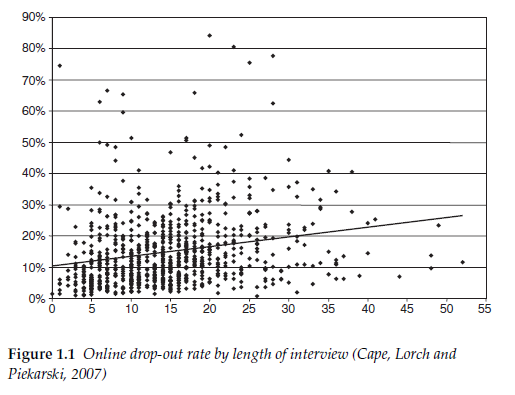
With interviewer-administered surveys respondents will often continue to the end, encouraged and cajoled by the interviewer for whom only a completed interview counts. Online, respondents who are bored or fatigued simply log off, even if they lose the financial or other incentives to complete the questionnaire. Figure 1.1, taken from Cape, Lorch and Piekarski (2007), shows how drop out is a function of length of questionnaire, as respondents become bored and fatigued. It can be seen that in a large number of projects more than 20 per cent drop out. With an interviewer-administered interview, many of these would have continued reluctantly to the end, providing potentially unreliable data.
Figure 1.1 also demonstrates that length of the questionnaire is not the only factor in the decision to drop out. Cape, Lorch and Piekarski attribute this largely to the quality of the questionnaire design. This shows that with poor questionnaire design, fatigue is likely to set in earlier and results become unreliable sooner in the interview. The importance of good questionnaire design in gaining good quality data is demonstrated.
6. Mistakes made by the interviewer because of boredom and fatigue
A long and tedious interview affects not only the respondent but also the interviewer. Like everybody else, interviewers make mistakes. Whether the interview is on the telephone or face to face, responses can be misheard, or a wrong code recorded. And these errors become more frequent if the interviewer is tired of or bored with the interview. An interview that is tedious for the respondent is also tedious for the interviewer. This can be made worse for the interviewer by the embarrassment felt in being responsible for boring the respondent. The interviewer responds by reading the questions more quickly, leading to an increase in the number of errors of misunderstanding as well as recording errors on the part of the interviewer.
This, however, is not a problem confined to techniques using interviewers. With self-completion surveys, where there is no interviewer, a long and tedious questionnaire simply results in respondents failing to finish the interview. This means that the response rate falls and the sample of completed interviews is less representative of the population than it could have been.
7. Desire by the respondent to answer a different question to the one asked
Sometimes respondents will ‘interpret’ the question in a way that fits their circumstances. When asked how often they go to the cinema, respondents who see films at a club may choose to include those occasions in their response because that is the closest they come to going to a cinema. If the interviewer is made aware of this, then a note can be made and a decision taken later by the analyst as to whether to include this or not. However, often the interviewer will not be told, and, with most computer-aided systems, including Web-based surveys, there is no mechanism provided for respondents to alert the researcher to their interpretation of the question.
8. Inaccuracy of memory regarding behaviour
Memory is notoriously unreliable regarding past behaviour. It is invariably more accurate for respondents to record their behaviour as it happens, using a diary or similar technique. However, the cost or feasibility of that type of approach often rules it out, and the behavioural data that are collected in most studies are behaviour as reported by memory.
The accuracy of recall will depend on many factors, including the recency, size and significance to the individual of the behaviour in question. Most people will be able to name the bank they use, but will be less reliable about which brand of tinned sardines they last bought. Frequently what is reported is an impression of behaviour, the respondents’ beliefs about what they do, rather than an accurate recording of what they have done. Tourangeau, Rips and Rasinski (2000) list the following reasons for memory failure by respondents to surveys:
There are several major sources of memory failure:
- Respondents may not have taken in the critical information in the first place;
- They may be unwilling to go through the work of retrieving it;
- Even if they do try, they may be unable to retrieve the event itself, but only generic information about events of that type;
- They may retrieve only partial information about the event and, as a result, fail to report it; or
- They may recall erroneous information about the event, including incorrect inferences incorporated into the representation of the event.
Researchers are generally aware that recall information can be unreliable. However, what is sometimes overlooked is the bias introduced into the responses by the third of the sources of memory failure listed above. When respondents generalize about types of events they will tend to report not only what they believe that they do, but also what they believe that they do most of the time. Even if what they say is accurate, minority behaviour will tend to be unreported.
9. Inaccuracy of memory regarding time periods (telescoping)
Particularly notorious is the accuracy of memory related to time. Respondents will tend to report that an event occurred more recently than it actually did. Researchers and psychologists have long been aware of this phenomenon. The first important theory of telescoping was proposed by Sudman and Bradburn (1973). They wrote: ‘There are two kinds of memory error that sometimes operate in opposite directions. The first is forgetting an episode entirely… The second kind of error is compression (telescoping) where the event is remembered as occurring more recently than it did.’
Thus, asked to recall events that occurred in the last three months, respondents will tend to include events that occurred in what feels like the last three months but is usually a longer period. Additional events are therefore ‘imported’ into that period and mistakenly reported (forward telescoping). In contrast, other events are forgotten or thought to have occurred longer ago than they really did (backward telescoping) and are therefore not reported. The extent to which telescoping occurs will depend on the importance of the event to the respondent and the time period asked about.
A technique suggested to help respondents (Tourangeau, Rips and Rasinski, 2000) in interviewer-administered surveys is to extend the question beyond what is absolutely necessary in order to give the respondent more time to think before they feel obliged to provide an answer. This may be particularly the case with telephone interviewing, where silences can be awkward and the respondent may avoid them by answering before they have fully thought it through.
10. Asking respondents to describe attitudes on subjects for which they hold no conscious attitude
Researchers often ask respondents to reveal their attitudes about a range of subjects that the respondents have never before given conscious thought to. Many respondents may feel that they have an attitude
towards issues such as street crime and how to deal with it, but few will have consciously thought about the issues surrounding the role of pizza in their lives. Questionnaires frequently present respondents with a bank of attitude statements on subjects that, while of importance to the manufacturer, are very low down on the respondent’s list of burning issues. Studies have shown that the data reported are more stable over time where respondents are not given time to think about their attitudes but are asked to respond quickly to each statement (Tourangeau, Rips and Rasinski, 2000). Attitudinal questions will often include an instruction to respondents to give their first reaction and not to spend time considering each statement.
11. Respondents lying as an act of defiance
Some people see market research as a tool of ‘big business’, and some people hold negative attitudes towards multinational corporations. They are held responsible by these people for many of the world’s problems from the globalization of products and services to political instability. Confronted with a market research interview, these people may see an opportunity to disrupt and distort the information held by big business, even if only in a small way.
Consequently, these people will appear to cooperate, but will deliberately lie about their behaviour and attitudes in the expectation that somehow they will be helping to disrupt the commissioning organization’s business. Sometimes they can be spotted at the analysis stage because of inconsistencies in their responses, which have been made up as they go along, but this may not always be the case.
Such people are probably few in number, and the tendency is to ignore them in the belief that they will cancel each other out, with one pizza- eater denying that he or she eats pizza counterbalanced by a non-pizza- eater claiming to be an avid consumer. Opt-in media such as web-based panels are particularly prone to this type of activity, as they are relatively easy to target.
The questionnaire writer has much to consider. The overriding objective is to achieve the most accurate data that will satisfy the research objectives and the business objectives, by avoiding all of these reasons for inaccuracy, at the same time as meeting the needs of all the various stakeholders in the questionnaire.
Source: Brace Ian (2018), Questionnaire Design: How to Plan, Structure and Write Survey Material for Effective Market Research, Kogan Page; 4th edition.
The post Collecting unbiased and accurate data by questionnaire appeared first on HKT Consultant.
]]>The post Interviewer-administered interviews appeared first on HKT Consultant.
]]>- Queries about the meaning of a question can be dealt with.
- A misunderstood question may be corrected.
- Respondents can be encouraged to provide deeper responses to open questions.
Sometimes a question can be unintentionally ambiguous. Although this should have been spotted and corrected before the questionnaire was finalized, it is possible for such questions to slip through. If respondents cannot answer because of the ambiguity, then they are able to ask the interviewer for clarification. Interviewers, though, must be careful not to lead respondents to a particular answer when giving their clarification, and should report back to the researcher that clarification was required.
Interviewers can sometimes spot that respondents have misunderstood the question by the response that they give, which may be inconsistent with previous answers, or simply inconsistent with what the interviewer already knows (or suspects) about the respondents and their situation. Such an inconsistency can be challenged, the question repeated and the response corrected if necessary.
An interviewer administering the questionnaire thus gives an opportunity for mistakes of the questionnaire writer to be corrected, but it also gives the questionnaire writer an opportunity to probe for information on open questions. At the simplest level, a series of non-directive probes (eg ‘What else?’) can be used to extract as much information as possible from the respondent. If a bland and unhelpful answer is anticipated, the interviewer can be specifically asked to obtain further clarification. For example, the question ‘Why did you buy the item from that shop in particular?’ is likely to get the answer ‘Because it was convenient.’ An interviewer can be given an instruction not to accept an answer that only mentions convenience, and the questionnaire will supply the probe ‘What do you mean by convenient?’
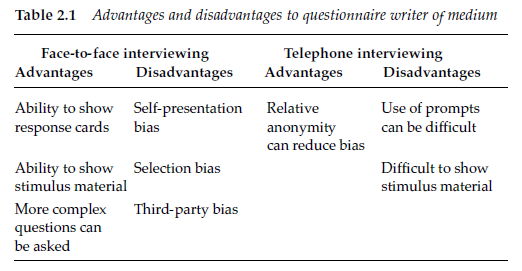
Interviewer-administered questionnaires can be used in either face-to- face interviews or in telephone interviews. Each of these has its advantages and disadvantages in questionnaire writing. The choice of which is to be used will have been strongly influenced by the overall survey design, but the appropriateness of the medium to the questions to be asked will also play a part (see Table 2.1).
1. Face-to-face
In the UK, face-to-face interviewing has been the dominant mode of data collection for many years. Although this dominance has been reduced by telephone interviewing and more recently by internet-based interviewing, the majority of market research interviewing in the UK and much of Europe is still face-to-face interviewer-administered. In the USA, face-to-face interviewing has never accounted for the same high proportion of interviews.
Many of the advantages of telephone interviewing are associated with access to respondents, survey control and speed. These do not relate to questionnaire design but can be deciding factors in the survey design.
2. Advantages of face-to-face interviewing
One clear advantage of face-to-face interviewing is the ability to show prompt cards easily to respondents. These cards can be used in questions where prompted awareness or recognition of names is required, where respondents are being asked to select their answer from a scale, or where it is desirable to prompt with a list of possible responses.
The ability to show things also means that products and ideas can be shown to respondents for their reactions. This is obviously important for evaluating any product or advertising, or where reaction is required to new ideas or concepts for products or advertising. Frequently, surveys evaluating products and concepts will be carried out in a central location. This facilitates:
- transportation of the product – particularly if it is something bulky like a washing machine;
- demonstration of the product – making sure it is cooked or served correctly;
- security of a concept or a new product that might be of significant interest to a competitor.
Where the product or concept is portable, or where the product is left with the respondent to be tried, then in-home face-to-face interviewing is often preferred.
3. Face-to-face CAPI
CAPI (computer-assisted personal interviewing) is the use of a portable computer that provides the questions and pre-codes on the screen. The computers can be either tablet computers with a touch screen for responses to be recorded by touching a ‘pen’ on to the screen, or laptop personal computers where answers are recorded by clicking the cursor on the appropriate box. Laptops may have multimedia capabilities. In central locations, desktop personal computers may be used. Personal digital assistants (PDAs) can be used in some circumstances where the number of questions is relatively small. (PDAs have also been used successfully as a self-completion medium.) Pocket PCs connected through a local WiFi network are now also used in appropriate circumstances.
Whichever type of computer is used, it can either provide the interviewer with a questionnaire and means of recording responses, or allow the respondent to participate in the interview through self-completion of part or all of the questionnaire. Either way, it brings a number of advantages for the questionnaire writer. Principal amongst these is the ability to include complex routeing between questions. Thus, the question that is asked of the respondent can be determined by a combination of answers from a number of previous questions. Such complex routeing would have resulted in a significant level of error if the interviewer had had to determine which question was to be asked.
Similarly, with CAPI, calculations can be programmed into the questionnaire, which it would not have been possible to ask the interviewer to carry out without risking a high level of error. Thus an estimate of a household’s annual consumption of a grocery product can be calculated. This would be impossible for respondents to estimate accurately. However, they may be able to make more accurate estimates of shortterm consumption for each member of the family, from which total household consumption can be calculated. In business-to-business interviewing, volumes of consumption or output can be summed either as a total or within predetermined categories, for the interviewer to read back to the respondent to check the accuracy. This information can be used both as inputs to future questions and for question routeing.
The questionnaire writer has to worry less about the layout of the questionnaire with CAPI than with paper questionnaires. Eliminating many interviewer instructions as well as providing the means of recording precoded or numerical data makes this part of the questionnaire writer’s task easier.
With pre-coded prompted questions, CAPI can randomize or rotate the order in which the response list is presented to the respondent on-screen. Some researchers prefer to use prompt lists on cards that can be handed to and easily read by the respondent. However, where the respondent is asked to read response lists from the screen, then randomization and rotation of response lists can present a significant advantage (see Chapter 7).
The combination of being able to make calculations and to randomize response lists has led to the development of some complex techniques such as adaptive conjoint analysis. With this technique, the responses to questions asked at the beginning of the sequence are used to construct scenarios shown at later questions where the respondent is asked to provide preferences between them. Even the number of scenarios asked about is determined by the respondent’s pattern of answers. Whilst this is theoretically possible with paper questionnaires (and a lot of show cards), the adaptive conjoint questionnaire is made easy to administer with the use of a computerized questionnaire.
Multimedia CAPI provides the questionnaire writer with more opportunities to present colour images, moving images and sound. Thus television or cinema advertisements can be played as stimuli either for recognition or for evaluation. When evaluating television or cinema advertisements on CAPI, care must be taken to ensure that all parties involved in implementing the findings are happy with the quality of the reproduction of the ad on the computer screen.
CAPI also presents self-completion options such as having icons or representations of brands that can be moved on the screen and placed in appropriate response boxes by the respondent.
Packs can be displayed, and supermarket shelves simulated. This creates opportunities to simulate a presentation, as it would appear in a store, with different numbers of facings for different products, as an attempt to reproduce better the actual in-store choice situation.
Three-dimensional pack simulations can be shown and rotated by respondents, whilst they are asked questions about the simulations.
Electronic questionnaires thus provide the possibility of showing improved stimuli; of offering new ways of measuring consumer response; and of making the process more interesting and involving for the respondent.
4. Disadvantages of face-to-face interviewing
The main disadvantage of face-to-face interviewing is generally the cost of obtaining a sufficiently representative sample of the survey population. However, that is an issue of survey design and does not relate directly to the interview process.
The accuracy of the data can be influenced by the interaction between interviewer and respondent. Carefully chosen and well- trained interviewers are essential if the quality of the data is to be maximized. The biases that can be introduced by the presence of the interviewer, and the inaccuracies that can be caused if the interviewers fail to ask questions and record responses as they should, have already been discussed in Chapter 1. How to minimize these is part of the skill of the questionnaire writer.
5. Telephone-administered questionnaires
5.1. Advantages of telephone interviewing
Most of the advantages enjoyed by telephone interviewing are to the benefit of the survey design rather than to the questionnaire design. Thus there are efficiencies in cost and speed, particularly where the sample is geographically dispersed, or where, as often happens in business-to-busi- ness surveys, the respondents are prepared to talk on the telephone but not to have someone visit them.
One advantage for data accuracy is that the telephone as a medium gives more anonymity to the respondents in respect of their relationship to the interviewer. This can help to diminish some of the bias that can occur as a result of respondents trying to impress or face-save in front of interviewers (see Chapter 12). It is also the experience of many researchers that respondents are more prepared to discuss sensitive subjects such as health on the telephone than face to face with an interviewer. Fuller responses are achieved to open questions, and they are more likely to be honest because the interviewer is not physically present with the respondent. Telephone interviewing thus becomes the medium of choice for interviews where there is a need for an interviewer-administered interview, coupled with a sensitive subject matter.
Computer-assisted telephone interviewing (CATI) brings many of the same advantages to this medium as CAPI does to face-to-face interviewing. These include an ability to include complex routeing and calculations within the interview, and the automatic randomization or rotation of question order and of prompt lists within questions.
5.2. Disadvantages of telephone interviewing
From the point of view of the questionnaire writer, telephone interviewing has a number of disadvantages.
First, there is limited ability to show material such as prompt lists or stimuli. However, where the list is short it can be read out by the interviewer and remembered by the respondents.
When it is straightforward for the respondents to understand, they can hold the question and answer in their head until the time comes for them to respond. It is important that the interviewer reaches the end of the options before the respondent answers, so that the complete list of possible responses is read out.
For longer lists of response options, or repeated lists such as scales, respondents can be asked to write them down.
The inability to show material such as concepts or advertising is a drawback to telephone interviewing. Radio ads or the soundtrack from television ads can be played over the telephone as a prompt for recognition. Care must be taken to distinguish responses that arise because of the quality of the recording as heard by the respondent, which can be variable, from those relating to content. Other ways must be sought, though, for visual material.
It is possible to mail material to respondents for them to look at during the interview. This creates a lengthy and more expensive process. The respondents have to be recruited and agreement obtained in an initial interview; the material then has to be sent; the main interview can then be carried out once the material has arrived.
It may be desirable for respondents not to see the material before a certain point in the interview. In that case, the initial contact would complete the interview up until that point, when respondents would be asked permission for the researcher to send them material and to call them again to complete the interview. This procedure runs the risk of a high proportion of respondents refusing the researcher permission to send the material. There will also be a proportion of respondents who will have received the material but whom it will be impossible to recontact. This has implications for over-sampling and hence cost.
With some populations, it is possible to speed up this process. In busi- ness-to-business studies, it is now common to e-mail material to respondents. This means that the gap between the first and second contacts or parts of the interview can be reduced to minutes. By reducing that period, fewer respondents are lost between the two stages. Alternatively, the material can be faxed, but the quality of reproduction is generally significantly less, and monochrome.
A possible method of showing material, particularly in business-to- business surveys, is to ask the respondent to log on to a website where the material is displayed. The respondent can log on whilst the interviewer continues to talk on the telephone, so there is no loss of continuity in the interview. This is more difficult for consumer surveys because of households that have one line for both telephone and internet connection, and cannot use both at the same time. The increase in the use of broadband, though, makes this a more viable option for consumer surveys.
Interviews started on the telephone can be continued on the internet, by asking the respondent to log on to a website that contains the remainder of the questionnaire. There is an inevitable loss of numbers, however, because control passes to the respondents, some of whom will never log on to the website and so will not complete the interview.
Source: Brace Ian (2018), Questionnaire Design: How to Plan, Structure and Write Survey Material for Effective Market Research, Kogan Page; 4th edition.
The post Interviewer-administered interviews appeared first on HKT Consultant.
]]>The post Self-completion surveys appeared first on HKT Consultant.
]]>However, self-completion studies can also suffer from there being no interviewer to identify when a respondent has misunderstood, or to ask for clarification where there are inconsistencies, or to probe for fuller answers.
From the aspect of the survey design, self-completion questionnaires are often considerably cheaper per interview to administer than interviewer-administered ones. Against that must be balanced the difficulties of achieving a representative sample when there is such a high degree of self-selection as is typical with self-completion studies, and particularly when there is a low response rate.
1. Paper questionnaires
Paper self-completion questionnaires are typically sent by mail to people who qualify or are thought to qualify as eligible for the study. They may be members of a panel who have agreed to take part in surveys, or they may be taken from a database such as customers of a company or members of an organization.
1.1. Advantages of paper questionnaires
With a paper self-completion questionnaire, respondents have time to consider their answers. They can leave the questionnaire whilst they think about an issue, or whilst they go away to check something or look up some information. With little time pressure on them, they can write lengthy and full answers to open questions if they wish to do so.
Descriptive material can be included for evaluation. Written descriptions and pictures of new concepts, products or ideas can be included, and again the respondents have the time to read and digest these before giving their responses. For photographs and drawings, as well as written material, a level of production quality can be achieved that is appropriate to the study.
1.2. Disadvantages of paper questionnaires
With a paper self-completion questionnaire, it is impossible to stop respondents from reading through all of the questions before responding. In other modes the question sequence is often carefully chosen by the questionnaire writer in order to reveal certain pieces of information at a specific point in the interview. That is impossible with this type of questionnaire.
Certain measures cannot therefore be taken. It is not possible to ask a spontaneous brand awareness question if the questionnaire includes brand names in any of the other questions. Respondents may have read through the questionnaire and will have been prompted by mentions of a brand before completing the spontaneous awareness question.
Having time to consider answers, whilst often an advantage, is not always what the questionnaire writer wants. With attitudinal and image questions, it is often the first reaction that is sought, rather than a considered response. An instruction in the question for respondents to give their first reaction cannot be enforced, nor encouraged in the way that an interviewer can, either face to face or by telephone.
Where prompt material has been sent to the respondents for their reaction, it is difficult to retrieve all of it. This can present a security concern if the material is commercially sensitive.
2. Web-based self-completion
There are several different ways of carrying out surveys using the internet. The questionnaire can either be delivered by e-mail or accessed via a web page. The main approaches are summarized by Bradley (1999) as follows:
- Open web – a website open to anyone who visits it.
- Closed web – respondents are invited to visit a website to complete a questionnaire.
- Hidden web – the questionnaire appears to a visitor only when triggered by some mechanism (eg date, visitor number, interest in a specific page). This includes pop-up surveys.
- E-mail URL embedded – a respondent is invited by e-mail to the survey site, and the e-mail contains a URL or web address on which respondents click.
- Simple e-mail – an e-mail with questions contained in it.
- E-mail attachment – the questionnaire is sent as an attachment to an email.
The last two of these, the simple e-mail and e-mail attachment, are rarely used in commercial research for a variety of practical reasons. Attachments require respondents to download the questionnaire, complete it and then return it. This requires a lot of cooperation and has been shown to lead to low response rates. Questionnaires embedded within e-mails can have their layout distorted, depending on the e-mail software with which it is opened. This can lead to the questionnaire being incomprehensible to the recipient. Both of these routes also suffer from the inability to include complex routeing.
Most practitioners now use questionnaires hosted on a website to which respondents are invited or routed in some way. This book will therefore concentrate on the web-based questionnaire.
As noted above, the invitation to the website or questionnaire can be delivered in a number of ways:
- It can be delivered by e-mail to people on a panel or to a mailing list of customers or people who might qualify for the survey.
- Pop-ups can be used to direct respondents to the questionnaire whilst they are visiting another site. (These are particularly useful where the objectives of the survey relate to the site being visited, such as evaluating the site.)
- Invitations can be posted as banner ads on other sites (eg ISP home pages).
- Respondents can be directed to the site following a recruitment interview by telephone or face to face.
There are many different ways of capturing a sample online. There are also many issues regarding how representative such samples are of a population that contains people other than those with internet access. These issues are outside the scope of this book and are well covered elsewhere.
2.1. Advantages of web-based self-completion
Web-based questionnaires have the same strength as paper self-completion questionnaires in that, in theory at least, respondents can complete the questionnaire in their own time, going away from it if they are interrupted, and returning to it later. In practice, there is little evidence that respondents leave a questionnaire whilst they think about it and return later.
In terms of data collection, the major differences between online surveys and other forms of data collection are the same as between postal selfcompletion and interviewer-administered surveys. Any advantages are those that come from being technology driven (Ilieva, Baron and Healey, 2002).
Some of the differences between online and other forms of data collection are given by Taylor (2000) as:
- It is a visual medium, allowing images, messages and longer lists of response options. (One survey of motorists has a list of more than 90 different car makes and models for respondents to code their vehicle against. This level of detail would be difficult in any other medium.)
- It captures the unedited voice of the consumer, so that open-ended responses can be richer, longer and more revealing.
- It may be more effective in addressing sensitive issues (medical issues, in particular, may be more easily discussed).
- Scales may elicit different response patterns – it has been the experience both of Taylor and of other researchers that the extremes of scales are used less often.
- More ‘Don’t knows’ may be generated, which is likely to be a function of the ‘Don’t know’ code appearing as a response option.
In addition to online surveys being more effective with sensitive issues, evidence from Kellner (2004) and Basi (1999) supports the view that because there is no interviewer there is less social desirability bias and the respondents answer more honestly (see Chapter 12). This means that data on ‘threatening’ questions, where respondents feel a need to appear to be socially acceptable, are likely to represent better how the survey population really feels.
The distribution of usage of the points on rating scales has been shown to be different, with less use of the extreme points than is found with face- to-face or telephone interviewing. However, Cobanoglu, Warde and Moreo (2001) have shown that mean scores for data collected via a web- based questionnaire are the same as for other self-completion methods, postal and fax surveys. This supports the view that using a web-based questionnaire should be seen as an alternative method of administering a self-completion survey.
Most studies of how people respond to web-based questionnaires have found that they are completed more quickly than their equivalent telephone or face-to-face administered versions. Being quicker can help to make it a more pleasurable experience for respondents.
The presentation of the questionnaire can also help to make its completion pleasurable. With a little flair and imagination, web questionnaires can be designed to have visual appeal, an equivalent level of which is often too costly to achieve with paper questionnaires. In addition to the page design, techniques such as showing icons to represent each brand can be used for respondents to move around the screen and drop into the appropriate response box. By involving the respondents more, the interview is more likely to keep their attention and continue to provide good- quality data through to the end of the questionnaire.
Demonstration of material can also be achieved with a web-based survey in many of the same ways as with CAPI surveys. Television advertisements can be shown, although the quality with which they are seen will depend on the specification of the equipment that the respondent is using to view it. High-quality representation of still images can be achieved, so that pack designs can be shown either for new or for existing products. There is software available that allows the respondent to rotate the pack representation in three dimensions and even to change elements of it such as colour or text. This kind of technique allows much more interaction in the interview, again involving the respondents and maintaining their interest.
A disadvantage of paper self-completion questionnaires is that the respondents can look ahead. With web-based questionnaires the questions are presented in the sequence that the researcher wants them to be. Generally, web-based questionnaires will allow respondents to go back over questions already answered in order either to check or to change previous answers. However, it is unlikely that respondents will go completely through the interview and then go back to the beginning and change all of their answers.
As with other electronic questionnaires, CATI and CAPI, the web- based questionnaire can change the order of questions between respondents; rotate or randomize response lists; customize response lists against previous answers; cope with complex routeing; and carry out calculations within the interview.
2.2. Disadvantages of web-based self-completion
As with all self-completion media, a major disadvantage is not having an interviewer on hand to clarify questions or to repair misunderstandings.
It might be thought that an issue with web-based questionnaires would be the difficulty of recording open-ended verbatim responses. Most respondents are not accomplished typists, and it might be expected that questions that require responses to be typed in verbatim would be poorly completed, and be at best completed perfunctorily and in abbreviated fashion. However, experience has shown that, whilst this is undoubtedly an issue with some respondents, the overall level of detail to which this type of question is completed is high. The ability of respondents to take their time and think about their answer appears to more than cancel out any typing difficulties, and responses are generally as complete as for interviewer-administered questionnaires.
Web-based surveys have other disadvantages compared to face-to-face surveys, such as the inability to touch or smell stimuli, but these tend to be issues of survey design rather than questionnaire design.
Source: Brace Ian (2018), Questionnaire Design: How to Plan, Structure and Write Survey Material for Effective Market Research, Kogan Page; 4th edition.
The post Self-completion surveys appeared first on HKT Consultant.
]]>The post Introduction appeared first on HKT Consultant.
]]>From the research objectives and, if possible, the business objectives as well, it should be clear what data need to be collected, in outline if not in detail. Once the researcher knows the definition of the research universe, the data collection medium and the survey design, the questions themselves can be drafted. The steps in planning are:
- Define the principal information that is required.
- Determine the secondary information that is required for analysis purposes.
- Map the flow of the subject areas or sub-sections within the questionnaire.
The questionnaire writer should ask the questions that are relevant to the objectives and not be tempted to ask questions of areas that might be of interest but not relevant to the objectives. To do so is to waste resources in terms of the time of everyone involved, including the respondents, and to spend money unnecessarily.
Source: Brace Ian (2018), Questionnaire Design: How to Plan, Structure and Write Survey Material for Effective Market Research, Kogan Page; 4th edition.
The post Introduction appeared first on HKT Consultant.
]]>The post Defining the information required in the questionnaire appeared first on HKT Consultant.
]]>Other information required
It may not always be obvious from the research objectives what additional information is required for analysis purposes. This may include demographic or classification data, but could be far broader. In an attitu- dinal study, for example, it could include brand and product usage and brand loyalty so that attitudes can be cross-analysed by products used and weight of usage. It is important that the ways in which the data are to be analysed is thought about at the planning stage. If the appropriate data are not collected, the analysis cannot be carried out.
Source: Brace Ian (2018), Questionnaire Design: How to Plan, Structure and Write Survey Material for Effective Market Research, Kogan Page; 4th edition.
The post Defining the information required in the questionnaire appeared first on HKT Consultant.
]]>