The post Research methodology: a step-by-step guide for beginners appeared first on HKT Consultant.
]]>Main contentsSee more from basic to advanced


The post Research methodology: a step-by-step guide for beginners appeared first on HKT Consultant.
]]>The post Research: an integral part of your practice appeared first on HKT Consultant.
]]>Suppose you are working in the field of health. You may be a front-line service provider, supervisor or health administrator/planner. You may be in a hospital or working as an outreach community health worker. You may be a nurse, doctor, occupational therapist, physiotherapist, social worker or other paramedic. In any of these positions, some of the following questions may come to your mind or someone else may ask you for their answers:
- How many patients do I see every day?
- What are some of the most common conditions prevalent among my patients?
- What are the causes of these conditions?
- Why do some people have a particular condition whereas others do not?
- What are the health needs of the community?
- What are the benefits of this programme to the community?
- How do I demonstrate the effectiveness of my service?
- Why do some people use the service while others do not?
- What do people think about the service?
- How satisfied are patients with the service?
- How effective is the service?
- How can the service be improved?
You can add many other questions to this list. At times it may be possible to ignore these questions because of the level at which you work, at other times you may make an effort to find answers on your own initiative, or, sometimes, you may be required to obtain answers for effective administration and planning.
Let us take another discipline: business studies. Assume you work in the area of marketing. Again, you can work at different levels: as a salesperson, sales manager or sales promotion executive. The list of questions that may come to your mind can be endless. The types of questions and the need to find answers to them will vary with the level at which you work in the organisation. You may just want to find out the monthly fluctuation in the sales of a particular product, or you may be asked to develop an R&D strategic plan to compete for a greater share of the market for the products produced by your company. The list of questions that may come to mind could be endless. For example:
- What is the best strategy to promote the sale of a particular product?
- How many salespersons do I need?
- What is the effect of a particular advertising campaign on the sale of this product?
- How satisfied are the consumers with this product?
- How much are consumers prepared to spend on this product?
- What do consumers like or dislike about this product?
- What type of packaging do consumers prefer for this product?
- What training do the salespersons need to promote the sale of this product?
- What are the attributes of a good salesperson?
To take a different example, let us assume that you work as a psychologist, counsellor or social worker. While engaging in the helping process you may ask yourself (or someone else may ask you) the following questions:
- What are my clients’ most common presenting problems?
- What are their most common underlying problems?
- What is the socioeconomic background of my clients?
- Why am I successful in certain cases and not in others?
- What resources are available in the community to help a client with a particular need?
- What intervention strategies are appropriate for this problem?
- How satisfied are my clients with my services?
As a supervisor, administrator or manager of an agency, again different questions relating to effectiveness and efficiency of a service may come to your mind. For example:
- How many people are coming to my agency?
- What are the socioeconomic-demographic characteristics of my clients?
- How many cases in a day can a worker effectively handle?
- Why do some people use the service while others do not?
- How effective is the service?
- What are the most common needs of clients who come to this agency?
- What are the strengths and weaknesses of the service?
- How satisfied are the clients with the service?
- How can I improve this service for my clients?
As a professional you might be interested in finding answers to theoretical questions, such as:
- Which is the most effective intervention for a particular problem?
- What causes X or what are the effects of Y?
- What is the relationship between two phenomena?
- How do I measure the self-esteem of my clients?
- How do I ascertain the validity of my questionnaire?
- What is the pattern of programme adoption in the community?
- Which is the best way of finding out community attitudes towards an issue?
- Which is the best way to find out the effectiveness of a particular treatment?
- How can I select an unbiased sample?
- What is the best way to find out about the level of marriage satisfaction among my clients?
In this age of consumerism you cannot afford to ignore the consumers of a service. Consumers have the right to ask questions about the quality and effectiveness of the service they are receiving and you, as the service provider, have an obligation to answer their questions. Some of the questions that a consumer may ask are:
- How effective is the service that I am receiving?
- am I getting value for money?
- How well trained are the service providers?
Most professions that are in the human service industry would lend themselves to the questions raised above and you as a service provider should be well prepared to answer them. Research is one of the ways to help you answer such questions objectively.
Source: Kumar Ranjit (2012), Research methodology: a step-by-step guide for beginners, SAGE Publications Ltd; Third edition.
The post Research: an integral part of your practice appeared first on HKT Consultant.
]]>The post Research: a way to gather evidence for your practice appeared first on HKT Consultant.
]]>The concept of EBP encourages professionals and other decision-makers to use evidence regarding the effectiveness of an intervention in conjunction with the characteristics and circumstance of a client and their own professional judgement to determine the appropriateness of an intervention when providing a service to a client. In this age of accountability, you as a professional must be accountable to your clients as well as your profession. It is as a part of this accountability that you need to demonstrate the effectiveness of the service(s) you provide.
Research is one of the ways of collecting accurate, sound and reliable information about the effectiveness of your interventions, thereby providing you with evidence of its effectiveness. As service providers and professionals, we use techniques and procedures developed by research methodologists to consolidate, improve, develop, refine and advance clinical aspects of our practice to serve our clients better.
Source: Kumar Ranjit (2012), Research methodology: a step-by-step guide for beginners, SAGE Publications Ltd; Third edition.
The post Research: a way to gather evidence for your practice appeared first on HKT Consultant.
]]>The post Applications of research appeared first on HKT Consultant.
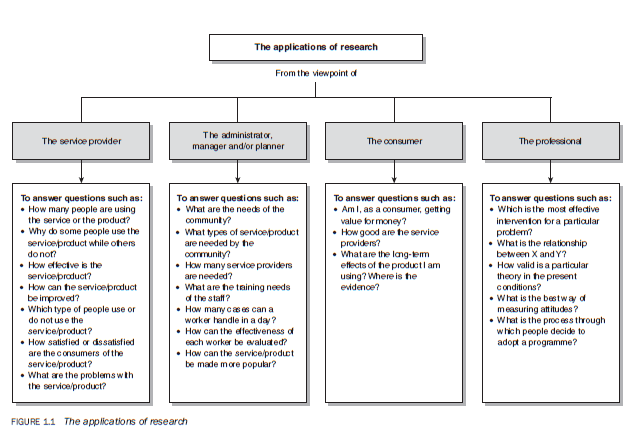
]]>Within any profession, where you directly or indirectly provide a service, such as health (nursing, occupational therapy, physiotherapy, community health, health promotion and public health), education, psychology or social work, the application of research can be viewed from four different perspectives:
- the service provider;
- the service administrator, manager and/or planner;
- the service consumer; and
- the professional.
These perspectives are summarised in Figure 1.1. Though it is impossible to list all the issues in every discipline, this framework can be applied to most disciplines and situations in the humanities and the social sciences. You should be able to use this to identify, from the viewpoint of the above perspectives, the possible issues in your own academic field where research techniques can be used to find answers.
Source: Kumar Ranjit (2012), Research methodology: a step-by-step guide for beginners, SAGE Publications Ltd; Third edition.
The post Applications of research appeared first on HKT Consultant.
]]>The post Research: what does it mean? appeared first on HKT Consultant.
]]>- is being undertaken within a framework of a set of philosophies;
- uses procedures, methods and techniques that have been tested for their validity and reliability;
- is designed to be unbiased and objective.
Your philosophical orientation may stem from one of the several paradigms and approaches in research — positivist, interpretive, phenomenology, action or participatory, feminist, qualitative, quantitative — and the academic discipline in which you have been trained. The concept of ‘validity’ can be applied to any aspect of the research process. It ensures that in a research study correct procedures have been applied to find answers to a question. ‘Reliability’ refers to the quality of a measurement procedure that provides repeatability and accuracy. ‘Unbiased and objective’ means that you have taken each step in an unbiased manner and drawn each conclusion to the best of your ability and without introducing your own vested interest. The author makes a distinction between bias and subjectivity. Subjectivity is an integral part of your way of thinking that is ‘conditioned’ by your educational background, discipline, philosophy, experience and skills. For example, a psychologist may look at a piece of information differently from the way in which an anthropologist or a historian looks at it. Bias, on the other hand, is a deliberate attempt to either conceal or highlight something. Adherence to the three criteria mentioned above enables the process to be called ‘research’. Therefore, when you say you are undertaking a research study to find the answer to a question, this implies that the method(s) you are adopting fulfils these expectations (discussed later in the chapter).
However, the degree to which these criteria are expected to be fulfilled varies from discipline to discipline and so the meaning of ‘research’ differs from one academic discipline to another. For example, the expectations of the research process are markedly different between the physical and the social sciences. In the physical sciences a research endeavour is expected to be strictly controlled at each step, whereas in the social sciences rigid control cannot be enforced and sometimes is not even demanded.
Within the social sciences the level of control required also varies markedly from one discipline to another, as social scientists differ over the need for the research process to meet the above expectations. Despite these differences among disciplines, their broad approach to enquiry is similar. The research model, the basis of this book, is based upon this broad approach.
As beginners in research you should understand that research is not all technical, complex, statistics and computers. It can be a very simple activity designed to provide answers to very simple questions relating to day-to-day activities. On the other hand, research procedures can also be employed to formulate intricate theories or laws that govern our lives. The difference between research and non-research activity is, as mentioned, in the way we find answers to our research questions. For a process to be called research, it is important that it meets certain requirements and possesses certain characteristics. To identify these requirements and characteristics let us examine some definitions of research:
The word research is composed of two syllables, re and search.The dictionary defines the former as a prefix meaning again, anew or over again and the latter as a verb meaning to examine closely and carefully, to test and try, or to probe. Together they form a noun describing a careful, systematic, patient study and investigation in some field of knowledge, undertaken to establish facts or principles. (Grinnell 1993: 4)
Grinnell further adds: ‘research is a structured inquiry that utilises acceptable scientific methodology to solve problems and creates new knowledge that is generally applicable.’ (1993: 4) Lundberg (1942) draws a parallel between the social research process, which is considered scientific, and the process that we use in our daily lives. According to him:
Scientific methods consist of systematic observation, classification and interpretation of data. Now, obviously, this process is one in which nearly all people engage in the course of their daily lives. The main difference between our day-to-day generalisations and the conclusions usually recognised as scientific method lies in the degree of formality, rigorousness, verifiability and general validity of the latter. (Lundberg 1942: 5)
Burns (1997: 2) defines research as ‘a systematic investigation to find answers to a problem’.
According to Kerlinger (1986: 10), ‘scientific research is a systematic, controlled empirical and critical investigation of propositions about the presumed relationships about various phenomena’. Bulmer (1977: 5) states: ‘Nevertheless sociological research, as research, is primarily committed to establishing systematic, reliable and valid knowledge about the social world.’
Source: Kumar Ranjit (2012), Research methodology: a step-by-step guide for beginners, SAGE Publications Ltd; Third edition.
The post Research: what does it mean? appeared first on HKT Consultant.
]]>The post The research process: characteristics and requirements appeared first on HKT Consultant.
]]>Let us briefly examine these characteristics to understand what they mean:
- Controlled – In real life there are many factors that affect an outcome. A particular event is seldom the result of a one-to-one relationship. some relationships are more complex than others. Most outcomes are a sequel to the interplay of a multiplicity of relationships and interacting factors. In a study of cause-and-effect relationships it is important to be able to link the effect(s) with the cause(s) and vice versa. In the study of causation, the establishment of this linkage is essential; however, in practice, particularly in the social sciences, it is extremely difficult – and often impossible – to make the link.
The concept of control implies that, in exploring causality in relation to two variables, you set up your study in a way that minimises the effects of other factors affecting the relationship. This can be achieved to a large extent in the physical sciences, as most of the research is done in a laboratory. However, in the social sciences it is extremely difficult as research is carried out on issues relating to human beings living in society, where such controls are impossible. Therefore, in the social sciences, as you cannot control external factors, you attempt to quantify their impact.
- Rigorous – You must be scrupulous in ensuring that the procedures followed to find answers to questions are relevant, appropriate and justified. Again, the degree of rigour varies markedly between the physical and the social sciences and within the social sciences.
- Systematic – This implies that the procedures adopted to undertake an investigation follow a certain logical sequence. The different steps cannot be taken in a haphazard way. Some procedures must follow others.
- Valid and verifiable – This concept implies that whatever you conclude on the basis of your findings is correct and can be verified by you and others.
- Empirical – This means that any conclusions drawn are based upon hard evidence gathered from information collected from real-life experiences or observations.
- Critical – Critical scrutiny of the procedures used and the methods employed is crucial to a research enquiry. the process of investigation must be foolproof and free from any drawbacks. the process adopted and the procedures used must be able to withstand critical scrutiny.
For a process to be called research, it is imperative that it has the above characteristics.

Source: Kumar Ranjit (2012), Research methodology: a step-by-step guide for beginners, SAGE Publications Ltd; Third edition.
The post The research process: characteristics and requirements appeared first on HKT Consultant.
]]>The post Types of research appeared first on HKT Consultant.
]]>- applications of the findings of the research study;
- objectives of the study;
- mode of enquiry used in conducting the study.
The classification of the types of a study on the basis of these perspectives is not mutually exclusive: that is, a research study classified from the viewpoint of ‘application’ can also be classified from the perspectives of ‘objectives’ and ‘enquiry mode’ employed. For example, a research project may be classified as pure or applied research (from the perspective of application), as descriptive, correlational, explanatory or exploratory (from the perspective of objectives) and as qualitative or quantitative (from the perspective of the enquiry mode employed).
1. Types of research: application perspective
If you examine a research endeavour from the perspective of its application, there are two broad categories: pure research and applied research. In the social sciences, according to Bailey (1978: 17):
Pure research involves developing and testing theories and hypotheses that are intellectually challenging to the researcher but may or may not have practical application at the present time or in the future. Thus such work often involves the testing of hypotheses containing very abstract and specialised concepts.
Pure research is also concerned with the development, examination, verification and refinement of research methods, procedures, techniques and tools that form the body of research methodology. Examples of pure research include developing a sampling technique that can be applied to a particular situation; developing a methodology to assess the validity of a procedure; developing an instrument, say, to measure the stress level in people; and finding the best way of measuring people’s attitudes. The knowledge produced through pure research is sought in order to add to the existing body of knowledge of research methods.
Most of the research in the social sciences is applied. In other words, the research techniques, procedures and methods that form the body of research methodology are applied to the collection of information about various aspects of a situation, issue, problem or phenomenon so that the information gathered can be used in other ways — such as for policy formulation, administration and the enhancement of understanding of a phenomenon.
2. Types of research: objectives perspective
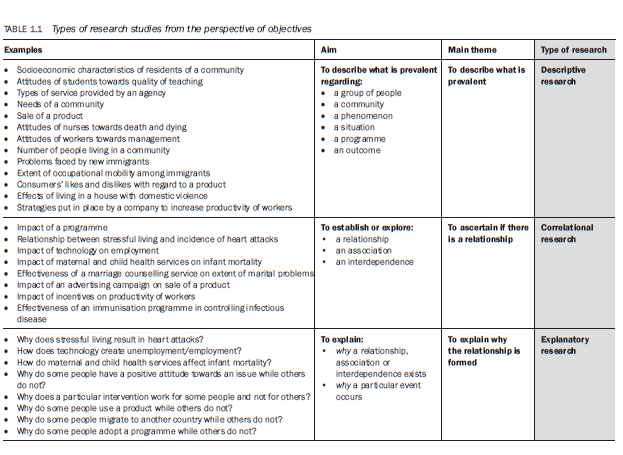
If you examine a research study from the perspective of its objectives, broadly a research endeavour can be classified as descriptive, correlational, explanatory or exploratory.
A research study classified as a descriptive study attempts to describe systematically a situation, problem, phenomenon, service or programme, or provides information about, say, the living conditions of a community, or describes attitudes towards an issue. For example, it may attempt to describe the types of service provided by an organisation, the administrative structure of an organisation, the living conditions of Aboriginal people in the outback, the needs of a community, what it means to go through a divorce, how a child feels living in a house with domestic violence, or the attitudes of employees towards management. The main purpose of such studies is to describe what is prevalent with respect to the issue/ problem under study.
The main emphasis in a correlational study is to discover or establish the existence of a relationship/association/interdependence between two or more aspects of a situation. What is the impact of an advertising campaign on the sale of a product? What is the relationship between stressful living and the incidence of heart attack? What is the relationship between fertility and mortality? What is the relationship between technology and unemployment? What is the effect of a health service on the control of a disease, or the home environment on educational achievement? These studies examine whether there is a relationship between two or more aspects of a situation or phenomenon and, therefore, are called correlational studies.
Explanatory research attempts to clarify why and how there is a relationship between two aspects of a situation or phenomenon. This type of research attempts to explain, for example, why stressful living results in heart attacks; why a decline in mortality is followed by a fertility decline; or how the home environment affects children’s level of academic achievement.
The fourth type of research, from the viewpoint of the objectives of a study, is called exploratory research. This is when a study is undertaken with the objective either to explore an area where little is known or to investigate the possibilities of undertaking a particular research study. When a study is carried out to determine its feasibility it is also called a feasibility study or a pilot study. It is usually carried out when a researcher wants to explore areas about which s/he has little or no knowledge. A small-scale study is undertaken to decide if it is worth carrying out a detailed investigation. On the basis of the assessment made during the exploratory study, a full study may eventuate. Exploratory studies are also conducted to develop, refine and/or test measurement tools and procedures. Table 1.1 shows the types of research study from the viewpoint of objectives.
Although, theoretically, a research study can be classified in one of the above objectives— perspective categories, in practice, most studies are a combination of the first three; that is, they contain elements of descriptive, correlational and explanatory research. In this book the guidelines suggested for writing a research report encourage you to integrate these aspects.
3. Types of research: mode of enquiry perspective
The third perspective in our typology of research concerns the process you adopt to find answers to your research questions. Broadly, there are two approaches to enquiry:
- the structured approach;
- the unstructured
In the structured approach everything that forms the research process — objectives, design, sample, and the questions that you plan to ask of respondents — is predetermined. The unstructured approach, by contrast, allows flexibility in all these aspects of the process. The structured approach is more appropriate to determine the extent of a problem, issue or phenomenon, whereas the unstructured approach is predominantly used to explore its nature, in other words, variation/diversity per se in a phenomenon, issue, problem or attitude towards an issue. For example, if you want to research the different perspectives of an issue, the problems experienced by people living in a community or the different views people hold towards an issue, then these are better explored using unstructured enquiries. On the other hand, to find out how many people have a particular perspective, how many people have a particular problem, or how many people hold a particular view, you need to have a structured approach to enquiry. Before undertaking a structured enquiry, in the author’s opinion, an unstructured enquiry must be undertaken to ascertain the diversity in a phenomenon which can then be quantified through the structured enquiry. Both approaches have their place in research. Both have their strengths and weaknesses. Therefore, you should not ‘lock’ yourself solely into a structured or unstructured approach.
The structured approach to enquiry is usually classified as quantitative research and unstructured as qualitative research. Other distinctions between quantitative and qualitative research are outlined in Table 2.1 in Chapter 2. The choice between quantitative and qualitative approaches (or structured or unstructured) should depend upon:
- Aim of your enquiry – exploration, confirmation or quantification.
- Use of the findings – policy formulation or process understanding.
The distinction between quantitative and qualitative research, in addition to the structured/ unstructured process of enquiry, is also dependent upon some other considerations which are briefly presented in Table 2.1.
A study is classified as qualitative if the purpose of the study is primarily to describe a situation, phenomenon, problem or event; if the information is gathered through the use of variables measured on nominal or ordinal scales (qualitative measurement scales); and if the analysis is done to establish the variation in the situation, phenomenon or problem without quantifying it. The description of an observed situation, the historical enumeration of events, an account of the different opinions people have about an issue, and a description of the living conditions of a community are examples of qualitative research.
On the other hand, the study is classified as quantitative if you want to quantify the variation in a phenomenon, situation, problem or issue; if information is gathered using predominantly quantitative variables; and if the analysis is geared to ascertain the magnitude of the variation. Examples of quantitative aspects of a research study are: How many people have a particular problem? How many people hold a particular attitude?
The use of statistics is not an integral part of a quantitative study. The main function of statistics is to act as a test to confirm or contradict the conclusions that you have drawn on the basis of your understanding of analysed data. Statistics, among other things, help you to quantify the magnitude of an association or relationship, provide an indication of the confidence you can place in your findings and help you to isolate the effect of different variables.
It is strongly recommended that you do not ‘lock yourself’ into becoming either solely a quantitative or solely a qualitative researcher. It is true that there are disciplines that lend themselves predominantly either to qualitative or to quantitative research. For example, such disciplines as anthropology, history and sociology are more inclined towards qualitative research, whereas psychology, epidemiology, education, economics, public health and marketing are more inclined towards quantitative research. However, this does not mean that an economist or a psychologist never uses the qualitative approach, or that an anthropologist never uses quantitative information. There is increasing recognition by most disciplines in the social sciences that both types of research are important for a good research study. The research problem itself should determine whether the study is carried out using quantitative or qualitative methodologies.
As both qualitative and quantitative approaches have their strengths and weaknesses, and advantages and disadvantages, ‘neither one is markedly superior to the other in all respects’ (Ackroyd & Hughes 1992: 30). The measurement and analysis of the variables about which information is obtained in a research study are dependent upon the purpose of the study. In many studies you need to combine both qualitative and quantitative approaches. For example, suppose you want to find out the types of service available to victims of domestic violence in a city and the extent of their utilisation. Types of service is the qualitative aspect of the study as finding out about them entails description of the services. The extent of utilisation of the services is the quantitative aspect as it involves estimating the number of people who use the services and calculating other indicators that reflect the extent of utilisation.
Source: Kumar Ranjit (2012), Research methodology: a step-by-step guide for beginners, SAGE Publications Ltd; Third edition.
The post Types of research appeared first on HKT Consultant.
]]>The post Paradigms of research appeared first on HKT Consultant.
]]>A positivist paradigm lends itself to both quantitative and qualitative research. However, the author makes a distinction between qualitative data on the one hand and qualitative research on the other as the first is confined to the measurement of variables and the second to a use of methodology.
The author believes that no matter what paradigm the researcher works within, s/he should adhere to certain values regarding the control of bias, and the maintenance of objectivity in terms of both the research process itself and the conclusions drawn. It is the application of these values to the process of information gathering, analysis and interpretation that enables it to be called a research process.
Source: Kumar Ranjit (2012), Research methodology: a step-by-step guide for beginners, SAGE Publications Ltd; Third edition.
The post Paradigms of research appeared first on HKT Consultant.
]]>The post The research process: an eight-step model appeared first on HKT Consultant.
]]>Suppose you want to go out for a drive. Before you start, you must decide where you want to go and then which route to take. If you know the route, you do not need to consult a street directory, but, if you do not know the route, then you need to use one. Your problem is compounded if there is more than one route. You need to decide which one to take. The research process is very similar to undertaking a journey. As with your drive, for a research journey there are also two important decisions to make. The first is to decide what you want to find out about or, in other words, what research questions you want to find answers to. Having decided upon your research questions or research problems, you then need to decide how to go about finding their answers. The path to finding answers to your research questions constitutes research methodology. Just as there are posts along the way as you travel to your destination, so there are practical steps through which you must pass in your research journey in order to find the answers to your research questions (Figure 2.1). The sequence of these steps is not fixed and with experience you can change it. At each operational step in the research process you are required to choose from a multiplicity of methods, procedures and models of research methodology which will help you best achieve your research objectives. This is where your knowledge base of research methodology plays a crucial role.
The aim of this article is to provide you with knowledge that will enable you to select the most appropriate methods and procedures. The strength of this book lies in anchoring the theoretical knowledge of the steps that you need to go through on your research journey. At each operational step, the book aims to provide, at a beginner’s level, knowledge of methods and procedures used by both qualitative and quantitative researchers, though there is an inclination towards the quantitative way of thinking.
Quantitative and qualitative research methodologies differ both in their underpinning philosophy and, to some extent, in the methods, models and procedures used. Though the research process is broadly the same in both, quantitative and qualitative research are differentiated in terms of the methods of data collection, the procedures adopted for data processing and analysis, and the style of communication of the findings. For example, if your research problem lends itself to a qualitative mode of enquiry, you are more likely to use the unstructured interview or observation as your method of data collection. When analysing data in qualitative research, you go through the process of identifying themes and describing what you have found out during your interviews or observation rather than subjecting your data to statistical procedures. Table 2.1 summarises the differences between qualitative and quantitative research.

Since, at a number of steps of the research process, the choice of methods and procedures is influenced by the quantitative/qualitative distinction, the methods and procedures discussed in some of the chapters in this book are dealt with under separate headings for qualitative and quantitative research; however, the author has tried to keep this distinction to a minimum as the model is applicable to both. Also note that this book is for beginners, it does not cover extensively the applicability and use of each method, model and procedure. In addition, the author has elaborated more on methods, models and procedures associated with quantitative research as compared with those linked with qualitative research. For a deeper understanding of a method or procedure relating to either, you may wish to consult other books identified in the text or in the Bibliography.

Figure 2.2 shows the proposed model. The tasks identified in arrows are the operational steps you need to follow in order to conduct a study, quantitative or qualitative. Topics identified in rectangles are the required theoretical knowledge needed to carry out these steps. The tasks identified in circles are the intermediary steps that you need to complete to go from one step to another. It is important for a beginner to work through these steps in the proposed sequence, though, as already stated, with experience you do not need to follow the sequence.
In this book the theoretical knowledge required is written around each operational step and follows the same sequential progression as is needed when actually undertaking a research investigation. For each operational step, the required theoretical knowledge is further organised, in different chapters, around the operational step to which, in the author’s opinion, it is most logically related (Figure 2.3). Again, for a beginner, it is important to study this diagram to relate the theoretical knowledge to the operational steps.


The following sections of this chapter provide a quick glance at the whole process to acquaint you with the various tasks you need to undertake to carry out your study, thus giving you some idea of what the research journey involves.
Source: Kumar Ranjit (2012), Research methodology: a step-by-step guide for beginners, SAGE Publications Ltd; Third edition.
The post The research process: an eight-step model appeared first on HKT Consultant.
]]>The post Research Phase I: deciding what to research appeared first on HKT Consultant.
]]>Formulating a research problem is the first and most important step in the research process. A research problem identifies your destination: it should tell you, your research supervisor and your readers what you intend to research. The more specific and clearer you are the better, as everything that follows in the research process — study design, measurement procedures, sampling strategy, frame of analysis and the style of writing of your dissertation or report — is greatly influenced by the way in which you formulate your research problem. Hence, you should examine it thoroughly, carefully and critically. The main function of formulating a research problem is to decide what you want to find out about. Chapter 4 deals in detail with various aspects of formulating a research problem.
It is extremely important to evaluate the research problem in the light of the financial resources at your disposal, the time available, and your own and your research supervisor’s expertise and knowledge in the field of study. It is equally important to identify any gaps in your knowledge of relevant disciplines, such as statistics required for analysis. Also, ask yourself whether you have sufficient knowledge about computers and software if you plan to use them.
Source: Kumar Ranjit (2012), Research methodology: a step-by-step guide for beginners, SAGE Publications Ltd; Third edition.
The post Research Phase I: deciding what to research appeared first on HKT Consultant.
]]>