The post E-commerce Business: How to Build, Launch, and Grow a Profitable Online Store appeared first on HKT Consultant.
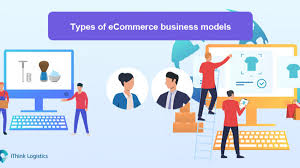
]]>There are various types of online business options that you can choose from based on your preferences, capital, and online business model. For different businesses, you have to implement various techniques and strategies. Some of the favorite online companies include: B2B businesses, B2C businesses, Affiliate marketing business, Google Adwords marketing, Online auction selling.
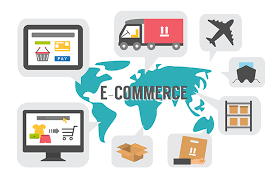
Online business works pretty much on the same principles as an offline/retail store does. On a broader scale, the whole eCommerce process can be broken down into three main components or work processes: Receiving Orders, Processing Order Information and Shipping.
The main advantage of an eCommerce business is that it allows you to conduct your business flexible and at the same time is very useful in reaching a full range of target audience within seconds. Nowadays, internet home business has also become a prevalent means of earning money in the form of eCommerce. Another significant benefit of an eCommerce business is that it helps you to identify the target audience very quickly and reach them easily too. For example, if you are trying to sell some goods or products, you can easily make market research from the internet and identify your niche market. Accordingly, you can send emails or promotional brochures to prospective customers who will be interested in your product or service. Compared to conventional promotional methods, this is pretty cost-effective as you do not have to approach the customers on an individual basis.
Main contentsSee more from basic to advanced


















The post E-commerce Business: How to Build, Launch, and Grow a Profitable Online Store appeared first on HKT Consultant.
]]>The post Introduction to e-business and e-commerce appeared first on HKT Consultant.
]]>For the author, e-business and e-commerce is an exciting area to be involved with, since many new opportunities and challenges arise yearly, monthly and even daily. Innovation is a given, with the continuous introduction of new technologies, new business models and new communications approaches. For example, Google innovates relentlessly. Its service has developed a long way since 1998 (Figure 1.1) with billions of pages now indexed and other services such as web mail, pay per click adverts, analytics and social networks all part of its offering. Complete Activity 1.1 or view Table 1.1 to see other examples of the rate at which new innovations occur.


Source: Dave Chaffey (2010), E-Business and E-Commerce Management: Strategy, Implementation and Practice, Prentice Hall (4th Edition).
The post Introduction to e-business and e-commerce appeared first on HKT Consultant.
]]>The post The impact of the electronic communications on traditional businesses appeared first on HKT Consultant.
]]>- The growth in popularity of social networks such as Bebo, Facebook (Case Study 1.1) and MySpace, virtual worlds such as Habbo Hotel and Second Life, and blogs created by many individuals and businesses;
- Rich media such as online video and interactive applications into their web sites;
- Selection of mobile commerce services which exploit the usage of mobile phones and other portable wireless devices such as laptops around the world. The potential of mobile commerce is evident from research by Wireless Intelligence (2008) which found that at the end of 2007, globally there were 3 billion subscriber connections (representing half the planet’s population) with penetration rates in developing countries such as India (21%) and China (41%) showing the potential for future growth;
- Using location-based tracking of goods and inventory as they are manufactured and transported.
You can see that an organization’s capability to manage technology-enabled change is the essence of successfully managing e-business. The pace of change and the opportunities for new communications approaches make e-business and e-commerce an exciting area of business to be involved in.
In E-Business and E-Commerce Management we will explore approaches managers can use to assess the relevance of different e-business opportunities and then devise and implement strategies to exploit these opportunities. We will also study how to manage more practical risks such as delivering a satisfactory service quality, maintaining customer privacy and managing security. We introduce some of the opportunities and risks later in this chapter.
In this chapter we start by introducing the scope of e-business and e-commerce. Then we review the the main opportunities and risks of e-business together with the drivers and barriers to adoption of e-business services. Finally, we will look at some of the organizational challenges of managing e-business using the classic McKinsey 7S strategy framework.
Source: Dave Chaffey (2010), E-Business and E-Commerce Management: Strategy, Implementation and Practice, Prentice Hall (4th Edition).
The post The impact of the electronic communications on traditional businesses appeared first on HKT Consultant.
]]>The post Real-world E-Business: HP.com appeared first on HKT Consultant.
]]>Overview and main concepts covered
Ted Speroni heads the European operations of HPcom, as well as the tech giant’s regional preferred online partner programme. This practitioner interview highlights some of the challenges and opportunities for a traditional organization in managing e-commerce. It also introduces some of the important online marketing communications techniques such as search engine marketing, affiliate marketing, social media and widget marketing which are described in Chapter 9.
The interview
- Can you briefly summarise your role at HP.com?
Ted Speroni, HP.com: I look after HP.com for the EMEA region. We have around 40 country websites throughout the region in something like 28 languages, so that’s my responsibility. I’m also responsible for all of our electronic content management across Europe, which is where we intersect with the online retail community.
At HP, we have a clear strategy of making our products available wherever our customers want to buy them – through high street shops, proximity resellers, online retailers, e-resellers and direct through HP.
We only sell direct through HPcom in five countries in Europe – the UK, France, Germany, Switzerland and Spain. So in most countries, we connect in with the leading etailers. We get daily feeds from all of them on their product availability and pricing, and we display them on HPcom. We then deep link into the shopping basket on each etailer, so we’re generating leads for them.
It’s just like an affiliate programme [a commission-based sales arrangement covered in Chapter 9], but we don’t get a commission because it’s for our own products. We track the number and quality of leads we are sending each retailer and their conversion rates. We have all the data on which products sell and which cross-sell.
It’s a pretty big programme – we have about 150 partners in Europe that are part of it and we generate quite a considerable amount of leads and traffic for them. You have to qualify to be part of it – there are certain criteria you have to meet.
- What are you doing at the moment to drive more traffic to these etailers?
Ted Speroni, HP.com: The first thing is the integrated marketing approach we have. Search engine marketing (SEM) and search engine optimisation (SEO) are probably the two biggest areas we are working on.
The fundamental principle is that we want to drive all that traffic to pages where we give the customer choice. All the marketing traffic drives people to landing pages that give people a choice about where to purchase the product.
Our investment in SEM is probably in line with the growth we see overall in the industry. We’re also making quite heavy investments internally in SEO, because a much higher percentage of our traffic comes from natural search and the conversion rate is not that dissimilar to SEM.
Natural search is a big area of focus for us at the moment. With SEM, we always get people to the right page, to specific landing pages. With natural search, we’re not as convinced we’re always getting people to the correct page.
For that, we’re analysing where the traffic is going from natural search results so that we can give the customer choice on those pages, and also looking at how to make sure people go to the pages they want to go to.
- Do you have any challenges in terms of funnelling search traffic – whether natural or paid – through your site, rather than straight to etailers? Do you allow brand bidding, for example?
Ted Speroni, HP.com: We are currently assessing what we will do in this area from both a technical perspective and from a commercial perspective as part of our co-op marketing programme with the channel. I would anticipate that we will do some limited pilots as part of this assessment.
- How difficult is it to maintain communication with partners across multiple channels?
Ted Speroni, HP.com: We’re pretty happy with the multi-channel approach we have taken. Encompassing all the different ways customers want to buy products is the most important thing.
We’ve struggled with that for a long time and we’re just trying to make each channel as efficient as possible. We still have a way to go – I’m still working on a number of projects to optimise the different channels.
One thing is the question of high street retailers and the question of integration of inventory. When a customer wants to buy a specific camera they want to know whether it is in stock today, and I don’t want the site to send them to the wrong place.
- How are you managing the syndication of your product content to your partners in the programme? How challenging is that?
Ted Speroni, HP.com: My team syndicates out [electronically distributes] all the content to our resellers. What this is all about is we want to control the HP brand in relation to our products. We produce electronic content feeds in 28 languages of all the product information – pictures, marketing messaging, specifications, everything.
Whenever a customer anywhere in Europe is seeing information about an HP product, there’s a very high probability that that will be content we have created. The picture is the picture we want people to see. We feel it’s been very successful for us – not only in terms of controlling our brand, but also in terms of cutting costs for our partners. They don’t need to do content acquisition.
We’ll either syndicate the content via XML feeds, or sometimes the resellers are buying the content through content aggregators. And this extends beyond simple product information – we also syndicate out our recommended cross-sell products. If you buy an HP printer, we have a list of recommended accessories.
This is a key thing – similar to what Dell have talked about in terms of increasing average shopping basket. Our top priority partners are partners that sell complete HP solutions, so this tool helps them sell complete HP solutions. Resellers can’t say they don’t know which products sell well with others, because we are telling them.
I should also mention another component – we’re not just syndicating content, we also syndicate a configurator for configuring PCs.
We feed all the data into the configurator about the different configurations you can build. You as a customer configure the PC and the information goes into the shopping basket of the retailer, as well as coming through to the HP factory so we can build the configuration. We then match up the order when the retailer passes the order through to us, and we ship it.
It goes beyond syndicating content – you’re syndicating widgets, real web apps that can be integrated into websites.
How else are you looking to use widgets?
Ted Speroni, HP.com: Another area is product advisors. We have product advisors on HPcom and we would like to syndicate them out. The principle behind this is that we don’t want to provide a link on retailers’ websites to HPcom, we want to keep the customers on their sites. As we move HPcom to a more modular, Web 2.0-type approach, we’ll see which components we can syndicate out. We also have flash demos so there’s an opportunity for resellers to have them on their website, although the resellers do have to have some merchandising people that know about the products. Their sites also have to be Web 2.0-enabled.
- What are you doing in terms of social media and social shopping?
Ted Speroni, HP.com: We’re starting to pilot some social tagging concepts on our product pages, so that people can easily embed our product pages into different sites, like Myspace profiles for example.
It’s at a very early stage but it’s about the whole concept of exporting our stuff onto the social networking sites, as opposed to trying to get people onto our sites. We haven’t implemented it in Europe, but in the US we have started some pilots.
For a while now, we have also had RSS links on promotions from our site – we’ve had some uptake of that, but it’s not a killer app I would say. We’re basically looking at how we can help people who want to create content around our products, and facilitate that.
There’s a lot of HP content on YouTube – lots of people make videos about how to make the new HP printer, for example. So our approach is ‘if people want to do this, let’s help them and let’s benefit from it’. If we can get user generated linkage to our products, it’s incredibly powerful.
- Have you looked at user generated reviews?
Ted Speroni, HP.com: We’re doing a pilot in the US with user generated reviews. We haven’t started that yet in Europe – I’m trying to work out a scaleable model with all the language issues.
We have to have some quality control on the user reviews – we can’t depend completely on community policing. We need some proactive moderation – since it’s on our website, we can’t take risks with legal issues and so on.
You can say our products aren’t good but you have to use appropriate language. Also, we don’t want you to be able to comment on our competitors’ products. You can say what you want about our products but you can’t push competitors’ products.
We’ve been runnning this for about six months in the US and there’s been good uptake, and we haven’t had big issues with appropriateness. In Europe, I am looking to deploy something and looking into the multi-language issues.
Source: Dave Chaffey (2010), E-Business and E-Commerce Management: Strategy, Implementation and Practice, Prentice Hall (4th Edition).
The post Real-world E-Business: HP.com appeared first on HKT Consultant.
]]>The post E-commerce defined appeared first on HKT Consultant.
]]>- A communications perspective – the delivery of information, products or services or payment by electronic means.
- A business process perspective – the application of technology towards the automation of business transactions and workflows.
- A service perspective – enabling cost cutting at the same time as increasing the speed and quality of service delivery.
- An online perspective – the buying and selling of products and information online.
The UK government also used a broad definition when explaining the scope of e-commerce to industry:
E-commerce is the exchange of information across electronic networks, at any stage in the supply chain, whether within an organization, between businesses, between businesses and consumers, or between the public and private sector, whether paid or unpaid. (Cabinet Office, 1999)
These definitions show that electronic commerce is not solely restricted to the actual buying and selling of products, but also includes pre-sale and post-sale activities across the supply chain.
E-commerce is facilitated by a range of digital technologies that enable electronic communications. These technologies include Internet communications through web sites and e-mail as well as other digital media such as wireless or mobile and media for delivering digital television such as cable and satellite. We will explain the characteristics of these technologies and some of the challenges in managing them in Chapter 3.
When evaluating the strategic impact of e-commerce on an organization, it is useful to identify opportunities for buy-side and sell-side e-commerce transactions as depicted in Figure 1.2, since systems with different functionalities will need to be created in an organization to accommodate transactions with buyers and with suppliers. Buy-side e-commerce refers to transactions to procure resources needed by an organization from its suppliers. In Chapter 6, Case Study 6.1 reviews how Shell has developed an e-business capability that enables buy-side e-commerce for its customers. Sell-side e-commerce refers to transactions involved with selling products to an organization’s customers. So e-commerce transactions between organizations can be considered from two perspectives: sell-side from the perspective of the selling organization and buy-side from the perspective of the buying organization.

Activity 1.3 . Understanding e-commerce and e-business
Purpose
To encourage discussion of what is understood by ‘e-commerce’ and ‘e-business’ and their significance to managers.
Activity
Read the extract below and then answer the questions which follow. Although this is now a dated example, it is still useful as a historic document showing the different aspects of e-business that a business must address. In one of his last AGM speeches for General Electric (Welch, 2001), Jack Welch made these comments about GE’s adoption of e-business.
Like the Amazons of the world, we started out with what we call ‘e-Sell’, primarily distributing our products on the Internet. Moving our traditional customers to the Web for much more efficient transactions has been very successful. And in 2000 we sold $8 billion in goods and services online, a number that’ll grow to $20 billion this year, making this year-old institution one of the biggest, if not the biggest, e-Business company in the world.
On what we call the ‘e-Buy’ side, we followed the same path, adopting many of the dot.com ideas on auctions, having a global network of Six Sigma suppliers. The concept of reverse auctions was right in the GE sweet spot and we wasted no time in spreading the new technology across our businesses. We now run global auctions daily-$6 billion worth last year, $12 billion this year, generating over $600 million in savings for the company in 2001.
But the biggest breakthrough of all was what we call ‘e-Make’ and that didn’t come from the dot.coms. They had little infrastructure and few processes. e-Make came from learning what the Internet could do for internal processes and seeing the enormous advantage Digitization can give a big old company that actually makes things, particularly one with Six Sigma methodology already deeply entrenched in its veins. By digitizing our processes from customer service to travel and living, we’ll take over a billion dollars of cost out of our operations this year alone.
Last year I told you I believed e-Business was neither ‘old economy’ nor ‘new economy’, but simply new technology. I’m more sure of that today. If we needed confirmation that this technology was made for us, we got it. GE was named last year ‘e-Business of the Year’ by InternetWeek magazine and awarded the same title last week by WORTH magazine.
Digitization is, in fact, a game changer for GE. And, with competition cutting back because of the economy, this is the time for GE to widen the digital gap, to further improve our competitive position. We will do that by increasing our spending on information technology by 10% to 15% this year despite the weak economy.
Note: the Six Sigma concept of process quality improvement is described in more detail at www.isixsigma.com, and reverse auctions are explored in Chapters 2 and 7.
Source: Dave Chaffey (2010), E-Business and E-Commerce Management: Strategy, Implementation and Practice, Prentice Hall (4th Edition).
The post E-commerce defined appeared first on HKT Consultant.
]]>The post E-business defined appeared first on HKT Consultant.
]]>e-business (e’biz’nis) – the transformation of key business processes through the use of Internet technologies.
Today, IBM calls the e-business services it provides for its clients ‘on-demand’ web services, as explained in Chapter 3.
You will find that the term ‘e-business’ is used in two main ways within organizations. The first is as a concept which can be applied to strategy and operations. For example, ‘our organization needs an improved e-business strategy (or e-business technology)’. Secondly, ‘e-business’ is used as an adjective to describe businesses that mainly operate online, i.e. they have no physical presence on the high streets and seek to minimize customer service and support through enabling ‘web self-service’, i.e. customers serve themselves before, during and after sales. In the dot-com era e-businesses used to be known as ‘pureplays’. Amazon (www.amazon.com) and eBay (www.ebay.com, Case Study 1.3) are the world’s two biggest e-businesses.
In an international benchmarking study analysing the adoption of e-business in SMEs the Department of Trade and Industry emphasizes the application of technology (information and communications technologies (ICTs)) in the full range of business processes, but also emphasizes how it involves innovation. DTI (2000) describes e-business as follows:
when a business has fully integrated information and communications technologies (ICTs) into its operations, potentially redesigning its business processes around ICT or completely reinventing its business model. . . e-business, is understood to be the integration of all these activities with the internal processes of a business through ICT. (DTI, 2000)
Referring back to Figure 1.2, the key business processes referred to in the IBM and DTI definitions are the organizational processes or units in the centre of the figure. They include research and development, marketing, manufacturing and inbound and outbound logistics.
The buy-side e-commerce transactions with suppliers and the sell-side e-commerce transactions with customers can also be considered to be key business processes.
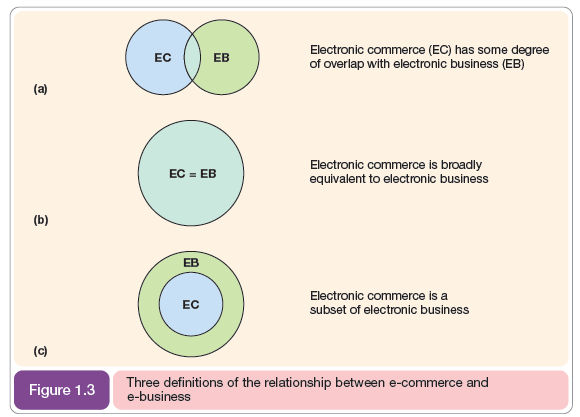
Figure 1.3 presents some alternative viewpoints of the relationship between e-business and e-commerce. In Figure 1.3(a) there is a relatively small overlap between e-commerce and e-business. From Figure 1.2 we can reject Figure 1.3(a) since the overlap between buy-side and sell-side e-commerce is significant. Figure 1.3(b) seems to be more realistic, and indeed many commentators seem to consider e-business and e-commerce to be synonymous. It can be argued, however, that Figure 1.3(c) is most realistic since e-commerce does not refer to many of the transactions within a business, such as processing a purchasing order, that are part of e-business.
So e-commerce can best be conceived of as a subset of e-business and this is the perspective we will use in this book. Since the interpretation in Figure 1.3(b) is equally valid, what is important within any given company is that managers involved with the implementation of e-commerce or e-business are agreed on the scope of what they are trying to achieve!
In Chapter 8 we go on to consider how e-marketing, a concept now used by many marketing professionals, relates to the concepts of e-business and e-commerce.
1. Intranets and extranets
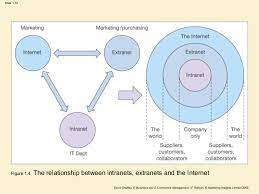
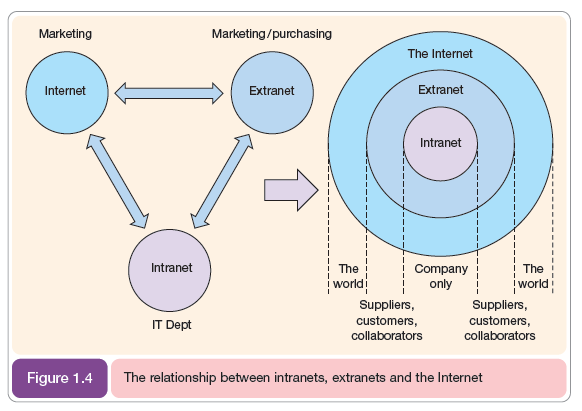
The majority of Internet services are available to any business or consumer that has access to the Internet. However, many e-business applications that access sensitive company information require access to be limited to qualified individuals or partners. If information is restricted to employees inside an organization, this is an intranet as is shown in Figure 1.4.
In a survey of 275 managers responsible for an intranet featured in CIO (2002), the main benefits mentioned by managers were:
- Improved information sharing (customer service), 97%
- Enhanced communications and information sharing (communications), 95%
- Increased consistency of information (customer service), 94%
- Increased accuracy of information (customer service), 93%
- Reduced or eliminated processing, 93%
- Easier organizational publishing, 92%.
It is apparent that benefits focus on information delivery, suggesting that management of information quality is a key to successful use of intranets. Notice that cost saving is not referred to directly in the list of benefits. Direct cost reduction can be achieved through reduced cost of printing and indirectly though reduced staff time needed to access information. However, intranets represent a substantial investment, so careful consideration of the return on investment is required. David Viney, who has managed implementation of intranets at Pricewaterhouse- Coopers, British Airways and Centrica PLC estimates that for a large implementation of more than 10,000 staff, the cost could average £250 per user or seat (Viney, 2003). He suggests this cost breaks down into four categories: software (content management systems), hardware (servers to store content and applications), integration of information sources and applications and process change (staff costs and opportunity costs associated within implementation). He also suggests that if the portal project involves integration with ERP systems, this could add £150 per seat.
If access to an organization’s web services is extended to some others, but not everyone beyond the organization, this is an extranet. Whenever you log on to an Internet service such as that for an e-retailer or online news site, this is effectively an extranet arrangement, although the term is most often used to mean a business-to-business application such as the Shell SIMON capability described in Case Study 6.1 where certain customers or suppliers are given shared access. We look at examples of intranets and extranets in Chapter 3 including the Dell Premier extranet.
2. Different types of sell-side e-commerce
Sell-side e-commerce doesn’t only involve selling products such as books and DVDs online, but also involves using Internet technologies to market services using a range of techniques we will explore in Chapters 8 and 9. Not every product is suitable for sale online, so the way in which a web site is used to market products will vary. It is useful to consider the four main types of online presence for sell-side e-commerce, which each have different objectives and are appropriate for different markets. Note that these are not clear-cut categories of web sites since any company may combine these types, but with a change in emphasis according to the market they serve. As you review web sites, note how organizations have different parts of the site focusing on these functions of sales transactions, services, relationship-building, brandbuilding and providing news and entertainment. The four main types of site are:
- Transactional e-commerce sites. These enable purchase of products online. The main business contribution of the site is through sale of these products. The sites also support the business by providing information for consumers that prefer to purchase products offline. These include retail sites, travel sites and online banking services.
- Services-oriented relationship-building web sites. Provide information to stimulate purchase and build relationships. Products are not typically available for purchase online. Information is provided through the web site and e-newsletters to inform purchase decisions. The main business contribution is through encouraging offline sales and generating enquiries or leads from potential customers. Such sites also add value to existing customers by providing them with detailed information to help support them in their lives at work or at home.
- Brand-building sites. Provide an experience to support the brand. Products are not typically available for online purchase. Their main focus is to support the brand by developing an online experience of the brand. They are typical for low-value, high-volume fast- moving consumer goods (FMCG brands) for consumers.
- Portal, publisher or media sites. Provide information, news or entertainment about a range of topics. ‘Portal’ refers to a gateway of information. This is information both on the site and through links to other sites. Portals have a diversity of options for generating revenue, including advertising, commission-based sales, sale of customer data (lists). Social networks can also be considered to be in this category since they are often advertising-supported.
3. Digital marketing
Digital marketing, e-marketing or Internet marketing is yet another field you will hear of which is closely related to e-commerce. ‘Digital marketing’ is a term increasingly used by specialist e-marketing agencies, in recruitment of specialist staff and the new media trade publications such as New Media Age (www.nma.co.uk) and Revolution (www.revolutionmagazine.com) to refer to sell-side e-commerce. We cover digital marketing in more detail in Chapters 8 and 9.
To help explain the scope and approaches used for digital marketing the IDM (www.theidm.com) has developed a more detailed explanation of digital marketing:
Digital marketing involves:
Applying these technologies which form online channels to market:
- Web, e-mail, databases, plus mobile/wireless and digital TV.
To achieve these objectives:
- Support marketing activities aimed at achieving profitable acquisition and retention of customers … within a multi-channel buying process and customer lifecycle.
Through using these marketing tactics:
- Recognising the strategic importance of digital technologies and developing a planned approach to reach and migrate customers to online services through e-communications and traditional communications. Retention is achieved through improving our customer knowledge (of their profiles, behaviour, value and loyalty drivers), then delivering integrated, targeted communications and online services that match their individual needs.
Let’s now look at each part of this description in more detail. The first part of the description illustrates the range of access platforms and communications tools that form the online channels which e-marketers use to build and develop relationships with customers including PCs, PDAs, mobile phones, interactive digital TV and radio.
Different access platforms deliver content and enable interaction through a range of different online communication tools or media channels. Some are well-established techniques which will be familiar to you, like web sites, search engines, e-mail and text messaging. One of the most exciting things about working in digital media is the introduction of new tools and techniques which have to be assessed for their relevance to a particular marketing campaign.
For example, recent innovations which we discuss further in Chapters 8 and 9 include blogs, feeds, podcasts and social networks. The growth of social networks has been documented by Boyd and Ellison (2007) who describe social networking sites (SNS) as:
Web-based services that allow individuals to (1) construct a public or semi-public profile within a bounded system, (2) articulate a list of other users with whom they share a connection, and (3) view and traverse their list of connections and those made by others within the system.
The interactive capabilities to post comments or other content and rate content are surprisingly missing from this definition.
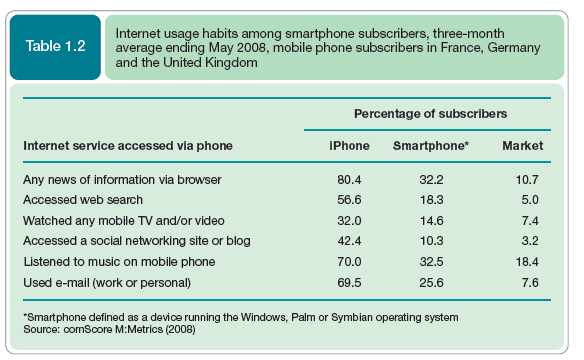
Mobile services adoption is increasing rapidly as users purchase the latest models. Table 1.2 shows how more advanced devices with improved functionality and download speed encourage adoption of services. For example, the majority of iPhone users browse the mobile web compared to a minority in the market for all handsets.
As an example, an online bank can potentially use many of these technologies to communicate with its customers according to the customers’ preferences – some prefer to use the web, others mobile banking or SMS alerts, others wireless or interactive TV and others traditional channels. Bank First Direct (www.firstdirect.com) which is part of the HSBC banking group has a strategy of innovation and showcases its latest approaches in First Direct Interactive (Figure 1.5). It uses SMS short codes as direct response from TV or print advertising to integrate traditional and digital media channels and also uses SMS periodically to deliver relevant related product offers to customers.
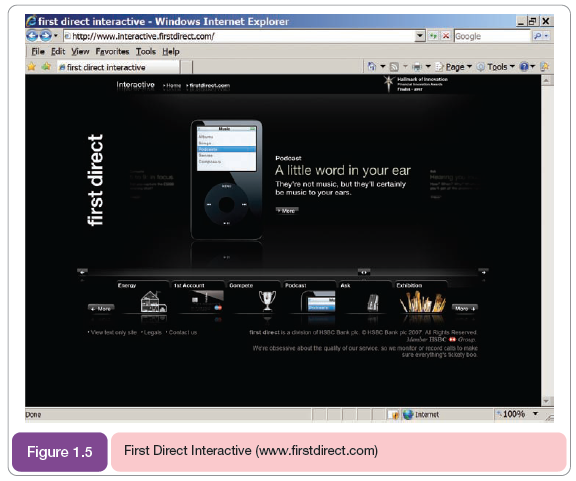
The second part of the definition of digital marketing shows that it should not be the technology that drives digital marketing, but the business returns from gaining new customers and maintaining relationships with existing customers. It also emphasizes how digital marketing does not occur in isolation, but is most effective when it is integrated with other communications channels such as phone, direct mail or face-to-face. The role of the Internet in supporting multi-channel marketing and multi-channel marketing strategy is another recurring theme in this book and Chapters 2 and 5 in particular explain its role in supporting different customer communications channels and distribution channels. Online channels should also be used to support the whole buying process or customer journey from pre-sale to sale to post-sale and further development of customer relationships. This clarifies how different marketing channels should integrate and support each other in terms of their proposition development and communications based on their relative merits for the customer and the company.
The final part of the description summarizes approaches to customer-centric marketing. It shows how success online requires a planned approach to migrate existing customers to online channels and acquire new customers by selecting the appropriate mix of e-communications and traditional communications. Gaining and keeping online customers needs to be based on developing customer insight by researching their characteristics and behaviour, what they value and what keeps them loyal, and then delivering tailored, relevant web and e-mail communications.
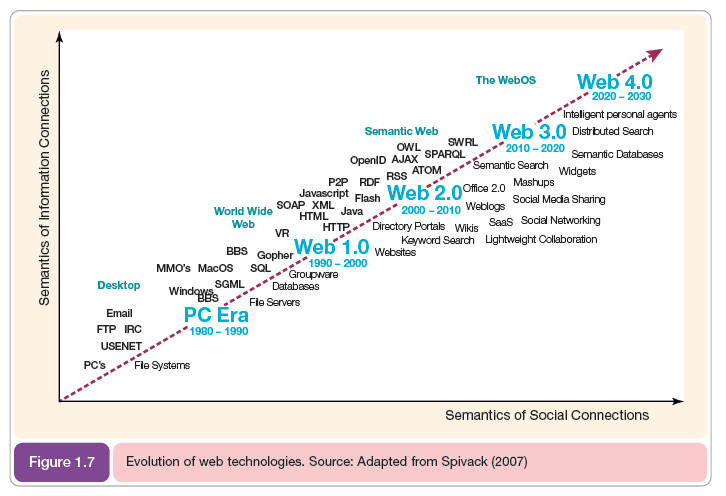
4. Web 2.0
Since 2004, the Web 2.0 concept has increased in prominence amongst web site owners and developers. The main technologies and principles of Web 2.0 have been explained in an influential article by Tim O’Reilly (O’Reilly, 2005). Behind the label ‘Web 2.0’ lies a bewildering range of interactive tools and social communications techniques like those we have just men-tioned such as blogs, podcasts and social networks which have engaged many web users. These are aimed at increasing user participation and interaction on the web. With the widespread adoption of high-speed broadband in many countries, rich media experiences are increasingly used to engage customers with the hope they will have a viral effect, i.e. they will be discussed online or offline and more people will become aware of or interact with the brand campaign. Mini Case Study 1.1 gives an example of a viral campaign which helped sell products.
Web 2.0 also references methods of exchanging data between sites in standardized formats,
such as the feeds merchants use to supply shopping comparison sites with data about products offered and their prices. We include examples of Web 2.0 e-business applications
throughout the book and discuss them in more detail in Chapter 3.
The main characteristics of Web 2.0 are that it typically involves:
- Web services or interactive applications hosted on the web such as Flickr (flickr.com), Google Maps
 (http://maps.google.com) or blogging services such as Blogger.com or Typepad (www.typepad.com);
- Supporting participation – many of the applications are based on altruistic principles of community participation best represented by the most popular social networks such as Bebo, MySpace and Facebook;
- Encouraging creation of user-generated content – blogs are the best example of this. Another example is the collaborative encyclopedia Wikipedia (wikipedia.com);
- Enabling rating of content and online services – services such as delicious (http://del.icio.us) and traceback comments on blogs support this. These services are useful given the millions of blogs that are available – rating and tagging (categorizing) content help indicate the relevance and quality of the content;
- Ad funding of neutral sites – web services such as Google Mail/GMail and many blogs are based on contextual advertising such as Google Adsense or Overture/Yahoo! Content Match;
- Data exchange between sites through XML-based data standards. RSS is based on XML, but has relatively little semantic markup to describe the content. An attempt by Google to facilitate this which illustrates the principle of structured information exchange and searching is Google Base (http://base.google.com). This allows users to upload data about particular services such as training courses in a standardized format based on XML. New classes of content can also be defined and mashups created;
- Use of rich media or creation of rich Internet applications (RIA) which provide for a more immersive, interactive experience. These may be integrated into web browsers or may be separate applications like that downloaded for Second Life (secondlife.com);
- Rapid application development using interactive technology approaches known as ‘Ajax’ (Asynchronous JavaScript and XML). The best-known Ajax implementation is Google Maps which is responsive since it does not require refreshes to display maps.
5. Supply chain management
When distinguishing between buy-side and sell-side e-commerce we are looking at different aspects of managing an organization’s supply chain. Supply chain management (SCM) is the coordination of all supply activities of an organization from its suppliers and delivery of products to its customers. The opportunities for using e-commerce to streamline and restructure the supply chain are described in more detail in Chapter 6. The value chain is a related concept that describes the different value-adding activities that connect a company’s supply side with its demand side. We can identify an internal value chain within the boundaries of an organization and an external value chain where these activities are performed by partners. Note that in the era of e-business a company will manage many interrelated value chains, so in Chapter 6 we also consider the concept of a value network.
Source: Dave Chaffey (2010), E-Business and E-Commerce Management: Strategy, Implementation and Practice, Prentice Hall (4th Edition).
The post E-business defined appeared first on HKT Consultant.
]]>The post A short history of Facebook appeared first on HKT Consultant.
]]>This case is about a social network, Facebook. According to its owners,
Facebook is a social utility that helps people communicate more efficiently with their friends, family and coworkers. The company develops technologies that facilitate the sharing of information through the social graph, the digital mapping of people’s real-world social connections. Anyone can sign up for Facebook and interact with the people they know in a trusted environment.
The case illustrates some of the challenges for an owner of a social network managing growth and decline in usage. It also highlights the challenges for partners and advertisers considering working with a social network.
The case is presented through key events during the development of Facebook
2. Facebook launched and extended – 4 February 2004
Facebook was founded while Mark Zuckerberg was a student at Harvard University. Initially membership was limited to Harvard students. The initial viral effect of the software was indicated since more than half of the undergraduate population at Harvard registered on the service within the first month!
Zuckerberg used open source-software PHP and the MySQL database to create the original ‘TheFacebook. com’ site and these technologies are still in use today.
When Facebook first launched in February 2004, there were just three things that users could do on the site, although they are still core to the functionality of the site. Users could create a profile with your picture and information, view other people’s profiles, and add people as friends.
Since 2004, Facebook has introduced other functionality to create the Facebook experience. Some of the most significant of these include:
- A wall for posting messages
- News feeds
- Messages
- Posting of multiple photos and videos
- Groups
- Applications
- Facebook or social ads.
3. Intellectual property dispute – September 2004 ongoing
There has been an ongoing dispute on ownership of Facebook since another Harvard-originated social networking site ‘HarvardConnection’, which later changed its name to ConnectU, alleged in September 2004 that Zuckerberg had used their source code to develop Facebook when they originally contracted him to help in building their site.
It is also alleged that another system predated Facebook. Aaron J. Greenspan, a Harvard student, in 2003 created a simple web service that he called houseSYSTEM. It was used by several thousand Harvard students for a variety of online college-related tasks – six months before Facebook started and eight months before ConnectU went online. Mark Zuckerberg was briefly an early participant. No suit has been filed by Greenspan, instead he has published a book about his experience. This service later expanded to include any university student, then high school students, and eventually to anyone aged 13 and over.
4. Brand identify established – 23 August 2005
In August, Facebook bought the domain name face- book.com from the Aboutface Corporation for $200,000 and dropped ‘the’ from its name.
5. International expansion – 11 December 2005
Throughout 2005, Facebook extended its reach into different types of colleges and by the end of 2005 included most small universities and junior colleges in the United States, Canada and Mexico. It was also made available in many universities in the UK and Ireland and by December, Australia and New Zealand were added to the Facebook network, bringing its size to more than 2000 colleges and over 25,000 high schools.
6. Initial concerns about privacy of member data – 14 December 2005
Two MIT students downloaded over 70,000 Facebook profiles from four schools (MIT, NYU, the University of Oklahoma, and Harvard) using an automated script, as part of a research project on Facebook privacy.
7. Facebook receives $25 million in funding – April 2006; Microsoft invests October 2007
In May 2005 Facebook received a $13 million cash infusion from venture firm Accel Partners, followed in April 2006 by a further $25 million from a range of partners including Greylock Partners, Meritech Capital Partners, and investor Peter Thiel, the co-founder of PayPal.
Facebook spokesman Chris R. Hughes explained the rationale for the investment when he said:
This investment supports our goal to build an industryleading company that will continue to grow and evolve with our users. We’re committed to building the best utility to enable people to share information with each other in a secure and trusted environment.
Paul S. Madera, Meritech’s managing director, said his firm was impressed by Facebook’s rapid growth and its potential for further expansion in the coveted college- age market. ‘They’ve been designated by their community as the chosen community portal,’ Madera said. ‘This is a company that the entire venture community would love to be a part of.’
In October 2007 Microsoft took a $240 million equity stake in Facebook. This stake was based on a $15 billion valuation of Facebook. Under the terms of this strategic alliance, Microsoft would be the exclusive third-party advertising platform partner for Facebook, and begin to sell advertising for Facebook internationally in addition to the United States.
8. New feed functionality launched – September 2006
New information feeds were launched in mid-2006 and these show the challenges of balancing the benefit of new functionality against disrupting existing user habits.
Writing in the Facebook blog in September 2006 Mark Zuckerberg said:
We’ve been getting a lot of feedback about Mini-Feed and News Feed. We think they are great products, but we know that many of you are not immediate fans, and have found them overwhelming and cluttered.
Other people are concerned that non-friends can see too much about them. We are listening to all your suggestions about how to improve the product; it’s brand new and still evolving.
Later, in an open letter on the blog dated 8 September 2006, Zuckerberg said:
We really messed this one up. When we launched News Feed and Mini-Feed we were trying to provide you with a stream of information about your social world. Instead, we did a bad job of explaining what the new features were and an even worse job of giving you control of them. I’d like to try to correct those errors now.
Categorizing friends into different types (Friends Lists – December 2007) is one approach that has helped to manage this.
9. Facebook Platform for applications launched – 24 May 2007
The Facebook Platform provides an API (Application Programming Interface) which enables software developers to create applications that interact with core Facebook features.
The Facebook developers resource (http://developers. facebook.com) explains there are three main components used to build FB apps:
- Interface (API). The Facebook API uses a REST-based interface. This means that our Facebook method calls are made over the Internet by sending HTTP GET or POST requests to our REST server. With the API, you can add social context to your application by utilizing profile, friend, photo, and event data.
- Query (FQL). Facebook Query Language, or FQL, allows you to use an SQL-style interface to more easily query the same data that you can access through other Facebook API methods.
- Facebook Markup (FBML). FBML enables you to build full Facebook Platform applications that deeply integrate into a user’s Facebook experience. You can hook into several Facebook integration points, including the Profile, Profile Actions, Canvas, News Feed and Mini-Feed.
By January 2008, over 18,000 applications had been built on Facebook Platform with 140 new applications added per day. More than 95% of Facebook members have used at least one application built on Facebook Platform.
According to the Facebook Applications Directory (www.facebook.com/apps), listing, in February 2008, the most popular FB applications were:
- Videos, photos, graffiti, greeting cards, flash embeds and more! 2,254,075 daily active users
- Who’s in your Top Friends? Add your Best Friends to your profile! 1,956,803 daily active users
- Super Wall. Share videos, pictures, graffiti and more with your friends! 915,832 daily active users
- Bumper Sticker. Stick your friends with funny stickers! 891,230 daily active users
- Friends For Sale! Buy and sell your friends as pets! 585,153 daily active users
- Play Scrabulous (Scrabble) within Facebook. 632,372 daily active users
- Texas Hold’Em Poker. Play Texas Hold’Em with your FB friends. 557,671 daily active users
- Compare your taste in movies with friends. 528,996 daily active users
- Compare people. Find out who stands where in various categories: cutest, sexiest, smartest and many more. 428,432 daily active users
- Are YOU Interested? FUN application to see who is interested in YOU! 486,459 daily active users
Some applications have been accused of FB Application Spam, i.e. ‘spamming’ users to request that the application be installed.
Facebook Platform for mobile applications was launched in October 2007, although many Facebook users already interacted with their friends through mobile phones.
10. Facebook passes 30 million active users – July 2007
Facebook active users passed 30 million according to the Facebook blog in July 2007. Mashable (http:// mashable.com/2007/07/10/facebook-users-2) reported that this represented a doubling in the first half of 2007).
Data produced by querying the Facebook ad targeting tool (www.facebook.com/ads) completed in November 2007 by blogger P.K.Francis suggests that the majority of Facebook users in many countries are female:
http://midnightexcess.wordpress.com/2007/11 / 23/facebook-member-stats-an-update.
In terms of user engagement metrics, Facebook (www.facebook.com/press/info.php7statistics) shows there are:
- 68 million active users
- An average of 250,000 new registrations per day since January 2007
- Sixth-most trafficked site in the United States (comScore)
- More than 65 billion page views per month
- More than half of active users return daily
- People spend an average of 20 minutes on the site daily (comScore).
11. Advertisers assess reputational damage – Summer 2007
In August 2007, the BBC announced that six major mainly financial services firms (First Direct, Vodafone, Virgin Media, the AA, Halifax and the Prudential) had withdrawn advertisements from the networking web site Facebook, after they appeared on a British National Party page.
At a similar time, bank HSBC was forced to respond to groups set up on Facebook criticizing them for introduction of new student banking charges (although not until the case had been featured in the national media).
12. Facebook Ads launched – 7 November 2007
Some of the features of Facebook ads (www.facebook. com/ads) include:
- Targeting by age, gender, location, interests, and more.
- Alternative payment models: cost per click (CPC) or impression-based (CPM).
- ‘Trusted Referrals’ or ‘Social Ads’ – ads can also be shown to users whose friends have recently engaged with a company’s Facebook page or engaged with the company web site through Facebook Beacon.
At the time of the launch the Facebook blog made these comments, which indicates the delicate balance in getting the balance right between advertising revenue and user experience. They said first of all, what’s not changing:
- ‘Facebook will always stay clutter-free and clean.
- Facebook will never sell any of your information.
- You will always have control over your information and your Facebook experience.
- You will not see any more ads than you did before this.’
And what is changing:
- ‘You now have a way to connect with products, businesses, bands, celebrities and more on Facebook.
- Ads should be getting more relevant and more meaningful to you.
- You now have the option to share actions you take on other sites with your friends on Facebook’ (these were originally implemented as ‘social ads’ and were based on a piece of technology known as ‘Beacon’ that tracks purchases or reviews made by Facebook users on outside sites, then reports these purchases to those users’ friends).
Commercial companies or more commonly not-for-profit organizations (e.g. www.facebook.com/joinred) can also create their own Facebook pages (currently free). Facebook users can then express their support by adding themselves as a fan, writing on the company Wall, uploading photos, and joining other fans in discussion groups. When users become fans, they can optionally agree to be kept up-to-date about developments which then appear in their news feeds.
13. Privacy concerns sparked by ‘Beacon technology’ – November 2007
Facebook received a lot of negative publicity on its new advertising format related to the ‘Beacon’ tracking system which Mark Zuckerberg was forced to respond to on the Facebook blog (5 December 2007). He said:
About a month ago, we released a new feature called Beacon to try to help people share information with their friends about things they do on the web. We’ve made a lot of mistakes building this feature, but we’ve made even more with how we’ve handled them. We simply did a bad job with this release, and I apologize for it. While I am disappointed with our mistakes, we appreciate all the feedback we have received from our users. I’d like to discuss what we have learned and how we have improved Beacon.
When we first thought of Beacon, our goal was to build a simple product to let people share information across sites with their friends. It had to be lightweight so it wouldn’t get in people’s way as they browsed the web, but also clear enough so people would be able to easily control what they shared. We were excited about Beacon because we believe a lot of information people want to share isn’t on Facebook, and if we found the right balance, Beacon would give people an easy and controlled way to share more of that information with their friends.
But we missed the right balance. At first we tried to make it very lightweight so people wouldn’t have to touch it for it to work. The problem with our initial approach of making it an opt-out system instead of opt-in was that if someone forgot to decline to share something, Beacon still went ahead and shared it with their friends. It took us too long after people started contacting us to change the product so that users had to explicitly approve what they wanted to share. Instead of acting quickly, we took too long to decide on the right solution. I’m not proud of the way we’ve handled this situation and I know we can do better.
14. New friends list functionality launched – December 2007
A criticism leveled at Facebook has been the difficulty in separating out personal friends and business acquaintances.
In December 2007, Facebook launched a significant new functionality called Friend Lists to enhance the user experience. Friend Lists enables users to create named groups of friends in particular categories, e.g. business or personal and these private lists can be used to message people, send group or event invitations, and to filter updates from certain groups of friends.
December 2007/January 2008 – First drop in numbers using Facebook and new data centres to manage growth in users
Application spam has been considered one of the possible causes to the drop in visitors to Facebook at the beginning of 2008. The fall in visitors between December 2007 to January 2008 was its first drop since the website first launched.
To put this in context, the Facebook blog reported at the end of 2007, that nearly two million new users from around the world sign up for Facebook each week. This creates technical challenges – the blog reported that at end of 2007 full capacity was reached in their California data centres. They explained that in the past they had handled this problem by purchasing a few dozen servers, but this time they had run out of physical space in our data centres for new machines. But now Facebook assigns a user logging on to a relevant data centre – users in Europe and the eastern half of the US are connected direct to a new Virginia data centre whenever they’re browsing the site and not making any changes otherwise users are connected to California.
15. Facebook expands internationally – February 2008
Despite the hype generated amongst English speakers, Facebook only announced the launch of a Spanish site in February 2008 with local language versions planned for Germany and France. It seems that Facebook will inevitably follow the path taken by other social networks such as MySpace in launching many local language versions.
Source: Dave Chaffey (2010), E-Business and E-Commerce Management: Strategy, Implementation and Practice, Prentice Hall (4th Edition).
The post A short history of Facebook appeared first on HKT Consultant.
]]>The post Business or consumer models of e-commerce transactions appeared first on HKT Consultant.
]]>Figure 1.8 gives examples of different companies operating in the business-to-consumer (B2C) and business-to-business (B2B) spheres. Often companies such as BP or Dell Computer will have products that appeal to both consumers and businesses, so will have different parts of their site to appeal to these audiences.
Referring to the well-known online companies in Table 1.1 initially suggests these companies are mainly focused on B2C markets. However, B2B communications are still important for many of these companies since business transactions can drive revenue, as for example eBay Business (http://business.ebay.com/) or the B2C service may need to be sustained through advertising provided through B2B transactions, for example Google’s revenue is largely based on its B2B AdWords (http://adwords.google.com/) advertising service and advertising based revenue is also important to sites such as YouTube, MySpace and Facebook.
Figure 1.8 also presents two additional types of transaction, those where consumers transact directly with other consumers (C2C) and where they initiate trading with companies (C2B). Note that the C2C and C2B monikers are less widely used (e.g. Economist, 2000), but they do highlight significant differences between Internet-based commerce and earlier forms of commerce. Consumer-to-consumer interactions (also known as peer-to-peer or person- to-person, P2P) were relatively rare, but are now very common in the form of the social networks. Hoffman and Novak (1996) suggested that C2C interactions are a key characteristic of the Internet that is important for companies to take into account, but it is only in recent years with the growth of always-on broadband connections and mobile access to the web that these have become so popular. P2P transactions are also the main basis for some online business models for e-businesses such as Betfair (see Mini Case Study 1.2) and eBay (www.ebay.com, see Case Study 1.2) which are still run on a business basis, and some blogs which are not run by companies, but by individuals.

Finally, the diagram also includes government and public services organizations which deliver online or e-government services. As well as the models shown in Figure 1.8, it has also been suggested that employees should be considered as a separate type of consumer through the use of intranets which are referred to as employee-to-employee or E2E.
1. E-government defined
E-government refers to the application of e-commerce technologies to government and public services. In the same way that e-business can be understood as transactions with customers (citizens), suppliers and internal communications, e-government covers a similar range of applications:
- Citizens – facilities for dissemination of information and use of online services at local and national levels. For example, at a local level you can find out when refuse is collected and at national level it is possible to fill in tax returns.
- Suppliers – government departments have a vast network of suppliers. The potential benefits (and pitfalls) of electronic supply chain management and e-procurement described in Chapters 6 and 7 are equally valid for government.
- Internal communications – this includes information collection and dissemination and e-mail and workflow systems for improving efficiency within government departments.
E-government is now viewed as important within government in many countries. The European Union has set up ‘i2010’ (European Information society in 2010) whose aims include
providing an integrated approach to information society and audio-visual policies in the EU, covering regulation, research, and deployment and promoting cultural diversity. (eEurope, 2005)
E-business has introduced new opportunities for small and large organizations to compete in the global marketplace. Many commentators have noted that one of the biggest changes introduced by electronic communications is how approaches to transmitting and transforming information can be used for competitive advantage. A significant commentary on the disruptive, transformational nature of electronic communications is provided in Box 1.2.
The Internet also provides significant opportunities for many businesses to build closer relationships with their existing customers and suppliers online to help achieve customer retention. Encouraging use of online, e-business services by customers and suppliers can significantly reduce costs while providing a new, convenient channel for purchase and customer service. Through providing high-quality online services, organizations can build lasting relationships with their stakeholders. While it is sometimes said that ‘online, your customers are only a mouse click away from your competitors’, this is a simplification, and encouraging use of online services can help achieve ‘soft lock-in’. This means that a customer or supplier continues to use a service since they find the service valuable and they have also invested a lot of time in learning the service or integrating it with their systems and there are some costs in switching. Think of different online services you use for different purposes. How often do you switch between them? Of course, the ideal is that the service meets the needs of its users so well and delivers value such that they are satisfied and do not consider switching.
Source: Dave Chaffey (2010), E-Business and E-Commerce Management: Strategy, Implementation and Practice, Prentice Hall (4th Edition).
The post Business or consumer models of e-commerce transactions appeared first on HKT Consultant.
]]>The post E-business opportunities appeared first on HKT Consultant.
]]>The Internet also provides significant opportunities for many businesses to build closer relationships with their existing customers and suppliers online to help achieve customer retention. Encouraging use of online, e-business services by customers and suppliers can significantly reduce costs while providing a new, convenient channel for purchase and customer service. Through providing high-quality online services, organizations can build lasting relationships with their stakeholders. While it is sometimes said that ‘online, your customers are only a mouse click away from your competitors’, this is a simplification, and encouraging use of online services can help achieve ‘soft lock-in’. This means that a customer or supplier continues to use a service since they find the service valuable and they have also invested a lot of time in learning the service or integrating it with their systems and there are some costs in switching. Think of different online services you use for different purposes. How often do you switch between them? Of course, the ideal is that the service meets the needs of its users so well and delivers value such that they are satisfied and do not consider switching.
Source: Dave Chaffey (2010), E-Business and E-Commerce Management: Strategy, Implementation and Practice, Prentice Hall (4th Edition).
The post E-business opportunities appeared first on HKT Consultant.
]]>The post Business adoption of digital technologies for e-commerce and e-business appeared first on HKT Consultant.
]]>1. Drivers of business Internet adoption
Business adoption of e-commerce and e-business is driven by benefits to different parts of their organization. First and foremost, they are concerned how the benefits of e-business will impact on profitability or generating value to an organization. The two main ways in which this can be achieved are:
- Potential for increased revenue arising from increased reach to a larger customer base and encouraging loyalty and repeat purchases among existing customers.
- Cost reduction achieved through delivering services electronically. Reductions include staff costs, transport costs and costs of materials such as paper.
At a relatively early point in e-business adoption, a government report (DTI, 2000) identified two main categories of drivers which remain relevant today:
Cost/efficiency drivers
- Increasing speed with which supplies can be obtained
- Increasing speed with which goods can be dispatched
- Reduced sales and purchasing costs
- Reduced operating costs.
Competitiveness drivers
- Customer demand
- Improving the range and quality of services offered
- Avoiding losing market share to businesses already using e-commerce.
More recently, in interviews with Australian businesses, Perrott (2005) identifies four key areas driving performance which are cost-benefit, competitive pressures, market advantage and value adding, i.e. improving customer satisfaction while building strong relationships.
When reviewing potential benefits, it is useful to identify both tangible benefits (for which monetary savings or revenues can be identified) and intangible benefits (for which it is more difficult to calculate cost savings). The types of potential benefits are summarized in Table 1.3.

In Chapter 5 (Figure 5.12), an alternative information-based model of value creation is discussed in relation to financial services organization Capital One. This reviews new opportunities for adding value, reducing costs, managing risks and creating a new reality (transformation).

An example of an analysis performed to identify the barriers and drivers for adoption of Internet technologies for one market is that from Doherty et al. (2003). These authors researched the drivers and barriers to retailers’ adoption to determine the most important factors. Table 1.4 summarizes the ranking in importance for different degrees of Internet adoption from static brochureware, through an active web site containing product information (B) to a transactional site where items can be purchased (C). You can see that the two most important factors which correlate with adoption are ‘Internet target segment’, i.e. customers in their market are typically adopters of the Internet, and ‘Internet strategy’, i.e. a defined Internet strategy is in place. This suggests, as would be expected, that companies that do not have a coherent Internet or e-business strategy are less likely to use higher levels of Internet services. Many larger organizations that have responded to the challenge of e-business have created a separate e-commerce plan and separate resources to implement it. This book covers what needs to go into such a plan and the issues to consider when implementing it.
More recently, in Europe, research completed for the i2010 initiative monitored usage of the Internet by business (European Commission, 2008) and it found that around 95% of businesses in the majority of countries surveyed have Internet access although this figure masks lower levels of access for SMEs (small and medium-sized enterprises) and particularly micro-businesses (Figure 1.10).
Now read Case Study 1.2 which illustrates the benefits of setting up an online operation for a small or medium enterprise (SME). It also highlights some of the challenges of managing an online business and highlights the need for continued investment to refine online services and the marketing needed to attract visitors to the web site.

2. North West Supplies extends its reach online
North West Supplies (Figure 1.11) was launched as a business in March 1999 when Andrew Camwell, a member of the RAF Volunteer Reserve at the time, spotted a gap in the UK market for mail-order supplies of military garments to people active in the Volunteer Reserve and the Air Cadet Force. Andrew, his wife Carys, and her sister Elaine Hughes, started running a mail order business out of shop premises in the village of Cemaes Bay.
The web store at www.northwestsupplies.co.uk has been online since November 2002. As it can take several months for a web site to be indexed by search engines, NWS used pay-per-click advertising (PPC – see Chapter 9)
as a method of very quickly increasing the web site’s presence in the major search engines. This marketing method proved successful. The directors were pleasantly surprised as they had previously been somewhat dubious about the prospect of the Internet generating sales in their sector. Within six months of running the web site, the company had increased turnover by £20,000, but further advances would incur a high advertising cost. Following an eCommerce Review by Opportunity Wales, the company decided to tackle the issues by implementing search engine optimization (SEO – see Chapter 9) and a site redesign which included:

Improved graphic design – this was to be changed to a more professional and up-to-date look.
- Best, featured and latest products – the introduction of a dynamic front page to entice customers to revisit the site on a regular basis. The contents of this page would feature the best sellers, and latest or featured products.
- Reviews and ratings – to provide confidence to consumers and allow some kind of interaction with them, this would allow users to review products they have purchased and give them a star rating.
- Cross-selling – when customers view a product there may be other products or categories that may be of interest or complementary, hence there was a proposal to allow staff to link products and categories so that these would be displayed.
- Segmentation – the site would be split into two sections emphasizing the segmentation of product lines into military wear and outdoor wear sectors, thus being less confusing, and easier to use for the respective users (see Figure 1.11 section labelled ‘Best, featured and latest products’).
- Navigation by sub-categories – as the product range had expanded, the additional pages created in each category made it harder for customers to find specific items or made them have to browse many pages before finding a suitable product. The introduction of sub-categories would provide a clear link to the areas of interest and contain fewer pages to browse, thus helping the customer to make a choice more easily and more quickly. A new search tool and order tracking were also seen as important parts of the online customer experience (Chapter 8).
Benefits
The owners describe the benefits of the improvements to the site as follows:
- Increased direct sales – ‘The new launch increased sales and appealed to a broader audience – young and old.’ The annual turnover of the business has increased from £250,000 to £350,000 and this is mainly attributable to the new web site. The high- profile launch aimed at existing customers, the greater visibility in search engines, and the greater usability of the site have all contributed to this.
- Improved promotion of the whole range of stock – ‘We started selling stuff that we hadn’t sold before.’ The changes in navigation, particularly division into two market segments (military and outdoors) and greater use of sub-categories, meant that products were easier to find and hence easier to buy, leading to increased sales of products that had previously been slow sellers.
- New Customers – ‘We now send more items abroad.’ The better performance of the site in search engines has led to an increase in orders from new customers and from abroad. The company now has regular sales to Canada, Australia, New Zealand and various European states. 60% of orders are from new customers – not bad for a business that initially set up on the premise of a niche market for UK-based cadet forces.
- Adding value to the brand – ‘New corporate clients could look at our Web site and see we weren’t fly-bynight and that we meant business.’ Improvements to the design have raised confidence levels in visitors and this has led to increased sales. But perhaps more significantly, the professional image of the site was a good boost to confidence for potential business partners in the emerging business-to-business division that started to trade as North Star Contracts.
Source: Dave Chaffey (2010), E-Business and E-Commerce Management: Strategy, Implementation and Practice, Prentice Hall (4th Edition).
The post Business adoption of digital technologies for e-commerce and e-business appeared first on HKT Consultant.
]]>