E-commerce Business: How to Build, Launch, and Grow a Profitable Online Store

E-commerce (also known as electronic commerce) Business is the process of buying and selling of products or services, making money transfers, and transferring data over an electronic medium (Internet). This network allows people to do business without the constraint of distance and time.

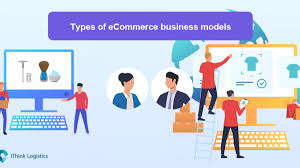
There are various types of online business options that you can choose from based on your preferences, capital, and online business model. For different businesses, you have to implement various techniques and strategies. Some of the favorite online companies include: B2B businesses, B2C businesses, Affiliate marketing business, Google Adwords marketing, Online auction selling.

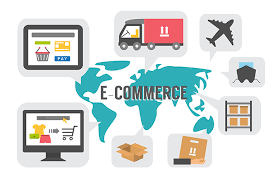
Online business works pretty much on the same principles as an offline/retail store does. On a broader scale, the whole eCommerce process can be broken down into three main components or work processes: Receiving Orders, Processing Order Information and Shipping.

The main advantage of an eCommerce business is that it allows you to conduct your business flexible and at the same time is very useful in reaching a full range of target audience within seconds. Nowadays, internet home business has also become a prevalent means of earning money in the form of eCommerce. Another significant benefit of an eCommerce business is that it helps you to identify the target audience very quickly and reach them easily too. For example, if you are trying to sell some goods or products, you can easily make market research from the internet and identify your niche market. Accordingly, you can send emails or promotional brochures to prospective customers who will be interested in your product or service. Compared to conventional promotional methods, this is pretty cost-effective as you do not have to approach the customers on an individual basis.

[title text=”Main contents” link_text=”See more from basic to advanced” link=”/category/corporate-management/e-commerce/”]

[blog_posts style=”normal” col_spacing=”xsmall” columns=”3″ columns__md=”1″ depth_hover=”2″ auto_slide=”6000″ cat=”180″ posts=”3″ offset=”93″ show_date=”false” excerpt_length=”25″ comments=”false” image_height=”60%” image_size=”original” image_hover=”zoom” text_align=”left”]

[blog_posts style=”normal” col_spacing=”xsmall” columns=”3″ columns__md=”1″ depth_hover=”2″ auto_slide=”6000″ cat=”180″ posts=”3″ offset=”90″ show_date=”false” excerpt_length=”25″ comments=”false” image_height=”60%” image_size=”original” image_hover=”zoom” text_align=”left”]

[blog_posts style=”normal” col_spacing=”xsmall” columns=”3″ columns__md=”1″ depth_hover=”2″ auto_slide=”5000″ cat=”180″ posts=”6″ offset=”84″ show_date=”false” excerpt_length=”25″ comments=”false” image_height=”60%” image_size=”original” image_hover=”zoom” text_align=”left”]

[blog_posts style=”normal” col_spacing=”xsmall” columns=”3″ columns__md=”1″ depth_hover=”2″ auto_slide=”6000″ cat=”180″ posts=”6″ offset=”78″ show_date=”false” excerpt_length=”25″ comments=”false” image_height=”60%” image_size=”original” image_hover=”zoom” text_align=”left”]

[blog_posts style=”normal” col_spacing=”xsmall” columns=”3″ columns__md=”1″ depth_hover=”2″ auto_slide=”7000″ cat=”180″ posts=”6″ offset=”72″ show_date=”false” excerpt_length=”25″ comments=”false” image_height=”60%” image_size=”original” image_hover=”zoom” text_align=”left”]

[blog_posts style=”normal” col_spacing=”xsmall” columns=”3″ columns__md=”1″ depth_hover=”2″ auto_slide=”8000″ cat=”180″ posts=”6″ offset=”66″ show_date=”false” excerpt_length=”25″ comments=”false” image_height=”60%” image_size=”original” image_hover=”zoom” text_align=”left”]

[blog_posts style=”normal” col_spacing=”xsmall” columns=”3″ columns__md=”1″ depth_hover=”2″ auto_slide=”6000″ cat=”180″ posts=”6″ offset=”60″ show_date=”false” excerpt_length=”25″ comments=”false” image_height=”60%” image_size=”original” image_hover=”zoom” text_align=”left”]

[blog_posts style=”normal” col_spacing=”xsmall” columns=”3″ columns__md=”1″ depth_hover=”2″ auto_slide=”7000″ cat=”180″ posts=”6″ offset=”54″ show_date=”false” excerpt_length=”25″ comments=”false” image_height=”60%” image_size=”original” image_hover=”zoom” text_align=”left”]

[row style=”small” class=”form-lien-he”]

[col span=”2″ span__sm=”12″]

[/col]
[col span=”4″ span__sm=”12″]

[button text=”Home” color=”secondary” style=”gloss” radius=”5″ depth=”2″ depth_hover=”3″ expand=”true” icon=”icon-star” icon_pos=”left” link=”https://phantran.net/”]

[/col]
[col span=”4″ span__sm=”12″]

[button text=”See basic to advanced” style=”gloss” radius=”5″ depth=”2″ depth_hover=”3″ expand=”true” icon=”icon-checkmark” icon_pos=”left” link=”/category/corporate-management/e-commerce/”]

[/col]
[col span=”2″ span__sm=”12″]

[/col]

[/row]

Introduction to e-business and e-commerce

Organizations have now been applying technologies based on the Internet, World Wide Web and wireless communications to transform their businesses for over 15 years since the cre­ation of the first web site (http://info.cern.ch) by Sir Tim Berners-Lee in 1991. Deploying these technologies has offered many opportunities for innovative e-businesses to be created based on new approaches to business. Table 1.1 highlights some of the best-known examples and in Activity 1.1 you can explore some of the reasons for success of these e-businesses.

For the author, e-business and e-commerce is an exciting area to be involved with, since many new opportunities and challenges arise yearly, monthly and even daily. Innovation is a given, with the continuous introduction of new technologies, new business models and new communications approaches. For example, Google innovates relentlessly. Its service has developed a long way since 1998 (Figure 1.1) with billions of pages now indexed and other services such as web mail, pay per click adverts, analytics and social networks all part of its offering. Complete Activity 1.1 or view Table 1.1 to see other examples of the rate at which new innovations occur.

Source: Dave Chaffey (2010), E-Business and E-Commerce Management: Strategy, Implementation and Practice, Prentice Hall (4th Edition).

The impact of the electronic communications on traditional businesses

During the same period managers at established businesses have had to determine how to apply new electronic communications technologies to transform their organisations. As we will see later in this chapter, existing businesses have evolved their approaches to e-business through a series of stages. Innovation in e-business is relentless, with the continuous intro­duction of new technologies, new business models and new communications approaches. So all organizations have to review new electronic and Internet-based communications approaches for their potential to make their business more competitive and also manage ongoing risks such as security and performance . For example, current opportunities which many businesses are reviewing the benefits, costs and risks of implementing include:

  • The growth in popularity of social networks such as Bebo, Facebook (Case Study 1.1) and MySpace, virtual worlds such as Habbo Hotel and Second Life, and blogs created by many individuals and businesses;
  • Rich media such as online video and interactive applications into their web sites;
  • Selection of mobile commerce services which exploit the usage of mobile phones and other portable wireless devices such as laptops around the world. The potential of mobile commerce is evident from research by Wireless Intelligence (2008) which found that at the end of 2007, globally there were 3 billion subscriber connections (representing half the planet’s population) with penetration rates in developing countries such as India (21%) and China (41%) showing the potential for future growth;
  • Using location-based tracking of goods and inventory as they are manufactured and transported.

You can see that an organization’s capability to manage technology-enabled change is the essence of successfully managing e-business. The pace of change and the opportunities for new communications approaches make e-business and e-commerce an exciting area of busi­ness to be involved in.

In E-Business and E-Commerce Management we will explore approaches managers can use to assess the relevance of different e-business opportunities and then devise and implement strategies to exploit these opportunities. We will also study how to manage more practical risks such as delivering a satisfactory service quality, maintaining customer privacy and managing security. We introduce some of the opportunities and risks later in this chapter.

In this chapter we start by introducing the scope of e-business and e-commerce. Then we review the the main opportunities and risks of e-business together with the drivers and bar­riers to adoption of e-business services. Finally, we will look at some of the organizational challenges of managing e-business using the classic McKinsey 7S strategy framework.

Source: Dave Chaffey (2010), E-Business and E-Commerce Management: Strategy, Implementation and Practice, Prentice Hall (4th Edition).

Real-world E-Business: HP.com

Ted Speroni, Director, EMEA (Europe, Middle East and Asia), HP.com

Overview and main concepts covered

Ted Speroni heads the European operations of HPcom, as well as the tech giant’s regional preferred online partner programme. This practitioner interview highlights some of the challenges and opportunities for a traditional organization in managing e-commerce. It also introduces some of the important online marketing communications techniques such as search engine marketing, affiliate marketing, social media and widget marketing which are described in Chapter 9.

The interview

  1. Can you briefly summarise your role at HP.com?

Ted Speroni, HP.com: I look after HP.com for the EMEA region. We have around 40 country websites throughout the region in something like 28 languages, so that’s my responsibility. I’m also responsible for all of our electronic content management across Europe, which is where we intersect with the online retail community.

At HP, we have a clear strategy of making our products available wherever our customers want to buy them – through high street shops, proximity resellers, online retailers, e-resellers and direct through HP.

We only sell direct through HPcom in five countries in Europe – the UK, France, Germany, Switzerland and Spain. So in most countries, we connect in with the leading etailers. We get daily feeds from all of them on their product availability and pricing, and we display them on HPcom. We then deep link into the shopping basket on each etailer, so we’re generating leads for them.

It’s just like an affiliate programme [a commission-based sales arrangement covered in Chapter 9], but we don’t get a commission because it’s for our own prod­ucts. We track the number and quality of leads we are sending each retailer and their conversion rates. We have all the data on which products sell and which cross-sell.

It’s a pretty big programme – we have about 150 partners in Europe that are part of it and we generate quite a considerable amount of leads and traffic for them. You have to qualify to be part of it – there are certain criteria you have to meet.

  1. What are you doing at the moment to drive more traffic to these etailers?

Ted Speroni, HP.com: The first thing is the integrated marketing approach we have. Search engine marketing (SEM) and search engine optimisation (SEO) are probably the two biggest areas we are working on.

The fundamental principle is that we want to drive all that traffic to pages where we give the customer choice. All the marketing traffic drives people to landing pages that give people a choice about where to purchase the product.

Our investment in SEM is probably in line with the growth we see overall in the industry. We’re also making quite heavy investments internally in SEO, because a much higher percentage of our traffic comes from natural search and the conversion rate is not that dissimilar to SEM.

Natural search is a big area of focus for us at the moment. With SEM, we always get people to the right page, to specific landing pages. With natural search, we’re not as convinced we’re always getting people to the correct page.

For that, we’re analysing where the traffic is going from natural search results so that we can give the customer choice on those pages, and also looking at how to make sure people go to the pages they want to go to.

  1. Do you have any challenges in terms of funnelling search traffic – whether natural or paid – through your site, rather than straight to etailers? Do you allow brand bidding, for example?

Ted Speroni, HP.com: We are currently assessing what we will do in this area from both a technical perspective and from a commercial perspective as part of our co-op marketing programme with the channel. I would anticipate that we will do some limited pilots as part of this assessment.

  1. How difficult is it to maintain communication with partners across multiple channels?

Ted Speroni, HP.com: We’re pretty happy with the multi-channel approach we have taken. Encompassing all the different ways customers want to buy products is the most important thing.

We’ve struggled with that for a long time and we’re just trying to make each channel as efficient as possible. We still have a way to go – I’m still working on a number of projects to optimise the different channels.

One thing is the question of high street retailers and the question of integration of inventory. When a customer wants to buy a specific camera they want to know whether it is in stock today, and I don’t want the site to send them to the wrong place.

  1. How are you managing the syndication of your product content to your part­ners in the programme? How challenging is that?

Ted Speroni, HP.com: My team syndicates out [electronically distributes] all the content to our resellers. What this is all about is we want to control the HP brand in relation to our products. We produce electronic content feeds in 28 languages of all the product information – pictures, marketing messaging, specifications, everything.

Whenever a customer anywhere in Europe is seeing information about an HP product, there’s a very high probability that that will be content we have created. The picture is the picture we want people to see. We feel it’s been very successful for us – not only in terms of controlling our brand, but also in terms of cutting costs for our part­ners. They don’t need to do content acquisition.

We’ll either syndicate the content via XML feeds, or sometimes the resellers are buying the content through content aggregators. And this extends beyond simple product information – we also syndicate out our recommended cross-sell products. If you buy an HP printer, we have a list of recommended accessories.

This is a key thing – similar to what Dell have talked about in terms of increasing average shopping basket. Our top priority partners are partners that sell complete HP solutions, so this tool helps them sell complete HP solutions. Resellers can’t say they don’t know which products sell well with others, because we are telling them.

I should also mention another component – we’re not just syndicating content, we also syndicate a configurator for configuring PCs.

We feed all the data into the configurator about the different configurations you can build. You as a customer configure the PC and the information goes into the shopping basket of the retailer, as well as coming through to the HP factory so we can build the configuration. We then match up the order when the retailer passes the order through to us, and we ship it.

It goes beyond syndicating content – you’re syndicating widgets, real web apps that can be integrated into websites.

How else are you looking to use widgets?

Ted Speroni, HP.com: Another area is product advisors. We have product advisors on HPcom and we would like to syndicate them out. The principle behind this is that we don’t want to provide a link on retailers’ websites to HPcom, we want to keep the customers on their sites. As we move HPcom to a more modular, Web 2.0-type approach, we’ll see which components we can syndicate out. We also have flash demos so there’s an opportunity for resellers to have them on their website, although the resellers do have to have some merchandising people that know about the prod­ucts. Their sites also have to be Web 2.0-enabled.

  1. What are you doing in terms of social media and social shopping?

Ted Speroni, HP.com: We’re starting to pilot some social tagging concepts on our product pages, so that people can easily embed our product pages into different sites, like Myspace profiles for example.

It’s at a very early stage but it’s about the whole concept of exporting our stuff onto the social networking sites, as opposed to trying to get people onto our sites. We haven’t implemented it in Europe, but in the US we have started some pilots.

For a while now, we have also had RSS links on promotions from our site – we’ve had some uptake of that, but it’s not a killer app I would say. We’re basically looking at how we can help people who want to create content around our products, and facilitate that.

There’s a lot of HP content on YouTube – lots of people make videos about how to make the new HP printer, for example. So our approach is ‘if people want to do this, let’s help them and let’s benefit from it’. If we can get user generated linkage to our products, it’s incredibly powerful.

  1. Have you looked at user generated reviews?

Ted Speroni, HP.com: We’re doing a pilot in the US with user generated reviews. We haven’t started that yet in Europe – I’m trying to work out a scaleable model with all the language issues.

We have to have some quality control on the user reviews – we can’t depend completely on community policing. We need some proactive moderation – since it’s on our website, we can’t take risks with legal issues and so on.

You can say our products aren’t good but you have to use appropriate language. Also, we don’t want you to be able to comment on our competitors’ products. You can say what you want about our products but you can’t push competitors’ products.

We’ve been runnning this for about six months in the US and there’s been good uptake, and we haven’t had big issues with appropriateness. In Europe, I am looking to deploy something and looking into the multi-language issues.

Source: Dave Chaffey (2010), E-Business and E-Commerce Management: Strategy, Implementation and Practice, Prentice Hall (4th Edition).

E-commerce defined

Electronic commerce (e-commerce) is often thought simply to refer to buying and selling using the Internet; people immediately think of consumer retail purchases from companies such as Amazon. But e-commerce involves much more than electronically mediated finan­cial transactions between organizations and customers. E-commerce should be considered as all electronically mediated transactions between an organization and any third party it deals with. By this definition, non-financial transactions such as customer requests for fur­ther information would also be considered to be part of e-commerce. Kalakota and Whinston (1997) refer to a range of different perspectives for e-commerce:

  • A communications perspective – the delivery of information, products or services or payment by electronic means.
  • A business process perspective – the application of technology towards the automation of business transactions and workflows.
  • A service perspective – enabling cost cutting at the same time as increasing the speed and quality of service delivery.
  • An online perspective – the buying and selling of products and information online.

The UK government also used a broad definition when explaining the scope of e-commerce to industry:

E-commerce is the exchange of information across electronic networks, at any stage in the supply chain, whether within an organization, between businesses, between busi­nesses and consumers, or between the public and private sector, whether paid or unpaid. (Cabinet Office, 1999)

These definitions show that electronic commerce is not solely restricted to the actual buying and selling of products, but also includes pre-sale and post-sale activities across the supply chain.

E-commerce is facilitated by a range of digital technologies that enable electronic communi­cations. These technologies include Internet communications through web sites and e-mail as well as other digital media such as wireless or mobile and media for delivering digital television such as cable and satellite. We will explain the characteristics of these technologies and some of the challenges in managing them in Chapter 3.

When evaluating the strategic impact of e-commerce on an organization, it is useful to identify opportunities for buy-side and sell-side e-commerce transactions as depicted in Figure 1.2, since systems with different functionalities will need to be created in an organization to accommodate transactions with buyers and with suppliers. Buy-side e-commerce refers to transactions to procure resources needed by an organization from its suppliers. In Chapter 6, Case Study 6.1 reviews how Shell has developed an e-business capability that enables buy-side e-commerce for its customers. Sell-side e-commerce refers to transactions involved with selling products to an organization’s customers. So e-commerce transactions between organi­zations can be considered from two perspectives: sell-side from the perspective of the selling organization and buy-side from the perspective of the buying organization.

Activity 1.3 . Understanding e-commerce and e-business

Purpose

To encourage discussion of what is understood by ‘e-commerce’ and ‘e-business’ and their significance to managers.

Activity

Read the extract below and then answer the questions which follow. Although this is now a dated example, it is still useful as a historic document showing the different aspects of e-business that a business must address. In one of his last AGM speeches for General Electric (Welch, 2001), Jack Welch made these comments about GE’s adoption of e-business.

Like the Amazons of the world, we started out with what we call ‘e-Sell’, primarily distributing our products on the Internet. Moving our traditional customers to the Web for much more efficient transactions has been very successful. And in 2000 we sold $8 billion in goods and services online, a number that’ll grow to $20 billion this year, making this year-old institution one of the biggest, if not the biggest, e-Business company in the world.

On what we call the ‘e-Buy’ side, we followed the same path, adopting many of the dot.com ideas on auctions, having a global network of Six Sigma suppliers. The concept of reverse auctions was right in the GE sweet spot and we wasted no time in spreading the new technology across our businesses. We now run global auctions daily-$6 billion worth last year, $12 billion this year, generating over $600 million in savings for the company in 2001.

But the biggest breakthrough of all was what we call ‘e-Make’ and that didn’t come from the dot.coms. They had little infrastructure and few processes. e-Make came from learning what the Internet could do for internal processes and seeing the enormous advantage Digitization can give a big old company that actually makes things, particularly one with Six Sigma methodology already deeply entrenched in its veins. By digitizing our processes from customer service to travel and living, we’ll take over a billion dollars of cost out of our operations this year alone.

Last year I told you I believed e-Business was neither ‘old economy’ nor ‘new economy’, but simply new technology. I’m more sure of that today. If we needed confirmation that this technology was made for us, we got it. GE was named last year ‘e-Business of the Year’ by InternetWeek magazine and awarded the same title last week by WORTH magazine.

Digitization is, in fact, a game changer for GE. And, with competition cutting back because of the economy, this is the time for GE to widen the digital gap, to further improve our competitive position. We will do that by increasing our spending on information technology by 10% to 15% this year despite the weak economy.

Note: the Six Sigma concept of process quality improvement is described in more detail at www.isixsigma.com, and reverse auctions are explored in Chapters 2 and 7.

Source: Dave Chaffey (2010), E-Business and E-Commerce Management: Strategy, Implementation and Practice, Prentice Hall (4th Edition).

E-business defined

Given that Figure 1.2 depicts different types of e-commerce, what then is e-business? Let’s start from the definition by IBM (www.ibm.com/e-business), which was one of the first suppliers to use the term in 1997 to promote its services:

e-business (e’biz’nis) – the transformation of key business processes through the use of Internet technologies.

Today, IBM calls the e-business services it provides for its clients ‘on-demand’ web services, as explained in Chapter 3.

You will find that the term ‘e-business’ is used in two main ways within organizations. The first is as a concept which can be applied to strategy and operations. For example, ‘our organiz­ation needs an improved e-business strategy (or e-business technology)’. Secondly, ‘e-business’ is used as an adjective to describe businesses that mainly operate online, i.e. they have no physical presence on the high streets and seek to minimize customer service and support through enabling ‘web self-service’, i.e. customers serve themselves before, during and after sales. In the dot-com era e-businesses used to be known as ‘pureplays’. Amazon (www.amazon.com) and eBay (www.ebay.com, Case Study 1.3) are the world’s two biggest e-businesses.

In an international benchmarking study analysing the adoption of e-business in SMEs the Department of Trade and Industry emphasizes the application of technology (information and communications technologies (ICTs)) in the full range of business processes, but also emphasizes how it involves innovation. DTI (2000) describes e-business as follows:

when a business has fully integrated information and communications technologies (ICTs) into its operations, potentially redesigning its business processes around ICT or completely reinventing its business model. . . e-business, is understood to be the integration of all these activities with the internal processes of a business through ICT. (DTI, 2000)

Referring back to Figure 1.2, the key business processes referred to in the IBM and DTI defi­nitions are the organizational processes or units in the centre of the figure. They include research and development, marketing, manufacturing and inbound and outbound logistics.

The buy-side e-commerce transactions with suppliers and the sell-side e-commerce transactions with customers can also be considered to be key business processes.

Figure 1.3 presents some alternative viewpoints of the relationship between e-business and e-commerce. In Figure 1.3(a) there is a relatively small overlap between e-commerce and e-business. From Figure 1.2 we can reject Figure 1.3(a) since the overlap between buy-side and sell-side e-commerce is significant. Figure 1.3(b) seems to be more realistic, and indeed many commentators seem to consider e-business and e-commerce to be synony­mous. It can be argued, however, that Figure 1.3(c) is most realistic since e-commerce does not refer to many of the transactions within a business, such as processing a purchasing order, that are part of e-business.

So e-commerce can best be conceived of as a subset of e-business and this is the perspec­tive we will use in this book. Since the interpretation in Figure 1.3(b) is equally valid, what is important within any given company is that managers involved with the implementation of e-commerce or e-business are agreed on the scope of what they are trying to achieve!

In Chapter 8 we go on to consider how e-marketing, a concept now used by many mar­keting professionals, relates to the concepts of e-business and e-commerce.

1. Intranets and extranets

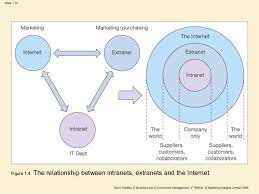
The majority of Internet services are available to any business or consumer that has access to the Internet. However, many e-business applications that access sensitive company information require access to be limited to qualified individuals or partners. If information is restricted to employees inside an organization, this is an intranet as is shown in Figure 1.4.

In a survey of 275 managers responsible for an intranet featured in CIO (2002), the main benefits mentioned by managers were:

  1. Improved information sharing (customer service), 97%
  2. Enhanced communications and information sharing (communications), 95%
  3. Increased consistency of information (customer service), 94%
  4. Increased accuracy of information (customer service), 93%
  5. Reduced or eliminated processing, 93%
  6. Easier organizational publishing, 92%.

It is apparent that benefits focus on information delivery, suggesting that management of infor­mation quality is a key to successful use of intranets. Notice that cost saving is not referred to directly in the list of benefits. Direct cost reduction can be achieved through reduced cost of printing and indirectly though reduced staff time needed to access information. However, intranets represent a substantial investment, so careful consideration of the return on investment is required. David Viney, who has managed implementation of intranets at Pricewaterhouse- Coopers, British Airways and Centrica PLC estimates that for a large implementation of more than 10,000 staff, the cost could average £250 per user or seat (Viney, 2003). He suggests this cost breaks down into four categories: software (content management systems), hardware (servers to store content and applications), integration of information sources and applications and process change (staff costs and opportunity costs associated within implementation). He also suggests that if the portal project involves integration with ERP systems, this could add £150 per seat.

If access to an organization’s web services is extended to some others, but not everyone beyond the organization, this is an extranet. Whenever you log on to an Internet service such as that for an e-retailer or online news site, this is effectively an extranet arrangement, although the term is most often used to mean a business-to-business application such as the Shell SIMON capability described in Case Study 6.1 where certain customers or suppliers are given shared access. We look at examples of intranets and extranets in Chapter 3 including the Dell Premier extranet.

2. Different types of sell-side e-commerce

Sell-side e-commerce doesn’t only involve selling products such as books and DVDs online, but also involves using Internet technologies to market services using a range of techniques we will explore in Chapters 8 and 9. Not every product is suitable for sale online, so the way in which a web site is used to market products will vary. It is useful to consider the four main types of online presence for sell-side e-commerce, which each have different objectives and are appropriate for different markets. Note that these are not clear-cut categories of web sites since any company may combine these types, but with a change in emphasis according to the market they serve. As you review web sites, note how organizations have different parts of the site focusing on these functions of sales transactions, services, relationship-building, brand­building and providing news and entertainment. The four main types of site are:

  • Transactional e-commerce sites. These enable purchase of products online. The main business contribution of the site is through sale of these products. The sites also support the business by providing information for consumers that prefer to purchase products offline. These include retail sites, travel sites and online banking services.
  • Services-oriented relationship-building web sites. Provide information to stimulate purchase and build relationships. Products are not typically available for purchase online. Information is provided through the web site and e-newsletters to inform purchase decisions. The main business contribution is through encouraging offline sales and generating enquiries or leads from potential customers. Such sites also add value to existing customers by providing them with detailed information to help support them in their lives at work or at home.
  • Brand-building sites. Provide an experience to support the brand. Products are not typi­cally available for online purchase. Their main focus is to support the brand by developing an online experience of the brand. They are typical for low-value, high-volume fast- moving consumer goods (FMCG brands) for consumers.
  • Portal, publisher or media sites. Provide information, news or entertainment about a range of topics. ‘Portal’ refers to a gateway of information. This is information both on the site and through links to other sites. Portals have a diversity of options for generating revenue, including advertising, commission-based sales, sale of customer data (lists). Social networks can also be considered to be in this category since they are often advertising-supported.

3. Digital marketing

Digital marketing, e-marketing or Internet marketing is yet another field you will hear of which is closely related to e-commerce. ‘Digital marketing’ is a term increasingly used by specialist e-marketing agencies, in recruitment of specialist staff and the new media trade publications such as New Media Age (www.nma.co.uk) and Revolution (www.revolutionmagazine.com) to refer to sell-side e-commerce. We cover digital marketing in more detail in Chapters 8 and 9.

To help explain the scope and approaches used for digital marketing the IDM (www.theidm.com) has developed a more detailed explanation of digital marketing:

Digital marketing involves:

Applying these technologies which form online channels to market:

  • Web, e-mail, databases, plus mobile/wireless and digital TV.

To achieve these objectives:

  • Support marketing activities aimed at achieving profitable acquisition and retention of customers … within a multi-channel buying process and customer lifecycle.

Through using these marketing tactics:

  • Recognising the strategic importance of digital technologies and developing a planned approach to reach and migrate customers to online services through e-communications and traditional communications. Retention is achieved through improving our customer knowledge (of their profiles, behaviour, value and loyalty drivers), then delivering inte­grated, targeted communications and online services that match their individual needs.

Let’s now look at each part of this description in more detail. The first part of the descrip­tion illustrates the range of access platforms and communications tools that form the online channels which e-marketers use to build and develop relationships with customers including PCs, PDAs, mobile phones, interactive digital TV and radio.

Different access platforms deliver content and enable interaction through a range of differ­ent online communication tools or media channels. Some are well-established techniques which will be familiar to you, like web sites, search engines, e-mail and text messaging. One of the most exciting things about working in digital media is the introduction of new tools and techniques which have to be assessed for their relevance to a particular marketing campaign.

For example, recent innovations which we discuss further in Chapters 8 and 9 include blogs, feeds, podcasts and social networks. The growth of social networks has been docu­mented by Boyd and Ellison (2007) who describe social networking sites (SNS) as:

Web-based services that allow individuals to (1) construct a public or semi-public profile within a bounded system, (2) articulate a list of other users with whom they share a connection, and (3) view and traverse their list of connections and those made by others within the system.

The interactive capabilities to post comments or other content and rate content are surpris­ingly missing from this definition.

Mobile services adoption is increasing rapidly as users purchase the latest models. Table 1.2 shows how more advanced devices with improved functionality and download speed encourage adoption of services. For example, the majority of iPhone users browse the mobile web compared to a minority in the market for all handsets.

As an example, an online bank can potentially use many of these technologies to com­municate with its customers according to the customers’ preferences – some prefer to use the web, others mobile banking or SMS alerts, others wireless or interactive TV and others traditional channels. Bank First Direct (www.firstdirect.com) which is part of the HSBC banking group has a strategy of innovation and showcases its latest approaches in First Direct Interactive (Figure 1.5). It uses SMS short codes as direct response from TV or print advertising to integrate traditional and digital media channels and also uses SMS periodi­cally to deliver relevant related product offers to customers.

The second part of the definition of digital marketing shows that it should not be the tech­nology that drives digital marketing, but the business returns from gaining new customers and maintaining relationships with existing customers. It also emphasizes how digital mar­keting does not occur in isolation, but is most effective when it is integrated with other communications channels such as phone, direct mail or face-to-face. The role of the Inter­net in supporting multi-channel marketing and multi-channel marketing strategy is another recurring theme in this book and Chapters 2 and 5 in particular explain its role in supporting different customer communications channels and distribution channels. Online channels should also be used to support the whole buying process or customer journey from pre-sale to sale to post-sale and further development of customer relationships. This clarifies how different marketing channels should integrate and support each other in terms of their proposition development and communications based on their relative merits for the customer and the company.

The final part of the description summarizes approaches to customer-centric marketing. It shows how success online requires a planned approach to migrate existing customers to online channels and acquire new customers by selecting the appropriate mix of e-communi­cations and traditional communications. Gaining and keeping online customers needs to be based on developing customer insight by researching their characteristics and behaviour, what they value and what keeps them loyal, and then delivering tailored, relevant web and e-mail communications.

4. Web 2.0

Since 2004, the Web 2.0 concept has increased in prominence amongst web site owners and developers. The main technologies and principles of Web 2.0 have been explained in an influ­ential article by Tim O’Reilly (O’Reilly, 2005). Behind the label ‘Web 2.0’ lies a bewildering range of interactive tools and social communications techniques like those we have just men-tioned such as blogs, podcasts and social networks which have engaged many web users. These are aimed at increasing user participation and interaction on the web. With the widespread adoption of high-speed broadband in many countries, rich media experiences are increasingly used to engage customers with the hope they will have a viral effect, i.e. they will be discussed online or offline and more people will become aware of or interact with the brand campaign. Mini Case Study 1.1 gives an example of a viral campaign which helped sell products.

Web 2.0 also references methods of exchanging data between sites in standardized formats,

such as the feeds merchants use to supply shopping comparison sites with data about prod­ucts offered and their prices. We include examples of Web 2.0 e-business applications

throughout the book and discuss them in more detail in Chapter 3.

The main characteristics of Web 2.0 are that it typically involves:

  1. Web services or interactive applications hosted on the web such as Flickr (flickr.com), Google Maps™                                   (http://maps.google.com) or blogging services such as Blogger.com or Typepad (www.typepad.com);
  2. Supporting participation – many of the applications are based on altruistic principles of community participation best represented by the most popular social networks such as Bebo, MySpace and Facebook;
  3. Encouraging creation of user-generated content – blogs are the best example of this. Another example is the collaborative encyclopedia Wikipedia (wikipedia.com);
  4. Enabling rating of content and online services – services such as delicious (http://del.icio.us) and traceback comments on blogs support this. These services are useful given the millions of blogs that are available – rating and tagging (categorizing) content help indicate the relevance and quality of the content;
  5. Ad funding of neutral sites – web services such as Google Mail/GMail™ and many blogs are based on contextual advertising such as Google Adsense™ or Overture/Yahoo! Content Match;
  6. Data exchange between sites through XML-based data standards. RSS is based on XML, but has relatively little semantic markup to describe the content. An attempt by Google to facilitate this which illustrates the principle of structured information exchange and searching is Google Base™ (http://base.google.com). This allows users to upload data about particular services such as training courses in a standardized format based on XML. New classes of content can also be defined and mashups created;
  7. Use of rich media or creation of rich Internet applications (RIA) which provide for a more immersive, interactive experience. These may be integrated into web browsers or may be separate applications like that downloaded for Second Life (secondlife.com);
  8. Rapid application development using interactive technology approaches known as ‘Ajax’ (Asynchronous JavaScript and XML). The best-known Ajax implementation is Google Maps which is responsive since it does not require refreshes to display maps.

5. Supply chain management

When distinguishing between buy-side and sell-side e-commerce we are looking at different aspects of managing an organization’s supply chain. Supply chain management (SCM) is the coordination of all supply activities of an organization from its suppliers and delivery of products to its customers. The opportunities for using e-commerce to streamline and restructure the supply chain are described in more detail in Chapter 6. The value chain is a related concept that describes the different value-adding activities that connect a company’s supply side with its demand side. We can identify an internal value chain within the bound­aries of an organization and an external value chain where these activities are performed by partners. Note that in the era of e-business a company will manage many interrelated value chains, so in Chapter 6 we also consider the concept of a value network.

Source: Dave Chaffey (2010), E-Business and E-Commerce Management: Strategy, Implementation and Practice, Prentice Hall (4th Edition).

A short history of Facebook

1. Context

This case is about a social network, Facebook. According to its owners,

Facebook is a social utility that helps people com­municate more efficiently with their friends, family and coworkers. The company develops technologies that facilitate the sharing of information through the social graph, the digital mapping of people’s real-world social connections. Anyone can sign up for Facebook and interact with the people they know in a trusted environment.

The case illustrates some of the challenges for an owner of a social network managing growth and decline in usage. It also highlights the challenges for partners and advertisers considering working with a social network.

The case is presented through key events during the development of Facebook

2. Facebook launched and extended – 4 February 2004

Facebook was founded while Mark Zuckerberg was a student at Harvard University. Initially membership was limited to Harvard students. The initial viral effect of the software was indicated since more than half of the under­graduate population at Harvard registered on the service within the first month!

Zuckerberg used open source-software PHP and the MySQL database to create the original ‘TheFacebook. com’ site and these technologies are still in use today.

When Facebook first launched in February 2004, there were just three things that users could do on the site, although they are still core to the functionality of the site. Users could create a profile with your picture and information, view other people’s profiles, and add people as friends.

Since 2004, Facebook has introduced other function­ality to create the Facebook experience. Some of the most significant of these include:

  • A wall for posting messages
  • News feeds
  • Messages
  • Posting of multiple photos and videos
  • Groups
  • Applications
  • Facebook or social ads.

3. Intellectual property dispute – September 2004 ongoing

There has been an ongoing dispute on ownership of Facebook since another Harvard-originated social networking site ‘HarvardConnection’, which later changed its name to ConnectU, alleged in September 2004 that Zuckerberg had used their source code to develop Facebook when they originally contracted him to help in building their site.

It is also alleged that another system predated Facebook. Aaron J. Greenspan, a Harvard student, in 2003 created a simple web service that he called houseSYSTEM. It was used by several thousand Harvard students for a variety of online college-related tasks – six months before Facebook started and eight months before ConnectU went online. Mark Zuckerberg was briefly an early participant. No suit has been filed by Greenspan, instead he has published a book about his experience. This service later expanded to include any university student, then high school students, and even­tually to anyone aged 13 and over.

4. Brand identify established – 23 August 2005

In August, Facebook bought the domain name face- book.com from the Aboutface Corporation for $200,000 and dropped ‘the’ from its name.

5. International expansion – 11 December 2005

Throughout 2005, Facebook extended its reach into different types of colleges and by the end of 2005 included most small universities and junior colleges in the United States, Canada and Mexico. It was also made available in many universities in the UK and Ireland and by December, Australia and New Zealand were added to the Facebook network, bringing its size to more than 2000 colleges and over 25,000 high schools.

6. Initial concerns about privacy of member data – 14 December 2005

Two MIT students downloaded over 70,000 Facebook profiles from four schools (MIT, NYU, the University of Oklahoma, and Harvard) using an automated script, as part of a research project on Facebook privacy.

7. Facebook receives $25 million in funding – April 2006; Microsoft invests October 2007

In May 2005 Facebook received a $13 million cash infu­sion from venture firm Accel Partners, followed in April 2006 by a further $25 million from a range of partners including Greylock Partners, Meritech Capital Partners, and investor Peter Thiel, the co-founder of PayPal.

Facebook spokesman Chris R. Hughes explained the rationale for the investment when he said:

This investment supports our goal to build an industry­leading company that will continue to grow and evolve with our users. We’re committed to building the best utility to enable people to share information with each other in a secure and trusted environment.

Paul S. Madera, Meritech’s managing director, said his firm was impressed by Facebook’s rapid growth and its potential for further expansion in the coveted college- age market. ‘They’ve been designated by their com­munity as the chosen community portal,’ Madera said. ‘This is a company that the entire venture community would love to be a part of.’

In October 2007 Microsoft took a $240 million equity stake in Facebook. This stake was based on a $15 billion valuation of Facebook. Under the terms of this strategic alliance, Microsoft would be the exclusive third-party advertising platform partner for Facebook, and begin to sell advertising for Facebook internation­ally in addition to the United States.

8. New feed functionality launched – September 2006

New information feeds were launched in mid-2006 and these show the challenges of balancing the benefit of new functionality against disrupting existing user habits.

Writing in the Facebook blog in September 2006 Mark Zuckerberg said:

We’ve been getting a lot of feedback about Mini-Feed and News Feed. We think they are great products, but we know that many of you are not immediate fans, and have found them overwhelming and cluttered.

Other people are concerned that non-friends can see too much about them. We are listening to all your suggestions about how to improve the product; it’s brand new and still evolving.

Later, in an open letter on the blog dated 8 September 2006, Zuckerberg said:

We really messed this one up. When we launched News Feed and Mini-Feed we were trying to provide you with a stream of information about your social world. Instead, we did a bad job of explaining what the new features were and an even worse job of giving you control of them. I’d like to try to correct those errors now.

Categorizing friends into different types (Friends Lists – December 2007) is one approach that has helped to manage this.

9. Facebook Platform for applications launched – 24 May 2007

The Facebook Platform provides an API (Application Programming Interface) which enables software devel­opers to create applications that interact with core Facebook features.

The Facebook developers resource (http://developers. facebook.com) explains there are three main components used to build FB apps:

  1. Interface (API). The Facebook API uses a REST-based interface. This means that our Facebook method calls are made over the Internet by sending HTTP GET or POST requests to our REST server. With the API, you can add social context to your application by utilizing profile, friend, photo, and event data.
  2. Query (FQL). Facebook Query Language, or FQL, allows you to use an SQL-style interface to more easily query the same data that you can access through other Facebook API methods.
  3. Facebook Markup (FBML). FBML enables you to build full Facebook Platform applications that deeply integrate into a user’s Facebook experience. You can hook into several Facebook integration points, including the Profile, Profile Actions, Canvas, News Feed and Mini-Feed.

By January 2008, over 18,000 applications had been built on Facebook Platform with 140 new applications added per day. More than 95% of Facebook members have used at least one application built on Facebook Platform.

According to the Facebook Applications Directory (www.facebook.com/apps), listing, in February 2008, the most popular FB applications were:

  1. Videos, photos, graffiti, greeting cards, flash embeds and more! 2,254,075 daily active users
  2. Who’s in your Top Friends? Add your Best Friends to your profile! 1,956,803 daily active users
  3. Super Wall. Share videos, pictures, graffiti and more with your friends! 915,832 daily active users
  4. Bumper Sticker. Stick your friends with funny stickers! 891,230 daily active users
  5. Friends For Sale! Buy and sell your friends as pets! 585,153 daily active users
  6. Play Scrabulous (Scrabble) within Facebook. 632,372 daily active users
  7. Texas Hold’Em Poker. Play Texas Hold’Em with your FB friends. 557,671 daily active users
  8. Compare your taste in movies with friends. 528,996 daily active users
  9. Compare people. Find out who stands where in various categories: cutest, sexiest, smartest and many more. 428,432 daily active users
  10. Are YOU Interested? FUN application to see who is interested in YOU! 486,459 daily active users

Some applications have been accused of FB Application Spam, i.e. ‘spamming’ users to request that the application be installed.

Facebook Platform for mobile applications was launched in October 2007, although many Facebook users already interacted with their friends through mobile phones.

10. Facebook passes 30 million active users – July 2007

Facebook active users passed 30 million according to the Facebook blog in July 2007. Mashable (http:// mashable.com/2007/07/10/facebook-users-2) reported that this represented a doubling in the first half of 2007).

Data produced by querying the Facebook ad targeting tool (www.facebook.com/ads) completed in November 2007 by blogger P.K.Francis suggests that the majority of Facebook users in many countries are female:

http://midnightexcess.wordpress.com/2007/11 / 23/facebook-member-stats-an-update.

In terms of user engagement metrics, Facebook (www.facebook.com/press/info.php7statistics) shows there are:

  • 68 million active users
  • An average of 250,000 new registrations per day since January 2007
  • Sixth-most trafficked site in the United States (comScore)
  • More than 65 billion page views per month
  • More than half of active users return daily
  • People spend an average of 20 minutes on the site daily (comScore).

11. Advertisers assess reputational damage – Summer 2007

In August 2007, the BBC announced that six major mainly financial services firms (First Direct, Vodafone, Virgin Media, the AA, Halifax and the Prudential) had withdrawn advertisements from the networking web site Facebook, after they appeared on a British National Party page.

At a similar time, bank HSBC was forced to respond to groups set up on Facebook criticizing them for intro­duction of new student banking charges (although not until the case had been featured in the national media).

12. Facebook Ads launched – 7 November 2007

Some of the features of Facebook ads (www.facebook. com/ads) include:

  • Targeting by age, gender, location, interests, and more.
  • Alternative payment models: cost per click (CPC) or impression-based (CPM).
  • ‘Trusted Referrals’ or ‘Social Ads’ – ads can also be shown to users whose friends have recently engaged with a company’s Facebook page or engaged with the company web site through Facebook Beacon.

At the time of the launch the Facebook blog made these comments, which indicates the delicate balance in getting the balance right between advertising revenue and user experience. They said first of all, what’s not changing:

  • ‘Facebook will always stay clutter-free and clean.
  • Facebook will never sell any of your information.
  • You will always have control over your information and your Facebook experience.
  • You will not see any more ads than you did before this.’

And what is changing:

  • ‘You now have a way to connect with products, busi­nesses, bands, celebrities and more on Facebook.
  • Ads should be getting more relevant and more mean­ingful to you.
  • You now have the option to share actions you take on other sites with your friends on Facebook’ (these were originally implemented as ‘social ads’ and were based on a piece of technology known as ‘Beacon’ that tracks purchases or reviews made by Facebook users on outside sites, then reports these purchases to those users’ friends).

Commercial companies or more commonly not-for-profit organizations (e.g. www.facebook.com/joinred) can also create their own Facebook pages (currently free). Facebook users can then express their support by adding themselves as a fan, writing on the company Wall, uploading photos, and joining other fans in discussion groups. When users become fans, they can optionally agree to be kept up-to-date about developments which then appear in their news feeds.

13. Privacy concerns sparked by ‘Beacon technology’ – November 2007

Facebook received a lot of negative publicity on its new advertising format related to the ‘Beacon’ tracking system which Mark Zuckerberg was forced to respond to on the Facebook blog (5 December 2007). He said:

About a month ago, we released a new feature called Beacon to try to help people share information with their friends about things they do on the web. We’ve made a lot of mistakes building this feature, but we’ve made even more with how we’ve handled them. We simply did a bad job with this release, and I apologize for it. While I am disappointed with our mistakes, we appreciate all the feedback we have received from our users. I’d like to discuss what we have learned and how we have improved Beacon.

When we first thought of Beacon, our goal was to build a simple product to let people share information across sites with their friends. It had to be lightweight so it wouldn’t get in people’s way as they browsed the web, but also clear enough so people would be able to easily control what they shared. We were excited about Beacon because we believe a lot of information people want to share isn’t on Facebook, and if we found the right balance, Beacon would give people an easy and controlled way to share more of that information with their friends.

But we missed the right balance. At first we tried to make it very lightweight so people wouldn’t have to touch it for it to work. The problem with our initial approach of making it an opt-out system instead of opt-in was that if someone forgot to decline to share something, Beacon still went ahead and shared it with their friends. It took us too long after people started contacting us to change the product so that users had to explicitly approve what they wanted to share. Instead of acting quickly, we took too long to decide on the right solution. I’m not proud of the way we’ve handled this situation and I know we can do better.

14. New friends list functionality launched – December 2007

A criticism leveled at Facebook has been the difficulty in separating out personal friends and business acquaintances.

In December 2007, Facebook launched a significant new functionality called Friend Lists to enhance the user experience. Friend Lists enables users to create named groups of friends in particular categories, e.g. business or personal and these private lists can be used to message people, send group or event invitations, and to filter updates from certain groups of friends.

December 2007/January 2008 – First drop in numbers using Facebook and new data centres to manage growth in users

Application spam has been considered one of the possible causes to the drop in visitors to Facebook at the beginning of 2008. The fall in visitors between December 2007 to January 2008 was its first drop since the website first launched.

To put this in context, the Facebook blog reported at the end of 2007, that nearly two million new users from around the world sign up for Facebook each week. This creates technical challenges – the blog reported that at end of 2007 full capacity was reached in their California data centres. They explained that in the past they had handled this problem by purchasing a few dozen servers, but this time they had run out of physical space in our data centres for new machines. But now Facebook assigns a user logging on to a relevant data centre – users in Europe and the eastern half of the US are connected direct to a new Virginia data centre when­ever they’re browsing the site and not making any changes otherwise users are connected to California.

15. Facebook expands internationally – February 2008

Despite the hype generated amongst English speakers, Facebook only announced the launch of a Spanish site in February 2008 with local language versions planned for Germany and France. It seems that Facebook will inevitably follow the path taken by other social networks such as MySpace in launching many local language versions.

Source: Dave Chaffey (2010), E-Business and E-Commerce Management: Strategy, Implementation and Practice, Prentice Hall (4th Edition).

Business or consumer models of e-commerce transactions

It is now commonplace to describe e-commerce transactions between an organization and its stakeholders according to whether they are primarily with consumers (business-to- consumer – B2C) or other businesses (business-to-business – B2B).

Figure 1.8 gives examples of different companies operating in the business-to-consumer (B2C) and business-to-business (B2B) spheres. Often companies such as BP or Dell Com­puter will have products that appeal to both consumers and businesses, so will have different parts of their site to appeal to these audiences.

Referring to the well-known online companies in Table 1.1 initially suggests these companies are mainly focused on B2C markets. However, B2B communications are still important for many of these companies since business transactions can drive revenue, as for example eBay Business (http://business.ebay.com/) or the B2C service may need to be sustained through advertising provided through B2B transactions, for example Google’s revenue is largely based on its B2B AdWords (http://adwords.google.com/) advertising service and advertising based revenue is also important to sites such as YouTube, MySpace and Facebook.

Figure 1.8 also presents two additional types of transaction, those where consumers trans­act directly with other consumers (C2C) and where they initiate trading with companies (C2B). Note that the C2C and C2B monikers are less widely used (e.g. Economist, 2000), but they do highlight significant differences between Internet-based commerce and earlier forms of commerce. Consumer-to-consumer interactions (also known as peer-to-peer or person- to-person, P2P) were relatively rare, but are now very common in the form of the social net­works. Hoffman and Novak (1996) suggested that C2C interactions are a key characteristic of the Internet that is important for companies to take into account, but it is only in recent years with the growth of always-on broadband connections and mobile access to the web that these have become so popular. P2P transactions are also the main basis for some online business models for e-businesses such as Betfair (see Mini Case Study 1.2) and eBay (www.ebay.com, see Case Study 1.2) which are still run on a business basis, and some blogs which are not run by companies, but by individuals.

Finally, the diagram also includes government and public services organizations which deliver online or e-government services. As well as the models shown in Figure 1.8, it has also been suggested that employees should be considered as a separate type of consumer through the use of intranets which are referred to as employee-to-employee or E2E.

1. E-government defined

E-government refers to the application of e-commerce technologies to government and public services. In the same way that e-business can be understood as transactions with cus­tomers (citizens), suppliers and internal communications, e-government covers a similar range of applications:

  • Citizens – facilities for dissemination of information and use of online services at local and national levels. For example, at a local level you can find out when refuse is collected and at national level it is possible to fill in tax returns.
  • Suppliers – government departments have a vast network of suppliers. The potential bene­fits (and pitfalls) of electronic supply chain management and e-procurement described in Chapters 6 and 7 are equally valid for government.
  • Internal communications – this includes information collection and dissemination and e-mail and workflow systems for improving efficiency within government departments.

E-government is now viewed as important within government in many countries. The Euro­pean Union has set up ‘i2010’ (European Information society in 2010) whose aims include

providing an integrated approach to information society and audio-visual policies in the EU, covering regulation, research, and deployment and promoting cultural diversity. (eEurope, 2005)

E-business has introduced new opportunities for small and large organizations to compete in the global marketplace. Many commentators have noted that one of the biggest changes introduced by electronic communications is how approaches to transmitting and trans­forming information can be used for competitive advantage. A significant commentary on the disruptive, transformational nature of electronic communications is provided in Box 1.2.

The Internet also provides significant opportunities for many businesses to build closer rela­tionships with their existing customers and suppliers online to help achieve customer retention. Encouraging use of online, e-business services by customers and suppliers can sig­nificantly reduce costs while providing a new, convenient channel for purchase and customer service. Through providing high-quality online services, organizations can build lasting relationships with their stakeholders. While it is sometimes said that ‘online, your cus­tomers are only a mouse click away from your competitors’, this is a simplification, and encouraging use of online services can help achieve ‘soft lock-in’. This means that a cus­tomer or supplier continues to use a service since they find the service valuable and they have also invested a lot of time in learning the service or integrating it with their systems and there are some costs in switching. Think of different online services you use for different purposes. How often do you switch between them? Of course, the ideal is that the service meets the needs of its users so well and delivers value such that they are satisfied and do not consider switching.

Source: Dave Chaffey (2010), E-Business and E-Commerce Management: Strategy, Implementation and Practice, Prentice Hall (4th Edition).

E-business opportunities

E-business has introduced new opportunities for small and large organizations to compete in the global marketplace. Many commentators have noted that one of the biggest changes introduced by electronic communications is how approaches to transmitting and transforming information can be used for competitive advantage. A significant commentary on the disruptive, transformational nature of electronic communications is provided in Box 1.2.

The Internet also provides significant opportunities for many businesses to build closer rela­tionships with their existing customers and suppliers online to help achieve customer retention. Encouraging use of online, e-business services by customers and suppliers can sig­nificantly reduce costs while providing a new, convenient channel for purchase and customer service. Through providing high-quality online services, organizations can build lasting relationships with their stakeholders. While it is sometimes said that ‘online, your cus­tomers are only a mouse click away from your competitors’, this is a simplification, and encouraging use of online services can help achieve ‘soft lock-in’. This means that a cus­tomer or supplier continues to use a service since they find the service valuable and they have also invested a lot of time in learning the service or integrating it with their systems and there are some costs in switching. Think of different online services you use for different purposes. How often do you switch between them? Of course, the ideal is that the service meets the needs of its users so well and delivers value such that they are satisfied and do not consider switching.

Source: Dave Chaffey (2010), E-Business and E-Commerce Management: Strategy, Implementation and Practice, Prentice Hall (4th Edition).

Business adoption of digital technologies for e-commerce and e-business

As managers, we need to assess the impact of e-commerce and e-business on our market­place and organizations. What are the drivers of changed consumer and business behaviour? How should we respond? How much do we need to invest? What are our priorities and how quickly do we need to act? Answering these questions is an essential part of formulating an e-business and e-marketing strategy and is considered in more detail in Part 2. To answer these questions marketing research will need to be conducted as described in Chapters 2 to 4 to determine the current levels of adoption of the Internet for different activities amongst customers and competitors in our market sector and in other sectors.

1. Drivers of business Internet adoption

Business adoption of e-commerce and e-business is driven by benefits to different parts of their organization. First and foremost, they are concerned how the benefits of e-business will impact on profitability or generating value to an organization. The two main ways in which this can be achieved are:

  • Potential for increased revenue arising from increased reach to a larger customer base and encouraging loyalty and repeat purchases among existing customers.
  • Cost reduction achieved through delivering services electronically. Reductions include staff costs, transport costs and costs of materials such as paper.

At a relatively early point in e-business adoption, a government report (DTI, 2000) identi­fied two main categories of drivers which remain relevant today:

Cost/efficiency drivers

  1. Increasing speed with which supplies can be obtained
  2. Increasing speed with which goods can be dispatched
  3. Reduced sales and purchasing costs
  4. Reduced operating costs.

Competitiveness drivers

  1. Customer demand
  2. Improving the range and quality of services offered
  3. Avoiding losing market share to businesses already using e-commerce.

More recently, in interviews with Australian businesses, Perrott (2005) identifies four key areas driving performance which are cost-benefit, competitive pressures, market advantage and value adding, i.e. improving customer satisfaction while building strong relationships.

When reviewing potential benefits, it is useful to identify both tangible benefits (for which monetary savings or revenues can be identified) and intangible benefits (for which it is more difficult to calculate cost savings). The types of potential benefits are summarized in Table 1.3.

In Chapter 5 (Figure 5.12), an alternative information-based model of value creation is dis­cussed in relation to financial services organization Capital One. This reviews new opportunities for adding value, reducing costs, managing risks and creating a new reality (transformation).

An example of an analysis performed to identify the barriers and drivers for adoption of Inter­net technologies for one market is that from Doherty et al. (2003). These authors researched the drivers and barriers to retailers’ adoption to determine the most important factors. Table 1.4 summarizes the ranking in importance for different degrees of Internet adoption from static brochureware, through an active web site containing product information (B) to a transactional site where items can be purchased (C). You can see that the two most important factors which correlate with adoption are ‘Internet target segment’, i.e. customers in their market are typically adopters of the Internet, and ‘Internet strategy’, i.e. a defined Internet strategy is in place. This suggests, as would be expected, that companies that do not have a coherent Internet or e-business strategy are less likely to use higher levels of Internet services. Many larger organizations that have responded to the challenge of e-business have created a separate e-commerce plan and separate resources to implement it. This book covers what needs to go into such a plan and the issues to consider when implementing it.

More recently, in Europe, research completed for the i2010 initiative monitored usage of the Internet by business (European Commission, 2008) and it found that around 95% of businesses in the majority of countries surveyed have Internet access although this figure masks lower levels of access for SMEs (small and medium-sized enterprises) and particularly micro-businesses (Figure 1.10).

Now read Case Study 1.2 which illustrates the benefits of setting up an online operation for a small or medium enterprise (SME). It also highlights some of the challenges of manag­ing an online business and highlights the need for continued investment to refine online services and the marketing needed to attract visitors to the web site.

2. North West Supplies extends its reach online

North West Supplies (Figure 1.11) was launched as a busi­ness in March 1999 when Andrew Camwell, a member of the RAF Volunteer Reserve at the time, spotted a gap in the UK market for mail-order supplies of military garments to people active in the Volunteer Reserve and the Air Cadet Force. Andrew, his wife Carys, and her sister Elaine Hughes, started running a mail order business out of shop premises in the village of Cemaes Bay.

The web store at www.northwestsupplies.co.uk has been online since November 2002. As it can take several months for a web site to be indexed by search engines, NWS used pay-per-click advertising (PPC – see Chapter 9)
as a method of very quickly increasing the web site’s pres­ence in the major search engines. This marketing method proved successful. The directors were pleasantly surprised as they had previously been somewhat dubious about the prospect of the Internet generating sales in their sector. Within six months of running the web site, the company had increased turnover by £20,000, but further advances would incur a high advertising cost. Following an eCommerce Review by Opportunity Wales, the company decided to tackle the issues by implementing search engine optimization (SEO – see Chapter 9) and a site redesign which included:

Improved graphic design – this was to be changed to a more professional and up-to-date look.

  • Best, featured and latest products – the introduction of a dynamic front page to entice customers to revisit the site on a regular basis. The contents of this page would feature the best sellers, and latest or featured products.
  • Reviews and ratings – to provide confidence to consumers and allow some kind of interaction with them, this would allow users to review products they have purchased and give them a star rating.
  • Cross-selling – when customers view a product there may be other products or categories that may be of interest or complementary, hence there was a proposal to allow staff to link products and categories so that these would be displayed.
  • Segmentation – the site would be split into two sections emphasizing the segmentation of product lines into military wear and outdoor wear sectors, thus being less confusing, and easier to use for the respective users (see Figure 1.11 section labelled ‘Best, featured and latest products’).
  • Navigation by sub-categories – as the product range had expanded, the additional pages created in each category made it harder for customers to find specific items or made them have to browse many pages before finding a suitable product. The introduction of sub-categories would provide a clear link to the areas of interest and contain fewer pages to browse, thus helping the customer to make a choice more easily and more quickly. A new search tool and order tracking were also seen as important parts of the online customer experience (Chapter 8).

Benefits

The owners describe the benefits of the improvements to the site as follows:

  • Increased direct sales – ‘The new launch increased sales and appealed to a broader audience – young and old.’ The annual turnover of the business has increased from £250,000 to £350,000 and this is mainly attributable to the new web site. The high- profile launch aimed at existing customers, the greater visibility in search engines, and the greater usability of the site have all contributed to this.
  • Improved promotion of the whole range of stock – ‘We started selling stuff that we hadn’t sold before.’ The changes in navigation, particularly division into two market segments (military and outdoors) and greater use of sub-categories, meant that products were easier to find and hence easier to buy, leading to increased sales of products that had previously been slow sellers.
  • New Customers – ‘We now send more items abroad.’ The better performance of the site in search engines has led to an increase in orders from new customers and from abroad. The company now has regular sales to Canada, Australia, New Zealand and various European states. 60% of orders are from new customers – not bad for a business that initially set up on the premise of a niche market for UK-based cadet forces.
  • Adding value to the brand – ‘New corporate clients could look at our Web site and see we weren’t fly-by­night and that we meant business.’ Improvements to the design have raised confidence levels in visitors and this has led to increased sales. But perhaps more significantly, the professional image of the site was a good boost to confidence for potential busi­ness partners in the emerging business-to-business division that started to trade as North Star Contracts.

Source: Dave Chaffey (2010), E-Business and E-Commerce Management: Strategy, Implementation and Practice, Prentice Hall (4th Edition).

E-business risks and barriers to business adoption

Opportunities have to be balanced against the risks of introducing e-business services which vary from strategic risks to practical risks. One of the main strategic risks is making the wrong decision about e-business investments. In every business sector, some companies have taken advantage of e-business and gained a competitive advantage. But others have invested in e-business without achieving the hoped-for returns, either because the execution of the plan was flawed, or simply because the planned approaches used for their market were inappropriate. The impact of the Internet and technology varies by industry. As Andy Grove, Chairman of Intel, one of the early adopters of e-business has noted, every organization needs to ask whether, for them:

The Internet is a typhoon force, a ten times force, or is it a bit of wind? Or is it a force that fundamentally alters our business? (Grove, 1996)

This statement still seems to encapsulate how managers must respond to different digital technologies; the impact will vary through time from minor for some companies to signifi­cant for others, and an appropriate response is required.

As well as the strategic risks, there are also many practical risks to manage which, if ignored, can lead to bad customer experiences and bad news stories which lead to damage to the reputation of the company. In the section on e-business opportunities, we reviewed the concept of soft lock-in; however, if the customer experience of a service is very bad, they will stop using it, and switch to other online options. Examples of poor online customer experi­ence which you will certainly be familiar with include:

  • Web sites that fail because of a spike in visitor traffic after a peak-hour TV advertising campaign.
  • Hackers penetrating the security of the system and stealing credit card details.
  • A company e-mails customers without receiving their permission, so annoying customers and potentially breaking privacy and data protection laws.
  • Problems with fulfilment of goods ordered online, meaning customer orders go missing or are delayed and the customer never returns.
  • E-mail customer-service enquiries from the web site don’t reach the right person and are ignored.

The perception of these risks may have limited adoption of e-business in many organizations which is suggested by the data in Figure 1.10. This is particularly the case for small and medium enterprises (SMEs). We study adoption levels and drivers in this type of business further in Chapter 4.

A DTI (2002) study evaluated some of the barriers to B2B e-commerce (Figure 1.12) which remain valid today. You can see that reasons of cost were the most important factors. This suggests the importance of man­agers assessing e-business to develop a cost-benefit analysis that considers both the initial investment costs and the ongoing costs that form the total cost of ownership (TCO) against the value created from the tangible and intangible benefits. The difficulties in implementation which we will review later in this book such as the lack of the right resources or difficulty in integrating systems are also indicated by the figure.

1. Evaluating an organization’s e-business capabilities

Assessment of an organization’s existing e-business capabilities is a starting point for the future development of their e-business strategy. We will see in Chapter 5 how different forms of stage models can be used to assess e-business capability. An example of a basic stage model reviewing capabilities for sell-side and buy-side e-commerce is shown in Figure 1.13. This shows how companies will introduce more complex technologies and extend the range of processes which are e-business-enabled. More detailed explanation and coverage of stage models is given in Chapter 5.

2. Drivers of consumer Internet adoption

To determine investment in sell-side e-commerce, managers need to assess how to adopt new services such as web, mobile and interactive TV and specific services such as blogs, social networks and feeds. In Chapter 4, we see how such demand analysis is conducted in a structured way. One example of demand analysis is popularity or adoption rates for differ­ent online services. The range of different ways in which consumers use the Internet to research or transact is shown in Figure 1.14. You can see that male and female usage of the Internet for different activities is now very similar, but with downloading of different types of digital content generally more popular amongst males.

We will see in Chapter 4 on strategy development for e-business how it is important that companies offering e-commerce services create a clear online value proposition (OVP) to encourage customers to use their specific online services. Typical benefits of online services are summarized by the ‘Six Cs’, a simple mnemonic to show different types of customer value:

  • Content – In the mid-1990s it was often said that ‘content is king’. Well, relevant rich content is still king. This means more detailed, in-depth information to support the buying process for transactional or relationship-building sites or branded experiences to encourage product usage for FMCG brands.
  • Customization – In this case mass customization of content, whether received as web site pages such as ‘Amazon recommends’ or e-mail alerts, and commonly known as ‘personalization’
  • Community – The Internet liberates consumers to discuss anything they wish through forums, chat-rooms and blog comments. We will explore these techniques more in Chapters 2 and
  • Convenience – This is the ability to select, purchase and in some cases use products from your desktop at any time: the classic 24 X 7 X 365 availability of a service. Online usage of products is, of course, restricted to digital products such as music or other data services. Amazon has advertised offline using creative showing a Christmas shopper battling against a gale-swept street clutching several bags to reinforce the convenience message.
  • Choice – The web gives a wider choice of products and suppliers than via conventional distri­bution channels. The success of online intermediaries such as Kelkoo (kelkoo.com) and Screentrade (www.screentrade.com) is evidence of this. Similarly, Tesco.com provides Tesco with a platform to give consumers a wider choice of products (financial, travel, white goods) with more detailed information than are physically available in-store.
  • Cost reduction – The Internet is widely perceived as a relatively low-cost place of purchase. Often customers expect to get a good deal online as they realize that online traders have a lower cost-base as they have lower staff and distribution costs than a retailer that runs a network of high-street stores. A simple price differential is a key approach to encouraging usage of online services. In the late 1990s, low-cost airline easyJet encouraged the limited change behaviour required from phone booking to online booking by offering a £2.50 discount on online flight bookings.

Note that the 7 Cs of Rayport and Jaworski (2003) provide a similar framework of Context, Content, Community, Customization, Communication, Connection and Commerce.

3. Barriers to consumer Internet adoption

An indication of some of the barriers to using the Internet, in particular for consumer pur­chases, is clear from a survey (Booz Allen Hamilton, 2002) of perceptions in different countries. It noted that consumer barriers to adoption of the Internet included:

  • No perceived benefit
  • Lack of trust
  • Security problems
  • Lack of skills
  • Cost

This lack of demand for Internet services from this group needs to be taken into account when forecasting future demand.

Source: Dave Chaffey (2010), E-Business and E-Commerce Management: Strategy, Implementation and Practice, Prentice Hall (4th Edition).

Management responses to e-commerce and e-business

A primary aim of this book is to consider the management issues when businesses look to take advantage of the opportunities afforded by e-commerce and e-business. How should an e-business strategy be developed? To what extent can we use existing business and IS strat­egy models? What are the main changes that need to be made to the organization as part of implementing the strategy? These issues are explored in more detail in Part 2. Before we can develop e-business strategy a foundation is needed. This is provided in Part 1 of the book.

Part 1: Introduction

Part 1 describes the background to e-business as follows:

  • Chapter 1: Introduction to e-business and e-commerce. Definition of the meaning and scope of e-business and e-commerce. Introduction to business use of the Internet – what are the benefits and barriers to adoption and how widely used is it?
  • Chapter 2: E-commerce fundamentals. Introduction to new business models and market­place structures enabled by electronic communications.
  • Chapter 3: E-business infrastructure. Background on the hardware, software and telecom­munications that need to be managed to achieve e-business.
  • Chapter 4: E-environment. Describes the macro-environment of an organization that pres­ents opportunities for and constraints on strategy and implementation.

Part 2: Strategy and applications

In Part 2 of the book approaches to developing e-business strategy are covered by reviewing how e-business strategy and applications should be developed for the organization as a whole (Chapter 5) and with an emphasis on the buy-side (Chapters 6 and 7) and the sell-side (Chapters 7and 8).

  • Chapter 5: E-business strategy. Approaches to developing e-business strategy. Differences from traditional strategic approaches. Relation to IS strategy.
  • Chapter 6: Supply chain management. A supply chain perspective on strategy with examples of how technology can be applied to increase supply chain and value chain efficiency.
  • Chapter 7: E-procurement. Evaluation of the benefits of adopting e-procurement.
  • Chapter 8: E-marketing. A sell-side e-commerce perspective to e-business reviewing differ­ences in marketing required through digital media.
  • Chapter 9: Customer relationship management. Using e-commerce as part of acquiring, retaining and extending the range of products sold to customers.

Here we introduce some of the strategy issues involved with e-business using the classic McKinsey 7S strategy instrument (Waterman et al., 1980). This is summarized in diagram­matic form in Figure 1.15 and in table form in Table 1.5 to highlight some aspects that need to be managed when developing an e-business strategy and that are covered in this text (Activity 1.5).

Part 3: Implementation

E-business management is described in Part 3 of the book where we examine practical man­agement issues involved with creating and implementing e-business solutions.

  • Chapter 10: Change management. How to manage the organizational, human and tech­nology change required in the move to e-business.
  • Chapter 11: Analysis and design. We discuss the main issues of analysis and design raised by e-commerce systems that need to be discussed by managers and solutions providers.
  • Chapter 12: Implementation and maintenance. How should e-commerce systems be managed and monitored once they are live?

To complete this chapter, read Case Study 1.3 for the background on the success factors

Source: Dave Chaffey (2010), E-Business and E-Commerce Management: Strategy, Implementation and Practice, Prentice Hall (4th Edition).

EBay – the world’s largest e-business

This case summarizes the strategic approach used by eBay to take advantage of increased consumer adoption of the Internet. It summarizes its objectives, strategy and proposition and some of the risks that need management.

1. Context

It’s hard to believe that one of the most celebrated dot­coms has now celebrated its tenth birthday. Pierre Omidyar, a 28-year-old French-born software engineer living in California coded the site while working for another company, eventually launching the site for business on Monday, 4 September 1995 with the more direct name ‘Auction Web’. Legend reports that the site attracted no visitors in its first 24 hours. The site became eBay in 1997.

2. Mission

eBay describes its purpose as to ‘pioneer new com­munities around the world built on commerce, sustained by trust, and inspired by opportunity’.

At the time of writing eBay comprises three major businesses:

  1. The eBay marketplaces (approximately 70% of net revenues in 2007). The mission for the core eBay business is to ‘create the world’s online market- place’.The marketplace platforms include an average of 100 million products for sale on each day! eBay’s SEC filing notes some of the success factors for this business for which eBay seeks to manage the func­tionality, safety, ease-of-use and reliability of the trading platform.
  2. PayPal (approximately 25% of net revenues in 2007). The mission is to ‘create the new global stan­dard for online payments’. This company was acquired in 2003.
  3. Skype Internet telephony (5% of net revenues in 2007). This company was acquired in 2005. eBay has suffered an ‘impairment charge’ from valuing the company too highly, but more recently it has started to provide the service for MySpace users.

Advertising and other net revenues represented 4% of total net revenues during 2007. This case focuses on the best-known eBay business, the eBay marketplace.

3. Revenue model

The vast majority of eBay’s revenue is for the listing and commission on completed sales. For PayPal purchases an additional commission fee is charged. Margin on each transaction is phenomenal since once the infra­structure is built, incremental costs on each transaction are tiny – all eBay is doing is transmitting bits and bytes between buyers and sellers.

Advertising and other non-transaction net revenues represent a relatively small proportion of total net revenues and the strategy is that this should remain the case. Advertising and other net revenues totalled $94.3 million in 2004 (just 3% of net revenue).

4. Proposition

The eBay marketplace is well known for its core service which enables sellers to list items for sale on an auction or fixed-price basis giving buyers the opportunity to bid for and purchase items of interest. At the end of 2007, there were over 532,000 online storefronts established by users in locations around the world.

Software tools are provided, particularly for frequent traders including Turbo Lister, Seller’s Assistant, Selling Manager and Selling Manager Pro, which help automate the selling process; the Shipping Calculator, Reporting tools, etc. Today over sixty per cent of listings are facil­itated by software, showing the value of automating posting for frequent trading.

Fraud is a significant risk factor for eBay. BBC (2005) reported that around 1 in 10,000 transactions within the UK were fraudulent. 0.0001 % is a small percentage, but scaling this up across the number of transactions, this is a significant volume.

eBay has developed ‘Trust and Safety Programs’ which are particularly important to reassure customers since online services are prone to fraud. For example, the eBay feedback forum can help establish credentials of sellers and buyers. Every registered user has a feed­back profile that may contain compliments, criticisms and/or other comments by users who have conducted business with that user. The Feedback Forum requires feedback to be related to specific transactions There is also a Safe Harbor data protection method and a stan­dard purchase protection system.

According to the SEC filing, eBay summarizes the core messages to define its proposition as follows:

For buyers:

  • Selection
  • Value
  • Convenience
  • Entertainment.

In 2007, as part of the social media revolution eBay intro­duced Neighbourhoods (http://neighborhoods.ebay.com) where groups can discuss brands and products they have a high involvement with.

For sellers:

  • Access to broad markets
  • Cost-effective marketing and distribution
  • Access to large buyer base
  • Good conversion rates.

In January 2008, eBay announced significant changes to its marketplaces business in three major areas: fee struc­ture, seller incentives and standards, and feedback. These changes have been controversial with some sellers, but are aimed at improving the quality of experience. Detailed Seller Ratings (DSRs) enable sellers to be reviewed in four areas: (1) item as described, (2) communication, (3) delivery time and (4) postage and packaging charges. This is part of a move to help increase conversion rate by increasing positive shopping experiences, for example by including more accurate descriptions with better pictures and avoiding excessive shipping charges. Power sellers with positive DSRs will be featured more favourably in the search results pages and will gain additional discounts.

5. Competition

Although there are now few direct competitors of online auction services in many countries, there are many indirect competitors. SEC (2008) describes competing channels as including online and offline retailers, distributors, liquidators, import and export companies, auctioneers, catalogue and mail-order companies, classifieds, directories, search engines, products of search engines, virtually all online and offline commerce participants (consumer-to-consumer, business-to-consumer and business-to-business) and online and offline shopping channels and networks.

BBC (2005) reports that eBay is not complacent about competition. It has already pulled out of Japan due to competition from Yahoo! and within Asia and China is also facing tough competition by Yahoo! which has a portal with a broader range of services more likely to attract subscribers.

Before the advent of online auctions, competitors in the collectables space included antique shops, car boot sales and charity shops. Anecdotal evidence suggests that all of these are now suffering at the hands of eBay. Some have taken the attitude of ‘if you can’t beat ‘em, join ‘em’. Many smaller traders who have previously run antique or car boot sales are now eBayers. Even chari­ties such as Oxfam now have an eBay service where they sell high-value items contributed by donors. Other retailers such as Vodafone have used eBay as a means to distribute certain products within their range.

6. Objectives and strategy

The overall eBay aims are to increase the gross merchandise volume and net revenues from the eBay Marketplace. More detailed objectives are defined to achieve these aims, with strategies focusing on:

  • Acquisition – increasing the number of newly regis­tered users on the eBay Marketplace.
  • Activation – increasing the number of registered users that become active bidders, buyers or sellers on the eBay Marketplace.
  • Activity – increasing the volume and value of transac­tions that are conducted by each active user on the eBay Marketplace. eBay had approximately 83 million active users at the end of 2007, compared to approx­imately 82 million at the end of 2006. An active user is defined as any user who bid on, bought, or listed an item during the most recent 12-month period.

The focus on each of these three areas will vary according to strategic priorities in particular local markets.

eBay Marketplace growth is also driven by defining approaches to improve performance in these areas. First, category growth is achieved by increasing the number and size of categories within the marketplace, for example: Antiques, Art, Books and Business & Industrial. Second, formats for interaction. The tra­ditional format is auction listings, but it has been refined now to include the ‘Buy-It-Now’ fixed price format. Another format is the ‘Dutch Auction’ format, where a seller can sell multiple identical items to the highest bidders. eBay Stores was developed to enable sellers with a wider range of products to showcase their prod­ucts in a more traditional retail format. eBay says it is constantly exploring new formats, often through acqui­sition of other comapnies, for example through the acquisition in 2004 of mobile.de in Germany and Marktplaats.nl in the Netherlands, as well as investment in craigslist, the US-based classified ad format. Another acquisition is Rent.com, which enables expansion into the online housing and apartment rental category. In 2007, eBay acquired StubHub an online ticket market­place, and it also owns comparison marketplace Shopping.com. Finally, marketplace growth is achieved through delivering specific sites localised for different geographies as follows. You can see there is still poten­tial for greater localisation, for example in parts of Scandinavia, Eastern Europe and Asia.

Localised eBay marketplaces:

  • Singapore
  • Sweden
  • United Kingdom
  • South Korea
  • Switzerland
  • United States
  • Spain Taiwan

In its SEC filing, success factors eBay believes are impor­tant to enable it to compete in its market include:

  • ability to attract buyers and sellers;
  • volume of transactions and price and selection of goods;
  • customer service; and
  • brand recognition.

eBay stresses the importance of developing its ‘Value- Added Tools and Services’ which are ‘pre-trade’ and ‘post-trade’ tools and services to enhance the user ex­perience and to make trading faster, easier and safer.

It also notes that in the context of its competitors, other factors it believes are important are:

  • community cohesion, interaction and size;
  • system reliability;
  • reliability of delivery and payment;
  • web site convenience and accessibility;
  • level of service fees; and
  • quality of search tools.

This implies that eBay believes it has optimized these factors, but its competitors still have opportunities for improving performance in these areas which will make the market more competitive.

7. Risk management

The SEC filing lists the risks and challenges of conducting business internationally as follows:

  • regulatory requirements, including regulation of auctioneering, professional selling, distance selling, banking, and money transmitting;
  • legal uncertainty regarding liability for the listings and other content provided by users, including uncer­tainty as a result of less Internet-friendly legal systems, unique local laws, and lack of clear prece­dent or applicable law;
  • difficulties in integrating with local payment providers, including banks, credit and debit card associations, and electronic fund transfer systems;
  • differing levels of retail distribution, shipping, and communications infrastructures;
  • different employee-employer relationships and the existence of workers’ councils and labour unions;
  • difficulties in staffing and managing foreign operations;
  • longer payment cycles, different accounting practices, and greater problems in collecting accounts receivable;
  • potentially adverse tax consequences, including local taxation of fees or of transactions on web sites;
  • higher telecommunications and Internet service provider costs;
  • strong local competitors;
  • different and more stringent consumer protection, data protection and other laws;
  • cultural ambivalence towards, or non-acceptance of, online trading;
  • seasonal reductions in business activity;
  • expenses associated with localising products, including offering customers the ability to transact business in the local currency;
  • laws and business practices that favour local competitors or prohibit foreign ownership of certain businesses;
  • profit repatriation restrictions, foreign currency exchange restrictions, and exchange rate fluctuations;
  • volatility in a specific country’s or region’s political or economic conditions; and
  • differing intellectual property laws and taxation laws.

8. Results

eBay’s community of confirmed registered users has grown from around 2 million at the end of 1998 to more than 94 million at the end of 2003 and to more than 135 million at 31 December 2004. It is also useful to identify active users who contribute revenue to the business as a buyer or seller. eBay had 56 million active users at the end of 2004 who are defined as any user who has bid, bought or listed an item during a prior 12-month period.

Financial results are presented in the above tables.

Source: Dave Chaffey (2010), E-Business and E-Commerce Management: Strategy, Implementation and Practice, Prentice Hall (4th Edition).

The e-commerce environment

All organizations operate within an environment that influences the way in which they con­duct business. Strategy development should be strongly influenced by considering the environment the business operates in, as illustrated in Figure 2.1. To inform e-commerce strategy, the most significant influences are those of the immediate marketplace of the micro-environment that is shaped by the needs of customers and how services are provided to them through competitors and intermediaries and via upstream suppliers. Wider influ­ences are provided by local and international economic conditions and legislation together with whatever business practices are acceptable to society. Finally, technological innovations are vital in providing opportunities to provide superior services to competitors or through changing the shape of the marketplace.

1. Strategic agility

The capacity to respond to these environmental opportunities and threats is commonly referred to as strategic agility. Strategic agility is a concept strongly associated with knowl­edge management theory and is based on developing a sound process for reviewing marketplace opportunities and threats and then selecting the appropriate strategy options. See Mini Case Study 2.1 for an excellent video introduction to the principles of strategic agility.

2. Online marketplace analysis

Analysis of the online marketplace or ‘marketspace’ is a key part of developing a long-term e-business plan or creating a shorter-term digital marketing campaign. Completing a mar­ketplace analysis helps to define the main types of online presence that are part of a ‘click ecosystem’ which describes the consumer behaviour (Chapter 9) or flow of online visitors between search engines, media sites and other intermediaries to an organization and its competitors. Prospects and customers in an online marketplace will naturally turn to search engines to find products, services, brands and entertainment. Search engines act as a distri­bution system which connects searchers to different intermediary sites for different phrases, so the flow of visits between sites must be understood by the marketer in their sector.

To help understand and summarize the online linkages between online businesses and traffic flows it is worthwhile to produce an online marketplace map as shown in Figure 2.3. This shows the relative importance of different online intermediaries in the marketplace and the flow of clicks between your different customer segments, your company site(s) and dif­ferent competitors via the intermediaries.

The main elements of the online marketplace map presented in Figure 2.3 are:

  1. Customer segments. The marketplace analysis should identify and summarize different target segments for an online business in order to then understand their online media consumption, buyer behaviour and the type of content and experiences they will be looking for from inter­mediaries and your web site.
  2. Search intermediaries. These are the main search engines in each country. Typically they are Google, Yahoo!, Microsoft Live Search and Ask, but others are important in some markets such as China (Baidu), Russia (Yandex) and South Korea (Naver). You can use audience panel data from different providers indicated in Box 2.1 to find out their relative importance in different countries. The Google Trends tool (Figure 2.4) is a free tool for assessing site popularity and the searches used to find sites and how they vary seasonally, which is useful for student assignments.

Companies need to know which sites are effective in harnessing search traffic and either partner with them or try to obtain a share of the search traffic using the search engine marketing and affiliate marketing techniques explained in Chapter 9. Well-known, trusted brands which have developed customer loyalty are in a good position to succeed online since a common consumer behaviour is to go straight to the site through entering a URL or from a bookmark or e-mail. Alternatively they may search for the brand or URL. Hitwise provides this type of insight, as shown in Table 2.1. Through evaluating the type and volume of phrases used to search for products in a given market it is possible to calcu­late the total potential opportunity and the current share of search terms for a company. ‘Share of search’ can be determined from web analytics reports from the company site which indicate the precise key phrases used by visitors to actually reach a site from different search engines.

3. Intermediaries and media sites.

Media sites and other intermediaries such as aggregators and affiliates are often successful in attracting visitors via search or direct since they are mainstream brands. Companies need to assess potential online media and distribution partners in the categories shown in Figure 2.2 such as:

  1. Mainstream news media sites or portals. Include traditional, e.g. FT.com or Times or Pureplay, e.g. Google news, an aggregator.
  2. Niche or vertical media sites, e.g. E-consultancy, ClickZ.com in B2B.
  3. Price comparison sites (also known as aggregators), g. Moneysupermarket, Kelkoo, Shopping.com, uSwitch.
  4. Superaffiliates. Affiliates gain revenue from a merchant they refer traffic to using a commission-based arrangement based on the proportion of sale or a fixed amount. They are important in e-retail markets, accounting for tens of percent of sales.
  5. Niche affiliates or bloggers. These are often individuals, but they may be important, for example, in the UK, Martin Lewis of Moneysavingexpert.com receives millions of visits every month. Smaller affiliates and bloggers can be important collectively.

Again, the relative importance of these site types can be assessed using the services summarized in Box 2.1.

4. Destination sites

These are the sites that the marketer is trying to generate visitors to, whether these are trans­actional sites, like retailers, financial services or travel companies or manufacturers or brands. Figure 2.3 refers to OVP or online value proposition which is a summary of the unique features of the site which are described in more detail in Chapters 4 and 8. The OVP is a key aspect to consider within planning – marketers should evaluate their OVPs against competi­tors’ and think about how they can refine them to develop a unique online experience.

Marketplace channel structures describe the way a manufacturer or selling organization delivers products and services to its customers. Typical channel structures between business and consumer organizations are shown in Figure 2.5.

A distribution channel will consist of one or more intermediaries such as wholesalers and retailers. For example, a music company is unlikely to distribute its CDs directly to retailers, but will use wholesalers who have a large warehouse of titles which are then distributed to individual branches according to demand. Of course, today they can distribute digital tracks straight to online retailers such as iTunes and Napster, a major change to their channel strat­egy. Bands can even bypass retailers and sell direct; for example, in 2008 Radiohead released their In Rainbows album direct from their site, allowing purchasers to name their own price!

The relationship between a company and its channel partners shown in Figure 2.5 can be dramatically altered by the opportunities afforded by the Internet. This occurs because the Internet offers a means of bypassing some of the channel partners. This process is known as disintermediation or ‘cutting out the middleman’.

Figure 2.6 illustrates disintermediation in a graphical form for a simplified retail channel. Further intermediaries such as additional distributors may occur in a business-to-business market. Figure 2.6(a) shows the former position where a company marketed and sold its prod­ucts by ‘pushing’ them through a sales channel. Figures 2.6(b) and (c) show two different types of disintermediation in which the wholesaler (b) or the wholesaler and retailer (c) are bypassed, allowing the producer to sell and promote direct to the consumer. The benefits of disintermediation to the producer are clear – it is able to remove the sales and infrastructure cost of selling through the channel. Benjamin and Weigand (1995) calculate that, using the sale of quality shirts as an example, it is possible to make cost savings of 28 per cent in the case of (b) and 62 per cent for case (c). Some of these cost savings can be passed on to the customer in the form of cost reductions.

Vauxhall (www.vauxhall.co.uk), the UK part of General Motors, provides a good example of the response to the opportunities provided by new electronic channels. The initial aims for this web site were not limited to online sales generation. Indeed, a wholesale replacement of dealerships was not envisaged. Additional aims included raising the profile and branding awareness of Vauxhall and lead generation for dealerships (such as brochure and test drive requests). To achieve these aims online approaches used include differential pricing (‘Vaux­hall Internet Price’), an online sales support tool (‘Vauxhall Advisor’) and an e-mail newsletter. CIO (Chief Information Officer) (2002) reported that in November 2001, eGM – a group created in 1999 to manage e-business projects and processes throughout General Motors – was dismantled and rolled back into GM’s traditional business units. While scep­tics may point to this as evidence of disappointing results from e-business, the article reports that GM executives, including CEO Rick Wagoner and CIO’s Ralph Szygenda, say the changes at eGM are not indicative of a wholesale retreat from e-business:

The intent from the beginning was to create a separate function for two to three years to drive [e-business capabilities] across GM. The dismantling of the eGM group is seen as a sign of success, with e-business now an integral part of the company’s fabric.

GM managers also point to the role of the Internet in generating leads for dealer sales. In September 2001, the GM BuyPower US web site has delivered an average of more than 2,000 leads to dealers per day with 20 per cent of dealer leads generated through BuyPower con- verting into sales. This pattern of the incorporation of e-business back into traditional structures is commonplace amongst the advanced adopters of e-business who have success­fully integrated e-business into their organizations.

Although disintermediation has occurred, reintermediation is perhaps a more significant phenomenon resulting from Internet-based communications. Figure 2.7 illustrates this con­cept. Let us take the example of car insurance in the UK market. In Figure 2.7(a) we commence with the traditional situation in which many sales were through brokers such as the Automobile Association (www.theaa.co.uk). With disintermediation (Figure 2.7(b)) there was the opportunity to sell direct, initially via call centres as with Direct Line (www.directline.co.uk) and then more recently by their transactional web site. Purchasers of products still needed assistance in the selection of products and this led to the creation of new intermediaries, the process referred to as reintermediation (Figure 2.7(c)).

In the UK Screentrade (www.screentrade.com) and Confused (www.confused.com) are examples of a new entrant broker providing a service for people to find online insurance at a competitive price. Esurance.com and Insurance.com are US examples. Reintermediation removes this inefficiency by placing an intermediary between purchaser and seller. This intermediary performs the price evaluation stage of fulfilment since its database has links updated from prices contained within the databases of different suppliers. Screentrade was purchased by Lloyds TSB, a tra­ditional financial services provider, but is still positioned as independent from its parent.

What are the implications of reintermediation for the e-commerce manager? First, it is necessary to make sure that your company, as a sup­plier, is represented with the new intermediaries operating within your chosen market sector. This implies the need to integrate, using the Internet, databases contain­ing price information with those of different intermediaries. Forming partnerships or setting up sponsorship with some intermediaries can give better online visibility compared to com­petitors. Second, it is important to monitor the prices of other suppliers within this sector (possibly by using the intermediary web site for this purpose). Third, it may be appropriate to create your own intermediary, for example DIY chain B&Q has set up its own intermediary to help budding DIYers, but it is positioned separately from its owners. Such tactics to counter or take advantage of reintermediation are sometimes known as countermediation. Screentrade is another example of countermediation, except that here the strategy of Lloyds TSB was to use the lower-risk approach of purchasing an existing online intermediary rather than creating its own intermediary. A further example is Opodo (www.opodo.com) which has been set up by nine European airlines including Air France, BA, KLM and Lufthansa. Such collaboration would have been inconceivable just a short time ago.

Source: Dave Chaffey (2010), E-Business and E-Commerce Management: Strategy, Implementation and Practice, Prentice Hall (4th Edition).

Location of trading in online the marketplace

While traditional marketplaces have a physical location, an Internet-based market has no physical presence – it is a virtual marketplace. Rayport and Sviokla (1996) used this distinc­tion to coin a new term: electronic marketplace. This has implications for the way in which the relationships between the different actors in the marketplace occur.

The new electronic marketspace has many alternative virtual locations where an organization needs to position itself to communicate and sell to its customers. Thus one tactical marketing question is: ‘What representation do we have on the Internet?’ One aspect of representation that needs to be considered is the different types of marketplace location which indicate the balance of power in a relationship. Berryman et al. (1998) identified a useful framework for this, identi­fying three different types of location. Seller-controlled sites are the main home page of the company and are e-commerce-enabled. Buyer-controlled sites are intermediaries which have been set up so that it is the buyer who initiates the market-making. This can occur through pro­curement posting where a purchaser specifies what they wish to purchase, it is sent by e-mail to suppliers registered on the system and then offers are awaited. Aggregators involve a group of purchasers combining to purchase a multiple order, thus reducing the purchase cost. Neutral sites are independent evaluator intermediaries that enable price and product comparison.

The framework of Berryman et al. (1998) has been updated by McDonald and Wilson (2002) who introduce two additional locations for purchase which are useful (Table2.3).

A Seller-controlled sites are those that are the main site of the supplier company and are e-commerce-enabled.

B Seller-oriented sites are controlled by third parties, but represent the seller rather than providing a full range of options.

C Neutral sites are independent evaluator intermediaries that enable price and product comparison and will result in the purchase being fulfilled on the target site.

D Buyer-oriented sites are controlled by third parties on behalf of the buyer.

E Buyer-controlled sites usually involve either procurement posting on buyer-company sites or those of intermediaries that have been set up in such a way that it is the buyer who initi­ates the market making.

We will see in Chapter 7 that the most successful intermediaries such as Covisint are those which are not independent, but are seller-oriented or seller-controlled.

Evans and Wurster (1999) have argued that there are three aspects of navigation that are key to achieving competitive advantage online. These should be considered when selecting intermediaries. The three aspects are:

  • Reach. Evans and Wurster say: ‘It [reach] means, simply, how many customers a business can connect with and how many products it can offer to those customers.’ Reach can be increased by moving from a single site to representation with a large number of different intermediaries. Allen and Fjermestad (2001) suggest that niche suppliers can readily reach a much wider market due to search-engine marketing (Chapter 8). Evans and Wurster also suggest reach refers to the range of products and services that can be offered since this will increase the number of people the company can appeal to.
  • Richness. This is the depth or detail of information which is both collected about the customer and provided to the customer. The latter is related to the richness of product information and how well it can be personalized to be relevant to the individual needs.
  • Affiliation. This refers to whose interest the selling organization represents – consumers or suppliers – and stresses the importance of forming the right partnerships. This particularly applies to retailers. The authors suggest that successful online retailers will provide customers who provide them with the richest information on comparing competitive products. They suggests this tilts the balance in favour of the customer.

It is also useful to consider the scale of e-commerce when evaluating the long-term potential of an e-commerce site and in particular business-to-business marketplaces or exchanges (Chapter 7, p. 400). Has the facility been set up by a single supplier or by multiple suppliers? Can it support many customers or is it available to a limited number of customers? Such questions need to be asked by companies developing an e-business strategy since it will govern who it is best to partner, both for procurement and for sales. Such questions are answered from a strategic perspective in later chapters. Figure 2.8 shows three alternatives across the continuum of trading for trading within the electronic marketspace.

The options can be summarized as follows:

  • Sell-side at supplier’s site (typically one supplier to many customers). Examples: most e-tailers such as Amazon (amazon.com) or Dell (www.dell.com).
  • Sell-side at distribution portal (some suppliers to many customers).
  • Buy-side at buyer’s site (many (or some) suppliers to a single customer). Examples: first to set this up was General Electric Trading Post Network, now the GE subsidiary Global eXchange Services (gxs.com).
  • Buy-side at procurement portal (many suppliers to selected customers).
  • Neutral exchanges, marketplaces or hubs (many suppliers to many customers). Examples: VertMarkets (vertmarkets.com) and Global Composite (www.globalcomposites.com).

Markets can also be considered from another perspective – that of the type of commercial arrangement that is used to agree a sale and price between the buyer and supplier. The main types of commercial arrangements are shown in Table 2.4.

It can be seen from Table 2.4 that each of these commercial arrangements is similar to traditional arrangements. Although the mechanism cannot be considered to have changed, the relative importance of these different options has changed with the Internet. Owing to the ability to rapidly publish new offers and prices, auction has become an important means of selling on the Internet. A turnover of several billion dollars has been achieved by eBay from consumers offering items such as cars and antiques. Many airlines have successfully tri­alled auctions to sell seats remaining on an aircraft just before a flight, and this has led to the site www.lastminute.com which can broker or link to such offers.

An example of a completely new commercial mechanism that has been made possible through the web is provided by priceline.com (www.priceline.com). This travel site is characterized by its unique and proprietary ‘Name Your Own Price™’ buying service. Here, users enter the price they wish to pay for airline tickets, hotel rooms or car hire together with their credit card details. If priceline.com can match the user’s price and other terms with inventory available from its participating suppliers, the deal will go ahead. The brand has also been licensed overseas. In the UK, priceline.com has three core services: air­line tickets, hotels and car hire, and a similar service has been launched in Asia (Figure 2.9).

1. The importance of multi-channel marketplace models

In the previous section we discussed new types of online channels and intermediaries, but it needs to be stressed that in many categories, purchasers use a combination of channels. As consumers follow their customer journeys as they select products and interact with brands, they do not use the Internet in isolation – they consume other media such as print, TV, direct mail and outdoor. These media are still very important for marketers to communicate with customers who still spend the majority of their waking hours in the real world rather than the virtual world. It follows that an effective approach to using the Internet is as part of a multi-channel marketing strategy. This defines how different marketing channels should integrate and support each other in terms of their proposition development and communi­cations based on their relative merits for the customer and the company. The multi-channel approach is also a common theme throughout this book and we return to it in Chapter 4.

Developing ‘channel chains’ which help us understand multi-channel behaviour is a power­ful technique recommended by McDonald and Wilson (2002) for analysing the changes in a marketplace introduced by the Internet. A channel chain shows different customer journeys for customers with different channel preferences. It can be used to assess the current and future performance of these different customer journeys. An example of a channel chain is shown in Figure 2.10. A market map can be used to show the flow of revenue between a manufacturer or service provider and its customers through traditional intermediaries and new types of intermediaries. For example, Thomas and Sullivan (2005) give the example of a US multi-channel retailer that used cross-channel tracking of purchases through assigning each customer a unique identifier to calculate channel preferences as follow: 63% bricks- and-mortar store only, 12.4% Internet-only customers, 11.9% catalogue-only customers, 11.9% dual-channel customers and 1% three-channel customers. This shows the future potential for further growth and suggests that different strategies need to be developed to appeal to each group.

2. Different types of online intermediary

As we showed through Figure 2.3, identifying different types of online intermediary as potential partners to promote an e-business is a key part of marketplace analysis. In this sec­tion, we take a more in-depth look at the different types of intermediaries and the business and revenue models they adopt.

Sarkar et al. (1996) identified many different types of new intermediaries (mainly from a B2C perspective) which they refer to using the dated term ‘cybermediaries’. Hagel and Ray- port (1997) use‘infomediary’specifically to refer to sale of customer information. See Box 2.2 for further information on this concept and the related concept of the metamediary.

Some of the main new intermediaries identified by Sarkar et al. (1996) were:

  • Directories (such as Yahoo!, Excite).
  • Search engines (AltaVista, Infoseek).
  • Malls (BarclaySquare, Buckingham Gate).
  • Virtual resellers (own-inventory and sell-direct, e.g. Amazon, CDNow).
  • Financial intermediaries (offering digital cash and cheque payment services, such as Digicash).
  • Forums, fan clubs and user groups (referred to collectively as ‘virtual communities’).
  • Evaluators (sites which perform review or comparison of services)

Timmers (1999) identified other sites which we will review later for their alternative revenue models. It is useful to review how the role of online intermediaries has changed since this time to evaluate the importance of different types of intermediaries today in reaching and influencing an audience. General directories are now less important and have mainly merged with search engines since search is now the preferred form of access through the search engines that have risen to the top of the pile, namely Google, Yahoo! and Microsoft Live. However, traditional directory owners such as the Yellow Pages (www.yell.com) and many small-scale directories of sites still exist in vertical sectors which give opportunities for visibility to be reviewed by companies.

Online shopping malls, which were online equivalents of the offline phenomenon, did not prove effective since there was no consumer benefit in visiting a shopping mall retailer when you could go direct to the retailer’s web site. Instead, sites in the evaluator category such as the price comparison search engines we considered earlier in this chapter such as Kelkoo and Pricerunner have become important destinations since they enable a choice of many suppli­ers across many categories based on price. E-retailers such as Amazon have remained important, but many such as CDNow have failed since they could not balance the expendi­ture on customer acquisition with the need to retain customers. These have been replaced by new e-retailers such as CDWow (www.cdwow.com) and Play.com (www.play.com). Many of the forms of digital currency such as Digicash and E-cash did not prove popular. Instead, PayPal (www.paypal.com) became popular and was purchased by eBay (www.ebay.com, see Case Study 1.3). The C2C virtual communities category described by Sarkar et al. has proved to be where many online users spend the most time, with specialist forums and chatrooms and the major social networks such as Bebo, Facebook and MySpace. For the younger age group, HabboHotel (www.habbohotel.com) has proved popular in many countries.

A more recent trend in consumer intermediaries is the growth of cashback sites. An inter­esting initiative blending search, comparison sites and cashback launched by Microsoft in 2008 is shown in Mini Case Study 2.2 on a new Microsoft cashback initiative in their Live Search. This is a typical powerplay between intermediaries which digital communications facilitates.

A further type of intermediary is the virtual marketplace or virtual trading community. These are of vital importance in the B2B marketplace. From the supplier’s or manufacturer’s perspective they provide a new channel for selling their products. If the marketplace is set up by major players in an industry such as the Covisint marketplace originally created by Ford, GM and DaimlerChrysler (www.covisint.com) it will probably be essential to trade with key customers via this method, since this will be a prerequisite for trading with the customer. From the viewpoint of the B2B customer procuring supplies, the virtual marketplace offers the opportunity for lower prices as pricing becomes more transparent, giving rise to greater price competition. The form of these marketplaces is considered in more detail in Focus on electronic B2B marketplaces in Chapter 7.

Portals

The concept of the portal evolved to reflect the range of services offered by some online intermediaries. The term ‘portal’ originated with reference to sites that were the default home pages of users. In other words, when users started their web browser, the first page they saw was their personal home page. When users use a newly installed browser it will be set up so that the home page is that of the company that produces it. In the case of Microsoft this is usually www.msn.com (the Microsoft Network) and for broadband provider Orange in Europe it is www.orange.com.

3. Types of intermediaries

Intermediaries vary in scope and the services they offer, so naturally terms have evolved to describe the different types. The main types of intermediary you will identify as part of an online marketplace analysis are shown in Table 2.5. It is useful, in particular for marketers, to understand these terms since they act as a checklist for how their companies can be repre­sented on the different types of intermediaries.

Table 2.6 shows the relative importance of different types of intermediaries according to an online audience panel measurement company. It is apparent that there is similarity in the top search engines, portals, social networks and media owners in the different regions. Com- score publishes data on other European, Asian and Latin American countries at www.comscore.com/press. In the UK, US properties dominate.

4. The importance of search engines

Search engines are a key type of intermediary for organizations marketing their services online, since today they are the primary method of finding information about a company and its products. Research compiled by Searchenginewatch (www.searchenginewatch.com) shows that over 90 per cent of web users state that they use search engines to find infor­mation online. Their importance can also be seen from their audience size in Table 2.2. Search engines also offer a directory of different web sites. We see how search engines work in more detail in Chapter 9 and also how companies can market themselves on the search engines through search engine optimization and paid search marketing. For marketplace analysis it is useful for companies to assess demand for products and brand preferences in different countries using tools such as the Google Keyword Tool (Figure 2.12) which shows the volume of searches by consumers related to clothes in the UK in a one-month period. CPC is the cost per click charged to advertisers. Google uses this tool to encourage advertis­ers to use its Adwords advertising service.

Source: Dave Chaffey (2010), E-Business and E-Commerce Management: Strategy, Implementation and Practice, Prentice Hall (4th Edition).

Business models for e-commerce

A review of the different online business models made available through e-commerce is of relevance to existing companies, but in particular, start-up companies and online intermedi­aries. Venkatram (2000) points out that existing businesses need to use the Internet to build on current business models, while at the same time experimenting with new business models. New business models may be important to gain a competitive advantage over exist­ing competitors, while at the same time heading off similar business models created by new entrants. More commonly, they may simply offer a different revenue stream through adver­tising or charging for services in a new way. For Internet start-ups the viability of a business model and in particular their sources of revenue will be crucial to funding from venture capitalists. But what is a business model? Timmers (1999) defines a ‘business model’ as:

An architecture for product, service and information flows, including a description of the various business actors and their roles; and a description of the potential benefits for the various business actors; and a description of the sources of revenue.

The business model for e-commerce requires consideration of a company and its position in which relate to structure of the micro-environment shown in Figure 2.1. Investors will require eight key elements of the business model to be defined which will summarize the organization’s e-business strategy:

  1. Value proposition. Which products and or services will the company offer? This is supple­mented by the added value defined using the online value proposition described in Chapter 5 under the six headings of Content, Customization, Community, Convenience, Choice and Cost Reduction.
  2. Market or audience. Which audience will the company serve and target with its com­munications? For example, business-to-business, business-to-consumer or not-for-profit? Within these categories are there particular audience segments that will be targeted. The scope of geographical markets such as countries, regions or towns need to be defined. A communications plan as described in Chapters 8 and 9 will detail how the audience will be reached and influenced using online communications on other sites and offline com­munications such as advertising and public relations.
  3. Revenue models and cost base. What are the specific revenue models that will generate different income streams? What are the main costs of the business forming its budget? How are these forecast to change through time?
  4. Competitive environment. Who are the direct and indirect competitors for the service and which range of business models do they possess?
  5. Value chain and marketplace positioning. How is the company and its services positioned in the value chain between customers and suppliers and in comparison with direct and indirect competitors?
  6. Representation in the physical and virtual world. What is its relative representation in the physical and virtual world, e.g. high-street presence, online only, intermediary, mixture? How will the company influence its audience through the buying process through multi­channel marketing? For example, how important will be personal interactions such as phone and chat which attract high service costs, but often have higher conversion rates?
  7. Organizational structure. How will the organization be internally structured to create, deliver and promote its service (this is covered in Chapter 10)? How will it partner with other companies to provide services, for example through outsourcing?
  8. Management. What experience in similar markets and companies do the managers have? What is their profile which can be helpful to attract publicity?

Timmers (1999) identifies no less than eleven different types of business model that can be facilitated by the web. These are described mainly in terms of their revenue models and value chain or marketplace positioning. You will notice that many of these are in common with the intermediary types identified by Sarkar which we reviewed earlier in the chapter:

  1. E-shop – marketing of a company or shop via the web;
  2. E-procurement – electronic tendering and procurement of goods and services;
  3. E-malls – a collection of e-shops such as Indigo Square (indigosquare.com);
  4. E-auctions – eBay (ebay.com) is the best-known example and offers both B2B and B2C offerings;
  5. Virtual communities – these can be B2C communities such as the major social networks or B2B communities such as built around trade publishers; these are important for their potential in e-marketing and are described in the section on virtual communities in Chapter 9;
  6. Collaboration platforms – these enable collaboration between businesses or individuals, e.g. E-groups, now part of Yahoo! (yahoo.com) services;
  7. Third-party marketplaces – marketplaces are described in Focus on electronic B2B market­places in Chapter 7;
  8. Value-chain integrators – offer a range of services across the value chain;
  9. Value-chain service providers – specialize in providing functions for a specific part of the value chain, such as the logistics company UPS (ups.com);
  10. Information brokerage – provide information for consumers and businesses, often to assist in making the buying decision or for business operations or leisure;
  11. Trust and other services – examples of trust services include Internet Shopping is Safe (ISIS) (imrg.org/isis) or TRUSTe (www.truste.org) which authenticate the quality of service provided by companies trading on the web.

Pant and Ravichandran (2001) have also produced a similar list of business models. Publishers are a major type of business model that is not clearly represented in the Timmers categories. We examine the revenue models for these in the next section.

Riggins and Mitra (2007) have a more recent evaluation of alternative online marketplace players which we review in Chapter 7. Regardless of the descriptors used, the important point is that as part of strategy development, organizations should identify relevant partners and develop tactics for working with them appropriately.

Finally, Michael Rappa, a professor at North Carolina State University, has a useful compi­lation of examples of online business models in these and other categories in the link shown at the end of the chapter. At a lower level, Rappa identifies utilities providers that provide online services such as the Internet service providers and hosting companies we discuss in Chapter 3.

Now complete Activity 2.2 to assess whether it is possible to simplify these business models and read Case Study 2.1 to see examples of new revenue models that can be used by a forward-looking retailer.

  1. Marketplace position perspective. The book publisher here is the manufacturer, Amazon is a retailer and Yahoo! is both a retailer and a marketplace intermediary.
  2. Revenue model perspective (p. 80). The book publisher can use the web to sell direct and Yahoo! and Amazon can take commission-based sales. Yahoo! also has advertising as a revenue model.
  3. Commercial arrangement perspective (p. 69). All three companies offer fixed-price sales, but, in its place as a marketplace intermediary, Yahoo! also offers alternatives.

1. Revenue models

Revenue models specifically describe different techniques for generation of income. For existing companies, revenue models have mainly been based upon the income from sales of products or services. This may be either for selling direct from the manufacturer or supplier of the service or through an intermediary that will take a cut of the selling price. Both of these revenue models are, of course, still crucial in online trading. There may, however, be options for other methods of generating revenue; perhaps a manufacturer may be able to sell advertising space or sell digital services that were not previously possible.

2. Online publisher and intermediary revenue models

For a publisher, there are many options for generating revenue online based around advertising and fees for usage of the online service. These options, particularly the first four in the list below, can also be reviewed by other types of business such as price comparison sites, aggregators, social networks and destination sites which can also carry advertising to supplement revenue. The main types of online revenue model are:

  1. CPM display advertising on site. CPM stands for ‘cost per thousand’ where M denotes ‘mille’. This is the traditional method by which site owners charge a fee for advertising. The site owner such as FT.com charges advertisers a rate card price (for example €50 CPM) according to the number of times ad are served to site visitors. Ads may be served by the site owner’s own ad server or more commonly through a third-party ad network service such as Doubleclick (which is owned by Google).
  2. CPC advertising on site (pay-per-click text ads). CPC stands for ‘cost per click’. Advertisers are charged not simply for the number of times their ads are displayed, but according to the number of times they are clicked upon. These are typically text ads served by a search engine such as Google (google.com) on what is known as its content network. Google has its Adsense (http://adsense.google.com) programme for publishers
    which enables them to offer text- or image-based ads typically on a CPC basis, but option­ally on a CPM basis. Microsoft and Yahoo! have similar, but much smaller networks. Typical costs per click can be surprisingly high, i.e. they are in the range €0.10 to €4, but sometimes up to €20 for some categories such as ‘life insurance’ which have a high value to the advertiser. The revenue for search engines and publishers from these sources can also be significant: Google’s annual reports (http://investor.google.com) show that this is between a quarter and a third of Google’s revenue.
  3. Sponsorship of site sections or content types (typically fixed fee for a period). A company can pay to advertise a site channel or section. For example, the bank HSBC spon­sors the Money section on the Orange broadband provider portal orange.co.uk. This type of deal is often struck for a fixed amount per year. It may also be part of a reciprocal arrangement, sometimes known as a ‘contra-deal’ where neither party pays. Afixed-fee sponsorship approach was famously used in 2005 by Alex Tew, a21-year-old considering going to university in the UK who earned $1,000,000 in 4 months when he set up his Million Dollar Homepage (www.miNiondoNarhomepage.com). His page (Figure 2.14) was divided into 100-pixel blocks (each measuring 10 by 10 pixels) of which there are 10,000, giving 1,000,000 pixels in total. Alex spent £50 on buying the domain name www.miNiondollarhomepage.com and a basic web-hosting package. He designed the site himself but it began as a blank page.
  4. Affiliate revenue (CPA, but could be CPC). Affiliate revenue is commission-based, for example I display Amazon books on my site DaveChaffey.com (davechaffey.com) and receive around 5% of the cover price as a fee from Amazon. Such an arrangement is sometimes known as cost per acquisition (CPA). Increasingly, this approach is replacing CPM or CPC approaches where the advertiser has more negotiating power. For example, in 2005 the manufacturing company Unilever negotiated CPA deals with online publishers where it paid for every e-mail address captured by a campaign rather than a traditional CPM deal. However, it depends on the power of the publisher, who will often receive more revenue overall for CPM deals. After all, the publisher cannot influence the quality of the ad creative or the incentivization to click which will affect the clickthrough rate on the ad and so earnings from the ad.
  5. Transaction fee revenue. A company receives a fee for facilitating a transaction. Examples include eBay and Paypal who charge a percentage of the transaction cost between buyer and seller.
  6. Subscription access to content or services. A range of documents can be accessed from a publisher for a period of a month or typically a year. These are often referred to as premium services on web sites. For example, I subscribe to the FT(ft.com) for access to the digital technology section for around €80 per year.
  7. Pay-per-view access to documents. Here payment occurs for single access to a document, video or music clip which can be downloaded. It may or may not be protected with a pass­word or digital rights management. I pay to access detailed best-practice guides on Internet marketing from Marketing Sherpa (marketingsherpa.com).
  8. Subscriber data access for e-mail marketing. The data a site owner has about its customers are also potentially valuable since it can send different forms of e-mail to its customers if they have given their permission that they are happy to receive e-mail from either the publisher or third parties. The site owner can charge for adverts placed in its newletter or can deliver a separate message on behalf of the advertiser (sometimes known as ‘list rental’). A related approach is to conduct market research with the site customers.

3. Calculating revenue for an online business

Site owners can develop models (Figure 2.13) of potential revenue depending on the mix of revenue-generating techniques from the four main revenue options they use on the site given in the options above.

Consider the capacity of a site owner to maximize revenue or ‘monetize’ their site – which factors will be important? The model will be based on assumptions about the level of traffic and number of pages viewed plus the interaction with different types of ad unit. Their abil­ity to maximize revenue will be based on these factors which can be modelled in the spreadsheet shown in Figure 2.15:

  • Number and size of ad units. This is a delicate balance between the number of ad units in each site section or page – too many obtrusive ad units may present a bad experience for site users, too few will reduce revenue. Figure 2.15 has a parameter for the number of ad units or containers in each ad revenue category. There is a tension with advertisers who know that the awareness and response they generate from their ads is maximized when they are as large as practical and in prominent placements. Many online newspaper sites such as the New York Times (nytimes.com) or London Times (www.timesonline.co.uk) will tend to display ads to the top and right of the screen where they will not interfere too much with reading the articles. A more accurate revenue model would develop revenue for different page types such as the home page and different page categories, e.g. the money or travel sections of a newspaper.
  • Capacity to sell advertising. Figure 2.15 also has a parameter for the percentage of ad inven­tory sold in each category – for example, for the CPM ad display revenue only 40% of inventory may be sold. This is why you may see publisher sites such as FT.com with their own ‘house ads’ – it is a sign they have been unable to sell all their ad space. A benefit of using the Google AdSense publisher programme is that inventory is commonly all used.
  • Fee levels negotiated for different advertising models. These will depend on the market competition or demand for advertising space from advertisers. For ‘pay-per- performance’ advertising options such as the CPC and CPA models, it also depends on the response. In the first case, the site owner only receives revenue when the ad is clicked upon and in the second case, the site owner only receives revenue when the ad is clicked upon and a product is purchased on the destination merchant site.
  • Traffic volumes. More visitors equate to more opportunities to generate revenue through serving more pages (which helps with CPM based advertising) or more clicks to third- party sites (which helps generate revenue from CPC and CPA deals).
  • Visitor engagement. The longer visitors stay on a site (its ‘stickiness’), the more page views that will accumulate, which again gives more opportunities for ad revenue. For a destination site a typical number of page views per visit would be in the range 5 to 10, but for a social network, media site or community the figure could be greater than 30.

Considering all of these approaches to revenue generation together, the site owner will seek to use the best combination of these techniques to maximize the revenue. An illustration of this approach is shown in Figure 2.15.

To assess how effective different pages or sites in their portfolio are at generating revenue using these techniques, they will use two approaches. The first is eCPM, or effective cost per thousand. This looks at the total the advertiser can charge (or cost to advertisers) for each page or site. Through increasing the number of ad units on each page this value will increase. This is why you will see some sites which are cluttered with ads. The other alterna­tive to assess page or site revenue-generating effectiveness is revenue per click (RPC), which is also known as ‘earnings per click’ (EPC). Alternatively, revenue can be calculated as ad rev­enue per 1,000 site visitors. This is particularly important for affiliate marketers who make money through commission when their visitors click through to third-party retail sites such as Amazon, and then purchase there.

Activity 2.4 explores some of the revenue models that are possible.

Source: Dave Chaffey (2010), E-Business and E-Commerce Management: Strategy, Implementation and Practice, Prentice Hall (4th Edition).

Focus on auction business models

With the success of eBay (www.ebay.com), auctions have been highlighted as one of the new business models for the Internet. But how do auctions work, what infrastructure is required and what is the potential for B2B auctions? In this section we will address some of these issues.

Auctions involve determination of the basis for product or service exchange between a buyer and seller according to particular trading rules that help select the best match between the buyer and seller from a number of participants.

Klein (1997) identifies different roles for auction:

  1. Price discovery – an example of price discovery is in the traditional consumer auction involving bidding for antiques. Antiques do not have standardized prices, but the auction can help establish a realistic market price through a gathering of buyers.
  2. Efficient allocation mechanism – the sale of items that are difficult to distribute through traditional channels falls into this category. Examples include ‘damaged inventory’ that has a limited shelf life or is only available at a particular time such as aircraft flight or theatre tickets. Lastminute.com (lastminute.com) has specialized in disposal of this type of inventory in Europe, not always by means of auctions.
  3. Distribution mechanism – as a means of attracting particular audiences.
  4. Coordination mechanism – here the auction is used to coordinate the sale of a product to a number of interested parties; an example is the broadband spectrum licences for 3G tele­coms in the UK (spectrumauctions.gov.uk).

To understand auctions it is important to distinguish between offers and bids. An offer is a commitment for a trader to sell under certain conditions such as a minimum price. A bid is made by a trader to buy under certain conditions such as a commitment to purchase at a particular price.

There are many potential combinations of the sequence of bids and offers and these have been described by Reck (1997). Despite the combinations two main types of auction can be identified:

  1. Forward, upward or English auction (initiated by seller). These are the types of auctions available on consumer sites such as eBay. For these auctions, the seller sets the rules and the timing, and then invites potential bidders. Increasing bids are placed within a certain time limit and the highest bid will succeed provided the reserve (minimum) price is exceeded. The forward auction can also potentially be used to perform price discovery in a market.
  2. Reverse, downward or Dutch auction (initiated by buyer). These are more common on busi- ness-to-business marketplaces. For these auctions, the buyer sets the rules and the timing. Here, the buyer places a request for tender or quotation (RFQ) and many suppliers compete, decreasing the price, with the supplier whom the buyer selects getting the contract. This will not necessarily be the lowest price since other factors such as quality and capability to deliver will be taken into account. Companies may use reverse auctions to:
    • rationalize suppliers in a particular spending category;
    • source new components in an area they are unfamiliar with.

Some marketplaces also offer a basic exchange where buyers and sellers can offer and bid, but without the constraints of an auction. The scale of some auctions is shown by the auc­tion activity of large manufacturers such as DaimlerChrysler. Through 2001 there were over 512 online auction bidding events processed for DaimlerChrysler on vendor-supported portal Covisint (www.covisint.com) amounting to approximately €10 billion, that is, a third of their total procurement volume. In May 2001, DaimlerChrysler staged the largest online bidding event ever, with an order volume of €3.5 billion in just four days. As well as savings in material purchasing prices, DaimlerChrysler also reduced throughput times in purchas­ing by 80 per cent (Covisint, 2002).

Note that Covisint (www.covisint.com) is no longer a marketplace, rather it is a neutral supplier of technology owned by Compuware. The original vision of a neutral B2B market­place has not transpired. Instead, each manufacturer or company requiring B2B services uses e-business technology to source materials. So the e-business messaging technology has proved successful, but the B2B auction marketplace model has not. In 2006, Covisint technogies had 266,000 users in more than 30,000 companies in 96 countries. Although it doesn’t now exist as a single marketplace, many manufacturers still use this technology for procurement. For example, in January 2006, GM announced that it was going to continue using Covisint for links with its 18,000 worldwide suppliers.

Emiliani (2001) reviews the implications of B2B reverse auctions in detail and Case Study 2.1 shows how auctions can be used in a B2B context.

Case Study 2.1 The impact of B2B reverse auctions

This case explains the process of a reverse auction and the types of products suitable for purchase by this method. The benefits of reverse auctions are explored through many examples from different sectors including purchases by government departments.

A dozen people sit in a room staring at the projection of a computer screen on the wall.

For 20 minutes or so nothing much happens. ‘It’s a little like watching paint dry’, says Steve Dempsey, government partner with the consulting firm Accenture.

But suddenly someone miles away, linked via the internet, makes a bid. A pale blue dot registers at the top of the screen. Soon others follow, different colours repre­senting different companies. An e-auction, aimed at cutting the price the public sector pays for anything from paper to computer equipment to air freight, is under way.

Reverse auctions – where companies bid their way down to the lowest price at which they are prepared to supply – are a commonplace tool in parts of the private sector. Operating a little like eBay in reverse, they are a way for buyers to negotiate, online, with suppliers to source a range of goods – those whose quality and nature can be defined with absolute clarity.

Accenture has run more than 1,500 such auctions in the private sector in businesses as diverse as the oil and chemical industries, industrial equipment, marketing and foodstuffs. More than 125 different commodities have been bought and sold this way, including fork lift trucks, coffee, foil, fuel, filters, pallets, pipes and struc­tural steel. Auctions have also included services, such as temporary staff and contracts for earth removal.

The approach has now come to the public sector and has been greeted with enthusiasm by the Office for Government Commerce, which is charged with lopping £1bn off the government’s £13bn civil procurement bill over three years.

‘E-auctions are not suitable for everything’, Mr Dempsey says. The product has to be a commodity -one where the purchaser can specify precisely what standards the desired good or service has to meet. It could not, for example, be used to buy in the services of lawyers or consultants, or something where the purchaser has to design the service or innovate. But about a third of all commodities are suitable for auction, Mr Dempsey says. For the government, that may mean hundreds of millions of pounds’ worth of goods a year.

The auctions it has conducted in the private sector have produced average savings of 17 per cent on the historic price of previous contracts, Accenture claims.

In the public sector, only the Driver and Vehicle Licensing Agency, Royal Mail and the Police Information Technology Organization have used the reverse auction approach – buying computer supplies and security water­marked paper, for example. The four auctions, however, have each produced savings of between 22 per cent and 25 per cent on the previous contract.

The reason, Mr Dempsey argues, is twofold: the field of suppliers can be widened from those who traditionally do business with government; and the auction takes place in real time, increasing the competition on suppliers to find their lowest price.

The process works by the purchaser spelling out precisely what is needed, advertising the requirement and then drawing up an approved list of those who can meet it. Potentially, Mr Dempsey says, that opens up the market to small and medium-sized companies that might not normally see the government as a customer. The parameters of the auction are then set, the suppliers trained – and battle commences. Usually auctions are set to last 30 minutes but are extended for 10 minutes each time a bid comes in during the last five minutes. An average auction runs for about 90 minutes, although some have lasted for several hours.

‘You can really feel the tension and excitement’, Mr Dempsey says. A company may, for example, have excess stocks of what the government needs. Or it may have a hole in its production run, or a sales target that the contract fills. ‘It creates real time, dynamic competition between suppliers’, he says. ‘It’s a real marketplace.’ The DVLA, for example, saved more than £200,000 buying several tons of watermarked paper. It is now working on a similar e-auction for millions of the envelopes it uses every year. The Royal Mail, having saved £550,000 on its first two e-auctions, is in the process of buying more than £20m of air freight space to shift air mails.

Paul Cattroll of the DVLA says the reaction of suppliers is mixed. Some feel that it has forced them to reduce their profit margins. ‘But it is an opportunity for the government to get better value for money for the taxpayer’, he says.

Despite the need to prepare the auction carefully, Accenture argues that the process can prove quicker than traditional procurement, while cutting the adminis­trative cost for both purchaser and provider.

E-auctions have been slow to take off in the public sector because there was a question mark over whether they breached European Union procurement rules.

Another barrier is that government contracts tend to run for many years.

But over time e-auctions could become common­place. The DVLA and Royal Mail, having tried them on a pilot basis, both plan to use them again. And the Office of Government Commerce, happy they now fit within EU procurement rules, is encouraging other government departments to use them.

Source: Dave Chaffey (2010), E-Business and E-Commerce Management: Strategy, Implementation and Practice, Prentice Hall (4th Edition).

Focus on Internet start-up companies

To conclude the chapter, we review how to evaluate the potential of new Internet start-ups. Many ‘dot-coms’ were launched in response to the opportunities of new business and rev­enue models opened up by the Internet in the mid-to-late 1990s. We also consider what lessons can be learnt from the dot-com failures. But Table 1.1 showed that innovation and the growth of Internet pureplays did not end in 2000, but rather many successful online companies such as digital publishers and social networks have developed since then.

1. From ‘bricks and mortar’ to ‘clicks and mortar’

These expressions were introduced in 1999/2000 to refer to traditional ‘bricks and mortar’ enterprises with a physical presence, but limited Internet presence. In the UK, an example of a ‘bricks and mortar’ store would be the bookseller Waterstones (www.waterstones.co.uk), which when it ventured online would become ‘clicks and mortar’. Significantly, in 2001 Waterstones decided it was most cost-effective to manage the Internet channel through a partnership with Amazon (www.amazon.co.uk). In 2006 it reversed this decision and set up its own independent site once more. As mentioned above, some virtual merchants such as Amazon that need to operate warehouses and shops to sustain growth have also become ‘clicks and mortar’ companies. An Internet ‘pureplay’ which only has an online representa­tion is referred to as ‘clicks only’. A pureplay typically has no retail distribution network. They may have phone-based customer service, as is the case with office supplier Euroffice (www.euroffice.co.uk), or not, as is the case with financial services provider Zopa (www.zopa.com), or may offer phone service for more valuable customers, as is the case with hardware provider dabs.com (www.dabs.com).

2. Assessing e-businesses

Internet pureplay companies are often perceived as dynamic and successful owing to the rapid increase in visitors to sites, or sales, or due to initial valuations on stock markets. In reality, it is difficult to assess the success of these companies since despite positive indications in terms of sales or audience, the companies have often not been profitable. Consider the three major socal networks: Bebo, Facebook or MySpace – none of these was profitable at the time of writing the fourth edition.

Boo.com is an interesting case of the potential and pitfalls of an e-commerce start-up and criteria for success, or one could say of ‘how not to do it’. The boo.com site was launched in November 1999 following two significant delays in launching and in January 2000 it was reported that 100 of its 400 employees had been made redundant due to disappointing initial revenues of about £60,000 in the Christmas period. Boo faced a high ‘burn rate’ because of the imbalance between promotion and site development costs and revenues. As a conse­quence, it appeared to change its strategy by offering discounts of up to 40 per cent on fashions from the previous season. Closure followed in mid-2000 and the boo.com brand was purchased by an American entrepreneur who still continues to use the brand, as you can see on www.boo.com.Boo.com features as a case study in Chapter 5.

Boo.com sold upmarket clothing brands such as North Face, Paul Smith and Helly Hansen. Its founders were all under 30 and included Kajsa Leander, an ex-model. Investors provided a reported £74 million in capital. This enthusiasm is partly based on the experience of two of the founders in creating bokus.com, a relatively successful online bookseller.

As with all new companies, it is difficult for investors to assess the long-term sustainability of start-ups. There are a number of approaches that can be used to assess the success and sus­tainability of these companies. There have been many examples where it has been suggested that dot-com companies have been overvalued by investors who are keen to make a fast return from their investments. There were some clear anomalies if traditional companies are com­pared to dot-coms. You can read more about the fate of lastminute.com in Case Study 2.2.

3. Valuing Internet start-ups

Desmet et al. (2000) apply traditional discounted cash flow techniques to assess the potential value of Internet start-ups or dot-coms. They point out that traditional techniques do not work well when profitability is negative, but revenues are growing rapidly. They suggest that for new companies the critical factors to model when considering the future success of a company are:

  1. The cost of acquiring a customer through marketing.
  2. The contribution margin per customer (before acquisition cost).
  3. The average annual revenues per year from customers and other revenues such as banner advertising and affiliate revenues.
  4. The total number of customers.
  5. The customer churn rate.

As would be expected intuitively, modelling using these variables indicates that for companies with a similar revenue per customer, contribution margin and advertising costs, it is the churn rate that will govern their long-term success. To look at this another way, given the high costs of customer acquisition for a new company, it is the ability to retain customers for repeat purchases which governs the long-term success of companies. This then forces dot­com retailers to compete on low prices with low margins to retain customers.

A structured evaluation of the success and sustainability of UK Internet start-ups has been undertaken by management consultancy Bain and Company in conjunction with Management Today magazine and was described in Gwyther (1999). Six criteria were used to assess the companies as follows.

3.1. Concept

This describes the strength of the business model. It includes:

  • potential to generate revenue including the size of the market targeted;
  • ‘superior customer value’, in other words how well the value proposition of the service is differentiated from that of competitors;
  • first-mover advantage (less easy to achieve today).

3.2. Innovation

This criterion looks at another aspect of the business concept, which is the extent to which the business model merely imitates existing real-world or online models. Note that imitation is not necessarily a problem if it is applied to a different market or audience or if the experi­ence is superior and positive word-of-mouth is generated.

3.3. Execution

A good business model does not, of course, guarantee success. If there are problems with aspects of the implementation of the idea, then the start-up will fail. Aspects of execution that can be seen to have failed for some companies are:

  • promotion – online or offline techniques are insufficient to attract sufficient visitors to the site;
  • performance, availability and security – some sites have been victims of their own success and have not been able to deliver fast access to the sites or technical problems have meant that the service is unavailable or insecure. Some sites have been unavailable despite large-scale adver­tising campaigns due to delays in creating the web site and its supporting infrastructure;
  • fulfilment – the site itself may be effective, but customer service and consequently brand image will be adversely affected if products are not dispatched correctly or promptly.

3.4. Traffic

This criterion is measured in terms of the number of visitors, the number of pages they visit and the number of transactions they make which control the online ad revenues. Page impressions or visits are not necessarily an indication of success but are dependent on the business model. After the viability of the business model, how it will be promoted is arguably the most important aspect for a start-up. For most companies a critical volume of loyal, returning and revenue-generating users of a service is required to repay the investment in these companies. Promotion from zero base is difficult and costly if there is a need to reach a wide audience. An important decision is the investment in promotion and how it is split between online and offline techniques. Perhaps surprisingly, to reach the mass market, traditional advertising was required to get the message about the service across clearly to the numbers required. For example, Boo had major TV and newspaper campaigns which gener­ated awareness and visits, but didn’t translate to sufficient initial or repeat transactions. Some of the other start-up companies such as lastminute.com and Zopa.com have been able to grow without the initial investment in advertising. These have grown more organically, helped by favourable word of mouth and mentions in newspaper features supported by some traditional advertising. Promotion for all these companies seems to indicate that the Internet medium is simply adding an additional dimension to the communications mix and that traditional advertising is still required.

3.5. Financing

This describes the ability of the company to attract venture capital or other funding to help execute the idea. It is particularly important given the cost of promoting these new concepts.

3.6. Profile

This is the ability of the company to generate favourable publicity and to create awareness within its target market.

These six criteria can be compared with the other elements of business and revenue model which we discussed earlier in this chapter.

4. The dot-com bubble bursts

The media played a key role in the dot-com story. Initially the media helped produce stratospheric prices for dot-coms by tempting investors with instant gains when companies went through IPOs (independendent public offerings). The media could then also report on the newsworthy spectacle of the failure of many of these businesses. As failure of more and more dot-coms was reported this also impacted on the share prices of the more successful dot-coms such as Yahoo! and even other technology stocks. Popular analogies for the dot­com collapse are the bursting of the South Sea Company’s bubble in 1720 and the wilting of the fortunes invested in tulips in the 17th century.

5. Why dot-coms failed

At the end of Chapter 5 we review the reasons for failed e-business strategies and, in Case Study 5.3, examine the reasons for one of the most spectacular dot-com failures – Boo.com. We will see that in many cases it was a case of an unsound business strategy, or ideas before their time. Many of the dot-coms were founded on innovative ideas which required a large shift in consumer behaviour. A rigorous demand analysis would have shown that, at the time, there were relatively few Internet users, with the majority on dial-up connections, so there wasn’t the demand for these services. We see in the Boo.com example that there were also failings in implementation, with technology infrastructure resulting in services that were simply too slow with the poor experience leading to sales conversion rates and return­ing customer rates that were too low for a sustainable business.

Remember, though, that many companies that identified a niche and carefully con­trolled their growth did survive, of which ‘boys’ toys site’ Firebox (Mini Case Study 2.3) is a great example.

6. The impact of the dot-com phenomenon on traditional organizations

The failure of so many dot-coms has accounted for much adverse publicity in the media and e-commerce and e-business were perhaps perceived by some as a fad. However, for every story about dot-com failure there is perhaps an untold story of e-business success. In the background, traditional companies have continued to adopt new technologies. The changes made by existing business are aptly summed up by David Weymouth, Barclays Bank chief information officer, who says (Simons, 2000):

There is no merit in becoming a dot-com business. Within five years successful busi­nesses will have embraced and deployed at real-scale across the whole enterprise the processes and technologies that we now know as dot-com.

What then is the legacy of the dot-com phenomenon? What can we learn from the dot-com successes and failures? We look at the strategic reasons for many of the dot-com failures in Chapter 4 and Case Study 5.3 on Boo.com highlights many of the classic problems of dot­com businesses.

The following guidelines can be suggested for managers developing e-commerce strategy for their own companies:

  1. Explore new business and revenue models.
  2. Perform continuous scanning of the marketplace and respond rapidly.
  3. Set up partner networks to use the expertise and reputation of specialists.
  4. Remember that the real world is still important for product promotion and fulfilment.
  5. Carefully examine the payback and return on investment of new approaches.

As a conclusion to this chapter, consider Case Study 2.3 which highlights the issues faced by a new e-business launched in 2005.

Source: Dave Chaffey (2010), E-Business and E-Commerce Management: Strategy, Implementation and Practice, Prentice Hall (4th Edition).

Lastminute.com – an international dot-com survivor

This case illustrates the fortunes of lastminute.com, a start-up which used the Internet to introduce an innovative service. The case describes the service and its growth. Success factors in achieving growth and threats to growth throughout the history of the company are described.

lastminute.com was a European innovation, since at launch, no equivalent site existed in the USA. Its busi­ness model is based on commission from selling ‘distressed inventories’ which will have no value if they are not sold immediately. This includes hotel rooms, airline and theatre tickets. In the first half of 2005, the breakdown of product sales (total transaction value on which lastminute gain commission) was as follows:

  • Hotels £96 million
  • Holidays £163 million
  • Flights £158 million
  • Car hire £71 million
  • Non-travel, e.g. theatre tickets £24 million
  • Total £512 million

lastminute explain TTV as follows: Total transaction value (‘TTV’) does not represent statutory turnover. Where lastminute.com acts as agent or cash collector, TTV represents the price at which products or services have been sold across the Group’s various platforms. In other cases, for example the reservation of restaurant tables, a flat fee is earned, irrespective of the value of products or services provided. In such cases TTV repre­sents the flat fee commission earned. Where last- minute.com acts as principal, TTV represents the price at which goods or services are sold across the Group’s various platforms.

Turnover for H1 2005 was £222 million with gross profit of £83 million. For the Group as a whole, the number of active customers increased in the half year to 1.69 million compared with 0.99 million in the first half of 2004 (71 per cent growth). There were over 10 million e-mail subscribers and 7 million cumulative customers, although not all were active customers. Active customers purchased 3.6 million items in the half-year, an increase of 49 per cent over the previous year. This gives an average order value of £142 (512 divided by 3.6).

Although the turnover and gross profit of last- minute.com did improve until the point of takeover, it did not achieve profitability in all markets (it did in the UK for its travel business). It did make great steps in reducing its customer acquisition costs which were £7.30 prior to takeover (£5.69 in the UK) in its final financial report as an independent company. Note ‘customer acquisition costs’ are calculated in the financial report as all external media spend divided by the number of unique customers. This is effectively media spend per customer, not customer acquisition costs. Since this figure includes repeat customers it would be expected that this number would fall naturally in more mature markets.

In 2005, lastminute had relationships with 13,600 suppliers including Lufthansa, Air France, Alitalia, bmi british midland, United Airlines, Virgin Atlantic Airways, Starwood Hotels and Resorts Worldwide, The Savoy Group, Sol Melia, Six Continents, JMC, Disneyland Paris, Kempinski Hotels, English National Ballet, The Royal Albert Hall, The Way Ahead Box Office and Conran Restaurants.

In terms of its brand, lastminute says:

lastminute.com seeks to differentiate itself by gener­ating some of the lowest prices for many travel and entertainment deals, and by packaging and delivering products and services, such as restaurant reservations, entertainment tickets and gifts, in convenient, novel and distinctive ways. It also aims to inspire its customers to try something different. Since 1998 the company believes that it has developed a distinctive brand, which communicates spontaneity and a sense of adventure, attracting a loyal community of registered subscribers.

At 30 September 2001, there were over 4 million regis­tered subscribers, with a total transaction value on the site of £124 million. Of these subscribers, there have only been 536,000 customers since inception. However, lastminute.com is working hard at increasing the conversion rate of new subscribers to customers. This increased from 5.5% to 13.9% between 2000 and 2001.

The preferences of users for the type of service required are held on a database and then matched against the offers of suppliers to the site. The choice of suppliers is one of the key differences between an intermediary site such as this and one hosted by a single supplier or travel agency. Enhancements in 2001, to help increase conversion rate included:

  • 9 times faster image download time;
  • completely redesigned home page and navigation;
  • smarter search capability including a mapping search tool to find restaurants, hotels and entertainment options in your local area;
  • 200% product supply increase with over 100,000 offers available at any given time;
  • new ‘MySpace’ category with personalized offers and e-mail alerts;
  • new ‘Staying In’ category with food and in-home entertainment delivery options.

The company was founded by Brent Hoberman, 31, and Martha Lane-Fox, 27, both Oxford graduates. Hoberman suggested the idea in 1996 while working at Spectrum, a company specializing in new media strategies. At the time, Lane-Fox said that the idea was too complex and would need thousands of suppliers to be effective. Hoberman and Lane-Fox raised £600,000 to get the company going and achieved many high-profile backers such as France Telecom, Deutsche Telecom, Sony Music Entertainment, the British Airports Authority and Intel and venture capital company Arts Alliance Advisers. One problem was the domain name which had been regis­tered by a Sardinian businessman. Both founders were adamant that their site had to be called this and the Sardinian was happy to sell it for several hundred thou­sand pounds. This can be compared to the owner of Jungle.com, a Californian who sold it for £235,000 to the site’s founder.

The company hoped to use the money from flotation to increase access to the service by offering access to its service by WAP mobile and has signed deals with BT Cellnet and Orange to help achieve this. Other site improvements will also be made – Lane-Fox has been quoted as saying ‘We’ve spent a lot of money improving the back-end, but we want to do more with the front- end.’ The improvements to the ‘back-end’ have been necessary to avoid problems with customer service. Writing in Computer Weekly, 2 March 2000, Anne Hyland reported that several customers had money deducted from their account without purchasing any products from the site. For example, Charlotte Brett, a London customer has had £50 deducted from her account on three occasions in January and February 2000. The money was recredited to her account, but Ms

Brett was quoted as saying ‘I am a very angry customer; in my experience they have failed on the three key areas of technology, customer service and Internet capability’. Brent Hoberman said the problems were caused by its third-party credit-authority firm.

What of the future threats and opportunities for the company? In a Guardian interview with Jamie Doward on 27 February 2000 Lane-Fox was asked about the threat of a major ticket site setting up its own site. Lane- Fox dismissed this possibility: ‘Companies can’t do it on their own web site because they fear cannibalization’, and she says of first-mover advantage: ‘you still have to set the company up and we’re starting to get critical mass in Europe’. lastminute.com have opened offices in London, Paris, Munich and Stockholm to help achieve this. Towards the end of 2001, nine European airlines including Air France, BA, KLM and Lufthansa responded to lastminute.com with the launch of Opodo (which stands for Opportunities tO DO (www.opodo.com) which has been set up by nine European airlines. By April 2002, Opodo had become the third most important travel site in the UK, but it appears that the last- minute.com brand is now well established and it is unlikely to be displaced.

To help counter this competition, lastminute.com completed 14 acquisitions between 2003 and 2005, lastminute.com now owns and operates online brands including holidayautos.com, travelprice.com, degriftour.com, travel-select.com, travel4less.co.uk, eXhilaration.co.uk, medhotels. com, first-option.co.uk, gemstonetravel.com, onlinetravel.com and lastminute.de.

2005: The end of lastminute.com as an independent organization

In July 2005, lastminute.com was purchased by Sabre Holdings Corporation (www.sabre-holdings.com/investor), best known as the world’s largest electronic global distri­bution system (GDS), connecting travel agents and travel suppliers with travellers and also the owner of online travel service Travelocity (www.travelocity.com). It was acquired for £577 million, including gross debt of approximately £79 million and estimated cash at bank of £72 million.

Lastminute is now an international e-business with separate web sites for the UK, Ireland, France, Belgium, the Netherlands, Germany, Italy, Spain, Sweden, Australia, New Zealand, Japan, USA, Norway and Denmark.

Source: Dave Chaffey (2010), E-Business and E-Commerce Management: Strategy, Implementation and Practice, Prentice Hall (4th Edition).

Zopa launches a new lending model

This case shows how it is still possible to develop radical new online business models. It shows how an online business can be launched without large-scale expendi­ture on advertising and how it needs to be well targeted at its intended audience.

1. Context

It might be thought that innovation in business models was left behind in the dot-com era, but still fledgling businesses are launching new online services. Zopa is an interesting example of a pureplay social or peer-to- peer lending service launched in March 2005 with US and Italian sites launching in 2007 and a Japanese site planned for 2008.

Zopa is an online service which enables borrowers and lenders to bypass the big high-street banks. Since launch in March 2005, £20 million in unsecured personal loans have been arranged at Zopa in the UK. There are over 150,000 UK members and 200,000 worldwide. Zopa is an example of a consumer-to-consumer (peer-to-peer) exchange intermediary. It illustrates the challenges and opportunities of launching a new business online, espe­cially a business with a new business model.

Zopa stands for ‘zone of possible agreement’ which is a term from business theory. It refers to the overlap between one person’s bottom line (the lowest they’re prepared to receive for something they are offering) and another person’s top line (the most they’re prepared to pay for something). In practice, this approach underpins negotiations about the majority of types of products and services.

2. The business model

The exchange provides a matching facility between people who want to borrow with people who want to lend. Significantly, each lender’s money is parcelled out between at least 50 borrowers. Zopa revenue is based on charging borrowers 1 per cent of their loan as a fee, and from commission on any repayment protection insurance that the borrower selects. At the time of launch, Zopa estimated it needs to gain just a 0.2 per cent share of the UK loan market to break even, which it could achieve within 18 months of launch.

In 2007, listings were launched (http://uk.zopa.com/ ZopaWeb/Listings/) where loans can be requested by individuals in a similar way to eBay listings.

The main benefit for borrowers is that they can borrow relatively cheaply over shorter periods for small amounts. This is the reverse of banks, where if you borrow more and for longer it gets cheaper. The service will also appeal to borrowers who have difficulty gaining credit ratings from traditional financial services providers.

For lenders, higher returns are possible than through traditional savings accounts if there are no bad debts. These are in the range of 20 to 30% higher than putting money in a deposit account, but of course, there is the risk of bad debt. Lenders choose the minimum interest rate that they are prepared to accept after bad debt has been taken into account for different markets within Zopa. Borrowers are placed in different risk categories with different interest rates according to their credit histories (using the same Equifax-based credit ratings as used by the banks) and lenders can decide which balance of risk against return they require.

Borrowers who fail to pay are pursued through the same mechanism as banks use and also get a black mark against their credit histories. But, for the lender, their investment is not protected by any compensation scheme, unless they have been defrauded.

The Financial Times reported that banks don’t currently see Zopa as a threat to their high-street busi­ness. One financial analyst said Zopa was ‘one of these things that could catch on but probably won’t’.

Zopa does not have a contact centre. According to its web site, enquiries to Zopa are restricted to e-mail in order to keep its costs down. However, there is a service promise of answering e-mails within 3 hours during working hours.

Although the service was launched initially in the UK in 2005, Financial Times (2005) reported that Zopa has 20 countries where people want to set up franchises. Other countries include China, New Zealand, India and some South American countries.

The peer-to-peer lending marketplace now has several providers. For example, the social lending site Kiva allows lenders to give to a specific entrepreneur in a poor or developing world country. In the US, Prosper (www.prosper.com) has over 600,000 members and uses a loan listing model.

3. About the founders

The three founders of Zopa are chief executive Richard Duvall, chief financial officer James Alexander and David Nicholson, inventor of the concept and business architect. All were involved with Egg, with Richard Duvall creating
the online bank for Prudential in 1998. Mr Alexander had been strategy director at Egg after joining in 2000, and previously had written the business plan for Smile, another online bank owned by the Co-operative Bank. The founders were also joined by Sarah Matthews from Egg who was Egg’s brand development director.

4. Case Study 2.1

The idea for the business was developed from market research that showed there was a potential market of ‘freeformers’ to be tapped.

Freeformers are typically not in standard employ­ment, rather they are self-employed or complete work that is project-based or freelance. Examples include consultants and entrepreneurs. Consequently, their incomes and lifestyles may be irregular, although they may still be assessed as creditworthy. According to James Alexander, ‘they’re people who are not under­stood by banks, which value stability in people’s lives and income over everything else’. Institute of Directors (IOD) (2005) reported that the research showed that freeformers had ‘much less of a spending model of money and much more of an asset model’.

Surprisingly, the research indicated a large number of freeformers. New Media Age reported Duvall as esti­mating that in the UK there may be around 6 million freeformers (of a population of around 60 million). Duvall is quoted as saying: ‘it’s a group that’s growing really quickly. I think in 10 or 15 years time most people will work this way. It’s happening right across the developed world. We’ve been doing some research in the US and we think there are some 30 or 40 million people there with these attitudes and behaviours.’

Some of the directors see themselves as freeformers: they have multiple interests and do not only work for Zopa; James Alexander works for one day a week in a charity and Sarah Matthews works just 3 days a week for Zopa. You can see example personas of typical borrowers and lenders on the web site: www.zopa.com/ ZopaWeb/public/how/zopamembers.shtml.

From reviewing the customer base, lenders and borrowers are often united by a desire to distance them­selves from conventional institutions. James Alexander says: ‘I spend a lot of time talking to members and have found enormous goodwill towards the idea, which is really like lending to family members or within a com­munity.’ But he also says that some of the lenders are simply entrepreneurs who have the funds, understand portfolio diversification and risk and are lending on Zopa alongside other investments.

5. Business status

The Financial Times (2005) reported that Zopa had just 300 members at launch, but within 4 months it had 26,000 members. According to James Alexander, around 35 per cent are lenders, who between them have £3m of capital waiting to be distributed. The company has not, to date, revealed how much has been lent, but average loans have been between £2,000 and £5,000. Moneyfacts.co.uk isn’t showing any current accounts with more than 5 per cent interest, but Zopa is a riskier product, so you’d expect better rates. Unlike a deposit account, it’s not covered by any compensation schemes.

6. Marketing communications

The launch of Zopa has been quite different from Egg and other dot-coms at the turn of the millennium. Many companies at that time invested large amounts in offline media such as TV and print to rapidly grow awareness and to explain their proposition to customers.

Instead, Zopa has followed a different communi­cations strategy, which has relied on word of mouth and PR with some online marketing activities where the cost of customer acquisition can be controlled. The launch of such a model and the history of its founders makes it relatively easy to have major pieces about the item in relevant newspapers and magazines such as The Guardian, The Financial Times, The Economist and the Institute of Directors house magazine, which its target audience may read. Around launch, IOD (2005) reports that Duvall’s PR agency, Sputnik, achieved 200 million opportunities for the new company to be read about. Of course, not all coverage is favourable: many of the articles explored the risk of lending and the viability of the start-up. However, others have pointed out that the rates for the best-rated ‘A category’ borrowers are better than any commercial loan offered by a bank and for lenders, rates are better than any savings account. The main online marketing activities that Zopa uses are search engine marketing and affiliate marketing. In 2007 Zopa created its own Facebook application ‘People Like You’, which lets Facebookers compare their personality with other people’s. Zopa communicates with its audi­ence in an informal way through its blogs (http://blog.zopa.com).

7. Funding

Zopa initially received funding from two private equity groups, Munich-based Wellington Partners and Benchmark Capital of the US. Although the model was

unique within financial services, its appeal was increased by the well-publicized success of other peer- to-peer Internet services such as Betfair, the gambling web site, and eBay, the auction site.

Source: Dave Chaffey (2010), E-Business and E-Commerce Management: Strategy, Implementation and Practice, Prentice Hall (4th Edition).