The post Corporate Marketing Management appeared first on HKT Consultant.
]]>The ‘marketing concept’ proposes that to complete its organizational objectives, an organization should anticipate the needs and wants of potential consumers and satisfy them more effectively than its competitors. This concept originated from Adam Smith’s book The Wealth of Nations but would not become widely used until nearly 200 years later. Marketing and Marketing Concepts are directly related. The term of Corporate Marketing, what is commonly known as attracting customers, incorporates knowledge gained by studying the management of exchange relationships and is the business process of identifying, anticipating and satisfying customers’ needs and wants.
Main contentsSee more from basic to advanced


The post Corporate Marketing Management appeared first on HKT Consultant.
]]>The post The Value of Marketing appeared first on HKT Consultant.
]]>1. MARKETING DECISION MAKING
CEOs recognize that marketing builds strong brands and a loyal customer base, intangible assets that contribute heavily to the value of a firm.3 Many firms, even service and nonprofit, now have a chief marketing officer (CMO) to put marketing on a more equal footing with other C-level executives such as the chief financial officer (CFO) or chief information officer (CIO).4
In an Internet-fueled environment where consumers, competition, technology, and economic forces change rapidly and consequences quickly multiply, marketers must choose features, prices, and markets and decide how much to spend on advertising, sales, and online and mobile marketing. Meanwhile, the economic downturn that began globally in 2008 and the sluggish recovery since have brought budget cuts and intense pressure to make every marketing dollar count.
There is little margin for error in marketing. Just a short time ago, MySpace, Yahoo!, Blockbuster, and Barnes & Noble were admired leaders in their industries. What a difference a few years can make! Each of these brands has been completely overtaken by an upstart challenger—Facebook, Google, Netflix, and Amazon—and they now struggle, sometimes unsuccessfully, for mere survival. Firms must constantly move forward. At greatest risk are those that fail to carefully monitor their customers and competitors, continuously improve their value offerings and marketing strategies, or satisfy their employees, stockholders, suppliers, and channel partners in the process.
2. WINNING MARKETING
Skillful marketing is a never-ending pursuit, but some businesses are adapting and thriving in these changing times. Consider American Express. 5
Other top marketers are following suit. Using a Web-only campaign, BMW claimed a $110 million revenue gain for its 1-series. More than 3 million people saw a five-video teaser campaign, and 20,000 gave their contact details. BMW also targeted influential bloggers and used feedback from social media as input to styling and sales forecasts.6
Even business-to-business firms are getting into the action. Corning has struggled transcending its reputation as sellers of Pyrex cookware—a business it sold more than a decade ago—to its current status as makers of highly engineered specialty glass and ceramic products. To expand the vision on Wall Street as a company with a rich portfolio, Corning created a YouTube video, “A Day Made of Glass . . . Made Possible by Corning.” Unconventionally long but beautifully put together, within three weeks it attracted more than a million views. Much of the social conversation it created revolved around themes of glass, product toughness, and hope for the future—exactly what Corning wanted.
Source: Kotler Philip T., Keller Kevin Lane (2015), Marketing Management, Pearson; 15th Edition.
The post The Value of Marketing appeared first on HKT Consultant.
]]>The post The Scope of Marketing appeared first on HKT Consultant.
]]>1. WHAT IS MARKETING?
Marketing is about identifying and meeting human and social needs. One of the shortest good definitions of marketing is “meeting needs profitably.” When Google recognized that people needed to more effectively and efficiently access information on the Internet, it created a powerful search engine that organized and prioritized queries. When IKEA noticed that people wanted good furnishings at substantially lower prices, it created knockdown furniture. These two firms demonstrated marketing savvy and turned a private or social need into a profitable business opportunity.
The American Marketing Association offers the following formal definition: Marketing is the activity, set of institutions, and processes for creating, communicating, delivering, and exchanging offerings that have value for customers, clients, partners, and society at large.8 Coping with these exchange processes calls for a considerable amount of work and skill. Marketing management takes place when at least one party to a potential exchange thinks about the means of achieving desired responses from other parties. Thus, we see marketing management as the art and science of choosing target markets and getting, keeping, and growing customers through creating, delivering, and communicating superior customer value.
We can distinguish between a social and a managerial definition of marketing. A social definition shows the role marketing plays in society; for example, one marketer has said that marketing’s role is to “deliver a higher standard of living.” Here is a social definition that serves our purpose: Marketing is a societal process by which individuals and groups obtain what they need and want through creating, offering, and freely exchanging products and services of value with others. Cocreation of value among consumers and with businesses and the importance of value creation and sharing have become important themes in the development of modern marketing thought.9
Managers sometimes think of marketing as “the art of selling products,” but many people are surprised when they hear that selling is not the most important part of marketing! Selling is only the tip of the marketing iceberg. Peter Drucker, famed management theorist, put it this way:10
There will always, one can assume, be need for some selling. But the aim of marketing is to make selling superfluous. The aim of marketing is to know and understand the customer so well that the product or service fits him and sells itself. Ideally, marketing should result in a customer who is ready to buy. All that should be needed then is to make the product or service available.
When Nintendo designed its Wii game system, when Apple launched its iPad tablet computer, and when Toyota introduced its Prius hybrid automobile, these manufacturers were swamped with orders because they had designed the right product, based on careful marketing homework about consumers, competition, and all the external factors that affect cost and demand.
2. WHAT IS MARKETED?
Marketers market 10 main types of entities: goods, services, events, experiences, persons, places, properties, organizations, information, and ideas. Let’s take a quick look at these categories.
GOODS Physical goods constitute the bulk of most countries’ production and marketing efforts. Each year, U.S. companies market billions of fresh, canned, bagged, and frozen food products and millions of cars, refrigerators, televisions, machines, and other mainstays of a modern economy.
SERVICES As economies advance, a growing proportion of their activities focuses on the production of services. The U.S. economy today produces a services-to-goods mix of roughly two-thirds to one-third.11 Services include the work of airlines, hotels, car rental firms, barbers and beauticians, maintenance and repair people, and accountants, bankers, lawyers, engineers, doctors, software programmers, and management consultants. Many market offerings mix goods and services, such as a fast-food meal.
EVENTS Marketers promote time-based events, such as major trade shows, artistic performances, and company anniversaries. Global sporting events such as the Olympics and the World Cup are promoted aggressively to companies and fans. Local events include craft fairs, bookstore readings, and farmer’s markets.
EXPERIENCES By orchestrating several services and goods, a firm can create, stage, and market experiences. Walt Disney World’s Magic Kingdom lets customers visit a fairy kingdom, a pirate ship, or a haunted house.
Customized experiences include a week at a baseball camp with retired baseball greats, a four-day rock and roll fantasy camp, and a climb up Mount Everest.
PERSONS Artists, musicians, CEOs, physicians, high-profile lawyers and financiers, and other professionals often get help from marketers.12 Many athletes and entertainers have done a masterful job of marketing themselves—NFL quarterback Peyton Manning, talk show veteran Oprah Winfrey, and rock and roll legends The Rolling Stones. Management consultant Tom Peters, himself a master at self-branding, has advised each person to become a “brand.”
PLACES Cities, states, regions, and whole nations compete to attract tourists, residents, factories, and company headquarters.13 Place marketers include economic development specialists, real estate agents, commercial banks, local business associations, and advertising and public relations agencies. The Las Vegas Convention & Visitors Authority has met with much success with its provocative ad campaign “What Happens Here, Stays Here,” portraying Las Vegas as “an adult playground.”
PROPERTIES Properties are intangible rights of ownership to either real property (real estate) or financial property (stocks and bonds). They are bought and sold, and these exchanges require marketing. Real estate agents work for property owners or sellers, or they buy and sell residential or commercial real estate. Investment companies and banks market securities to both institutional and individual investors.
ORGANiZATIONS Museums, performing arts organizations, corporations, and nonprofits all use marketing to boost their public images and compete for audiences and funds. Some universities have created chief marketing officer (CMO) positions to better manage their school identity and image, via everything from admission brochures and Twitter feeds to brand strategy.14
Oprah Winfrey has built a personal brand worth billions which she has used across many lines of business.
INFORMATION Information is essentially what books, schools, and universities produce, market, and distribute at a price to parents, students, and communities. Firms make business decisions using information supplied by organizations like Thomson Reuters: “We combine industry expertise with innovative technology to deliver critical information to leading decision makers in the financial, legal, tax and accounting, healthcare, science and media markets, powered by the world’s most trusted news organization.”15
IDEAS Every market offering includes a basic idea. Charles Revson of Revlon once observed: “In the factory we make cosmetics; in the drugstore we sell hope.” Products and services are platforms for delivering some idea or benefit. Social marketers promote such ideas as “Friends Don’t Let Friends Drive Drunk” and “A Mind Is a Terrible Thing to Waste.”
3. WHO MARKETS?
MARKETERS AND PROSPECTS A marketer is someone who seeks a response—attention, a purchase, a vote, a donation—from another party, called the prospect. If two parties are seeking to sell something to each other, we call them both marketers.
Marketers are skilled at stimulating demand for their products, but that’s a limited view of what they do. They also seek to influence the level, timing, and composition of demand to meet the organization’s objectives. Eight demand states are possible:
- Negative demand—Consumers dislike the product and may even pay to avoid it.
- Nonexistent demand—Consumers may be unaware of or uninterested in the product.
- Latent demand—Consumers may share a strong need that cannot be satisfied by an existing product.
- Declining demand—Consumers begin to buy the product less frequently or not at all.
- Irregular demand—Consumer purchases vary on a seasonal, monthly, weekly, daily, or even hourly basis.
- Full demand—Consumers are adequately buying all products put into the marketplace.
- Overfull demand—More consumers would like to buy the product than can be satisfied.
- Unwholesome demand—Consumers may be attracted to products that have undesirable social consequences.
In each case, marketers must identify the underlying cause(s) of the demand state and determine a plan of action to shift demand to a more desired state.
MARKETS Traditionally, a “market” was a physical place where buyers and sellers gathered to buy and sell goods. Economists describe a market as a collection of buyers and sellers who transact over a particular product or product class (such as the housing market or the grain market).
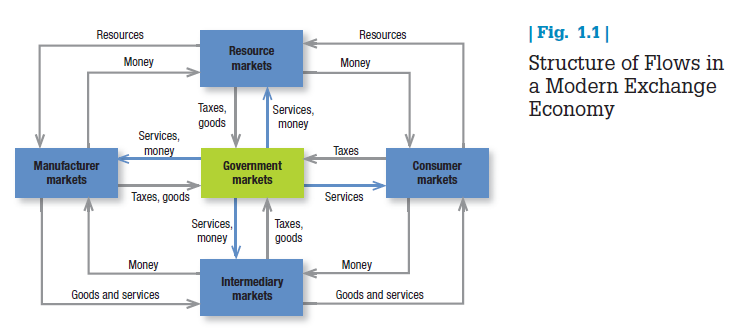
Five basic markets and their connecting flows are shown in Figure 1.1. Manufacturers go to resource markets (raw material markets, labor markets, money markets), buy resources and turn them into goods and services, and sell finished products to intermediaries, who sell them to consumers. Consumers sell their labor and receive money with which they pay for goods and services. The government collects tax revenues to buy goods from resource, manufacturer, and intermediary markets and uses these goods and services to provide public services. Each nation’s economy, and the global economy, consists of interacting sets of markets linked through exchange processes.
Marketers view sellers as the industry and use the term market to describe customer groups. They talk about need markets (the diet-seeking market), product markets (the shoe market), demographic markets (the “millennium” youth market), geographic markets (the Chinese market), or voter markets, labor markets, and donor markets.
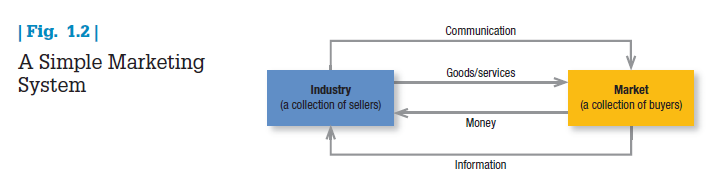
Figure 1.2 shows how sellers and buyers are connected by four flows. Sellers send goods and services and communications such as ads and direct mail to the market; in return they receive money and information such as customer attitudes and sales data. The inner loop shows an exchange of money for goods and services; the outer loop shows an exchange of information.
KEY CUSTOMER MARKETS Consider the following key customer markets: consumer, business, global, and nonprofit.
Consumer Markets Companies selling mass consumer goods and services such as juices, cosmetics, athletic shoes, and air travel establish a strong brand image by developing a superior product or service, ensuring its availability, and backing it with engaging communications and reliable performance.
Business Markets Companies selling business goods and services often face well-informed professional buyers skilled at evaluating competitive offerings. Advertising and Web sites can play a role, but the sales force, the price, and the seller’s reputation may play a greater one.
Global Markets Companies in the global marketplace navigate cultural, language, legal, and political differences while deciding which countries to enter, how to enter each (as exporter, licenser, joint venture partner, contract manufacturer, or solo manufacturer), how to adapt product and service features to each country, how to set prices, and how to communicate in different cultures.
Nonprofit and Governmental Markets Companies selling to nonprofit organizations with limited purchasing power such as churches, universities, charitable organizations, and government agencies need to price carefully. Much government purchasing requires bids; buyers often focus on practical solutions and favor the lowest bid, other things equal.16
Source: Kotler Philip T., Keller Kevin Lane (2015), Marketing Management, Pearson; 15th Edition.
The post The Scope of Marketing appeared first on HKT Consultant.
]]>The post Core Marketing Concepts appeared first on HKT Consultant.
]]>1. NEEDS, WANTS, AND DEMANDS
Needs are the basic human requirements such as for air, food, water, clothing, and shelter. Humans also have strong needs for recreation, education, and entertainment. These needs become wants when directed to specific objects that might satisfy the need. A U.S. consumer needs food but may want a Chicago-style “deep-dish” pizza and a craft beer. A person in Afghanistan needs food but may want rice, lamb, and carrots. Our wants are shaped by our society.
Demands are wants for specific products backed by an ability to pay. Many people want a Mercedes; only a few can buy one. Companies must measure not only how many people want their product, but also how many are willing and able to buy it.
These distinctions shed light on the criticism that “marketers get people to buy things they don’t want.” Marketers do not create needs: Needs pre-exist marketers. Marketers might promote the idea that a Mercedes satisfies a person’s need for social status. They do not, however, create the need for social status.
Some customers have needs of which they are not fully conscious or cannot articulate. What does the customer mean in asking for a “powerful” lawn mower or a “peaceful” hotel? The marketer must probe further. We can distinguish five types of needs:
- Stated needs (The customer wants an inexpensive car.)
- Real needs (The customer wants a car whose operating cost, not initial price, is low.)
- Unstated needs (The customer expects good service from the dealer.)
- Delight needs (The customer would like the dealer to include an onboard GPS system.)
- Secret needs (The customer wants friends to see him or her as a savvy consumer.)
Responding only to the stated need may shortchange the customer.17 Consumers did not know much about tablet computers when they were first introduced, but Apple worked hard to shape consumer perceptions of them. To gain an edge, companies must help customers learn what they want.
2. TARGET MARKETS, POSITIONING, AND SEGMENTATION
Not everyone likes the same cereal, restaurant, university, or movie. Marketers therefore identify distinct segments of buyers by identifying demographic, psychographic, and behavioral differences between them. They then decide which segment(s) present the greatest opportunities. For each of these target markets, the firm develops a market offering that it positions in target buyers’ minds as delivering some key benefit(s). Volvo develops its cars for the buyer to whom safety is a major concern, positioning them as the safest a customer can buy. Porsche targets buyers who seek pleasure and excitement in driving and want to make a statement about their wheels.

3. OFFERINGS AND BRANDS
Companies address customer needs by putting forth a value proposition, a set of benefits that satisfy those needs. The intangible value proposition is made physical by an offering, which can be a combination of products, services, information, and experiences.
A brand is an offering from a known source. A brand name such as Apple carries many different kinds of associations in people’s minds that make up its image: creative, innovative, easy-to-use, fun, cool, iPod, iPhone, and iPad to name just a few. All companies strive to build a brand image with as many strong, favorable, and unique brand associations as possible.
4. MARKETING CHANNELS
To reach a target market, the marketer uses three kinds of marketing channels. Communication channels deliver and receive messages from target buyers and include newspapers, magazines, radio, television, mail, telephone, smart phone, billboards, posters, fliers, CDs, audiotapes, and the Internet. Beyond these, firms communicate through the look of their retail stores and Web sites and other media, adding dialogue channels such as e-mail, blogs, text messages, and URLs to familiar monologue channels such as ads.
Distribution channels help display, sell, or deliver the physical product or service(s) to the buyer or user. These channels may be direct via the Internet, mail, or mobile phone or telephone or indirect with distributors, wholesalers, retailers, and agents as intermediaries.
To carry out transactions with potential buyers, the marketer also uses service channels that include warehouses, transportation companies, banks, and insurance companies. Marketers clearly face a design challenge in choosing the best mix of communication, distribution, and service channels for their offerings.
5. PAID, OWNED, AND EARNED MEDIA
The rise of digital media gives marketers a host of new ways to interact with consumers and customers. We can group communication options into three categories.18 Paid media include TV, magazine and display ads, paid search, and sponsorships, all of which allow marketers to show their ad or brand for a fee. Owned media are communication channels marketers actually own, like a company or brand brochure, Web site, blog, Facebook page, or Twitter account. Earned media are streams in which consumers, the press, or other outsiders voluntarily communicate something about the brand via word of mouth, buzz, or viral marketing methods. The emergence of earned media has allowed some companies, such as Chipotle, to reduce paid media expenditures.19
6. IMPRESSIONS AND ENGAGEMENT
Marketers now think of three “screens” or means to reach consumers: TV, Internet, and mobile. Surprisingly, the rise of digital options did not initially depress the amount of TV viewing, in part because, as one Nielsen study found, three of five consumers use two screens at once.20
Impressions, which occur when consumers view a communication, are a useful metric for tracking the scope or breadth of a communication’s reach that can also be compared across all communication types. The downside is that impressions don’t provide any insight into the results of viewing the communication.
Engagement is the extent of a customer’s attention and active involvement with a communication. It reflects a much more active response than a mere impression and is more likely to create value for the firm. Some online measures of engagements are Facebook “likes” Twitter tweets, comments on a blog or Web site, and sharing of video or other content. Engagement can extend to personal experiences that augment or transform a firm’s products and services.
7. VALUE AND SATISFACTION
The buyer chooses the offerings he or she perceives to deliver the most value, the sum of the tangible and intangible benefits and costs. Value, a central marketing concept, is primarily a combination of quality, service, and price (qsp), called the customer value triad. Value perceptions increase with quality and service but decrease with price.
We can think of marketing as the identification, creation, communication, delivery, and monitoring of customer value. Satisfaction reflects a persons judgment of a products perceived performance in relationship to expectations. If performance falls short of expectations, the customer is disappointed. If it matches expectations, the customer is satisfied. If it exceeds them, the customer is delighted.
8. SUPPLY CHAIN
The supply chain is a channel stretching from raw materials to components to finished products carried to final buyers. As Figure 1.3 shows, the supply chain for coffee may start with Ethiopian farmers who plant, tend, and pick the coffee beans and sell their harvest. If sold through a Fair Trade cooperative, the coffee is washed, dried, and packaged for shipment by an Alternative Trading Organization (ATO) that pays a minimum of $1.26 a pound. The ATO transports the coffee to the developed world where it can sell it directly or via retail channels. Each company in the chain captures only a certain percentage of the total value generated by the supply chain’s value delivery system. When a company acquires competitors or expands upstream or downstream, its aim is to capture a higher percentage of supply chain value.
Problems with a supply chain can be damaging or even fatal for a business. When Johnson & Johnson ran into manufacturing problems with its consumer products unit (which makes Tylenol and other products), it hired away from Bayer AG a top executive known for her skill at fixing consumer and supply chain problems.21

9. COMPETITION
Competition includes all the actual and potential rival offerings and substitutes a buyer might consider. An automobile manufacturer can buy steel from U.S. Steel in the United States, from a foreign firm in Japan or Korea, or from a mini-mill such as Nucor at a cost savings, or it can buy aluminum parts from Alcoa to reduce the car’s weight or engineered plastics from Saudi Basic Industries Corporation (SABIC) instead of steel. Clearly, U.S. Steel is more likely to be hurt by substitute products than by other integrated steel companies and would be defining its competition too narrowly if it didn’t recognize this.
10. MARKETING ENVIRONMENT
The marketing environment consists of the task environment and the broad environment. The task environment includes the actors engaged in producing, distributing, and promoting the offering. These are the company, suppliers, distributors, dealers, and target customers. In the supplier group are material suppliers and service suppliers, such as marketing research agencies, advertising agencies, banking and insurance companies, transportation companies, and telecommunications companies. Distributors and dealers include agents, brokers, manufacturer representatives, and others who facilitate finding and selling to customers.
The broad environment consists of six components: demographic environment, economic environment, social-cultural environment, natural environment, technological environment, and political-legal environment. Marketers must pay close attention to the trends and developments in these and adjust their marketing strategies as needed. New opportunities are constantly emerging that await the right marketing savvy and ingenuity. Consider Pinterest.22
PINTEREST One of the fastest-growing social media sites ever-its surpassed 10 million monthly unique U.S. visitors in January 2012 and doubled that just four months later-Pinterest is a visual bookmarking tool that lets users collect and share images of projects or products on digital scrapbooks or “pinboards.” Especially popular with women planning weddings, saving recipes, and designing kitchen upgrades, Pinterest has driven more traffic to websites in a month than Twitter, Google+, LinkedIn, and YouTube combined. Part of its appeal is its unique customizable grid of images. Pinterest’s sweet spot is that users are often in a shopping mindset; one study showed almost 70% of online purchasers who found a product via Pinterest went on to buy, compared to 40% for Facebook. Brands from Dell and Mercedes-Benz to Peanut Butter & Co. and Zombie SAK are integrating the site into their social media strategies. Nevertheless, Pinterest is still exploring how to best monetize its business venture.
Source: Kotler Philip T., Keller Kevin Lane (2015), Marketing Management, Pearson; 15th Edition.
The post Core Marketing Concepts appeared first on HKT Consultant.
]]>The post The New Marketing Realities appeared first on HKT Consultant.
]]>1. TECHNOLOGY
The pace of change and the scale of technological achievement can be staggering. The number of mobile phones in India recently exceeded 500 million, Facebook’s monthly users passed 1 billion, and more than half of African urban residents were able to access the Internet monthly.23
With the rapid rise of e-commerce, the mobile Internet, and Web penetration in emerging markets, the Boston Consulting Group believes brand marketers must enhance their “digital balance sheets.” 24 Massive amounts of information and data about almost everything are now available to consumers and marketers. In fact, technology research specialists Gartner predicts that by 2017, CMOs will spend more time on information technology (IT) than chief information officers (CIOs). Aetna’s CMO and CIO have already collaborated successfully for years, launching new products and services including iTriage, a popular health app for the iPhone. With iTriage, users can research ailments, find nearby physicians, and learn about prescribed medicines.25 Procter & Gamble (P&G) is determined to stay ahead of technology trends.26
P&G P&G uses the latest Web-based tools in all 80 countries where it sells products: ubiquitous high-speed networking, data visualization, and high-speed analysis of multiple information streams. In 40 locations worldwide, a massive business sphere can display real-time market share, profits, and prices by country, region, brand, and product. Tide laundry detergent has a dedicated “news desk” that monitors social media chatter and joins in when relevant. When Tide was used to clean up a nasty fuel spill in a NASCAR race, the brand ran social media ads with real news footage within 72 hours. P&G looks at a wide range of technology applications. One pilot study showed that field salespeople increased revenue 1.5 percent merely by using iPads to show store customers the layouts of different floor displays.
The old credo “information is power” is giving way to the new idea that “sharing information is power.”27 Software giant SAP’s online community numbers more than 2 million customers, partners, and others. Once a year, 100 are chosen to contribute ideas to product development.28
At the other end of the size spectrum, by running Facebook ads offering a free cut, shampoo, and hot towel treatment to new customers in exchange for name, phone number, e-mail address, and preferred social network, The Gent’s Place barbershop in Frisco, TX, has picked up 5,000 clients. Its average marketing cost for each was $10.13, which it quickly recoups from repeat purchases.29
Even traditional marketing activities are profoundly affected by technology. To improve sales force effectiveness, drug maker Roche decided to issues iPads to its entire sales team. Though the company had a sophisticated customer relationship management (CRM) software system before, it still depended on sales reps to accurately input data in a timely fashion, which unfortunately did not always happen. With iPads, however, sales teams can do real-time data entry, improving the quality of the data entered while freeing up time for other tasks.30
2. GLOBALIZATION
The world has become a smaller place. New transportation, shipping, and communication technologies have made it easier for us to know the rest of the world, to travel, to buy and sell anywhere. By 2025, annual consumption in emerging markets will total $30 trillion and contribute more than 70 percent of global GDP growth.31 A staggering 56 percent of global financial services consumption is forecast to come from emerging markets by 2050, up from 18 percent in 2010.
Demographic trends favor developing markets such as India, Pakistan, and Egypt, with populations whose median age is below 25. In terms of growth of the middle class, defined as earning more than $3,000 per year, the Philippines, China, and Peru are the three fastest-growing countries.32
Globalization has made countries increasingly multicultural. U.S. minorities have much economic clout, and their buying power is growing faster than that of the general population. According to the University of Georgia’s Terry College of Business minority buying report, the combined buying power of U.S. racial minorities (African Americans, Asians, and Native Americans) is projected to rise from $1.6 trillion in 2010 to $2.1 trillion in 2015, accounting for 15 percent of the nation’s total. The buying power of U.S. Hispanics will rise from $1 trillion in 2010 to $1.5 trillion in 2015, nearly 11 percent of the nation’s total. One survey found that 87 percent of companies planned to increase or maintain multicultural media budgets.33
Globalization changes innovation and product development as companies take ideas and lessons from one country and apply them to another. After years of little success with its premium ultrasound scanners in the Chinese market, GE successfully developed a portable, ultra-low-cost version that addressed the country’s unique market needs. Later, it began to successfully sell the product throughout the developed world for use in ambulances and operating rooms where existing models were too big.34
3. SOCIAL RESPONSIBILITY
Poverty, pollution, water shortages, climate change, wars, and wealth concentration demand our attention. The private sector is taking some responsibility for improving living conditions, and firms all over the world have elevated the role of corporate social responsibility.
Because marketing’s effects extend to society as a whole, marketers must consider the ethical, environmental, legal, and social context of their activities.35 “Marketing Insight: Getting to Marketing 3.0” describes how companies need to change to do that.
The organization’s task is thus to determine the needs, wants, and interests of target markets and satisfy them more effectively and efficiently than competitors while preserving or enhancing consumers’ and society’s longterm well-being.
As goods become more commoditized and consumers grow more socially conscious, some companies—including The Body Shop, Timberland, and Patagonia—incorporate social responsibility as a way to differentiate themselves from competitors, build consumer preference, and achieve notable sales and profit gains.
4. Marketing insight: Getting to Marketing 3.0
Philip Kotler, Hermawan Kartayaya, and Iwan Setiawan believe today’s customers want marketers to treat them as whole human beings and acknowledge that their needs extend beyond pure consumerism. Successful marketing is thus distinguished by its human or emotional element. A third wave of thinking, values-driven and heralded as “Marketing 3.0,” has moved us beyond the productcentric and consumer-centric models of the past, these authors say. Its three central trends are increased consumer participation and collaborative marketing, globalization, and and the rise of a creative society.
- We live with sustained technological development—low-cost Internet, cheap computers and mobile phones, open source services and systems. Expressive and collaborative social media, such as Facebook and Wikipedia, have changed the way marketers operate and interact with consumers.
- Culturally relevant brands can have far-reaching effects. A cultural brand might position itself as a national or local alternative to a global brand with poor environmental standards, for instance.
- Creative people are increasingly the backbone of developed economies. Marketing can now help companies tap into creativity and spirituality by instilling marketing values in corporate culture, vision, and mission.
These authors believe the future of marketing will be horizontal: consumer-to-consumer. They feel the recent economic downturn has not fostered trust in the marketplace and that customers now increasingly turn to one another for credible advice and information when selecting products.
Sources: Philip Kotler, Hermawan Kartajaya, and Iwan Setiawan, Marketing 3.0: From Products to Customers to the Human Spirit (Hoboken, NJ: Wiley, 2010); Michael Krauss, “Evolution of an Academic: Kotler on Marketing 3.0,” Marketing News, January 30, 2011; Vivek Kaul, “Beyond Advertising: Philip Kotler Remains One of the Most Influential Marketing Thinkers,” The Economic Times, February 29, 2012. For more stimulating related ideas, see also Jim Stengel, Grow: How Ideals Power Growth and Profit at the World’s Greatest Companies (New York: Crown, 2011).
Source: Kotler Philip T., Keller Kevin Lane (2015), Marketing Management, Pearson; 15th Edition.
The post The New Marketing Realities appeared first on HKT Consultant.
]]>The post A Dramatically Changed Marketplace appeared first on HKT Consultant.
]]>1. NEW CONSUMER CAPABILITIES
Social media is an explosive worldwide phenomenon. In Germany, the percentage of consumers over 65 accessing the Internet increased from 24 percent to 33 percent from 2011 to 2012; most belonged to a social media service. The number of Germans browsing the Web wirelessly increased to 29 million in 2012 and was expected to hit 60 million in 2016. More than 10 percent of Germans were using tablets to access the Internet in 2012. Almost two- thirds of German companies surveyed in 2012 reported positive payback to their social media activities (Facebook, Twitter, social media newsrooms, customer feedback communities).37
Empowerment is not just about technology, though. Consumers are willing to move to another brand if they think they are not being treated right or do not like what they are seeing, as Progressive Insurance found out.38
PROGRESSIVE INSURANCE Kate Fisher, a Progressive customer, was killed by an underinsured driver who ran a red light. Her family felt they had to sue the driver for negligence to prompt Progressive to make up what the driver could not pay. Matt Fisher, Kate’s brother, was furious when Progressive actively participated in the negligent driver’s legal defense. His Tumblr post, “My Sister Paid Progressive Insurance to Defend Her Killer in Court,” was picked up by media outlets and sparked public outrage on Progressive’s Facebook and Twitter pages. More than 1,000 customers reported dropping Progressive, and many more said they would not do business with the company. Although Progressive felt it had defensible business reasons for its actions, critics were enraged by its awkward responses, like: “We fully investigated this claim and relevant background and feel we properly handled the claim within our contractual obligations.” After a few tumultuous days, Progressive reportedly settled with the Fishers for tens of thousands of dollars more than the $76,000 they had sought.
Expanded information, communication, and mobility enable customers to make better choices and share their preferences and opinions with others around the world. Table 1.2 summarizes some of the new consumer capabilities we outline next.
- Consumers can use the Internet as a powerful information and purchasing aid.From the home, office, or mobile phone, they can compare product prices and features, consult user reviews, and order goods online from anywhere in the world 24 hours a day, seven days a week, bypassing limited local offerings and realizing significant price savings. They can also engage in “showrooming”: comparing products in stores but buying online.39 Because consumers and other constituents can in fact track down virtually any kind of company information, firms now realize that transparency in corporate words and actions is of paramount importance.
- Consumers can search, communicate, and purchase on the move.Consumers increasingly integrate smart phones and tablets into their daily lives. One study found the majority of European smart phone owners use their devices to research products and make purchases.40 There is one cell phone for every two people on the planet—and 10 times more cell phones are produced globally each day than babies are born. Telecommunications is one of the world’s trillion-dollar industries, along with tourism, military, food, and automobiles.41
- Consumers can tap into social media to share opinions and express loyalty.Personal connections and usergenerated content thrive on social media such as Facebook, Flickr, Wikipedia, and YouTube. Sites like Dogster for dog lovers, TripAdvisor for travelers, and Moterus for bikers bring together consumers with a common interest. At CarSpace.com, auto enthusiasts talk about chrome rims, the latest BMW model, and where to find a great local mechanic.
- Consumers can actively interact with companies.Consumers see their favorite companies as workshops from which to draw out the offerings they want. By opting in or out of lists, they can receive marketing and sales-related communications, discounts, coupons, and other special deals. With smart phones, they can scan barcodes and QR (Quick Response) codes to access a brand’s Web site and other information.42
- Consumers can reject marketing they find inappropriate.Some customers today may see fewer product differences and feel less brand loyal. Others may become more price- and quality-sensitive in their search for value. Almost two-thirds of consumers in one survey reported that they disliked advertising.43 For these and other reasons, consumers can be less tolerant about undesired marketing. They can choose to screen out online messages, skip commercials with their DVRs, and avoid marketing appeals through the mail or over the phone.

2. NEW COMPANY CAPABILITIES
At the same time, globalization, social responsibility, and technology have also generated a new set of capabilities to help companies cope and respond (see Table 1.3).
- Companies can use the Internet as a powerful information and sales channel, including for individually differentiated goods. A Web site can list products and services, history, business philosophy, job opportunities, and other information of interest to consumers worldwide. Solo Cup marketers note that linking their storefronts to their Web site and Facebook page makes it easier for consumers to buy Solo paper cups and plates while engaging with the brand online.44 Thanks to advances in factory customization, computer technology, and database marketing software, companies can allow customers to buy M&M candies with their names on them, Wheaties boxes or Jones soda cans with their picture on the front, and Heinz ketchup bottles with customized messages.45
- Companies can collectfuller and richer information about markets, customers, prospects, and competitors. Marketers can conduct fresh marketing research by using the Internet to arrange focus groups, send out questionnaires, and gather primary data in several other ways. They can assemble information about individual customers’ purchases, preferences, demographics, and profitability. The drugstore chain CVS uses loyalty-card data to better understand what consumers purchase, the frequency of store visits, and other buying preferences. Its ExtraCare program supports 69 million shoppers in more than 7,300 stores. Eighty-two percent of CVS’s front store (non-pharmacy) sales go through the ExtraCare program.
- Companies can reach consumers quickly and efficiently via social media and mobile marketing, sending targeted ads, coupons, and information.GPS technology can pinpoint consumers’ exact location, letting marketers send them messages at the mall with wish-list reminders and coupons or offers good only that day. Location- based advertising is attractive because it reaches consumers closer to the point of sale. Social media and buzz are also powerful. Over a two-year period, Dell took in more than $2 million in U.S. revenue from coupons provided through Twitter and another $1 million from people who started at Twitter and bought a new computer on Dell’s Web site. By mid-2012, the @DellOutlet Twitter account had more than 1.6 million followers.47 Word-of-mouth marketing agency BzzAgent recruited 600,000 consumers who voluntarily join promotional programs for products and services they deem worth talking about.
- Companies can improve purchasing, recruiting, training, and internal and external communications. Firms can recruit new employees online, and many have Internet training products for their employees, dealers, and agents. Blogging has waned as companies embrace social media. “We want to be where our customers are” said Bank of America after dropping its blog in favor of Facebook and Twitter.48 Farmers Insurance uses specialized software to help its 15,000 agents nationwide maintain their own Facebook pages.49 Via intranets and databases, employees can query one another, seek advice, and exchange information. Seeking a single online employee portal that transcended business units, General Motors launched a platform called mySocrates in 2006 to carry announcements, news, links, and historical information. GM credits the portal with $17.4 million in cost savings to date.50 Popular hybrid Twitter/Facebook-type products designed especially for business employees have been introduced by Salesforce.com, IBM, and several start-ups.51
- Companies can improve their cost efficiency. Corporate buyers can achieve substantial savings by using the Internet to compare sellers’ prices and purchase materials at auction or by posting their own terms in reverse auctions. Companies can improve logistics and operations to reap substantial cost savings while improving accuracy and service quality. Small businesses can especially unleash the power of the Internet. Physicians operating a small practice can use Facebook-like services such as Doximity to connect with referring physicians and specialists.

3. CHANGING CHANNELS
One of the reasons consumers have more choices is that channels of distribution have changed as a result of retail transformation and disintermediation.
- Retail transformation. Store-based retailers face competition from catalog houses; direct-mail firms; newspaper, magazine, and TV direct-to-customer ads; home shopping TV; and e-commerce. In response, entrepreneurial retailers are building entertainment into their stores with coffee bars, demonstrations, and performances, marketing an “experience” rather than a product assortment.
- Disintermediation. Early dot-coms such as Amazon.com, E*TRADE, and others successfully created disintermediation in the delivery of products and services by intervening in the traditional flow of goods. In response, traditional companies engaged in reintermediation and became “brick-and-click” retailers, adding online services to their offerings. Some with plentiful resources and established brand names became stronger contenders than pure-click firms.
4. HEIGHTENED COMPETITION
While globalization has created intense competition among domestic and foreign brands, the rise of private labels and mega-brands and a trend toward deregulation and privatization have also increased competition.
- Private labels. Brand manufacturers are further buffeted by powerful retailers that market their own store brands, increasingly indistinguishable from any other type of brand.
- Mega-brands. Many strong brands have become mega-brands and extended into related product categories, including new opportunities at the intersection of two or more industries. Computing, telecommunications, and consumer electronics are converging, with Apple and Samsung releasing a stream of state-of-the-art devices from MP3 players to LCD TVs to fully loaded smart phones.
- Deregulation. Many countries have deregulated industries to create greater competition and growth opportunities. In the United States, laws restricting financial services, telecommunications, and electric utilities have all been loosened in the spirit of greater competition.
- Privatization. Many countries have converted public companies to private ownership and management to increase their efficiency. The telecommunications industry has seen much privatization in countries such as Australia, France, Germany, Italy, Turkey, and Japan.
Source: Kotler Philip T., Keller Kevin Lane (2015), Marketing Management, Pearson; 15th Edition.
The post A Dramatically Changed Marketplace appeared first on HKT Consultant.
]]>The post Marketing in Practice appeared first on HKT Consultant.
]]>1. MARKETING BALANCE
Companies must always move forward, innovating products and services, staying in touch with customer needs, and seeking new advantages rather than relying on past strengths. India’s Hindustan Unilever asks all staff members— not just marketers—to obtain a “consumer license” to work on its brands, which requires spending 50 hours of face time with shoppers. As one senior executive noted, “Our consumers are moving faster than marketers do; whether in terms of rural or urban changes or the way they consume media and entertainment.”54 Moving forward especially means incorporating the Internet and digital efforts into marketing plans. Marketers must balance increased spending on search advertising, social media, e-mails, and text messages with appropriate spending on traditional marketing communications. But they must do so in tough economic times, when accountability has become a top priority and returns on investment are expected from every marketing activity. The ideal is retaining win- Coca-Cola reinforces its message of happiness with special ning practices from the past while adding fresh approaches that reflect the new promotional “Hug Me” vending machines which dispense marketing realities.
2. MARKETING MEMO Reinventing Marketing at Coca-Cola
Coca-Cola is fundamentally changing the way it does marketing, primarily by adding a strong digital component to its traditional marketing tools. The new model is based on moving consumers from impressions to expressions to conversations to transactions.
Coca-Cola defines consumer expressions as any level of engagement with brand content: a comment, “like,” or share on Facebook, a Tweet, or an uploaded photo or video. Coca-Cola strives to put strongly sharable pieces of communications online that will generate impressions but also lead to expressions from consumers who join or extend the communication storyline and ultimately buy the product.
These communications focus on the core themes of “happiness” and “optimism” that define the brand’s positioning. One successful application is the video of the “Hug Me” vending machine in Singapore that dispensed cans of Coke when people put their arms around it and hugged it. Within in a week, the video generated 112 million impressions.
Coca-Cola actively experiments, allocating 70 percent of its budget to activities it knows will work, 20 percent to improving those activities, and 10 percent to experimentation. The company accepts that experiments can fail but believes in taking chances to learn and develop better solutions. Even in its traditional advertising and promotion, it looks for innovation.
For instance, Coca-Cola places much importance on cultural leadership and causes that benefit others. The mission of its Artic Home project is to protect the habitat of polar bears—who have starred in animated form in its holiday ads for years. Committing $3 million to the World Wildlife Fund, Coca-Cola drew attention to the project by turning its traditional red cans white.
Sources: Joe Tripodi, “Coca-Cola Marketing Shifts from Impressions to Expressions,” Harvard Business Review, HBR Blog Network, April 27, 2011; Tim Nudd, “Coca-Cola Joins the Revolution in World Where the Mob Rules,” Adweek, June 19, 2012; Surajeet Das Gupta and Vivea Susan Pinto, “Q&A: Joseph Tripodi,” Business Standard, November 3, 2011; “Coca-Cola Sets Facebook Record,” www.warc.com, September 6, 2012.
3. MARKETING ACCOUNTABILITY
Marketers are increasingly asked to justify their investments in financial and profitability terms, as well as in terms of building the brand and growing the customer base. Organizations recognize that much of their market value comes from intangible assets, particularly brands, customer base, employees, distributor and supplier relations, and intellectual capital. They are thus applying more metrics—brand equity, customer lifetime value, return on marketing investment (ROMI)—to understand and measure their marketing and business performance and a broader variety of financial measures to assess the direct and indirect value their marketing efforts create.
4. MARKETING IN THE ORGANIZATION
As the late David Packard of Hewlett-Packard observed, “Marketing is far too important to leave to the marketing department.” Increasingly, marketing is not done only by the marketing department; every employee has an impact on the customer. Marketers now must properly manage all possible touch points: store layouts, package designs, product functions, employee training, and shipping and logistics. To create a strong marketing organization, marketers must think like executives in other departments, and executives in other departments must think more like marketers. Interdepartmental teamwork that includes marketers is needed to manage key processes like production innovation, new-business development, customer acquisition and retention, and order fulfillment.
Source: Kotler Philip T., Keller Kevin Lane (2015), Marketing Management, Pearson; 15th Edition.
The post Marketing in Practice appeared first on HKT Consultant.
]]>The post Company Orientation toward the Marketplace appeared first on HKT Consultant.
]]>1. THE PRODUCTION CONCEPT
The production concept is one of the oldest concepts in business. It holds that consumers prefer products that are widely available and inexpensive. Managers of production-oriented businesses concentrate on achieving high production efficiency, low costs, and mass distribution. This orientation has made sense in developing countries such
as China, where the largest PC manufacturer, Legend (principal owner of Lenovo Group), and domestic appliances giant Haier have taken advantage of the country’s huge and inexpensive labor pool to dominate the market. Marketers also use the production concept when they want to expand the market.
2. THE PRODUCT CONCEPT
The product concept proposes that consumers favor products offering the most quality, performance, or innovative features. However, managers are sometimes caught in a love affair with their products. They might commit the “better- mousetrap” fallacy, believing a better product will by itself lead people to beat a path to their door. As many start-ups have learned the hard way, a new or improved product will not necessarily be successful unless it’s priced, distributed, advertised, and sold properly.
3. THE SELLING CONCEPT
The selling concept holds that consumers and businesses, if left alone, won’t buy enough of the organization’s products. It is practiced most aggressively with unsought goods—goods buyers don’t normally think of buying such as insurance and cemetery plots—and when firms with overcapacity aim to sell what they make, rather than make what the market wants. Marketing based on hard selling is risky. It assumes customers coaxed into buying a product not only won’t return or bad-mouth it or complain to consumer organizations but might even buy it again.
4. THE MARKETING CONCEPT
The marketing concept emerged in the mid-1950s as a customer-centered, sense-and-respond philosophy. The job is to find not the right customers for your products, but the right products for your customers. Dell doesn’t prepare a PC or laptop for its target market. Rather, it provides product platforms on which each person customizes the features he or she desires in the machine.
The marketing concept holds that the key to achieving organizational goals is being more effective than competitors in creating, delivering, and communicating superior customer value to your target markets. Harvard’s Theodore Levitt drew a perceptive contrast between the selling and marketing concepts: 56
Selling focuses on the needs of the seller; marketing on the needs of the buyer. Selling is preoccupied with the seller’s need to convert his product into cash; marketing with the idea of satisfying the needs of the customer by means of the product and the whole cluster of things associated with creating, delivering, and finally consuming it.
5. THE HOLISTIC MARKETING CONCEPT
Without question, the trends and forces that have defined the new marketing realities in the first years of the 21st century are leading business firms to embrace a new set of beliefs and practices. The holistic marketing concept is based on the development, design, and implementation of marketing programs, processes, and activities that recognize their breadth and interdependencies. Holistic marketing acknowledges that everything matters in mar- keting—and that a broad, integrated perspective is often necessary.
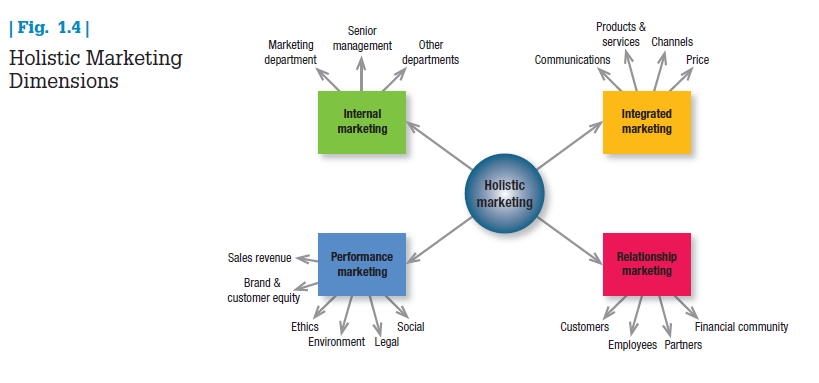
Holistic marketing thus recognizes and reconciles the scope and complexities of marketing activities. Figure 1.4 provides a schematic overview of four broad components characterizing holistic marketing: relationship marketing, integrated marketing, internal marketing, and performance marketing. We’ll examine these major themes throughout this book.
RELATIONSHIP MARKETING Increasingly, a key goal of marketing is to develop deep, enduring relationships with people and organizations that directly or indirectly affect the success of the firm’s marketing activities. Relationship marketing aims to build mutually satisfying long-term relationships with key constituents in order to earn and retain their business.
Four key constituents for relationship marketing are customers, employees, marketing partners (channels, suppliers, distributors, dealers, agencies), and members of the financial community (shareholders, investors, analysts). Marketers must create prosperity among all these constituents and balance the returns to all key stakeholders. To develop strong relationships with them requires understanding their capabilities and resources, needs, goals, and desires.
The ultimate outcome of relationship marketing is a unique company asset called a marketing network, consisting of the company and its supporting stakeholders—customers, employees, suppliers, distributors, retailers, and others—with whom it has built mutually profitable business relationships. The operating principle is simple: build an effective network of relationships with key stakeholders, and profits will follow. Thus more companies are choosing to own brands rather than physical assets, and they are subcontracting activities to firms that can do them better and more cheaply while retaining core activities at home.
Companies are also shaping separate offers, services, and messages to individual customers, based on information about their past transactions, demographics, psychographics, and media and distribution preferences. By focusing on their most profitable customers, products, and channels, these firms hope to achieve profitable growth, capturing a larger share of each customer’s expenditures by building high customer loyalty. They estimate individual customer lifetime value and design their market offerings and prices to make a profit over the customer’s lifetime.
Marketing must skillfully conduct not only customer relationship management (CRM), but partner relationship management (PRM) as well. Companies are deepening their partnering arrangements with key suppliers and distributors, seeing them as partners in delivering value to final customers so everybody benefits. IBM is a business-to-business powerhouse that has learned the value of strong customer bonds.57
IBM Having celebrated its 100th corporate anniversary in 2011, IBM is a remarkable survivor that has maintained market leadership for decades in the challenging technology industry. The company has managed to successfully evolve its business and seamlessly update the focus of its products and services numerous times in its history— from mainframes to PCs to its current emphasis on cloud computing, “big data,” and IT services. Part of the reason is that IBM’s well-trained sales force and service organization offer real value to customers by staying close to them and fully understanding their requirements. IBM often even cocreates products with customers; with the state of New York it developed a method for detecting tax evasion that reportedly saved taxpayers $1.6 billion over a seven-year period. As famed Harvard Business School professor Rosabeth Moss Kanter has noted, “IBM is not a technology company but a company solving problems using technology.”
INTEGRATED MARKETING Integrated marketing occurs when the marketer devises marketing activities and assembles marketing programs to create, communicate, and deliver value for consumers such that “the whole is greater than the sum of its parts.” Two key themes are that (1) many different marketing activities can create, communicate, and deliver value and (2) marketers should design and implement any one marketing activity with all other activities in mind. When a hospital buys an MRI machine from General Electric’s Medical Systems division, for instance, it expects good installation, maintenance, and training services to go with the purchase.
The company must develop an integrated channel strategy. It should assess each channel option for its direct effect on product sales and brand equity, as well as its indirect effect through interactions with other channel options.
All company communications also must be integrated so communication options reinforce and complement each other. A marketer might selectively employ television, radio, and print advertising, public relations and events, and PR and Web site communications so each contributes on its own and improves the effectiveness of the others. Each must also deliver a consistent brand message at every contact. Consider this award-winning campaign for Iceland.58
ICELAND Already reeling from some of the biggest losses in the global financial crisis in 2008, Iceland faced more misfortune when dormant volcano Eyjafjallajokull unexpectedly erupted in April 2010. Its enormous plumes of ash created the largest air-travel disruption since World War II, resulting in a wave of negative press and bad feelings throughout Europe and elsewhere. With tourism generating around 20 percent of the country’s foreign exchange and bookings plummeting, government and tourism officials decided to launch “Inspired by Iceland.” This campaign was based on the insight that 80 percent of visitors to Iceland recommend the destination to friends and family. The country’s own citizens were recruited to tell their stories and encourage others to join in via a Web site or Twitter, Facebook, and Vimeo. Celebrities such as Yoko Ono and Eric Clapton shared their experiences, and live concerts generated PR. Real-time Web cams across the country showed that the country was not ash-covered but green. The campaign was wildly successful—22.5 million stories were created by people all over the world—and ensuing bookings were dramatically above forecasts.
INTERNAL MARKETING Internal marketing, an element of holistic marketing, is the task of hiring, training, and motivating able employees who want to serve customers well. Smart marketers recognize that marketing activities within the company can be as important—or even more important—than those directed outside the company. It makes no sense to promise excellent service before the company’s staff is ready to provide it.
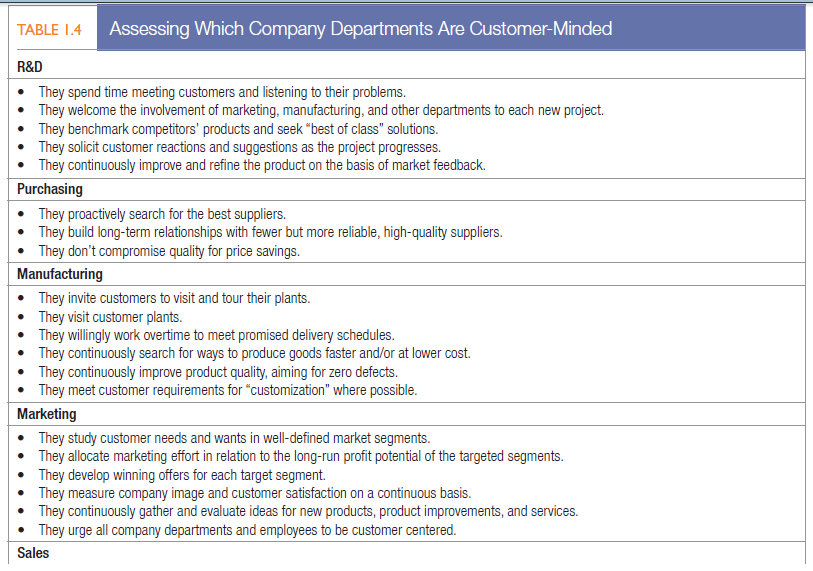
Marketing succeeds only when all departments work together to achieve customer goals (see Table 1.4): when engineering designs the right products, finance furnishes the right amount of funding, purchasing buys the right materials, production makes the right products in the right time horizon, and accounting measures profitability in the right ways. Such interdepartmental harmony can only truly coalesce, however, when senior management clearly communicates a vision of how the company’s marketing orientation and philosophy serve customers. The following example highlights some of the potential challenge in integrating marketing:
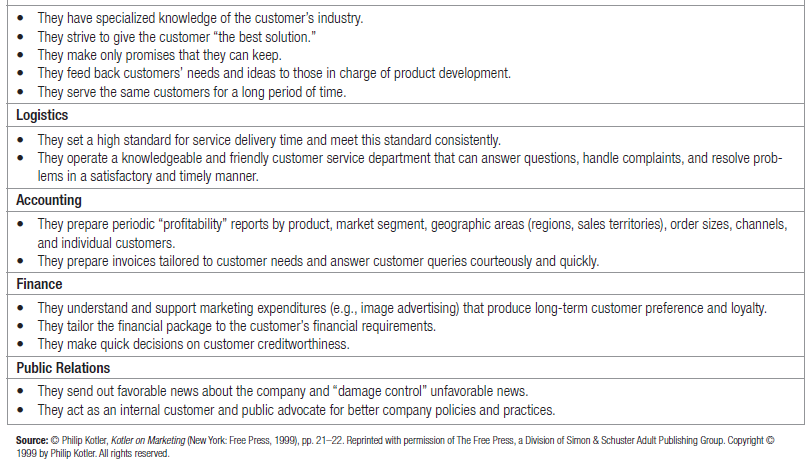
The marketing vice president of a major European airline wants to increase the airline’s traffic share. His strategy is to build up customer satisfaction by providing better food, cleaner cabins, better-trained cabin crews, and lower fares, yet he has no authority in these matters. The catering department chooses food that keeps food costs down; the maintenance department uses inexpensive cleaning services; the human resources department hires people without regard to whether they are naturally friendly; the finance department sets the fares. Because these departments generally take a cost or production point of view, the vice president of marketing is stymied in his efforts to create an integrated marketing program.
Internal marketing requires vertical alignment with senior management and horizontal alignment with other departments so everyone understands, appreciates, and supports the marketing effort.
PERFORMANCE MARKETING Performance marketing requires understanding the financial and nonfinancial returns to business and society from marketing activities and programs. As noted previously, top marketers are increasingly going beyond sales revenue to examine the marketing scorecard and interpret what is happening to market share, customer loss rate, customer satisfaction, product quality, and other measures. They are also considering the legal, ethical, social, and environmental effects of marketing activities and programs.
When they founded Ben & Jerry’s, Ben Cohen and Jerry Greenfield embraced the performance marketing concept by dividing the traditional financial bottom line into a “double bottom line” that also measured the environmental impact of their products and processes. That later expanded into a “triple bottom line” to represent the social impacts, negative and positive, of the firm’s entire range of business activities.
Many firms have failed to live up to their legal and ethical responsibilites, and consumers are demanding more responsible behavior.59 One research study reported that at least one-third of consumers around the world believed that banks, insurance providers, and packaged-food companies should be subject to stricter regulation.60
Source: Kotler Philip T., Keller Kevin Lane (2015), Marketing Management, Pearson; 15th Edition.
The post Company Orientation toward the Marketplace appeared first on HKT Consultant.
]]>The post Updating the Four Ps Marketing mix appeared first on HKT Consultant.
]]>A complementary view of the four Ps can be found in Marketing Insight: Understanding the 4 As of Marketing,”
Given the breadth, complexity, and richness of marketing, however—as exemplified by holistic marketing— clearly these four Ps are not the whole story anymore. If we update them to reflect the holistic marketing concept, we arrive at a more representative set that encompasses modern marketing realities: people, processes, programs, and performance, as in Figure 1.6.

People reflects, in part, internal marketing and the fact that employees are critical to marketing success. Marketing will only be as good as the people inside the organization. It also reflects the fact that marketers must view consumers as people to understand their lives more broadly, and not just as shoppers who consume products and services.
Processes reflects all the creativity, discipline, and structure brought to marketing management. Marketers must avoid ad hoc planning and decision making and ensure that state-of-the-art marketing ideas and concepts play an appropriate role in all they do, including creating mutually beneficial long-term relationships and imaginatively generating insights and breakthrough products, services, and marketing activities.

Programs reflects all the firm’s consumer-directed activities. It encompasses the old four Ps as well as a range of other marketing activities that might not fit as neatly into the old view of marketing. Regardless of whether they are online or offline, traditional or nontraditional, these activities must be integrated such that their whole is greater than the sum of their parts and they accomplish multiple objectives for the firm.
We define performance as in holistic marketing, to capture the range of possible outcome measures that have financial and nonfinancial implications (profitability as well as brand and customer equity) and implications beyond the company itself (social responsibility, legal, ethical, and the environment).
Finally, these new four Ps actually apply to all disciplines within the company, and by thinking this way, managers more closely align themselves with the rest of the company.
MARKETING INSIGHT Understanding the 4 As of Marketing
According to Jagdish Sheth and Rajendra Sisodia, poor management as a consequence of not knowing what drives consumers is behind the majority of marketing failures. The authors make the case that consumer knowledge is a much more reliable route to success. Their customer-centric marketing management framework emphasizes what they believe are the most important consumer values—acceptability, affordability, accessibility, and awareness—which they dub the four As.
Acceptability
Acceptability is the extent to which a firm’s total product offering exceeds customer expectations. The authors assert that Acceptability is the dominant component in the framework and that design, in turn, is at the root of acceptability. Functional aspects of design can be boosted by, for instance, enhancing the core benefit or increasing reliability of the product; psychological acceptability can be improved with changes to brand image, packing and design, and positioning.
Affordability
Affordability is the extent to which customers in the target market are able and willing to pay the product’s price. It has two dimensions: economic (ability to pay) and psychological (willingness to pay). Acceptability combined with affordability determines the product’s value proposition. When Peachtree Software lowered the price of its accounting software from $5000 to $199 and started charging for customer support, sales demand increased enormously.
Accessibility
Accessibility, the extent to which customers are able to readily acquire the product, has two dimensions: availability and convenience. Successful companies develop innovative ways to deliver both, as online shoe retailer Zappos does with excellent customer service and return policies and its tracking of up-to-the-minute information about warehouse stock, brands, and styles.
Awareness
Awareness is the extent to which customers are informed regarding the product’s characteristics, persuaded to try it, and reminded to repurchase. It has two dimensions: brand awareness and product knowledge. Sheth and Sisodia say awareness is ripest for improvement because most companies are either ineffectual or inefficient at developing it. For instance, properly done advertising can be incredibly powerful, but word-of-mouth marketing and co-marketing can more effectively reach potential customers.
Sheth and Sisodia base the 4 As framework on the four distinctive roles a consumer plays in the marketplace—seeker, buyer, payer, and user. A fifth consumer role—evangelizer—captures the fact that consumers often recommend products to others and are increasingly critical with the advent of the Internet and social media platforms.
Note that we can easily relate the 4 As to the traditional 4 Ps. Marketers set the product (which mainly influences acceptability), the price (which mainly influences affordability), the place (which mainly influences accessibility), and promotion (which mainly influences awareness).
Sources: Jagdish N. Sheth and Rajendra Sisodia, The 4 A’s of Marketing:
Creating Value for Customer, Company and Society (New York: Routledge, 2012); “New Rules: Jagdish Sheth Outlines 4A’s of Marketing,” The Financial Express, April 6, 2004; “Industry Leaders Discuss Marketing for Not for Profit Organizations @ BIMTECH Marketing Summit,” www.mbauniverse.com, May 1,2012.
Source: Kotler Philip T., Keller Kevin Lane (2015), Marketing Management, Pearson; 15th Edition.
The post Updating the Four Ps Marketing mix appeared first on HKT Consultant.
]]>The post Marketing Management Tasks appeared first on HKT Consultant.
]]>Zeus Inc. (name disguised) operates in several industries, including chemicals, cameras, and film. The company is organized into SBUs. Corporate management is considering what to do with its Atlas camera division, which produces a range of professional quality 35mm and consumer-friendly digital cameras. Although Zeus has a sizable share and is producing revenue, the 35mm market is rapidly declining at an accelerating rate. In the much faster-growing digital camera segment, Zeus faces strong competition and has been slow to gain sales. Zeus’s corporate management wants Atlas’s marketing group to produce a strong turnaround plan for the division.
1. DEVELOPING MARKETING STRATEGIES AND PLANS
The first task facing Atlas is to identify its potential long-run opportunities, given its market experience and core competencies (see Chapter 2). Atlas can design its cameras with better features. It can make a line of digital video cameras, or it can use its core competency in optics to design a line of binoculars and telescopes. Whichever direction it chooses, it must develop concrete marketing plans that specify the marketing strategy and tactics going forward.

2. CAPTURING MARKETING INSIGHTS
Atlas needs a reliable marketing information system to closely monitor its marketing environment so it can continually assess market potential and forecast demand. Its microenvironment consists of all the players who affect its ability to produce and sell cameras—suppliers, marketing intermediaries, customers, and competitors. Its macro environment includes demographic, economic, physical, technological, political-legal, and social-cultural forces that affect sales and profits (see Chapter 3).
Atlas also needs a dependable marketing research system. To transform strategy into programs, marketing managers must make basic decisions about their expenditures, activities, and budget allocations. They may use sales-response functions that show how the amount of money spent in each application will affect sales and profits (see Chapter 4).
3. CONNECTING WITH CUSTOMERS
Atlas must consider how to best create value for its chosen target markets and develop strong, profitable, long-term relationships with customers (see Chapter 5). To do so, it needs to understand consumer markets (see Chapter 6). Who buys cameras, and why? What features and prices are they looking for, and where do they shop? Atlas also sells 35mm cameras to business markets, including large corporations, professional firms, retailers, and government agencies (see Chapter 7), where purchasing agents or buying committees make the decisions. Atlas needs to gain a full understanding of how organizational buyers buy. It needs a sales force well trained in presenting product benefits. Atlas must also take into account changing global opportunities and challenges (see Chapter 8).
4. BUILDING STRONG BRANDS
Atlas will not want to market to all possible customers. It must divide the market into major market segments, evaluate each one, and target those it can best serve (see Chapter 9). Suppose Atlas decides to focus on the consumer market and develop a positioning strategy (see Chapter 10). Should it position itself as the “Cadillac” brand, offering superior cameras at a premium price with excellent service and strong advertising? Should it build a simple, low-priced camera aimed at more price-conscious consumers? Or something in between? Atlas must understand the strengths and weaknesses of the Zeus brand as customers see it (see Chapter 11). Is its 35mm film heritage a handicap in the digital camera market?
Atlas must consider growth strategies while also paying close attention to competitors (see Chapter 12), anticipating their moves and knowing how to react quickly and decisively. It may want to initiate some surprise moves, in which case it needs to anticipate how its competitors will respond.
5. MARKETING MEMO Marketers’ Frequently Asked Questions
- How can we spot and choose the right market segment(s)?
- How can we differentiate our offerings?
- How should we respond to customers who buy on price?
- How can we compete against lower-cost, lower-price competitors?
- How far can we go in customizing our offering for each customer?
- How can we grow our business?
- How can we build stronger brands?
- How can we reduce the cost of customer acquisition?
- How can we keep our customers loyal longer?
- How can we tell which customers are more important?
- How can we measure the payback from different types of marketing communications?
- How can we improve sales force productivity?
- How can we establish multiple channels and yet manage channel conflict?
- How can we get the other company departments to be more customer-oriented?
6. CREATING VALUE
At the heart of the marketing program is the product—the firm’s tangible offering to the market, which includes the product quality, design, features, and packaging (see Chapter 13). To gain a competitive advantage, Atlas may provide leasing, delivery, repair, and training as part of its product offering (see Chapter 14). Based on its product positioning, Atlas must initiate new-product development, testing, and launching as part of its longterm view (see Chapter 15).
A critical marketing decision relates to price (see Chapter 16). Atlas must decide on wholesale and retail prices, discounts, allowances, and credit terms. Its price should match well with the offer’s perceived value; otherwise, buyers will turn to competitors’ products.
7. DELIVERING VALUE
Atlas must also determine how to properly deliver to the target market the value embodied in its products and services. Channel activities include those the company undertakes to make the product accessible and available to target customers (see Chapter 17). Atlas must identify, recruit, and link various marketing facilitators to supply its products and services efficiently to the target market. It must understand the various types of retailers, wholesalers, and physical-distribution firms and how they make their decisions (see Chapter 18).
8. COMMUNICATING VALUE
Atlas must also adequately communicate to the target market the value embodied by its products and services. It will need an integrated marketing communication program that maximizes the individual and collective contribution of all communication activities (see Chapter 19). Atlas needs to set up mass communication programs consisting of advertising, sales promotion, events, and public relations (see Chapter 21). It also has to tap into online, social media, and mobile options to reach consumers whenever and wherever it may be appropriate (see Chapter 20). Atlas also needs to plan more personal communications, in the form of direct and database marketing, as well as hire, train, and motivate salespeople (see Chapter 22).
9. CONDUCTING MARKETING RESPONSIBLY FOR LONG-TERM SUCCESS
Finally, Atlas must build a marketing organization capable of responsibly implementing the marketing plan (see Chapter 23). Because surprises and disappointments can occur as marketing plans unfold, Atlas will need feedback and control to understand the efficiency and effectiveness of its marketing activities and how it can improve them.
Source: Kotler Philip T., Keller Kevin Lane (2015), Marketing Management, Pearson; 15th Edition.
The post Marketing Management Tasks appeared first on HKT Consultant.
]]>