Uname:Linux info 3.0 #1337 SMP Tue Jan 01 00:00:00 CEST 2000 all GNU/Linux

Observation methodology – HKT Consultant https://phantran.net/category/methodology/qualitative-research/qualitative-methods/observation Sun, 18 Sep 2022 10:14:53 +0000 en-US hourly 1 https://wordpress.org/?v=7.0 https://phantran.net/wp-content/uploads/2021/02/cropped-Logo-HKT-500-x-400-32x32.png Observation methodology – HKT Consultant https://phantran.net/category/methodology/qualitative-research/qualitative-methods/observation 32 32 Observation Methods – Definition, Types, Examples, Advantages https://phantran.net/observation-methods-definition-types-examples-advantages.htm Wed, 23 Oct 2019 08:38:33 +0000 https://phuongphapnghiencuu.com/?p=8473 The observation method is described as a method to observe and describe the behavior of a subject. As the name suggests, it is a way of collecting relevant information and data by observing. It is also referred to as a participatory study because the researcher has to establish a link with the respondent and for

The post Observation Methods – Definition, Types, Examples, Advantages appeared first on HKT Consultant.

]]>

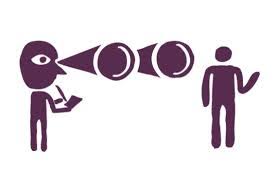
The observation method is described as a method to observe and describe the behavior of a subject. As the name suggests, it is a way of collecting relevant information and data by observing. It is also referred to as a participatory study because the researcher has to establish a link with the respondent and for this has to immerse himself in the same setting as theirs. Only then can he use the observation method to record and take notes.

Meaning and examples

Observation method is used in cases where you want to avoid an error that can be a result of bias during evaluation and interpretation processes. It is a way to obtain objective data by watching a participant and recording it for analysis at a later stage.


Observation method in data collection can be

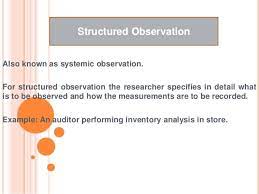
  • Structured observation method – This is a systematic observation method where data is collected as per a pre-defined schedule. The specific variable is used in this method for data collection.
  • Unstructured observation method – The unstructured observation method is conducted in a free and open manner without using any pre-determined objectives, schedules or variables.

Sampling methods for Observational Data

The researcher has a vital role to play as he will have to collect, record and classify the data appropriately. The primary sampling methods are

  • Event sampling – In the event sampling observation method the researcher decides beforehand what events or behavior he will record and which ones he is going to ignore
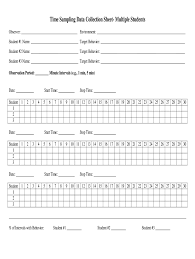
  • Time sampling – In the time sampling observation method, the researcher chooses the time when he will observe. He makes a record of the occurrence only in the specified and pre-determined period
  • Target-time or instantaneous sampling –  In the target-time or instantaneous sampling observation method, the researcher decides beforehand the moments when the observation will happen and will be recorded at that moment. Everything that happens before or after that moment is of no consequence hence is typically ignored

Types of observation method

The different types of observation method are as follows:

1) Controlled observations

The controlled observation is carried out in a closed space. It is the researcher who has the authority to decide the place and the time where and when the observation will take place. He also decides who the participants will be and in what circumstances will he use the standardized process.

The participants are chosen for a variable group randomly. The researcher observes and records a detailed and descriptive data of behavior and divides it into a distinct category. Sometimes the researcher codes the action as per an agreed scale by using a behavior schedule. The coding can include letters or numbers or a range to measure behavior intensity and describe its characteristics.

The collected data is often turned into statistics. In a controlled observation method, the participants are informed by the researcher about the aim of the research. This makes them aware of being observed. The researcher avoids direct contact during the observation method and generally uses a two-way mirror to observe and record details.

Advantages of controlled observation method

  1. The data and information received from a controlled observation method are structured and analytical. It is thus easy to analyze it quickly and is considered less time-consuming than the other observation methods
  2. Other researchers can easily replicate the report that has been created through the controlled observation method. They use a similar observation schedule, and this makes it easy to test for reliability.
  3. As the controlled observation method is several quick observations can be conducted within a short time frame. Thus the researcher can collect large samples which makes it easier for him to generalize a large population

Limitations of controlled observation method 

  1. The controlled observation method lacks validity because when the participants are aware of being observed their behavior will automatically change

2) Naturalistic observations

Social scientists and psychologists generally use the naturalistic observation method. The process involves observing and studying the spontaneous behavior of the participants in open or natural surroundings. The role of the researcher is to find and record whatever he can see and observe in natural habitat.

Advantages of naturalistic observation method 

  1. When a participant is in a natural habitat, his flow of behavior is natural and not forced.
  2. The studies have gained better ecological validity than the controlled observation method
  3. The naturalistic observation method is used by the researchers to create new ideas. The researcher has the chance to observe the total situation and can find avenues that other people have not thought about

Limitations of naturalistic observation methods

  1. The naturalistic observation method facilitates observations on a micro-scale. It often lacks a representative sample and thus cannot help the researcher in making a generalization that relates to a broader society
  2. In this type of observation method, the researcher needs proper training to recognize aspects that are significant and worth attention.
  3. The observations through naturalistic observation method are not as reliable as the researcher wants them to be because it is not possible to control some variables. This is why other researchers cannot similarly repeat the study or research.
  4. Establishing the cause and effect relationship is not possible because the researcher cannot manipulate the variables

3) Participant observations

The participant observation method is often considered a variant of the naturalistic observation method because it has some similarities with it. The point of difference is that the researcher is not a distant observer anymore because he has joined the participants and become a part of their group. He does this to get a more in-depth and greater insight into their lives.

The researcher interacts with other members of the group freely, participates in their activities, studies their behavior and acquires a different way of life. Participant observation can be overt or covert.

  1. Overt –When the researcher asks permission from a group to mingle the observation method is known as overt. He does so by revealing his true purpose and real identity to the group with whom he wants to mingle
  2. Covert– When the researcher does not show either his true identity or real meaning to the group he wants to join then the observation is known as covert. He keeps both concealed and takes on a false role and identity to enter and mingle in the group. He generally acts as if he is a genuine member of that group

Advantages of Participant Observation methods

  1. It is easy to study and observe the natural behavior of the participants in the group by becoming a part of that group. The respondents generally do not know that they are being observed and behavior recorded, so they are not restrained or constrained in their activities and behavior
  2. The researcher becomes understanding by following the events of the respondents from such a close angle.
  3. During the participant observation method, the researcher develops a good and healthy relationship with the respondents. This rapport helps him to participate in all the activities and make observations with a detached mind
  4. The participant observation method helps the research to observe the actual behavior of the respondents and create an inclusive and intensive case study of that group
  5. Actual participation in the activities provides the researcher with an opportunity to converse freely with other members about various events, their meaning and their importance to them. He gains an in-depth knowledge which would not have been possible only by observation.

Limitations of Participant Observation methods

  1. It is challenging to work undercover. For example, the researcher will have only to observe and not record in front of others because he will not want to blow his cover. He relies heavily on his memory which can be faulty at times
  2. Sometimes the researcher becomes too involved in the intricacies of that group. There is a higher chance of losing his objectivity because his reporting will be selective and dependent on his memory
  3. The emotional participation of the researcher can result in bias interpretation. He will be influenced to some degree and a time might come when he would start supporting them unconditionally because their views and behavior will ultimately become his. This will result in a personal viewpoint of the scenario and not an objective or scientific report
  4. In the participant observation method, the researcher’s experience becomes intense because of his proximity to the group members but the range becomes limited
  5. The researcher misses many vital points because of his familiarity
  6. Proximity with the group will involve him in group factionalism, and he will have to take sides. He then loses his objectivity as an impartial observer with whom everyone is ready to cooperate.

Advantages of Observation Method

  • Provides direct access to research phenomena
  • By observing firsthand, the researcher can collect, check and record accurate data
  • Greater flexibility in terms of application
  • Generate a permanent record of phenomena and the researcher or others can refer with it later
  • The organization method is one of the simplest methods of data collection. It does not require too much technical knowledge
  • The observation method is one of the best ways to formulate a hypothesis. The researcher can observe and come to know about the activities, perceptions, likes and dislikes to form a theory on his subject
  • Observation method is one of the most common methods used in all sciences and is very easy to follow and accept
  • In some instances observation is the only available tool to collect essential data and information
  • The observation method does not require the willingness of the participant to record. The researcher can observe from a distance and record his findings

Disadvantages of Observation Method

  • Faces a severe disadvantage because it takes a longer time frame compared to other data collection methods
  • There is a chance of higher observer bias in the observation method
  • Several personal behaviors are not open for observation and this proves a limitation in case of observation method
  • There is a higher chance of the observer influencing the behavior of a sample group elements
  • Uncertainties of the event cannot determine the actual time when the event will take place, and this is why every occurrence that is open to observation cannot be observed
  • Many of the incidents are abstract like love, affection and the researcher can’t gain an exact and correct account of those
  • The social phenomena generalization made by observation are not considered reliable as it cannot be used for lab experiments
  • In some cases, it is seen that two persons observing the same phenomena come at different results and this can lead to faulty perceptions
  • Observation method is considered an expensive affair as it requires hard effort, plenty of time and high cost

The post Observation Methods – Definition, Types, Examples, Advantages appeared first on HKT Consultant.

]]>
Introduction to observation https://phantran.net/introduction-to-observation.htm https://phantran.net/introduction-to-observation.htm#comments Mon, 09 Aug 2021 02:01:41 +0000 https://phantran.net/?p=35851 Observation has one overpowering claim to validity: it deals not with what people say they do but what they actually do – to the extent that their behaviour is open to observation, and insofar as observation is as objective as it seems to be. Two questions follow from this. In the first place why don’t

The post Introduction to observation appeared first on HKT Consultant.

]]>
Observation has one overpowering claim to validity: it deals not with what people say they do but what they actually do – to the extent that their behaviour is open to observation, and insofar as observation is as objective as it seems to be. Two questions follow from this. In the first place why don’t we just take what we are told, because surely people know themselves better than anyone else does? And secondly, if observation is more valid why is it not used more often in social research?

For some dimensions of human experience asking people is the only feasible way of finding out, particularly the ‘invisible’ elements: thoughts, feelings, intentions, attitudes and the like. Sometimes these can be inferred from beha­viour but in the main we can only speculate. The question of validity (how accurate these self-reports are) is not a simple one because people ‘construct’ their understanding of themselves; and how is anyone to say whether these self­constructions are accurate? It is not a meaningful question: such formulations represent how people manage them­selves, changing with age and experience, a process of per­manent revision in an attempt to find an effective way of being. It is an entirely subjective ‘reality’ even if sometimes appearing to verge on self-delusion: we all have a preferred way of viewing ourselves.

Words and deeds

Whether people report their behaviour accurately is a dif­ferent matter; and here the notion of accuracy has a different meaning. We can observe what people do and that includes observing ourselves. Comparing observed beha­viour with the acknowledged subjectivity of self-perception, it is easy to assign to observation an unchallenged objectivity. Less easy is to acknowledge that observation is to a greater or lesser degree a process of selection and reconstruction. Interestingly, it is research on the validity of witness state­ments (traditionally highly valued in criminal courts) that has shown how much omission, reconstruction and unvarnished error there can be in such reports.

We can accept that we may not be entirely accurate in our recollection of past events, including our own behaviour. That we may not accurately know how we behave in the pre­sent is another matter. If you have ever had to keep a work diary as part of a job evaluation exercise you will know that the pattern is often rather different from your unanalysed impression; in particular that the productive elements are fewer than you would like to think. And that is evident at the more mundane level of how we spend our money – an exercise that most of us are driven to at some point when our bank balance is inexplicably depleted or a credit card bill far beyond what was expected.

The simple fact is that we don’t normally feel the need to have an explicit record of what we do so that we can’t ‘know’ ourselves in that fashion – and, therefore, cannot be other than approximately accurate. We have an impression of how we conduct ourselves and how other people behave in a range of social situations. In the ordinary business of living that is all we need: self-invigilation is unnecessary. But research requires a more rigorous approach.

In social research on human behaviour survey methods of one kind or another (interviews, questionnaires) predominate. Some are more expensive on time and resources than others; questionnaires are often preferred for that reason. But none is as time-consuming as observation; and this is the main answer to our earlier question as to why it is less often used.

Structured observation is the most economical form with its highly specific focus and systematic checking of the ele­ments of behaviour – for example, bullying incidents in a playground; stopping to look at a picture in a gallery; fre­quency of donations to a street beggar and so on. Here the observation is of the restricted non-participant variety. At the other extreme essentially unstructured participant observation, typically in the theoretical framework of ethnography (usually describing a particular sub-culture in our own society) involves a much longer duration – weeks and usually months, exceptionally even longer than that.

Such groups are investigated in this way for a number of reasons (to be considered later) but also because their mem­bers may not be willing, or sufficiently ‘organized’, to answer questions about themselves. One of the under-recognized weaknesses of survey methods is the implicit assumption that people have their self-knowledge arranged in such a way that they can be easily interrogated about it. This is part of the contemporary expectation in Western society that people should be able to explain themselves. Compliance with such expectations is one reason why self-reports have to be treated with caution: responses to survey questions may be little more than an artefact of the method employed.

Source: Gillham Bill (2008), Observation Techniques: Structured to Unstructured, Continuum; Illustrated edition.

The post Introduction to observation appeared first on HKT Consultant.

]]>
https://phantran.net/introduction-to-observation.htm/feed 1
Observation and self-report: similarities and Differences https://phantran.net/observation-and-self-report-similarities-and-differences.htm https://phantran.net/observation-and-self-report-similarities-and-differences.htm#comments Mon, 09 Aug 2021 02:03:05 +0000 https://phantran.net/?p=35852 Both self-report (as in questionnaires and interviews) and observation techniques can differ in their degree of struc­ture. The first of these may involve short, prescriptive question-and-answer formats that are easily analysed in quantitative terms. Using structured observation schedules which involve the recording and counting of pre-determined categories of behaviour is an almost exact analogy. On

The post Observation and self-report: similarities and Differences appeared first on HKT Consultant.

]]>
Both self-report (as in questionnaires and interviews) and observation techniques can differ in their degree of struc­ture. The first of these may involve short, prescriptive question-and-answer formats that are easily analysed in quantitative terms. Using structured observation schedules which involve the recording and counting of pre-determined categories of behaviour is an almost exact analogy.

On the other hand, interviewing can be largely unstructured, apart from identifying the broad area of interest, following directions determined mainly by those being interviewed. Observation can be similarly open-ended, recording what turns up at a level of fine detail, with analysis deferred (as well as final purposes, research questions, theoretical interpretation etc.).

Whether surveys or various methods of observation are employed, the differing levels of structure lead to different kinds of data being collected. For the researcher the ques­tion becomes: what kind of data do I need? Table 1.1 pro­vides a simple contrast.

This polarized distinction is false in two respects:

  • the extremes can be used in combination to complement each other
  • the extremes represent points on a graded scale because there are techniques with varying degrees of structure (as is the case with interviews).

A structured observation schedule has to be preceded by an unstructured phase – otherwise how would the researcher know what to focus on? However, this kind of unstructured observation is more likely to be of the detached, non­participant variety (see page 23 for more on this ‘fly-on-the- wall’ technique).

The need for a combination of structured and unstruc­tured methods commonly arises when the researcher derives an unsatisfactorily impressionistic judgement from partici­pant observation alone. Conversely, it may be that struc­tured, detached data raise more questions than they answer (as in surveys based on questionnaires) so that supplemen­tary participant observation is required to get at what the data actually mean (the qualitative dimension).

What do structured and unstructured methods have in common ?

The broad common characteristic is that both are systematic, because in taking this approach we come to see things, events and the connections between them that would either be overlooked or not recognized as significant. Detailed recording, in words or images, brings into focus what is there to be seen or understood.

It is a fallacy to suppose that because something (an object, human behaviour) is within our field of view that we ‘see it’. We have all had the experience of ‘not seeing’ something we were looking for even though it was there to be seen all the time (I commonly ‘lose’ something on my desk). But there is another and more profound point: we tend not to see things that we do not know about or understand, that we cannot relate to our existing knowl­edge. Systematic observation: checking, specifying and seeking explanation forces us out of our preconceptions, leading to a shift in understanding.

Source: Gillham Bill (2008), Observation Techniques: Structured to Unstructured, Continuum; Illustrated edition.

The post Observation and self-report: similarities and Differences appeared first on HKT Consultant.

]]>
https://phantran.net/observation-and-self-report-similarities-and-differences.htm/feed 5
The uses of observation as research method https://phantran.net/the-uses-of-observation-as-research-method.htm https://phantran.net/the-uses-of-observation-as-research-method.htm#respond Mon, 09 Aug 2021 02:03:59 +0000 https://phantran.net/?p=35853 The most general use of observation in research is exploratory, as it is in real life. When we take up a new job, enter university, move to a different part of the country (or to a different country), or even just go on holiday to a new region, we look around us. In that novel

The post The uses of observation as research method appeared first on HKT Consultant.

]]>
The most general use of observation in research is exploratory, as it is in real life. When we take up a new job, enter university, move to a different part of the country (or to a different country), or even just go on holiday to a new region, we look around us. In that novel setting everything is going on presumably as normal; we nodce differences, of course, but our main preoccupation is how things work in the social sense, what the ‘rules’ are: because every social setting operates in a different way. This is a familiar and often surprising experience when we change jobs, even within the same regulated profession, or to another insti­tution governed by the same, standardized legal require­ments. A different school, hospital, police force has its own character, operates its own ‘rules’ within the same regulatory framework. If we have any sense we don’t make overt com­parisons but ‘research’ the sub-culture we find ourselves in. This kind of initial, exploratory phase is adaptive: we learn lessons that we can act upon, avoid blundering on in a state of ignorance. It is also widely applicable in the preliminary stage of much social research, from which purpose, ques­tions and methods emerge.

Observation as an initial technique may lead to quite dif­ferent methods in the main study: surveys, problem-focused action research, focused case studies, experiments of one kind or another. None of these would be possible, or sen­sible, without preliminary observation of an unfamiliar social context. Such early immersion also guides reading and, as the issues are identified, we come to know what to search for in the literature – the beginning of an iterative cycle of first­hand experience and studying the research reports of others.

Source: Gillham Bill (2008), Observation Techniques: Structured to Unstructured, Continuum; Illustrated edition.

The post The uses of observation as research method appeared first on HKT Consultant.

]]>
https://phantran.net/the-uses-of-observation-as-research-method.htm/feed 0
Observation in multi-method research https://phantran.net/observation-in-multi-method-research.htm https://phantran.net/observation-in-multi-method-research.htm#respond Mon, 09 Aug 2021 02:04:39 +0000 https://phantran.net/?p=35854 In the same way that surveys can give the bigger picture within which more in-depth interviews are nested, so can observation provide a wider descriptive framework. In a school, for example, it would make only limited sense to interview teachers about their views on the official dis­ciplinary policy without some account, by direct observation, of

The post Observation in multi-method research appeared first on HKT Consultant.

]]>
In the same way that surveys can give the bigger picture within which more in-depth interviews are nested, so can observation provide a wider descriptive framework. In a school, for example, it would make only limited sense to interview teachers about their views on the official dis­ciplinary policy without some account, by direct observation, of how student behaviour was routinely dealt with. Both approaches have their strengths and limitations; in combi­nation these balance out.

Because of the difficulty of getting a comprehensive pic­ture via any one method in social research, during the past 20 years or so there has been increasing interest in the complementary strengths of different methods. A key text, recommended for further reading (but not for its read­ability) is Brewer and Hunter’s 1989 book Multi-method Research: A Synthesis of Styles. Case study research methods (see Gillham, 2000), with the emphasis on multiple sources of evidence, are part of the same movement. The notion of taking multiple perspectives on a complex social phenom­enon (teenage pregnancies, for example) is a commonsense one. Interviews, national level statistics and demographic patterns can combine with participant observation – going with these young women on their daily routines, visiting them in their homes, helping them with the practicalities of claiming allowances, and so on – all these factors in com­bination enable outsiders (perhaps neither young, nor female, nor pregnant, nor poor) to grasp the wider issues. And the observational element adds something vivid and ‘real*, which may not be apparent even from loosely struc­tured interviews with the teenagers concerned.

Source: Gillham Bill (2008), Observation Techniques: Structured to Unstructured, Continuum; Illustrated edition.

The post Observation in multi-method research appeared first on HKT Consultant.

]]>
https://phantran.net/observation-in-multi-method-research.htm/feed 0
Structured observation in practice https://phantran.net/structured-observation-in-practice.htm https://phantran.net/structured-observation-in-practice.htm#respond Mon, 09 Aug 2021 02:06:55 +0000 https://phantran.net/?p=35855 For the moment the terms structured, detached and non­participant are used almost interchangeably: that is not quite correct (see page 19) but sufficiently so to equate their meaning. All introductory classifications simplify reality. Structured observation (specifying exact behaviours and recording their frequency over short, usually intermittent, periods of time) is something that figures regularly in

The post Structured observation in practice appeared first on HKT Consultant.

]]>
For the moment the terms structured, detached and non­participant are used almost interchangeably: that is not quite correct (see page 19) but sufficiently so to equate their meaning. All introductory classifications simplify reality.

Structured observation (specifying exact behaviours and recording their frequency over short, usually intermittent, periods of time) is something that figures regularly in text­books; less often in the real world of research. It has had a vogue in educational research and survivals appear occa­sionally in Master’s dissertations, as I have reason to know. One can understand the appeal of the technique: it renders tangible an approach to complex, fast-moving situations like school classrooms or playgrounds. The fall from favour has much to do with its ‘thin’ mechanistic quality and, it has to be said, the obsessional complexity of some of the proce­dures advocated. See, for example, Flanders’ Interaction Ana­lysis Categories (FLAC) devised by the American educationist of that name (Flanders, 1970) where in classroom observa­tion during a minute, and every three seconds, one of 20 categories of teacher and pupil behaviour is checked. One can only admire the rigour of such a scheme but its use is less than enthralling.

However, the basic principle of identifying people and (precisely) what they do is capable of a more practicable but still valid use. Let us take an example.

Structured observation in practice

I am currently exploring the practice of street begging in Glasgow. This can be approached in several ways: getting anywhere near a full picture is not easy and this is spelt out in Chapter 6 Work in Progress.

Begging is commonplace in the city. You may be approached in the street but the focus of my investigation is those who site themselves in a carefully chosen position, usually with a plastic cup for donations. For want of a better term I call these ‘stationary’ beggars and they are most often encountered in and around the pedestrianized sections of three main shopping streets. To begin with I observed them in an unstructured fashion and for varying periods of time (15-30 minutes) – sufficient for me to see how I might carry out a more structured observation. All the ‘stationary’ beg­gars (those who just sit and wait as against those who walk around accosting people in the street) were male; while most of the donations appeared to come from women usually, by my estimate, in the younger age range (under 45).a

Source: Gillham Bill (2008), Observation Techniques: Structured to Unstructured, Continuum; Illustrated edition.

The post Structured observation in practice appeared first on HKT Consultant.

]]>
https://phantran.net/structured-observation-in-practice.htm/feed 0
Event sampling in Structured observation https://phantran.net/td-event-sampling-in-structured-observation.htm https://phantran.net/td-event-sampling-in-structured-observation.htm#respond Mon, 09 Aug 2021 02:08:27 +0000 https://phantran.net/?p=35856 1. Event sampling Event sampling is used when the behaviour of interest is discontinuous and low frequency, where you would miss the events if you didn’t observe continuously. The behaviour has to be specified exactly (making a monetary donation, engaging in conversation) so that it can be recorded on an observation schedule in a simple

The post Event sampling in Structured observation appeared first on HKT Consultant.

]]>
1. Event sampling

Event sampling is used when the behaviour of interest is discontinuous and low frequency, where you would miss the events if you didn’t observe continuously. The behaviour has to be specified exactly (making a monetary donation, engaging in conversation) so that it can be recorded on an observation schedule in a simple check-mark fashion.

Now, my impression when passing these street beggars was that they didn’t get much custom: continuous observation showed a highly variable picture. But it also led me to expand the interaction categories as follows:

  • ‘silent’ donation where nothing is said
  • donation plus some conversation
  • conversation but no donation.

Men were more likely to come into the first category. The last category, usually male, were different again; I came to describe them as ‘hangers on’ and some beggars had more of these than others.

In other words, even the simplest scheme requires amplification in practice. The point to watch is that it does not become too fragmented or unmanageable. For example, the ‘silent’ donation is a bit of a misnomer as I caught a hint of non-verbal communication now and then, usually eye contact, but too subtle for me to be sure of it. Note also that I was trying to identify unambiguous ‘chunks of behaviour’, not elusive fragments.

Defining the ‘events’

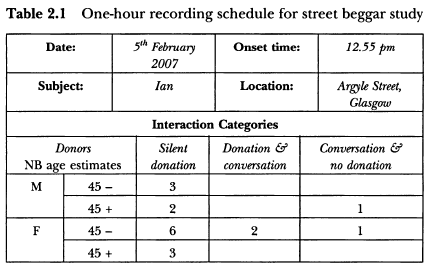
What the above discussion demonstrates is that defining a ‘simple’ event is not all that simple. I had thought initially in terms of a donation interaction but, once I had started observing, it became clear that that was not adequate. I had to define the events in terms of the kind of interaction. The interactions could have been further divided, for example in terms of different levels of conversation (the odd remark to a longer exchange). I decided against that on grounds of manageability: it is possible to create a recording schedule that is so exhaustive (exhausting?) as to be impractical. What I did was to observe one of the subjects of study for an hour and record each donating ‘event’. So I recorded frequency (how many times in the hour) and who donated (gender and my estimate of age 45+-). My first use of the developed schedule produced the results shown in Table 2.1.

The main point is that even when you try to keep it simple you have to develop your categories to be anywhere near adequate; and that there is a preceding phase of develop­ment where you try out your initial assumptions following a period of unstructured impressionistic observation. You might think that this preliminary stage should be sufficient to identify the categories. In fact, it is only by attempting to record these events that their limitations become apparent, because you don’t really observe in a focused way until you have the task of recording. This being ‘work in progress’, what is said here is neither a full account nor the last word – see Chapter 6 for a narrative account of this particular project.

2. Linked events

One of the virtues of continuous structured observation is that you can link events over time. It may be something as simple as noting the time someone joins a queue at an enquiry desk up to the time their enquiry is dealt with. Such a start-to-finish observation has multiple uses, for example ‘shopping behaviour’: a customer browsing a display up to the point of making a purchase. Other examples could be how long a child in a class has to wait to get a response from the teacher; how long people spend scanning an under­ground map, or reading a product instruction booklet before using the product and so on. This touches on the area of ‘experimental observation’ (see Chapter 3).

The limits of event sampling

The continuous recording of behavioural events works well when those events are not too frequent: it gets more difficult as the frequency increases, the main strain being on your capacity for sustained attention. This overload experience usually arises when observing several individuals in a group, such as a whole class of children. When the events are very high frequency – happening simultaneously and/or so often that continuous recording verges on the impossible – you have a number of options. These are:

  • narrowing your category(ies) so you are observing only one or two types of behaviour clearly defined, i.e. picking them out of the flow
  • carrying out time sampling where you observe, at intervals, for very short periods of time (a few seconds to a few minutes)
  • constructing a narrative account – essentially unstruc­tured, selective and, to a degree, impressionistic; this takes us out of the ‘structured’ frame entirely but there comes a point where any kind of specified behavioural sampling is not only impractical but inadequate.

Source: Gillham Bill (2008), Observation Techniques: Structured to Unstructured, Continuum; Illustrated edition.

The post Event sampling in Structured observation appeared first on HKT Consultant.

]]>
https://phantran.net/td-event-sampling-in-structured-observation.htm/feed 0
Time sampling in Structured Observation https://phantran.net/time-sampling-in-structured-observation.htm https://phantran.net/time-sampling-in-structured-observation.htm#respond Mon, 09 Aug 2021 02:10:12 +0000 https://phantran.net/?p=35858 This is also known as interval sampling because you observe for a specified duration at specified intervals – like taking a succession of snapshots, an analogy which is pretty close. Sampling means estimating the frequency of events in a continuous time sequence from a much shorter period (or periods) of time. The main practical challenge

The post Time sampling in Structured Observation appeared first on HKT Consultant.

]]>
This is also known as interval sampling because you observe for a specified duration at specified intervals – like taking a succession of snapshots, an analogy which is pretty close. Sampling means estimating the frequency of events in a continuous time sequence from a much shorter period (or periods) of time. The main practical challenge is deciding on the length of time for the sample estimate; there is a certain amount of trial and error in this.

The general principle is that the higher the frequency of the ‘events’ the shorter the periods of observation. There is a kind of gradient here: at some point, which can only be determined by the practicalities of recording as well as ‘representativeness’, the choice moves from event sampling to interval sampling (or the other way). With discontinuous interval sampling (as in taking a population sample for a survey) the level of representativeness needs to be gauged in some way.

Alternate sampling

Interval sampling has one important advantage in that you can alternate the focus of your observation. The focus could be:

  • on some individuals in a group, e.g. boys as against girls in a classroom
  • on some specific behaviours, e.g. how many children are not ‘actively learning’ in a classroom setting or more specifically are engaged in a particular learning activity – or not, as the case may be
  • on different sites, e.g. in a public art gallery how many people are looking at one painting rather than another, or one kind of painting rather than another.

The question remains, however: how do you decide on the duration of the ‘interval’ in practice? Initially you should take a short interval – say every three minutes where you record for perhaps ten seconds – and then work out whether a longer interval (or a shorter duration of observation) would suffice. If the purpose of the research is the difference in gender response to teachers’ ques­tions then you might move the focus of recording from boys to girls (and back again) every other recording per­iod or you might cover all the children at the same time. Note that you would have to define in terms of specific behaviours what you mean by a ‘response’ (volunteering an answer, signalling the desire to do so, following work instructions).

And because children’s work in a classroom has a ‘devel­opmental’ sequence, in that it evolves throughout the les­son, then a consideration for sampling is whether these phases are adequately represented.

Source: Gillham Bill (2008), Observation Techniques: Structured to Unstructured, Continuum; Illustrated edition.

The post Time sampling in Structured Observation appeared first on HKT Consultant.

]]>
https://phantran.net/time-sampling-in-structured-observation.htm/feed 0
Validating observation sampling https://phantran.net/validating-observation-sampling.htm https://phantran.net/validating-observation-sampling.htm#respond Mon, 09 Aug 2021 02:10:56 +0000 https://phantran.net/?p=35857 In survey research a sample of the population (however defined) is taken because it is much more economical to do so. A ‘valid’ – i.e. representative – sample is achieved in various ways (not our concern here but see the book in the present series dealing with social surveys (Gillham, 2008)). Validating interval sampling is

The post Validating observation sampling appeared first on HKT Consultant.

]]>
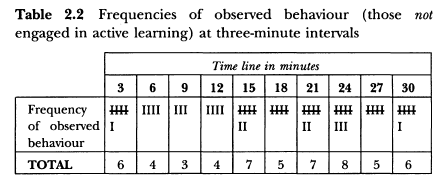
In survey research a sample of the population (however defined) is taken because it is much more economical to do so. A ‘valid’ – i.e. representative – sample is achieved in various ways (not our concern here but see the book in the present series dealing with social surveys (Gillham, 2008)). Validating interval sampling is achieved by taking a given period of observation, dividing it up into, say, three-minute intervals and then calculating whether by taking every other three-minute interval (i.e. every six minutes) you obtain a similar picture to the more frequent sampling. Table 2.2 illustrates a hypothetical example of observed classroom behaviour (children engaged or not in active learning). Here the intervals are every three minutes; the period of observation (counting/recording) is ten seconds – but it could be less. It is usually easier to record the ‘inactive’ children, defined as those who are not:

  • reading or writing individually
  • choosing a book
  • using a computer
  • using apparatus or equipment
  • involved in making something or painting
  • engaged with a teacher or classroom assistant on a learning activity
  • working cooperatively with other children.

It is not a difficult matter to record the individual children involved and their gender (you need to be able to identify the children and simply check them at each observation). If you do this ten-second check every three minutes during a 30-minute period you will quickly identify those for whom active learning is a problem; but the total observation time is less than two minutes.

There are two elements here:

  • deciding on the length of the interval (when you’re not recording)
  • deciding on the duration of the active recording of behavioural events (a function of the frequency of the behaviour and the time needed for recording).

Duration needs to be only as long as is required to check the behavioural events – a practical question; frequency needs to be often enough to give a representative sample. The frequency of observation copes with individual children’s on task/off task variation.

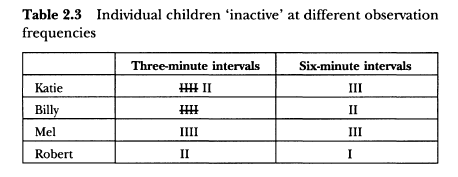
Table 2.2 shows that the average number of ‘inactive’ children at three-minute intervals is 5.5. If we take six- minute intervals it is 5.4: not much in that. But if we are interested in individual children then the higher frequency of observation might be important; for example the hypo­thetical example in Table 2.3.

In other words the less frequent interval does not differ­entiate so well in this respect, i.e. those who are more reg­ularly ‘inactive’ are underestimated.

Why sample ?

Since in the above instance you are only ‘active’ as an observer for less than two minutes out of 30 why not carry out continuous monitoring of the children? The answer is that, quite apart from the burden of the task, you don’t get as clear a picture. The successive snapshots tell the story with a precision that is not spurious; and you can validate these frequencies against a class-teacher’s subjective judgement.

To take another example: if an art student is interested in comparing the public’s response to different styles of con­temporary painting (e.g. abstract v. representational) in a public art gallery then the task could be to observe how many people stop to look at these different kinds of painting for at least 15 seconds. Looking at paintings is not a momentary business but if no-one stops to look for more than three minutes then a ten-minute interval and 120 sec­onds for observation would make it unlikely that anyone was counted twice. The student can then move to a room where paintings of the other genre are hung and repeat the exercise; if both kinds are present in the same site then it becomes a simple matter of shifting the observational focus. This is an example of the ‘alternate site’ situation. Within an hour the number of people looking at each of two paintings is observed every five minutes for 120 seconds, alternating one to the other.

This last example is introduced because it commonly leads to this question: surely people know which kinds of painting they prefer? The answer is that it depends on their knowl­edge and experience; and their ability to express it. In any case we may give a view or opinion but find our eyes drawn to the kind of abstract painting that we might dismiss in response to a general, hypothetical question. We don’t always know what is going to interest or appeal; only our behaviour shows that.

So here we come back to the point made in the first chapter: that you study behaviour not just for its own sake but because it reflects those elusive internal states that underlie what people do, and of which they may not be fully aware.

Source: Gillham Bill (2008), Observation Techniques: Structured to Unstructured, Continuum; Illustrated edition.

The post Validating observation sampling appeared first on HKT Consultant.

]]>
https://phantran.net/validating-observation-sampling.htm/feed 0
Semi-structured Observation Method https://phantran.net/semi-structured-observation-method.htm https://phantran.net/semi-structured-observation-method.htm#comments Mon, 09 Aug 2021 02:11:32 +0000 https://phantran.net/?p=35859 If observation is a primary technique of real-world social research one can be forgiven for thinking that structured observation, with its ‘count’ emphasis and fragmented character, is not the best way of doing it. Sometimes that level of specificity is necessary and useful and it is to be hoped that we have done justice to

The post Semi-structured Observation Method appeared first on HKT Consultant.

]]>
If observation is a primary technique of real-world social research one can be forgiven for thinking that structured observation, with its ‘count’ emphasis and fragmented character, is not the best way of doing it. Sometimes that level of specificity is necessary and useful and it is to be hoped that we have done justice to this approach in the preceding chapter.

As a representation of the reality of what people do, structured observation is as accurate as a questionnaire is of what people think. You know exactly what you want to find out and the form of the data is precisely specified. The limitations are roughly the same as for questionnaires: not much scope for discovery and the underlying reasons lag somewhere behind.

However, being relatively unstructured in approach does not mean you don’t know what you are looking for. In the semi-structured variety of observation you go in with quite specific questions but they are ‘open’ so that you cannot predict what you are going to find. It is particularly suited to the kind of research which seeks to identify practical pro­blems people experience; and then what can be done about them.

An example of how this approach works is the study of the difficulties older people experience in maintaining an independent living style. You don’t need to be a demographic expert (or a pension fund actuary) to know that we are part of an ageing population, and that old age is accompanied by a range of disabilities, many of them rela­tively minor. Helping people to manage their disability has a long tradition; the profession of occupational therapy has a distinguished role in this respect. But the problem has become much broader and, in a sense, mainstream.

A major consequence of the ageing process is when peo­ple find they cannot cope, or only cope with difficulty, in their normal environment. At a mobility level this is easy to appreciate: stair-lifts, adapted bathrooms and lavatories, wheelchair access, although not cheap, can help older people and their carers with problems that are almost self­evident.

But an accumulation of less conspicuous disabilities can make independent living more difficult and, in total, become as much a barrier as the more high-profile pro­blems. We can go further than that: people often cope well with major disabilities – the conspicuous problems of living. It seems to call forth their emotional resources and a helpful response from others. What wears people down are the multiple, minor defeats of everyday. On their own they may not amount to much: in total they can lead to a non-coping depressive state. At this point we need to take a theoretical side-step.

1. Ecological psychology

Ecology is a term dinned into us by the media: it’s about being ‘green’ – sensitive to environmental issues. But that is only one application of the term.

Ecological psychology is about the interaction of people and their environment in terms of its effect on their psy­chological make-up: at the detailed level of the behaviour and mental experience of individuals. It emphasizes that those psychological dimensions are only meaningfully understood in the context in which they occur, and that the environment facilitates or constrains people’s behavioural or mental state. It is from this standpoint that we can approach the notion of disability. This is not just something about the individual: a disability occurs in a given situation. It is an interactive (person <-> environment) problem which can be approached from either end or, indeed, from both.

People don’t just have to adapt to their environment: their environment can also be adapted to them – at a level of functional detail. A simple example is the problem of lifting and carrying experienced by many people with moderate disabilities. They can be taught more effective, less effortful techniques; as well as being provided with aids that make the tasks easier such as the ‘helping hand’ – rather like the tool used by litter collectors – that makes it easier to pick things up or pull them towards you, or the dycem,, a non-slip mat to keep things steady – jars and tins, for example. These are relatively ‘minor’ problems with simple solutions: they have to be multiplied many times and viewed as part of a persis­tent daily struggle for many people. Helping them to cope practically is to help them emotionally and a practical focus has to be reckoned in terms of these benefits as well.

2. Observing the problems of living

You can learn a lot about helping people maintain their independence by talking to them. But this approach is lim­ited for two reasons:

  • they may accept their problems as being normal and ‘only what you can expect’
  • they may not even realize they have difficulties in living for which they could get help, as often people adapt when they don’t need to.

Inclusive design

An ergonomically-minded designer brings a particular mind-set to issues such as these. Designers are trained to analyse the functional problems posed by the myriad man­made objects that form part of our domestic existence. The purpose of design is not just to produce something that looks good but something that is also reliable and easy to use. An important principle is that design which makes life easier for people with disabilities can mean products that are easier to use for everyone. The recent Focus range of cars from Ford is an example of this. Designs that only the fully able­bodied can use are exclusive – hence the reverse term.

That trend in design exists as a corollary of observational methods that direct the designer’s attention. Not that this is just for such specialists: there is a straightforward common- sense dimension to identifying difficulties that points the way to possible solutions.

Take, for example, the case of a man in his seventies who has suffered a stroke that has resulted in a degree of paralysis to the left side of the body. He lives on his own but is still mobile and speech is only slightly impaired. The major problem is the limited use of his left hand – in most people the sub-dominant hand. This is not so severe a han­dicap as it might have been because he was normally right­handed, so it could have been worse. But the problems are numerous, nonetheless, and by no means obvious.

It is instructive to spend an hour or so as if your sub­dominant hand were not functional. You can’t exactly replicate the difficulties this person might have. But you soon come to see that even a relatively minor disability leads to many problems – some more marked than others. Take something as simple as writing a letter or making a shopping list: you write with your dominant hand but you need the other one to stop the paper from sliding around. This is the kind of thing you don’t normally need to think about but the examples are multiple – not just obviously intricate ones like threading a needle but larger movements like holding a cupboard door open with one hand to stop it swinging closed so that you can take something out with the other; and so on.

The context focus

The strategy for observation is straightforward.

An initial period of ‘open’ observation is required: getting a sense of the person in his or her context, making pre­liminary notes of particular tasks that look problematic. You ask questions as you go but watching is the primary method. Most people can tell you what causes their difficulty but they cannot necessarily analyse it: at least at the level of devising a solution.

It is only by spending time ‘on site’ and through the routine of a person’s day that you can arrive at a ‘disability map’ highlighting those features which require attention. Occupational therapists in particular are well aware of the problems associated with particular disabilities so that, in many cases, the solutions are readily available. But some are specific to an individual and to a particular context and not so straightforward to resolve.

So, in the case of our hypothetical stroke patient, we may find he is unable to use a conventional cooker because he cannot stoop down and do the two-handed job of taking something out of the oven. A waist-level or microwave oven on a flat surface is one solution. If he likes to heat a tin of soup for his lunch he may have difficulty in using the wall- mounted can-opener – normally holding the tin in the left hand and operating the opener with the right – as the two actions need to be simultaneous. But he can’t achieve the necessary left-hand grip on the can. Again this is a case where there are ready-made design solutions – openers with single-handed or even no-hands operation. But there are many other problems not so well-focused – as you will dis­cover from trying out a one-handed style of operation yourself.

Source: Gillham Bill (2008), Observation Techniques: Structured to Unstructured, Continuum; Illustrated edition.

The post Semi-structured Observation Method appeared first on HKT Consultant.

]]>
https://phantran.net/semi-structured-observation-method.htm/feed 1