Uname:Linux info 3.0 #1337 SMP Tue Jan 01 00:00:00 CEST 2000 all GNU/Linux

Methodology – HKT Consultant https://phantran.net/category/methodology Sun, 18 Sep 2022 10:00:43 +0000 en-US hourly 1 https://wordpress.org/?v=7.0 https://phantran.net/wp-content/uploads/2021/02/cropped-Logo-HKT-500-x-400-32x32.png Methodology – HKT Consultant https://phantran.net/category/methodology 32 32 Research: Definition, Methods, Types & Examples https://phantran.net/research-definition-methods-types-examples.htm Fri, 09 Aug 2019 01:33:24 +0000 https://phuongphapnghiencuu.com/?p=7879 Research is defined as careful consideration of study regarding a particular concern or problem using scientific methods. According to the American sociologist Earl Robert Babbie, “research is a systematic inquiry to describe, explain, predict, and control the observed phenomenon. It involves inductive and deductive methods.” Inductive research methods analyze an observed event, while deductive methods

The post Research: Definition, Methods, Types & Examples appeared first on HKT Consultant.

]]>

Research is defined as careful consideration of study regarding a particular concern or problem using scientific methods. According to the American sociologist Earl Robert Babbie, “research is a systematic inquiry to describe, explain, predict, and control the observed phenomenon. It involves inductive and deductive methods.”

Inductive research methods analyze an observed event, while deductive methods verify the observed event. Inductive approaches are associated with qualitative research, and deductive methods are more commonly associated with quantitative analysis.

Research is conducted with a purpose to:

  • Identify potential and new customers
  • Understand existing customers
  • Set pragmatic goals
  • Develop productive market strategies
  • Address business challenges
  • Put together a business expansion plan
  • Identify new business opportunities

What are the characteristics of research?

  1. Good research follows a systematic approach to capture accurate data. Researchers need to practice ethics and a code of conduct while making observations or drawing conclusions.
  2. The analysis is based on logical reasoning and involves both inductive and deductive methods.
  3. Real-time data and knowledge is derived from actual observations in natural settings.
  4. There is an in-depth analysis of all data collected so that there are no anomalies associated with it.
  5. It creates a path for generating new questions. Existing data helps create more research opportunities.
  6. It is analytical and uses all the available data so that there is no ambiguity in inference.
  7. Accuracy is one of the most critical aspects of research. The information must be accurate and correct. For example, laboratories provide a controlled environment to collect data. Accuracy is measured in the instruments used, the calibrations of instruments or tools, and the experiment’s final result.

What is the purpose of research?

There are three main purposes:

  1. Exploratory: As the name suggests, researchers conduct exploratory studies to explore a group of questions. The answers and analytics may not offer a conclusion to the perceived problem. It is undertaken to handle new problem areas that haven’t been explored before. This exploratory process lays the foundation for more conclusive data collection and analysis.
  2. Descriptive: It focuses on expanding knowledge on current issues through a process of data collection. Descriptive studies describe the behavior of a sample population. Only one variable is required to conduct the study. The three primary purposes of descriptive studies are describing, explaining, and validating the findings. For example, a study conducted to know if top-level management leaders in the 21st century possess the moral right to receive a considerable sum of money from the company profit.
  3. Explanatory: Causal or explanatory research is conducted to understand the impact of specific changes in existing standard procedures. Running experiments is the most popular form. For example, a study that is conducted to understand the effect of rebranding on customer loyalty.

Here is a comparative analysis for better understanding:

Exploratory Research Descriptive Research Explanatory Research
Approach used Unstructured Structured Highly structured
Conducted through Asking questions Asking questions By using hypotheses.
Time Early stages of decision making Later stages of decision making Later stages of decision making

Research begins by asking the right questions and choosing an appropriate method to investigate the problem. After collecting answers to your questions, you can analyze the findings or observations to draw reasonable conclusions.

When it comes to customers and market studies, the more thorough your questions, the better the analysis. You get essential insights into brand perception and product needs by thoroughly collecting customer data through surveys and questionnaires. You can use this data to make smart decisions about your marketing strategies to position your business effectively.

Types of research methods and example

what is research

Research methods are broadly classified as Qualitative and Quantitative.

Both methods have distinctive properties and data collection methods.

Qualitative methods

Qualitative research is a method that collects data using conversational methods, usually open-ended questions. The responses collected are essentially non-numerical. This method helps a researcher understand what participants think and why they think in a particular way.

Types of qualitative methods include:

  1. One-to-one Interview
  2. Focus Groups
  3. Ethnographic studies
  4. Text Analysis
  5. Case Study

Quantitative methods

Quantitative methods deal with numbers and measurable forms. It uses a systematic way of investigating events or data. It answers questions to justify relationships with measurable variables to either explain, predict, or control a phenomenon.

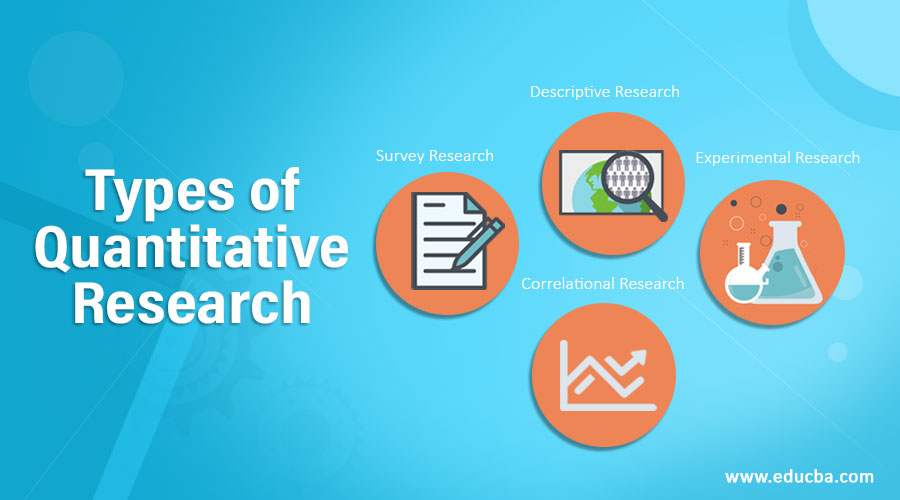
Types of quantitative methods include:

  1. Survey research
  2. Descriptive research
  3. Correlational research

Remember, research is only valuable and useful when it is valid, accurate, and reliable. Incorrect results can lead to customer churn and a decrease in sales.

It is essential to ensure that your data is:

  • Valid – founded, logical, rigorous, and impartial.
  • Accurate – free of errors and including required details.
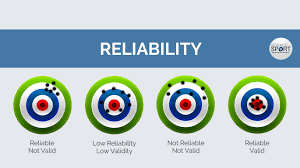
  • Reliable – other people who investigate in the same way can produce similar results.
  • Timely – current and collected within an appropriate time frame.
  • Complete – includes all the data you need to support your business decisions.

8 tips for conducting accurate research

  1. Identify the main trends and issues, opportunities, and problems you observe. Write a sentence describing each one.
  2. Keep track of the frequency with which each of the main findings appears.
  3. Make a list of your findings from the most common to the least common.
  4. Evaluate a list of the strengths, weaknesses, opportunities, and threats that have been identified in a SWOT analysis.
  5. Prepare conclusions and recommendations about your study.
  6. Act on your strategies
  7. Look for gaps in the information, and consider doing additional inquiry if necessary
  8. Plan to review the results and consider efficient methods to analyze and dissect results for interpretation.

Review your goals before making any conclusions about your research. Keep in mind how the process you have completed and the data you have gathered help answer your questions. Ask yourself if what your analysis revealed facilitates the identification of your conclusions and recommendations.

The post Research: Definition, Methods, Types & Examples appeared first on HKT Consultant.

]]>
What Is Research Methodology? https://phantran.net/what-is-research-methodology.htm Fri, 09 Aug 2019 01:56:56 +0000 https://phuongphapnghiencuu.com/?p=7848 Research methodology simply refers to the practical “how” of any given piece of research. More specifically, it’s about how a researcher systematically designs a study to ensure valid and reliable results that address the research aims and objectives. For example, how did the researcher go about deciding: What data to collect (and what data to ignore) Who to collect it from

The post What Is Research Methodology? appeared first on HKT Consultant.

]]>

Research methodology simply refers to the practical “how” of any given piece of research. More specifically, it’s about how a researcher systematically designs a study to ensure valid and reliable results that address the research aims and objectives.

For example, how did the researcher go about deciding:

  • What data to collect (and what data to ignore)
  • Who to collect it from (in research, this is called “sampling design”)
  • How to collect it (this is called “data collection methods”)
  • How to analyse it (this is called “data analysis methods”)

In a dissertation, thesis, academic journal article (or pretty much any formal piece of research), you’ll find a research methodology chapter (or section) which covers the aspects mentioned above. Importantly, a good methodology chapter in a dissertation or thesis explains not just what methodological choices were made, but also explains why they were made.

In other words, the methodology chapter should justify the design choices, by showing that the chosen methods and techniques are the best fit for the research aims and objectives, and will provide valid and reliable results. A good research methodology provides scientifically sound findings, whereas a poor methodology doesn’t. We’ll look at the main design choices below.

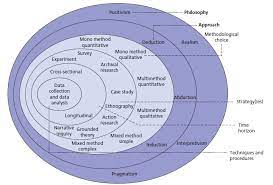
What are qualitative, quantitative and mixed-method methodologies?

Qualitative, quantitative and mixed-methods are different types of methodologies, distinguished by whether they focus on words, numbers or both. This is a bit of an oversimplification, but its a good starting point for understandings. Let’s take a closer look.

Qualitative research refers to research which focuses on collecting and analysing words (written or spoken) and textual data, whereas quantitative research focuses on measurement and testing using numerical data. Qualitative analysis can also focus on other “softer” data points, such as body language or visual elements.

It’s quite common for a qualitative methodology to be used when the research aims and objectives are exploratory in nature. For example, a qualitative methodology might be used to understand peoples’ perceptions about an event that took place, or a candidate running for president. 

Contrasted to this, a quantitative methodology is typically used when the research aims and objectives are confirmatory in nature. For example, a quantitative methodology might be used to measure the relationship between two variables (e.g. personality type and likelihood to commit a crime) or to test a set of hypotheses.

As you’ve probably guessed, the mixed-method methodology attempts to combine the best of both qualitative and quantitative methodologies to integrate perspectives and create a rich picture.

What are the main sampling design approaches?

As we mentioned earlier, sampling design is about deciding who you’re going to collect your data from (i.e. your sample). There are many sample options, but the two main categories of sampling design are probability sampling and non-probability sampling.

Probability sampling means that you use a completely random sample from the group of people you’re interested in (this group is called the “population”). By using a completely random sample, the results of your study will be generalisable to the entire population. In other words, you can expect the same results across the entire group, without having to collect data from the entire group (which is often not possible for large groups).

Non-probability sampling, on the other hand, doesn’t use a random sample. For example, it might involve using a convenience sample, which means you’d interview or survey people that you have access to (perhaps your friends, family or work colleagues), rather than a truly random sample (which might be difficult to achieve due to resource constraints). With non-probability sampling, the results are typically not generalisable.

What are the main data collection methods?

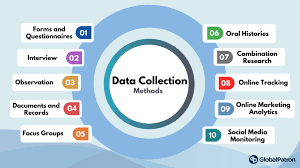
There are many different options in terms of how you go about collecting data for your study. However, these options can be grouped into the following types:

  • Interviews (which can be unstructured, semi-structured or structured)
  • Focus groups and group interviews
  • Surveys (online or physical surveys)
  • Observations
  • Documents and records
  • Case studies

The choice of which data collection method to use depends on your overall research aims and objectives, as well as practicalities and resource constraints. For example, if your research is exploratory in nature, qualitative methods such as interviews and focus groups would likely be a good fit. Conversely, if your research aims to measure specific variables or test hypotheses, large-scale surveys that produce large volumes of numerical data would likely be a better fit.

What are the main data analysis methods?

Data analysis methods can be grouped according to whether the research is qualitative or quantitative.

Popular data analysis methods in qualitative research include:

  • Qualitative content analysis
  • Discourse analysis
  • Narrative analysis
  • Grounded theory
  • IPA

Qualitative data analysis all begins with data coding, after which one (or more) analysis technique is applied.

Popular data analysis methods in quantitative research include:

  • Descriptive statistics (e.g. means, medians, modes)
  • Inferential statistics (e.g. correlation, regression, structural equation modelling)

Again, the choice of which data collection method to use depends on your overall research aims and objectives, as well as practicalities and resource constraints.

How do I choose a research methodology?

As you’ve probably picked up by now, your research aims and objectives have a major influence on the research methodology. So, the starting point for developing your research methodology is to take a step back and look at the big picture of your research, before you make methodology decisions. The first question you need to ask yourself is whether your research is exploratory or confirmatory in nature.

If your research aims and objectives are primarily exploratory in nature, your research will likely be qualitative and therefore you might consider qualitative data collection methods (e.g. interviews) and analysis methods (e.g. qualitative content analysis). 

Conversely, if your research aims and objective are looking to measure or test something (i.e. they’re confirmatory), then your research will quite likely be quantitative in nature, and you might consider quantitative data collection methods (e.g. surveys) and analyses (e.g. statistical analysis).

Designing your research and working out your methodology is a large topic, which we’ll cover in other posts. For now, however, the key takeaway is that you should always start with your research aims and objectives. Every methodology decision will flow from that. 

The post What Is Research Methodology? appeared first on HKT Consultant.

]]>
Research methodology: a step-by-step guide for beginners https://phantran.net/research-methodology-a-step-by-step-guide-for-beginners.htm https://phantran.net/research-methodology-a-step-by-step-guide-for-beginners.htm#comments Sat, 10 Aug 2019 03:24:33 +0000 https://phantran.net/?p=18243 The book of Research Methodology: A Step-by-Step Guide for Beginners integrates various quantitative and qualitative methodologies into eight practice-based-steps, providing lots of examples throughout to link theory with practice. Written specifically for students with no previous experience of research and research methodology, the writing style is simple and clear and the author presents this complex

The post Research methodology: a step-by-step guide for beginners appeared first on HKT Consultant.

]]>
The book of Research Methodology: A Step-by-Step Guide for Beginners integrates various quantitative and qualitative methodologies into eight practice-based-steps, providing lots of examples throughout to link theory with practice. Written specifically for students with no previous experience of research and research methodology, the writing style is simple and clear and the author presents this complex subject in a straightforward way that empowers readers to tackle research with confidence. The book has been revised and updated to include extended coverage of qualitative research methods in addition to existing comprehensive coverage of quantitative methods. There are also brand new learning features such as reflective questions throughout the text to help students consolidate their knowledge.

The post Research methodology: a step-by-step guide for beginners appeared first on HKT Consultant.

]]>
https://phantran.net/research-methodology-a-step-by-step-guide-for-beginners.htm/feed 3
Doing Management Research: A Comprehensive Guide https://phantran.net/doing-management-research-a-comprehensive-guide.htm https://phantran.net/doing-management-research-a-comprehensive-guide.htm#comments Sat, 10 Aug 2019 03:25:56 +0000 https://phantran.net/?p=18260 This book provides refreshing and powerful insights on the challenges of conducting management research from a European perspective. Particularly for someone embarking on a management research career this book will provide valuable guidelines.’ — Ian MacMillan, Wharton School of Business, University of Pennsylvania. This comprehensive volume is distinguished by its balance and pragmatism. The authors

The post Doing Management Research: A Comprehensive Guide appeared first on HKT Consultant.

]]>
This book provides refreshing and powerful insights on the challenges of conducting management research from a European perspective. Particularly for someone embarking on a management research career this book will provide valuable guidelines.’ — Ian MacMillan, Wharton School of Business, University of Pennsylvania. This comprehensive volume is distinguished by its balance and pragmatism. The authors who present the various research methods are not proponents but researchers who have applied these methods. The authors who discuss philosophical and strategic issues are not advocates but researchers who have had to confront these issues in their research’ – Bill Starbuck, New York University.

Doing Management Research is a fabulous contribution to our field. Thietart and his colleagues have put together a unique and valuable guide to help management scholars more deeply understand the issues, dynamics and contradictions of executing first class managerial research. This book will hold an important place on the researcher’s desk for years to come’ – Michael Tushman, Harvard Business School ‘This is an excellent in-depth examination of the conduct of management research. It will serve as a valuable resource for management scholars and researchers and is a must read for Ph.D. students in management.’ — Michael Hitt, Arizona State University.

This book will prove to be an excellent guide for those engaged in management research for the first time and an excellent refresher for more experienced scholars. Raymond Thietart and his colleagues should be thanked roundly for this comprehensive volume’ – Gordon Walker, Southern Methodist University, Cox Business School `This textbook makes an outstanding contribution to texts on management research. For researchers considering management research it offers an extensive guide to the research process’ – Paula Roberts, Nurse Researcher Doing Management Research, a major new textbook, provides answers to questions and problems which researchers invariably encounter when embarking on management research, be it quantitative or qualitative.

This book will carefully guide the reader through the research process from beginning to end. An excellent tool for academics and students, it enables the reader to acquire and build upon empirical evidence, and to decide what tools to use to understand and describe what is being observed, and then, which methods of analysis to adopt. There is an entire section dedicated to writing up and communicating the research findings. Written in an accessible and easy-to-use style, this book can be read from cover to cover or dipped into, to clarify particular issues during the research process. Doing Management Research results from the ‘hands-on’ experience of a large group of researchers who have all had to address the different issues raised when undertaking management research. It is anchored in real methodological problems that researchers face in their work. This work will also become one of the most useful reference tools for senior researchers who are looking for answers to epistemological or methodological problems.

The post Doing Management Research: A Comprehensive Guide appeared first on HKT Consultant.

]]>
https://phantran.net/doing-management-research-a-comprehensive-guide.htm/feed 2
Personal attributes of a successful researcher https://phantran.net/nha-nghien-cuu-khoa-hoc-va-nhung-to-chat-can-co.htm Sun, 11 Aug 2019 02:02:44 +0000 https://phuongphapnghiencuu.com/?p=7852 Researchers are: “Professionals engaged in the conception or creation of new knowledge, products, processes, methods and systems, and in the management of the projects concerned.” (European Commission’s definition). What is your dream as a researcher? Finding a cure for a rare disease? Making an invention that creates history? Winning a Nobel? Now, as importantly, what do you think will get you

The post Personal attributes of a successful researcher appeared first on HKT Consultant.

]]>

Researchers are: “Professionals engaged in the conception or creation of new knowledge, products, processes, methods and systems, and in the management of the projects concerned.” (European Commission’s definition).

What is your dream as a researcher? Finding a cure for a rare disease? Making an invention that creates history? Winning a Nobel? Now, as importantly, what do you think will get you there?

When we look at successful scientists down the ages, we find that there are some qualities that they all have in common; these are the attributes that both define them as a researcher and help them succeed in their field. Some attributes might be more pronounced in some researchers and some less so, but they are all present to some extent. Wouldn’t you want to know what these attributes are and which renowned researchers you share these with? Come, let’s explore.

Inquisitiveness

Go back to the time you were a child and dismantled a toy or ripped apart a figure to find out what lay inside or made the sound. Researchers carry that child-like inquisitiveness throughout their life. They are fascinated about various phenomena in the natural world and enjoy striving to know more about them. And for the truly inquisitive researcher, the search for knowledge and information never seems to stop. Apart from wanting to know more about their field, inquisitive researchers also seek to explore other fields, because you never know where the solution for a scientific problem could come from. To Isaac Newton, it came in an orchard, and to Archimedes, in a bathtub. A researcher never stops being inquisitive!

Thirst for knowledge

Coupled with insatiable inquisitiveness, successful researchers have an immense yearning to dive deep – to understand a problem, a concept, or a phenomenon from all perspectives. In fact, this is what helps them bring new questions and insights to the table. Perhaps this thirst originates from the feeling that we as humans really know so little about the world and how much more there is to learn.

Charles Darwin began the study of what would lead to his landmark theory of evolution at the age of 22. But he wasn’t satisfied with making only a few basic observations. So, he spent the next several decades satiating his need to gain more knowledge about the process of evolution across species. 28 years after he commenced his exploration, when he was 50, he finally deemed it fit to publish his pathbreaking book On the Origins of the Species.

Analytical ability

Analysis is about learning, observing, and then putting that learning and observation together into a meaningful conclusion. It’s about connecting the dots and seeing the big picture leading to the aha moment. Archimedes channeled all his previous knowledge and learning when he immersed himself into a bathtub that fortuitous day. For days, he had been musing over his king’s problem: how could he determine whether the gold the king had was real? When he immersed himself into the tub, he was able to at once analyze what caused the displacement of the water (the immersion of a weight into the water) and how he could use this to determine the authenticity of the gold (by submerging it in water). Aha indeed.

Take a course & improve your skills

Learn attributes of scientific language

Handy tips to make your writing readable, precise, clear and coherent

What will you learn?

  1. Factors that influence readability of a document
  2. How to maintain objectivity and precision in scientific writing
  3. How to maintain clarity and coherence of scientific writing

Try this course for free with R Upskill Membership

Innovativeness

Innovativeness is about looking at something with a new perspective or, as is often said, with a new pair of eyes. It is the springboard of many an invention and discovery. With Newton, it was looking at a falling apple – a mundane event by most people’s accounts – through the lens of gravity, leading him to formulate his three laws of motion. An innovative researcher knows that the next big invention or discovery can originate anywhere; they just need to look well enough. Chinese scientist Tu Youyou, who won the 2015 Nobel for Physiology or Medicine for her innovative therapy for malaria, found the answer not in something new age but in an ancient Chinese text on herbs.

Adaptability

If innovativeness is all about looking at something in a new way, adaptability is about how soon and how well you can align yourself with a new situation you are presented with. As a researcher, you may have to frequently come to grips with new challenges. It could be modifying your research focus to apply for a grant, moving to a new country to pursue an opportunity, or approaching your research problem in a wholly new way based on peer reviewer comments. Your adaptability could determine how well you perform as a researcher and also how successful you can be.

Zabta Khan Shinwari, current Chair of the Biotechnology Department at Quaid-i-Azam University (QAU) in Islamabad, Pakistan and erstwhile Secretary-General of the Pakistan Academy of Sciences (PAS), is quite the master at adaptability. Although he had a PhD in molecular systematics, based on his supervisor’s suggestion, he decided to explore the rapidly evolving field of biotechnology in the mid-90s. Later, as he explored the field, he realized that its ethical aspects were as important as the scientific discoveries, and so, decided to pursue bioethics, a decision that was to eventually lead to his winning the 2015 UNESCO Avicenna Prize for Ethics in Science. As an aside, isn’t it fascinating that he adjusted to the Japanese language and way of life on his way to completing his PhD from Kyoto University in a mere 2.5 years? But that is another story.

Focus

It is one thing to have an aim, and quite another to never lose sight of it. The difference is focus. This is what distinguishes successful researchers, feels Linqi Zhang, Chair of the Department of Basic Medical Sciences and Comprehensive Aids Research Center at Tsinghua University in Beijing, China. He believes that it is single-mindedness that helps researchers concentrate on solving problems. He explains: “When [others] encounter a mountain too high, they will take a detour… The successful researcher will find the solution no matter how long that takes.”

Focus helps you continue looking at the bigger picture and the greater goal of your research – through all the false starts, dead ends, rejects, and revisions – because you know where you want to be at the end of it all.

Perseverance

If there is one quality that marks success in science (and in fact, in many other fields), it’s probably perseverance. The greatest scientific discoveries may take years, and taking a germ of an idea to its fruition takes perseverance through all those years. Perseverance is about never giving up and striving to overcome every obstacle on your research journey.

Marie Curie, who discovered radium and polonium, exhibited tremendous perseverance on the road to those double discoveries. In her youth, she had to endure immense prejudice and adversity as a young woman in Germany-occupied Poland. In her later years, she went through grave heartbreak when she lost her husband, Pierre, in an accident. Curie though remained undeterred through it all. Her perseverance powered her on to the rare feat of a double Nobel win.

Collaboration

When we look at the winners of the Nobel, the Lasker, or any major scientific award in recent years, one thing becomes clear: research is increasingly becoming a collaborative effort. Science is evolving: it is getting super-specialized and multi-disciplinary, and researchers are collaborating for various reasons such as accessing scientific expertise, pursuing new fields and problems, and getting published and cited more. Collaborative efforts can also help resolve global challenges such as climate change or pandemics, as they necessitate many heads drawn from diverse fields to come up with solutions. This evolution is also reflected in the growing number of multiauthor papers stemming from international collaborations. Collaboration clearly is the way forward.

Communication

Great researchers need to be great communicators. You need to communicate with editors, reviewers, co-authors, and funders at the very least. Through research papers, you need to be able to effectively communicate your research with readers. A compelling abstract can pique interest in your paper, leading to more readers and eventually to increased citations. A well-constructed grant proposal leads to a greater chance of consideration and perhaps even an approval. Apart from this, to make science accessible to people both within and outside the scientific community, you also need to adopt different styles of communication. At conferences, you need to know how to present your research to an informed audience. At the other end, you need to communicate your research in a more accessible manner to press reporters and lay people.

Today, you have several channels of communication at your disposal to help take your research far beyond your doorstep. So, you can choose what works for you: mixed-media formats such as blogs and videos, more visual forms such as infographics and graphic abstracts, or a purely aural form such as podcasts.

Foresightedness

Scientists are able to make inventions and discoveries because they are able to first see the potential or need for them. Stanley Whittingham, John Goodenough, and Akira Yoshino, who won the 2019 Nobel in Chemistry, first saw the need for their invention in the global oil crisis of the 70s: the crisis clearly pointed to the need for a future that is less dependent on fossil fuels. After 30 years and numerous incremental developments, they gave the world the lithium-ion battery, which now powers devices ranging from computers to cars. Foresightedness is about seeing far and then striving to bring that vision to reality.

Integrity

Integrity is one of the pillars of science. It is said that great science is built by standing on the shoulders of giants. However, if those shoulders lack integrity, there remains little hope for advancement. Researchers who are passionate about their field, deeply committed to their work, and also understand the potential impact they can create are the ones who are driven by integrity. They uphold best ethical practices at all times, even in highly competitive situations. And thereby, also show the way for the others.

Passion

Passion lies at the heart of great research – and great researchers. Despite the setbacks and challenges, their passion to dig deeper, to make a difference to the field or the society at large, keeps researchers zealous.

It’s what kept Thomas Edison motivated despite the multiple failures before he invented the lightbulb. It kept Curie striving through adversities and calamities. It had Darwin diving deeper and deeper into the study of evolution for close to 30 years. It had Youyou going back 1,600 years in search of a remedy.

So, keep walking on the path that brings you closer to achieving your goals. And keep growing along the way.

The post Personal attributes of a successful researcher appeared first on HKT Consultant.

]]>
Quantitative Research: Definition, Methods, Types and Examples https://phantran.net/quantitative-research-definition-methods-types-and-examples.htm https://phantran.net/quantitative-research-definition-methods-types-and-examples.htm#comments Sun, 08 Sep 2019 22:16:40 +0000 https://phantran.net/?p=15767 What is quantitative research? Quantitative research is defined as a systematic investigation of phenomena by gathering quantifiable data and performing statistical, mathematical, or computational techniques. Quantitative research collects information from existing and potential customers using sampling methods and sending out online surveys, online polls, questionnaires, etc., the results of which can be depicted in the

The post Quantitative Research: Definition, Methods, Types and Examples appeared first on HKT Consultant.

]]>

What is quantitative research?

Quantitative research is defined as a systematic investigation of phenomena by gathering quantifiable data and performing statistical, mathematical, or computational techniques. Quantitative research collects information from existing and potential customers using sampling methods and sending out online surveys, online polls, questionnaires, etc., the results of which can be depicted in the form of numerical. After careful understanding of these numbers to predict the future of a product or service and make changes accordingly.

An example of quantitative research is the survey conducted to understand the amount of time a doctor takes to tend to a patient when the patient walks into the hospital. A patient satisfaction survey template can be administered to ask questions like how much time did a doctor takes to see a patient, how often does a patient walks into a hospital, and other such questions.

Quantitative outcome research is mostly conducted in the social sciences using the statistical methods used above to collect quantitative data from the research study. In this research method, researchers and statisticians deploy mathematical frameworks and theories that pertain to the quantity under question.

Quantitative research templates are objective, elaborate, and many times, even investigational. The results achieved from this research method are logical, statistical, and unbiased. Data collection happened using a structured method and conducted on larger samples that represent the entire population.

As mentioned above, quantitative research is data-oriented. There are two methods to conduct quantitative research. They are:

  • Primary quantitative research methods
  • Secondary quantitative research methods

Primary quantitative research methods

There are four different types of quantitative research methods:

Primary quantitative research is the most widely used method of conducting market research. The distinct feature of primary research is that the researcher focuses on collecting data directly rather than depending on data collected from previously done research. Primary quantitative research design can be broken down into three further distinctive tracks, as well as the process flow. They are:

A. Techniques and Types of Studies

There are multiple types of primary quantitative research. They can be distinguished into the four following distinctive methods, which are:

  1. Survey Research:

Survey Research is the most fundamental tool for all quantitative outcome research methodologies and studies. Surveys used to ask questions to a sample of respondents, using various types such as online polls, online surveys, paper questionnaires, web-intercept surveys, etc. Every small and big organization intends to understand what their customers think about their products and services, how well are new features faring in the market and other such details.

By conducting survey research, an organization can ask multiple survey questions, collect data from a pool of customers, and analyze this collected data to produce numerical results. It is the first step towards collecting data for any research.

This type of research can be conducted with a specific target audience group and also can be conducted across multiple groups along with comparative analysis. A prerequisite for this type of research is that the sample of respondents must have randomly selected members. This way, a researcher can easily maintain the accuracy of the obtained results as a huge variety of respondents will be addressed using random selection. Traditionally, survey research was conducted face-to-face or via phone calls but with the progress made by online mediums such as email or social media, survey research has spread to online mediums as well.

Traditionally, survey research was conducted face-to-face or via phone calls but with the progress made by online mediums such as email or social media, survey research has spread to online mediums as well.

There are two types of surveys, either of which can be chosen based on the time in-hand and the kind of data required:

Cross-sectional surveys: Cross-sectional surveys are observational surveys conducted in situations where the researcher intends to collect data from a sample of the target population at a given point in time. Researchers can evaluate various variables at a particular time. Data gathered using this type of survey is from people who depict similarity in all variables except the variables which are considered for research. Throughout the survey, this one variable will stay constant.

  • Cross-sectional surveys are popular with retail, SMEs, healthcare industries. Information is garnered without modifying any parameters in the variable ecosystem.
  • Using a cross-sectional survey research method, multiple samples can be analyzed and compared.
  • Multiple variables can be evaluated using this type of survey research.
  • The only disadvantage of cross-sectional surveys is that the cause-effect relationship of variables cannot be established as it usually evaluates variables at a particular time and not across a continuous time frame.

Longitudinal surveys: Longitudinal surveys are also observational surveys but, unlike cross-sectional surveys, longitudinal surveys are conducted across various time durations to observe a change in respondent behavior and thought-processes. This time can be days, months, years, or even decades. For instance, a researcher planning to analyze the change in buying habits of teenagers over 5 years will conduct longitudinal surveys.

  • In cross-sectional surveys, the same variables were evaluated at a given point in time, and in longitudinal surveys, different variables can be analyzed at different intervals of time.
  • Longitudinal surveys are extensively used in the field of medicine and applied sciences. Apart from these two fields, they are also used to observe a change in the market trend, analyze customer satisfaction, or gain feedback on products/services.
  • In situations where the sequence of events is highly essential, longitudinal surveys are used.
  • Researchers say that when there are research subjects that need to be thoroughly inspected before concluding, they rely on longitudinal surveys.
  1. Correlational research:

A comparison between two entities is invariable. Correlation research is conducted to establish a relationship between two closely-knit entities and how one impacts the other and what are the changes that are eventually observed. This research method is carried out to give value to naturally occurring relationships, and a minimum of two different groups are required to conduct this quantitative research method successfully. Without assuming various aspects, a relationship between two groups or entities must be established.

Researchers use this quantitative research design to correlate two or more variables using mathematical analysis methods. Patterns, relationships, and trends between variables are concluded as they exist in their original set up. The impact of one of these variables on the other is observed along with how it changes the relationship between the two variables. Researchers tend to manipulate one of the variables to attain the desired results.

Ideally, it is advised not to make conclusions merely based on correlational research. This is because it is not mandatory that if two variables are in sync that they are interrelated.

Example of Correlational Research Questions:

  • The relationship between stress and depression.
    The equation between fame and money.
    The relation between activities in a third-grade class and its students.
  1. Causal-comparative research:

This research method mainly depends on the factor of comparison. Also called quasi-experimental research, this quantitative research method is used by researchers to conclude the cause-effect equation between two or more variables, where one variable is dependent on the other independent variable. The independent variable is established but not manipulated, and its impact on the dependent variable is observed. These variables or groups must be formed as they exist in the natural set up. As the dependent and independent variables will always exist in a group, it is advised that the conclusions are carefully established by keeping all the factors in mind.

Causal-comparative research is not restricted to the statistical analysis of two variables but extends to analyzing how various variables or groups change under the influence of the same changes. This research is conducted irrespective of the type of relation that exists between two or more variables. Statistical analysis is used to distinctly present the outcome obtained using this quantitative research method.

Example of Causal-Comparative Research Questions:

  • The impact of drugs on a teenager.
    The effect of good education on a freshman.
    The effect of substantial food provision in the villages of Africa.
  1. Experimental research:

Also known as true experimentation, this research method is reliant on a theory. Experimental research, as the name suggests, is usually based on one or more theories. This theory has not been proven in the past and is merely a supposition. In experimental research, an analysis is done around proving or disproving the statement. This research method is used in natural sciences.Traditional research methods are more effective than modern techniques.

There can be multiple theories in experimental research. A theory is a statement that can be verified or refuted.

After establishing the statement, efforts are made to understand whether it is valid or invalid. This type of quantitative research method is mainly used in natural or social sciences as there are various statements which need to be proved right or wrong.

  • Traditional research methods are more effective than modern techniques.
  • Systematic teaching schedules help children who find it hard to cope up with the course.
  • It is a boon to have responsible nursing staff for ailing parents.

B. Data collection methodologies

The second major step in primary quantitative research is data collection. Data collection can be divided into sampling methods and data collection with the use of surveys and polls.

Data collection methodologies: Sampling methods

There are two main sampling methods for quantitative research: Probability and Non-probability sampling.

Probability sampling: A theory of probability is used to filter individuals from a population and create samples in probability sampling. Participants of a sample are chosen random selection processes. Each member of the target audience has an equal opportunity to be selected in the sample.

There are four main types of probability sampling:

  • Simple random sampling: As the name indicates, simple random sampling is nothing but a random selection of elements for a sample. This sampling technique is implemented where the target population is considerably large.
  • Stratified random sampling: In the stratified random sampling method, a large population is divided into groups (strata), and members of a sample are chosen randomly from these strata. The various segregated strata should ideally not overlap one another.
  • Cluster sampling: Cluster sampling is a probability sampling method using which the main segment is divided into clusters, usually using geographic and demographic segmentation parameters.
  • Systematic sampling: Systematic sampling is a technique where the starting point of the sample is chosen randomly, and all the other elements are chosen using a fixed interval. This interval is calculated by dividing the population size by the target sample size.

Non-probability sampling: Non-probability sampling is where the researcher’s knowledge and experience are used to create samples. Because of the involvement of the researcher, not all the members of a target population have an equal probability of being selected to be a part of a sample.

There are five non-probability sampling models:

  • Convenience sampling: In convenience sampling, elements of a sample are chosen only due to one prime reason: their proximity to the researcher. These samples are quick and easy to implement as there is no other parameter of selection involved.
  • Consecutive sampling: Consecutive sampling is quite similar to convenience sampling, except for the fact that researchers can choose a single element or a group of samples and conduct research consecutively over a significant period and then perform the same process with other samples.
  • Quota sampling: Using quota sampling, researchers can select elements using their knowledge of target traits and personalities to form strata. Members of various strata can then be chosen to be a part of the sample as per the researcher’s understanding.
  • Snowball sampling: Snowball sampling is conducted with target audiences, which are difficult to contact and get information. It is popular in cases where the target audience for research is rare to put together.
  • Judgmental sampling: Judgmental sampling is a non-probability sampling method where samples are created only based on the researcher’s experience and skill.

Data collection methodologies: Using surveys & polls

Once the sample is determined, then either surveys or polls can be distributed to collect the data for quantitative research.

  • Using surveys for primary quantitative research

A Survey is defined as a research method used for collecting data from a pre-defined group of respondents to gain information and insights on various topics of interest. The ease of survey distribution and the wide number of people it can be reached depending on the research time and research objective make it one of the most important aspects of conducting quantitative outcome research.

Fundamental levels of measurement – nominal, ordinal, interval and ratio scales

There are four measurement scales that are fundamental to creating a multiple-choice question in a survey. They are nominal, ordinal, interval, and ratio measurement scales without the fundamentals of which, no multiple-choice questions can be created. Hence, it is crucial to understand these levels of measurement to be able to develop a robust survey.

Use of different question types

To conduct quantitative research, close-ended questions have to be used in a survey. They can be a mix of multiple question types including multiple-choice questions like semantic differential scale questions, rating scale questions, etc.

Survey Distribution and Survey Data Collection

In the above, we have seen the process of building a survey along with the survey design to conduct primary quantitative research. Survey distribution to collect data is the other important aspect of the survey process. There are different ways of survey distribution. Some of the most commonly used methods are:

  • Email: Sending a survey via email is the most widely used and most effective method of survey distribution. The response rate is high in this method because the respondents are aware of your brand. You can use the QuestionPro email management feature to send out and collect survey responses.
  • Buy respondents: Another effective way to distribute a survey and conduct primary quantitative research is to use a sample. Since the respondents are knowledgeable and are on the panel by their own will, responses are much higher.
  • Embed survey on a website: Embedding a survey in a website increases a high number of responses as the respondent is already in close proximity to the brand when the survey pops up.
  • Social distribution: Using social media to distribute the survey aids in collecting a higher number of responses from the people that are aware of the brand.
  • QR code: QuestionPro QR codes store the URL for the survey. You can print/publish this code in magazines, on signs, business cards, or on just about any object/medium.
  • SMS survey: A quick and time-effective way of conducting a survey to collect a high number of responses is the SMS survey.
  • QuestionPro app: The QuestionPro App allows users to circulate surveys quickly, and the responses can be collected both online and offline.

Survey example

An example of a survey is short customer satisfaction (CSAT) survey template that can quickly be built and deployed to collect feedback about what the customer thinks about a brand and how satisfied and referenceable the brand is.

  • Using polls for primary quantitative research

Polls are a method to collect feedback with the use of close-ended questions from a sample. The most commonly used types of polls are election polls and exit polls. Both of these are used to collect data from a large sample size but using basic question types like a multiple-choice question.

C. Data analysis techniques

The third aspect of primary quantitative research design is data analysis. After the collection of raw data, there has to be an analysis of this data to derive statistical inferences from this research. It is important to relate the results to the objective of research and establish the statistical relevance of results.

It is important to consider aspects of research which were not considered for the data collection process and report the difference between what was planned vs. what was actually executed.

It is then required to select precise statistical analysis methods such as SWOT, Conjoint, Cross-tabulation, etc. to analyze the quantitative data.

  • SWOT analysis: SWOT Analysis stands for the acronym of Strengths, Weakness, Opportunities, and Threat analysis. Organizations use this statistical analysis technique to evaluate their performance internally and externally to develop effective strategies for improvement.
  • Conjoint Analysis: Conjoint Analysis is a market analysis method to learn how individuals make complicated purchasing decisions. Trade-offs are involved in the daily activities of an individual, and these reflect their ability to decide from a complex list of product/service options.
  • Cross-tabulation: Cross-tabulation is one of the preliminary statistical market analysis methods which establishes relationships, patterns, and trends within the various parameters of the research study.
  • TURF Analysis: TURF Analysis, an acronym for Totally Unduplicated Reach and Frequency Analysis, is executed in situations where the reach of a favorable communication source is to be analyzed along with the frequency of this communication. It is used for understanding the potential of a target market.

Inferential statistics methods such as confidence interval, margin of error, etc. can then be used to provide results.

Secondary quantitative research methods

Secondary quantitative research or desk research is a research method that involves using already existing data or secondary data. Existing data is summarized and collated to increase the overall effectiveness of research.

This research method involves the collection of quantitative data from existing data sources like the internet, government resources, libraries, research reports, etc. Secondary quantitative research helps to validate the data that is collected from primary quantitative research as well as aid in strengthening or proving or disproving previously collected data.

Following are five popularly used secondary quantitative research methods:

  1. Data available on the internet: With the high penetration of internet and mobile devices, it has become increasingly easy to conduct quantitative research using the internet. Information about most research topics is available online, and this aids in boosting the validity of primary quantitative data as well as proving the relevance of previously collected data.
  2. Government and non-government sources: Secondary quantitative research can also be conducted with the help of government and non-government sources that deal with market research reports. This data is highly reliable and in-depth and hence, can be used to increase the validity of quantitative research design.
  3. Public libraries: Now a sparingly used method of conducting quantitative research, it is still a reliable source of information though. Public libraries have copies of important research that were conducted earlier. They are a storehouse of valuable information and documents from which information can be extracted.
  4. Educational institutions: Educational institutions conduct in-depth research on multiple topics, and hence, the reports that they publish are an important source of validation in quantitative research.
  5. Commercial information sources: Local newspapers, journals, magazines, radio, and TV stations are a great source to obtain data for secondary quantitative research. These commercial information sources have in-depth, first-hand information on economic developments, political agenda, market research, demographic segmentation, and similar subjects.

Quantitative research characteristics

Some distinctive characteristics of quantitative research are:

  • Structured tools: Structured tools such as surveys, polls, or questionnaires are used to gather quantitative data. Using such structure methods helps in collecting in-depth and actionable data from the survey respondents.
  • Sample size: Quantitative research is conducted on a significant sample size that represents the target market. Appropriate sampling methods have to be used when deriving the sample to fortify the research objective
  • Close-ended questions: Closed-ended questions are created per the objective of the research. These questions help collect quantitative data and hence, are extensively used in quantitative research.
  • Prior studies: Various factors related to the research topic are studied before collecting feedback from respondents.
  • Quantitative data: Usually, quantitative data is represented by tables, charts, graphs, or any other non-numerical form. This makes it easy to understand the data that has been collected as well as prove the validity of the market research.
  • Generalization of results: Results of this research method can be generalized to an entire population to take appropriate actions for improvement.

Quantitative research examples

Some examples of quantitative research are:

  1. If any organization would like to conduct a customer satisfaction (CSAT) survey, a customer satisfaction survey template can be used. Through this survey, an organization can collect quantitative data and metrics on the goodwill of the brand or organization in the mind of the customer based on multiple parameters such as product quality, pricing, customer experience, etc. This data can be collected by asking a net promoter score (NPS) question, matrix table questions, etc. that provide data in the form of numbers that can be analyzed and worked upon.
  2. Another example of quantitative research is an organization that conducts an event, collecting feedback from the event attendees about the value that they see from the event. By using an event survey template, the organization can collect actionable feedback about satisfaction levels of customers during various phases of the event such as the sales, pre and post-event, the likelihood of recommending the organization to their friends and colleagues, hotel preferences for the future events and other such questions.

What are the advantages of quantitative research?

There are many advantages of quantitative research. Some of the major advantages of why researchers use this method in market research are:

  • Collect reliable and accurate data: As data is collected, analyzed, and presented in numbers, the results obtained will be extremely reliable. Numbers do not lie. They offer an honest picture of the conducted research without discrepancies and is also extremely accurate. In situations where a researcher predicts conflict, quantitative research is conducted.
  • Quick data collection: A quantitative research is carried out with a group of respondents who represent a population. A survey or any other quantitative research method applied to these respondents and the involvement of statistics, conducting, and analyzing results is quite straightforward and less time-consuming.
  • Wider scope of data analysis: Due to the statistics, this research method provides a wide scope of data collection.
  • Eliminate bias: This research method offers no scope for personal comments or biasing of results. The results achieved are numerical and are thus, fair in most cases.

The post Quantitative Research: Definition, Methods, Types and Examples appeared first on HKT Consultant.

]]>
https://phantran.net/quantitative-research-definition-methods-types-and-examples.htm/feed 8
Types of quantitative methods https://phantran.net/types-of-quantitative-methods.htm Sun, 08 Sep 2019 22:17:07 +0000 https://phuongphapnghiencuu.com/?p=8311 Quantitative methods represent the steps of using the Scientific Method of research. There are following types of quantitative method… 1. Experimental Research is the most well-established quantitative methodology in both the physical and social sciences. This approach uses the principles of research in the physical sciences to conduct experiments that explore human behavior. 2. Survey

The post Types of quantitative methods appeared first on HKT Consultant.

]]>

Quantitative methods represent the steps of using the Scientific Method of research. There are following types of quantitative method…

1. Experimental Research is the most well-established quantitative methodology in both the physical and social sciences. This approach uses the principles of research in the physical sciences to conduct experiments that explore human behavior.

2. Survey Research is used to ask people a number of questions about particular topics. Surveys can be online, mailed, handed out, or conducted in interview format. After researchers have collected survey data, they represent participants’ responses in numerical form using tables, graphs, charts, and/or percentages.

3. Content Analysis. Researchers use content analysis to count the number of occurrences of their particular focus of inquiry. Communication researchers often conduct content analyses of movies, commercials, television shows, magazines, etc., to count the number of occurrences of particular phenomena in these contexts to explore potential effects.

4. Meta-Analysis. Do you ever get frustrated when you hear about one research project that says a particular food is good for your health, and then some time later, you hear about another research project that says the opposite? Meta-analysis analyzes existing statistics found in a collection of quantitative research to demonstrate patterns in a particular line of research over time.

The post Types of quantitative methods appeared first on HKT Consultant.

]]>
Qualitative Research: Definition, Types, Methods and Examples https://phantran.net/qualitative-research-definition-types-methods-and-examples.htm Mon, 09 Sep 2019 02:23:05 +0000 https://phuongphapnghiencuu.com/?p=8348 Qualitative research is defined as a market research method that focuses on obtaining data through open-ended and conversational communication. This method is not only about “what” people think but also “why” they think so. For example, consider a convenience store looking to improve its patronage. A systematic observation concludes that the number of men visiting this store are more. One good method to determine why women were not visiting the store is to conduct an in-depth interview of potential customers in the category.

The post Qualitative Research: Definition, Types, Methods and Examples appeared first on HKT Consultant.

]]>

What is qualitative research?

Qualitative research is defined as a market research method that focuses on obtaining data through open-ended and conversational communication.

This method is not only about “what” people think but also “why” they think so. For example, consider a convenience store looking to improve its patronage. A systematic observation concludes that the number of men visiting this store are more. One good method to determine why women were not visiting the store is to conduct an in-depth interview of potential customers in the category.

For example, on successfully interviewing female customers, visiting the nearby stores and malls, and selecting them through random sampling, it was known that the store doesn’t have enough items for women and so there were fewer women visiting the store, which was understood only by personally interacting with them and understanding why they didn’t visit the store, because there were more male products than female ones.

Qualitative research is based on the disciplines of social sciences like psychology, sociology, and anthropology. Therefore, the qualitative research methods allow for in-depth and further probing and questioning of respondents based on their responses, where the interviewer/researcher also tries to understand their motivation and feelings. Understanding how your audience takes decisions can help derive conclusions in market research.

Types of qualitative research methods with examples

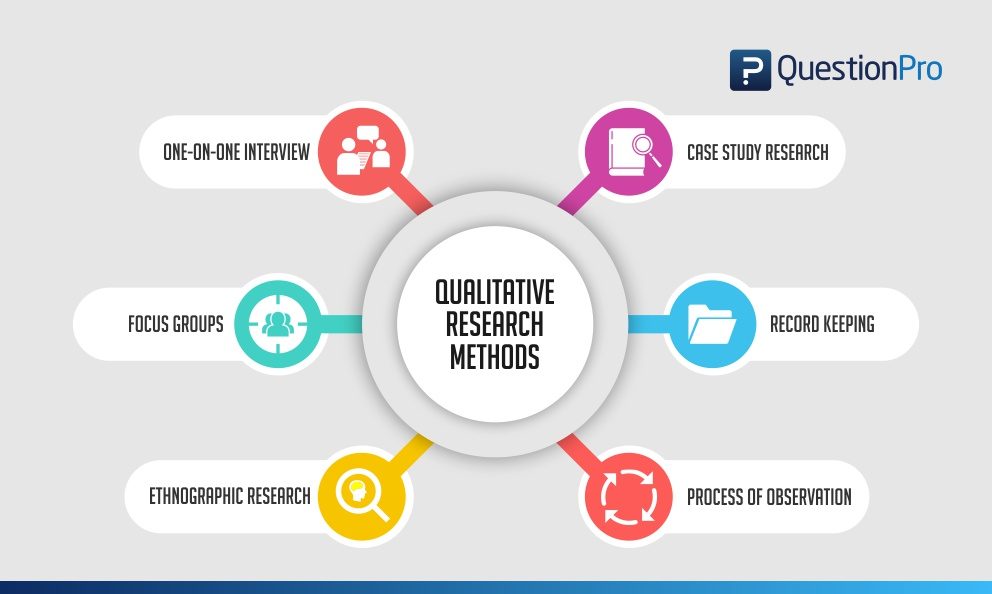
Qualitative research methods are designed in a manner that help reveal the behavior and perception of a target audience with reference to a particular topic. There are different types of qualitative research methods like an in-depth interview, focus groups, ethnographic research, content analysis, case study research that are usually used.

The results of qualitative methods are more descriptive and the inferences can be drawn quite easily from the data that is obtained.

Qualitative research methods originated in the social and behavioral sciences. Today our world is more complicated and it is difficult to understand what people think and perceive. Online qualitative research methods make it easier to understand that as it is more communicative and descriptive.

The following are the qualitative research methods that are frequently used. Also, read about qualitative research examples:

1. One-on-one interview:

Conducting in-depth interviews is one of the most common qualitative research methods. It is a personal interview that is carried out with one respondent at a time. This is purely a conversational method and invites opportunities to get details in depth from the respondent.

One of the advantages of this method provides a great opportunity to gather precise data about what people believe and what their motivations are. If the researcher is well experienced asking the right questions can help him/her collect meaningful data. If they should need more information the researchers should ask such follow up questions that will help them collect more information.

These interviews can be performed face-to-face or on phone and usually can last between half an hour to two hours or even more. When the in-depth interview is conducted face to face it gives a better opportunity to read the body language of the respondents and match the responses.

2. Focus groups: A focus group is also one of the commonly used qualitative research methods, used in data collection. A focus group usually includes a limited number of respondents (6-10) from within your target market.

The main aim of the focus group is to find answers to the “why” “what” and “how” questions. One advantage of focus groups is, you don’t necessarily need to interact with the group in person. Nowadays focus groups can be sent an online survey on various devices and responses can be collected at the click of a button.

Focus groups are an expensive method as compared to the other online qualitative research methods. Typically they are used to explain complex processes. This method is very useful when it comes to market research on new products and testing new concepts.

3. Ethnographic research: Ethnographic research is the most in-depth observational method that studies people in their naturally occurring environment.

This method requires the researchers to adapt to the target audiences’ environments which could be anywhere from an organization to a city or any remote location. Here geographical constraints can be an issue while collecting data.

This research design aims to understand the cultures, challenges, motivations, and settings that occur. Instead of relying on interviews and discussions, you experience the natural settings first hand.

This type of research method can last from a few days to a few years, as it involves in-depth observation and collecting data on those grounds. It’s a challenging and a time-consuming method and solely depends on the expertise of the researcher to be able to analyze, observe and infer the data.

4. Case study research: The case study method has evolved over the past few years and developed into a valuable qual research method. As the name suggests it is used for explaining an organization or an entity.

This type of research method is used within a number of areas like education, social sciences and similar. This method may look difficult to operate, however, it is one of the simplest ways of conducting research as it involves a deep dive and thorough understanding of the data collection methods and inferring the data.

5. Record keeping: 

This method makes use of the already existing reliable documents and similar sources of information as the data source. This data can be used in new research. This is similar to going to a library. There one can go over books and other reference material to collect relevant data that can likely be used in the research.

6. Process of observation:

Qualitative Observation is a process of research that uses subjective methodologies to gather systematic information or data. Since, the focus on qualitative observation is the research process of using subjective methodologies to gather information or data. Qualitative observation is primarily used to equate quality differences.

Qualitative observation deals with the 5 major sensory organs and their functioning – sight, smell, touch, taste, and hearing. This doesn’t involve measurements or numbers but instead characteristics.

Qualitative research: data collection and analysis

A. Qualitative data collection

Qualitative data collection allows collecting data that is non-numeric and helps us to explore how decisions are made and provide us with detailed insight. For reaching such conclusions the data that is collected should be holistic, rich, and nuanced and findings to emerge through careful analysis.

  1. Whatever method a researcher chooses for collecting qualitative data, one aspect is very clear the process will generate a large amount of data. In addition to the variety of methods available, there are also different methods of collecting and recording the data.

For example, if the qualitative data is collected through a focus group or one-to-one discussion, there will be handwritten notes or video recorded tapes. If there are recording they should be transcribed and before the process of data analysis can begin.

  1. As a rough guide, it can take a seasoned researcher 8-10 hours to transcribe the recordings of an interview, which can generate roughly 20-30 pages of dialogues. Many researchers also like to maintain separate folders to maintain the recording collected from the different focus group. This helps them compartmentalize the data collected.
  2. In case there are running notes taken, which are also known as field notes, they are helpful in maintaining comments, environmental contexts, nonverbal cues etc. These filed notes are helpful and can be compared while transcribing audio recorded data. Such notes are usually informal but should be secured in a similar manner as the video recordings or the audio tapes.

B. Qualitative data analysis

Qualitative data analysis such as notes, videos, audio recordings images, and text documents. One of the most used methods for qualitative data analysis is text analysis.

Text analysis is a  data analysis method that is distinctly different from all other qualitative research methods, where researchers analyze the social life of the participants in the research study and decode the words, actions, etc.

There are images also that are used in this research study and the researchers analyze the context in which the images are used and draw inferences from them. In the last decade, text analysis through what is shared on social media platforms has gained supreme popularity.

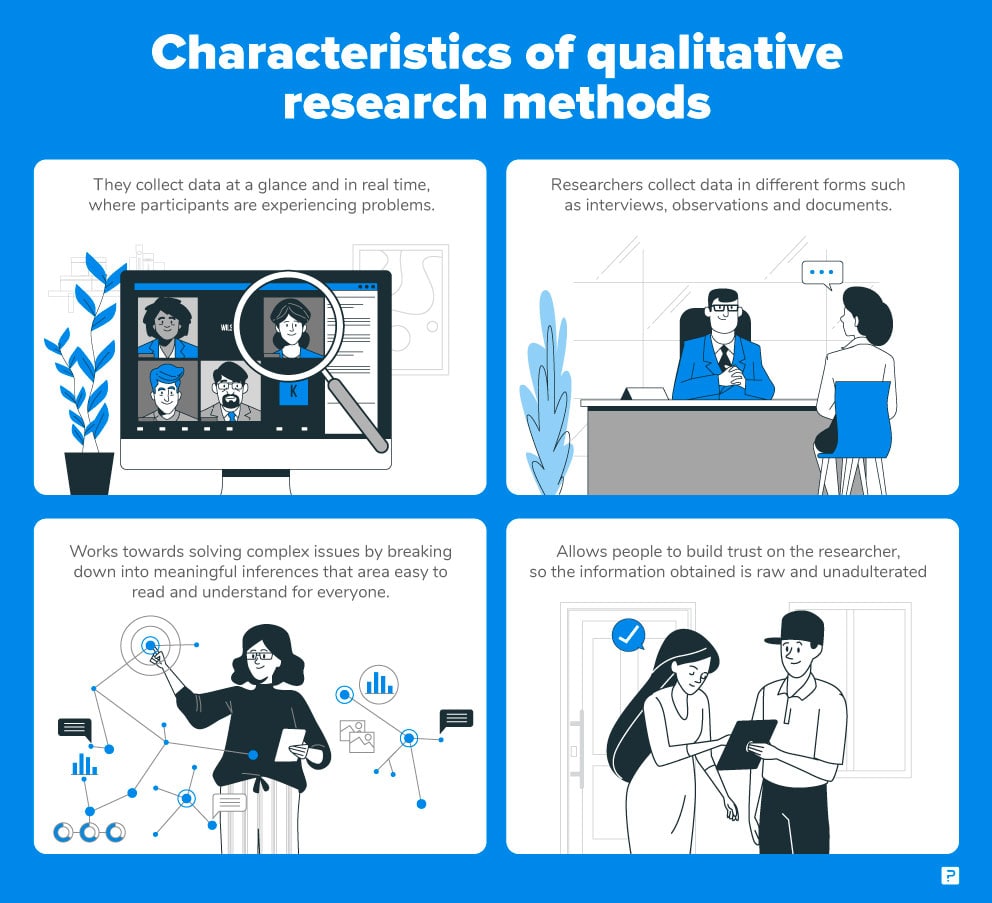
Characteristics of qualitative research methods

  1. Qualitative research methods usually collect data at the sight, where the participants are experiencing issues or problems. These are real-time data and rarely bring the participants out of the geographic locations to collect information.
  2. Qualitative researchers typically gather multiple forms of data, such as interviews, observations, and documents, rather than rely on a single data source.
  3. This type of research method works towards solving complex issues by breaking down into meaningful inferences, that is easily readable and understood by all.
  4. Since it’s a more communicative method, people can build their trust on the researcher and the information thus obtained is raw and unadulterated.

When to use qualitative research

Researchers make use of qualitative research techniques when they need to capture accurate, in-depth insights. It is very useful to capture “factual data”. Here are some examples of when to use qualitative research.

  • Developing a new product or generating an idea.
  • Studying your product/brand or service to strengthen your marketing strategy.
  • To understand your strengths and weaknesses.
  • Understanding purchase behavior.
  • To study the reactions of your audience to marketing campaigns and other communications.
  • Exploring market demographics, segments, and customer groups.
  • Gathering perception data of a brand, company, or product.

Qualitative research methods vs quantitative research methods

The basic differences between qualitative research methods and quantitative research methods are simple and straightforward. They differ in:

  • Their analytical objectives
  • Types of questions asked
  • Types of data collection instruments
  • Forms of data they produce
  • Degree of flexibility
Attributes Qualitative research methods Quantitative research methods
Analytical objectives This research method focuses on describing individual experiences and beliefs. Quantitative research method focuses on describing the characteristics of a population.
Types of questions asked Open-ended questions Closed-ended questions
Data collection Instrument Use semi-structured methods such as in-depth interviews, focus groups, and participant observation Use highly structured methods such as structured observation using questionnaires and surveys
Form of data produced Descriptive data Numerical data
Degree of flexibility Participant responses affect how and which questions researchers ask next Participant responses do not influence or determine how and which questions researchers ask next

The post Qualitative Research: Definition, Types, Methods and Examples appeared first on HKT Consultant.

]]>
Qualitative methods: what and why use them? https://phantran.net/qualitative-methods-what-and-why-use-them.htm Mon, 09 Sep 2019 04:28:04 +0000 https://phuongphapnghiencuu.com/?p=7856 Qualitative methods, as the name indicates, are methods that do not involve measurement or statistics.  Because the natural sciences have had such resounding success with quantitative methods, qualitative methods are sometimes looked down upon as less scientific.  That is, of course, a mistake.  Qualitative methods have been in use in philosophy, sociology, and history for centuries, and

The post Qualitative methods: what and why use them? appeared first on HKT Consultant.

]]>
Qualitative methods, as the name indicates, are methods that do not involve measurement or statistics.  Because the natural sciences have had such resounding success with quantitative methods, qualitative methods are sometimes looked down upon as less scientific.  That is, of course, a mistake.  Qualitative methods have been in use in philosophy, sociology, and history for centuries, and many of the famous studies we refer to in psychology classes every day were actually qualitative!

One qualitative method that goes back a long way is the case study.  When physicians like Sigmund Freud became interested in psychological problems, they continued their tradition of writing and publishing descriptions of their most interesting patients, the treatments they attempted to use, and the progress of the disorder.  Much of the content of abnormal psychology, for example, is built upon these case studies.

Another example is the méthode clinique or clinical method.  This method was particularly well used by Jean Piaget and his followers.  The basic idea is to present a person (in Piaget’s case, usually a young child) with a situation or problem for them to deal with.  The researcher observes how they handle the situation and asks them questions to try to understand the thought processes they are using.  Another version of the méthode clinique is called experimental phenomenology.  One study, for example, asked chess masters and novices to think out loud while playing chess, and analyzed the differences in approach.  One more example is the method of introspection used by Wilhelm Wundt — often considered the founder of scientific psychology — and his students.  Researchers paid careful attention to their own perceptions of simple events like colors, and noted changes in their perceptions following changes in the events.

Probably the oldest qualitative method is naturalistic observation.  This has been used by biologists who study animals in the wild (ethologists) for centuries, and by sociologists studying people’s behavior for nearly as long.  The idea of naturalistic observation is to step back from the situation and make every effort not to interfere.  A biologist studying birds, for example, may construct a blind — a small hut covered with natural materials — so as not to disturb the birds.  Child psychologists often observe children in a similar way.  In experimental schools, the children are often so used to being observed that the researchers don’t even have to hide!  Recently, video and audio technology has allowed us to do the same with people.  Unfortunately, the ethics of spying on people is very questionable!

A variation on naturalistic observation used by some sociologists and psychologists is called participant observation.  A sociologist who is interested in studying the lifestyles of people in some subculture (say a motorcycle gang) may actually join the subculture and interact with the people.  Many anthropologists use this technique as well.  In most cases, it is clear to all that the researcher is not really a part of the group, but sometimes the researcher hides his identity as a researcher.

One of the most useful qualitative techniques is interviewing.  It is often a part of all of the preceding methods.  Contrary to what many people believe, interviewing is not easy.  In fact, it is a rare person who is truly skillful at interviewing.  You have to be very careful not to listen to the person you interview through any prejudiced ideas you might have.  You have to make sure you are not leading the person in the direction you would like them to go.  You have to make sure you don’t misinterpret what they say.  In other words, you need to be very aware of your own biases!

Many researchers using qualitative methods adhere to a school of thought called phenomenology, and refer to their methods as phenomenological methods.  Phenomenology is the study of the contents of consciousness — phenomena — and phenomenological methods are ways of describing and analyzing these contents.  Originally, the methods focussed on describing one’s own thought, feelings, and perceptions.  For example, researchers would investigate their own experiences of an emotion such as anger, or cognitive processes like making a decision.  As you can imagine, the problem of biases are even more difficult to handle in these kind of studies.  Many people, if asked about their experiences of anger, might say something like “I could feel the adrenaline flowing through my veins!”  Unfortunately, that is a prejudicial statement based on people’s common knowledge about the presence of adrenaline.  In fact, nobody actually feels adrenaline in their veins!  We may feel muscle tension, or the hair raising in our necks, or a change in our hearing — but not adrenaline in our  veins.

As time went on, other ways of investigating phenomena were added.  For example, the researcher might ask other people to write what are called protocols — naïve descriptions of their experiences — and use them for analysis.  This is done, for example, when the researcher wants to investigate something he or she doesn’t have personal experience with, such as a schizophrenics verbal hallucinations.

There are arguments for and against the use of qualitative methods.  The most common criticisms of qualitative methods revolve around the problem of bias mentioned above:  It is much easier for biases to creep into qualitative studies than into quantitative ones.  The great advantage of measurement is that, once we have agreed upon what constitutes a measure (say, a meter stick), everyone can use it and be fairly confident that what they measure is what anyone else would measure.  If, on the other hand, we say “this looks like navy blue to me,” someone else might say “no, I think it’s purple,” and another person “no, it’s clearly royal blue!”

The arguments for qualitative methods revolve around realism.  Measures do not encompass the whole of an event.  You can ask people to rate their anxiety, but how much will that tell you about what they are actually feeling?  How do you measure something like love or hate?  Or think about the anthropologist looking at a culture:  Does counting the number of artifacts or timing rituals tell you much about their meaning to the people involved?  Or consider a person’s personality:  Do scores on personality tests tell you much about a person’s life or experiences?  Qualitative researchers would say not much!

Although quantitative methods are still preferred in psychology, more and more people are acknowledging that qualitative methods also have an important place.  Not everything about human beings can be understood by measurement, or in laboratories, or by using rats and pigeons.

Numerous specific research methods/instruments are used when conducting qualitative research.

  • Case Studies
  • Conversation Analysis
  • Field Studies
  • Focus Groups
  • Interviews
  • Naturalistic Observation
  • Participant Observation
  • Ethnography
  • Phenomenology
  • Autoethnography- This bibliography is compiled from a section of Heather Forest’s ILA on Autoethnography & Storytelling. It includes citations for several peer review journal articles that describe recent autoethnographic studies.
  • Grounded Theory Methods Folder- This bibliography contains references historical and recent books on grounded theory methodology and symbolic interactionalism.
  • Critical Discourse Analysis- Books, chapters, journal articles, whole journals, & dissertations.

The post Qualitative methods: what and why use them? appeared first on HKT Consultant.

]]>
Difference Between Qualitative and Quantitative Research https://phantran.net/difference-between-qualitative-and-quantitative-research.htm Mon, 09 Sep 2019 08:38:28 +0000 https://phuongphapnghiencuu.com/?p=8318 If the subject into which you conduct research is a scientific subject or topic, then the research methods include experiments, tests, the study of many other results of different experiments performed earlier about the topic or the subject and the like. On the other hand, research methodology about the scientific topic involves the techniques regarding

The post Difference Between Qualitative and Quantitative Research appeared first on HKT Consultant.

]]>

If the subject into which you conduct research is a scientific subject or topic, then the research methods include experiments, tests, the study of many other results of different experiments performed earlier about the topic or the subject and the like.

On the other hand, research methodology about the scientific topic involves the techniques regarding how to go about conducting the research, the justification of the use of particular tools of research, advanced techniques that can be used in performing the experiments, and the like.

A method is what you did. It is a simple description. You selected, for example, 100 rats and measured their weights. You fed some rats and some not.

A week later, you measured their weights again.

The methodology is why that should give you a meaningful result and why you used some specified method and not some other one.

This would, in particular, include the way you have controlled for errors, e.g., why you fed the rats for a week rather than a month and why 100 rats you thought were enough.

The table below summarizes the primary differences between the research methods and research methodology.

Quantitative research Qualitative research
Research method seeks to answer: what did the researcher use to complete his research. Research methodology seeks to answer: how did the researcher complete his study.
Research methods are the techniques and tools by which you research a subject or a topic. Methodology explains and justifies the techniques and tools by which you may proceed with your research.
Research methods involve the tasks of conducting experiments, tests, surveys, and the like utilizing the knowledge and skills learned through research methodology. Research methodology involves the learning of various techniques to conduct research and acquiring knowledge to perform tests, experiments, surveys, and critical analysis.
The research method aims at finding solutions to research problems. Research methodology ensures the employment of the correct procedures to solve the problems.
Research methods are the end of any scientific or non-scientific research. Research methodology paves the way to choose appropriate research methods and thus is the beginning of any research.

The post Difference Between Qualitative and Quantitative Research appeared first on HKT Consultant.

]]>