Interviews: Types and Methods in Management Research

An interview is generally a qualitative research technique which involves asking open-ended questions to converse with respondents and collect elicit data about a subject. The interviewer in most cases is the subject matter expert who intends to understand respondent opinions in a well-planned and executed series of questions and answers. Interviews are similar to focus groups and surveys when it comes to garnering information from the target market but are entirely different in their operation – focus groups are restricted to a small group of 6-10 individuals whereas surveys are quantitative in nature. Interviews are conducted with a sample from a population and the key characteristic they exhibit is their conversational tone.

[title text=”Main contents” link_text=”See more from basic to advanced” link=”category/methodology/qualitative-research/qualitative-methods/interviewing/”]

[blog_posts style=”normal” col_spacing=”xsmall” columns=”3″ columns__md=”1″ depth_hover=”2″ auto_slide=”5000″ cat=”244″ posts=”3″ offset=”42″ show_date=”false” excerpt_length=”25″ comments=”false” image_height=”60%” image_size=”original” image_hover=”zoom” text_align=”left”]

[blog_posts style=”normal” col_spacing=”xsmall” columns=”3″ columns__md=”1″ depth_hover=”2″ auto_slide=”6000″ cat=”244″ posts=”3″ offset=”39″ show_date=”false” excerpt_length=”25″ comments=”false” image_height=”60%” image_size=”original” image_hover=”zoom” text_align=”left”]

[blog_posts style=”normal” col_spacing=”xsmall” columns=”3″ columns__md=”1″ depth_hover=”2″ auto_slide=”7000″ cat=”244″ posts=”6″ offset=”33″ show_date=”false” excerpt_length=”25″ comments=”false” image_height=”60%” image_size=”original” image_hover=”zoom” text_align=”left”]

[blog_posts style=”normal” col_spacing=”xsmall” columns=”3″ columns__md=”1″ depth_hover=”2″ auto_slide=”8000″ cat=”244″ posts=”6″ offset=”27″ show_date=”false” excerpt_length=”25″ comments=”false” image_height=”60%” image_size=”original” image_hover=”zoom” text_align=”left”]

[blog_posts style=”normal” col_spacing=”xsmall” columns=”3″ columns__md=”1″ depth_hover=”2″ auto_slide=”5000″ cat=”244″ posts=”6″ offset=”21″ show_date=”false” excerpt_length=”25″ comments=”false” image_height=”60%” image_size=”original” image_hover=”zoom” text_align=”left”]

[blog_posts style=”normal” col_spacing=”xsmall” columns=”3″ columns__md=”1″ depth_hover=”2″ auto_slide=”6000″ cat=”244″ posts=”6″ offset=”15″ show_date=”false” excerpt_length=”25″ comments=”false” image_height=”60%” image_size=”original” image_hover=”zoom” text_align=”left”]

[blog_posts style=”normal” col_spacing=”xsmall” columns=”3″ columns__md=”1″ depth_hover=”2″ auto_slide=”7000″ cat=”244″ posts=”6″ offset=”9″ show_date=”false” excerpt_length=”25″ comments=”false” image_height=”60%” image_size=”original” image_hover=”zoom” text_align=”left”]

[blog_posts style=”normal” col_spacing=”xsmall” columns=”3″ columns__md=”1″ depth_hover=”2″ auto_slide=”8000″ cat=”244″ posts=”9″ offset=”0″ show_date=”false” excerpt_length=”25″ comments=”false” image_height=”60%” image_size=”original” image_hover=”zoom” text_align=”left”]

[row style=”small” class=”form-lien-he”]

[col span=”2″ span__sm=”12″]

[/col]
[col span=”4″ span__sm=”12″]

[button text=”Home” color=”secondary” style=”gloss” radius=”5″ depth=”2″ depth_hover=”3″ expand=”true” icon=”icon-star” icon_pos=”left” link=”https://phantran.net/”]

[/col]
[col span=”4″ span__sm=”12″]

[button text=”See basic to advanced” style=”gloss” radius=”5″ depth=”2″ depth_hover=”3″ expand=”true” icon=”icon-checkmark” icon_pos=”left” link=”/category/methodology/qualitative-research/qualitative-methods/interviewing/”]

[/col]
[col span=”2″ span__sm=”12″]

[/col]

[/row]

Fundamental Types of Interviews in Research

A researcher has to conduct interviews with a group of participants at a juncture in the research where information can only be obtained by meeting and personally connecting with a section of their target audience. Interviews offer the researchers with a platform to prompt their participants and obtain inputs in the desired detail. There are three fundamental types of interviews in research:

  • Structured Interviews:

Structured interviews are defined as research tools that are extremely rigid in their operations are allows very little or no scope of prompting the participants to obtain and analyze results. It is thus also known as a standardized interview and is significantly quantitative in its approach. Questions in this interview are pre-decided according to the required detail of information.

Structured interviews are excessively used in survey research with the intention of maintaining uniformity throughout all the interview sessions.

They can be closed-ended as well as open-ended – according to the type of target population. Closed-ended questions can be included to understand user preferences from a collection of answer options whereas open-ended can be included to gain details about a particular section in the interview.

Advantages of structured interviews:

  • Structured interviews focus on the accuracy of different responses due to which extremely organized data can be collected. Different respondents have different type of answers to the same structure of questions – answers obtained can be collectively analyzed.
  • They can be used to get in touch with a large sample of the target population.
  • The interview procedure is made easy due to the standardization offered by structured interviews.
  • Replication across multiple samples becomes easy due to the same structure of interview.
  • As the scope of detail is already considered while designing the interview, better information can be obtained and the researcher can analyze the research problem in a comprehensive manner by asking accurate research questions.
  • Since the structure of the interview is fixed, it often generates reliable results and is quick to execute.
  • The relationship between the researcher and the respondent is not formal due to which the researcher can clearly understand the margin of error in case the respondent either degrees to be a part of the survey or is just not interested in providing the right information.

Disadvantages of structured interviews:

  • Limited scope of assessment of obtained results.
  • The accuracy of information overpowers the detail of information.
  • Respondents are forced to select from the provided answer options.
  • The researcher is expected to always adhere to the list of decided questions irrespective of how interesting the conversation is turning out to be with the participants.
  • A significant amount of time is required for a structured interview.

Learn more: Market Research

  • Semi-Structured Interviews:

Semi-structured interviews offer a considerable amount of leeway to the researcher to probe the respondents along with maintaining basic interview structure. Even if it is a guided conversation between researchers and interviewees – an appreciable flexibility is offered to the researchers. A researcher can be assured that multiple interview rounds will not be required in the presence of structure in this type of research interview.

Keeping the structure in mind, the researcher can follow any idea or take creative advantage of the entire interview. Additional respondent probing is always necessary to garner information for a research study. The best application of semi-structured interview is when the researcher doesn’t have time to conduct research and requires detailed information about the topic.

Advantages of semi-structured interviews:

  • Questions of semi-structured interviews are prepared before the scheduled interview which provides the researcher with time to prepare and analyze the questions.
  • It is flexible to an extent while maintaining the research guidelines.
  • Researchers can express the interview questions in the format they prefer, unlike the structured interview.
  • Reliable qualitative data can be collected via these interviews.
  • Flexible structure of the interview.

Learn more: Quantitative Data

Disadvantages of semi-structured interviews:

    • Participants may question the reliability factor of these interviews due to the flexibility offered.
    • Comparing two different answers becomes difficult as the guideline for conducting interviews is not entirely followed. No two questions will have the exact same structure and the result will be an inability to compare are infer results.
  • Unstructured Interviews:

Also called as in-depth interviews, unstructured interviews are usually described as conversations held with a purpose in mind – to gather data about the research study. These interviews have the least number of questions as they lean more towards a normal conversation but with an underlying subject.

The main objective of most researchers using unstructured interviews is to build a bond with the respondents due to which there are high chances that the respondents will be 100% truthful with their answers. There are no guidelines for the researchers to follow and so, they can approach the participants in any ethical manner to gain as much information as they possibly can for their research topic.

Since there are no guidelines for these interviews, a researcher is expected to keep their approach in check so that the respondents do not sway away from the main research motive. For a researcher to obtain the desired outcome, he/she must keep the following factors in mind:

  • Intent of the interview.
  • The interview should primarily take into consideration the participant’s interest and skills.
  • All the conversations should be conducted within permissible limits of research and the researcher should try and stick by these limits.
  • The skills and knowledge of the researcher should match the purpose of the interview.
  • Researchers should understand the do’s and don’ts of unstructured interviews.

Advantages of Unstructured Interviews:

  • Due to the informal nature of unstructured interviews – it becomes extremely easy for researchers to try and develop a friendly rapport with the participants. This leads to gaining insights in extreme detail without much conscious effort.
  • The participants can clarify all their doubts about the questions and the researcher can take each opportunity to explain his/her intention for better answers.
  • There are no questions which the researcher has to abide by and this usually increases the flexibility of the entire research process.

Disadvantages of Unstructured Interviews:

  • As there is no structure to the interview process, researchers take time to execute these interviews.
  • The absence of a standardized set of questions and guidelines indicates that the reliability of unstructured interviews is questionable.
  • In many cases, the ethics involved in these interviews are considered borderline upsetting.

Learn more: Qualitative Market Research

Methods of Research Interviews:

There are three methods to conduct research interviews, each of which is peculiar in its application and can be used according to the research study requirement.

Personal Interviews:

Personal interviews are one of the most used types of interviews, where the questions are asked personally directly to the respondent. For this, a researcher can have a guide online surveys to take note of the answers. A researcher can design his/her survey in such a way that they take notes of the comments or points of view that stands out from the interviewee.

Advantage:

  • Higher response rate.
  • When the interviewees and respondents are face-to-face, there is a way to adapt the questions if this is not understood.
  • More complete answers can be obtained if there is doubt on both sides or a particular information is detected that is remarkable.
  • The researcher has an opportunity to detect and analyze the interviewee’s body language at the time of asking the questions and taking notes about it.

Disadvantages:

  • They are time-consuming and extremely expensive.
  • They can generate distrust on the part of the interviewee, since they may be self-conscious and not answer truthfully.
  • Contacting the interviewees can be a real headache, either scheduling an appointment in workplaces or going from house to house and not finding anyone.
  • Therefore, many interviews are conducted in public places, such as shopping centers or parks. There are even consumer studies that take advantage of these sites to conduct interviews or surveys and give incentives, gifts, coupons, in short; There are great opportunities for online research in shopping centers.
  • Among the advantages of conducting these types of interviews is that the respondents will have more fresh information if the interview is conducted in the context and with the appropriate stimuli, so that researchers can have data from their experience at the scene of the events, immediately and first hand. The interviewer can use an online survey through a mobile device that will undoubtedly facilitate the entire process.

Telephonic Interviews:

Telephonic interviews are widely used and easy to combine with online surveys to carry out research effectively.

Advantages:

  • To find the interviewees it is enough to have their telephone numbers on hand.
  • They are usually lower cost.
  • The information is collected quickly.
  • Having a personal contact can also clarify doubts, or give more details of the questions.

Disadvantages:

  • Many times researchers observe that people do not answer phone calls because it is an unknown number for the respondent, or simply already changed their place of residence and they cannot locate it, which causes a bias in the interview.
  • Researchers also face that they simply do not want to answer and resort to pretexts such as they are busy to answer, they are sick, they do not have the authority to answer the questions asked, they have no interest in answering or they are afraid of putting their security at risk.
  • One of the aspects that should be taken care of in these types of interviews is the kindness with which the interviewers address the respondents, in order to get them to cooperate more easily with their answers. Good communication is vital for the generation of better answers.

Email or Web Page Interviews:

Online research is growing more and more because consumers are migrating to a more virtual world and it is best for each researcher to adapt to this change.

The increase in people with Internet access has made it popular that interviews via email or web page stand out among the types of interviews most used today. For this nothing better than an online survey.

More and more consumers are turning to online shopping, which is why they are a great niche to be able to carry out an interview that will generate information for the correct decision making.

Advantages of email surveys:

  • Speed in obtaining data
  • The respondents respond according to their time, at the time they want and in the place they decide.
  • Online surveys can be mixed with other research methods or using some of the previous interview models. They are tools that can perfectly complement and pay for the project.
  • A researcher can use a variety of questions, logics, create graphs and reports immediately.

Undoubtedly, the objective of the research will set the pattern of what types of interviews are best for data collection. Based on the research design, a research can plan and test the questions, for instance, if the questions are the correct and if the survey flows in the best way.

In addition there are other types of research that can be used under specific circumstances, for example in the case of no connection or adverse situations to carry out surveyors, in these types of occasions it is necessary to conduct a field research, which can not be considered an interview if not rather a completely different methodology.

To summarize the discussion, an effective interview will be one that provides researchers with the necessary data to know the object of study and that this information is applicable to the decisions researchers make.

Introduction to Interviewing as qualitative methods

Interview because I am interested in other people’s stories. Most sim­ply put, stories are a way of knowing. The root of the word story is the Greek word histor, which means one who is “wise” and “learned” (Watkins, 1985, p. 74). Telling stories is essentially a meaning-making pro­cess. When people tell stories, they select details of their experience from their stream of consciousness. Every whole story, Aristotle tells us, has a beginning, a middle, and an end (Butcher, 1902). In order to give the details of their experience a beginning, middle, and end, people must reflect on their experience. It is this process of selecting constitutive de­tails of experience, reflecting on them, giving them order, and thereby making sense of them that makes telling stories a meaning-making expe­rience. (See Schutz, 1967, p. 12 and p. 50, for aspects of the relationship between reflection and meaning making.)

Every word that people use in telling their stories is a microcosm of their consciousness (Vygotsky, 1987, pp. 236-237). Individuals’ con­sciousness gives access to the most complicated social and educational issues, because social and educational issues are abstractions based on the concrete experience of people. W. E. B. Du Bois knew this when he wrote, “I seem to see a way of elucidating the inner meaning of life and significance of that race problem by explaining it in terms of the one hu­man life that I know best” (Wideman, 1990, p. xiv).

Although anthropologists have long been interested in people’s sto­ries as a way of understanding their culture, such an approach to research in education has not been widely accepted. For many years those who were trying to make education a respected academic discipline in univer­sities argued that education could be a science (Bailyn, 1963). They urged their colleagues in education to adapt research models patterned after those in the natural and physical sciences.

In the 1970s a reaction to the dominance of experimental, quanti­tative, and behaviorist research in education began to develop (Gage, 1989). The critique had its own energy and was also a reflection of the era’s more general resistance to received authority (Gitlin, 1987, esp.chap. 4). Researchers in education split into two, almost warring, camps: quantitative and qualitative.

It is interesting to note that the debate between the two camps got especially fierce and the polemics more extreme when the economics of higher education took a downturn in the mid-1970s and early 1980s (Gage, 1989). But the political battles were informed by real epistemological dif­ferences. The underlying assumptions about the nature of reality, the re­lationship of the knower and the known, the possibility of objectivity, the possibility of generalization, inherent in each approach are different and to a considerable degree contradictory. To begin to understand these basic differences in assumptions, I urge you to read James (1947), Lincoln and Guba (1985, chap. 1), Mannheim (1975), and Polanyi (1958).

For those interested in interviewing as a method of research, perhaps the most telling argument between the two camps centers on the sig­nificance of language to inquiry with human beings. Bertaux (1981) has argued that those who urge educational researchers to imitate the natural sciences seem to ignore one basic difference between the subjects of in­quiry in the natural sciences and those in the social sciences: The subjects of inquiry in the social sciences can talk and think. Unlike a planet, or a chemical, or a lever, “If given a chance to talk freely, people appear to know a lot about what is going on” (p. 39).

At the very heart of what it means to be human is the ability of people to symbolize their experience through language. To understand human behavior means to understand the use of language (Heron, 1981). Heron points out that the original and archetypal paradigm of human inquiry is two persons talking and asking questions of each other. He says:

The use of language, itself, . . . contains within it the paradigm of cooperative inquiry; and since language is the primary tool whose use enables human construing and intending to occur, it is difficult to see how there can be any more fundamental mode of inquiry for human beings into the human condition. (p. 26)

Interviewing, then, is a basic mode of inquiry. Recounting narratives of experience has been the major way throughout recorded history that humans have made sense of their experience. To those who would ask, however, “Is telling stories science?” Peter Reason (1981) would respond,

The best stories are those which stir people’s minds, hearts, and souls and by so doing give them new insights into themselves, their problems and their human condition. The challenge is to develop a human science that can more fully serve this aim. The question, then, is not “Is story telling science?” but “Can science learn to tell good stories?” (p. 50)

1. THE PURPOSE OF INTERVIEWING

The purpose of in-depth interviewing is not to get answers to ques­tions, nor to test hypotheses, and not to “evaluate” as the term is nor­mally used. (See Patton, 1989, for an exception.) At the root of in-depth interviewing is an interest in understanding the lived experience of other people and the meaning they make of that experience. (For a deeply thoughtful elaboration of a phenomenological approach to research, see Van Manen, 1990, from whom the notion of exploring “lived” experi­ence mentioned throughout this text is taken.)

Being interested in others is the key to some of the basic assumptions underlying interviewing technique. It requires that we interviewers keep our egos in check. It requires that we realize we are not the center of the world. It demands that our actions as interviewers indicate that others’ stories are important.

At the heart of interviewing research is an interest in other individuals’ stories because they are of worth. That is why people whom we interview are hard to code with numbers, and why finding pseudonyms for partici- pants1 is a complex and sensitive task. (See Kvale, 1996, pp. 259-260, for a discussion of the dangers of the careless use of pseudonyms.) Their stories defy the anonymity of a number and almost that of a pseudonym. To hold the conviction that we know enough already and don’t need to know others’ stories is not only anti-intellectual; it also leaves us, at one extreme, prone to violence to others (Todorov, 1984).

Schutz (1967, chap. 3) offers us guidance. First of all, he says that it is never possible to understand another perfectly, because to do so would mean that we had entered into the other’s stream of consciousness and experienced what he or she had. If we could do that, we would be that other person.

Recognizing the limits on our understanding of others, we can still strive to comprehend them by understanding their actions. Schutz gives the example of walking in the woods and seeing a man chopping wood. The observer can watch this behavior and have an “observational under­standing” of the woodchopper. But what the observer understands as a result of this observation may not be at all consistent with how the wood- chopper views his own behavior. (In analogous terms, think of the prob­lem of observing students or teachers.) To understand the woodchopper’s behavior, the observer would have to gain access to the woodchopper’s “subjective understanding,” that is, know what meaning he himself made out of his chopping wood. The way to meaning, Schutz says, is to be able to put behavior in context. Was the woodchopper chopping wood to sup­ply a logger, heat his home, or get in shape? (For Schutz’s complete and detailed explication of this argument, see esp. chaps. 1-3. For a thought­ful secondary source on research methodology based on phenomenol­ogy, for which Schutz is one primary resource, see Moustakas, 1994.)

Interviewing provides access to the context of people’s behavior and thereby provides a way for researchers to understand the meaning of that behavior. A basic assumption in in-depth interviewing research is that the meaning people make of their experience affects the way they carry out that experience (Blumer, 1969, p. 2). To observe a teacher, student, principal, or counselor provides access to their behavior. Interviewing allows us to put behavior in context and provides access to understand­ing their action. The best article I have read on the importance of con­text for meaning is Elliot Mishler’s (1979) “Meaning in Context: Is There Any Other Kind?” the theme of which was later expanded into his book, Research Interviewing: Context and Narrative (1986). Ian Dey (1993) also stresses the significance of context in the interpretation of data in his use­ful book on qualitative data analysis.

2. INTERVIEWING: “THE” METHOD OR “A” METHOD?

The primary way a researcher can investigate an educational organi­zation, institution, or process is through the experience of the individual people, the “others” who make up the organization or carry out the pro­cess. Social abstractions like “education” are best understood through the experiences of the individuals whose work and lives are the stuff upon which the abstractions are built (Ferrarotti, 1981). So much research is done on schooling in the United States; yet so little of it is based on studies involving the perspective of the students, teachers, administrators, counselors, special subject teachers, nurses, psychologists, cafeteria work­ers, secretaries, school crossing guards, bus drivers, parents, and school committee members, whose individual and collective experience consti­tutes schooling.

A researcher can approach the experience of people in contempo­rary organizations through examining personal and institutional docu­ments, through observation, through exploring history, through experi­mentation, through questionnaires and surveys, and through a review of existing literature. If the researcher’s goal, however, is to understand the meaning people involved in education make of their experience, then interviewing provides a necessary, if not always completely sufficient, avenue of inquiry.

An educational researcher might suggest that the other avenues of inquiry listed above offer access to people’s experience and the mean­ing they make of it as effectively as and at less cost than does interview­ing. I would not argue that there is one right way, or that one way is better than another. Howard Becker, Blanche Geer, and Martin Trow carried on an argument in 1957 that still gains attention in the literature because, among other reasons, Becker and Geer seemed to be arguing that participant observation was the single and best way to gather data about people in society. Trow took exception and argued back that for some purposes interviewing is far superior (Becker & Geer, 1957; Trow, 1957).

The adequacy of a research method depends on the purpose of the research and the questions being asked (Locke, 1989). If a researcher is asking a question such as, “How do people behave in this classroom?” then participant observation might be the best method of inquiry. If the researcher is asking, “How does the placement of students in a level of the tracking system correlate with social class and race?” then a survey may be the best approach. If the researcher is wondering whether a new curriculum affects students’ achievements on standardized tests, then a quasi-experimental, controlled study might be most effective. Research interests don’t always or often come out so neatly. In many cases, re­search interests have many levels, and as a result multiple methods may be appropriate. If the researcher is interested, however, in what it is like for students to be in the classroom, what their experience is, and what meaning they make out of that experience—if the interest is in what Schutz (1967) calls their “subjective understanding”—then it seems to me that in­terviewing, in most cases, may be the best avenue of inquiry.

I say “in most cases,” because below a certain age, interviewing chil­dren may not work. I would not rule out the possibility, however, of sitting down with even very young children to ask them about their experience. Carlisle (1988) interviewed first-grade students about their responses to literature. She found that although she had to shorten the length of time that she interviewed students, she was successful at exploring with first graders their experience with books.

3. WHY NOT INTERVIEW?

Interviewing research takes a great deal of time and, sometimes, money. The researcher has to conceptualize the project, establish access and make contact with participants, interview them, transcribe the data, and then work with the material and share what he or she has learned. Sometimes I sense that a new researcher is choosing one method because he or she thinks it will be easier than another. Any method of inquiry worth anything takes time, thoughtfulness, energy, and money. But inter­viewing is especially labor intensive. If the researcher does not have the money or the support to hire secretarial help to transcribe tapes, it is his or her labor that is at stake. (See Chapter 8.)

Interviewing requires that researchers establish access to, and make contact with, potential participants whom they have never met. If they are unduly shy about themselves or hate to make phone calls, the process of getting started can be daunting. On the other hand, overcoming shyness, taking the initiative, establishing contact, and scheduling and completing the first set of interviews can be a very satisfying accomplishment.

My sense is that graduate programs today in general, and the one in which I teach in particular, are much more individualized and less monolithic than I thought them to be when I was a doctoral candidate. Students have a choice of the type of research methodology they wish to pursue. But in some graduate programs there may be a cost to pay for that freedom: Those interested in qualitative research may not be required to learn the tenets of what is called “quantitative” research. As a result, some students tend not to understand the history of the method they are using or the critique of positivism and experimentalism out of which some ap­proaches to qualitative research in education grew. (For those interested in learning that critique as an underpinning for their work, as a start see Johnson, 1975; Lincoln & Guba, 1985.)

Graduate candidates must understand the so-called paradigm wars (Gage, 1989) that took place in the 1970s and 1980s and are still being waged in the 2000s (Shavelson & Towne, 2002). By not being aware of the history of the battle and the fields upon which it has been fought, students may not understand their own position in it and the potential implications for their career as it continues. If doctoral candidates choose to use interviewing as a research methodology for their dissertation or other early research, they should know that their choice to do qualitative research has not been the dominant one in the history of educational research. Although qualitative research has gained ground in the last 30 years, professional organizations, some journals in education, and person­nel committees on which senior faculty tend to sit, are often dominated by those who have a predilection for quantitative research. Furthermore, the federal government issued an additional challenge to qualitative re­searchers when it enacted legislation that guides federal funding agencies to award grants to researchers whose methodologies adhere to “scien­tific” standards. (See the definition of “scientific” in section 102,18 of the Education Sciences Reform Act of 2002.) In some arenas, doctoral can­didates choosing to do qualitative rather than quantitative research may have to fight a stiffer battle to establish themselves as credible. They may also have to be comfortable with being outside the center of the conven­tional educational establishments. They will have to learn to search out funding agencies, journals, and publishers open to qualitative approach­es. (For a discussion of some of these issues, see Mishler, 1986, esp. pp. 141-143; Wolcott, 1994, pp. 417-422.)

Although the choice of a research method ideally is determined by what one is trying to learn, those coming into the field of educational research must know that some researchers and scholars see the choice as a political and moral one. (See Bertaux, 1981; Fay, 1987; Gage, 1989; Lather, 1986a, 1986b; Popkowitz, 1984.) Those who espouse qualitative research often take the high moral road. Among other criticism, they de­cry the way quantitative research turns human beings into numbers.

But, there are equally serious moral issues involved in qualitative re­search. As I read Todorov’s (1984) The Conquest of America, I began to think of interviewing as a process that turns others into subjects so that their words can be appropriated for the benefit of the researcher. Daphne Patai (1987) raises a similar issue when she points out that the Brazilian women she interviewed seemed to enjoy the activity, but she was deeply troubled by the possibility that she was exploiting them for her scholarship.

Interviewing as exploitation is a serious concern and provides a con­tradiction and a tension within my work that I have not fully resolved. Part of the issue is, as Patai recognizes, an economic one. Steps can be taken to assure that participants receive an equitable share of whatever fi­nancial profits ensue from their participation in research. But, at a deeper level, there is a more basic question of research for whom, by whom, and to what end. Research is often done by people in relative positions of power in the guise of reform. All too often the only interests served are those of the researcher’s personal advancement. It is a constant struggle to make the research process equitable, especially in the United States where a good deal of our social structure is inequitable.

[title text=”Main contents” link_text=”See more from basic to advanced” link=”category/methodology/qualitative-research/qualitative-methods/interviewing/”]

[blog_posts style=”normal” col_spacing=”xsmall” columns=”3″ columns__md=”1″ depth_hover=”2″ auto_slide=”5000″ cat=”244″ posts=”3″ offset=”42″ show_date=”false” excerpt_length=”25″ comments=”false” image_height=”60%” image_size=”original” image_hover=”zoom” text_align=”left”]

[blog_posts style=”normal” col_spacing=”xsmall” columns=”3″ columns__md=”1″ depth_hover=”2″ auto_slide=”6000″ cat=”244″ posts=”3″ offset=”39″ show_date=”false” excerpt_length=”25″ comments=”false” image_height=”60%” image_size=”original” image_hover=”zoom” text_align=”left”]

[blog_posts style=”normal” col_spacing=”xsmall” columns=”3″ columns__md=”1″ depth_hover=”2″ auto_slide=”7000″ cat=”244″ posts=”6″ offset=”33″ show_date=”false” excerpt_length=”25″ comments=”false” image_height=”60%” image_size=”original” image_hover=”zoom” text_align=”left”]

[blog_posts style=”normal” col_spacing=”xsmall” columns=”3″ columns__md=”1″ depth_hover=”2″ auto_slide=”8000″ cat=”244″ posts=”6″ offset=”27″ show_date=”false” excerpt_length=”25″ comments=”false” image_height=”60%” image_size=”original” image_hover=”zoom” text_align=”left”]

[blog_posts style=”normal” col_spacing=”xsmall” columns=”3″ columns__md=”1″ depth_hover=”2″ auto_slide=”5000″ cat=”244″ posts=”6″ offset=”21″ show_date=”false” excerpt_length=”25″ comments=”false” image_height=”60%” image_size=”original” image_hover=”zoom” text_align=”left”]

[blog_posts style=”normal” col_spacing=”xsmall” columns=”3″ columns__md=”1″ depth_hover=”2″ auto_slide=”6000″ cat=”244″ posts=”6″ offset=”15″ show_date=”false” excerpt_length=”25″ comments=”false” image_height=”60%” image_size=”original” image_hover=”zoom” text_align=”left”]

[blog_posts style=”normal” col_spacing=”xsmall” columns=”3″ columns__md=”1″ depth_hover=”2″ auto_slide=”7000″ cat=”244″ posts=”6″ offset=”9″ show_date=”false” excerpt_length=”25″ comments=”false” image_height=”60%” image_size=”original” image_hover=”zoom” text_align=”left”]

[blog_posts style=”normal” col_spacing=”xsmall” columns=”3″ columns__md=”1″ depth_hover=”2″ auto_slide=”8000″ cat=”244″ posts=”9″ offset=”0″ show_date=”false” excerpt_length=”25″ comments=”false” image_height=”60%” image_size=”original” image_hover=”zoom” text_align=”left”]

[row style=”small” class=”form-lien-he”]

[col span=”2″ span__sm=”12″]

[/col]
[col span=”4″ span__sm=”12″]

[button text=”Home” color=”secondary” style=”gloss” radius=”5″ depth=”2″ depth_hover=”3″ expand=”true” icon=”icon-star” icon_pos=”left” link=”https://phantran.net/”]

[/col]
[col span=”4″ span__sm=”12″]

[button text=”See basic to advanced” style=”gloss” radius=”5″ depth=”2″ depth_hover=”3″ expand=”true” icon=”icon-checkmark” icon_pos=”left” link=”/category/methodology/qualitative-research/qualitative-methods/interviewing/”]

[/col]
[col span=”2″ span__sm=”12″]

[/col]

[/row]

Source: Seidman Irving (2006), Interviewing As Qualitative Research: A Guide for Researchers in Education And the Social Sciences, Teachers College Press; 3rd edition.

The Three-Interview Series

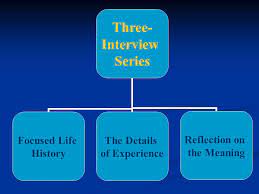
Perhaps most distinguishing of all its features, this model of in­depth, phenomenological interviewing involves conducting a series of three separate interviews with each participant. People’s behavior becomes meaningful and understandable when placed in the context of their lives and the lives of those around them. Without context there is little possibility of exploring the meaning of an experience (Patton, 1989). Interviewers who propose to explore their topic by arranging a one-shot meeting with an “interviewee” whom they have never met tread on thin contextual ice. (See Locke, Silverman, & Spirduso, 2004, pp. 209-226, for important insights on this issue in particular and qualitative research in general from the perspective of the readers of such research. Also see Mishler, 1986.)

Dolbeare and Schuman (Schuman, 1982) designed the series of three interviews that characterizes this approach and allows the interviewer and participant to plumb the experience and to place it in context. The first interview establishes the context of the participants’ experience. The second allows participants to reconstruct the details of their experience within the context in which it occurs. And the third encourages the par­ticipants to reflect on the meaning their experience holds for them.

1. Interview One: Focused Life History

In the first interview, the interviewer’s task is to put the participant’s experience in context by asking him or her to tell as much as possible about him or herself in light of the topic up to the present time. In our study of the experience of student teachers and mentors in a professional development school in East Longmeadow, Massachusetts (O’Donnell et al., 1989), we asked our participants to tell us about their past lives, up until the time they became student teachers or mentors, going as far back as possible within 90 minutes.

We ask them to reconstruct their early experiences in their families, in school, with friends, in their neighborhood, and at work. Because the topic of this interview study is their experience as student teachers or as men­tors, we focus on the participants’ past experience in school and in any situations such as camp counseling, tutoring, or coaching they might have done before coming to the professional development school program.

In asking them to put their student teaching or mentoring in the con­text of their life history, we avoid asking, “Why did you become a student teacher (or mentor) ?” Instead, we ask how they came to be participating in the program. By asking “how?” we hope to have them reconstruct and narrate a range of constitutive events in their past family, school, and work experience that place their participation in the professional devel­opment school program in the context of their lives. (See Gergen, 2001, for an introduction to the power of narratives for self-definition.)

2. Interview Two: The Details of Experience

The purpose of the second interview is to concentrate on the con­crete details of the participants’ present lived experience in the topic area of the study. We ask them to reconstruct these details. In our study of student teachers and mentors in a clinical site, for example, we ask them what they actually do on the job. We do not ask for opinions but rather the details of their experience, upon which their opinions may be built. According to Freeman Dyson (2004), a famous mathematician named Littlewood, who was Dyson’s teacher at the University of Cambridge, estimated that during the time we are awake and actually engaged in our lives, we see and hear things at about a rate of one per second. So in an 8-hour day, we are involved in perhaps 30,000 events. In this second interview, then, our task is to strive, however incompletely, to reconstruct the myriad details of our participants’ experiences in the area we are studying.

In order to put their experience within the context of the social set­ting, we ask the student teachers, for example, to talk about their relation­ships with their students, their mentors, the other faculty in the school, the administrators, the parents, and the wider community. In this second interview, we might ask them to reconstruct a day in their student teach­ing from the moment they woke up to the time they fell asleep. We ask for stories about their experience in school as a way of eliciting details.

3. Interview Three: Reflection on the Meaning

In the third interview, we ask participants to reflect on the meaning of their experience. The question of “meaning” is not one of satisfac­tion or reward, although such issues may play a part in the participants’ thinking. Rather, it addresses the intellectual and emotional connections between the participants’ work and life. The question might be phrased, “Given what you have said about your life before you became a mentor teacher and given what you have said about your work now, how do you understand mentoring in your life? What sense does it make to you?” This question may take a future orientation; for example, “Given what you have reconstructed in these interviews, where do you see yourself going in the future?”

Making sense or making meaning requires that the participants look at how the factors in their lives interacted to bring them to their pres­ent situation. It also requires that they look at their present experience in detail and within the context in which it occurs. The combination of exploring the past to clarify the events that led participants to where they are now, and describing the concrete details of their present experience, establishes conditions for reflecting upon what they are now doing in their lives. The third interview can be productive only if the foundation for it has been established in the first two.

Even though it is in the third interview that we focus on the par­ticipants’ understanding of their experience, through all three interviews participants are making meaning. The very process of putting experience into language is a meaning-making process (Vygotsky, 1987). When we ask participants to reconstruct details of their experience, they are select­ing events from their past and in so doing imparting meaning to them. When we ask participants to tell stories of their experience, they frame some aspect of it with a beginning, a middle, and an end and thereby make it meaningful, whether it is in interview one, two, or three. But in interview three, we focus on that question in the context of the two previous interviews and make that meaning making the center of our attention.

Source: Seidman Irving (2006), Interviewing As Qualitative Research: A Guide for Researchers in Education And the Social Sciences, Teachers College Press; 3rd edition.

Respect the Structure of In-depth Interviews

We have found it important to adhere to the three-interview struc­ture. Each interview serves a purpose both by itself and within the series. Sometimes, in the first interview, a participant may start to tell an inter­esting story about his or her present work situation; but that is the focus of the second interview. It is tempting, because the information may be in­teresting, to pursue the participant’s lead and forsake the structure of the interview. To do so, however, can erode the focus of each interview and the interviewer’s sense of purpose. Each interview comprises a multitude of decisions that the interviewer must make. The open-ended, in-depth inquiry is best carried out in a structure that allows both the participant and the interviewer to maintain a sense of the focus of each interview in the series.

Furthermore, each interview provides a foundation of detail that helps illumine the next. Taking advantage of the interactive and cumula­tive nature of the sequence of the interviews requires that interviewers adhere to the purpose of each. There is a logic to the interviews, and to lose control of their direction is to lose the power of that logic and the benefit from it. Therefore, in the process of conducting the three inter­views, the interviewer must maintain a delicate balance between provid­ing enough openness for the participants to tell their stories and enough focus to allow the interview structure to work. (See McCracken, 1988, p. 22, for further discussion of this delicate balance.)

Source: Seidman Irving (2006), Interviewing As Qualitative Research: A Guide for Researchers in Education And the Social Sciences, Teachers College Press; 3rd edition.

Length of In-depth Interviews

To accomplish the purpose of each of the three interviews, Dolbeare and Schuman (Schuman, 1982) used a 90-minute format. People learning this method for the first time often react, “Oh, that is so long. How will we fill that amount of time? How will we get a participant to agree to be interviewed for that length of time?”

An hour carries with it the consciousness of a standard unit of time that can have participants “watching the clock.” Two hours seems too long to sit at one time. Given that the purpose of this approach is to have the participants reconstruct their experience, put it in the context of their lives, and reflect on its meaning, anything shorter than 90 minutes for each interview seems too short. There is, however, nothing magical or absolute about this time frame. For younger participants, a shorter period may be appropriate. What is important is that the length of time be de­cided upon before the interview process begins.

Doing so gives unity to each interview; the interview has at least a chronological beginning, middle, and end. Interviewers can learn to hone their skills if they work within a set amount of time and have to fit their technique to it. Furthermore, if interviewers are dealing with a consider­able number of participants, they need to schedule their interviews so that they can finish one and go on to the next. As they begin to work with the vast amount of material that is generated in in-depth interviews, they will appreciate having allotted a limited amount of time to each.

The participants have a stake in a set amount of time also. They must know how much time is being asked of them; they have to schedule their lives. Moreover, an open-ended time period can produce undue anxiety. Most participants with whom I have worked come very quickly to ap­preciate the 90-minute period. Rather than seeming too long, it’s long enough to make them feel they are being taken seriously.

At times it is tempting to keep going at the end of the 90 minutes, because what is being discussed at that point is of considerable interest. Although one might gain new insights by continuing the interview be­yond the allotted time, it is my experience that a situation of diminishing returns sets in. Extending the interview causes an unraveling of the inter­viewer’s purpose and of the participant’s confidence that the interviewer will do what he or she promised.

A related phenomenon is that sometimes participants continue to talk after the interview is concluded and the tape is turned off. It is tempt­ing to continue, because the participants seem suddenly willing to discuss matters heretofore avoided. The problem is that such after-the-fact con­versations are not recorded and are not normally covered in the written consent form. (See Chapter 5.) Although the material may seem interest­ing, it is ultimately difficult to use.

Source: Seidman Irving (2006), Interviewing As Qualitative Research: A Guide for Researchers in Education And the Social Sciences, Teachers College Press; 3rd edition.

Spacing of In-depth Interviews

The three-interview structure works best, in my experience, when the researcher can space each interview from 3 days to a week apart. This allows time for the participant to mull over the preceding interview but not enough time to lose the connection between the two. In addition, the spacing allows interviewers to work with the participants over a 2- to 3-week period. This passage of time reduces the impact of possibly idio­syncratic interviews. That is, the participant might be having a terrible day, be sick, or be distracted in such a way as to affect the quality of a particular interview.

In addition, the fact that interviewers come back to talk three times for an IV2 hours affects the development of the relationship between the participants and the interviewers positively. The interviewers are asking a lot of the participants; but the interviewers reciprocate with their time and effort. With the contact visits, the telephone calls and letters to con­firm schedules and appointments (see Chapter 4), and the three actual interviews, interviewers have an opportunity to establish a substantial relationship with participants over time.

Source: Seidman Irving (2006), Interviewing As Qualitative Research: A Guide for Researchers in Education And the Social Sciences, Teachers College Press; 3rd edition.

Alternatives to the Structure and Process of In-depth, Phenomenological Interviews

Researchers will have reasons for exploring alternatives to the structure and procedures described above. As long as a structure is maintained that allows participants to reconstruct and reflect upon their experience within the context of their lives, alterations to the three-in­terview structure and the duration and spacing of interviews can cer­tainly be explored. But too extreme a bending of the form may result in your not being able to take advantage of the intent of the structure.

Our research teams have tried variations in spacing, usually neces­sitated by the schedules of our participants. On occasion, when a partici­pant missed an interview because of an unanticipated complication, we conducted interviews one and two during the same afternoon rather than spacing them a few days or a week apart. And sometimes participants have been unavailable for 2 or 3 weeks. Once a participant said he was leaving for summer vacation the day after we contacted him. We con­ducted interviews one, two, and three with him all on the same day with reasonable results.

As yet there are no absolutes in the world of interviewing. Relatively little research has been done on the effects of following one procedure over others; most extant research has conceived of interviewing in a stim­ulus-response frame of reference, which is inadequate to the in-depth pro­cedure (Brenner, Brown, & Canter, 1985; Hyman, Cobb, Fledman, Hart, & Stember, 1954; Kahn & Cannell, 1960; Mishler, 1986; Richardson et al., 1965). The governing principle in designing interviewing projects might well be to strive for a rational process that is both repeatable and documentable. Remember that it is not a perfect world. It is almost al­ways better to conduct an interview under less than ideal conditions than not to conduct one at all.

Source: Seidman Irving (2006), Interviewing As Qualitative Research: A Guide for Researchers in Education And the Social Sciences, Teachers College Press; 3rd edition.

Whose Meaning Is It? Validity and Reliability for In-depth, Phenomenological Interviewing

Whose meaning is it that an interview brings forth and that a re­searcher reports in a presentation, article, or book? That is not a simple question. Every aspect of the structure, process, and practice of inter­viewing can be directed toward the goal of minimizing the effect the interviewer and the interviewing situation have on how the participants reconstruct their experience. No matter how diligently we work to that effect, however, the fact is that interviewers are a part of the interview­ing picture. They ask questions, respond to the participant, and at times even share their own experiences. Moreover, interviewers work with the material, select from it, interpret, describe, and analyze it. Though they may be disciplined and dedicated to keeping the interviews as the par­ticipants’ meaning-making process, interviewers are also a part of that process (Ferrarotti, 1981; Kvale, 1996; Mishler, 1986).

The interaction between the data gatherers and the participants is inherent in the nature of interviewing. It is inherent, as well, in other qualitative approaches, such as participant observation. And I believe it is also inherent in most experimental and quasi-experimental method­ologies applied to human beings, despite the myriad and sophisticated measures developed to control for it (Campbell & Stanley, 1963).

One major difference, however, between qualitative and quantitative approaches is that in in-depth interviewing we recognize and affirm the role of the instrument, the human interviewer. Rather than decrying the fact that the instrument used to gather data affects this process, we say the human interviewer can be a marvelously smart, adaptable, flexible instrument who can respond to situations with skill, tact, and understand­ing (Lincoln & Guba, 1985, p. 107).

Although the interviewer can strive to have the meaning being made in the interview as much a function of the participant’s reconstruction and reflection as possible, the interviewer must nevertheless recognize that the meaning is, to some degree, a function of the participant’s inter­action with the interviewer. Only by recognizing that interaction and af­firming its possibilities can interviewers use their skills (see Chapter 6) to minimize the distortion (see Patton, 1989, p. 157) that can occur because of their role in the interview.

1. Is It Anybody’s Meaning?

How do we know that what the participant is telling us is true? And if it is true for this participant, is it true for anyone else? And if another per­son were doing the interview, would we get a different meaning? Or if we were to do the interview at a different time of year, would the participant reconstruct his or her experience differently? Or if we had picked dif­ferent participants to interview, would we get an entirely dissimilar and perhaps contradictory sense of the issue at hand? These are some of the questions underlying the issues of validity, reliability, and generalizability that researchers confront.

Many qualitative researchers disagree with the epistemological as­sumptions underlying the notion of validity. They argue for a new vocab­ulary and rhetoric with which to discuss validity and reliability (Mishler, 1986, pp. 108-110). Lincoln and Guba (1985), for example, substitute the notion of “trustworthiness” for that of validity. In a careful exposition they argue that qualitative researchers must inform what they do by concepts of “credibility,” “transferability,” “dependability,” and “confirmability” (pp. 289-332).

Others criticize the idea of objectivity that underlies notions of reli­ability and validity. Kvale (1996) sees the issue of validity as a question of the “quality of craftsmanship” of the researchers as they make defensible knowledge claims (pp. 241-244). Ferrarotti (1981) argues that the most profound knowledge can be gained only by the deepest intersubjectivity among researchers and that which they are researching. Such a discus­sion suggests that neither the vocabulary of “validity” nor “trustworthi­ness” is adequate.

Yet, in-depth interviewers can respond to the question, “Are the par­ticipant’s comments valid?” The three-interview structure incorporates features that enhance the accomplishment of validity. It places partici­pants’ comments in context. It encourages interviewing participants over the course of 1 to 3 weeks to account for idiosyncratic days and to check for the internal consistency of what they say. Furthermore, by interview­ing a number of participants, we can connect their experiences and check the comments of one participant against those of others. Finally, the goal of the process is to understand how our participants understand and make meaning of their experience. If the interview structure works to al­low them to make sense to themselves as well as to the interviewer, then it has gone a long way toward validity.

2. An Example of an Approach to Validity

One participant in our Secondary Teacher Education Program was a woman who had taught in parochial schools for a number of years but was not certified. She had enrolled in our program to get certified at the high school level in social studies. She agreed to be interviewed about her experience in our clinical site teacher education program.

The interviewer began her third interview with its basic question: “What does it mean to you to be a student teacher?” She responded:

Well, I guess-well, . . . [small laugh]-it kinda-it really kind of means that I’ve finally gotten down to actually trying to-I guess what it means is-[it] is the final passage into making a commitment to this, the profession, to teaching as-as a profession. What am I going to do with my life because I have all-all this time, going up and down and in and out of teaching. Should I or shouldn’t I? I was kind of stuck in that space where people say, you know, “Oh, those who can’t, teach. Those who can, do.” Just the whole negative status that teaching and education have. So it’s kind of fraught with that. And really resisting the fact that I had to student teach. I mean, I can remember [that] holding me back, what, 10 years ago, thinking, “Oh, no, I will actually have to be a student teacher some day,” and remembered what student teachers were like in my high school, and thinking, “Oh, I’ll never humiliate myself that way.” [small laugh] And so I guess it was the final-[pause]-biting the bullet to . . . making a commitment.

Is what she says valid? In the first interview she recounted how she had dropped out of college and taught in elementary grades in paro­chial schools because she needed money. In that interview she also talked about how she had dropped out of education courses because she didn’t think she was getting enough out of them; how she had switched to an academic field, but later realized that she really liked teaching.

The material in her third interview is internally consistent with the material in her first, which was given 2 weeks earlier. Internal consistency over a period of time leads one to trust that she is not lying to the inter­viewer. Furthermore, there is enough in the syntax, the pauses, the grop­ing for words, the self-effacing laughter, to make a reader believe that she is grappling seriously with the question of what student teaching means to her, and that what she is saying is true for her at the time she is saying it.

Moreover, in reading the transcript, we see that the interviewer has kept quiet, not interrupted her, not tried to redirect her thinking while she was developing it; so her thoughts seem to be hers and not the inter­viewer’s. These are her words, and they reflect her understanding of her experience at the time of her interview.

When I read this passage, I learned something both about this par­ticular student and about an aspect of the student-teaching experience that had not really been apparent to me. I began to think about aspects of the process we require prior to student teaching that enhance the need for students to make a commitment and about other aspects of our program that minimize that need. I began to wonder what the conditions are that encourage a person to make that commitment.

Finally, what the participant said about the status of education as a career and how that related to her personal indecision is consistent with what we know the literature says about the teaching profession and with what other participants in our study have said. I can relate this individual passage to a broader discourse on the issue.

The interview allowed me to get closer to understanding this student teacher’s experience than I would have been able to do by other methods such as questionnaires or observation. I cannot say that her understand­ing of student teaching as a commitment is valid for others, although passages in other interviews connect to what she has said. I can say that it seems valid for her at this point in her life. I cannot say that her un­derstanding of the meaningfulness of student teaching as a commitment she had heretofore not been willing to make will not change. Unlike the laws of physics, the rules governing human life and social interaction are always changing-except that we die. There is no solid, unmovable platform upon which to base our understanding of human affairs. They are in constant flux. Heisenberg’s principle of indeterminacy (Lincoln & Guba, 1985; Polanyi, 1958) speaks at least as directly to human affairs as it does to the world of physics.

The structure of the three interviews, the passage of time over which the interviews occur, the internal consistency and possible external con­sistency of the passages, the syntax, diction, and even nonverbal aspects of the passage, and the discovery and sense of learning that I get from read­ing the passage lead me to have confidence in its authenticity. Because we are concerned with the participant’s understanding of her experience, the authenticity of what she is saying makes it reasonable for me to have confidence in its validity for her.

3. Avoiding a Mechanistic Response

There is room in the universe for multiple approaches to validity. The problem is not in the multiplicity. Rather it lies in the sometimes doctrinaire ways some advocates of divergent approaches polarize the is­sue. (See Gage, 1989.) Those who advocate qualitative approaches are in danger of becoming as doctrinaire as those who once held the monopoly on educational research and advocated quantitative approaches.

On occasion I see dissertations in which doctoral candidates are as mechanical about establishing an “audit trail” or devising methods of “tri- angularization” (Lincoln & Guba, 1985, p. 283) as those in my genera­tion who dutifully devised procedures to confront “instrument decay” and “experimental mortality” (Campbell & Stanley, 1963, pp. 79, 182). What are needed are not formulaic approaches to enhancing either validity or trustworthiness but understanding of and respect for the issues that under­lie those terms. We must grapple with them, doing our best to increase our ways of knowing and of avoiding ignorance, realizing that our efforts are quite small in the larger scale of things. (For a “common sense” approach to validity, see Maxwell, 1996. For a “craftsmanship” approach to validity, see Kvale, 1996. For a highly personal view of validity, see Wolcott, 1994.)

Source: Seidman Irving (2006), Interviewing As Qualitative Research: A Guide for Researchers in Education And the Social Sciences, Teachers College Press; 3rd edition.

Research Proposals as Rites of Passage in Interview Research Method

In some respects becoming an academic is like joining a club. As in most other somewhat-exclusive clubs, there are those who are in and those who are out; there are elites and non-elites. There are privileges of membership, and there are penalties for not paying dues. To some extent, success in the club is a matter of merit; but that success is sometimes af­fected by issues of race, gender, and class that can influence entry into the club in the first place, or weight the power of those who have been admitted already.

Although pressures, strains, and contradictions affect those who work in collegiate institutions just as they do those who work in others, still, college faculty are paid for the pleasurable activities of reading, writing, teaching, and doing research. Relative to public school teachers, for ex­ample, we have a great deal of autonomy over our time and professional lives. Not all doctoral candidates in education move on to faculty posi­tions in colleges or universities. But those who use their doctorates to assume leadership positions in school systems often gain a degree of au­tonomy in their working lives that many would envy.

Those who have already earned the doctorate often act as gatekeep­ers to the club. During the rituals of proposal submission, review, and approval established by the gatekeepers, the power relationship between candidate and doctoral advisor is very unequal. (See Locke et al., 2000, chap. 2, for further discussion of dysfunctions that can occur between doctoral candidates and faculty mentors.) Elements of sexism, racism, classism, and institutional politics can enter the process. When that rela­tionship is inequitable, the rite of passage can be excessively anxiety pro­ducing. It takes a great deal of thoughtfulness on everyone’s part to make the relationship between doctoral candidate and committee equitable at the proposal stage.

Source: Seidman Irving (2006), Interviewing As Qualitative Research: A Guide for Researchers in Education And the Social Sciences, Teachers College Press; 3rd edition.

Commitment in Interview Research Method

When a candidate’s doctoral program is working well, a research topic arises out of work that has gone before. Course work, fieldwork, practica, clinical work, and comprehensive exams all lead the candidate forward to an area of inquiry about which he or she feels some passion. If the doctoral program has not worked well—if committee memberships have changed, if the doctoral student has been convinced against his or her own interests to pursue those of a professor—a student can progress through the earlier stages of the rite of passage without identifying a topic that is personally meaningful. Kenneth Liberman (1999, p. 51) notes that if doctoral candidates do not really believe in their topic and are not mo­tivated by the intrinsic values of their own research topics, their work can lack a sense of authenticity. In such a situation, the writing of a proposal may be more excruciating than satisfying.

In some cases doctoral candidates enter the program having already chosen a topic. For a while they make their peers nervous because they seem so advanced and confident. My sense is that such confidence is often misplaced. The experience of the doctoral program itself should bring about some sort of new orientation, some interest in new areas, some growth in the candidate’s outlook. If it does not, the candidate is looking backward instead of forward.

Substantively, one of the underlying reasons for writing a proposal is its planning function (Locke et al., 2000). Although Joseph Maxwell in his thoughtful book, Qualitative Research Design (1996), separates the pro­cess of research design from proposal writing, my experience is that the writing of the proposal is a prime opportunity for doctoral candidates to clarify their research design. To plan, candidates must assess where they have been and make a commitment to where they would like to go. This can be a stressful part of the process.

I remember one outstanding doctoral candidate who was stalled for 6 months at the prospect of writing his dissertation proposal. It was not that he could not find a subject; nor was he in search of a method. He was just frozen in his writing. After 6 months of not being able to get around his writing block, he finally discussed his anxieties about, in effect, chang­ing club memberships. He said that he had grown up in a working-class neighborhood where people sat on their front-porch steps in the summer drinking beer. That was what his parents still did. He was not sure that he wanted to leave the front porch to start drinking white wine in the living room at faculty gatherings. For many doctoral candidates, completing their dissertations implies a commitment to a new professional and personal identity that can be difficult to make. In many ways writing a dissertation proposal is a key step in the developmental process that occurs in doctoral study, and such processes are seldom free of significant complexities.

Source: Seidman Irving (2006), Interviewing As Qualitative Research: A Guide for Researchers in Education And the Social Sciences, Teachers College Press; 3rd edition.

From Thought to Language

Many students have trouble writing proposals because they are plagued by a sense of audience. The process seems dominated by doc­toral committees and Institutional Review Boards that must approve the proposed research. (For more on Institutional Review Boards, see Chapter 5.) When audience plays such a dominating role, writing can easily suffer. Rather than concentrating on what he or she wants to say, the candidate may filter every sentence through the screen of what is expected and what will be acceptable to the committee.

Preliminary ideas about research often stay locked in one’s inner speech. They are fleeting, predicated, and unstable (Vygotsky, 1987), making communication of them difficult. However, those ideas in inner speech must be made explicit. Doctoral candidates do have to communi­cate clearly to their committee what they are thinking.

A key to communicating about plans for research is to focus first on what is meaningful. When a proposal works best, it emanates from the motives of the candidate and works its way through thought, inner speech, and into external speech through meaning. Often, however, the form and substance of the inquiry in a dissertation proposal can seem to the candidate to be imposed from the outside; the format of dissertation proposals can seem to take precedence over their substance. Then the writing of the proposal can become mechanical and formulaic.

Source: Seidman Irving (2006), Interviewing As Qualitative Research: A Guide for Researchers in Education And the Social Sciences, Teachers College Press; 3rd edition.

What Is to Be Done in Interview Research Method?

Peter Elbow (1981) offers an approach to writing that I think can be useful in such cases. He suggests that trying both to create with the audience in mind and to make writing perfect from the start imposes an undue burden on the writing process. He suggests making writing and editing two separate aspects of the writing process. And he urges defer­ring thoughts of the audience until the editing part of the process.

To facilitate that separation, Elbow suggests what has come to be known as free-writing and focused free-writing. Focused free-writing is a process that allows the writer to concentrate on the topic and forget the audience. It advises writers to start writing on their topics and to continue for a specified period of time without stopping. If they get stuck, they should repeat their last word or write the word stuck until they get going again. A person new to the process might begin with 5 minutes of focused free-writing, gradually increasing the length of time.

After free-writing sections of the proposal, writers can then select from these the most cogent, refashioning from them a first draft. Elbow suggests other methods to help writers overcome blocks due to anxiety about audience. Near the end of the writing process, rather than at the beginning, writers can edit their drafts with the audience and the form of dissertation proposal in mind. I recommend Elbow’s Writing With Power (1981); Locke, Spirduso, and Silverman’s Proposals That Work (2000); Maxwell’s Qualitative Research Design (1996); and Schram’s Conceptualizing Qualitative Inquiry (2003) as important resources for anyone about to write a dissertation proposal.

Source: Seidman Irving (2006), Interviewing As Qualitative Research: A Guide for Researchers in Education And the Social Sciences, Teachers College Press; 3rd edition.

Questions to Structure the Interview Research Proposal

1. What?

Proposal writers need to ask themselves some simple questions. These can be divided into several groups. First is a group of questions I put under the heading of “What?” In what am I interested? What am I trying to learn about and understand? What is the basis of my interest?

Interviewers begin with an interest in a particular area. At the beginning of interviewers’ research lurks the desire to understand what is going on. But how did that desire begin? Important questions that must be asked in interviewing research and that are seldom asked in experimental or quasi-experimental research are, What is the context of my interest? How did I come to this interest? What is my stake in the inquiry, and what do I get out of pursuing my interest and learning about it? What are my expectations about the subject of inquiry?

Research, like almost everything else in life, has autobiographical roots. It is crucial for interviewers to identify the autobiographical roots of their interest in their topic. (See Locke, Silverman & Spirduso, 2004, pp. 217-218, for a compelling discussion of this issue.) Research is hard work; interviewing research is especially so. In order to sustain the energy needed to do the research well, a researcher must have some passion about his or her subject. Rather than seeking a “disinterested” position as a researcher, the interviewer needs to understand and affirm his or her interest in order to build on the energy that can come from it. Equally important, researchers must identify the source of their interest in order to channel it appropriately. They must acknowledge it in order to minimize the distortion such interest can cause in the way they carry out their interviewing. An autobiographical section explaining researchers’ connections to their proposed research seems to me to be crucial for those interested in in-depth interviewing. (For an example of such an explanation, see Maxwell, 1996, pp. 123-124.)

Finally, interviewers must not only identify their connection with the subject of the interview; they must also affirm that their interest in the subject reflects a real desire to know what is going on, to understand the experience. If, in fact, interviewers are so intimately connected to the subject of inquiry that they really do not feel perplexed, and what they are really hoping to do is corroborate their own experience, they will not have enough distance from the subject to interview effectively. The questions will not be real; that is, they will not be questions to which the interviewers do not already have the answers.

There is, therefore, an inherent paradox at the heart of the issue of what topics researchers choose to study. On the one hand, they must choose topics that engage their interest, their passion, and sustain their motivation for the labor-intensive work that interviewing research is. That usually means in some way or another they must be close to their topics. On the other hand, to be open to the process of listening and careful exploration that is crucial in an interviewing study, they must approach their research interests with a certain sense of naivete, innocence, and ab­sence of prejudgments (Moustakas, 1994, p. 85). Researchers who can ne­gotiate that complex tension will be able to listen intently, ask real ques­tions, and set the stage for working well with the material they gather.

2. Why? in Context

The next question to ask is why the subject might be important to others. Why is the subject significant? What is the background of this subject, and why is that background important to understand? To what else does the subject relate? If you understand the complexities of this subject, what will be the benefit and who will obtain it? What is the con­text of previous work that has been done on the subject (Locke et al., 2000)? How will your work build on what has been done already? (See Locke et al., 2000; Rubin & Rubin, 1995, for succinct discussions of the issue of significance.)

Locke and his colleagues are especially cogent in their discussion of what often appears in dissertation proposals as “reviews of the literature.” They stress that these sometimes mechanical summaries of previous re­search miss the intent of reading the literature connected to the subject. Such reading should inform researchers of the context of the research, allow them to gain a better sense of the issue’s significance and how it has been approached before, as well as reveal what is missing in the previ­ous research. These understandings can be integrated into the various sections of the proposal and do not necessitate a separate one that some­times reads like a book report. (See Locke et al., 2000, pp. 63-68, and Maxwell, 1996, chap. 3, who is also thoughtful on this issue.)

In addition to asking why the topic is historically significant, criti­cal ethnographers suggest that how the topic relates to issues of power, justice, and oppression must also be raised. Especially important are the issues of power that are implicit in the research topic itself (Solsken, 1989) and in interviewing as a methodology. John Rowan (1981) suggests that researchers consider not only how their own personal interests are served by their research but also who else’s interest is served. What about the participants in the research? What do they get out of participating? What do they risk? Does the research underwrite any existing patterns of op­pression? Or does the research offer some possibility of understanding that could create liberating energy? In a world beset by inequity, why is the topic of research important? (See Fay, 1987, for an important discus­sion of the foundations of critical social science.)

3. How?

A next question to ask is, How? Assuming that researchers have de­cided that in-depth interviewing is appropriate for their study, how can they adapt the structure of in-depth, phenomenological interviewing out­lined in Chapter 2 to their subject of study? I offer examples of such ad­aptations by two doctoral students who have worked with this approach to interviewing. (I share results of their work in the Appendix.)

Marguerite Sheehan (1989), who was a doctoral candidate in early childhood education at the University of Massachusetts, addressed the question as follows. She was interested in studying child care as a career. In her review of the literature she had found that most of the research on child-care providers focused on those who had left the field early because of what was called “burn-out.” Sheehan was interested in people who stayed in the field, especially those who saw providing child care as a career. She hoped to come to understand the nature of their experience and to see if she could unravel some of the factors that contributed to their longevity in the field. Sheehan took the three-interview structure and adapted it as follows:

Interview One (life history): How did the participant come to be a child-care provider? A review of the participant’s life history up to the time he or she became a child-care provider.

Interview Two (contemporary experience): What is it like for the participant to be a child-care provider? What are the details of the participant’s work as a child-care provider?

Interview Three (reflection on meaning): What does it mean to the participant to be a child-care provider? Given what the participant has said in interviews one and two, how does he or she make sense of his or her work as a child-care provider?

Toon Fuderich (1995), who also was a doctoral candidate at the School of Education of the University of Massachusetts, was interested in studying the experience of Cambodian refugees who as children had experienced the terrors of war. She adapted her interest in this topic to the three-interview structure as follows:

Interview One (life history): How did the participant become a refugee? What was the participant’s life history before coming to the United States?

Interview Two (contemporary experience): What is life like for the participant in the United States? What is her education, work, and family life like?

Interview Three (reflection on meaning): What does it mean to the participant to be living in the United States now? How does she make sense of her present life in the context of her life experience?

4. Who? When? Where?

The next set of questions asks whom the researchers will interview, and how they will get access and make contact with their participants. In Chapter 4 we discuss the complexities of access, contact, and select­ing participants. What is called for at this point is a consideration of the strategy the researchers will use. What will the range of participants be? What strategy of gaining access to them will the researchers use? How will they make contact with the participants? The strategy may allow for a process of participant selection that evolves over the course of the study, but the structure and strategy for that selection must be thought out in the proposal.

Some writers suggest that the “how” of a qualitative research study can itself be emergent as the study proceeds. That orientation assumes that because qualitative research does not begin with a set of hypoth­eses to test, strict control of variables is not necessary. Furthermore, because the inquiry is being done in order to learn about complexities of which researchers are not totally aware, the design and even the focus of the study have to be seen as “emergent” (Lincoln & Guba, 1985, pp. 208-211, pp. 224-225) or “flexible” (Rubin & Rubin, 1995, pp. 43-48).

Although it is understandable that researchers would want to build flexibility into a research design, there is a danger in overemphasizing the “emergent” nature of research design in qualitative research. To the inex­perienced, it can appear to minimize the need for careful preparation and planning. It can lead to the notion that qualitative research is somehow an “art” that really is incommunicable, or that somehow those who engage in it have earned a special status because they do not share the assump­tions of those who do what is called quantitative research (McCracken, 1988, pp. 12-13). The danger of overemphasizing the “emergent” nature of the design of the study is a looseness, lack of focus, and misplaced non­chalance about purpose, method, and procedure on the part of those who do qualitative research. Lincoln and Guba (1985) themselves stress that the emergent nature of qualitative research cannot be used as a license for “undisciplined and haphazard ‘poking around’” (p. 251).

Source: Seidman Irving (2006), Interviewing As Qualitative Research: A Guide for Researchers in Education And the Social Sciences, Teachers College Press; 3rd edition.

Rationale of Interview Research

Although the paradigms that underlie research methods in the social sciences seem to be changing rapidly (Kvale, 1996; Lincoln & Guba, 1985), the extent to which researchers will have to defend their use of in-depth interviewing as their research methodology will depend on their individ­ual departments. Some are still dominated by experimentalism or other forms of quantitative research. In others there may be a predisposition to experimental and quasi-experimental methods but nevertheless openness to qualitative research. In still others there may be a strong preference for qualitative research among a significant number of the faculty.

Whatever the departmental context, for the interviewing process to be meaningful to researchers themselves and its use credible to review­ers, it is important that researchers understand why they are choosing interviewing rather than experimental or quasi-experimental research. They must understand something about the history of science, the devel­opment of positivism, and the critique of positivism as it is applied to the social sciences in general and the field of education in particular.

Because there is currently more acceptance of qualitative research in graduate programs in education, many new researchers have not been asked to learn the assumptions and the practices of experimental or quasi­experimental research. Without this background, qualitative researchers do not know what they do not know about methodology. Consequently, their rationale for choosing a qualitative over a quantitative approach may not be as well grounded as it could be.

At the minimum, Campbell and Stanley’s (1963) definitive essay on threats to what they call internal and external validity in experimental and quasi-experimental research should be required reading for all those who intend to do interviewing and other forms of qualitative research. They should grapple firsthand with the issues that shaped a generation of educational researchers and that still inform a significant body of edu­cational research practice today. Even better would be thoughtful read­ing in the history of science and epistemology. (See, e.g., James, 1947; Johnson, 1975; Lincoln & Guba, 1985; Mannheim, 1975; Matson, 1966; Polanyi, 1958.)

Source: Seidman Irving (2006), Interviewing As Qualitative Research: A Guide for Researchers in Education And the Social Sciences, Teachers College Press; 3rd edition.

Working with the Interview Material

Research proposals should describe how researchers intend to work with and analyze the material they gather. Describing this process ahead of time is especially difficult for those who are doing empirical research for the first time. It is difficult to project how they will work with material from interview participants if they have never done interviewing work before. In Chapter 8, I discuss working with the material. I stress the im­portance of paying attention to the words of the participant, using those words to report on the results as much as possible, and looking for both salient material within individual interviews and connections among in­terviews and participants.

The role that theory plays becomes an issue when researchers are actually trying to analyze and interpret the material they gather. Some scholars would argue that the theory used to discern and forge relation­ships among the words that participants share with interviewers must come out of those words themselves. Theory cannot and should not be imposed on the words but must emanate from them. This approach, ex­tensively discussed by Glaser and Strauss (1967), has been somewhat per­suasive in the field of qualitative research. It argues, rightly I think, espe­cially against taking theoretical frameworks developed in other contexts and force-fitting the words of the participants into the matrices developed from those theories.

On the other hand it may be naive for us to argue that researchers can be theory free. Everyone has theories. They are the explanations people develop to help them make connections among events. Theories are not the private preserve of scientists. Interviewers walk into inter­views with theories about human behavior, teaching and learning, the organization of schools, and the way societies work. Some of the theo­ries are informed and supported by others, and some are idiosyncratic. Others arise from readings interviewers have done in and about the sub­ject of their inquiry.

Some scholars argue that in qualitative research such reading should be kept to a minimum lest it contaminate the view and the understanding of the researcher (Glaser & Strauss, 1967). To a certain extent I agree with that view. It helps to interview participants about their experience if the interviewers are not weighted down with preformed ideas based on what they have gleaned from the literature.

For example, in an interview I had the pleasure of conducting with Linda Miller Cleary in 1996, she spoke to me about the interviewing work that she and her colleague Thomas Peacock were conducting on the experience of American Indian educators (Cleary & Peacock, 1997). She said that, especially when interviewing in a cross-cultural setting, she was cautious about doing too much reading ahead of time. While affirming that she had to do enough reading to be informed and thoughtful about her topic, she was concerned about taking too many stereotypes from the literature into her interviewing. She said that “because I hadn’t done a lot of reading, I could ask questions that were real questions” (L. M. Cleary, personal communication, August 11, 1996).

Interviewers must be prepared for their work and be aware of the research on which they are building (Yow, 1994, p. 33). Some researchers go further and argue that interviewers must be expert on their topics before they begin the interviews (Kvale, 1996, p. 147).

I think an intermediate position is sensible at the proposal stage. It is crucial to read enough to be thoughtful and intelligent about the context and history of the topic and to know what literature on the subject is available. It is important to conduct the interviews with that context in mind, while being genuinely open to what the participants are saying. After the interviews have been completed and researchers are starting to work intensively with the material, a return to the reading will help with the analysis and interpretation of the interview material. No prior reading is likely to match the individual stories of participants’ experience, but reading before and after the interviews can help make those stories more understandable by providing a context for them.

The range of fields and associated readings that those who do re­search in education must synthesize is daunting. Often, we fall short of the task. But for those who take the task seriously, it is first-rate intel­lectual work. This work should be affirmed, represented in the proposal, and digested before the completion of the research, but not necessarily totally before the interviewing. This is a precarious and difficult position to hold. It requires maintaining a delicate balance between the some­times competing claims of the relevant literature and the experience of the interview participants.

Source: Seidman Irving (2006), Interviewing As Qualitative Research: A Guide for Researchers in Education And the Social Sciences, Teachers College Press; 3rd edition.

Piloting Your Interview Research

The best advice I ever received as a researcher was to do a pilot of my proposed study. The dictionary (Gove, 1971) definition of the verb pi­lot is “to guide along strange paths or through dangerous places” (p. 1716).

Although it may not seem ahead of time that the world of interviewing research takes one along strange paths or through dangerous places, the unanticipated twists and turns of the interviewing process and the com­plexities of the interviewing relationship deserve exploration before the researchers plunge headlong into the thick of their projects.

I urge all interviewing researchers to build into their proposal a pi­lot venture in which they try out their interviewing design with a small number of participants. They will learn whether their research structure is appropriate for the study they envision. They will come to grips with some of the practical aspects of establishing access, making contact, and conducting the interview. The pilot can alert them to elements of their own interview techniques that support the objectives of the study and to those that detract from those objectives. After completing the pilot, researchers can step back, reflect on their experience, discuss it with their doctoral committee, and revise their research approach based on what they have learned from their pilot experience. (See Locke et al., 2000, pp. 80-82; Maxwell, 1996, for further discussion of pilot studies.)

Source: Seidman Irving (2006), Interviewing As Qualitative Research: A Guide for Researchers in Education And the Social Sciences, Teachers College Press; 3rd edition.

The Perils of Easy Access for Interview Research

Beginning interviewers tend to look for the easiest path to their po­tential participants. They often want to select people with whom they al­ready have a relationship: friends, those with whom they work, students they teach, or others with whom they have some tangential connection. This is understandable but problematic. My experience is that the easier the access, the more complicated the interview.

1. Interviewing People Whom You Supervise

Conflicts of interest are inherent in interviewing people you supervise. For example, I worked with a doctoral candidate who was the principal of an elementary school. She wanted to interview teachers in her school about their experience in developing collaborative learning projects in their class­rooms. She had been deeply involved in the project with her teachers and was eager to understand what effect it had had on their experiences.

In discussions with me, the principal said that her school was small and not a large, unfeeling bureaucracy. She had a close working relation­ship with the teachers. She felt that they trusted her. Finally, she thought that despite her investment in the project, she could be impartial in the interview.

One of the principles of an equitable interviewing relationship, how­ever, is that the participants not make themselves unduly vulnerable by participating in the interview. In any hierarchical school system, no mat­ter how small, in which a principal has hiring and firing power and con­trol over other working conditions, a teacher being interviewed by the principal may not feel free to talk openly. That is especially the case when the teachers know that the interviewer has an investment in the program. The issue in such cases is not whether the principal can achieve enough distance from the subject to allow her to explore fully, but rather whether the teachers she is interviewing feel secure in that exploration. If they do not, the outcomes of such interviews are not likely to be productive.

As a general principle then, it is wise to avoid interviewing partici­pants whom you supervise (de Laine, 2000, p. 122, and Morse, 1994, p. 27, briefly but compellingly discuss this issue). That does not mean in this case that the doctoral candidate could not explore the experiences of elementary teachers in collaborative learning projects; it does mean that she had to seek to understand the experience of teachers in schools other than her own.

2. Interviewing your Students

Inexperienced interviewers who are also teachers often conceptual­ize a study that involves interviewing students, and they are often sorely tempted to interview their own. As legitimate as it may be to want to understand the effectiveness of, say, a teaching method or a curriculum, a student can hardly be open to his or her teacher who has both so much power and so much invested in the situation. The teacher-researcher should seek to interview students in some other setting with some other teacher who is using a similar method or curriculum.

3. Interviewing Acquaintances

Sometimes new interviewers want to select participants whom they know but not in a way related to the subject of study. For example, one doctoral candidate was contemplating an interview study about the com­plexities of being a cooperating teacher for social studies student teach­ers. He wanted to interview a participant with whom he did not work professionally but with whom he had regular contact at church. Even experienced interviewers cannot anticipate some of the uncomfortable situations that may develop in an interview. Having to consider not only the interviewing relationship but a church relationship as well might limit the full potential of such an interview.

For example, in an interview about the experience of being a cooper­ating teacher, the acquaintance from church might reveal that the reason he or she takes on student teachers is for the free time it allows. Normally an interviewer would want to follow up on an aspect of an interview that made him or her feel uneasy, but to do so in this case could affect his relationship with the participant at church. The interviewer may avoid a follow-up, slant the follow-up, or in some other way distort the interview process because of concern for his or her other relationship with the par­ticipant. The result is either incomplete or distorted information on a key aspect of the subject of study.

4. Interviewing Friends

Some new interviewers with whom I have worked want to interview participants to whom they have easy access because of friendship. The interviewing relationship in such cases can seldom develop on its own merit. It is affected by the friendship in obvious and less obvious ways.

One of the less obvious ways is that the interviewers and the partici­pants who are friends usually assume that they understand each other. Instead of exploring assumptions and seeking clarity about events and experiences, they tend to assume that they know what is being said. The interviewer and the participant need to have enough distance from each other that they take nothing for granted (see Bell & Nutt, 2002; Bogdan & Taylor, 1975; Hyman et al., 1954; McCracken, 1988; Spradley, 1979).

5. Taking Oneself Just Seriously Enough

In addition to feeling shy about a process with which they have had little practice (Hyman et al., 1954), a major reason that some doctoral candidates with whom I have worked want to capitalize on easy access is that they tend not to take themselves seriously as researchers. Beginning interviewers find it difficult to imagine asking strangers to spend 4V2 hours with them.

Many doctoral candidates see research as something others do. Our educational system is structured so that most people consume research but seldom produce it. This has led many to adopt an uncritical attitude about published material and to regard it as somehow sacred. Doing research is seen as an elite occupation, done only by those at the top of the hierarchy (see Bernstein, 1975).

At the same time, when dissertation research does not grow organically out of the course work, clinical experiences, and independent reading that have gone before, it becomes a requirement to be overcome. Doctoral candidates who have had little practice in doing research and who see it as a hurdle rather than an opportunity find it difficult to affirm their own interest in their subject, their own status as researchers, the power of their research method, or the utility of their work other than to fulfill a requirement.

Cumulative societal inequities can exact a heavy toll on researchers at this juncture. Research in our society has long been seen as a male preserve, especially a White male preserve, associated with class and privilege. New researchers who are not middle-class, White males may have to struggle against social conventions to take themselves seriously in their task. Some doctoral candidates need bracing from their advisors and their peers at this point in their program in order to affirm themselves as researchers. Taking oneself seriously enough as a researcher is a first step toward establishing equity in the interviewing relationship.

Source: Seidman Irving (2006), Interviewing As Qualitative Research: A Guide for Researchers in Education And the Social Sciences, Teachers College Press; 3rd edition.

Access Through Formal Gatekeepers in Interview Research

When interviewers try to contact potential participants whom they do not know, they often face gatekeepers who control access to those people. Gatekeepers can range from the absolutely legitimate (to be respected) to the self-declared (to be avoided). If a researcher’s study involves participants below the age of 18, for example, access to them must involve absolutely legitimate gatekeepers: the participants’ parents or guardians. Although it may be appropriate to seek access to students through the schools, very soon in the process the parents or guardians of the children must affirm that access. Within the schools themselves, teachers, principals, and superintendents serve as legitimate gatekeepers whom researchers must heed.

Some participants are accessible only through the institutions in which they reside or work. For example, if a researcher wanted to inter­view prisoners about prison education programs, it is not likely that there would be any route of access other than through the warden. (See Code of Federal Regulations, 2001, 45\46.305,306, for regulations regarding research with prisoners.) A researcher studying the experience of people at a particular site, whether it be factory, school, church, human service organization, or business, must gain access through the person who has responsibility for the operation of the site. (See Lincoln & Guba, 1985, p. 252; Richardson et al., 1965, p. 97.)

On the other hand, one researching an experience or a process that takes place in a number of sites, but not studying the workings of any particular site, may not need to seek access through an authority. Such a researcher may want to study the work of high school teachers who teach in many schools scattered through a region or even across the country. In such a case, the researcher might go directly to them without asking for permission from their principals.

Likewise, a researcher studying the experience of students in high school, but not in a particular high school, might not have to seek access through a principal but only through parents. However, in both cases, if a researcher does not seek permission from a principal, the researcher would not be able to interview in the school building itself. In general, the more adult and autonomous the potential participants (for example, prisoners have little autonomy), the more likely that access can be more direct, if a particular site is not the subject of the inquiry.

In our study of community college faculty (Seidman, 1985), my col­leagues and I interviewed 76 participants in approximately 25 different community colleges in Massachusetts, New York State, and California. Because we were not studying a particular community college, we did not seek access to individual faculty through the administrators of the colleges. On the other hand, we were never secretive about our work; it would have been difficult to be so, carrying, as we were, a tape recorder large enough to allow us to make audiotapes of a sound quality suitable for the film that we made in the first phase of our research (Sullivan & Seidman, 1982). But even if we had been using a small, pocket-sized tape recorder, we would not have hidden our research from others. When asked in the halls what we were doing at the college, we answered explic­itly about our project.

On only one occasion was a faculty member uncomfortable with our approaching him directly and not through his administration. We told him that he should inform the administration of our project and our wish to interview him; we made it clear that we were not doing research about the site. We said that if an administrator wanted to meet with us, we would be happy to do so in order to explain our project, but we were not eager to seek permission from administrators to interview individual faculty. The participant did inform his administration, but no one wanted to meet us.

Sometimes the cooperation of formal gatekeepers may be necessary but fraught with complications. For example, gatekeepers may allow re­searchers access to employees in their organization and encourage them to participate. Such encouragement could raise the ethical question of how free employees are not to volunteer for the research if their supervi­sor is encouraging participation (Birch & Miller, 2002, pp. 99-100).

Source: Seidman Irving (2006), Interviewing As Qualitative Research: A Guide for Researchers in Education And the Social Sciences, Teachers College Press; 3rd edition.

Informal Gatekeepers for Interview Research

Sometimes although there is no formal gatekeeper, there is an in­formal one (Richardson et al., 1965). Most faculties, for example, usu­ally include a few members who are widely respected and looked to for guidance when decisions about whether or not to support an effort are made. In small groups, there is usually at least one person who, without having formal authority, nevertheless holds moral suasion. If that person participates in a project, then it must be okay; if he or she doesn’t, then the group feels there must be a good reason for not doing so. To the ex­tent that interviewers can identify informal gatekeepers, not to use them formally for seeking access to others but to gain their participation in the project as a sign of respect for the effort, access to others in the group may be facilitated.

On the other hand, groups often have self-appointed gatekeepers, who feel they must be informed and must try to control everything that goes on, even if they have no formal authority. Their self-importance is not respected by others in the group; avoiding their involvement in the study may be the best way to facilitate access to others in such a group.

Source: Seidman Irving (2006), Interviewing As Qualitative Research: A Guide for Researchers in Education And the Social Sciences, Teachers College Press; 3rd edition.

Access and Hierarchy of Interview Research

One of the differences between research and evaluation or policy studies is that the latter are often sponsored by an agency close to the people who participate in the interviews. In such studies, authority for ac­cess to participants often is formally granted by administrators in charge.

There is a sense of official sponsorship of the project (Lincoln & Guba, 1985), which affects the equity of the relationship between interviewer and participant. It is almost as if the interviewer were someone higher in the hierarchy instead of outside it.

Whenever possible, it is important to establish access to participants through their peers rather than through people “above” or “below” them in their hierarchy. For interviewing children, peer access may not be fea­sible. But in other situations, the demand of equity in the interviewing relationship calls for peer access when possible. If your participants are teachers, for example, try to establish access to them through other teach­ers; if they are counselors, reach them if at all possible through other counselors.

Source: Seidman Irving (2006), Interviewing As Qualitative Research: A Guide for Researchers in Education And the Social Sciences, Teachers College Press; 3rd edition.