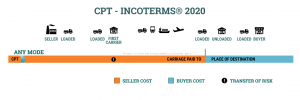
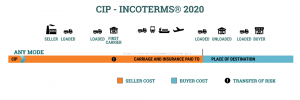
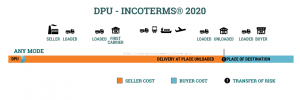
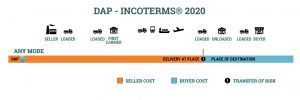
Incoterms rules history

The Incoterms or International Commercial Terms are a series of pre-defined commercial terms published by the International Chamber of Commerce (ICC) relating to international commercial law. They are widely used in international commercial transactions or procurement processes and their use is encouraged by trade councils, courts and international lawyers. A series of three-letter trade terms related to common contractual sales practices, the Incoterms rules are intended primarily to clearly communicate the tasks, costs, and risks associated with the global or international transportation and delivery of goods. Incoterms inform sales contracts defining respective obligations, costs, and risks involved in the delivery of goods from the seller to the buyer, but they do not themselves conclude a contract, determine the price payable, currency or credit terms, govern contract law or define where title to goods transfers.

The Incoterms rules are accepted by governments, legal authorities, and practitioners worldwide for the interpretation of most commonly used terms in international trade. They are intended to reduce or remove altogether uncertainties arising from the differing interpretations of the rules in different countries. As such they are regularly incorporated into sales contracts worldwide.

“Incoterms” is a registered trademark of the ICC.

The first work published by the ICC on international trade terms was issued in 1923, with the first edition known as Incoterms published in 1936. The Incoterms rules were amended in 1953, 1967, 1976, 1980, 1990, 2000, and 2010, with the ninth version — Incoterms 2020 — having been published on September 10, 2019.

1923: ICC’s first sounding of commercial trade terms

After ICC’s creation in 1919, one of its first initiatives was to facilitate international trade. In the early 1920’s the world business organization set out to understand the commercial trade terms used by merchants. This was done through a study that was limited to six commonly used terms in just 13 countries. The findings were published in 1923, highlighting disparities in interpretation.

1928: Clarity improved

To examine the discrepancies identified in the initial survey, a second study was carried out. This time, the scope was expanded to the interpretation of trade terms used in more than 30 countries.

1936: Global guidelines for traders

Based on the findings of the studies, the first version of the Incoterms® rules was published. The terms included FAS, FOB, C&F, CIF, Ex Ship and Ex Quay.

1953: Rise of transportation by rail

Due to World War II, supplementary revisions of the Incoterms® rules were suspended and did not resume again until the 1950’s. The first revision of the Incoterms® rules was then issued in 1953. It debuted three new trade terms for non-maritime transport. The new rules comprised DCP (Delivered Costs Paid), FOR (Free on Rail) and FOT (Free on Truck).

1967: Misinterpretations corrected

ICC launched the third revision of the Incoterms® rules, which dealt with misinterpretations of the previous version. Two trade terms were added to address delivery at frontier (DAF) and delivery at destination (DDP).

1974: Advances in air travel

The increased use of air transportation gave cause for another version of the popular trade terms. This edition included the new term FOB Airport (Free on Board Airport). This rule aimed to allay confusion around the term FOB (Free on Board) by signifying the exact “vessel” used.

1980: Proliferation of container traffic

With the expansion of carriage of goods in containers and new documentation processes, came the need for another revision. This edition introduced the trade term FRC (Free Carrier…Named at Point), which provided for goods not actually received by the ship’s side but at a reception point on shore, such as a container yard.

1990: A complete revision

The fifth revision simplified the Free Carrier term by deleting rules for specific modes of transport (i.e., FOR; Free on Rail, FOT; Free on Truck, and FOB Airport; Free on Board Airport). It was considered sufficient to use the general term FCA (Free Carrier…at Named Point) instead. Other provisions accounted for increased use of electronic messages.

2000: Amended customs clearance obligations

The “License, Authorisations and Formalities” section of FAS and DEQ Incoterms® rules were modified to comply with the way most customs authorities address the issues of exporter and importer of record.

2010: Reflections on the contemporary trade landscape

Incoterms® 2010 is the most current edition of the rules to date. This version consolidated the D-family of rules, removing DAF (Delivered at Frontier), DES (Delivered Ex Ship), DEQ (Delivered Ex Quay) and DDU (Delivered Duty Unpaid) and adding DAT (Delivered at Terminal) and DAP (Delivered at Place). Other modifications included an increased obligation for buyer and seller to cooperate on information sharing and changes to accommodate “string sales.”

2020: Revision

To keep pace with the ever-evolving global trade landscape, the latest update to the trade terms was launched in September 2019 for entry into force in 1 January 2020 as Incoterms 2020.

Source: ICC

Introduction to Incoterms 2020

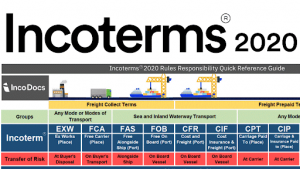
Incoterms are universally recognised rules. They guide buyers and sellers when formulating and fulfilling a contract for the shipment of goods. A careful study of Incoterms 2020 will repay the effort by enabling more favourable trade terms. It allows the manufacturer and buyer to open the doors to more effective trade finance. The latest version of Incoterms 2020 came into effect on 1st January 2020. It consisted of eleven separate Incoterms, with some specific revisions that are worth addressing.

Incoterms 2020 rules make security more prevalent by listing import and export requirements. Also, they help in distinguishing whether the buyer or seller is responsible for meeting each of those requirements. The updated definitions separate the Incoterms into two groups. Incoterms identify the responsibilities of each counterpart at different points during shipment. Likewise, some Incoterms are better suited to specific modes of transport than others. Each of the eleven Incoterms depends on the mode of transportation, including:

From a trade finance point of view, it is necessary to know where the risk transfer occurs. It has an impact on how much of the invoice can be financed using a service platform like Velotrade. Trade Finance service providers prefer some Incoterms to others. In fact, the longer the goods are under the seller’s responsibilities, the more of the invoice can be funded by the financial institution. Incoterms FOB and FCA are usually preferred for Invoice Discounting and Receivables Financing. In e-commerce finance, Incoterms DAP and DDP are the most used.

Introduction to Incoterms®2020

1. The purpose of the text of this Introduction is fourfold:

• to explain what the Incoterms® 2020 rules do and do NOT do and how they are best incorporated;
• to set out the important fundamentals of the Incoterms® rules: the basic roles and responsibilities of seller and buyer, delivery, risk, and the relationship between the Incoterms® rules and the contracts surrounding a typical contract of sale for export/import and also, where appropriate, for domestic sales;
• to explain how best to choose the right Incoterms® rule for the particular sale contract; and
• to set out the central changes between Incoterms®2010 and Incoterms®2020.

2. The Introduction follows this structure:

I. What the Incoterms® rules do
II. What the Incoterms® rules do NOT do
III. How best to incorporate the Incoterms® rules
IV. Delivery, risk and costs in the Incoterms® 2020 rules
V. Incoterms® 2020 rules and the carrier
VI. Rules for the contract of sale and their relationship to other contracts
VII. The eleven Incoterms® 2020 rules—”sea and inland waterway” and “any mode(s) of transport”: getting it right
VIII. Order within the Incoterms® 2020 rules
IX. Differences between Incoterms®2010 and Incoterms®2020
X. Caution with variants of Incoterms® rules

3. This Introduction gives guidance on the use of, and about the fundamental principles behind, the Incoterms® 2020 rules.

I. WHAT THE INCOTERMS® RULES DO

4. The Incoterms® rules explain a set of eleven of the most commonly-used three-letter trade terms, e.g. CIF, DAP, etc., reflecting business-to-business practice in contracts for the sale and purchase of goods.

5. The Incoterms® rules describe:

Obligations: Who does what as between seller and buyer, e.g. who organises carriage or insurance of the goods or who obtains shipping documents and export or import licences;
Risk: Where and when the seller “delivers” the goods, in other words where risk transfers from seller to buyer; and
Costs: Which party is responsible for which costs, for example transport, packaging, loading or unloading costs, and checking or security-related costs.

The Incoterms® rules cover these areas in a set often articles, numbered A1/B1 etc., the A articles representing the seller’s obligations and the B articles representing the buyer’s obligations. See paragraph 53 below.

II. WHAT THE INCOTERMS® RULES DO NOT DO

The Incoterms® rules are NOT in themselves—and are therefore no substitute for—a contract of sale. They are devised to reflect trade practice for no particular type of goods—and for any. They can be used as much for the trading of a bulk cargo of iron ore as for five containers of electronic equipment or ten pallets of airfreighted fresh flowers.

The Incoterms® rules do NOT deal with the following matters:

• whether there is a contract of sale at all;
• the specifications of the goods sold;
• the time, place, method or currency of payment of the price;
• the remedies which can be sought for breach of the contract of sale;
• most consequences of delay and other breaches in the performance of contractual obligations;
• the effect of sanctions;
• the imposition of tariffs;
• export or import prohibitions;
• force majeure or hardship;
• intellectual property rights; or
• the method, venue, or law of dispute resolution in case of such breach.

Perhaps most importantly, it must be stressed that the Incoterms® rules do NOT deal with the transfer of property/title/ownership of the goods sold.

These are matters for which the parties need to make specific provision in their contract of sale. Failure to do so is likely to cause problems later if disputes arise about performance and breach. In essence, the Incoterms® 2020 rules are nofthemselves a contract of sale: they only become port of that contract when they are incorporated into a contract which already exists. Neither do the Incoterms® rules provide the law applicable to the contract. There may be legal regimes which apply to the contract, whether international, like the Convention on the International Sale of Goods (CISG); or domestic mandatory law relating, for example, to health and safety or the environment.

III. HOW BEST TO INCORPORATE THE INCOTERMS® RULES

If parties want the Incoterms® 2020 rules to apply to their contract, the safest way to ensure this is to make that intention clear in their contract, through words such as “[the chosen Incoterms® rule] [named port, place or point] Incoterms® 2020“.

10, Thus, for example,CIF Shanghai Incoterms® 2020, or DAP No 123, ABC Street, Importland Incoterms® 2020.

11, Leaving the year out could cause problems that may be difficult to resolve. The parties, a judge or an arbitrator need to be able to determine which version of the Incoterms® rules applies to the contract.

12, The place named next to the chosen Incoterms® rule is even more important:

• in all Incoterms® rules except the C rules, the named place indicates where the goods are “delivered”, i.e. where risk transfers from seller to buyer;
• in the D rules, the named place is the place of delivery and also the place of destination and the seller must organise carriage to that point;
• in the C rules, the named place indicates the destination to which the seller must organise and pay for the carriage of the goods, which is not, however, the place or port of delivery.

13, Thus, an FOB sale raising doubt about the port of shipment leaves both parties uncertain as to where the buyer must present the ship to the seller for the shipment and the transport of the goods—and as to where the seller must deliver the goods on board so as to transfer risk in the goods from seller to buyer. Again, a CPT contract with an unclear named destination will leave both parties in doubt as to the point to which the seller must contract and pay for the transport of the goods.

14, It is best to avoid these types of issues by being as geographically specific as possible in naming the port, place or point, as the case may be, in the chosen Incoterms® rule.

15, When incorporating a particular Incoterms® 2020 rule into a sale contract, it is not necessary to use the trademark symbol. For further guidance on trademark and copyright, please refer to httpsWiccwbo.org/incoterms-copyright/.

IV. DELIVERY, RISK AND COSTS IN THE INCOTERMS® 2020 RULES

16, A named place or port attached to the three letters, e.g. CIP Las Vegas or CIF Los Angeles, then, is critical in the workings of the Incoterms® 2020 rules. Depending on which Incoterms® 2020 rule is chosen, that place will identify either the place or port at which the goods are considered to have been “delivered” by the seller to the buyer, the place of “delivery”, or the place or port to which the seller must organise the carriage of the goods, i.e. their destination; or, in the case of the D rules, both.

17. In all Incoterms® 2020 rules, A2 will define the place or port of “delivery”—and that place or port is closest to the seller in EXW and FCA (seller’s premises) and closest to the buyer in DAP, DPU and DDP.

18. The place or port of delivery identified by A2 is critical both for risk and for costs.

19. The place or port of delivery under A2 marks the place at which risk transfers from seller to buyer under A3. It is at that place or port that the seller performs its obligation to provide the goods under the contract as reflected in A1 such that the buyer cannot recover against the seller for the loss of or damage to the goods occurring after that point has passed.

20. The place or port of delivery under A2 also marks the central point under A9 which allocates costs to seller and buyer. In broad terms, A9 allocates costs before the point of delivery to the seller and costs after that point to the buyer.

Delivery points
Extremes and in-betweens: the four traditional Incoterms® rules groups

21. Versions of the Incoterms® rules before 2010 traditionally grouped the rules into four, namely E, F, C and D, with E and D lying at extreme poles from each other in terms of the point of delivery and the F and C rules lying in between. While the Incoterms® rules have, since 2010, been grouped according to the means of transport used, the old groupings are still helpful in understanding the point of delivery. Thus, the delivery point in EXW is an agreed point for collection of the goods by the buyer, whatever the destination to which the buyer will take them. At the other extreme in DAP, DPU and DDP, the delivery point is the same as the destination point to which the seller or its carrier will carry the goods. In the first, EXW, risk transfers before the transport cycle even starts; in the second, the D rules, risk transfers very late in that cycle. Again, in the first, EXW and, for that matter, FCA (seller’s premises), the seller performs its obligation to deliver the goods whether or not they actually arrive at their destination. In the second, the seller performs its obligation to deliver the goods only if they actually arrive at their destination.

22. The two rules at the extreme ends of the Incoterms® rules are EXW and DDP. However, traders should consider alternative rules to these two for their international contracts. Thus, with EXW the seller has to merely put the goods at the buyer’s disposal. This may cause problems for the seller and the buyer, respectively, with loading and export clearance. The seller would be better advised to sell under the FCA rule. Likewise, with DDP, the seller owes some obligations to the buyer which can only be performed within the buyer’s country, for example obtaining import clearance. It may be physically or legally difficult for the seller to carry out those obligations within the buyer’s country and a seller would therefore be better advised to consider selling goods in such circumstances under the DAP or DPU rules.

23. Between the two extremes of E and D rules, there lie the three F rules (FCA, FAS and FOB), and the four C rules (CPT,CIP,CFR and CIF).

24. With all seven F and C rules, the place of delivery is on the seller’s side of the anticipated carriage: consequently sales using these Incoterms® rules are often called “shipment” sales. Delivery occurs, for example,

a) when the goods are placed on board the vessel at the port of loading in CFR, CIF and FOB; or
b) by handing the goods over to the carrier in CPT and CIP; or
c) by loading them on the means of transport provided by the buyer or placing them at the disposal of the buyer’s carrier in FCA.
In the F and C groups, risk transfers at the seller’s end of the main carriage such that the seller will have performed its obligation to deliver the goods whether or not the goods actually arrive at their destination. This feature, of being shipment sales with delivery happening at the seller’s end early in the transit cycle, is common to the F and the C rules, whether they are the maritime Incoterms® rules or the Incoterms® rules intended for any mode[s] of transport.

25. The F and the C rules do, however, differ as to whether it is the seller or buyer who contracts for or arranges the carriage of the goods beyond the place or port of delivery. In the F rules, it is the buyer who makes such arrangements, unless the parties agree otherwise. In the C rules, this obligation falls to the seller.

26. Given that a seller on any of the C rules contracts for or arranges the carriage of the goods beyond delivery, the parties need to know what the destination is to which it must arrange carriage—and thatls the place attached to the name of the Incoterms® rule, e.g. “CIF the port of Dalian” or “CIP the inland city of Shenyang”. Whatever that named destination is, that place is not and never becomes the place of delivery. Risk will have transferred on shipment or on handing over the goods at the place of delivery, but the contract of carriage must have been made by the seller for the named destination. Delivery and destination, then, in the C rules, are necessarily not the same place.

V. INCOTERMS® 2020 RULES AND THE CARRIER

27 In the F and the C rules, placing the goods, for example, on board the vessel or handing them over to, or placing them at the disposal of, the carrier marks the point at which the goods are “delivered” by the seller to the buyer. Therefore this is the point at which risk transfers from the seller to the buyer.

28 Given those two important consequences, it becomes essential to identify who the carrier is where there is more than one carrier, each carrying out a separate leg of transport, for instance by road, rail, air or sea. Of course, where the seller has taken the far more prudent course of making one contract of carriage with one carrier taking responsibility for the entire carriage chain, in a so-called “through” contract of carriage, the problem does not arise. However, where there is no such “through” carriage contract, the goods could be handed over (where the CIP or CPT rules are used) to a road-haulier or rail company for onward transmission to a sea carrier. The same situation may arise with exclusively maritime transport where, for example, the goods are first handed over to a river or feeder short-sea carrier for onward transmission to an ocean carrier.

29 In these situations, when does the seller “deliver” the goods to the buyer: when it hands the goods over to the first, second or third carrier?

30 Before we answer that question, a preliminary point. While in most cases the carrier will be an independent third party engaged under a contract of carriage by either the seller or the buyer (depending on whether the parties have chosen a C Incoterms® rule or an F Incoterms® rule), there are situations where no such independent third party is engaged at all because the seller or the buyer itself will carry the goods sold. This is more likely to happen in the D rules (DAP, DPU and DDP), where the seller may use its own means of transport to carry the goods to the buyer at the delivery destination. Provision has therefore been made in the Incoterms® 2020 rules for a seller under the D rules either to contract for carriage or to arrange for carriage, that is to say through its own means of transport: see A4.

31 The question asked at paragraph 29 above is not simply a “carriage” question: it is an important “sale” question. The question is not which carrier can a seller or buyer of goods damaged in transit sue under the contract of carriage. The “sale” question is: where there is more than one carrier involved in the carriage of the goods from seller to buyer, at which point in the carriage string does the handing over of the goods mark the point of delivery and the transfer of risk as between seller and buyer?

32 There needs to be a simple answer to this question because the relationships between the multiple carriers used, and between the seller and/or the buyer with those several carriers, will be complex, depending as they do on the terms of a number of separate contracts of carriage. Thus, for example, in any such chain of contracts of carriage, one carrier, such as a carrier actually performing a leg of the transit by road, may well act as the seller’s agent in concluding a contract of carriage with a carrier by sea.

33 The Incoterms® 2020 rules give a clear answer to this question where the parties contract on FCA. In FCA, the relevant carrier is the carrier nominated by the buyer to whom the seller hands over the goods at the place or point agreed in the contract of sale. Thus even if a seller engages a road haulier to take the goods to the agreed delivery point, risk would transfer not at the place and time where the seller hands the goods over to the haulier engaged by the seller, but at the place and time where the goods are placed at the disposal of the carrier engaged by the buyer. This is why the naming of the place or point of delivery as precisely as possible is so important in FCA sales. The same situation can arise in FOB if a seller engages a feeder vessel or barge to take the goods to the vessel engaged by the buyer. A similar answer is provided by Incoterms® 2020. delivery occurs when the goods are placed on board the buyer’s carrier.

34 With the C rules, the position is more complex and may well attract different solutions under different legal systems. In CPT and CIP, the relevant carrier is likely to be regarded, at any rate in some jurisdictions, as the first carrier to whom the seller hands over the goods under A2 (unless the parties have agreed on the point of delivery). The buyer knows nothing of the contractual arrangements made between the seller and the first or subsequent carriers, or indeed between that first carrier and subsequent carriers. What the buyer does know, however, is that the goods are “in transit” to him or her—and that “transit” starts as far as the buyer knows, when the goods are put by the seller into the hands of the first carrier. The consequence is that risk transfers from seller to buyer at that early stage of “delivery” to the first carrier. The same situation can arise in CFR and CIF if a seller engages a feeder vessel or barge to take the goods to the agreed port of shipment, if any. A similar answer might be suggested in some legal systems: delivery occurs when the goods are placed on board the vessel at the agreed port of shipment, if any.

35 Such a conclusion, if adopted, may seem harsh on the buyer. Risk would transfer from seller to buyer in CPT and CIP sales when the goods are handed over to the first carrier. The buyer does not know at that stage whether or not that first carrier is responsible for loss of or damage to the goods under the relevant carriage contract. The buyer is not a party to that contract, has no control over it and will not know its terms. Yet, despite this, the buyer would end up bearing the risk in the goods from the very earliest moment of handing over, possibly without recovery against that first carrier.

36 While the buyer would end up bearing the risk of loss of or damage to the goods at an early stage of the transport chain, it would, on this view however, have a remedy against the seller. A2/A3 do not operate in a vacuum: under A4, the seller must contract for the carriage of the goods “from the agreed point of delivery, if any, at the place of delivery to the named place of destination or, if agreed, any point at that place.” Even if risk has transferred to the buyer at the time the goods were handed over to the first carrier under A2/A3, if that first carrier does not undertake responsibility under its contract of carriage for the through carriage of the goods to the named destination, the seller, on this view, would remain liable to the buyer under A4. In essence, the seller should make a contract of carriage to the destination named under the contract of sale.

VI. RULES FOR THE CONTRACT OF SALE AND THEIR RELATIONSHIP TO OTHER CONTRACTS

37 This discussion of the role of the carrier in the delivery of the goods as between the seller and the buyer in the C and F Incoterms® rules raises the question: what role do the Incoterms® rules play in the contract of carriage, or, indeed, in any of the other contracts typically surrounding an export contract, for example an insurance contract or a letter of credit?

38 The short answer is that the Incoterms® rules do not form part of those other contracts: where incorporated, the Incoterms® rules apply to and govern only certain aspects of the contract of sale.

39 This is not the same as saying, however, that the Incoterms® rules have no impact on those other contracts. Goods are exported and imported through a network of contracts that, in an ideal world, should match the one with the other. Thus, the sale contract, for example, will require the tender of a transport document issued by the carrier to the seller/shipper under a contract of carriage and against which the seller/shipper/beneficiary might wish to be paid under a letter of credit. Where the three contracts match, things go well; where they do not, problems rapidly arise.

40 What the Incoterms® rules say, for example, about carriage or transport documents (in A4/B4 and A6/B6), or what they say about insurance cover (A5/B5), does not bind the carrier or the insurer or any of the banks involved. Thus, a carrier is only bound to issue a transport document as required by the contract of carriage it makes with the other party to that contract: it is not bound to issue a transport document complying with the Incoterms® rules. Likewise, an insurer is bound to issue a policy to the level and in the terms agreed with the party purchasing the insurance, not a policy which complies with the Incoterms® rules. Finally, a bank will look only at the documentary requirements in the letter of credit, if any, not at the requirements of the sales contract.

41 Flowever, it is very much in the interests of all the parties to the different contracts in the network to ensure that the carriage or insurance terms they have agreed with the carrier or insurer, or the terms of a letter of credit, comply with what the sale contract says about ancillary contracts that need to be made or documents that need to be obtained and tendered. That task does not fall on the carrier, the insurer or the bank, none of whom are party to the contract of sale and none of whom are, therefore, party to or bound by the Incoterms® 2020 rules. It is, however, in the seller’s and buyer’s interest to try to ensure that the different parts of the network of contracts match—and the starting point is the sale contract—and therefore, where they apply, the Incoterms® 2020 rules.

VII. THE ELEVEN INCOTERMS® 2020 RULES—”SEA AND INLAND WATERWAY” AND “ANY MODE(S) OF TRANSPORT”: GETTING IT RIGHT

42 The main distinction introduced in the Incoterms® 2010 rules, that between Rules for any Mode or Modes of Transport (comprising EXW, FCA, CPT, CIP, DAP, the newly named DPU—the old DAT—and DDP), and Rules for Sea and Inland Waterway Transport, (comprising FAS, FOB, CFR and CIF) has been retained.

43 The four so-called “maritime” Incoterms® rules are intended for use where the seller places the goods on board (or in FAS alongside) a vessel at a sea or river port. It is at this point that the seller delivers the goods to the buyer. When these rules are used, the risk of loss of or damage to those goods is on the buyer’s shoulders from that port.

44 The seven Incoterms® rules for any mode or modes of transport (so-called “multi-modal”), on the other hand, are intended for use where:

a) the point at which the seller hands the goods over to, or places them at the disposal of, a carrier, or
b) the point at which the carrier hands the goods over to the buyer, or the point at which they are placed at the disposal of the buyer, or
c) both points (a) and (b)
are not on board (or in FAS alongside) a vessel.

45 Where delivery happens and risk transfers in each of these seven Incoterms® rules will depend on which particular rule is used. For example, in CPT, delivery happens at the seller’s end when the goods are handed over to the carrier contracted by the seller. In DAP, on the other hand, delivery happens when the goods are placed at the buyer’s disposal at the named place or point of destination.

46 The order in which the Incoterms® 2010 rules were presented has, as we have said, been largely retained in Incoterms® 2020 and it is important to underline the distinction between the two families of Incoterms® rules so that the right rule is used for the contract of sale depending on the means of transport used.

47 One of the most frequent problems in the use of the Incoterms® rules is the choice of the wrong rule for the particular type of contract.

48 Thus, for example, an FOB inland point (for example an airport or a warehouse) sale contract makes little sense: what type of contract of carriage must the buyer make? Does the buyer owe the seller an obligation to make a contract of carriage under which the carrier is bound to take over the goods at the named inland point or at the nearest port to that point?

49 Again, a CIF named sea port sale contract where the buyer expects the goods to be brought to an inland point in the buyer’s country makes little sense. Must the seller procure a contract of carriage and insurance cover to the eventual inland destination intended by the parties or to the seaport named in the sale contract?

50 Gaps, overlaps and unnecessary costs are likely to arise—and all this because the wrong Incoterms® rule has been chosen for the particular contract. What makes the mismatch “wrong” is that insufficient regard has been given to the two most important features of the Incoterms® rules, features which are mirrors of each other, namely the port, place or point of delivery and the transfer of risks.

51 The reason for the frequent misuse of the wrong Incoterms® rule is that Incoterms® rules are frequently regarded exclusively as price indicators: this or that is the EXW, FOB, or DAP price. The initials used in the Incoterms® rules are doubtless handy abbreviations for the formula used in the calculation of the price. Incoterms® rules are not, however, exclusively, or even primarily, price indicators. They are a list of general obligations that sellers and buyers owe each other under well-recognised forms of sale contract—and one of their main tasks is to indicate the port, place or point of delivery where the risk is transferred.

VIII. ORDER WITHIN THE INCOTERMS® 2020 RULES

52 All the ten A/B articles in each of the Incoterms® rules are important—but some are more important than others.

53 There has, indeed, been a radical shake-up in the internal order in which the ten articles within each Incoterms® rule have been organised. In Incoterms92020, the internal order within each Incoterms® rule now follows this sequence:

A1/B1 General obligations
A2/B2 Delivery/Taking delivery
A3/B3 Transfer of risks
A4/B4 Carriage
A5/B5 Insurance
A6/B6 Delivery/transport document
A7/B7 Export/import clearance
A8/B8 Checking/packaging/marking
A9/B9 Allocation of costs
A10/B10 Notices

54, It will be noticed that concerning the Incoterms® 2020 rules, after recording in A1/B1 the basic goods/payment obligations of the parties, Delivery and the Transfer of risks are moved to a more prominent location, namely to A2 and A3 respectively.

55, The broad sequence thereafter goes:

• ancillary contracts (A4/B4 and A5/B5, carriage and insurance);
• transport documents (A6/B6);
• export/import clearance (A7/B7);
• packaging (A8/B8);
• costs (A9/B9); and
• notices (A10/B10).

56, It is appreciated that this change in the order of the A/B articles will take some time—and cost—to become familiar. It is hoped that with delivery and risk now made more prominent, traders will find it easier to identify the differences among the various Incoterms® rules, i.e. the different points in time and place at which the seller “delivers” the goods to the buyer with risk transferring to the buyer from that time and point.

57, For the first time, the Incoterms® rules are published both in the traditional format setting out the eleven Incoterms® rules and in a new “horizontal” format setting out the ten articles within each Incoterms® rule under each of the headings listed above in paragraph 53, first for the seller and then for the buyer. Traders can therefore now far more easily see the difference, for example, between the place of delivery in FCA and the place of delivery in DAP; or the items of cost which fall on a buyer in CIF when compared with the items of cost which fall on a buyer in CFR. It is hoped that this “horizontal” representation of the Incoterms® 2020 rules will further assist traders in choosing the Incoterms® rule most appropriate to their commercial requirements.

IX. DIFFERENCES BETWEEN INCOTERMS92010 AND 2020

58, The most important initiative behind the Incoterms® 2020 rules has been to focus on how the presentation could be enhanced to steer users towards the right Incoterms® rule for their sale contract. Thus:

a) a greater emphasis in this Introduction on making the right choice;
b) a clearer explanation of the demarcation and connection between the sale contract and its ancillary contracts;
c) upgraded Guidance Notes presented now as Explanatory Notes to each Incoterms® rule; and
d) a re-ordering within the Incoterms® rules giving delivery and risk more prominence.

All these changes, though cosmetic in appearance, are in reality substantial attempts on the part of ICC to assist the international trading community towards smoother export/import transactions.

59, Apart from these general changes, there are more substantive changes in the Incoterms® 2020 rules when compared with Incoterms92010. Before looking at those changes, mention must be made of a particular development in trade practice which occurred since 2010 and which ICC has decided should not lead to a change in the Incoterms® 2020 rules, namely Verified Gross Mass (VGM).

60, Note on Verified Gross Mass (VGM)—Since 1 July 2016, Regulation 2 under the International Convention for the Safety of Life at Sea (SOLAS) imposed on shippers in the case of the shipment of containers the obligation either to weigh the packed container using calibrated and certified equipment, or to weigh the contents of the container and add the weight of the container when empty. In either case, the VGM is to be recorded with the carrier. A failure to comply bears the sanction under the SOLAS Convention that the container “should not be loaded onto a ship”: see paragraph 4.2, MSCI/Circ.1475,9 June 2014.

These weighing operations obviously incur expense and failure may lead to delay in loading. As this happened after 2010, it is unsurprising that there was some pressure in the consultations leading to Incoterms92020 for a clear indication to be given as to who, as between seller and buyer, should bear such obligations.

61. It was felt by the Drafting Group that obligations and costs relating to VGM were too specific and complex to warrant explicit mention in the Incoterms® 2020 rules.

62. Returning to the changes made by ICC to the Incoterms® 2010 rules in the Incoterms® 2020 rules, these are:

[a] Bills of lading with an on-board notation and the FCA Incoterms® rule
[b] Costs, where they are listed
[c] Different levels of insurance cover in CIF and CIP
[d] Arranging for carriage with seller’s or buyer’s own means of transport in FCA, DAP, DPU and DDP
[e] Change in the three-letter initials for DAT to DPU
[f] Inclusion of security-related requirements within carriage obligations and costs
[g] Explanatory Notes for Users

[a] Bills of lading with an on-board notation and the FCA Incoterms® rule

63. Where goods are sold FCA for carriage by sea, sellers or buyers (or more likely their banks where a letter of credit is in place) might want a bill of lading with an on-board notation.

64. Flowever, delivery under the FCA rule is completed before the loading of the goods on board the vessel. It is by no means certain that the seller can obtain an on-board bill of lading from the carrier. That carrier is likely, under its contract of carriage, to be bound and entitled to issue an on-board bill of lading only once the goods are actually on board.

65. To cater for this situation, FCA A6/B6 of Incoterms9 2020 now provides for an additional option. The buyer and the seller can agree that the buyer will instruct its carrier to issue an on-board bill of lading to the seller after the loading of the goods, the seller then being obliged to tender that bill of lading to the buyer, typically through the banks. ICC recognises that, despite this somewhat unhappy union between an on¬board bill of lading and FCA delivery, this caters for a demonstrated need in the marketplace. Finally, it should be emphasised that even where this optional mechanism is adopted, the seller is under no obligation to the buyer as to the terms of the contract of carriage.

66. Does it remain true to say that where containerised goods are delivered by seller to buyer by handing over to a carrier before loading onto a ship, the seller is well advised to sell on FCA terms rather than on FOB terms? The answer to that question is Yes. Where Incoterms9 2020 have made a difference, however, is that where such a seller still wants or needs a bill of lading with an on-board notation, the new additional option in the FCA term A6/B6 makes provision for such a document.

[b] Costs, where they are listed

67. In the new ordering of the articles within the Incoterms® 2020 rules, costs now appear at A9/B9 of each Incoterms® rule. Apart from that re-location, however, there is another change that will become obvious to users early on. The various costs which fall to be allocated by various articles within the Incoterms® rules have traditionally appeared in different parts of each Incoterms® rule. Thus, for example, costs related to the obtaining of a delivery document in FOB 2010 were mentioned in A8, the article under the heading “Delivery Document”, but not in A6, the article under the heading “Allocation of Costs”.

68. In the Incoterms® 2020 rules, however, the equivalent of A6/B6, namely A9/B9, now lists all the costs allocated by each particular Incoterms® rule. A9/B9 in the Incoterms® 2020 rules are consequently longer than A6/B6 in the Incoterms® 2010 rules.

69. The purpose is to provide users with a one-stop list of costs, so that the seller or buyer can now find in one place all the costs for which it would be responsible under that particular Incoterms® rule. Items of cost are also mentioned in their home article: thus, for example, the costs involved in obtaining documents in FOB still also appear at A6/B6 as well as at A9/B9. The thinking here was that users interested in discovering the specific allocation of documentary costs might be more inclined to go to the specific article dealing with delivery documents rather than to the general article listing all the costs.

[c] Different levels of insurance cover in CIF and CIP

70. In the Incoterms® 2010 rules, A3 of both CIF and CIP imposed on the seller the obligation to “obtain at its own expense cargo insurance complying at least with the minimum cover as provided by Clauses (C) of the Institute Cargo Clauses (Lloyd’s Market Association/lntemational Underwriting Association ‘LMA/IUA’) or any similar clauses.” Institute Cargo Clauses (C) provide cover for a number of listed risks, subject to itemised exclusions; Institute Cargo Clauses (A), on the other hand, cover “all risks”, again subject to itemised exclusions. During the consultations leading to the Incoterms® 2020 rules, the case was made for moving from Institute Cargo Clauses (C) to Institute Cargo Clauses (A), thus increasing the cover obtained by the seller for the benefit of the buyer. This could, of course, also involve an additional cost in premium. The contrary case, namely to stay with Institute Cargo Clauses (C), was equally strongly put, particularly by those involved in the maritime trade of commodities. After considerable discussion within and beyond the Drafting Group, the decision was made to provide for different minimum cover in the CIF Incoterms® rule and in the CIP Incoterms® rule. In the first, which is much more likely to be used in the maritime commodity trades, the status quo has been retained, with Institute Cargo Clauses (C) as the default position, although it is, of course, open to the parties to agree to higher cover. In the second, namely the CIP Incoterms® rule, the seller must now obtain insurance cover complying with Institute Cargo Clauses (A), although it is, of course, again open to the parties to agree on a lower level of cover.

[d] Arranging for carriage with seller’s or buyer’s own means of transport in FCA, DAP, DPU and DDP

71. In the Incoterms® 2010 rules, it was assumed throughout that where the goods were to be carried from the seller to the buyer, they would be carried by a third-party carrier engaged for the purpose either by the seller or the buyer, depending on which Incoterms® rule was used.

72. It became clear in the deliberations leading to Incoterms® 2020, however, that there were some situations where, although the goods were to be carried from the seller to the buyer, they could be so carried without any third-party carrier being engaged at all. Thus, for example, there was nothing stopping a seller on a D rule from arranging for such carriage without outsourcing that function to a third party, namely by using its own means of transportation. Likewise, with an FCA purchase, there was nothing to stop the buyer from using its own vehicle for the collection of the goods and for their transport to the buyer’s premises.

73. The rules appeared not to take account of these eventualities. The Incoterms® 2020 rules now do, by expressly allowing not only for the making of a contract of carriage, but also for simply arranging for the necessary carriage.

[e] Change in the three-letter initials for DAT to DPU

74. The only difference between DAT and DAP in the Incoterms® 2010 rules was that in DAT the seller delivered the goods once unloaded from the arriving means of transport into a “terminal”; whereas in DAP, the seller delivered the goods when the goods were placed at the disposal of the buyer on the arriving means of transport for unloading. It will also be recalled that the Guidance Note for DAT in Incoterms’6 2010 defined the word “terminal” broadly to include “any place, whether covered or not…”.

75. ICC decided to make two changes to DAT and DAP. First, the order in which the two Incoterms® 2020 rules are presented has been inverted, and DAP, where delivery happens before unloading, now appears before DAT. Secondly, the name of the rule DAT has been changed to DPU (Delivered at Place Unloaded), emphasising the reality that the place of destination could be any place and not only a “terminal”.

Flowever, if that place is not in a terminal, the seller should make sure that the place where it intends to deliver the goods is a place where it is able to unload the goods.

[f ] Inclusion of security-related requirements within carriage obligations and costs

76. It will be recalled that security-related requirements made a rather subdued entry into the Incoterms® 2010 rules, through A2/B2 and A10/B10 in each rule. The Incoterms® 2010 rules were the first revision of the Incoterms® rules to come into force after security-related concerns became so prevalent in the early part of this century. Those concerns, and the associated shipping practices which they have created in their wake, are now much more established. Connected as they are to carriage requirements, an express allocation of security-related obligations has now been added to A4 and A7 of each incoterms® rule. The costs incurred by these requirements are also now given a more prominent position in the costs article, namely A9/B9.

[g] Explanatory Notes for Users

77. The Guidance Notes appearing at the start of each incoterms® rule in the 2010 version now appear as “Explanatory Notes for Users”. These Notes explain the fundamentals of each incoterms® 2020 rule, such as when it should be used, when risk transfers and how costs are allocated between seller and buyer. The Explanatory Notes are intended (a) to help the user accurately and efficiently steer towards the appropriate incoterms® rule for a particular transaction; and (b) to provide those deciding or advising on disputes or contracts governed by Incoterms® 2020 with guidance on matters which might require interpretation. For guidance on more fundamental issues that cut across the incoterms® 2020 rules more generally, reference may, of course, also be made to the text of this introduction.

X. CAUTION WITH VARIANTS OF INCOTERMS* RULES

78. Sometimes the parties want to alter an incoterms® rule. The incoterms® 2020 rules do not prohibit such alteration, but there are dangers in so doing, in order to avoid any unwelcome surprises, the parties would need to make the intended effect of such alterations extremely clear in their contract. Thus, for example, if the allocation of costs in the incoterms® 2020 rules is altered in the contract, the parties should also clearly state whether they intend to vary the point at which delivery is made and the risk transfers to the buyer.

EXW | Fx Works – Incoterms 2020

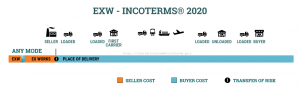
Ex Works (EXW) is the Incoterms 2020 rule used to describe the delivery of goods by the seller at their place of business, normally in their factory, offices or warehouse. The seller does not need to then load items onto a truck or ship, and the remainder of the shipment is the responsibility of the buyer (e.g. overseas shipment and customs duty). EXW is therefore more favourable to the seller as they do not need to worry about the freight once it has left their premises. However it is vital to note that once the seller has informed the buyer that the goods for the contract are identified and set aside, the delivery has been made, the buyer bears the risk from that moment and is obliged to pay, even though the goods are still in the possession and physical control of the seller.

This rule may be used irrespective of the mode of transport selected and may also be used where more than one mode of transport is employed. It is suitable for domestic trade, while FCA is usually more appropriate for international trade. “Ex Works” means that the seller delivers when it places the goods at the disposal of the buyer at the seller’s premises or at another named place (i.e., works, factory, warehouse, etc.). The seller does not need to load the goods on any collecting vehicle, nor does it need to clear the goods for export, where such clearance is applicable.

The parties are well advised to specify as clearly as possible the point within the named place of delivery, as the costs and risks to that point are for the account of the seller. The buyer bears all costs and risks involved in taking the goods from the agreed point, if any, at the named place of delivery.

EXW represents the minimum obligation for the seller. The rule should be used with care as:

  1. The seller has no obligation to the buyer to load the goods, even though in practice the seller may be in a better position to do so. If the seller does load the goods, it does so at the buyer’s risk and expense. In cases where the seller is in a better position to load the goods, FCA, which obliges the seller to do so at its own risk and expense is usually more appropriate.
  2. A buyer who buys from a seller on an EXW basis for export needs to be aware that the seller has an obligation to provide only such assistance as the buyer may require to effect that export: the seller is not bound to organize the export clearance. Buyers are therefore well advised not to use EXW if they cannot directly or indirectly obtain export clearance.
  3. The buyer has limited obligations to provide to the seller any information regarding the export of the goods. However, the seller may need this information for, e.g., taxation or reporting purposes.

EXW | Ex Works

EXW (insert named place of delivery) Incoterms® 2020

EXPLANATORY NOTES FOR USERS

1. Delivery and risk – “Ex Works” means that the seller delivers the goods to the buyer

  • when it places the goods at the disposal of the buyer at a named place (like a factory or warehouse), and
  • that named place may or may not be the seller’s premises.

For delivery to occur, the seller does not need to load the goods on any collecting vehicle, nor does it need to clear the goods for export, where such clearance is applicable.

2. Mode of transport – This rule may be used irrespective of the mode or modes of transport, if any, selected.

3. Place or precise point of delivery – The parties need only name the place of delivery. However, the parties are well advised also to specify as clearly as possible the precise point within the named place of delivery. A named precise point of delivery makes it clear to both parties when the goods are delivered and when risk transfers to the buyer; such precision also marks the point at which costs are for the buyer’s account. If the parties do not name the point of delivery, then they are taken to have left it to the seller to select the point “that best suits its purpose”. This means that the buyer may incur the risk that the seller may choose a point just before the point at which goods are lost or damaged. Best for the buyer therefore to select the precise point within a place where delivery will occur.

4. A note of caution to buyers – EXW is the Incoterms® rule which imposes the least set of obligations on the seller. From the buyer’s perspective, therefore, the rule should be used with care for different reasons as set out below.

5. Loading risks – Delivery happens – and risk transfers – when the goods are placed, not loaded, at the buyer’s disposal. However, risk of loss of or damage to the goods occurring while the loading operation is carried out by the seller, as it may well be, might arguably lie with the buyer, who has not physically participated in the loading. Given this possibility, it would be advisable, where the seller is to load the goods, for the parties to agree in advance who is to bear the risk of any loss of or damage to the goods during loading. This is a common situation simply because the seller is more likely to have the necessary loading equipment at its own premises or because applicable safety or security rules prevent access to the seller’s premises by unauthorised personnel. Where the buyer is keen to avoid any risk during loading at the seller’s premises, then the buyer ought to consider choosing the FCA rule (under which, if the goods are delivered at the seller’s premises, the seller owes the buyer an obligation to load, with the risk of loss of or damage to the goods during that operation remaining with the seller).

6. Export clearance – With delivery happening when the goods are at the buyer’s disposal either at the seller’s premises or at another named point typically within the seller’s jurisdiction or within the same Customs Union, there is no obligation on the seller to organise export clearance or clearance within third countries through which the goods pass in transit. Indeed, EXW may be suitable for domestic trades, where there is no intention at all to export the goods. The seller’s participation in export
clearance is limited to providing assistance in obtaining such documents and information as the buyer may require for the purpose of exporting the goods. Where the buyer intends to export the goods and where it anticipates difficulty in obtaining export clearance, the buyer would be better advised to choose the FCA rule, under which the obligation and cost of obtaining export clearance lies with the seller.

Ex Works Seller and Buyer Obligations

EXW A1 / B1 General Obligations

A1 (General Obligations)

In each of the eleven rules the seller must provide the goods and their commercial invoice as required by the contract of sale and any other evidence of conformity such as an analysis certificate or weighbridge document etc that might be relevant and specified in the contract.

Each of the rules also provides that any document can be in paper or electronic form as agreed to in the contract, or if the contract makes no mention of this then as is customary. The rules do not define what “electronic form” is, it can be anything from a pdf file to blockchain or some format yet to be developed in the future.

B1 (General obligations)

In each of the rules the buyer must pay the price for the goods as stated in the contract of sale.

The rules do not refer to when the payment is to be made (before shipment, immediately after shipment, thirty days after shipment, half now half later, or whatever) or how it is to be paid (prepayment, against an email of copy documents, on presentation of documents to a bank under a letter of credit, or other arrangement). These matters should be specified in the contract.

EXW A2 / B2: Delivery

A2 (Delivery)

The seller delivers simply when the goods are placed at the disposal of the buyer at an agreed point, which is usually the seller’s own premises or somewhere like their contracted manufacturer, on the specifically agreed date or within the agreed period such as “by 31 March” or “within 90 days after contract date.” This means that even though the goods are simply sitting within the seller’s premises they have already been “delivered,” the act of delivery here is not a physical handing over by a movement of the goods but a notional one achieved by the seller giving the appropriate notice to the buyer.

When the buyer arranges a collecting vehicle, whether a carrier’s vehicle or, new for the 2020 rules, the buyer’s own vehicle, to be at the named premises the seller has no obligation to load that vehicle. According to this rule the buyer must load the vehicle but in most cases this is simply not practical for a number of reasons. The seller most likely, for insurance and safety reasons, will not allow non-employees into their warehouse or factory. The seller certainly would not allow a buyer to go rampaging around the premises in a forklift that the buyer rolled off their vehicle, and to physically move the goods off say a rack three metres up might need a specialised forklift. The seller might even use an automated picking and despatch system. Usually the seller would be best placed to load the buyer’s vehicle, but if this is the expectation then the contract should clearly state that they do so at the buyer’s cost and risk. If the buyer is not prepared to take this risk then EXW is not the appropriate rule to be used and the parties should consider the FCA rule instead where it is the seller’s obligation and risk to load the collecting vehicle.

If the goods are going to be at a location other than the seller’s premises, such as a contracted manufacturer, or if the seller has several places within their premises such as numerous despatch docks, this information needs to be communicated to the buyer so their vehicle goes to the correct location. Any restrictions at the site need to be communicated too. If for example the loading dock needs to be accessed through a carpark it might be that a forty-foot container on a trailer can not be brought close to that dock. Or there might be restrictions on truck size in a narrow roadway.

B2 (Delivery)

The buyer’s role in EXW is that they must take delivery when the seller has made the goods available and has given their notice of this under A10. This usually will be when the goods are simply sitting in the seller’s premises and may well be before the buyer’s collecting vehicle arrives at the seller’s premises. The buyer should consider their exposure to risk from this point on and would be wise to ensure that they have adequate insurance cover such as under Institute Cargo Clauses (A).

The delivery requirements of the EXW rule can be difficult to work with.

EXW A3 / B3: Transfer of Risk

A3 (All Rules)

In all the rules the seller bears all risks of loss or damage to the goods until they have been delivered in accordance with A2 described above. The exception is loss or damage in circumstances described in B3 below, which varies dependent on the buyer’s role in B2.

B3 (All Rules)

The buyer bears all risks of loss or damage to the goods once the seller has delivered them as described in A2.

Additionally, if the buyer fails to give notice as described in B10 below and if the goods have been clearly identified as the goods described in the contract then the buyer bears all risks of loss or damage from the agreed date or the end of the agreed period for delivery.

EXW A4 / B4: Carriage

A4 (Carriage)

In this rule the seller has no obligation to the buyer for arranging carriage of the goods.

The seller however does have an obligation to provide the buyer with any information in its possession, including any transport-related security requirements, and requested by the buyer at its risk and request.

B4 (Carriage)

The buyer must arrange for the carriage of the goods, whether by the buyer itself or a contracted carrier, at its own cost from the named place of delivery. This allows for the buyer itself to take delivery of the goods such as might occur in a domestic transaction.

Note that as the seller in EXW is not responsible for loading the goods onto the vehicle the buyer will bear the cost of loading which would typically need to be added into its contract with the carrier. There is no point in the carrier’s truck turning up at the seller’s premises with no loading equipment and the seller refusing to load.

EXW A5 / B5: Insurance

A5 (Insurance)

The seller does not have the risk beyond the delivery point so it has no obligation to the buyer to arrange a contract of insurance. However, if the buyer requests, at its risk and cost, the seller must provide the buyer with information in its possession that the buyer needs to arrange its insurance. If there is any information which the buyer requests that is not already known to the seller, logically the seller can, and probably would, choose to assist.

Nevertheless, and this is not covered by the Incoterms® 2020 rules, a wise seller would investigate taking out marine insurance on a contingency basis. If the goods are lost or damaged in transit, and the buyer therefore refuses to pay for them, in essence breaching the contract, the seller will want to have a fall-back of being able to claim on its own marine insurance.

B5 (Insurance)

Despite having the risk of loss or damage to the goods from the delivery point, the buyer does not have an obligation to the seller to insure the goods. Whether the buyer chooses to insure the goods or bear the risk themselves is entirely their choice.

EXW A6 / B6: Delivery / Transport / Document

A6 (Delivery / Transport / Document)

Because the seller delivers when it makes the cargo available to the buyer to collect, the seller has no obligation to provide the buyer with any delivery or transport document.

B6 (Delivery / Transport / Document)

Because the buyer receives the goods from the seller it must provide the seller with appropriate evidence of having taken delivery. The form of that evidence is a matter to be agreed in the contract of sale to suit both parties. It could be a signature on the seller’s copy of the invoice, it could be the buyer’s simple receipt, it could be a freight forwarder’s cargo receipt, or some other form of evidence of having taken the goods.

EXW A7 / B7: Export / Import clearance

A7 (Export / Import clearance)

EXW is more suited to domestic transactions rather than international transactions.

In domestic transactions the seller has no obligations as there are not likely to be any clearances required.

In international transactions the seller has no obligation to arrange any export/transit/import clearances. However if the buyer requests, at its own risk and cost, the seller must assist in obtaining any documents and/or information which relate to formalities required by the countries of export/transit/import such as permits or licences; security clearance for export/transit/import; pre-shipment inspection required by the export/transit/import authorities; and any other official authorisations or approvals.

B7 (Export / Import clearance)

In domestic transactions the buyer has no obligation to the seller as there are not likely to be any clearances required.

In international transactions it is up to the buyer to carry out at its own cost all export/transit/import formalities required by the countries concerned, such as any permits or licences; any security clearances; pre-shipment inspection; and any other authorisations or formalities. Note the expression “it is up to” the buyer because all of these occur after EXW delivery so if the buyer fails to do any of these it is at its own risk as delivery has already occurred.

EXW A8 / B8: Checking / Packaging / Marking

A8 (Checking / Packaging / Marking)

In all rules the seller must pay the costs of any checking operations which are necessary for delivering the goods, such as checking quality, measuring the goods and/or packaging, weighing, counting the goods and/or packaging.

The seller must also package the goods, at its own cost, unless it is usual for the trade of the goods that they are sold unpackaged, such as in the case of bulk goods. The seller must also take into account the transport of the goods and package them appropriately, unless the parties have agreed in their contract that the goods be packaged and/or marked in a specific manner.

B8 (Checking / Packaging / Marking)

In all rules there is no obligation from the buyer to the seller as regards packaging and marking. There can in practice however be agreed exceptions, such as when the buyer provides the seller with labels, logos, or similar.

EXW A9 / B9: Allocation of Costs

A9 (Allocation Of Costs)

The seller must pay all costs until the goods have been delivered under A2, except any costs the buyer must pay as stated in B9.

B9 (Allocation Of Costs)

The buyer must pay all costs from the time the goods have been delivered under A2, reimburse the seller for any costs they incurred providing the buyer with any assistance or information which the buyer needed to arrange transport, insurance or export and import formalities.

The buyer must pay any and all duties, taxes, other charges and costs of any customs and other export formalities required if the goods are exported.

The buyer also must pay any additional costs incurred either if they have failed to take delivery of the goods when they have been placed at their disposal or if they have failed to give the seller appropriate notice provided the seller had clearly identified the goods as being the contract goods.

EXW A10 / B10: Notices

A10 (Notices)

The seller must give notice to the buyer which is needed for the buyer to take delivery of the goods. The form of this notice should be included in the terms and conditions of the contract, detailing whether a brief email or some manner of more formal notice is agreed.

B10 (Notices)

If the parties agree that the buyer is entitled to nominate a place of taking delivery within the named place, and/or the time within any agreed period, the buyer must give the seller sufficient notice. This means for example that if the agreed delivery place is a large bulk storage facility, the buyer may nominate a particular area which is outside a restricted zone, in which it is not allowed to operate its own equipment with its own personnel, so that it can load its vehicle. It also means for example where the delivery period is a particular calendar month, and the buyer wants to take delivery on the 17th day of that month, the buyer must give sufficient notice of this to the seller. Both such matters would usually be detailed in the sales contract.

Ex Works (EXW): Advantages and Disadvantages

This rule’s first version came into force in the original Incoterms® 1936 and included in its heading “Ex-factory, ex-mill, explantation, ex-warehouse etc” in the English section of that book with German and French translations included in the book. Its origin in common usages go back long before that.

All advantage would seem to be to the seller, it does nothing more than shout (or email) “come and get ‘em” or words to that effect. However if the sales contract is not well-drafted, while the seller might be expecting that the buyer is going to export the goods to an overseas market it could find that the buyer is in fact unable to complete export formalities and tries to reduce its potential losses by selling the goods into the seller’s home market at a discounted price.

It would seem at first glance that the buyer is disadvantaged by having to take all risks and arrange and pay for everything. Assuming that it is in a good position to do so then it would likely find that it can arrange all transport and formalities at the same costs as might be offered the seller were it of a mind to do so, but without paying the seller any mark-up on these costs. Another possibility is that the buyer is buying goods not only from one seller but a number of sellers and chooses to accumulate them at another location then consolidate them into one larger more cost-effective shipment in one or more shipping containers.

On the other hand, the buyer must be in a position, for an overseas sale, to carry out export formalities in the seller’s country. Most countries require the exporter to be a legally registered entity in that country to be able to carry out export formalities which generally means the buyer, usually an entity legally registered in its own country, will not be able to do so. If the buyer tries to circumvent this by using a buying agent, freight forwarder, friend or relative in the seller’s country to carry out export formalities it calls into question whether that third party to the sale is really in a legal position to be the exporter of record. Add to this the issues of the seller’s country’s taxation authorities looking at an EXW sale as a local sale and therefore likely subject to VAT/GST – how will the overseas buyer be able to recover the tax if it is of course not registered for VAT/GST in the seller’s country? The Incoterms® 2020 rules simply cannot deal with tax laws and regulations varying from country to country, as the rules must be universal across all countries, continents, markets and legal/tax jurisdictions.

FCA | Free Carrier – Incoterms 2020

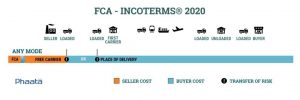
The FCA (Free Carrier) rule requires the seller to deliver the goods to the buyer or its carrier either at the seller’s premises loaded onto the collecting vehicle or delivered to another premises (typically a forwarder’s warehouse, airport or container terminal) not unloaded from the seller’s vehicle. The seller must carry out any export formalities and the buyer carries out any import formalities. From this it can be seen as a step up from the largely unworkable EXW in that the seller is now responsible for physically handing the goods over with risk transferring to the buyer only when delivery has been made, This rule works well for land transport within the Europe/Central Asia landmass, because often the truck collecting the goods will be the one transporting the goods to the destination.

FCA | Free Carrier

FCA (insert named place of delivery) Incoterms® 2020

EXPLANATORY NOTES FOR USERS

1. Delivery and risk – “Free Carrier (named place)” means that the seller delivers the goods to the buyer in one or other of two ways.

  • First, when the named place is the seller’s premises, the goods are delivered
    • when they are loaded on the means of transport arranged by the buyer.

  • Second, when the named place is another place, the goods are delivered
    • when, having been loaded on the seller’s means of transport,
    • they reach the named other place and
    • are ready for unloading from that seller’s means of transport and
    • at the disposal of the carrier or of another person nominated by the buyer.

Whichever of the two is chosen as the place of delivery, that place identifies where risk transfers to the buyer and the time from which costs are for the buyer’s account.

2. Mode of transport – This rule may be used irrespective of the mode of transport selected and may also be used where more than one mode of transport is employed.

3. Place or point of delivery – A sale under FCA can be concluded naming only the place of delivery, either at the seller’s premises or elsewhere, without specifying the precise point of delivery within that named place. However, the parties are well advised also to specify as clearly as possible the precise point within the named place of delivery. A named precise point of delivery makes it clear to both parties when the goods are delivered and when risk transfers to the buyer; such precision also marks the point at which costs are for the buyer’s account. Where the precise point is not identified, however, this may cause problems for the buyer. The seller in this case has the right to select the point “that best suits its purpose”: that point becomes the point of delivery, from which risk and costs transfer to the buyer. If the precise point of delivery is not identified by naming it in the contract, then the parties are taken to have left it to the seller to select the point “that best suits its purpose”. This means that
the buyer may incur the risk that the seller may choose a point just before the point at which goods are lost or damaged. Best for the buyer therefore to select the precise point within a place where delivery will occur.

4. “or procure goods so delivered’ – The reference to “procure” here caters for multiple sales down a chain (string sales), particularly, although not exclusively, common in the commodity trades.

5. Export/import clearance – FCA requires the seller to clear the goods for export, where applicable. However, the seller has no obligation to clear the goods for import or for transit through third countries, to pay any import duty or to carry out any import customs formalities.

6. Bills of lading with an on-board notation in FCA sales – We have already seen that FCA is intended for use irrespective of the mode or modes of transport used. Now if goods are being picked up by the buyer’s road-haulier in Las Vegas, it would be rather uncommon to expect a bill of lading with an on-board notation to be issued by the carrier from Las Vegas, which is not a port and which a vessel cannot reach for goods to be placed on board. Nonetheless, sellers selling FCA Las Vegas do sometimes find themselves in a situation where they need a bill of lading with an on¬board notation (typically because of a bank collection ora letter of credit requirement), albeit necessarily stating that the goods have been placed on board in Los Angeles as well as stating that they were received for carriage in Las Vegas. To cater for this possibility of an FCA seller needing a bill of lading with an on-board notation, FCA Incoterms®2020 has, for the first time, provided the following optional mechanism. If the parties have so agreed in the contract, the buyer must instruct its carrier to issue a bill of lading with an on-board notation to the seller. The carrier may or may not, of course, accede to the buyer’s request, given that the carrier is only bound and entitled to issue such a bill of lading once the goods are on board in Los Angeles. However, if and when the bill of lading is issued to the seller by the carrier at the buyer’s cost and risk, the seller must provide that same document to the buyer, who will need the bill of lading in order to obtain discharge of the goods from the carrier. This optional mechanism becomes unnecessary, of course, if the parties have agreed that the seller will present to the buyer a bill of lading stating simply that the goods have been received for shipment rather than that they have been shipped on board. Moreover, it should be emphasised that even where this optional mechanism is adopted, the seller is under no obligation to the buyer as to the terms of the contract of carriage. Finally, when this optional mechanism is adopted, the dates of delivery inland and loading on board will necessarily be different, which may well create difficulties for the seller under a letter of credit.

Free Carrier Seller and Buyer Obligations

FCA A1 / B1 General Obligations

A1 (General Obligations)

In each of the eleven rules the seller must provide the goods and their commercial invoice as required by the contract of sale and any other evidence of conformity such as an analysis certificate or weighbridge document etc that might be relevant and specified in the contract.

Each of the rules also provides that any document can be in paper or electronic form as agreed to in the contract, or if the contract makes no mention of this then as is customary. The rules do not define what “electronic form” is, it can be anything from a pdf file to blockchain or some format yet to be developed in the future.

B1 (General obligations)

In each of the rules the buyer must pay the price for the goods as stated in the contract of sale.

The rules do not refer to when the payment is to be made (before shipment, immediately after shipment, thirty days after shipment, half now half later, or whatever) or how it is to be paid (prepayment, against an email of copy documents, on presentation of documents to a bank under a letter of credit, or other arrangement). These matters should be specified in the contract.

FCA A2 / B2: Delivery

A2 (Delivery)

The seller delivers in one of two ways:

1) If the named place is the seller’s premises then when the goods have been loaded on the means of transport provided by the buyer. This includes of course the buyer’s carrier but allows the buyer to collect on its own vehicle such as in a domestic sale. The word “loaded” here would usually mean safely placed on the vehicle, but for example if pallets or crates are loaded onto a truck then any tying down or lashing will be the responsibility of the vehicle’s driver under safety and traffic rules. If the goods are loaded into a container on the back of the vehicle it would reasonably be expected that the seller would lash and secure the goods. As in EXW the seller would need to inform the buyer of any specific locations such as its own warehouse, contract manufacturer or a particular loading dock. Any restrictions at the site need to be communicated too. If for example the loading dock needs to be accessed through a carpark it might be that a forty-foot container on a trailer can not be brought close to that dock.

2) If the named place is not the seller’s premises then when the seller places the goods at the disposal of the buyer or its carrier on the seller’s vehicle delivering the goods to that place but not unloaded. Clearly the seller cannot be expected to provide the means to unload the goods into say a carrier’s terminal nor would they be allowed to for safety, security and insurance reasons.

This delivery must be made on:

1) the agreed date or

2) at the time nominated by the buyer within the agreed period, or

3) failing these, at the end of the agreed period. Why at the end? Because before that the buyer could still inform the seller of his desired time within the agreed period.

B2 (Delivery)

The buyer’s obligation is to take delivery when the goods have been delivered as described in A2.

Note that this rule does not discuss the means of transport at all, it merely mentions the carrier regardless of how the carrier will arrange transport of the goods.

FCA A3 / B3: Transfer Of Risk

A3 (Transfer of risk)

In all the rules the seller bears all risks of loss or damage to the goods until they have been delivered in accordance with A2 described above. The exception is loss or damage in circumstances described in B3 below, which varies dependent on the buyer’s role in B2

B3 (Transfer of risk)

The buyer bears all risks of loss or damage to the goods once the seller has delivered them as described in A2.

Additionally, if the buyer fails to have its carrier or another person give the required notice under B2, or that person fails to take the goods from the seller, then the buyer bears all risks either from the agreed date or time, or if no agreed date or time, then at the end of the agreed period.

For example, if the contract states the delivery must occur in June so the seller has the goods ready at their premises to place on a truck provided by the buyer’s carrier, and that carrier informs the seller that he will collect the goods on the 20th day of June but fails to do so, then buyer bears the risk of loss or damage to the goods from the end of the contract period being 30th June.

FCA A4 / B4: Carriage

A4 (Carriage)

In this rule the seller has no obligation to the buyer for arranging carriage of the goods.

The seller however does have an obligation to provide the buyer with any information in its possession, including any transport-related security requirements, and requested by the buyer at its risk and request.

The seller’s responsibility for any transport-related security requirements is only up to delivery, so if the seller trucks the goods to the carrier’s premises then transport-related security requirements for that leg only are the seller’s.

In some instances the seller and buyer can agree for the seller to contract for carriage, possibly because it can obtain more favourable rates than the buyer could, but such carriage is at the buyer’s risk and cost. While the rule states that the contract for carriage is to be “on the usual terms” it is most likely that the two parties will agree in their contract exactly what those terms are.

B4 (Carriage)
The buyer must arrange for the carriage of the goods, whether by the buyer itself or a contracted carrier, at its own cost from the named place of delivery. This allows for the buyer itself to take delivery of the goods such as might occur in a domestic transaction. The exception is where, as stated in A4, the contract for carriage is arranged by the seller.

Note that the contract of carriage needs to be specific as to where it commences. Remember that in A2 there are two places the delivery can occur, either at the seller’s premises loaded onto the collecting vehicle, or not unloaded from the seller’s vehicle at another place which is typically the carrier’s premises.

FCA A5 / B5: Insurance

A5 (Insurance)

The seller does not have the risk beyond the delivery point so it has no obligation to the buyer to arrange a contract of insurance. However, if the buyer requests, at its risk and cost, the seller must provide the buyer with information in its possession that the buyer needs to arrange its insurance. If there is any information which the buyer requests that is not already known to the seller, logically the seller can, and probably would, choose to assist.

Nevertheless, and this is not covered by the Incoterms® 2020 rules, a wise seller would investigate taking out marine insurance on a contingency basis. If the goods are lost or damaged in transit, and the buyer therefore refuses to pay for them, in essence breaching the contract, the seller will want to have a fall-back of being able to claim on its own marine insurance.

B5 (Insurance)

Despite having the risk of loss or damage to the goods from the delivery point, the buyer does not have an obligation to the seller to insure the goods. Whether the buyer chooses to insure the goods or bear the risk themselves is entirely their choice.

FCA A6 / B6: Delivery / Transport Document

A6 (Delivery/ Transport document)

The seller, at its own cost, must provide the buyer with the usual proof evidencing that the goods have been delivered to the buyer or another person, most usually of course its carrier, in accordance with A2. What form that proof takes is a matter for the parties to agree in their contract of sale. It could be as simple as the buyer’s signature on a copy of the invoice through to a forwarder’s cargo receipt or anything else agreed.

If the buyer requests, the seller must assist the buyer, at the buyer’s risk and cost, in obtaining a transport document.

Where the buyer has instructed its carrier to issue a transport document to the seller under B6, for example a bill of lading or air waybill, and it is in negotiable form such as a bill of lading consigned to order and in multiple originals, the seller is obliged to present a full set of those originals to the buyer. This will usually be along with other shipping documents presented to the seller’s bank under a letter of credit issued by the buyer’s bank

B6 (Delivery / Transport document)

The buyer must accept the proof provided by the seller that goods have been delivered as described in A2.

When the parties have agreed in their contract that the seller is to be given a transport document stating that the goods were loaded, such as an “on board” bill of lading, the buyer must instruct its carrier accordingly at the buyer’s cost and risk.

FCA A7 / B7: Export / Import clearance

A7 (Export / Import clearance)

This rule, like all the multimodal rules, is suitable for both domestic and international transactions.

Where applicable, the seller must at its own risk and expense carry out all export clearance formalities required by the country of export, such as licences or permits; security clearance for export; pre-shipment inspection; and any other authorisations or approvals.

The seller has no obligation to arrange any transit/import clearances. However if the buyer requests, at its own risk and cost, the seller must assist in obtaining any documents and/or information which relate to formalities required by the country of transit or import such as permits or licences; security clearance for transit/import; pre-shipment inspection required by the transit/import authorities; and any other official authorisations or approvals.

B7 (Export / Import clearance)

Where applicable, the buyer must assist the seller at the seller’s request, risk and cost, in obtaining any documents and/or information needed for all export-related formalities required by the country of export.

Where applicable, the buyer must carry out and pay for all formalities required by any country of transit and the country of import. These include licences and permits required for transit; import licences and permits required for import; import clearance; security clearance for transit and import; pre-shipment inspection; and any other official authorisations and approvals. They are the buyer’s responsibility because they occur after delivery by the seller.

At first glance it might seem strange that both seller and buyer have responsibility for pre-shipment inspections. To clarify, the seller is responsible if it is a requirement of the country of export, and the buyer is responsible if it is a requirement of the country of transit/import.

FCA A8 / B8: Checking / Packaging / Marking

A8 (Checking / Packaging / Marking)

In all rules the seller must pay the costs of any checking operations which are necessary for delivering the goods, such as checking quality, measuring the goods and/or packaging, weighing, counting the goods and/or packaging.

The seller must also package the goods, at its own cost, unless it is usual for the trade of the goods that they are sold unpackaged, such as in the case of bulk goods. The seller must also take into account the transport of the goods and package them appropriately, unless the parties have agreed in their contract that the goods be packaged and/or marked in a specific manner.

B8 (Checking / Packaging / Marking)

In all rules there is no obligation from the buyer to the seller as regards packaging and marking. There can in practice however be agreed exceptions, such as when the buyer provides the seller with labels, logos, or similar.

FCA A9 / B9: Allocation of Costs

A9 (Allocation of costs)

The seller must pay all costs until the goods have been delivered under A2, except any costs the buyer must pay as stated in B9.

The seller has to pay any costs involved in providing the usual proof that the goods have been delivered, so if the contract between the parties states that proof as being a bill of lading or an air waybill then the carrier’s document fee is for the seller.

The seller pays any costs, export duties and taxes, where applicable, related to export clearance.

If the buyer is requested by the seller to provide information or documents to assist the seller in their export formalities, then the seller must pay the buyer for these costs.

B9 (Allocation of costs)

The buyer must pay the seller all costs relating to the goods from when they have been delivered, other than those payable by the seller.

If the seller has been requested by the buyer to provide assistance in obtaining information or documents needed for the buyer to effect carriage, import formalities, insurance and the transport document, then the buyer must reimburse the seller’s costs.

Where applicable, the buyer pays any duties, taxes and other costs for transit or import clearance.

Additionally, and provided the seller has advised that the goods have been clearly identified as the goods under the contract, the buyer pays any additional costs incurred if the buyer fails to nominate who is to take the goods from the seller or that person fails to do so.

FCA A10 / B10: Notices

A10 (Notices)

Even though the buyer arranges its carrier or another person to take delivery of the goods, the seller must give the buyer sufficient notice that either the goods have been delivered or that the carrier or another person has failed to take delivery within the time agreed.

B10 (Notices)

The buyer must notify the seller of a number of things so that the seller can deliver and carry out any export formalities. These are contact details and location of the carrier or another person who the seller is to deliver to; the selected time, if any, in the agreed delivery period, such as when a container terminal is accepting cargo for a particular vessel, or when an airline requires cargo for a specific flight; the mode of transport and any transport-related security requirements.

Free Carrier (FCA): Advantages and Disadvantages

The first version of this rule appeared in Incoterms® 1980 to take into account container and roll on-roll off transport by sea as well as transport by air, road and rail. It absorbed the previous FOR/FOT (Free on Rail/Free on Truck, “truck” referring to a railway wagon not a road transport vehicle) appearing in the 1953 version to take into account the development of the rail freight network in Europe post World War Two, and FOB Airport which had originally appeared in the 1976 version to cater for the then new era of larger more powerful aircraft being able to carry cargo in addition to the passengers’ baggage. For some strange reason, in the Incoterms® 1990 version FCA’s delivery article was expanded to detail specific delivery procedures for rail transport, road transport (not mentioned in any previous versions), inland waterway, sea transport, air transport, unnamed transport (!) and multimodal transport. Sensibly Incoterms® 2000 revised this again to allow the current two options of delivery: loaded at the seller’s premises; or not unloaded elsewhere, typically at the carrier’s premises.

While initially seeming similar to EXW, FCA is in fact the more practical rule to use both in domestic and in international cross-border trades where the seller wants to minimise its effort and costs.

The seller must load the goods onto the buyer’s means of transport. This means that in most cases the buyer’s truck or its carrier’s truck backs up to the seller’s loading dock and the seller’s staff and equipment complete the loading. Depending on local rules and regulations, it would usually then be the truck driver’s responsibility to ensure that the load is secured on his truck, but this occurs after the seller has loaded the goods.

FCA is available for both domestic and international transactions.

If the transaction is an international trade then the seller will need to complete any export formalities required by its country’s authorities. This usually will mean that the buyer must inform the seller of the means of transport from the seller’s country, whether by road, rail, air or sea. The seller will usually need to know from the buyer the name and contact details of its carrier, the freight booking information including reference number/s, and any relevant data such as truck registration, railcar number, the flight details or the vessel’s details so that it can correctly declare both the date of export and the means of export to its authorities. The seller can outsource this task to the buyer’s carrier if they agree, at the seller’s cost.

Should the buyer fail to advise the seller about the carrier’s details, and fail to advise the booking details either via their carrier or themselves, the buyer will have no recourse on the seller and likely will have breached the contract. Similarly, if the buyer or its carrier fail to collect the goods at the agreed time and place, the buyer likely will have breached the contrac

The seller will of course build into its selling price the estimated costs of loading the goods and carrying out the export formalities, plus no doubt a positive margin of error in case they cost more than initially anticipated, a margin to take into account its administrative costs and quite likely a profit margin which after all it is entitled to do on any costs which are an input when determining its selling price. The costs of all these and its original ex works price are hidden from the buyer, simply being bundled into the one FCA price.

The seller is comforted by the knowledge that once it has delivered the goods, either at its own premises or those of the buyer’s nominated person or carrier, its risk for loss or damage of the goods has finished. If the truck used by the buyer’s carrier to collect the goods from the seller has an accident at the first corner after leaving the seller’s premises and the goods are damaged, or even if that truck has an electrical fault causing it to burst into flames at the seller’s loading dock immediately after loading has been completed, and damaging or destroying those goods, nevertheless the seller has delivered and is entitled to be paid for the goods.

In an export transaction using FCA the seller usually need not add VAT/GST to its sale, though it might require some form of evidence of export from the buyer to justify this action to its country’s tax authorities.

CPT | Carriage Paid To – Incoterms 2020

The CPT (Carriage Paid To) – Incoterms 2020 rule requires the seller to deliver the goods to its carrier but does not indicate whether that is either at the seller’s premises loaded onto the collecting vehicle or delivered to another premises not unloaded from the seller’s vehicle. The seller must carry out any export formalities and the buyer carries out any import formalities. It is the seller’s responsibility to contract for carriage and of course the cost of that will be built into the selling price. Like FCA, the risk transfers to the buyer immediately when delivery has been made, This rule works well for land transport within the Europe/Central Asia landmass, because often the truck collecting the goods will be the one transporting the goods to the destination.

CPT | Carriage Paid To

CPT (insert named place of destination) Incoterms® 2020

EXPLANATORY NOTES FOR USERS

1. Delivery and risk – “Carriage Paid To” means that the seller delivers the goods—and transfers the risk—to the buyer

  • by handing them over to the carrier
  • contracted by the seller
  • or by procuring the goods so delivered.
  • The seller may do so by giving the carrier physical possession of the goods in the manner and at the place appropriate to the means of transport used.

Once the goods have been delivered to the buyer in this way, the seller does not guarantee that the goods will reach the place of destination in sound condition, in the stated quantity or indeed at all. This is because risk transfers from seller to buyer when the goods are delivered to the buyer by handing them over to the carrier; the seller must nonetheless contract for the carriage of the goods from delivery to the agreed destination. Thus, for example, goods are handed over to a carrier in Las Vegas (which is not a port) for carriage to Southampton (a port) or to Winchester (which is not a port). In either case, delivery transferring risk to the buyer happens in Las Vegas, and the seller must make a contract of carriage to either Southampton or Winchester.

2. Mode of transport – This rule may be used irrespective of the mode of transport selected and may also be used where more than one mode of transport is employed.

3. Places (or points) of delivery and destinationIn CPT, two locations are important: the place or point (if any) at which the goods are delivered (for the transfer of risk) and the place or point agreed as the destination of the goods (as the point to which the seller promises to contract for carriage).

4. Identifying the place or point of delivery with precision – The parties are well advised to identify both places, or indeed points within those places, as precisely as possible in the contract of sale. Identifying the place or point (if any) of delivery as precisely as possible is important to cater for the common situation where several carriers are engaged, each for different legs of the transit from delivery to destination. Where this happens and the parties do not agree on a specific place or point of delivery, the default position is that risk transfers when the goods have been delivered to the first carrier at a point entirely of the seller’s choosing and over which the buyer has no control. Should the parties wish the risk to transfer at a later stage (e.g. at a sea or river port or at an airport), or indeed an earlier one (e.g. an inland point some way away from a sea or river port), they need to specify this in their contract of sale and to carefully think through the consequences of so doing in case the goods are lost or damaged.

5. Identifying the destination as precisely as possible – The parties are also well advised to identify as precisely as possible in the contract of sale the point within the agreed place of destination, as this is the point to which the seller must contract for carriage and this is the point to which the costs of carriage fall on the seller.

6. ‘or procuring the goods so delivered’ – The reference to “procure” here caters for multiple sales down a chain (string sales), particularly common in the commodity trades.

7. Costs of unloading at destination – If the seller incurs costs under its contract of carriage related to unloading at the named place of destination, the seller is not entitled to recover such costs separately from the buyer unless otherwise agreed between the parties.

8. Export/import clearance – CPT requires the seller to clear the goods for export, where applicable. However, the seller has no obligation to clear the goods for import or for transit through third countries, or to pay any import duty or to carry out any import customs formalities.

CPT Seller and Buyer Obligations

CPT A1 / B1 General Obligations

A1 (General Obligations)

In each of the eleven rules the seller must provide the goods and their commercial invoice as required by the contract of sale and any other evidence of conformity such as an analysis certificate or weighbridge document etc that might be relevant and specified in the contract.

Each of the rules also provides that any document can be in paper or electronic form as agreed to in the contract, or if the contract makes no mention of this then as is customary. The rules do not define what “electronic form” is, it can be anything from a pdf file to blockchain or some format yet to be developed in the future.

B1 (General obligations)

In each of the rules the buyer must pay the price for the goods as stated in the contract of sale.

The rules do not refer to when the payment is to be made (before shipment, immediately after shipment, thirty days after shipment, half now half later, or whatever) or how it is to be paid (prepayment, against an email of copy documents, on presentation of documents to a bank under a letter of credit, or other arrangement). These matters should be specified in the contract.

CPT A2 / B2: Delivery

A2 (Delivery)

The seller delivers the goods by handing them over to its contracted carrier, on the agreed date or within the agreed period.

There has in the past been some confusion because Incoterms® 2000 referred to “the first carrier” if there were subsequent carriers. In practice there may well be several carriers contracted in turn by the seller’s contracted carrier, such as the truck collecting the goods and taking them to the airport terminal,  the cargo handler contracted by the airline to move the goods to the aircraft and load them onto it, the airline itself, and the repeat of these at the other end. But the only carrier of concern is that carrier contracted to move the goods from the point of delivery to the destination.

Most importantly, delivery occurs when the seller passes the goods to their carrier to transport them, not when the goods reach the destination

B2 (Delivery)

The buyer not only must take delivery when they have been handed to the seller’s carrier, but also physically receive them at the named place, or point within that place, of destination.

CPT A3 / B3: Transfer Of Risk

A3 (Transfer of risk)

In all the rules the seller bears all risks of loss or damage to the goods until they have been delivered in accordance with A2 described above. The exception is loss or damage in circumstances described in B3 below, which varies dependent on the buyer’s role in B2.

B3 (Transfer of risk)

The buyer bears all risks of loss or damage to the goods once the seller has delivered them as described in A2.

If the contract provides for the buyer to inform the seller the time for dispatching the goods or the point of receiving the goods within the destination place and the buyer fails to do so, then the buyer bears the risk of loss or damage to the goods from the agreed date or the end of the agreed period.

For example, if the buyer does not inform the buyer where he is to send the goods, how can the seller dispatch them? If the seller has clearly identified the goods then the risk transfers to the buyer either on the agreed date or the end of the agreed period.

CPT A4 / B4: Carriage

A4 (Carriage)

The seller must contract for the carriage of the goods, or procure such contract if this is one leg of a “string” sale. The contract must be from the place of delivery and maybe an agreed point within that place. It must be made on “usual terms” and for the “usual route in a customary manner of the type used by the carriage of the type of goods sold.” If the seller and buyer agree on specific matters regarding the contract of carriage that is well and good, but if they don’t then the seller must arrange it in the usual manner for those goods.

As the seller has to arrange the carriage it needs to know from the buyer if there is a specific point in the place of destination to which the goods must be transported. For example, if the destination is shown as simply “New Delhi, India” where in that large metropolis is the seller’s carrier to leave the goods? It could be that it is to be the buyer’s premises, or a particular location say in a green-fields building site, or the carrier’s premises, or the airport, or the container yard… the exact point should be agreed upon. If it is not then it is the seller’s choice to select the point that best suits its purpose, usually being the cheapest option such as a cargo terminal.

If the delivery at the destination is to occur after the buyer completes any necessary import formalities then the cost of storage due to delays in those formalities being completed is for the buyer, always assuming the seller has provided the buyer with necessary documents in time.

The seller must comply with any transport-related security requirements for the whole of the transport to the destination.

B4 (Carriage)

The buyer has no obligation to the seller to arrange a contract of carriage.

CPT A5 / B5: Insurance

A5 (Insurance)

The seller does not have the risk beyond the delivery point so it has no obligation to the buyer to arrange a contract of insurance. However, if the buyer requests, at its risk and cost, the seller must provide the buyer with information in its possession that the buyer needs to arrange its insurance. If there is any information which the buyer requests that is not already known to the seller, logically the seller can, and probably would, choose to assist.

Nevertheless, and this is not covered by the Incoterms® 2020 rules, a wise seller would investigate taking out marine insurance on a contingency basis. If the goods are lost or damaged in transit, and the buyer therefore refuses to pay for them, in essence breaching the contract, the seller will want to have a fall-back of being able to claim on its own marine insurance.

B5 (Insurance)

Despite having the risk of loss or damage to the goods from the delivery point, the buyer does not have an obligation to the seller to insure the goods. Whether the buyer chooses to insure the goods or bear the risk themselves is entirely their choice.

CPT A6 / B6: Delivery / Transport / Document

A6 (Delivery / Transport document)

The seller must provide the buyer with the usual transport documents for the transport contracted in A4, if it is customary or the buyer requested it, and at the seller’s cost.

As CPT and CIP cover any mode or modes of transport, what form that document of transport takes will be dependent on the mode/s used. If the modes include carriage by sea such as in FCL or LCL transactions then it is usual for the seller to obtain a sea waybill or bill of lading. If the latter is issued in a negotiable form and in several originals then a full set of those originals must be presented to the buyer, sometimes through the seller’s bank to the buyer’s bank under a letter of credit. If the mode includes the goods going by air then typically an air waybill will be issued and if requested the seller will be given one “original for shipper” but this is not a negotiable transport document. Shipment by truck might involve issue of a CMR in Europe or simply some form of consignment note or truck waybill and these too are not negotiable. Shipment by rail similarly will usually be covered by some form of rail consignment note that is not negotiable.

The transport document must cover movement of the contracted goods within the agreed period for shipment. If it is agreed then this document must enable the buyer to claim the goods from the carrier at the named place of destination, and in a string sale enable the buyer to sell the goods in transit to a subsequent buyer by transferring that document. This would usually be in the form of a negotiable bill of lading.

B6 (Delivery / Transport document)

The buyer must accept the transport document provided by the seller so long as it is in conformity with the contract.

CPT A7 / B7: Export / Import clearance

A7 (Export / Import clearance)

This rule, like all the multimodal rules, is suitable for both domestic and international transactions.

Where applicable, the seller must at its own risk and expense carry out all export clearance formalities required by the country of export, such as licences or permits; security clearance for export; pre-shipment inspection; and any other authorisations or approvals.

The seller has no obligation to arrange any transit/import clearances. However if the buyer requests, at its own risk and cost, the seller must assist in obtaining any documents and/or information which relate to formalities required by the country of transit or import such as permits or licences; security clearance for transit/import; pre-shipment inspection required by the transit/import authorities; and any other official authorisations or approvals.

B7 (Export / Import clearance)

Where applicable, the buyer must assist the seller at the seller’s request, risk and cost, in obtaining any documents and/or information needed for all export-related formalities required by the country of export.

Where applicable, the buyer must carry out and pay for all formalities required by any country of transit and the country of import. These include licences and permits required for transit; import licences and permits required for import; import clearance; security clearance for transit and import; pre-shipment inspection; and any other official authorisations and approvals. They are the buyer’s responsibility because they occur after delivery by the seller.

At first glance it might seem strange that both seller and buyer have responsibility for pre-shipment inspections. To clarify, the seller is responsible if it is a requirement of the country of export, and the buyer is responsible if it is a requirement of the country of transit/import.

A8 / B8: Checking / Packaging / Marking

A8 (Checking / Packaging / Marking)

In all rules the seller must pay the costs of any checking operations which are necessary for delivering the goods, such as checking quality, measuring the goods and/or packaging, weighing, counting the goods and/or packaging.

The seller must also package the goods, at its own cost, unless it is usual for the trade of the goods that they are sold unpackaged, such as in the case of bulk goods. The seller must also take into account the transport of the goods and package them appropriately, unless the parties have agreed in their contract that the goods be packaged and/or marked in a specific manner.

B8 (Checking / Packaging / Marking)

In all rules there is no obligation from the buyer to the seller as regards packaging and marking. There can in practice however be agreed exceptions, such as when the buyer provides the seller with labels, logos, or similar.

CPT A9 / B9: Allocation of Costs

A9 (Allocation of costs)

The seller must pay all costs until the goods have been delivered under A2, other than any costs the buyer must pay as stated in B9.

Transport costs resulting from the contract of carriage, including costs of loading the goods and any transport-related security, must be paid by the seller. The cost of providing to the buyer proof of the goods being delivered are also for the seller.

If the contract of carriage includes unloading at the agreed destination, which would typically be the case in most shipments, the seller must pay these. Additionally, any costs of transit included in the contract of carriage must also be paid by the seller.

The seller must pay any costs involved in providing the usual proof that the goods have been delivered, so if the contract between the parties states that proof as being a transport document then the carrier’s document fee is for the seller.

The seller must pay any costs, export duties and taxes, where applicable, related to export clearance.

If the buyer is requested by the seller to provide information or documents in relation to export clearance, then the seller must pay the buyer for these costs.

B9 (Allocation of costs)

The buyer must pay the seller all costs relating to the goods from when they have been delivered, other than those payable by the seller.

If the seller has been requested by the buyer to provide assistance in obtaining information or documents needed for the buyer to effect insurance and import formalities, then the buyer must reimburse the seller’s costs.

Where applicable, the buyer must pay any duties, taxes and other costs for import clearance.

The buyer must pay for unloading costs unless they were paid by the seller under the contract of carriage.

The buyer must pay for any costs of the country of transit unless they have been paid by the seller under the contract of carriage.

CPT A10 / B10: Notices

A10 (Notices)

The C rules as we have seen before involve two distinct points. This is reflected by the requirement that the seller must give the buyer notice that the goods have been delivered as required in A2, and any notice the buyer will need enabling the buyer to receive the goods. The manner in which this will be done is usually detailed in the contract, such as by a simple email and/or copies of shipping documents being emailed.

B10 (Notices)

If the parties agree in the contract that the buyer is entitled to determine the time for the seller to deliver the goods, and possibly more importantly, the point within the named place of destination where it will receive the goods, the buyer must give the seller sufficient notice. The contract will usually detail how much notice is to be given, and this might vary with the mode/s of transport.

Carriage Paid To (CPT): Advantages and Disadvantages

This rule was first published in Incoterms® 1980 as DCP (Freight Carriage Paid To). It was changed in Incoterms® 1990 to the current CPT.

This rule has a number of advantages for the seller. 

If the seller has large numbers of goods to despatch daily or on a regular basis, by using CPT it chooses its own carrier and can easily coordinate loading of trucks at its despatch dock, whereas if it were to use FCA with each buyer arranging their own carrier it could be chaos at the loading dock. 

The seller might have better buying power for freight than the buyer, so in such a case the buyer would usually benefit from lower rates built into the price even though the seller would be entitled to add its margin. Additionally, the buyer is freed up from worrying about logistics in the seller’s country and making a freight booking potentially on the other side of the world.

Despite the three letters “CPT” being followed by the destination place, delivery occurs when the seller gives the goods to its carrier contracted to take them to that destination. It is at that delivery point in the seller’s country that the risk transfers from the seller to the buyer. 

The rule gives no definition of where a “place” might be, it will depend entirely on what the seller and buyer have agreed. For a shipment by road it could be the buyer’s premises, by rail it could be the nearest rail terminal or station to the buyer, because these two are usually used for domestic or intra-customs zone transactions. For air it could be either the airline’s terminal or the forwarder’s terminal at or near the destination airport, and for sea by containers as a full container load (FCL) it will usually be the carrier’s terminal (CY = container yard) or for less than container load (LCL) the cargo will be deconsolidated at a consolidator’s premises (CFS = container freight station). The destination for air and sea in containers could even be the buyer’s premises too, but this is unusual and involves the seller’s carrier taking hold of the goods again after they have been import-cleared and then delivering them beyond where they sat while being import-cleared.

The disadvantage to the buyer is that they take on the risk when the goods are in the possession and control of the seller’s carrier, which they will be from before the buyer might even be aware of the delivery until they arrive at the destination place and the buyer takes possession of them.

CIP | Carriage and Insurance Paid To – Incoterms 2020

CIP (or Carriage and Insurance Paid To) – Incoterms 2020 is an Incoterm where the seller is responsible for the delivery of goods to an agreed destination in the buyers country, and must pay for the cost of this carriage. The sellers risk however, ends once they have placed the goods on the ship, at the origin destination. The buyer can pay for additional insurance during carriage of the goods. The risk is passed when the goods are received by the first carrier.

Carriage and Insurance Paid to is eligible for any form of transportion.

CIP | Carriage and Insurance Paid To

CIP (insert named place of destination) Incoterms® 2020

EXPLANATORY NOTES FOR USERS

1. Delivery and risk – “Carriage and Insurance Paid To” means that the seller delivers the goods – and transfers the risk – to the buyer

  • by handing them over to the carrier
  • contracted by the seller
  • or by procuring the goods so delivered.
  • The seller may do so by giving the carrier physical possession of the goods in the manner and at the place appropriate to the means of transport used.

Once the goods have been delivered to the buyer in this way, the seller does not guarantee that the goods will reach the place of destination in sound condition, in the stated quantity or indeed at all.

This is because risk transfers from seller to buyer when the goods are delivered to the buyer by handing them over to the carrier; the seller must nonetheless contract for the carriage of the goods from delivery to the agreed destination. Thus, for example, goods are handed over to a carrier in Las Vegas (which is not a port) for carriage to Southampton (a port) or to Winchester (which is not a port). In either case, delivery transferring risk to the buyer happens in Las Vegas, and the seller must make a contract of carriage to either Southampton or Winchester.

2. Mode of transport – This rule may be used irrespective of the mode of transport selected and may also be used where more than one mode of transport is employed.

3. Places (or points) of delivery and destination – In CIP two locations are important: the place or point at which the goods are delivered (for the transfer of risk) and the place or point agreed as the destination of the goods (as the point to which the seller promises to contract for carriage).

4. Insurance – The seller must also contract for insurance cover against the buyer’s risk of loss of or damage to the goods from the point of delivery to at least the point of destination. This may cause difficulty where the destination country requires insurance cover to be purchased locally: in this case the parties should consider selling and buying under CPT. The buyer should also note that under the CIP Incoterms® 2020 rule the seller is required to obtain extensive insurance cover complying with Institute Cargo Clauses (A) or similar clause, rather than with the more limited cover under Institute Cargo Clauses (C). It is, however, still open to the parties to agree on a lower level of cover.

5. Identifying the place or point of delivery with precision – The parties are well advised to identify both places, or indeed points within those places, as precisely as possible in the contract of sale. Identifying the place or point (if any) of delivery as precisely as possible is important to cater for the common situation where several carriers are engaged, each for different legs of the transit from delivery to destination. Where this happens and the parties do not agree on a specific place or point of delivery, the default position is that risk transfers when the goods have been delivered to the first carrier at a point entirely of the seller’s choosing and over which the buyer has no control. Should the parties wish the risk to transfer at a later stage (e.g. at a sea or river port or at an airport), or indeed an earlier one (e.g. an inland point some way away from a sea or river port), they need to specify this in their contract of sale and to carefully think through the consequences of so doing in case the goods are lost or damaged.

6. Identifying the destination as precisely as possible – The parties are also well advised to identify as precisely as possible in the contract of sale the point within the agreed place of destination, as this is the point to which the seller must contract for carriage and insurance and this is the point to which the costs of carriage and insurance fall on the seller.

7. ‘or procuring the goods so delivered’ – The reference to “procure” here caters for multiple sales down a chain (string sales), particularly common in the commodity trades.

8. Costs of unloading at destination – If the seller incurs costs under its contract of carriage related to unloading at the named place of destination, the seller is not entitled to recover such costs separately from the buyer unless otherwise agreed between the parties.

9. Export/import clearance – CIP requires the seller to clear the goods for export, where applicable. However, the seller has no obligation to clear the goods for import or for transit through third countries, or to pay any import duty or to carry out any import customs formalities.

Carriage and Insurance Paid To Seller and Buyer Obligations

CIP A1 / B1 General Obligations

A1 (General Obligations)

In each of the eleven rules the seller must provide the goods and their commercial invoice as required by the contract of sale and any other evidence of conformity such as an analysis certificate or weighbridge document etc that might be relevant and specified in the contract.

Each of the rules also provides that any document can be in paper or electronic form as agreed to in the contract, or if the contract makes no mention of this then as is customary. The rules do not define what “electronic form” is, it can be anything from a pdf file to blockchain or some format yet to be developed in the future.

B1 (General obligations)

In each of the rules the buyer must pay the price for the goods as stated in the contract of sale.

The rules do not refer to when the payment is to be made (before shipment, immediately after shipment, thirty days after shipment, half now half later, or whatever) or how it is to be paid (prepayment, against an email of copy documents, on presentation of documents to a bank under a letter of credit, or other arrangement). These matters should be specified in the contract.

CIP A2 / B2: Delivery

A2 (Delivery)

The seller delivers the goods by handing them over to its contracted carrier, on the agreed date or within the agreed period.

There has in the past been some confusion because Incoterms® 2000 referred to “the first carrier” if there were subsequent carriers. In practice there may well be several carriers contracted in turn by the seller’s contracted carrier, such as the truck collecting the goods and taking them to the airport terminal, the cargo handler contracted by the airline to move the goods to the aircraft and load them onto it, the airline itself, and the repeat of these at the other end. But the only carrier of concern is that carrier contracted to move the goods from the point of delivery to the destination.

Most importantly, delivery occurs when the seller passes the goods to their carrier to transport them, not when the goods reach the destination

B2 (Delivery)

The buyer not only must take delivery when they have been handed to the seller’s carrier, but also physically receive them at the named place, or point within that place, of destination.

CIP A3 / B3: Transfer of risk

A3 (Transfer of risk)

In all the rules the seller bears all risks of loss or damage to the goods until they have been delivered in accordance with A2 described above. The exception is loss or damage in circumstances described in B3 below, which varies dependent on the buyer’s role in B2.

B3 (Transfer of risk)

The buyer bears all risks of loss or damage to the goods once the seller has delivered them as described in A2.

If the contract provides for the buyer to inform the seller the time for dispatching the goods or the point of receiving the goods within the destination place and the buyer fails to do so, then the buyer bears the risk of loss or damage to the goods from the agreed date or the end of the agreed period.

For example, if the buyer does not inform the buyer where he is to send the goods, how can the seller dispatch them? If the seller has clearly identified the goods then the risk transfers to the buyer either on the agreed date or the end of the agreed period.

CIP A4 / B4: Carriage

A4 (Carriage)

The seller must contract for the carriage of the goods, or procure such contract if this is one leg of a “string” sale. The contract must be from the place of delivery and maybe an agreed point within that place. It must be made on “usual terms” and for the “usual route in a customary manner of the type used by the carriage of the type of goods sold.” If the seller and buyer agree on specific matters regarding the contract of carriage that is well and good, but if they don’t then the seller must arrange it in the usual manner for those goods.

As the seller has to arrange the carriage it needs to know from the buyer if there is a specific point in the place of destination to which the goods must be transported. For example, if the destination is shown as simply “New Delhi, India” where in that large metropolis is the seller’s carrier to leave the goods? It could be that it is to be the buyer’s premises, or a particular location say in a green-fields building site, or the carrier’s premises, or the airport, or the container yard… the exact point should be agreed upon. If it is not then it is the seller’s choice to select the point that best suits its purpose, usually being the cheapest option such as a cargo terminal.

If the delivery at the destination is to occur after the buyer completes any necessary import formalities then the cost of storage due to delays in those formalities being completed is for the buyer, always assuming the seller has provided the buyer with necessary documents in time.

The seller must comply with any transport-related security requirements for the whole of the transport to the destination.

B4 (Carriage)
The buyer has no obligation to the seller to arrange a contract of carriage.

CIP A5 / B5: Insurance

A5 (Insurance)

The seller must arrange a contract of insurance at its own cost to cover the buyer’s risks. This cover must be of the level provided by LMA/IUA Institute Cargo Clauses (A) or similar dependent on the mode of transport used, often referred to generally as “all risks” as it covers all manner of risks with specific exclusions.

If the buyer requests, the seller must also arrange, at the buyer’s cost, additional cover under the LMA/IUA Institute War Clauses (Cargo) and Institute Strikes Clauses (Cargo) or similar dependent on the mode of transport unless such cover is already included, as it usually is, with the “all risks” insurance.

The amount of the insurance must be at least 110 percent of the invoice value and in the currency of that invoice and contract. It must cover the goods for at least the duration from the point of delivery described in A2 above to the named place of destination. Often in contracts of sale and letters of credit the stipulation is the unnecessary wording “warehouse to warehouse.”

The seller must provide the buyer a separate contract or a certificate under an existing policy giving the details of the shipment to enable the buyer, or anyone else having an insurable interest in the goods, to claim from the insurer. This document usually shows the seller as the insured and is then endorsed by the seller on the back of the original/s in blank or with a specific endorsement

The seller must also provide the buyer, at the buyer’s request, risk and expense, with information that the buyer needs to arrange any additional insurance.

B5 (Insurance)

Despite the buyer having the risk of loss or damage to the goods from the delivery point, the buyer does not have an obligation to the seller to insure the goods. However, the buyer must provide the seller, if it requests, with any information it needs to arrange any additional insurance requested by the buyer under A5. For example, the seller might need to know the location of the destination warehouse so its insurer can assess the risk and levy an appropriate premium.

CIP A6 / B6: Delivery / Transport / Document

A6 (Delivery / Transport document)

The seller must provide the buyer with the usual transport documents for the transport contracted in A4, if it is customary or the buyer requested it, and at the seller’s cost.

As CPT and CIP cover any mode or modes of transport, what form that document of transport takes will be dependent on the mode/s used. If the modes include carriage by sea such as in FCL or LCL transactions then it is usual for the seller to obtain a sea waybill or bill of lading. If the latter is issued in a negotiable form and in several originals then a full set of those originals must be presented to the buyer, sometimes through the seller’s bank to the buyer’s bank under a letter of credit. If the mode includes the goods going by air then typically an air waybill will be issued and if requested the seller will be given one “original for shipper” but this is not a negotiable transport document. Shipment by truck might involve issue of a CMR in Europe or simply some form of consignment note or truck waybill and these too are not negotiable. Shipment by rail similarly will usually be covered by some form of rail consignment note that is not negotiable.

The transport document must cover movement of the contracted goods within the agreed period for shipment. If it is agreed then this document must enable the buyer to claim the goods from the carrier at the named place of destination, and in a string sale enable the buyer to sell the goods in transit to a subsequent buyer by transferring that document. This would usually be in the form of a negotiable bill of lading.

B6 (Delivery / Transport document)

The buyer must accept the transport document provided by the seller so long as it is in conformity with the contract.

CIP A7 / B7: Export / Import clearance

A7 (Export / Import clearance)

This rule, like all the multimodal rules, is suitable for both domestic and international transactions.

Where applicable, the seller must at its own risk and expense carry out all export clearance formalities required by the country of export, such as licences or permits; security clearance for export; pre-shipment inspection; and any other authorisations or approvals.

The seller has no obligation to arrange any transit/import clearances. However if the buyer requests, at its own risk and cost, the seller must assist in obtaining any documents and/or information which relate to formalities required by the country of transit or import such as permits or licences; security clearance for transit/import; pre-shipment inspection required by the transit/import authorities; and any other official authorisations or approvals.

B7 (Export / Import clearance)

Where applicable, the buyer must assist the seller at the seller’s request, risk and cost, in obtaining any documents and/or information needed for all export-related formalities required by the country of export.

Where applicable, the buyer must carry out and pay for all formalities required by any country of transit and the country of import. These include licences and permits required for transit; import licences and permits required for import; import clearance; security clearance for transit and import; pre-shipment inspection; and any other official authorisations and approvals. They are the buyer’s responsibility because they occur after delivery by the seller.

At first glance it might seem strange that both seller and buyer have responsibility for pre-shipment inspections. To clarify, the seller is responsible if it is a requirement of the country of export, and the buyer is responsible if it is a requirement of the country of transit/import.

CIP A8 / B8: Checking / Packaging / Marking

A8 (Checking / Packaging / Marking)

In all rules the seller must pay the costs of any checking operations which are necessary for delivering the goods, such as checking quality, measuring the goods and/or packaging, weighing, counting the goods and/or packaging.

The seller must also package the goods, at its own cost, unless it is usual for the trade of the goods that they are sold unpackaged, such as in the case of bulk goods. The seller must also take into account the transport of the goods and package them appropriately, unless the parties have agreed in their contract that the goods be packaged and/or marked in a specific manner.

B8 (Checking / Packaging / Marking)

In all rules there is no obligation from the buyer to the seller as regards packaging and marking. There can in practice however be agreed exceptions, such as when the buyer provides the seller with labels, logos, or similar.

CIP A9 / B9: Allocation of Costs

A9 (Allocation of costs)

The seller must pay all costs until the goods have been delivered under A2, other than any costs the buyer must pay as stated in B9.

Transport costs resulting from the contract of carriage, including costs of loading the goods and any transport-related security, must be paid by the seller. The cost of providing to the buyer proof of the goods being delivered are also for the seller.

If the contract of carriage includes unloading at the agreed destination, the seller must pay these. Additionally, any costs of transit included in the contract of carriage must also be paid by the seller.

The seller must pay any costs involved in providing the usual proof that the goods have been delivered, so if the contract between the parties states that proof as being a transport document then the carrier’s document fee is for the seller.

The seller must pay any costs, export duties and taxes, where applicable, related to export clearance.

The seller must pay the costs of insurance.

If the buyer is requested by the seller to provide information or documents in relation to export clearance or insurance, then the seller must pay the buyer for these costs.

B9 (Allocation of costs)

The buyer must pay the seller all costs relating to the goods from when they have been delivered, other than those payable by the seller.

If the seller has been requested by the buyer to provide assistance in obtaining information or documents needed for the buyer to effect import formalities, then the buyer must reimburse the seller’s costs.

Where applicable, the buyer must pay any duties, taxes and other costs for import clearance.

The buyer must pay for unloading costs unless they were paid by the seller under the contract of carriage.

The buyer pays for any costs of the country of transit unless they have been paid by the seller under the contract of carriage.

CIP A10 / B10: Notices

A10 (Notices)

The C rules as we have seen before involve two distinct points. This is reflected by the requirement that the seller must give the buyer notice that the goods have been delivered as required in A2, and any notice the buyer will need enabling the buyer to receive the goods. The manner in which this will be done is usually detailed in the contract, such as by a simple email and/or copies of shipping documents being emailed.

B10 (Notices)

If the parties agree in the contract that the buyer is entitled to determine the time for the seller to deliver the goods, and possibly more importantly, the point within the named place of destination where it will receive the goods, the buyer must give the seller sufficient notice. The contract will usually detail how much notice is to be given, and this might vary with the mode/s of transport.

Carriage and Insurance Paid To: Advantages and Disadvantages

CIP first appeared in Incoterms® 1980 as standing for Freight Carriage and Insurance Paid To, but was shortened in the 1990 rules.

The only difference between CPT and CIP is that the CIP seller must contract for insurance against the buyer’s risk. The level of cover has been changed in Incoterms® 2020 to be the maximum of Institute Cargo Clauses (A), (Air) or similar, for 110% of the CIP value, or similar — what is sometimes referred to as an “all risks” cover.

DPU | Delivered at Place Unloaded – Incoterms 2020

This is a new rule for Incoterms 2020. While it is often stated as simply being a change of name from the previous DAT (Delivered At Terminal) it is in fact just that little bit more. DAT itself was introduced 2010 as an expansion of DEQ (Delivered Ex Quay) to cover any mode of transport. The implication in DAT was that the seller delivered the goods, unloaded, into a terminal whether that be an open area of land such as a container yard or a covered warehouse such as at an airport. Regrettably that explanation was not clear in the wording of DAT though its location before DAP in the order of the 2010 rules tends to reinforce that. The difference now between DPU and DAP is that it means any place including the buyer’s premises and therefore is shown now after DAP.

DPU | Delivered at Place Unloaded

DPU (insert named place of destination) Incoterms® 2020

EXPLANATORY NOTES FOR USERS

1. Delivery and risk – “Delivered at Place Unloaded” means that the seller delivers the goods – and transfers risk – to the buyer

  • when the goods,
  • once unloaded from the arriving means of transport,
  • are placed at the disposal of the buyer
  • at a named place of destination or
  • at the agreed point within that place, if any such point is agreed

The seller bears all risks involved in bringing the goods to and unloading them at the named place of destination. In this Incoterms® rule, therefore, the delivery and arrival at destination are the same. DPU is the only Incoterms® rule that requires the seller to unload goods at destination. The seller should therefore ensure that it is in a position to organise unloading at the named place. Should the parties intend the seller not to bear the risk and cost of unloading, the DPU rule should be avoided and DAP should be used instead.

2. Mode of transport – This rule may be used irrespective of the mode of transport selected and may also be used where more than one mode of transport is employed.

3. Places (or points) of delivery and destination – The parties are well advised to specify the destination place or point as clearly as possible and this for several reasons. First, risk of loss of or damage to the goods transfers to the buyer at that point of delivery/destination – and it is best for the seller and the buyer to be clear about the point at which that critical transfer happens. Secondly, the costs before that place or point of delivery/destination are for the account of the seller and the costs after that place or point are for the account of the buyer. Thirdly, the seller must contract or arrange for the carriage of the goods to the agreed place or point of delivery/destination. If it fails to do so, the seller is in breach of its obligations under this rule and will be liable to the buyer for any ensuing loss. The seller would, for example, be responsible for any additional costs levied by the carrier to the buyer for any additional on carriage.

4. or procuring the goods so delivered’ – The reference to “procure” here caters for multiple sales down a chain (string sales), particularly common in the commodity trades.

5. Export/import clearance – DPU requires the seller to clear the goods for export, where applicable. However, the seller has no obligation to clear the goods for import or for post-delivery transit through third countries, to pay any import duty or to carry out any import customs formalities. As a result, if the buyer fails to organise import clearance, the goods will be held up at a port or inland terminal in the destination country. Who bears the risk of any loss that might occur while the goods are thus held up at the port of entry in the destination country? The answer is the buyer: delivery will not have occurred yet, B3(a) ensuring that the risk of loss of or damage to the goods is with the buyer until transit to a named inland point can be resumed. If, in order to avoid this scenario, the parties intend the seller to clear the goods for import, pay any import duty or tax and carry out any import customs formalities, the parties might consider using DDP.

Delivered At Place Unloaded Seller and Buyer Obligations

DPU A1 / B1 General Obligations

A1 (General Obligations)

In each of the eleven rules the seller must provide the goods and their commercial invoice as required by the contract of sale and any other evidence of conformity such as an analysis certificate or weighbridge document etc that might be relevant and specified in the contract.

Each of the rules also provides that any document can be in paper or electronic form as agreed to in the contract, or if the contract makes no mention of this then as is customary. The rules do not define what “electronic form” is, it can be anything from a pdf file to blockchain or some format yet to be developed in the future.

B1 (General obligations)

In each of the rules the buyer must pay the price for the goods as stated in the contract of sale.

The rules do not refer to when the payment is to be made (before shipment, immediately after shipment, thirty days after shipment, half now half later, or whatever) or how it is to be paid (prepayment, against an email of copy documents, on presentation of documents to a bank under a letter of credit, or other arrangement). These matters should be specified in the contract.

DPU A2 / B2: Delivery

A2 (Delivery)

The DAP and DDP rules require the seller to take on almost the maximum responsibility of placing the goods at the disposal of the buyer at the agreed destination place, or point within that place, but not unloaded from the arriving means of transport. This usually would be a truck but could be a train, a barge or even a ship and unlikely though it might be a chartered aircraft.

The DPU rule goes one step further, requiring the seller to unload the goods from the arriving means of transport. DPU is the old DAT rule but expanded to mean any place to avoid the misunderstanding of the 2010 rule where many took it literally from its title to just mean a terminal, even though it meant anywhere from an open field to a covered warehouse including the buyer’s warehouse.

A common mistake with DAP and DDP especially is the reverse of the misunderstanding with the old DAT, to believe that the destination will always be the buyer’s premises, but this need not be the case. The buyer could nominate say the site of a new factory they are building for their client, it could be the container terminal in the destination country, or somewhere else. If it is the buyer’s premises or a site they have nominated then usually they would have the equipment on hand to unload the goods but sometimes the truck will have a crane mounted on it or even a forklift tucked into the rear of it, or the goods are so specialised that the seller would need to also provide the equipment to unload the goods making it DPU. If the destination is a terminal then it would be usual that the seller’s carrier would unload the means of transport or arrange for that unloading, such as the container from the truck delivering it from the quay, the goods from the chartered aircraft and so on, again making it DPU not DAP.

The delivery must be made on the agreed date or within the agreed period.

B2 (Delivery)

The buyer’s obligation is to take delivery when the goods have been delivered as described in A2.

DPU A3 / B3: Transfer Of Risk

A3 (Transfer of risk)

In all the rules the seller bears all risks of loss or damage to the goods until they have been delivered in accordance with A2 described above. The exception is loss or damage in circumstances described in B3 below, which varies dependent on the buyer’s role in B2

B3 (Transfer of risk)

The buyer bears all risks of loss or damage to the goods once the seller has delivered them as described in A2.

If the buyer fails to inform the seller exactly to where it is to deliver the goods, or if the buyer fails to import clear the goods then it bears the risk of loss or damage to the goods from the agreed date or agreed period for delivery.

For example, if the seller despatches the goods to the buyer and they are held indefinitely by the importing country’s authorities because the buyer failed to obtain the necessary import permit, then the buyer bears the risk.

DPU A4 / B4: Carriage

A4 (Carriage)

The seller must arrange, or contract for, carriage to the named place of destination, and if there is an agreed point within that destination then to that point. Cost of this carriage is for the seller. As the seller has to arrange the carriage it needs to know from the buyer if there is a specific point in the place of delivery to which the goods must be transported. For example, if the destination is shown as simply “Budapest, Hungary” where in that large metropolis is the seller’s carrier to leave the goods? It could be that it is to be the buyer’s premises, or a particular location say in an empty building site, or the carrier’s premises, or the airport, or the container yard, or a particular quay on the river… the exact point should be agreed upon. If it is not then it is the seller’s choice to select the point that best suits its purpose, usually being the cheapest option such as a cargo terminal.

For DAP and DDP, if the delivery at the destination is to occur after the buyer completes any necessary import formalities then the cost of storage due to delays in those formalities being completed is for the buyer, always assuming the seller has provided the buyer with necessary documents in time. For DDP it is the seller who bears the cost of any storage due to delays in import clearance.

B4 (Carriage)

The buyer has no obligation to the seller to arrange a contract of carriage.

DPU A5 / B5: Insurance

A5 (Insurance)

Despite the seller having the risk of loss or damage to the goods up to the delivery point, the seller does not have an obligation to the buyer to insure the goods.

B5 (Insurance)

Because the seller has the risk of loss or damage to the goods up to the delivery point, the buyer does not have an obligation to the seller to insure the goods.

DPU A6 / B6: Delivery / Transport Document

A6 (Delivery / Transport document)

The seller, at its own cost, must provide the buyer with any document the buyer needs to take over the goods. What form this document takes will depend on agreement in the contract, and might simply be in the form of a receipt which the buyer is to sign. However, it might, in the case of DAP and DPU where the buyer must import clear the goods, be a copy of the seller’s transport document to evidence the export and the date of shipment.

B6 (Delivery / Transport document)

The buyer must accept the document provided in A6 as it actually takes no part in the transport process.

DPU A7 / B7: Export / Import clearance

A7 (Export / Import clearance)

Where applicable, the seller must at its own risk and expense carry out all export clearance formalities required by the country of export, such as licences or permits; security clearance for export; pre-shipment inspection; and any other authorisations or approvals.

Additionally, as the point of delivery in these rules is in the importing country, the seller must also carry out and pay for any formalities required by any country of transit before that delivery occurs.

The seller has no obligation to arrange any import clearances. However if the buyer requests, at its own risk and cost, the seller must assist in obtaining any documents and/or information which relate to formalities required by the country of import such as permits or licences; security clearance for import; pre-shipment inspection required by the import authorities; and any other official authorisations or approvals.

B7 (Export / Import clearance)

Where applicable, the buyer must assist the seller at the seller’s request, risk and cost, in obtaining any documents and/or information needed for all export-related formalities required by the country of export as well as any formalities required by any country of transit.

Where applicable, the buyer must carry out and pay for all formalities required by the country of import. These include licences and permits required for import; import clearance; security clearance for transit and import; pre-shipment inspection; and any other official authorisations and approvals.

DPU A8 / B8: Checking / Packaging / Marking

A8 (Checking / Packaging / Marking)

In all rules the seller must pay the costs of any checking operations which are necessary for delivering the goods, such as checking quality, measuring the goods and/or packaging, weighing, counting the goods and/or packaging.

The seller must also package the goods, at its own cost, unless it is usual for the trade of the goods that they are sold unpackaged, such as in the case of bulk goods. The seller must also take into account the transport of the goods and package them appropriately, unless the parties have agreed in their contract that the goods be packaged and/or marked in a specific manner.

B8 (Checking / Packaging / Marking)

In all rules there is no obligation from the buyer to the seller as regards packaging and marking. There can in practice however be agreed exceptions, such as when the buyer provides the seller with labels, logos, or similar.

DPU A9 / B9: Allocation of Costs

A9 / B9 (Allocation of costs)

The only difference between DAP and DPU is that the seller pays for the unloading of the goods.

DPU A10 / B10: Notices

A10 (Notices)

The seller must give the buyer any notice the buyer needs to receive the goods.

B10 (Notices)

If the parties agree in the contract, the buyer must give the seller sufficient notice of when, and the point within the place of destination, where they require delivery. The contract will usually detail how much notice is to be given, and this might vary with the mode/s of transport.

Delivered at Place Unloaded (DPU): Advantages and Disadvantages

This rule started out life in 1953 as EXQ (Ex Quay) and was renamed in Incoterms® 1990 as DEQ (Delivered Ex Quay), requiring the seller to deliver the goods unloaded from the vessel onto the quay (wharf). Clearly this referred only to goods directly loaded onto the vessel such as bulk and break-bulk cargo. In Incoterms® 2010 this rule was replaced by an expanded one to cover any mode of transport, DAT (Delivered at Terminal) where a “terminal” was described in the Guidance Note (as “information that is particularly helpful” according to the Introduction in that book) but not in the rule itself, as including “any place, whether covered or not, such as a quay, warehouse, container yard or road, rail or air cargo terminal.” Clearly it was envisaged that it referred to delivery into some form of transport terminal for the buyer to collect them, after any import clearance formalities had been completed.

Fairly late in discussions for the Incoterms® 2020 rules there were representations from a very small number of National Committees to expand this rule to cover delivery to the destination outside a terminal and where the seller arranged unloading. This could occur for example with specialised capital machinery being delivered to a site where the seller was also responsible for assembly and installation. Thus, at almost the last minute, was borne DPU (Delivered at Place Unloaded). When the Drafting Committee revised DAT to DPU it received support from an increased number of National Committees.

This rule differs from DAP in only one point, that in DAP the seller delivers at the nominated place not unloaded and in DPU unloaded.

In hindsight, a very good question would be, should this rule exist at all? Why was A2 not split into two delivery options, as occurs with FCA? Then there would have only been 10 Incoterms® 2020 rules.

DAP | Delivered at Place – Incoterms 2020

DAP requires the seller to deliver to a place named by a buyer, typically the buyer’s premises. The buyer is responsible for unloading the means of transport. The seller has to carry out any export formalities and the buyer has to carry out any import formalities. Like with CPT and CIP the seller contracts for carriage and risk transfers only upon delivery which now is at the buyer’s premises. The seller has no obligation to the buyer to insure for its risk. This rule works well for transport of goods by land within the Europe/Central Asia landmass but strikes potential problems once there is a change in mode of transport along the way.

DAP | Delivered at Place

DAP (insert named place of destination) Incoterms® 2020

EXPLANATORY NOTES FOR USERS

1. Delivery and risk – “Carriage and Insurance Paid To” means that the seller delivers the goods—and transfers the risk—to the buyer

  • • by handing them over to the carrier
  • contracted by the seller
  • or by procuring the goods so delivered.

The seller may do so by giving the carrier physical possession of the goods in the manner and at the place appropriate to the means of transport used.

Once the goods have been delivered to the buyer in this way, the seller does not guarantee that the goods will reach the place of destination in sound condition, in the stated quantity or indeed at all. This is because risk transfers from seller to buyer when the goods are delivered to the buyer by handing them over to the carrier; the seller must nonetheless contract for the carriage of the goods from delivery to the agreed destination. Thus, for example, goods are handed over to a carrier in Las Vegas (which is not a port) for carriage to Southampton (a port) or to Winchester (which is not a port). In either case, delivery transferring risk to the buyer happens in Las Vegas, and the seller must make a contract of carriage to either Southampton or Winchester.

2. Mode of transport – This rule may be used irrespective of the mode of transport selected and may also be used where more than one mode of transport is employed.

3. Places (or points) of delivery and destination – In CIP two locations are important: the place or point at which the goods are delivered (for the transfer of risk) and the place or point agreed as the destination of the goods (as the point to which the seller promises to contract for carriage).

4. Insurance – The seller must also contract for insurance cover against the buyer’s risk of loss of or damage to the goods from the point of delivery to at least the point of destination. This may cause difficulty where the destination country requires insurance cover to be purchased locally: in this case the parties should consider selling and buying under CPT. The buyer should also note that under the CIP Incoterms® 2020 rule the seller is required to obtain extensive insurance cover complying with Institute Cargo Clauses (A) or similar clause, rather than with the more limited cover under Institute Cargo Clauses (C). It is, however, still open to the parties to agree on a lower level of cover.

5. Identifying the place or point of delivery with precision – The parties are well advised to identify both places, or indeed points within those places, as precisely as possible in the contract of sale. Identifying the place or point (if any) of delivery as precisely as possible is important to cater for the common situation where several carriers are engaged, each for different legs of the transit from delivery to destination. Where this happens and the parties do not agree on a specific place or point of delivery, the default position is that risk transfers when the goods have been delivered to the first carrier at a point entirely of the seller’s choosing and over which the buyer has no control. Should the parties wish the risk to transfer at a later stage (e.g. at a sea or river port or at an airport), or indeed an earlier one (e.g. an inland point some way away from a sea or river port), they need to specify this in their contract of sale and to carefully think through the consequences of so doing in case the goods are lost or damaged.

6. Identifying the destination as precisely as possible – The parties are also well advised to identify as precisely as possible in the contract of sale the point within the agreed place of destination, as this is the point to which the seller must contract for carriage and insurance and this is the point to which the costs of carriage and insurance fall on the seller.

7. ‘or procuring the goods so delivered’ – The reference to “procure” here caters for multiple sales down a chain (string sales), particularly common in the commodity trades.

8. Costs of unloading at destination – If the seller incurs costs under its contract of carriage related to unloading at the named place of destination, the seller is not entitled to recover such costs separately from the buyer unless otherwise agreed between the parties.

9. Export/import clearance – CIP requires the seller to clear the goods for export, where applicable. However, the seller has no obligation to clear the goods for import or for transit through third countries, or to pay any import duty or to carry out any import customs formalities.

Delivered at Place Seller and Buyer Obligations

DAP A1 / B1 General Obligations

A1 (General Obligations)

In each of the eleven rules the seller must provide the goods and their commercial invoice as required by the contract of sale and any other evidence of conformity such as an analysis certificate or weighbridge document etc that might be relevant and specified in the contract.

Each of the rules also provides that any document can be in paper or electronic form as agreed to in the contract, or if the contract makes no mention of this then as is customary. The rules do not define what “electronic form” is, it can be anything from a pdf file to blockchain or some format yet to be developed in the future.

B1 (General obligations)

In each of the rules the buyer must pay the price for the goods as stated in the contract of sale.

The rules do not refer to when the payment is to be made (before shipment, immediately after shipment, thirty days after shipment, half now half later, or whatever) or how it is to be paid (prepayment, against an email of copy documents, on presentation of documents to a bank under a letter of credit, or other arrangement). These matters should be specified in the contract.

DAP A2 / B2: Delivery

A2 (Delivery)

The DAP and DDP rules require the seller to take on almost the maximum responsibility of placing the goods at the disposal of the buyer at the agreed destination place, or point within that place, but not unloaded from the arriving means of transport. This usually would be a truck but could be a train, a barge or even a ship and unlikely though it might be a chartered aircraft.

The DPU rule goes one step further, requiring the seller to unload the goods from the arriving means of transport. DPU is the old DAT rule but expanded to mean any place to avoid the misunderstanding of the 2010 rule where many took it literally from its title to just mean a terminal, even though it meant anywhere from an open field to a covered warehouse including the buyer’s warehouse.

A common mistake with DAP and DDP especially is the reverse of the misunderstanding with the old DAT, to believe that the destination will always be the buyer’s premises, but this need not be the case. The buyer could nominate say the site of a new factory they are building for their client, it could be the container terminal in the destination country, or somewhere else. If it is the buyer’s premises or a site they have nominated then usually they would have the equipment on hand to unload the goods but sometimes the truck will have a crane mounted on it or even a forklift tucked into the rear of it, or the goods are so specialised that the seller would need to also provide the equipment to unload the goods making it DPU. If the destination is a terminal then it would be usual that the seller’s carrier would unload the means of transport or arrange for that unloading, such as the container from the truck delivering it from the quay, the goods from the chartered aircraft and so on, again making it DPU not DAP.

The delivery must be made on the agreed date or within the agreed period

B2 (Delivery)

The buyer’s obligation is to take delivery when the goods have been delivered as described in A2.

DAP A3 / B3: Transfer Of Risk

A3 (Transfer of risk)

In all the rules the seller bears all risks of loss or damage to the goods until they have been delivered in accordance with A2 described above. The exception is loss or damage in circumstances described in B3 below, which varies dependent on the buyer’s role in B2

B3 (Transfer of risk)

The buyer bears all risks of loss or damage to the goods once the seller has delivered them as described in A2.

If the buyer fails to inform the seller exactly to where it is to deliver the goods, or if the buyer fails to import clear the goods then it bears the risk of loss or damage to the goods from the agreed date or agreed period for delivery.

For example, if the seller despatches the goods to the buyer and they are held indefinitely by the importing country’s authorities because the buyer failed to obtain the necessary import permit, then the buyer bears the risk.

DAP A4 / B4: Carriage

A4 (Carriage)

The seller must arrange, or contract for, carriage to the named place of destination, and if there is an agreed point within that destination then to that point. Cost of this carriage is for the seller. As the seller has to arrange the carriage it needs to know from the buyer if there is a specific point in the place of delivery to which the goods must be transported. For example, if the destination is shown as simply “Budapest, Hungary” where in that large metropolis is the seller’s carrier to leave the goods? It could be that it is to be the buyer’s premises, or a particular location say in an empty building site, or the carrier’s premises, or the airport, or the container yard, or a particular quay on the river… the exact point should be agreed upon. If it is not then it is the seller’s choice to select the point that best suits its purpose, usually being the cheapest option such as a cargo terminal.

For DAP and DDP, if the delivery at the destination is to occur after the buyer completes any necessary import formalities then the cost of storage due to delays in those formalities being completed is for the buyer, always assuming the seller has provided the buyer with necessary documents in time. For DDP it is the seller who bears the cost of any storage due to delays in import clearance.

B4 (Carriage)

The buyer has no obligation to the seller to arrange a contract of carriage.

DAP A5 / B5: Insurance

A5 (Insurance)

Despite the seller having the risk of loss or damage to the goods up to the delivery point, the seller does not have an obligation to the buyer to insure the goods.

B5 (Insurance)

Because the seller has the risk of loss or damage to the goods up to the delivery point, the buyer does not have an obligation to the seller to insure the goods.

DAP A6 / B6: Delivery / Transport Document

A6 (Delivery / Transport document)

The seller, at its own cost, must provide the buyer with any document the buyer needs to take over the goods. What form this document takes will depend on agreement in the contract, and might simply be in the form of a receipt which the buyer is to sign. However, it might, in the case of DAP and DPU where the buyer must import clear the goods, be a copy of the seller’s transport document to evidence the export and the date of shipment.

B6 (Delivery / Transport document)

The buyer must accept the document provided in A6 as it actually takes no part in the transport process.

DAP A7 / B7: Export / Import clearance

A7 (Export / Import clearance)

Where applicable, the seller must at its own risk and expense carry out all export clearance formalities required by the country of export, such as licences or permits; security clearance for export; pre-shipment inspection; and any other authorisations or approvals.

Additionally, as the point of delivery in these rules is in the importing country, the seller must also carry out and pay for any formalities required by any country of transit before that delivery occurs.

The seller has no obligation to arrange any import clearances. However if the buyer requests, at its own risk and cost, the seller must assist in obtaining any documents and/or information which relate to formalities required by the country of import such as permits or licences; security clearance for import; pre-shipment inspection required by the import authorities; and any other official authorisations or approvals.

B7 (Export / Import clearance)

Where applicable, the buyer must assist the seller at the seller’s request, risk and cost, in obtaining any documents and/or information needed for all export-related formalities required by the country of export as well as any formalities required by any country of transit.

Where applicable, the buyer must carry out and pay for all formalities required by the country of import. These include licences and permits required for import; import clearance; security clearance for transit and import; pre-shipment inspection; and any other official authorisations and approvals.

DAP A8 / B8: Checking / Packaging / Marking

A8 (Checking / Packaging / Marking)

In all rules the seller must pay the costs of any checking operations which are necessary for delivering the goods, such as checking quality, measuring the goods and/or packaging, weighing, counting the goods and/or packaging.

The seller must also package the goods, at its own cost, unless it is usual for the trade of the goods that they are sold unpackaged, such as in the case of bulk goods. The seller must also take into account the transport of the goods and package them appropriately, unless the parties have agreed in their contract that the goods be packaged and/or marked in a specific manner.

B8 (Checking / Packaging / Marking)

In all rules there is no obligation from the buyer to the seller as regards packaging and marking. There can in practice however be agreed exceptions, such as when the buyer provides the seller with labels, logos, or similar.

DAP A9 / B9: Allocation of Costs

A9 (Allocation of costs)

The seller must pay all costs until the goods have been delivered under A2, other than any costs the buyer must pay as stated in B9.

Transport costs resulting from the contract of carriage, including costs of loading the goods and any transport-related security, must be paid by the seller. The cost of providing to the buyer proof of the goods being delivered are also for the seller.

If the contract of carriage includes unloading at the agreed destination, the seller must pay these.

The seller must pay any costs involved in providing the usual proof that the goods have been delivered.

The seller pays any costs, export duties and taxes, where applicable, related to export clearance and any transit clearance.

If the buyer is requested by the seller to provide information or documents to assist the seller in their export formalities or arranging insurance, then the seller must pay the buyer for these costs.

B9 (Allocation of costs)

The buyer must pay the seller all costs relating to the goods from when they have been delivered, other than those payable by the seller.

If the seller has been requested by the buyer to provide assistance in obtaining information or documents needed for the buyer to effect import formalities, then the buyer must reimburse the seller’s costs.

Where applicable, the buyer pays any duties, taxes and other costs for import clearance.

The buyer pays for unloading costs unless they were paid by the seller under the contract of carriage.

Additionally, and provided the seller has advised that the goods have been clearly identified as the goods under the contract, the buyer pays any additional costs incurred if the buyer fails to give notice in accordance with B10.

DAP A10 / B10: Notices

A10 (Notices)

The seller must give the buyer any notice the buyer needs to receive the goods.

B10 (Notices)

If the parties agree in the contract, the buyer must give the seller sufficient notice of when, and the point within the place of destination, where they require delivery. The contract will usually detail how much notice is to be given, and this might vary with the mode/s of transport.

Delivered at Place (DAP): Advantages and Disadvantages

DAP was the new name given in the Incoterms® 2010 rules for the previous DDU (Delivered Duty Unpaid) which first appeared in the 1990 rules. That was a misleading name because transactions under the other rules other than DDP (Delivered Duty Paid) were duty unpaid at the time of delivery, yet DDU itself actually meant that delivery occurred after the buyer had import cleared the goods and paid the duty.

Also rolled into DAP were the old DAF (Delivered at Frontier, first appearing in Incoterms® 1967) and DES (Delivered Ex Ship, originally “EXS” Ex Ship in the 1953 rules) which like DDU provided for delivery not unloaded. These two were effectively redundant as by stating “at the named place of destination” in DDU it included at the frontier or on the ship.

The DAP Incoterms® 2020 rule does not specify that the place of delivery must be the buyer’s premises even though that is the common usage. Delivery of the goods is to take place by the seller “placing them at the disposal of the buyer on the arriving means of transport ready for unloading at the agreed point, if any, at the named place of destination.” This means that the seller and buyer need to agree on precisely where that delivery is to take place because without such agreement how can the seller know where precisely to deliver?

This rule is suitable for domestic trade as well as transactions within a customs union. It can be impractical and/or problematic for cross-ocean trade.

In cross-ocean transactions the buyer must import-clear the goods so typically they will be held in a customs bonded warehouse or terminal until those formalities have been completed. Up until the time they go into customs control in the importing country they are at the seller’s risk, but while they are under customs control they are at the buyer’s risk. If the buyer has a problem, say with an incorrectly issued import permit which delays clearance or even leads to a refusal to clear, the buyer’s actions prevent the seller from delivering.

Once import clearance has been completed, and assuming the delivery point was not the customs warehouse or terminal where the goods were waiting for that clearance, the goods need to be released to the seller’s carrier or its agent to then continue the goods’ journey to the named destination.

DDP | Delivered Duty Paid – Incoterms 2020

This rule DDP | Delivered Duty Paid – Incoterms 2020 should be used with great care as the seller might need to be a registered entity both for import and VAT/GST in the buyer’s country, a fairly unlikely scenario. If the seller finds itself unable to be the importer or to be able to recover any VAT/GST paid then the parties should instead contract on DAP terms.

DDP | Delivered Duty Paid

DDP (insert named place of destination) Incoterms® 2020

EXPLANATORY NOTES FOR USERS

1. Delivery and risk – “Delivered Duty Paid” means that the seller delivers the goods to the buyer

  • when the goods are placed at the disposal of the buyer,
  • cleared for import,
  • on the arriving means of transport,
  • ready for unloading,
  • at the named place of destination or at the agreed point within that place, if any such point is agreed.

The seller bears all risks involved in bringing the goods to the named place of destination or to the agreed point within that place. In this Incoterms® rule, therefore, delivery and arrival at destination are the same.

2. Mode of transport – This rule may be used irrespective of the mode of transport selected and may also be used where more than one mode of transport is employed.

3. A note of caution to sellers: maximum responsibility – DDP, with delivery happening at destination and with the seller being responsible for the payment of import duty and applicable taxes is the Incoterms® rule imposing on the seller the maximum level of obligation of all eleven Incoterms® rules.

From the seller’s perspective, therefore, the rule should be used with care for different reasons as set out in paragraph 7.

4. Identifying the place or point of delivery/destination precisely – The parties are well advised to specify the destination place or point as clearly as possible and this for several reasons. First, risk of loss of or damage to the goods transfers to the buyer at that point of delivery/destination—and it is best for the seller and the buyer to be clear about the point at which that critical transfer happens. Secondly, the costs before that place or point of delivery/destination are for the account of the seller, including the costs of import clearance, and the costs after that place or point, other than the costs of import, are for the account of the buyer. Thirdly, the seller must contract or arrange for the carriage of the goods to the agreed place or point of delivery/destination. If it fails to do so, the seller is in breach of its obligations under the Incoterms® rule DDP and will be liable to the buyer for any ensuing loss. Thus, for example, the seller would be responsible for any additional costs levied by the carrier to the buyer for any additional on-carriage.

5. ‘or procuring the goods so delivered’ – The reference to “procure” here caters for multiple sales down a chain (string sales), particularly common in the commodity trades.

6. Unloading costs – If the seller incurs costs under its contract of carriage related to unloading at the place of delivery/destination, the seller is not entitled to recover such costs separately from the buyer unless otherwise agreed between the parties.

7. Export/import clearance – As set out in paragraph 3, DDP requires the seller to clear the goods for export, where applicable, as well as for import and to pay any import duty or to carry out any customs formalities. Thus if the seller is unable to obtain import clearance and would rather leave that side of things in the buyer’s hands in the country of import, then the seller should consider choosing DAP or DPU, under which rules delivery still happens at destination, but with import clearance being left to the buyer. There may be tax implications and this tax may not be recoverable from the buyer: see A9(d).

Delivery Duty Paid Seller and Buyer Obligations

DDP A1 / B1 General Obligations

A1 (General Obligations)

In each of the eleven rules the seller must provide the goods and their commercial invoice as required by the contract of sale and any other evidence of conformity such as an analysis certificate or weighbridge document etc that might be relevant and specified in the contract.

Each of the rules also provides that any document can be in paper or electronic form as agreed to in the contract, or if the contract makes no mention of this then as is customary. The rules do not define what “electronic form” is, it can be anything from a pdf file to blockchain or some format yet to be developed in the future.

B1 (General obligations)

In each of the rules the buyer must pay the price for the goods as stated in the contract of sale.

The rules do not refer to when the payment is to be made (before shipment, immediately after shipment, thirty days after shipment, half now half later, or whatever) or how it is to be paid (prepayment, against an email of copy documents, on presentation of documents to a bank under a letter of credit, or other arrangement). These matters should be specified in the contract.

DDP A2 / B2: Delivery

A2 (Delivery)

The DAP and DDP rules require the seller to take on almost the maximum responsibility of placing the goods at the disposal of the buyer at the agreed destination place, or point within that place, but not unloaded from the arriving means of transport. This usually would be a truck but could be a train, a barge or even a ship and unlikely though it might be a chartered aircraft.

The DPU rule goes one step further, requiring the seller to unload the goods from the arriving means of transport. DPU is the old DAT rule but expanded to mean any place to avoid the misunderstanding of the 2010 rule where many took it literally from its title to just mean a terminal, even though it meant anywhere from an open field to a covered warehouse including the buyer’s warehouse.

A common mistake with DAP and DDP especially is the reverse of the misunderstanding with the old DAT, to believe that the destination will always be the buyer’s premises, but this need not be the case. The buyer could nominate say the site of a new factory they are building for their client, it could be the container terminal in the destination country, or somewhere else. If it is the buyer’s premises or a site they have nominated then usually they would have the equipment on hand to unload the goods but sometimes the truck will have a crane mounted on it or even a forklift tucked into the rear of it, or the goods are so specialised that the seller would need to also provide the equipment to unload the goods making it DPU. If the destination is a terminal then it would be usual that the seller’s carrier would unload the means of transport or arrange for that unloading, such as the container from the truck delivering it from the quay, the goods from the chartered aircraft and so on, again making it DPU not DAP.

The delivery must be made on the agreed date or within the agreed period.

B2 (Delivery)

The buyer’s obligation is to take delivery when the goods have been delivered as described in A2.

DDP A3 / B3: Transfer Of Risk

A3 (Transfer of risk)

In all the rules the seller bears all risks of loss or damage to the goods until they have been delivered in accordance with A2 described above. The exception of loss or damage in the circumstances described in B3.

B3 (Transfer of risk)

The buyer bears all risks of loss or damage to the goods once the seller has delivered them as described in A2.

If the buyer fails to inform the seller exactly to where it is to deliver the goods, or fails to assist the seller with import formalities, then it bears the risk of loss or damage to the goods from the agreed date or agreed period for delivery.

The buyers obligation is in loss or damage in circumstances described in B3 below, which varies dependent on the buyer’s role in B2

DDP A4 / B4: Carriage

A4 (Carriage)

The seller must arrange, or contract for, carriage to the named place of destination, and if there is an agreed point within that destination then to that point. Cost of this carriage is for the seller. As the seller has to arrange the carriage it needs to know from the buyer if there is a specific point in the place of delivery to which the goods must be transported. For example, if the destination is shown as simply “Budapest, Hungary” where in that large metropolis is the seller’s carrier to leave the goods? It could be that it is to be the buyer’s premises, or a particular location say in an empty building site, or the carrier’s premises, or the airport, or the container yard, or a particular quay on the river… the exact point should be agreed upon. If it is not then it is the seller’s choice to select the point that best suits its purpose, usually being the cheapest option such as a cargo terminal.

For DAP and DDP, if the delivery at the destination is to occur after the buyer completes any necessary import formalities then the cost of storage due to delays in those formalities being completed is for the buyer, always assuming the seller has provided the buyer with necessary documents in time. For DDP it is the seller who bears the cost of any storage due to delays in import clearance.

B4 (Carriage)

The buyer has no obligation to the seller to arrange a contract of carriage.

DDP A5 / B5: Insurance

A5 (Insurance)

Despite the seller having the risk of loss or damage to the goods up to the delivery point, the seller does not have an obligation to the buyer to insure the goods.

B5 (Insurance)

Because the seller has the risk of loss or damage to the goods up to the delivery point, the buyer does not have an obligation to the seller to insure the goods.

DDP A6 / B6: Delivery / Transport Document

A6 (Delivery / Transport document)

The seller, at its own cost, must provide the buyer with any document the buyer needs to take over the goods. What form this document takes will depend on agreement in the contract, and might simply be in the form of a receipt which the buyer is to sign. However, it might, in the case of DAP and DPU where the buyer must import clear the goods, be a copy of the seller’s transport document to evidence the export and the date of shipment.

B6 (Delivery / Transport document)

The buyer must accept the document provided in A6 as it actually takes no part in the transport process.

DDP A7 / B7: Export / Import clearance

A7 (Export / Import clearance)

Where applicable, the seller must at its own risk and expense carry out all export clearance formalities required by the country of export, such as licences or permits; security clearance for export; pre-shipment inspection; all import clearance formalities required by the country of import and any other authorisations or approvals.

Additionally, as the point of delivery in these rules is in the importing country, the seller must also carry out and pay for any formalities required by any country of transit and the country of import.

B7 (Export / Import clearance)

Where applicable, the buyer must assist the seller at the seller’s request, risk and cost, in obtaining any documents and/or information needed for all export-related formalities required by the country of export as well as any formalities required by any country of transit and the country of import.

DDP A8 / B8: Checking / Packaging / Marking

A8 (Checking / Packaging / Marking)

In all rules the seller must pay the costs of any checking operations which are necessary for delivering the goods, such as checking quality, measuring the goods and/or packaging, weighing, counting the goods and/or packaging.

The seller must also package the goods, at its own cost, unless it is usual for the trade of the goods that they are sold unpackaged, such as in the case of bulk goods. The seller must also take into account the transport of the goods and package them appropriately, unless the parties have agreed in their contract that the goods be packaged and/or marked in a specific manner.

B8 (Checking / Packaging / Marking)

In all rules there is no obligation from the buyer to the seller as regards packaging and marking. There can in practice however be agreed exceptions, such as when the buyer provides the seller with labels, logos, or similar.

DDP A9 / B9: Allocation of Costs

A9 / B9 (Allocation of costs)

The only difference between DAP and DDP is that the seller must pay for all costs until the goods have been delivered up to the time they have been delivered, including all import formalities. This may well include VAT/GST.

DDP A10 / B10: Notices

A10 (Notices)

The seller must give the buyer any notice the buyer needs to receive the goods.

B10 (Notices)

If the parties agree in the contract, the buyer must give the seller sufficient notice of when, and the point within the place of destination, where they require delivery. The contract will usually detail how much notice is to be given, and this might vary with the mode/s of transport.

Delivery Duty Paid (DDP): Advantages and Disadvantages

This rule was originally published in Incoterms® 1967 and has continued largely unchanged in its intent.

The seller must deliver the goods as in DAP, but this time all import clearance formalities are at the cost and risk of the seller. This may well work fine with domestic transactions or transactions within a customs union, but for cross-ocean international trade it can be particularly problematic.

As the opposite of EXW where the buyer must be able to carry out the export clearance formalities, with DDP the seller must be able to carry out the import clearance formalities. The importing country’s rules might require an importer to be a registered commercial entity in that country, there might need to be an import permit being issued and as the seller is highly unlikely to be a registered or recognised commercial entity in the importing country (not through another related entity that is itself registered there) there are likely to be all sorts of problems. Add to these, if the importing country charges VAT/GST on imports, unless otherwise agreed in the contract and permitted by that tax regime, the seller will pay these taxes and may not be able to recoup them.

FAS | Free Alongside Ship – Incoterms 2020

The FAS (Free Alongside Ship) – Incoterms 2020 rule goes back to the days of sailing ships, and requires the seller to place the goods alongside the vessel nominated by the buyer. FAS is rarely used these days but still might be appropriate typically in shipments of heavy machinery which is brought to the wharf or barged up to the alongside the vessel, in both cases to be loaded on board by the buyer or its vessel’s equipment. The goods are not delivered until the vessel is available in the port of shipment for the goods to be next to it. The seller must carry out export formalities and the buyer must carry out import formalities. The buyer contracts for carriage therefore the shipper on the bill of lading should be the buyer not the seller. The seller will most likely require at least a mate’s receipt or some other form of evidence of export such as a copy of the bill of lading for their VAT/GST purposes.

FAS | Free Alongside Ship

FAS (insert named port of shipment) Incoterms® 2020

EXPLANATORY NOTES FOR USERS

1. Delivery and risk – “Free Alongside Ship” means that the seller delivers the goods to the buyer

  • when the goods are placed alongside the ship (e.g. on a quay or a barge)
  • nominated by the buyer
  • at the named port of shipment
  • or when the seller procures goods already so delivered.

The risk of loss of or damage to the goods transfers when the goods are alongside the ship, and the buyer bears all costs from that moment onwards.

2. Mode of transport – This rule is to be used only for sea or inland waterway transport where the parties intend to deliver the goods by placing the goods alongside a vessel. Thus, the FAS rule is not appropriate where goods are handed over to the carrier before they are alongside the vessel, for example where goods are handed over to a carrier at a container terminal. Where this is the case, parties should consider using the FCA rule rather than the FAS rule.

3. Identifying the loading point precisely – The parties are well advised to specify as clearly as possible the loading point at the named port of shipment where the goods are to be transferred from the quay or barge to the ship, as the costs and risks to that point are for the account of the seller and these costs and associated handling charges may vary according to the practice of the port.
4. “or procuring the goods so delivered’ – The seller is required either to deliver the goods alongside the ship or to procure goods already so delivered for shipment. The reference to “procure” here caters for multiple sales down a chain (string sales), particularly common in the commodity trades.

5. Export/import clearance – FAS requires the seller to clear the goods for export, where applicable. Flowever, the seller has no obligation to clear the goods for import or for transit through third countries, to pay any import duty or to carry out any import customs formalities.

FAS Seller and Buyer Obligations

FAS A1 / B1 General Obligations

A1 (General Obligations)

In each of the eleven rules the seller must provide the goods and their commercial invoice as required by the contract of sale and any other evidence of conformity such as an analysis certificate or weighbridge document etc that might be relevant and specified in the contract.

Each of the rules also provides that any document can be in paper or electronic form as agreed to in the contract, or if the contract makes no mention of this then as is customary. The rules do not define what “electronic form” is, it can be anything from a pdf file to blockchain or some format yet to be developed in the future.

B1 (General obligations)

In each of the rules the buyer must pay the price for the goods as stated in the contract of sale.

The rules do not refer to when the payment is to be made (before shipment, immediately after shipment, thirty days after shipment, half now half later, or whatever) or how it is to be paid (prepayment, against an email of copy documents, on presentation of documents to a bank under a letter of credit, or other arrangement). These matters should be specified in the contract.

FAS A2 / B2: Delivery

A2 (Delivery)

The seller has to place the goods alongside the vessel nominated or provided by the buyer on the agreed date, or within the agreed period as notified by the buyer, or if there is no such time notified then at the end of that period.

The way in which the goods are delivered will be dependent on the nature of the goods and the custom of the port. For example, the goods might be, say, rolls of aluminium sheet in which case they will likely have an outer sheath and strapping, they could be granite slabs strapped to pallets, they could be timber logs, they could be a large item of complex machinery or some other product. They could be sitting on the quay or they could be barged downriver to the vessel. But the critical point is that the vessel must be present to be alongside of. Placing the goods on the quay for example before the vessel berths is not delivery under FAS.

B2 (Delivery)

The buyer’s obligation is to take delivery when the goods have been delivered as described in A2.

FAS A3 / B3: Transfer Of Risk

A3 (Transfer of risk)

In all the rules the seller bears all risks of loss or damage to the goods until they have been delivered in accordance with A2 described above. The exception is loss or damage in circumstances described in B3 below, which varies dependent on the buyer’s role in B2

B3 (Transfer of risk)

The buyer bears all risks of loss or damage to the goods once the seller has delivered them as described in A2.

If the buyer fails to inform the seller of where and when the vessel will be presented or if the vessel fails to arrive on time, or it fails to take the goods, so that the seller cannot deliver, then the buyer bears the risk of loss or damage to the goods from the agreed date or at the end of the agreed period.

FAS A4 / B4: Carriage

A4 (Carriage)

The seller has no obligation to contract for carriage. If the buyer requests the seller it must provide the buyer, at the buyer’s risk and cost, any information known by the seller, including transport-related security requirements, that the buyer needs to arrange carriage.

If agreed, the seller must contract for carriage on the usual terms, which are usually agreed in the contract or determined by previous dealings between the parties, at the buyer’s risk and cost.

The seller must comply with any transport-related security requirements but only up to delivery.

B4 (Carriage)

The buyer must contract for carriage, which includes the loading on board, from the port of shipment, except if it is agreed that the seller makes the contract of carriage as described in A4.

FAS A5 / B5: Insurance

A5 (Insurance)

The seller does not have the risk beyond the delivery point so it has no obligation to the buyer to arrange a contract of insurance. However, if the buyer requests, at its risk and cost, the seller must provide the buyer with information in its possession that the buyer needs to arrange its insurance.

B5 (Insurance)

Despite having the risk of loss or damage to the goods from the delivery point, the buyer does not have an obligation to the seller to insure the goods. Whether the buyer chooses to insure the goods or bear the risk themselves is entirely their choice.

FAS A6 / B6: Delivery / Transport Document

A6 (Delivery / Transport document)

The seller, at its own cost, must provide the buyer with the usual proof that the goods have been delivered in accordance with A2. What form it takes is likely to be agreed in the contract of sale having regard to whether the goods are placed on the quay or brought to the vessel’s side by a barge and the nature of the goods.

Unless this proof is a transport document, then the seller must assist the buyer, at the buyer’s request, risk and expense, to obtain a transport document.

B6 (Delivery / Transport document)

The buyer must accept the proof of delivery provided by the seller.

FAS A7 / B7: Export / Import clearance

A7 (Export/ Import clearance)

This rule, like all the multimodal rules, is suitable for both domestic and international transactions.

Where applicable, the seller must at its own risk and expense carry out all export clearance formalities required by the country of export, such as licences or permits; security clearance for export; pre-shipment inspection; and any other authorisations or approvals.

The seller has no obligation to arrange any transit/import clearances. However if the buyer requests, at its own risk and cost, the seller must assist in obtaining any documents and/or information which relate to formalities required by the country of transit or import such as permits or licences; security clearance for transit/import; pre-shipment inspection required by the transit/import authorities; and any other official authorisations or approvals.

B7 (Export/ Import clearance)

Where applicable, the buyer must assist the seller at the seller’s request, risk and cost, in obtaining any documents and/or information needed for all export-related formalities required by the country of export.

Where applicable, the buyer must carry out and pay for all formalities required by any country of transit and the country of import. These include licences and permits required for transit; import licences and permits required for import; import clearance; security clearance for transit and import; pre-shipment inspection; and any other official authorisations and approvals. They are the buyer’s responsibility because they occur after delivery by the seller.

At first glance it might seem strange that both seller and buyer have responsibility for pre-shipment inspections. To clarify, the seller is responsible if it is a requirement of the country of export, and the buyer is responsible if it is a requirement of the country of transit/import.

FAS A8 / B8: Checking / Packaging / Marking

A8 (Checking / Packaging / Marking)

In all rules the seller must pay the costs of any checking operations which are necessary for delivering the goods, such as checking quality, measuring the goods and/or packaging, weighing, counting the goods and/or packaging.

The seller must also package the goods, at its own cost, unless it is usual for the trade of the goods that they are sold unpackaged, such as in the case of bulk goods. The seller must also take into account the transport of the goods and package them appropriately, unless the parties have agreed in their contract that the goods be packaged and/or marked in a specific manner.

B8 (Checking / Packaging / Marking)

In all rules there is no obligation from the buyer to the seller as regards packaging and marking. There can in practice however be agreed exceptions, such as when the buyer provides the seller with labels, logos, or similar.

FAS A9 / B9: Allocation of Costs

A9 (Allocation of costs)

The seller must pay all costs until the goods have been delivered under A2, meaning alongside the vessel for FAS and loaded on board the vessel for FOB, except any costs the buyer must pay as stated in B9.

The seller has to pay any costs involved in providing the usual proof that the goods have been delivered, so if the contract between the parties states that proof as being a bill of lading then any document fee is for the seller.

The seller pays any costs, export duties and taxes, where applicable, related to export clearance.

If the buyer is requested by the seller to provide information or documents to assist the seller in their export formalities, then the seller must pay the buyer for these costs.

B9 (Allocation of costs)

The buyer must pay the seller all costs relating to the goods from when they have been delivered, other than those payable by the seller.

If the seller has been requested by the buyer to provide assistance in obtaining information or documents needed for the buyer to effect loading on board, carriage, import formalities, insurance and the transport document, then the buyer must reimburse the seller’s costs.

Where applicable, the buyer pays any duties, taxes and other costs for transit or import clearance.

Additionally, and provided the seller has advised that the goods have been clearly identified as the goods under the contract, the buyer pays any additional costs incurred if the buyer fails to nominate the vessel, or the vessel fails to take the goods from the seller, or closes for cargo earlier than when the buyer notified the seller.

FAS A10 / B10: Notices

A10 (Notices)

The seller must give the buyer sufficient notice that the goods have been delivered alongside the buyer’s vessel, or that the vessel failed to take delivery once they were made available. This could occur for example where the vessel departed without loading the goods from the quay or the barge. While this rule does not make the requirement anywhere, it would be logical to include in the seller’s notice any specific requirements the buyer’s vessel might need to make to take delivery of the goods and load them onto the vessel. These matters would usually be specified in the sales contract between the two parties.

B10 (Notices)

The buyer must give sufficient notice to the seller of any transport-related security requirements and the vessel’s name and loading point within the port of loading. These would usually be specified in the contract.

Free Alongside Ship (FAS): Advantages and Disadvantages

This rule gives the seller the advantage to simply place the goods alongside the vessel which is to take the goods.

The potential disadvantage to the seller is that it may have scheduled the goods to be put alongside on a particular date only to get there and find no vessel to be alongside of. Possibly the vessel’s berthing was delayed due to congestion at the load port or possibly the vessel was delayed in transit by bad weather. Nevertheless, until the vessel is in a position for the goods to be truly considered as alongside, the risk of loss or damage to the goods remains the seller’s.

Another disadvantage for the seller is that unless the parties agree that the seller will be given a transport document, typically the bill of lading, the seller has to assist the buyer in obtaining the transport document. So if all the seller receives is a mate’s receipt, then he would have to tender that to have a bill of lading issued to the buyer.

If the bill of lading is issued to the seller, it should ideally endeavour to check if it is entitled to be named as the consignor/shipper under the contract of carriage, to avoid any unforeseen consequences. Such a bill of lading would more correctly be a “received for shipment” bill of lading as there is no requirement for the seller to load the goods on board the vessel.

The advantage to the buyer is that it provides the vessel to load, and is in control from that point on. The buyer needs to ensure that the vessel has the means to load the goods from the quay or barge, or that suitable lifting equipment is available on the quay or barge. Loading is at the buyer’s risk and cost.

If the buyer requires extra documents such as a certificate of origin, the seller must assist the buyer, at the buyer’s request, risk and cost, to obtain it. There could be complications if the issuing authority in the seller’s country will only show a registered company in that country as the exporter/shipper/consignor as the seller is only the exporter but not the shipper or consignor.

FOB | Free On Board – Incoterms 2020

FOB (Free on Board) is the most commonly-used trade term but in practice it is used without reference to any version of the Incoterms® rules. In such cases it is then up to the seller and buyer to agree in their contract on what they mean when they use these three letters. This trade term goes back to the days of sailing ships, and in the Incoterms® 2020 rules, as in previous versions, requires the seller to place the goods on board the vessel nominated by the buyer. From that point on risk of loss or damage to the goods transfers to the buyer. “On board” is no longer defined as placing the goods “across the ship’s rail” and in fact is not defined any further as it will be a matter for the contract to specify depending on the nature of the goods. Cost of carriage is payable by the buyer, the bill of lading usually indicating “freight collect”.

The seller must carry out all export formalities and the buyer must carry out import formalities. The buyer contracts for carriage therefore the shipper on the bill of lading should be the buyer not the seller. The seller will most likely require at least a mate’s receipt or some other form of evidence of export such as a copy of the bill of lading for their VAT/GST purposes. Often where there is a letter of credit involved the seller is shown on the bill of lading as the shipper, in which case the seller would be wise to inform themselves of the additional liabilities they might be taking on under the terms and conditions of the bill of lading.

FOB | Free On Board

FOB (insert named port of shipment) Incoterms® 2020

EXPLANATORY NOTES FOR USERS

1. Delivery and risk – Free on Board” means that the seller delivers the goods to the buyer

  • on board the vessel
  • nominated by the buyer
  • at the named port of shipment
  • or procures the goods already so delivered.

The risk of loss of or damage to the goods transfers when the goods are on board the vessel, and the buyer bears all costs from that moment onwards.

2. Mode of transport – This rule is to be used only for sea or inland waterway transport where the parties intend to deliver the goods by placing the goods on board a vessel. Thus, the FOB rule is not appropriate where goods are handed over to the carrier before they are on board the vessel, for example where goods are handed over to a carrier at a container terminal. Where this is the case, parties should consider using the FCA rule rather than the FOB rule.

3. “or procuring the goods so delivered’ – The seller is required either to deliver the goods on board the vessel or to procure goods already so delivered for shipment. The reference to “procure” here caters for multiple sales down a chain (string sales), particularly common in the commodity trades.

4. Export/import clearance – FOB requires the seller to clear the goods for export, where applicable. However, the seller has no obligation to clear the goods for import or for transit through third countries, to pay any import duty or to carry out any import customs formalities.

Free on Board (FOB) Seller and Buyer Obligations

FOB A1 / B1 General Obligations

A1 (General Obligations)

In each of the eleven rules the seller must provide the goods and their commercial invoice as required by the contract of sale and any other evidence of conformity such as an analysis certificate or weighbridge document etc that might be relevant and specified in the contract.

Each of the rules also provides that any document can be in paper or electronic form as agreed to in the contract, or if the contract makes no mention of this then as is customary. The rules do not define what “electronic form” is, it can be anything from a pdf file to blockchain or some format yet to be developed in the future.

B1 (General obligations)

In each of the rules the buyer must pay the price for the goods as stated in the contract of sale.

The rules do not refer to when the payment is to be made (before shipment, immediately after shipment, thirty days after shipment, half now half later, or whatever) or how it is to be paid (prepayment, against an email of copy documents, on presentation of documents to a bank under a letter of credit, or other arrangement). These matters should be specified in the contract.

FOB A2 / B2: Delivery

A2 (Delivery)

The seller delivers by placing the goods on board the vessel nominated or provided by the buyer on the agreed date, or within the agreed period as notified by the buyer, or if there is no such time notified then at the end of that period.

There is still a belief that the ship’s rail is the defining point, ie: before the notional vertical line above the rail is the seller’s cost and risk and after is the buyer’s cost and risk. A court ruled that the delivery point was when the goods were on the deck but that then caused the question was the notional vertical line replaced with a notional horizontal one in line with the deck itself and what if the goods were being placed below deck? This ship’s rail concept was removed in the Incoterms® 2010 version. Typically then, “on board” is taken to mean when the goods are safely on the deck or in the hold. If the cargo needs to be then further secured for transportation such as being lashed or separated with some material or spread evenly throughout the hold for bulk goods like grain the seller and buyer should agree in their contract what is needed and at whose cost and risk this is done.

B2 (Delivery)

The buyer’s obligation is to take delivery when the goods have been delivered as described in A2.

FOB A3 / B3: Transfer Of Risk

A3 (Transfer of risk)

In all the rules the seller bears all risks of loss or damage to the goods until they have been delivered in accordance with A2 described above. The exception is loss or damage in circumstances described in B3 below, which varies dependent on the buyer’s role in B2

B3 (Transfer of risk)

The buyer bears all risks of loss or damage to the goods once the seller has delivered them as described in A2.

If the buyer fails to inform the seller of where and when the vessel will be presented or if the vessel fails to arrive on time, or it fails to take the goods, so that the seller cannot deliver, then the buyer bears the risk of loss or damage to the goods from the agreed date or at the end of the agreed period.

FOB A4 / B4: Carriage

A4 (Carriage)

The seller has no obligation to contract for carriage. If the buyer requests the seller it must provide the buyer, at the buyer’s risk and cost, any information known by the seller, including transport-related security requirements, that the buyer needs to arrange carriage.

If agreed, the seller must contract for carriage on the usual terms, which are usually agreed in the contract or determined by previous dealings between the parties, at the buyer’s risk and cost.

The seller must comply with any transport-related security requirements but only up to delivery.

B4 (Carriage)

The buyer must contract for carriage from the port of shipment, except if it is agreed that the seller makes the contract of carriage as described in A4.

FOB A5 / B5: Insurance

A5 (Insurance)

The seller does not have the risk beyond the delivery point so it has no obligation to the buyer to arrange a contract of insurance. However, if the buyer requests, at its risk and cost, the seller must provide the buyer with information in its possession that the buyer needs to arrange its insurance.

B5 (Insurance)

Despite having the risk of loss or damage to the goods from the delivery point, the buyer does not have an obligation to the seller to insure the goods. Whether the buyer chooses to insure the goods or bear the risk themselves is entirely their choice.

FOB A6 / B6: Delivery / Transport Document

A6 (Delivery / Transport document)

The seller, at its own cost, must provide the buyer with the usual proof that the goods have been delivered in accordance with A2.

Unless this proof is a transport document, then the seller must assist the buyer, at the buyer’s request, risk and expense, to obtain a transport document. In practice it is often the seller who will arrange with the buyer that the proof is an “on board” bill of lading showing the seller as shipper/consignor, or it can be a simple mate’s receipt issued by the vessel’s master

B6 (Delivery / Transport document)

The buyer must accept the proof of delivery provided by the seller.

FOB A7 / B7: Export / Import clearance

A7 (Export / Import clearance)

This rule, like all the multimodal rules, is suitable for both domestic and international transactions.

Where applicable, the seller must at its own risk and expense carry out all export clearance formalities required by the country of export, such as licences or permits; security clearance for export; pre-shipment inspection; and any other authorisations or approvals.

The seller has no obligation to arrange any transit/import clearances. However if the buyer requests, at its own risk and cost, the seller must assist in obtaining any documents and/or information which relate to formalities required by the country of transit or import such as permits or licences; security clearance for transit/import; pre-shipment inspection required by the transit/import authorities; and any other official authorisations or approvals.

B7 (Export/ Import clearance)

Where applicable, the buyer must assist the seller at the seller’s request, risk and cost, in obtaining any documents and/or information needed for all export-related formalities required by the country of export.

Where applicable, the buyer must carry out and pay for all formalities required by any country of transit and the country of import. These include licences and permits required for transit; import licences and permits required for import; import clearance; security clearance for transit and import; pre-shipment inspection; and any other official authorisations and approvals. They are the buyer’s responsibility because they occur after delivery by the seller.

At first glance it might seem strange that both seller and buyer have responsibility for pre-shipment inspections. To clarify, the seller is responsible if it is a requirement of the country of export, and the buyer is responsible if it is a requirement of the country of transit/import.

FOB A8 / B8: Checking / Packaging / Marking

A8 (Checking / Packaging / Marking)

In all rules the seller must pay the costs of any checking operations which are necessary for delivering the goods, such as checking quality, measuring the goods and/or packaging, weighing, counting the goods and/or packaging.

The seller must also package the goods, at its own cost, unless it is usual for the trade of the goods that they are sold unpackaged, such as in the case of bulk goods. The seller must also take into account the transport of the goods and package them appropriately, unless the parties have agreed in their contract that the goods be packaged and/or marked in a specific manner.

B8 (Checking / Packaging / Marking)

In all rules there is no obligation from the buyer to the seller as regards packaging and marking. There can in practice however be agreed exceptions, such as when the buyer provides the seller with labels, logos, or similar.

FOB A9 / B9: Allocation of Costs

A9 (Allocation of costs)

The seller must pay all costs until the goods have been delivered under A2, meaning alongside the vessel for FAS and loaded on board the vessel for FOB, except any costs the buyer must pay as stated in B9.

The seller has to pay any costs involved in providing the usual proof that the goods have been delivered, so if the contract between the parties states that proof as being a bill of lading then any document fee is for the seller.

The seller pays any costs, export duties and taxes, where applicable, related to export clearance.

If the buyer is requested by the seller to provide information or documents to assist the seller in their export formalities, then the seller must pay the buyer for these costs.

B9 (Allocation of costs)

The buyer must pay the seller all costs relating to the goods from when they have been delivered, other than those payable by the seller.

If the seller has been requested by the buyer to provide assistance in obtaining information or documents needed for the buyer to effect loading on board, carriage, import formalities, insurance and the transport document, then the buyer must reimburse the seller’s costs.

Where applicable, the buyer pays any duties, taxes and other costs for transit or import clearance.

Additionally, and provided the seller has advised that the goods have been clearly identified as the goods under the contract, the buyer pays any additional costs incurred if the buyer fails to nominate the vessel, or the vessel fails to take the goods from the seller, or closes for cargo earlier than when the buyer notified the seller.

FOB A10 / B10: Notices

A10 (Notices)

The seller must give sufficient notice to the buyer that the goods have been delivered, meaning loaded on board, or that the vessel failed to take the goods within the time agreed. Such a failure could be for example where the agreed delivery period was March and the vessel arrived in the load port on 31 March but only allowed loading on 1 April.

B10 (Notices)

The buyer must give sufficient notice to the seller of any transport-related security requirements that apply after loading of the vessel, and the vessel’s name and loading point within the port of loading. These would usually be specified in the contract.

Using Free on Board for Container Shipments

Unfortunately, sellers and buyers commonly treat FOB as merely a price point – the seller doesn’t pay the freight and the buyer does. Freight forwarders treat it as a way that they know local charges in the export country are paid by the seller, freight is marked as “collect” on the transport document and paid by the buyer. Often their instruction forms to be completed and signed by the seller will only show three or four options and FOB always features, whether the goods are being transported by container or by air. The simple fact is that in the vast majority of transactions handled by freight forwarders, being LCL, FCL or air, FOB should not be an option for any of them.

Incoterms® 1990 in its preface for FOB stated “When the ship’s rail serves no practical purpose, such as in the case of roll-on/roll-off or container traffic, the FCA term is more appropriate to use.” In the Incoterms® 2000 rules FOB had a one paragraph preface which included “If the parties do not intend to deliver the goods across the ship’s rail, the FCA term should be used.” Then the 2010 version strengthened this concept by splitting FAS, FOB, CFR and CIF off into their own section as “Rules for Sea or Inland Waterway Transport” and included an even stronger explanation “FOB may not be appropriate where goods are handed over to the carrier before they are on board the vessel, for example goods in containers, which are typically delivered at a terminal. In such situations, the FCA rule should be used.” Now in the 2020 version’s Explanatory Notes for Users the matter is even more clearly explained as “This rule is to be used only for sea or inland waterway transport where the parties intend to deliver the goods by placing the goods on board a vessel. Thus, the FOB rule is not appropriate where goods are handed over to the carrier before they are on board the vessel, for example where goods are handed over to a carrier at a container terminal. Where this is the case, parties should consider using the FCA rule rather than the FOB rule.”

Why this apparent set against using FOB for container shipments? Everybody does it, why don’t the rules accommodate it? The answer is that the delivery point in the FOB Incoterms® 2020 rule is when the goods are delivered on board the vessel by the seller. This is almost always impossible for the seller to do when the goods are containerised. When the seller sells goods which will be shipped as a full container load (FCL) it either packs the container provided by the buyer’s carrier at its premises, or delivers the goods to a facility nominated by the buyer’s carrier where they will be packed into the container. From there the container may well be moved to a terminal or container yard (CY) contracted by the shipping line in the port, awaiting arrival of the vessel to be loaded. If the goods are less than a container load (LCL) they will be picked up from the seller by the buyer’s carrier or delivered by the seller to a container freight station (CFS) nominated by the buyer’s carrier where they will be consolidated with other goods into a container, which then moves as just described. The seller has no direct control of, or knowledge of, what is happening to the goods once they leave the seller’s possession and are in the possession and control of the buyer’s carrier. The seller certainly cannot deliver the goods on board the vessel.

Free on Board (FOB): Advantages and Disadvantages

What are the advantages for the seller to use the FOB Incoterms® 2020 rule? The most obvious is that when the goods have been delivered on board the buyer’s vessel the seller has not only physically done what it has to do but it might seem also has no further costs, risk of loss or damage to the goods or responsibilities. Well, that is not quite correct. The seller must at its own cost still provide the buyer with proof that the goods have been delivered on board, whether that be a mate’s receipt, some other form of receipt or a transport document such as a bill of lading. The seller must also assist the buyer with any information or documents the buyer will need for its import clearance formalities, at the buyer’s request, risk and cost. The most usual such document is the certificate of origin but in practice it is unusual for the seller to charge the buyer with the relatively insignificant cost of this.

Despite the seller not having risk of loss or damage after delivery, a prudent seller would look at the agreed payment arrangements which are of course outside the coverage of Incoterms® 2020. What would happen if the buyer refused payment because it knew that the vessel had sunk? Or the market for that commodity had a sudden downturn? What would happen if the buyer simply went bankrupt during the voyage? Clearly the seller would still have the risk of loss or damage to the goods, so the seller might like to investigate a contingency policy for marine cover.

The benefit to the buyer is that it has control of the goods on the vessel it has arranged, and it has control of the costs as well. The buyer has the risk of loss or damage to the goods from the point where they are delivered on board, and depending on the nature of the goods and their packaging, if any, it would be wise to detail in the contract precisely what this means. For example, with bulk product poured into the holds it would likely include the word “trimmed” to indicate that the load is evenly poured throughout the hold and relatively level at the top to distribute the weight correctly; for drums of product it might include agreement that dunnage, often scrap material, be provided to prevent the drums moving and sliding, and that they be lashed to hold them in place – what part does the seller have to play in these?

CFR | Cost and Freight – Incoterms 2020

CFR (Cost and Freight) is one of the most commonly-used trade terms after FOB but in practice it is used without reference to any version of the Incoterms® rules, including Incoterms 2020. In such cases it is then up to the seller and buyer to agree in their contract on what they mean when they use these three letters.

This trade term goes back to the days of sailing ships, and in the Incoterms® 2020 rules, as in previous versions, requires the seller to place the goods on board the vessel contracted by themselves. From that point on risk of loss or damage to the goods transfers to the buyer. “On board” is no longer defined as placing the goods “across the ship’s rail” and in fact is not defined any further as it will be a matter for the contract to specify depending on the nature of the goods. The seller must carry out all export formalities and the buyer must carry out import formalities. Cost of carriage is payable by the seller, the bill of lading usually indicating “freight prepaid.”

CFR | Cost and Freight

CFR (insert named port of destination) Incoterms® 2020

EXPLANATORY NOTES FOR USERS

1. Delivery and risk – “Cost and Freight” means that the seller delivers the goods to the buyer

  • on board the vessel
  • or procures the goods already so delivered.

The risk of loss of or damage to the goods transfers when the goods are on board the vessel, such that the seller is taken to have performed its obligation to deliver the goods whether or not the goods actually arrive at their destination in sound condition, in the stated quantity or, indeed, at all. In CFR, the seller owes no obligation to the buyer to purchase insurance cover: the buyer would be well-advised therefore to purchase some cover for itself.

2. Mode of transport – This rule is to be used only for sea or inland waterway transport. Where more than one mode of transport is to be used, which will commonly be the case where goods are handed over to a carrier at a container terminal, the appropriate rule to use is CPT rather than CFR.

3. “or procuring the goods so delivered’ – The reference to “procure” here caters for multiple sales down a chain (string sales), particularly common in the commodity trades.

4. Ports of delivery and destination – In CFR, two ports are important: the port where the goods are delivered on board the vessel and the port agreed as the destination of the goods. Risk transfers from seller to buyer when the goods are delivered to the buyer by placing them on board the vessel at the shipment port or by procuring the goods already so delivered. However, the seller must contract for the carriage of the goods from delivery to the agreed destination. Thus, for example, goods are placed on board a vessel in Shanghai (which is a port) for carriage to Southampton (also a port). Delivery here happens when the goods are on board in Shanghai, with risk transferring to the buyer at that time; and the seller must make a contract of carriage from Shanghai to Southampton.

5. Must the shipment port be named? – While the contract will always specify a destination port, it might not specify the port of shipment, which is where risk transfers to the buyer. If the shipment port is of particular interest to the buyer, as it may be, for example, where the buyer wishes to ascertain that the freight element of the price is reasonable, the parties are well advised to identify it as precisely as possible in the contract.

6. Identifying the destination point at the discharge port – The parties are well advised to identify as precisely as possible the point at the named port of destination, as the costs to that point are for the account of the seller. The seller must make a contract or contracts of carriage that cover(s) the transit of the goods from delivery to the named port or to the agreed point within that port where such a point has been agreed in the contract of sale.

7. Multiple carriers – It is possible that carriage is effected through several carriers for different legs of the sea transport, for example, first by a carrier operating a feeder vessel from Hong Kong to Shanghai, and then onto an ocean vessel from Shanghai to Southampton. The question which arises here is whether risk transfers from seller to buyer at Hong Kong or at Shanghai: where does delivery take place? The parties may well have agreed this in the sale contract itself. Where, however, there is no such agreement, the default position is that risk transfers when the goods have been delivered to the first carrier, i.e. Hong Kong, thus increasing the period during which the buyer incurs the risk of loss or damage. Should the parties wish the risk to transfer at a later stage (here, Shanghai) they need to specify this in their contract of sale.

8. Unloading costs – If the seller incurs costs under its contract of carriage related to unloading at the specified point at the port of destination, the seller is not entitled to recover such costs separately from the buyer unless otherwise agreed between the parties.

9. Export/import clearance – CFR requires the seller to clear the goods for export, where applicable. However, the seller has no obligation to clear the goods for import or for transit through third countries, to pay any import duty or to carry out any import customs formalities.

CFR Seller and Buyer Obligations

CFR A1 / B1 General Obligations

A1 (General Obligations)

In each of the eleven rules the seller must provide the goods and their commercial invoice as required by the contract of sale and any other evidence of conformity such as an analysis certificate or weighbridge document etc that might be relevant and specified in the contract.

Each of the rules also provides that any document can be in paper or electronic form as agreed to in the contract, or if the contract makes no mention of this then as is customary. The rules do not define what “electronic form” is, it can be anything from a pdf file to blockchain or some format yet to be developed in the future.

B1 (General obligations)

In each of the rules the buyer must pay the price for the goods as stated in the contract of sale.

The rules do not refer to when the payment is to be made (before shipment, immediately after shipment, thirty days after shipment, half now half later, or whatever) or how it is to be paid (prepayment, against an email of copy documents, on presentation of documents to a bank under a letter of credit, or other arrangement). These matters should be specified in the contract.

CFR A2 / B2: Delivery

A2 (Delivery)

The seller delivers by placing the goods on board the vessel on the agreed date, or within the agreed period, or if there is no such time notified then at the end of that period, and in the manner customary at the port.

Most importantly, delivery occurs when the seller loads the goods onto the vessel, not when the vessel reaches the destination port.

B2 (Delivery)

The buyer must not only take delivery of the goods when the seller has delivered them on board the vessel but also receive them from the carrier at the named destination port.

Most importantly, delivery occurs when the goods are released from the seller’s direct control, not when the goods reach the destination.

The main difference in wording to FOB is simply that with CFR and CIF reference to the vessel being nominated by the buyer is absent as is reference to the buyer nominating a loading point within the load port. The contract for carriage and cost implications are dealt with in other articles.

CFR A3 / B3: Transfer Of Risk

A3 (Transfer of risk)

In all the rules the seller bears all risks of loss or damage to the goods until they have been delivered in accordance with A2 described above. The exception is loss or damage in circumstances described in B3 below, which varies dependent on the buyer’s role in B2

B3 (Transfer of risk)

The buyer bears all risks of loss or damage to the goods once the seller has delivered them as described in A2.

If the buyer fails to inform the seller about the destination port or the point within that destination port, then the seller is unable to deliver under A2 and the buyer bears the risk of loss or damage to the goods from the agreed date or at the end of the agreed period.

CFR A4 / B4: Carriage

A4 (Carriage)

The seller must arrange, or procure in case of a string-sale, a contract, for the carriage of the goods from the agreed point of delivery in A2 to the named port of destination or, if agreed, to any point (quay or wharf) in that port.

The contract of carriage must be made on usual terms which are appropriate to the type of goods and by a vessel normally used for transporting the type of goods, by the usual route (often agreed in the contract of sale) at the seller’s cost.

B4 (Carriage)

The buyer has no obligation to the seller to arrange a contract of carriage.

CFR A5 / B5: Insurance

A5 (Insurance)

The seller does not have the risk beyond the delivery point so it has no obligation to the buyer to arrange a contract of insurance. However, if the buyer requests, at its risk and cost, the seller must provide the buyer with information in its possession that the buyer needs to arrange its insurance.

B5 (Insurance)

Despite having the risk of loss or damage to the goods from the delivery point, the buyer does not have an obligation to the seller to insure the goods. Whether the buyer chooses to insure the goods or bear the risk themselves is entirely their choice.

CFR A6 / B6: Delivery / Transport Document

A6 (Delivery / Transport document)

The seller, at its own cost, must provide the buyer with the usual transport document covering transport to the agreed port of destination.

The transport document must cover the contracted goods within the agreed period for shipment. If it is agreed then this document must enable the buyer to claim the goods from the carrier at the named place of destination, and in a string sale enable the buyer to sell the goods in transit to a subsequent buyer by transferring that document.

B6 (Delivery / Transport document)

The buyer must accept the transport document provided by the seller if it is conformity with the contract between them.

CFR A7 / B7: Export / Import clearance

A7 (Export / Import clearance)

Where applicable, the seller must at its own risk and expense carry out all export clearance formalities required by the country of export, such as licences or permits; security clearance for export; pre-shipment inspection; and any other authorisations or approvals.

The seller has no obligation to arrange any transit/import clearances. However if the buyer requests, at its own risk and cost, the seller must assist in obtaining any documents and/or information which relate to formalities required by the country of transit or import such as permits or licences; security clearance for transit/import; pre-shipment inspection required by the transit/import authorities; and any other official authorisations or approvals.

B7 (Export / Import clearance)

Where applicable, the buyer must assist the seller at the seller’s request, risk and cost, in obtaining any documents and/or information needed for all export-related formalities required by the country of export.

Where applicable, the buyer must carry out and pay for all formalities required by any country of transit and the country of import. These include licences and permits required for transit; import licences and permits required for import; import clearance; security clearance for transit and import; pre-shipment inspection; and any other official authorisations and approvals. They are the buyer’s responsibility because they occur after delivery by the seller.

At first glance it might seem strange that both seller and buyer have responsibility for pre-shipment inspections. To clarify, the seller is responsible if it is a requirement of the country of export, and the buyer is responsible if it is a requirement of the country of transit/import.

CFR A8 / B8: Checking / Packaging / Marking

A8 (Checking / Packaging / Marking)

In all rules the seller must pay the costs of any checking operations which are necessary for delivering the goods, such as checking quality, measuring the goods and/or packaging, weighing, counting the goods and/or packaging.

The seller must also package the goods, at its own cost, unless it is usual for the trade of the goods that they are sold unpackaged, such as in the case of bulk goods. The seller must also take into account the transport of the goods and package them appropriately, unless the parties have agreed in their contract that the goods be packaged and/or marked in a specific manner.

B8 (Checking / Packaging / Marking)

In all rules there is no obligation from the buyer to the seller as regards packaging and marking. There can in practice however be agreed exceptions, such as when the buyer provides the seller with labels, logos, or similar.

CFR A9 / B9: Allocation of Costs

A9 (Allocation of costs)

The seller must pay all costs until the goods have been delivered under A2, on board the vessel, except any costs the buyer must pay as stated in B9.

The seller must pay the costs of loading the goods on board the vessel, the freight costs and any transport-related security costs.

If the contract of carriage includes transit costs, and/or unloading at the discharge port then these costs are for the seller.

The seller has to pay any costs involved in providing the usual proof that the goods have been delivered, so if the contract between the parties states that proof as being a bill of lading then any document fee is for the seller.

In the case only of CIF, the seller pays the cost of insurance covering the buyer’s risk.

The seller pays any costs, export duties and taxes, where applicable, related to export clearance.

If the buyer is requested by the seller to provide information or documents to assist the seller in their export formalities, then the seller must pay the buyer for these costs.

B9 (Allocation of costs)

The buyer must pay the seller all costs relating to the goods from when they have been delivered, other than those payable by the seller.

If the seller has been requested by the buyer to provide assistance in obtaining information or documents needed for the buyer to effect insurance (only in the case of CFR), and transit and import clearance then the buyer must reimburse the seller’s costs.

Where applicable, the buyer pays any duties, taxes and other costs for transit or import clearance.

Additionally, and provided the seller has advised that the goods have been clearly identified as the goods under the contract, the buyer pays any additional costs incurred if the buyer fails to give notice, if the parties have agreed in the contract that the buyer is entitled to determine the time for shipping the goods and/or the point of receiving the goods in the port of destination.

CFR A10 / B10: Notices

A10 (Notices)

The seller must give the buyer notice that the goods have been delivered, meaning loaded on board the vessel. The seller must also give the buyer any notice required by the buyer so that the buyer can receive the goods. What that notice is will be agreed in the sales contract and might well also refer to conditions contained in a charter party contract of carriage if relevant.

B10 (Notices)

If the parties agree in the contract that the buyer is entitled to determine the time for the seller to ship the goods, and possibly more importantly, the point within the named port of destination where it will receive the goods, the buyer must give the seller sufficient notice. The contract will usually detail how much notice is to be given.

Cost and Freight (CFR): Advantages and Disadvantages

Like FOB this is rule has its origins back in the sailing ship days. It was abbreviated as “C&F” until Incoterms® 1990 when it was changed to CFR. In the days of telexes in the 1970s and 1980s traders found that the ampersand sign “&” was not an international symbol in their telex messages so common usage then became “CNF” as the phonetic version of C&F. SWIFT also had problems with the ampersand in letters of credit, and quite possibly early computer programmers did too – imagine every rule being all alphabetical characters except one which has its middle character as an alphanumeric symbol but could be sometimes just an alphabetical character, better to make them all uniform.

Even though “everybody does it”, this rule is not suitable for container transport, for the same reason as given above in FOB.

As with FOB, CFR is often treated as just a price point, the seller arranges and pays for carriage. Of course, there is more to it than that.

This rule can be advantageous for the seller. It is now responsible to arrange carriage, often by chartering the vessel, and must pay the cost of carriage. As the cost of carriage is an input to the selling price the seller most likely will add a margin of error and a profit margin, all built in to its CFR price. Like FOB, the seller’s risk for loss or damage to the cargo ceases once the goods are on board the vessel, and like FOB it would be prudent for the seller and buyer to agree in their contract as to how the goods are to be stowed.

The disadvantage to the seller is that it will usually have to pay the freight before obtaining the bill of lading, and thus typically before payment is received from the buyer.

Just as with FOB, while under Incoterms® 2020 the seller has no risk beyond delivery, if the buyer defaults for whatever reason the seller will be at risk and would be prudent to investigate some form of contingency insurance.

For the buyer the advantage is that it does not have to arrange carriage and avoids possibly paying a deposit on that to the vessel owner.

The buyer might consider it a disadvantage that it bears the risk for loss or damage of the goods from delivery, and typically, as with FOB, it would take out appropriate insurance or have arranged an annual policy.

CIF | Cost Insurance and Freight – Incoterms 2020

The CIF – Incoterms 2020 is identical to CFR except in one aspect. Even though the risk transfers to the seller upon loading the goods on board the vessel, in CIF the seller is obliged to take out the minimum level of insurance cover for the buyer’s risk. This will be at Institute Cargo Clauses (C) or similar. The seller must give the buyer the insurance policy or a certificate under a policy – this document usually evidences the seller as the party being insured so it must then blank endorse the document on the back to allow the buyer to claim should it so require.

CIF | Cost Insurance and Freight

CIF (insert named port of destination) Incoterms® 2020

EXPLANATORY NOTES FOR USERS

1. Delivery and risk – “Cost Insurance and Freight” means that the seller delivers the goods to the buyer

  • on board the vessel
  • or procures the goods already so delivered.

The risk of loss of or damage to the goods transfers when the goods are on board the vessel, such that the seller is taken to have performed its obligation to deliver the goods whether or not the goods actually arrive at their destination in sound condition, in the stated quantity or, indeed, at all.

2. Mode of transport – This rule is to be used only for sea or inland waterway transport. Where more than one mode of transport is to be used, which will commonly be the case where goods are handed over to a carrier at a container terminal, the appropriate rule to use is CIP rather than CIF.

3. “or procuring the goods so delivered’ – The reference to “procure” here caters for multiple sales down a chain (string sales), particularly common in the commodity trades.

4. Ports of delivery and destination – In CIF, two ports are important: the port where the goods are delivered on board the vessel and the port agreed as the destination of the goods. Risk transfers from seller to buyer when the goods are delivered to the buyer by placing them on board the vessel at the shipment port or by procuring the goods already so delivered. However, the seller must contract for the carriage of the goods from delivery to the agreed destination. Thus, for example, goods are placed on board a vessel in Shanghai (which is a port) for carriage to Southampton (also a port). Delivery here happens when the goods are on board in Shanghai, with risk transferring to the buyer at that time; and the seller must make a contract of carriage from Shanghai to Southampton.

5. Must the shipment port be named? – While the contract will always specify a destination port, it might not specify the port of shipment, which is where risk transfers to the buyer. If the shipment port is of particular interest to the buyer, as it may be, for example, where the buyer wishes to ascertain that the freight or the insurance element of the price is reasonable, the parties are well advised to identify it as precisely as possible in the contract.

6. Identifying the destination point at the discharge port – The parties are well advised to identify as precisely as possible the point at the named port of destination, as the costs to that point are for the account of the seller. The seller must make a contract or contracts of carriage that cover the transit of the goods from delivery to the named port or to the agreed point within that port where such a point has been agreed in the contract of sale.

7. Multiple carriers – It is possible that carriage is effected through several carriers for different legs of the sea transport, for example, first by a carrier operating a feeder vessel from Hong Kong to Shanghai, and then onto an ocean vessel from Shanghai to Southampton. The question which arises here is whether risk transfers from seller to buyer at Hong Kong or at Shanghai: where does delivery take place? The parties may well have agreed this in the sale contract itself. Where, however, there is no such agreement, the default position is that risk transfers when the goods have been delivered to the first carrier, i.e. Hong Kong, thus increasing the period during which the buyer incurs the risk of loss or damage. Should the parties wish the risk to transfer at a later stage (here, Shanghai) they need to specify this in their contract of sale.

8. Insurance – The seller must also contract for insurance cover against the buyer’s risk of loss of or damage to the goods from the port of shipment to at least the port of destination. This may cause difficulty where the destination country requires insurance cover to be purchased locally: in this case the parties should consider selling and buying under CFR. The buyer should also note that under the CIF Incoterms® 2020 rule the seller is required to obtain limited insurance cover complying with Institute Cargo Clauses (C) or similar clause, rather than with the more extensive cover under Institute Cargo Clauses (A). It is, however, still open to the parties to agree on a higher level of cover.

9. Unloading costs – If the seller incurs costs under its contract of carriage related to unloading at the specified point at the port of destination, the seller is not entitled to recover such costs separately from the buyer unless otherwise agreed between the parties.

10. Export/import clearance – CIF requires the seller to clear the goods for export, where applicable. However, the seller has no obligation to clear the goods for import or for transit through third countries, to pay any import duty or to carry out any import customs formalities.

CIF Seller and Buyer Obligations

CIF A1 / B1 General Obligations

A1 (General Obligations)

In each of the eleven rules the seller must provide the goods and their commercial invoice as required by the contract of sale and any other evidence of conformity such as an analysis certificate or weighbridge document etc that might be relevant and specified in the contract.

Each of the rules also provides that any document can be in paper or electronic form as agreed to in the contract, or if the contract makes no mention of this then as is customary. The rules do not define what “electronic form” is, it can be anything from a pdf file to blockchain or some format yet to be developed in the future.

B1 (General obligations)

In each of the rules the buyer must pay the price for the goods as stated in the contract of sale.

The rules do not refer to when the payment is to be made (before shipment, immediately after shipment, thirty days after shipment, half now half later, or whatever) or how it is to be paid (prepayment, against an email of copy documents, on presentation of documents to a bank under a letter of credit, or other arrangement). These matters should be specified in the contract.

CIF A2 / B2: Delivery

A2 (Delivery)

The seller delivers by placing the goods on board the vessel on the agreed date, or within the agreed period, or if there is no such time notified then at the end of that period, and in the manner customary at the port.

Most importantly, delivery occurs when the seller loads the goods onto the vessel, not when the vessel reaches the destination port.

B2 (Delivery)

The buyer must not only take delivery of the goods when the seller has delivered them on board the vessel but also receive them from the carrier at the named destination port.

Most importantly, delivery occurs when the goods are released from the seller’s direct control, not when the goods reach the destination.

The main difference in wording to FOB is simply that with CFR and CIF reference to the vessel being nominated by the buyer is absent as is reference to the buyer nominating a loading point within the load port. The contract for carriage and cost implications are dealt with in other articles.

The ship’s rail matter is the same as explained above with FOB.

CIF A3 / B3: Transfer Of Risk

A3 (Transfer of risk)

In all the rules the seller bears all risks of loss or damage to the goods until they have been delivered in accordance with A2 described above. The exception is loss or damage in circumstances described in B3 below, which varies dependent on the buyer’s role in B2

B3 (Transfer of risk)

The buyer bears all risks of loss or damage to the goods once the seller has delivered them as described in A2.

If the buyer fails to inform the seller about the destination port or the point within that destination port, then the seller is unable to deliver under A2 and the buyer bears the risk of loss or damage to the goods from the agreed date or at the end of the agreed period.

CIF A4 / B4: Carriage

A4 (Carriage)

The seller must arrange, or procure in case of a string-sale, a contract, for the carriage of the goods from the agreed point of delivery in A2 to the named port of destination or, if agreed, to any point (quay or wharf) in that port.

The contract of carriage must be made on usual terms which are appropriate to the type of goods and by a vessel normally used for transporting the type of goods, by the usual route (often agreed in the contract of sale) at the seller’s cost.

B4 (Carriage)

The buyer has no obligation to the seller to arrange a contract of carriage.

CIF A5 / B5: Insurance

A5 (Insurance)

The seller must arrange a contract of insurance at its own cost to cover the buyer’s risks. This cover must be of the level provided by LMA/IUA Institute Cargo Clauses (C) or similar clauses under other insurance regimes. This type of cover is the minimum available for defined risks only. Anything which is not defined is not covered.

If the buyer requests, the seller must also arrange, at the buyer’s cost, additional cover under the LMA/IUA Institute War Clauses (Cargo) and Institute Strikes Clauses (Cargo) or similar unless such cover is already included.

The amount of the insurance must be at least 110 percent of the invoice value and in the currency of that invoice and contract. It must cover the goods for at least the duration from the point of delivery described in A2 above to the named port of destination.

The seller must provide the buyer a separate contract or a certificate under an existing policy giving the details of the shipment to enable the buyer, or anyone else having an insurable interest in the goods, to claim from the insurer. This document usually shows the seller as the insured and is then endorsed by the seller on the back of the original/s in blank or with a specific endorsement.

The seller must also provide the buyer, at the buyer’s request, risk and expense, with information that the buyer needs to arrange any additional insurance.

B5 (Insurance)

Despite the buyer having the risk of loss or damage to the goods from the delivery point, the buyer does not have an obligation to the seller to ensure the goods. However, the buyer must provide the seller, if it requests, with any information it needs to arrange any additional insurance requested by the buyer under A5.

CIF A6 / B6: Delivery / Transport Document

A6 (Delivery / Transport document)

The seller, at its own cost, must provide the buyer with the usual transport document covering transport to the agreed port of destination.

The transport document must cover the contracted goods within the agreed period for shipment. If it is agreed then this document must enable the buyer to claim the goods from the carrier at the named place of destination, and in a string sale enable the buyer to sell the goods in transit to a subsequent buyer by transferring that document.

B6 (Delivery / Transport Document)

The buyer must accept the transport document provided by the seller if it is conformity with the contract between them.

CIF A7 / B7: Export / Import clearance

A7 (Export / Import clearance)

Where applicable, the seller must at its own risk and expense carry out all export clearance formalities required by the country of export, such as licences or permits; security clearance for export; pre-shipment inspection; and any other authorisations or approvals.

The seller has no obligation to arrange any transit/import clearances. However if the buyer requests, at its own risk and cost, the seller must assist in obtaining any documents and/or information which relate to formalities required by the country of transit or import such as permits or licences; security clearance for transit/import; pre-shipment inspection required by the transit/import authorities; and any other official authorisations or approvals.

B7 (Export / Import clearance)

Where applicable, the buyer must assist the seller at the seller’s request, risk and cost, in obtaining any documents and/or information needed for all export-related formalities required by the country of export.

Where applicable, the buyer must carry out and pay for all formalities required by any country of transit and the country of import. These include licences and permits required for transit; import licences and permits required for import; import clearance; security clearance for transit and import; pre-shipment inspection; and any other official authorisations and approvals. They are the buyer’s responsibility because they occur after delivery by the seller.

At first glance it might seem strange that both seller and buyer have responsibility for pre-shipment inspections. To clarify, the seller is responsible if it is a requirement of the country of export, and the buyer is responsible if it is a requirement of the country of transit/import.

CIF A8 / B8: Checking / Packaging / Marking

A8 (Checking / Packaging / Marking)

In all rules the seller must pay the costs of any checking operations which are necessary for delivering the goods, such as checking quality, measuring the goods and/or packaging, weighing, counting the goods and/or packaging.

The seller must also package the goods, at its own cost, unless it is usual for the trade of the goods that they are sold unpackaged, such as in the case of bulk goods. The seller must also take into account the transport of the goods and package them appropriately, unless the parties have agreed in their contract that the goods be packaged and/or marked in a specific manner.

B8 (Checking / Packaging / Marking)

In all rules there is no obligation from the buyer to the seller as regards packaging and marking. There can in practice however be agreed exceptions, such as when the buyer provides the seller with labels, logos, or similar.

CIF A9 / B9: Allocation of Costs

A9 (Allocation of costs)

The seller must pay all costs until the goods have been delivered under A2, on board the vessel, except any costs the buyer must pay as stated in B9.

The seller must pay the costs of loading the goods on board the vessel, the freight costs and any transport-related security costs.

If the contract of carriage includes transit costs, and/or unloading at the discharge port then these costs are for the selle

The seller has to pay any costs involved in providing the usual proof that the goods have been delivered, so if the contract between the parties states that proof as being a bill of lading then any document fee is for the seller.

In the case only of CIF, the seller pays the cost of insurance covering the buyer’s risk.

The seller pays any costs, export duties and taxes, where applicable, related to export clearance.

If the buyer is requested by the seller to provide information or documents to assist the seller in their export formalities, then the seller must pay the buyer for these costs.

B9 (Allocation of costs)

The buyer must pay the seller all costs relating to the goods from when they have been delivered, other than those payable by the seller.

If the seller has been requested by the buyer to provide assistance in obtaining information or documents needed for the buyer to effect insurance (only in the case of CFR), and transit and import clearance then the buyer must reimburse the seller’s costs.

Where applicable, the buyer pays any duties, taxes and other costs for transit or import clearance.

Additionally, and provided the seller has advised that the goods have been clearly identified as the goods under the contract, the buyer pays any additional costs incurred if the buyer fails to give notice, if the parties have agreed in the contract that the buyer is entitled to determine the time for shipping the goods and/or the point of receiving the goods in the port of destination.

CIF A10 / B10: Notices

A10 (Notices)

The seller must give the buyer notice that the goods have been delivered, meaning loaded on board the vessel. The seller must also give the buyer any notice required by the buyer so that the buyer can receive the goods. What that notice is will be agreed in the sales contract and might well also refer to conditions contained in a charter party contract of carriage if relevant.

B10 (Notices)

If the parties agree in the contract that the buyer is entitled to determine the time for the seller to ship the goods, and possibly more importantly, the point within the named port of destination where it will receive the goods, the buyer must give the seller sufficient notice. The contract will usually detail how much notice is to be given.

Cost, Insurance and Freight (CIF): Advantages and Disadvantages

The advantage to the seller is that it can often obtain cheap insurance and then build a larger amount into its selling price.

The advantage to the buyer is that it does not have to worry about declaring the shipment to its own insurer.

The disadvantage to the buyer can be that the insurer may well not be too enthusiastic about meeting any claim.

Note that some countries do not permit CIF imports, requiring the buyer to insure with an insurer in its own country.