Skip to content
    • info@phantran.net
  • Connecting and sharing with us
  • -
  • About us
    • info@phantran.net
HKT ConsultantHKT Consultant
  • Home
  • Corporate Management
    • Entrepreneurship
      • Startup
      • Entrepreneurship
      • Growth of firm
    • Managing primary activities
      • Marketing
      • Sales Management
      • Retail Management
      • Import – Export
      • International Business
      • E-commerce
      • Project Management
      • Production Management
      • Quality Management
      • Logistics Management
      • Supply Chain Management
    • Managing support activities
      • Strategy
      • Human Resource Management
      • Organizational Culture
      • Information System Management
      • Corporate Finance
      • Stock Market
      • Accounting
      • Office Management
  • Economics of Firm
    • Theory of the Firm
    • Management Science
    • Microeconomics
  • Research Methodology
    • Methodology
      • Research Process
      • Experimental Research
      • Research Philosophy
      • Management Research
      • Writing a thesis
      • Writing a paper
    • Qualitative Research
      • Literature Review
      • Interview
      • Case Study
      • Action Research
      • Qualitative Content Analysis
      • Observation
      • Phenomenology
    • Quantitative Research
      • Statistics and Econometrics
      • Questionnaire Survey
      • Quantitative Content Analysis
      • Meta Analysis
      • Statistical Software
        • STATA
        • SPSS
        • SEM-AMOS
        • SmartPLS
        • Eviews
Analysis of Variance with SPSS – Problem 10.3: Nonparametric Kruskal-Wallis Test

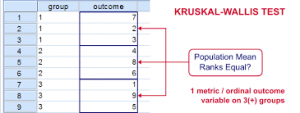
What else can you do if the homogeneity of variance assumption is violated (or if your data are ordinal or highly skewed)? One answer is a nonparametric statistic. Let’s make comparisons similar to Problem 10.1, assuming that the data are ordinal or the assumption of equality of group variances is violated. Remember that the

16
Sep
Analysis of Variance with SPSS – Problem 10.4: Two-Way (or Factorial) ANOVA

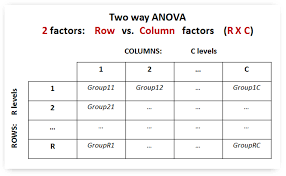
In previous problems, we compared two or more groups based on the levels of only one independent variable or factor using t tests (Chapter 9) and one-way ANOVA (this chapter). These were called single factor designs. In this problem, we will compare groups based on two independent variables. The appropriate statistic for this is

1 Comment

16
Sep
Several Measures of Reliability with SPSS – Problem 3.1: Cronbach’s Alpha for the Motivation Scale

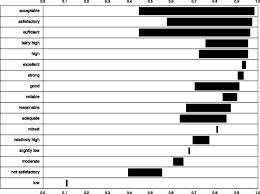
The motivation score is composed of six items that were rated on four-point Likert scales, from very atypical (1) to very typical (4). Do the scores for these items go together (interrelate) well enough to add them together for future use as a composite variable labeled motivation? What is the internal consistency reliability of

16
Sep
Several Measures of Reliability with SPSS – Problems 3.2 and 3.3: Cronbach’s Alpha for the Competence and Pleasure Scales

Again, is it reasonable to add the scores for these items together to form summated measures of the concepts of competence and pleasure? What is the internal consistency reliability of the competence scale? What is the internal consistency reliability of the pleasure scale? Let’s repeat the same steps as before to check the reliability

16
Sep
Several Measures of Reliability with SPSS – Problem 3.4: Test-Retest Reliability Using Correlation

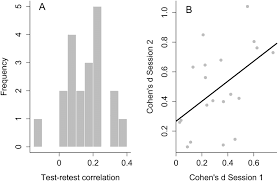
Is there support for the test-retest reliability of the two visualization test scores? Let’s do a Pearson r for visualization test and visualization retest scores. Click on Analyze → Correlate → Bivariate. Move variables visualization and visualization retest into the variable box. Do not select flag significant correlations because statistical significance is not important for reliability

1 Comment

16
Sep
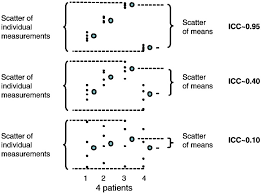
Several Measures of Reliability with SPSS – Problem 3.5: Intraclass Correlation Coefficients (ICC)

ICC performs a reliability analysis for two or usually more judges or observers who have rated the same somewhat subjective behavior. In our example, the mosaic pattern test was given to students; then responses to the test were scored by three different observers, raters, or judges. The scores these judges recorded were called mosaic,

16
Sep
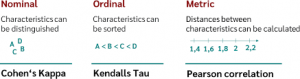
Several Measures of Reliability with SPSS – Problem 3.6: Cohen’s Kappa With Nominal Data

When we have two nominal categorical variables with the same values (usually two raters’ observations or scores using the same codes), we can compute Cohen’s kappa to check the reliability or agreement between the measures. Cohen’s kappa is preferable over simple percentage agreement because it corrects for the probability that raters will agree due

16
Sep
Problem 4.1: Factor Analysis on Math Attitude Variables with SPSS

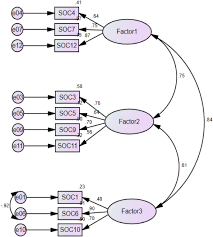
In Problem 4.1, we perform a principal axis factor analysis on the math attitude variables. Factor analysis is more appropriate than PCA when one has the belief that there are latent variables underlying the variables or items measured. In this example, we have beliefs about the constructs underlying the math attitude questions; we believe

1 Comment

16
Sep
Problem 4.2: Principal Components Analysis on Achievement Variables with SPSS

Principal components analysis is most useful if one simply wants to reduce a relatively large number of variables to a smaller number of variables that still capture the same information. In this problem we will look at the initial (unrotated) solution as well as the rotated solution because we might want to use the

16
Sep
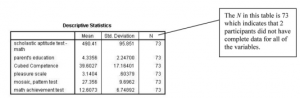
Multiple Regression with SPSS – Problem 6.1: Using the Simultaneous Method to Compute Multiple Regression

To reiterate, the purpose of multiple regression is to predict an interval (or scale) dependent variable from a combination of several interval/scale and/or dichotomous independent/predictor variables. In the following assignment, we will see if math achievement can be predicted better from a combination of several of our other variables, such as the motivation scale,

17
Sep
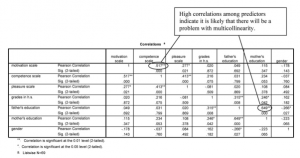
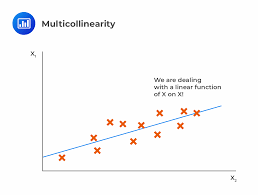
Multiple Regression with SPSS – Problem 6.2: Simultaneous Regression Correcting Multicollinearity

In Problem 6.2, we will use the combined/average of the two variables, mother’s education and father’s education, and then recompute the multiple regression after omitting competence and pleasure. We combined father’s education and mother’s education because it makes conceptual sense and because these two variables are quite highly related (r = .65). We know

17
Sep
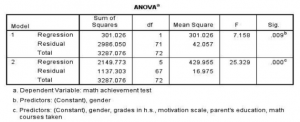
Multiple Regression with SPSS – Problem 6.3: Hierarchical Multiple Linear Regression

In Problem 6.3, we will use the hierarchical approach, which is used when you want to enter the variables in a series of blocks or groups. This enables the researcher to see if each new group of variables adds anything to the prediction produced by the previous blocks of variables. This approach is an

1 Comment

17
Sep
Multiple Regression with SPSS – Problem 6.4: Forward Multiple Linear Regression

In Problem 6.4, we will use the forward approach, which is when SPSS adds variables one at a time by assessing which variable has the smallest probability of F (i.e., p value) continuing until all variables are added that have a p value equal to or less than .05. This enables the researcher to

17
Sep
Multiple Regression with SPSS – Problem 6.5: Backward Elimination Multiple Linear Regression

In Problem 6.5, we will use the backward approach, which is when all the variables are added into the model, then are eliminated one by one, with the variable that has the largest probability of F (i.e., p value) removed until all variables have a p value equal to or less than .10. The

17
Sep
Mediation, Moderation, and Canonical Correlation

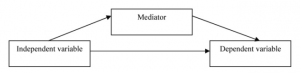
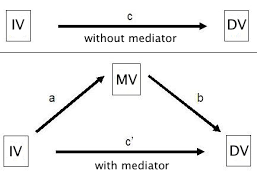
1. Mediation Mediation occurs when the observed relationship between two variables is due, at least in part, to a third variable. Statistically, mediation occurs when a variable (i.e., the mediating variable) reduces the magnitude of the relationship between two other variables. Mediation can be pictured as: Conditions of Mediation There are a few important

19
Sep
Running the Mediation analysis in SPSS using PROCESS

The purpose of testing statistical mediation is to understand the effects of a presumed mediating variable on the relationship between a scale or dichotomous predictor variable and a scale outcome variable. If mediation is occurring, the mediating variable will reduce the size of the relationship between the predictor and the outcome variable. Perfect mediation

19
Sep
Running the Moderation analysis in SPSS using PROCESS

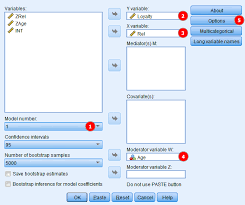
In the previous post, we will conduct a moderation analysis. Recall that the purpose of moderation is to investigate how the interaction between two or more independent variables affects the relationship of these variables to the outcome variable. When conducting a moderation analysis with interval or ratio (scale) predictors, centering the predictors makes effects

6 Comments

19
Sep
Problem 7.3: Moderation: Graphing the Slopes with SPSS

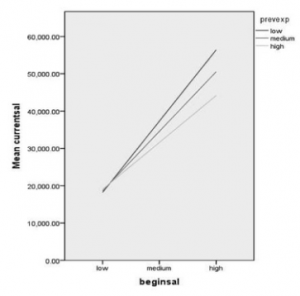
In Problem 7.3 we will graph the slopes using the data from the output from Problem 7.2. What do the slopes look like when previous experience (months) is moderating the relationship between beginning salary and current salary? Follow these steps: Open a new and blank SPSS data file by going to File → Data

19
Sep
Problem 7.4: Canonical Correlation with SPSS

In Problem 7.4 we will assess the relationship between multiple scale independent variables and multiple scale dependent variables. This analysis is an extension of multiple regression. Recall with multiple regression there are multiple scale (or dichotomous) independent variables and one scale dependent variable. Yet, researchers are at times interested in more than one dependent

19
Sep
Problem 8.1: Logistic Regression with SPSS

Is there a combination of gender, parents’ education, mosaic, and visualization test that predicts whether students will take algebra 2? Let’s try a logistic regression to predict a dichotomous (two category) dependent variable when the independent variables (called covariates in SPSS) are either dichotomous or normal/scale. First, we should check for multicollinearity. Because tolerance

1 Comment

19
Sep
  • 1
  • …
  • 179
  • 180
  • 181
  • 182
  • 183
  • 184
  • 185
  • …
  • 196
Theories of the firm
  • Social Theories and ConceptsSocial Theories and Concepts
  • Hyper-competition theoryHyper-competition theory
  • Behavioral theory of the firmBehavioral theory of the firm
  • Becoming and evolution of a scientific theoryBecoming and evolution of a scientific theory
  • Transaction Cost EconomicsTransaction Cost Economics
  • Definition of Theory of the FirmDefinition of Theory of the Firm
  • What is a Scientific Theory?What is a Scientific Theory?
  • Decision TheoryDecision Theory

Methodology & Skills
  • A Comparison of R, Python, SAS, SPSS and STATA for a Best Statistical SoftwareA Comparison of R, Python, SAS, SPSS and STATA for a Best Statistical Software
  • Create your professional WordPress website without codeCreate your professional WordPress website without code
  • Learn Programming Languages (JavaScript, Python, Java, PHP, C, C#, C++, HTML, CSS)Learn Programming Languages (JavaScript, Python, Java, PHP, C, C#, C++, HTML, CSS)
  • Quantitative Research: Definition, Methods, Types and ExamplesQuantitative Research: Definition, Methods, Types and Examples
  • Qualitative methods: what and why use them?Qualitative methods: what and why use them?
  • Research methodology: a step-by-step guide for beginnersResearch methodology: a step-by-step guide for beginners
  • Doing Management Research: A Comprehensive GuideDoing Management Research: A Comprehensive Guide

Connecting and sharing with us

... by your free and real actions.

hotlineTComment and discuss your ideas

Enthusiastic to comment and discuss the articles, videos on our website by sharing your knowledge and experiences.

hỗ trợ hkt Respect the copyright

Updating and sharing our articles and videos with sources from our channel.

hỗ trợ hkt Subscribe and like our articles and videos

Supporting us mentally and with your free and real actions on our channel.

HKT Channel - Science Theories

About HKT CHANNEL
About HKT CONSULTANT

Website Structure

Corporate Management
Startup & Entrepreneurship
Management Science
Theories of the firm

HKT Consultant JSC.

      "Knowledge - Experience - Success"
- Email: Info@phantran.net
- Website:
phantran.net

  • Home
  • Corporate Management
    • Entrepreneurship
      • Startup
      • Entrepreneurship
      • Growth of firm
    • Managing primary activities
      • Marketing
      • Sales Management
      • Retail Management
      • Import – Export
      • International Business
      • E-commerce
      • Project Management
      • Production Management
      • Quality Management
      • Logistics Management
      • Supply Chain Management
    • Managing support activities
      • Strategy
      • Human Resource Management
      • Organizational Culture
      • Information System Management
      • Corporate Finance
      • Stock Market
      • Accounting
      • Office Management
  • Economics of Firm
    • Theory of the Firm
    • Management Science
    • Microeconomics
  • Research Methodology
    • Methodology
      • Research Process
      • Experimental Research
      • Research Philosophy
      • Management Research
      • Writing a thesis
      • Writing a paper
    • Qualitative Research
      • Literature Review
      • Interview
      • Case Study
      • Action Research
      • Qualitative Content Analysis
      • Observation
      • Phenomenology
    • Quantitative Research
      • Statistics and Econometrics
      • Questionnaire Survey
      • Quantitative Content Analysis
      • Meta Analysis
      • Statistical Software
        • STATA
        • SPSS
        • SEM-AMOS
        • SmartPLS
        • Eviews
  • About us